Thursday, February 12, 2009
This just in
Karnataka, India
This just in: Fundies Buckle Under Onslaught Of Undies
Whoo hoooo! Free, nonviolent expression works.
In the pink
News from India
It's time for what has become the annual update on the Great Indian Valentine's Day Controversy.
In case you have only recently joined us, self-styled "defenders of Indian culture" have protested, often violently, against the de facto adoption of Valentine's Day into the calendar of many and varied Indian festivals. And it's not just "Hindu nationalists" - reports indicate Muslim hardliners as equally incensed. Looks like a great opportunity for interfaith bonding against a mutually recognized "threat."
Mind you, no one in the pro-VD camp is suggesting that VD be an official, government holiday...the cultural curmudgeons just don't want private citizens strolling hand-in-hand or sending valentine cards.
The recent Mangalore pub incident has the Moral Police back in the headlines, major. (As Richard Gere, Shilpa Shetty and Khushboo can tell you, they are not to be trifled with.)
This year, there's a very creative response - the Pink Chaddi Campaign from the Consortium of Loose, Forward & Pub-Going Women. PCC asks participants to send a pair of pink women's undies (any size, style or fabric) to the head office of the Moral Police - mailing address found here.
No, Valentine's Day is not a part of traditional India.
Neither are televisions, cell phones, DVD players or cars. Or speaking English, for that matter. Or cricket. What a great idea - let's get rid of all those, too!Even in America, I personally always found "V D" to be an obnoxious holiday, regardless of one's relationship status. If you are not attached, VD sucks for obvious reasons. Even if you are, it puts insane pressure on the relationship to prove itself visually and materially. Yuck! But if someone chooses to celebrate it in whatever fashion, that is their choice. My anti-Valentine's friends and I used to have an annual "Love Stinks" party, the apex of which was playing the J. Geils anthem at full volume.
One of the Ram Sene's threats is "tie or die" - that any couple found holding hands or "canoodling" on the 14th will be forced (by them) to marry then and there on the spot. OR ELSE.
Now, despite the death threat, let's try to look at this in a positive way. What a great opportunity for all the gay and lesbian Indian couples who otherwise could ne
ver marry! Now's their chance!Subhamoy Das of About.com Hinduism has thoughtfully provided an overview of (shock!) romantic love stories found in the annals of traditional Hinduism. The image at right is one of the more G-rated depictions found in "traditional" art.
Perhaps no other faith glorifies the idea of love between the sexes as Hinduism. This is evident from the amazing variety of mythical love stories that abounds Sanskrit literature, which is undoubtedly one of the richest treasure hoards of exciting love tales.
Let's face it, the western Cupid is just a cheap, cherubic ripoff of the god Kamadeva.
Tuesday, January 27, 2009
Celebrate Saraswati - Geek Girls Unite

Another excuse to close the office
Kathmandu
January 31 is Sree Panchami, the day to honour Sri Saraswati, goddess of learning and wisdom. (Last year it was February 8.)

Wear yellow and bring yellow flowers to the Saraswati shrine (if you need one, you can borrow one of mine...they are all over Kathmandu.) It's considered the most auspicious day to begin learning anything, especially to read or write a new language.
The following prayer is recited on this day:
Yaa Kundendu tushaara haaradhavalaa, Yaa shubhravastraavritha|veenavara dandamanditakara, Yaa shwetha padmaasana||
Yaa brahmaachyutha shankara prabhritibhir Devaisadaa Vanditha|
Saa Maam Paatu Saraswatee Bhagavatee Nihshesha jaadyaapahaa||
--English Translation:
"May Goddess Saraswati,
and whose pure white garland is like frosty dew drops;
who is adorned in radiant white attire,
on whose beautiful arm rests the veena,
and whose throne is a white lotus;
who is surrounded and respected by the Gods, protect me.
May you fully remove my lethargy, sluggishness, and ignorance."
Saraswati, the goddess of knowledge and arts, represents the free flow of wisdom and consciousness.
--Saraswati painting courtesy Exotic India.
In the western pantheon (we actually do have one), she would be Athena, goddess of learning and wisdom; though Athena is also equated with war, which both Lisa Simpson and Saraswati would emphatically disown.
And I have heard that the Tibetan version of Saraswati is Tsering-Ma.
Tuesday, January 13, 2009
Eppady sugam?
In Kathmandu
It's time for the annual Pongal-Makar Sankranti photos!

Something about the light in south India makes photography there very special.
I haven't been far enough south to celebrate Pongal (or to learn any new Tamil phrases) in several years; that makes me sad.
But I can still taste the Ghee Pongal from my last visit to Saravana Bhavan!


Monday, December 29, 2008
To the book depository!
Jawalakhel, Patan, Nepal
FINALLY. Third time was the charm as Raju and I once again descended upon the UNESCO Kathmandu office, demanding the free publications and books that were so rightfully ours as authentic bearers and students of a dying cultural tradition (in our case, masked and other ritual dances of the Kathmandu Valley).
UNESCO is supposed to distribute their various publications (most of which are about development and architectual restoration) to the general public. As students of religious classical dance, we were more interested in the sector called "Intangible Heritage." This proved to be intangible indeed. Three separate visits all the way out to the Jawalakhel office had found the lights on, but nobody home. Last Sunday (Sunday is a working day in Nepal), we were told they would definitely be in on Dec. 24, Christmas Eve.
Arriving at 2pm Christmas Eve, we were told that in fact, the staff got that day off as well as Christmas Day and the following Friday. The real reason for democracy and secularism: More holidays!
At long last the day dawned when they were both open and in the office, though on this day, too, the librarian and periodicals person was not in. Evidently taking five days' leave for "Christmas" (Christians still constitute less than 10% of the country, but all offices that are even vaguely government-related get to close) wasn't enough; she had 3 more days coming to her.
After much smooth talking by my friend we scored these glossy bound publications:
Masked Dances of Nepal Mandal: (a bit troubling as only 26 of its 163 pages are translated into English, meaning there's a whole lot left untranslated - but I will take what I can get; English information about the dances is scarce)
Tiji Festival of Lo Manthang (more of a photographic booklet than book, but a good basic rundown of a Tibetan Buddhist cham dance ritual)
Intangible Cultural Heritage of Nepal: Future Directions (evidently the idea of supporting Intangible-Cultural heritage, that is rituals, dances, folk music and festivals, is less established than that of preserving material culture and they are still struggling for full financial support)
--and best of all, a 7-volume set called Cultural Portraits Handbook. This includes slim volumes dedicated to Swayambhunath, Bauddhanath, Patan, Bhaktapur, Hanuman Dhoka, Changu Narayan and Pashupati.
Score! We left quite chuffed with our "Christmas" packages full of books about ritual dances of Hinduism and Buddhism.
Monday, January 14, 2008
Pongal O Pongal!
PaharGanj/Ram Nagar
It's PONGAL, and I am not in Tamil Nadu! Not even close, not even in South India! However, I can still eat
sweet pongal (and ghee pongal) at the Saravana Bhavan here on Connaught Place. (sigh)'Thai Pongal', as it is popularly called in Tamil Nadu, is a thanksgiving ceremony celebrated by Tamil farmers to thank the spirits of nature, the sun and farm animals for their assistance in providing a successful harvest all through the year.
The festival is spread over four days, from the last day of 'Margazhi' to the third day of following month 'Thai' as 'Bhogi', 'Thai Pongal', 'Mattu Pongal' and 'Kannum Pongal'.
"We may have settled here, but we haven't forgotten our traditions. Almost all Tamils in Delhi celebrate Pongal the same way it is celebrated in Tamil Nadu," Natesan, secretary of Tamil Youth Cultural Association, told.
It's also Makar Sankranti, which has something to do with the movement of the sun through the Vedic zodiac, and the approach of spring. I believe the sun is entering the sign of Capricorn (in the Indian zodiac, which calculates differently from the Western one).
The best Makar Sankranti ever was at the Kalachakra 2 years ago. The whole town of Amaravati, Andhra Pradesh was alive with Tibetan and Buddhist festivity anyway, and then added to that was the Makar Sankranti observance (dressed-up cows and bullocks, street musicians, and special, extra- elaborate kollam designs in front of doorways). Here's the best picture I got that day...it's one of my best "India" photos ever, IMHO.
Pongal is not just one day, but several, including my favourite, Mattu Pongal or the day to honour
cows and bullocks. In the Madurai area of Tamil Nadu, this has traditionally included a kind of bullfight or bull-run called Jallikettu. This year the whole area is up in arms (declaring a "black Pongal") because the Supreme Court has banned the practice, declaring it inhumane and cruel.I have a suggestion - they should do what Nepalis do at Gai Jatra, and instead of using real cows, dress up humans as cows. Then they could see how much fun it is to be chased, poked , stabbed and have their tails pulled. It's quite amusing to see all the Madurai Hindus defend their "400 year old tradition" - what about the much older Hindu tradition (about 4000 years old) of honouring the cows?
Sunday, October 22, 2006
Diwali walli* goes Nepali
Kathmandu and Lalitpur, Nepal
*Wallah: someone who is particularly expert at or specializes in a certain activity or profession. Walli: feminine of Wallah.
Everything happens at once, all the time, here.
We're now in the middle of yet another cluster of festival days. This one is Diwali, aka Tihar, the Hindu festival of lights and Lakshmi, goddess of wealth and abundance. Some things are closed, some are open for business, many look deceptively open yet are operating on skeleton crew.Naturally, all government offices are closed. In fact, I think they were literally closed more days than they were open this month.
Bunches of dressed-up, beaming people roam the streets, butter-lamps are lit at in doorways at dusk, children make the rounds singing and drumming deusi-bailo (a sort of Newari trick-or-treating from door to door) in the evenings. Every home and shop has a rangoli (sort of mandala-design invitation to the goddess, painted with cow dung, coloured powder, lamps and flower petals) at the front door - a painted pathway to guide Lakshmi as she enters to bless the residence. Everywhere you can hear the sounds of ringing puja bells, and Newari panchbhaje bands go from door to door playing their distinctive, reedy ceremonial music. A few months ago I wrote about the snake holiday (Naag Panchami). I can really hear the snake spirit in the sounds of the long, narrow Newari horns.
New Newaris
Today I am rushing to get some prints made for
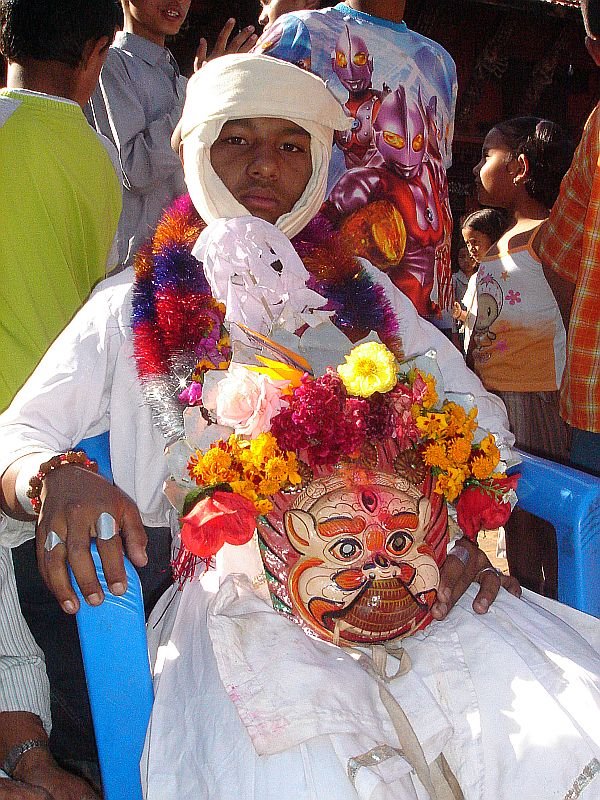
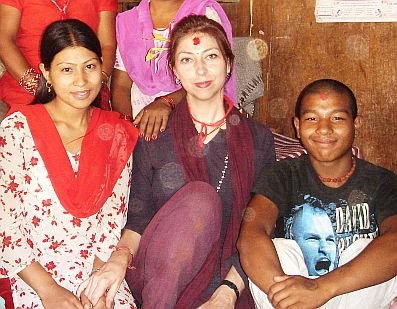
Pramochan, one of the (the many) Newari masked dancers I photographed this past Dasain season. On Dasain day, I received tikka and jamara (red powder on the forehead and sprigs of barley behind the ear) from Pramochan's father. Tikka and jamara are a sort of blessing given from elders to juniors on Dasain day. So, Pramochan's familiy (all five of whom live in a traditional Nepali wooden house, which looks like a hayloft with a five-foot ceiling) have invited me to Mha Puja. (Yet another puja!)I love the tradition of jamara, which is (as far as I know) unique to Nepal. On the first day of Dasain, the lady of the house plants seeds of barley, rice or corn, in a bed of sand, in a special niche inside the home. The seeds are then covered and allowed to sprout secretly in warmth and darkness. It's during these nine days that the goddess Durga is symbolically fighting evil. On the tenth day, Vijaya Dashami, the jamara is uncovered and revealed to have grown into long, bright green grassy stalks. The stalks are then ritually harvested and bestowed upon juniors by the family elders.
Everyone walks around town with an enormous red dot (made of red kumkum powder, rice and yogurt) on their foreheads and chartreuse s
prigs sprouting from their hair like feathers (see photo below). Nepalis absolutely love tikka and jamara ("sooooo beauty-full") and seemed very proud to be seen with me, once I was properly marked.Today's festivity, Mha Puja, is done only by the Newari community on the occasion of Newari New Year (it's now 1126). This ceremony honours and blesses the individual's body for the coming year. Fortunately I have a Newari and Nepali interpreter and hope to find out more about it. I am bringing the prints as a present for the family. (Others might get away with bringing a box of sweets, but as a foreigner with a digital camera, I am honour-bound to provide free prints to the family. I think it's a tradeoff for the stigma they might otherwise receive of associating with a foreigner.)
Rituals in transfigured time
Here
in Nepal, we are running three simultaneous calendars. The business calendar is (sort of) the "English" or Gregorian calendar. Then there's the Vikram Sambat or Nepali Hindu calendar, in which it's 2063 and the new year is in April. It is quite common for buildings to boast of having been "established in 2059" (my Australian friend Dave took a photo of this - he thought it was a typo), or for people to say "the conference will begin after 10 Bhadra."When yet another time cycle, the Newari calendar, starts tomorrow, and it will be 1127. The Newari new year is figured from our AD 867, when legend has it that a Newari Jyapu (farmer caste) discovered a riverbed of gold, and thus paid off everyone's debts. A good way to make a fresh start.
Now if I could just make some money and pay off a few of my debts...guess I will be offering Lakshmi extra marigolds and butter lamps for that one.
New widgets on the block!
Feeds, widgets, clusters, tags, bookmarklets, clouds, sprinkles, aggregators, badges. I'm just now learning about the galaxy of nifty blog features and how they procreate.
I've added a couple of new widgets (nifty code dropped into my template to do cool things) to the blog site. The SirenLocator Map (requires Flash, I think) should show online viewers as they appear, and even reveal a map of their nation (for those unclear on geography).
Scroll down and you will find the Current Moon Phase, essential for life in Nepal and other parts of Asia.
My SirenDelicious feed shows my favourite items and headlines saved to Del.icio.us. And Global Voices headlines feed show selected headers from the Nepali and Indian blogosphere.
Coming soon: my very own tag cloud, and a Newsvine widget. Oh, and I've finally caught up and gotten myself a YouTube account, but some stupid folk singer already snatched the name Sirensongs....so SirenTV will be appearing as "SirensongsIndia." Maybe someday I'll figure out how to upload my many videos directly to this site.
Wednesday, October 04, 2006
Goats' head soup
Bhaktapur, Nepal-
Just saw my first goat sacrifice yesterday, and am still recovering.
I was under the naive impression that they held the poor thing down, slit its throat and let the blood drain out while the animal just kind of faded away. Nope. One guy holds it up by the horns and yanks its head back, another guy holds it by its tail, lifting it off the ground. The idea is to get the blood to SPURT and PUMP out onto the vehicle (usually car, tractor or motorbike) that is being .... well, christened is definitely not the right word. ("Inaugurated," maybe.)
Then as the goat screams and kicks in the air they carry it round the bike in a circle to get ALL Corners covered by blood.
If you stand too close you are in danger of getting spurted on, for real. Fresh blood is the reddest red you can imagine, it almost hurts your eyes. I used to have a bright red nail polish that was the same colour but you never see it elsewhere in nature. Not that bright.
Finally they brutally sever the head (at this point the throat is torn wide> open and you can almost see the heart still pumping) and put the head in the front adorning the ground. The body lies kicking and thrashing beside the vehicle.
I love all animals, but goats really have sass and personality, and this really bothered me. According to an American Hindu scholar who was with me, the scriptures say it is not a sin to eat meat as long as it was sacrificed to a god. But does sacrificing it in order to safeguard your vehicle count as religious? or at all spiritual?
Everywhere we went, at literally every corner of Bhaktapur, there were machines and vehicles adorned not just with pools of blood but what looked like clear plastic tubing. These turned out to be the washed strung-up entrails of the animal, draped like a festive garland over the radiator grill or handlebars. I purposely missed the sacrifice of a water buffalo last night in front of Brahmayani Peeth temple, but I did talk to the Navadurga Dancers who were required to drink the blood straight from the animal's neck. Their white ritual gowns were soaked pink like tie-dye. It is still really hot here in the daytime (okay, pretty hot - nothing like India though) so I am tired from walking all over town. Time to go shower. I have loads of photos to download, too.
Wednesday, September 27, 2006
Dancing days are here again
Lalitpur, Nepal
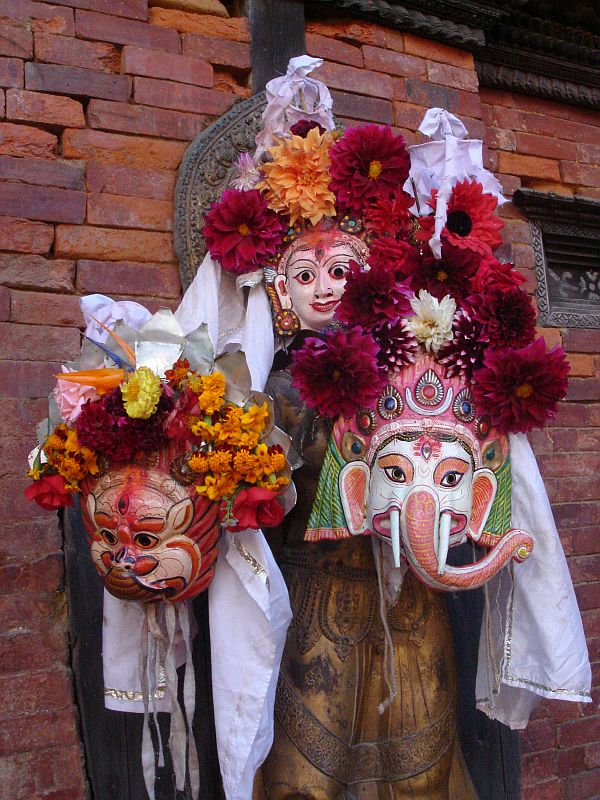
Indra Jatra, Dasain and Kartik Purnima mean it's time for the ritual masked dances of the Newari people. I'm currently engrossed in tracking them
down (obscure, community-based, secretive besides the language problems) and documenting them. Last night I went to Lalitpur (Patan) to see the Ashtamatrika (Eight Goddesses) dance of the Newari Buddhist community. I only have time to upload one photo right now (before running to Immigration).I have seen lots of masked dancing by now, and I think the Ashtamatrikas are the most exciting yet. They seem to be the most classically influenced, and the most ritualized. These dances were begun in the 1600s on the orders of the Lalitpur king (at that time it was one of the rival 3 kingdoms of the Kathamandu Valley), who was a great devotee of the eight guardian goddesses.
The transformation of the dancers, as soon as they don the mask, is really astonishing. They assume a hands-on-hips stance and begin trembling with shakti.
Hundreds of people from the community turn out and follow the Goddesses on their journey from Nakabahil (courtyard of the dance-god) to the courtyard of Taleju Bhavani Temple, where the gothic gables tower over the dancing devis.
I was the only foreigner there. It amazed me that so few outside people know about the vibrant, living culture of the valley, especially since it's been going on continually for the past four hundred years.
Last night there was a power cut, so we were marching through the cobblestoned streets in candlelight - it felt like the dances must have one hundred years ago.
Getting your goat
Bhrikutimandap, Kathmandu, Nepal
Finally, the weather cleared
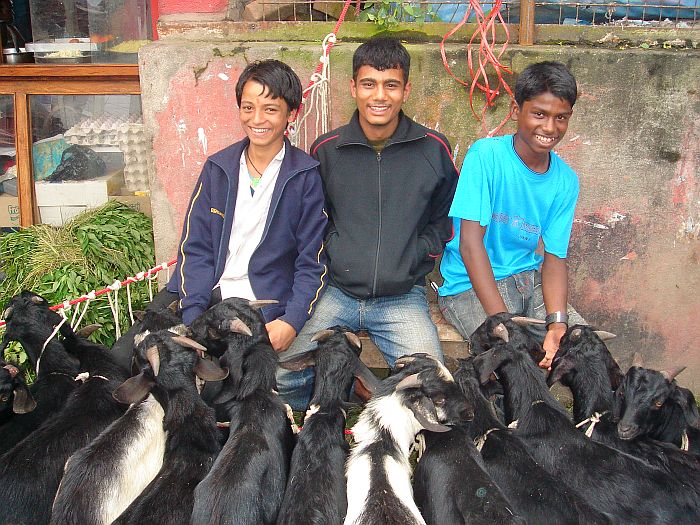
yesterday, after a weekend of seemingly interminable drizzle and rain and mud. Billowing white clouds now hang over the green hills that surround Kathmandu, and it's hot at mid-day. On my way to Immigration, I passed an impromptu open-air goat market - the sidewalk was transformed into a musky-smelling barnyard, with all sizes and colours of goats nibbling at green fodder suspended from rope ties. They were adorable! But sadly, all are doomed. They have all been brought in from the surrounding villages to be bought as sacrificial offerings for the Dasain holiday. If all goes as planned, each and every one (all male goats) will have their throats slit and their blood offered to the goddess Taleju Bhavani, a manifestation of Durga. The unwanted goats will go back to the hills.
I had romantic notions of topi-wearing hill-dwellers herding the goats, on foot, over valley and dale into the big city for market - a sort of annual pilgrimage. Actually, the goat-keepers rent a mini-van (for about 500NRs a day,or $7.00 US) and load the goats inside; as many as 20 goats are crammed into the little vehicle. They pick up uncooperative goats by the horns (in one hand) and the back-scruff (in the other) and toss them in.
The hundreds of goats there were distinguished by some numerical system scrawled onto their horns, and sometimes, blotches of coloured dye on their shaggy coats. One shyster tried to sell me a goat for 3000NRs (about $50), but it turned out the correct price was 160NRS for 4 kg.
The goats are weighed (or as they say here, "weighted") across the road on a medieval-looking contraption that is a combination of a seesaw and swingset. The balances are big enough for a couple of humans to stand in - in fact, it looks like the thing they use to weigh the accused with in Monty Python & the Holy Grail ("I am NOT a witch, and this is not my nose, it's a false one!"). There were a few regulation weights there to balance the goats, but they also used a chunk of cinder block.
If the goats had any inkling of their fate, they seemed pretty resigned to it.
On the other side of the road were an especially handsome looking gaggle of goats, with long shaggy coats, twisted ornamental horns, and an extra swatch of shag hanging between their eyes like overgrown bangs. They seemed like the cool, laid-back hippy goats. Turned out they are a special kind of mountain goat called "Changra," but they don't cost any more than the other goats. I scratched them behind the ears, ruffled their fringed bangs and said a silent prayer for them to be reborn as humans (hopefully, vegetarian humans).
Immigrant Song
At Immigration, they told me that in order to stay in the country on a three-month student visa, I need the following things:
-$750 deposited in my name in a Nepali bank account. This is to prove I have $250 a month to cover my expenses for the three months's time;
-a receipt of fees paid and enrollment from the dance academy in Bhaktapur (which means I have to pay the teacher in advance, usually not a good idea);
-Letter of recommendation from the Nepali Ministry of Education (this is known to take a month or more - sometimes tourist visas run out just waiting for it);
-Various copies of my passport, visa and application itself (not a big deal).
-After the initial submission of the bank statement, you then have to show another just to prove you still have the money (that you didn't just borrow it in order to make a false statement).
$250 a month is quite reasonable for living expenses in Nepal; the problem is, getting it all together at the same time (plus the school fees).
They give you a nicely printed list of all these things (guidelines for foreign researchers and students)... in Nepali script! Talk about missing the point.
All this has to be accomplished within the next 30 days, and about 10 of them are official holidays. Nepal maa, din din ne, ek naya mela aunchhu (in Nepal, every day a new festival is coming).