Showing posts with label unesco. Show all posts

Monday, December 29, 2008

To the book depository!

Christmas raid on UNESCO
Jawalakhel, Patan, Nepal

FINALLY. Third time was the charm as Raju and I once again descended upon the UNESCO Kathmandu office, demanding the free publications and books that were so rightfully ours as authentic bearers and students of a dying cultural tradition (in our case, masked and other ritual dances of the Kathmandu Valley).


UNESCO is supposed to distribute their various publications (most of which are about development and architectual restoration) to the general public. As students of religious classical dance, we were more interested in the sector called "Intangible Heritage." This proved to be intangible indeed. Three separate visits all the way out to the Jawalakhel office had found the lights on, but nobody home. Last Sunday (Sunday is a working day in Nepal), we were told they would definitely be in on Dec. 24, Christmas Eve.

Arriving at 2pm Christmas Eve, we were told that in fact, the staff got that day off as well as Christmas Day and the following Friday. The real reason for democracy and secularism: More holidays!

At long last the day dawned when they were both open and in the office, though on this day, too, the librarian and periodicals person was not in. Evidently taking five days' leave for "Christmas" (Christians still constitute less than 10% of the country, but all offices that are even vaguely government-related get to close) wasn't enough; she had 3 more days coming to her.

After much smooth talking by my friend we scored these glossy bound publications:

Masked Dances of Nepal Mandal: (a bit troubling as only 26 of its 163 pages are translated into English, meaning there's a whole lot left untranslated - but I will take what I can get; English information about the dances is scarce)

Tiji Festival of Lo Manthang (more of a photographic booklet than book, but a good basic rundown of a Tibetan Buddhist cham dance ritual)

Intangible Cultural Heritage of Nepal: Future Directions (evidently the idea of supporting Intangible-Cultural heritage, that is rituals, dances, folk music and festivals, is less established than that of preserving material culture and they are still struggling for full financial support)

--and best of all, a 7-volume set called Cultural Portraits Handbook. This includes slim volumes dedicated to Swayambhunath, Bauddhanath, Patan, Bhaktapur, Hanuman Dhoka, Changu Narayan and Pashupati.

Score! We left quite chuffed with our "Christmas" packages full of books about ritual dances of Hinduism and Buddhism.

Sunday, April 27, 2008

Escape From Kathmandu

Power Places Part Three
Bhaktapur, Changu, and Kathmandu, Nepal

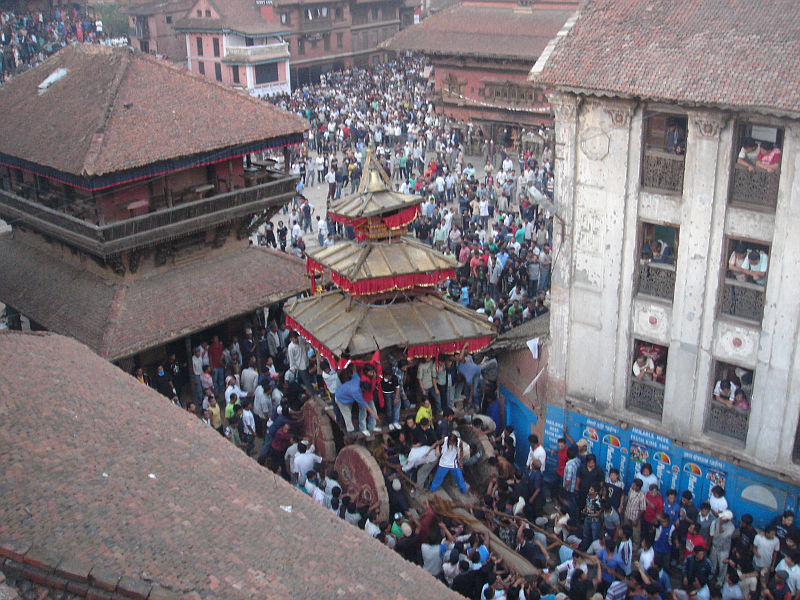
The morning after the insane tug-of-civil war that is Bisket Jatra in Bhaktapur (half the town goes to war with the other half the town trying to pull the chariot apart, or so it would seem), I met a couple of Americans who also wanted to go up to the hillside temple of Changu Narayan (one of the "Power Places of the Kathmandu Valley"). It is believed to be the very oldest temple in the valley, and also has the oldest inscription yet located here - from the 3rd century AD, in Licchavi script. (The Licchavis were one of the Indian Hindu dynasties who came up from Magadha way, I think.)
Lynette, Dave and I decided to do the ultra budget thing and catch the local bus up to Changu, rather than pay the inflated taxi prices (300NRs or five dollars! please, it costs 600 to go all the way back to Kathmandu. Changu is only 15 minutes away by car).

There are about five different bus stops (or 'bus stands' as they are called here - "tourist bus park," "Mini bus park" etc) in Bhaktapur, so to determine the right one, we had to wander through the hand-hewn brick and wood labyrinthes of Bhaktapur asking directions, which is part of the fun. "Changu bus stand?" is the best way to phrase the question. When we just said "Changu?" people pointed in the direction of Changu itself, which doesn't necessarily help you get the bus.

The road to Changu from Bhaktapur (the back road, not the driveable highway) would be a very nice walk - taking about 2 hours - if we had started early enough in the morning. As it was after 11am, it was already boiling hot. Don't be fooled by the clothing you see on the local people - they have the maddening ability to wear long sleeves, synthetic fibres, and even several layers, in the pre-monsoon swelter and barely break a sweat.

When we finally located the place everyone insisted was the "Changu bus stand," a taxi driver pulled up and did his very best to persuade us that in fact, there was NO bus to Changu. "No Changu bus. No bus. No bus today. Taxi, 300 Rs only." (By the way, the bus is 10NRs.) Instantly the shop owners, whose shop we were standing in front of, tried to get in on the act. They too insisted there was "no bus."

I had gotten the driver down to 200NRs and was trying to beat him down for 150 when we noticed a small crowd of people - women, children, and elderly - gathering on the corner diagonally opposite.

"I bet THAT's where the bus leaves from." I hopped across the smelly grey open sewer ditch and strode across the road. "Changu Bus?" I asked the young girls in kurta-surwal. They all nodded.
The taxi driver, as usual in such situations, displayed no trace of shame or embarassment at his "no bus" lies, shrugged and sped off.

The bus was so crowded, we elected to sit on top. This is by far the best and best-ventilated way to travel, especially in hot sweaty summer, but is considered unorthodox for women. As foreign women, Lynette and I were somewhat exempt from the etiquette and clambered up the metal ladder to the bus roof - where the view is unsurpassed.


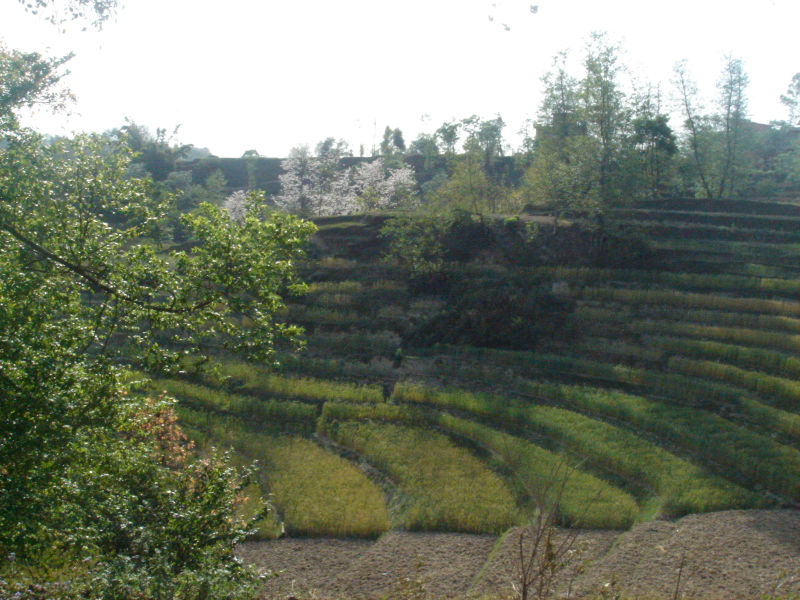
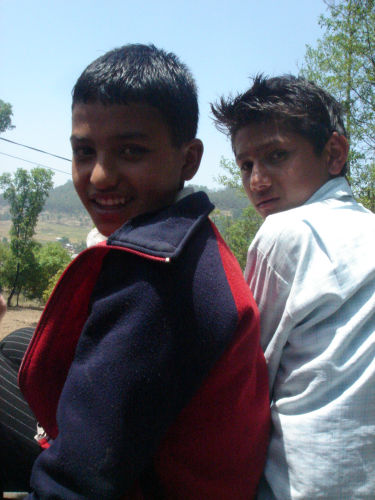
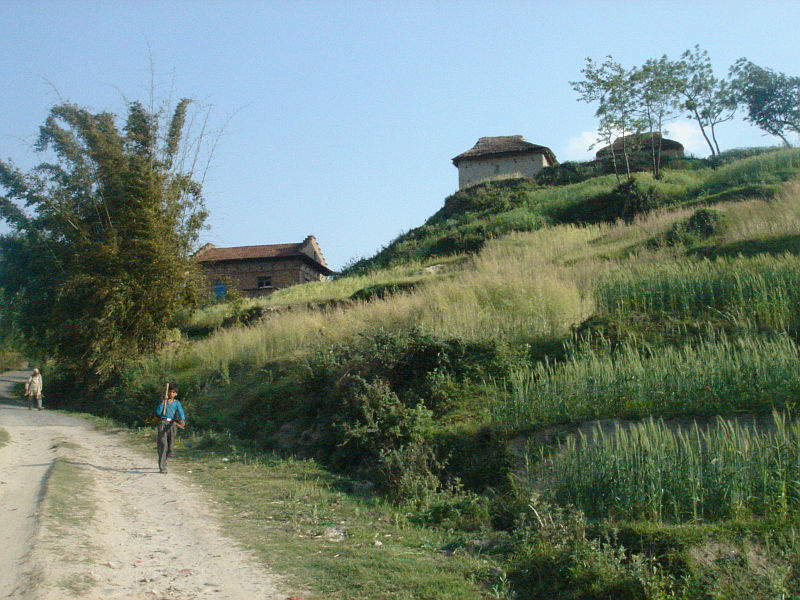
We were joined by half a dozen young boys till the tiny luggage-rack railing was crammed with humans. I made sure to get in the middle, sharing space with an empty red metal gas cylinder and a worn spare tire, where it seemed less likely I'd fall off. We need not have worried about falling - the bus creaked along slowly through wheat fields up the hillside.

Our fellow roof-riders seemed well-informed about the upcoming US elections and wanted to know "Who will be the next president of your country?" As usual in this part of the world, the name "Cleenton" evoked the most recognition - a trusted brand name on the subcontinent.

Changu Narayan has got to be one of the most reasonable entrance fees in all of Asia - 60NRs or exactly $1.00 US to see the oldest temple in the Valley (and the one best noted for its sculptures).


The last time I came was in September during the misty post-monsoon. I walked down from Telkot through damp pine forests that felt more like Scotland than Nepal. This ascent couldn't have been more different, in the hot dry season. However, it did mean this time I could take photos.

The isolated location of Changu Narayan means it's the least visited of the UNESCO World Heritage Sites in the Valley. It also means there are fewer tourists, which is both good and bad. It's never crowded, but ALL the attention of the shopkeepers, begging kids and touts was focused on US, the lone foreigners.


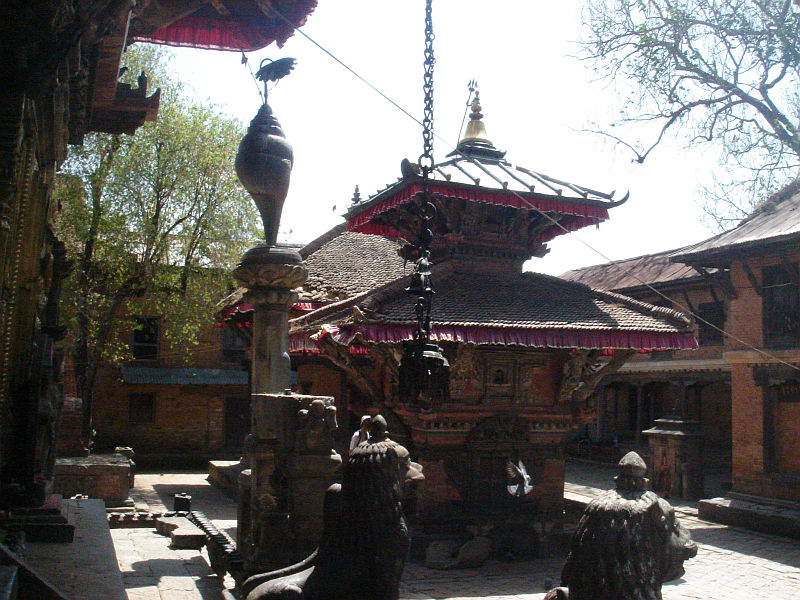
Changu displays a familiar Nepali combination - a rich upwelling of devotional energy manifested in myriad curlicues, psychedelic flourishes and startling chimeric beasts that defy description...lots of decay...and lots and lots of pigeon doo. In fact, a case could be made that the pigeon droppings rival the air pollution for destruction of the monuments. I can't support killing the pigeons outright, but I would definitely get behind a plan for pigeon birth control. (A few pigeons taking flight from the square in the morning light is nice. Hordes of them all over is a health and architectural hazard.)

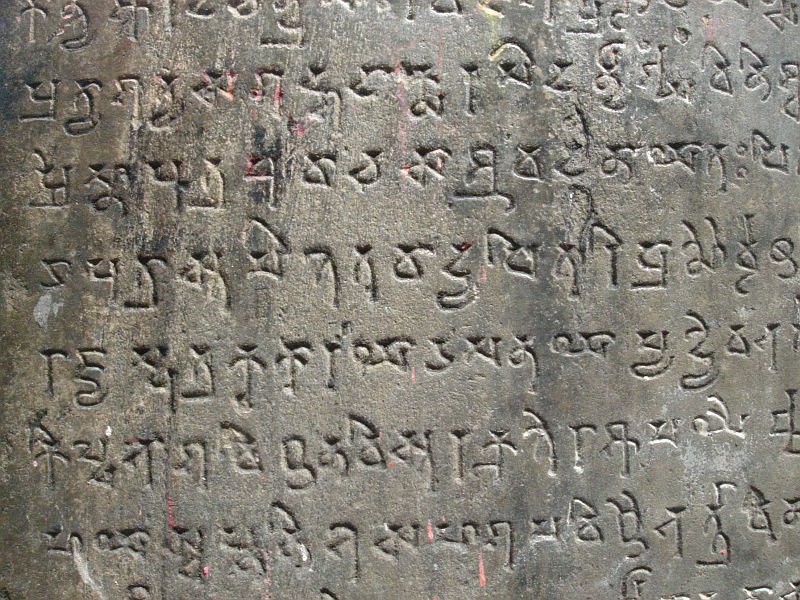
Despite the fact that I can't read it, I think the stone below is my favorite part of Changu. In the ancient and now disused Licchavi script, it supposedly relates the story of how a Licchavi king dissuaded his mother from sati, or widow's ritual suicide on the funeral pyre of her husband, and instead persuaded her to stay with him among the living because he would miss her. (Some proof that, despite what many would like to claim, sati was real, not an invention of the British or anti-Hindu propagandists.)
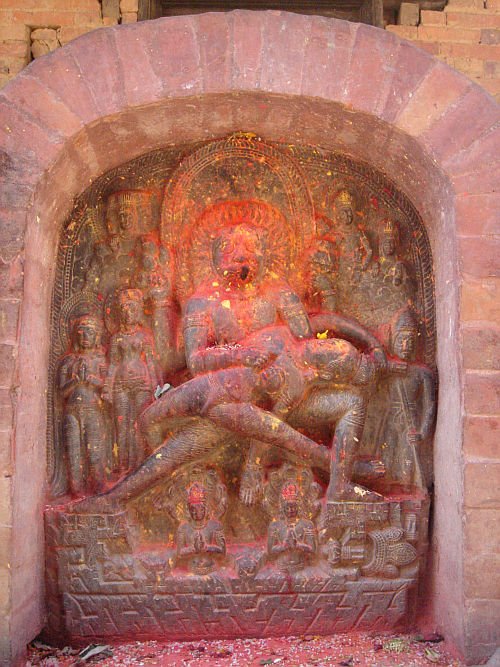
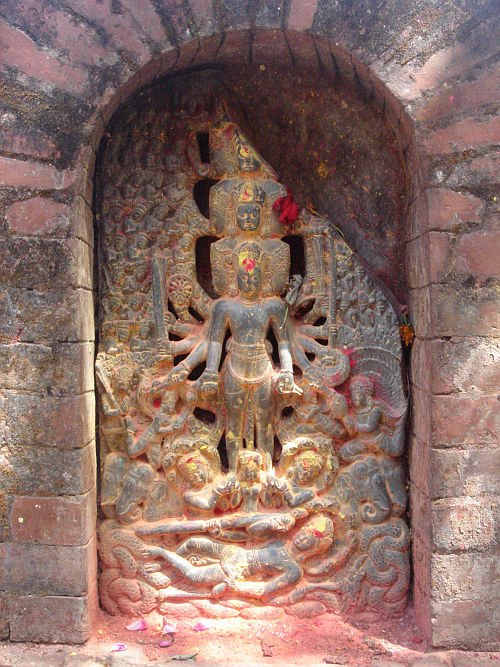
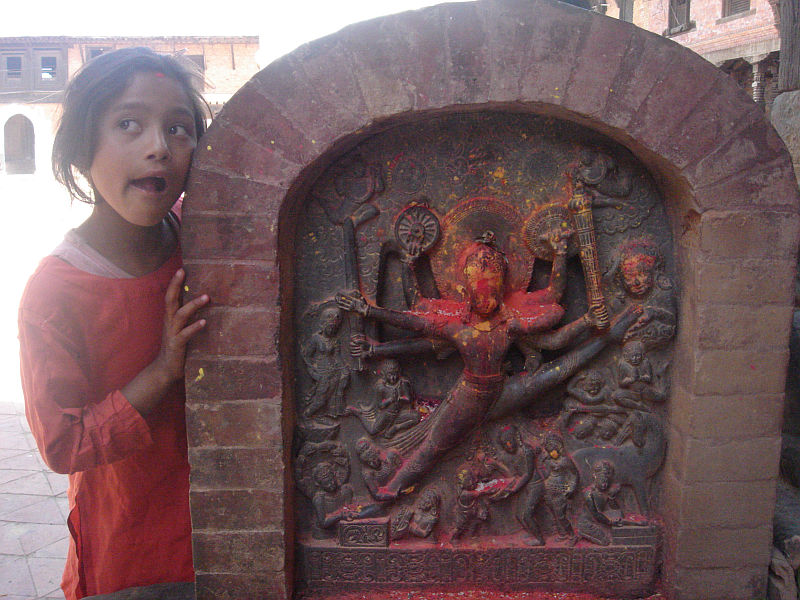
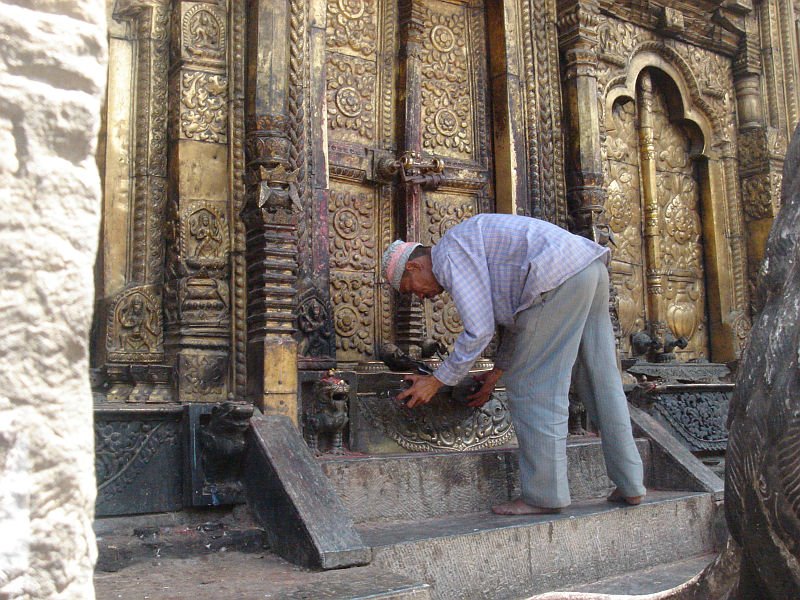
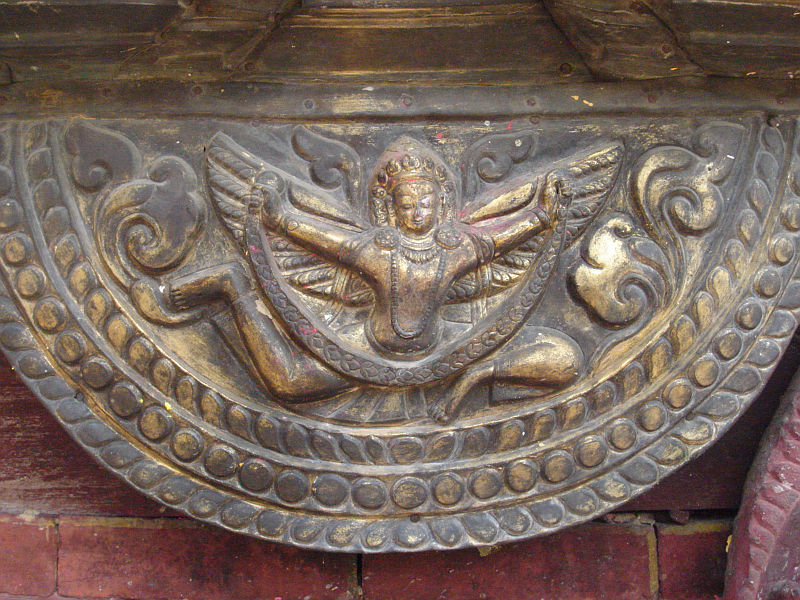
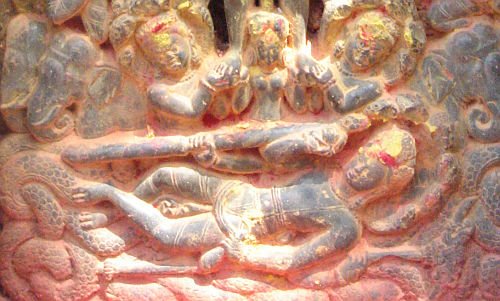
Narayan is one of the names of Lord Vishnu, who represents the "preserver or maintainer" form of the Godhead. This is the aspect of god traditionally meant to be embodied in the King of Nepal, though the current candidate seems to have been asleep at the switch. Though we weren't able to see the murti or statue inside ("Hindus only"), there are plenty of surrounding toranas (engraved and embossed metal archways), friezes, and sculptures. Most of them depict the various DasAvatar or ten earthly incarnations of Vishnu, including Lord Krishna, the dwarf manifestation whom I think was called Vamana, Parashurama, Narasingha the man-lion avatar disemboweling a nonbeliever (below), and what looks like Vishwarupa (the overwhelming all-encompassing universal form of God), a masterpiece of mind-boggling Hindu psychedelia depicting the three worlds (of the underworld, men and gods, below).

Despite having been damaged during an attempted robbery, the detailed cosmology of Vishwarupa is well worth a few minutes' contemplation. I'm afraid the photos really don't do the sculptures justice. There is a legend accompanying each of the statues - I know most of them and was able to bore Lynette and Dave with my know-it-all stories, but there is no printed guide available so you should bring a guidebook with details to Changu Narayan.


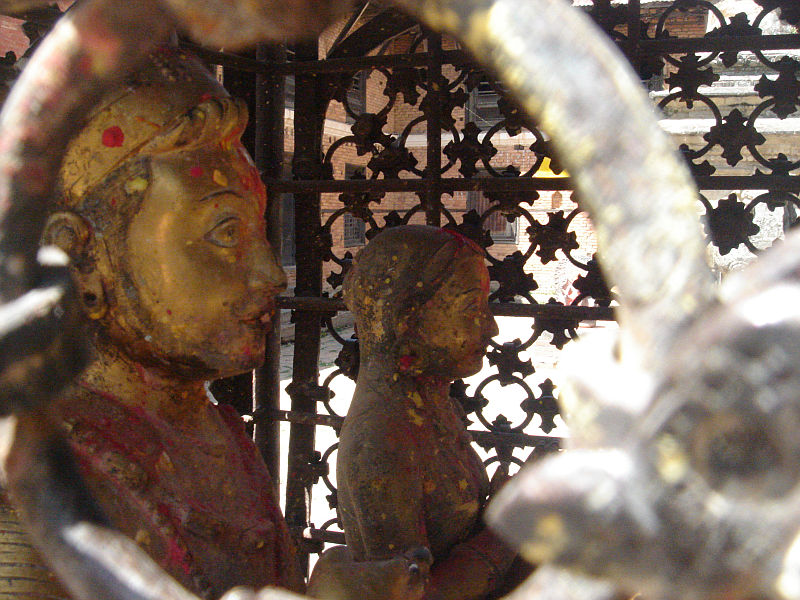
Isolated in their gilded cage are small statues of a former Licchavi King and Queen, possibly the ones who built the actual Changu Narayan temple (the site is believed to have been used for worship long before the building was erected). This is a common feature of Nepali temples - the patron king and queen immortalizing themselves in the kneeling posture of devotion, hands folded in salutation, facing the deity.


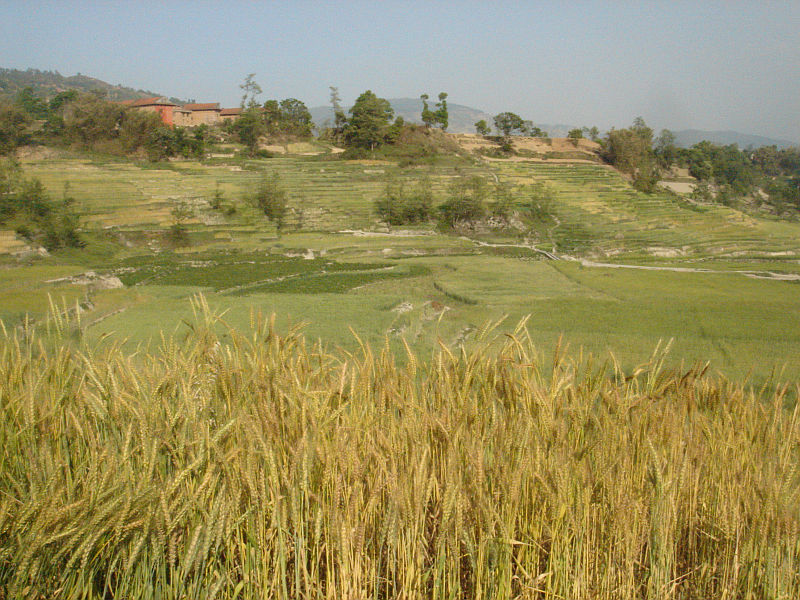
After a dreadful and very overpriced lunch at the neat, tidy garden style restaurant near the front gate (don't be fooled by the appearance - they do have a bathroom, though), we elected to walk the hour and half back down to Bhaktapur town, through the pine forest (the best part), windy wheat fields, and dusty small towns.
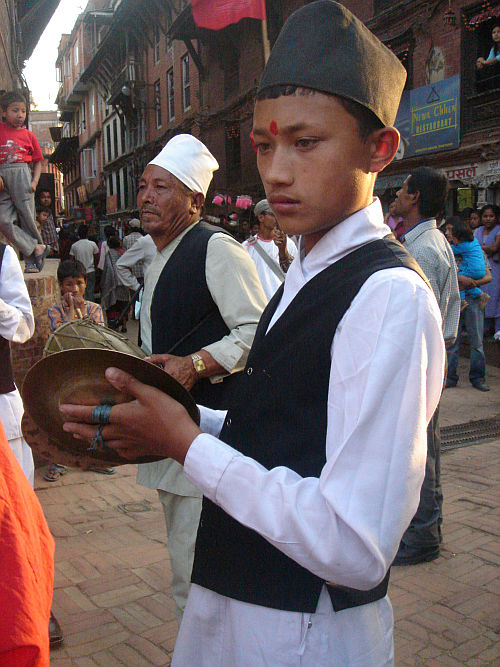

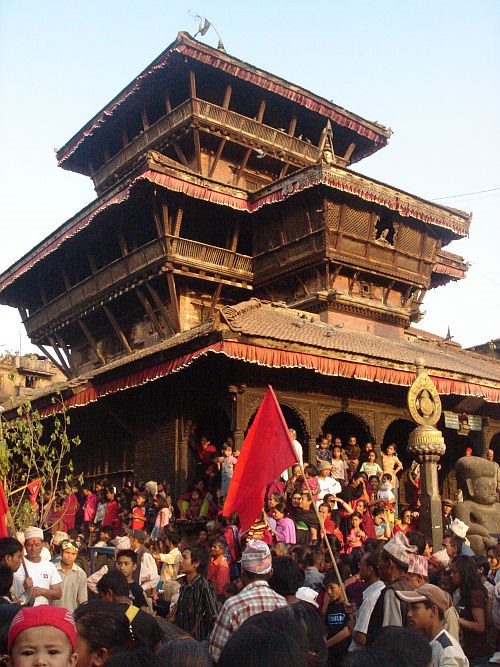
We knew we were near "town" when speeding vehicles threatened to knock us off the road into the ditch, and choked us with their fumes. Back in Bhaktapur, we were greeted by still more clanging cymbals, beating of drums and tooting of flutes. Was Bisket Jatra STILL going on?

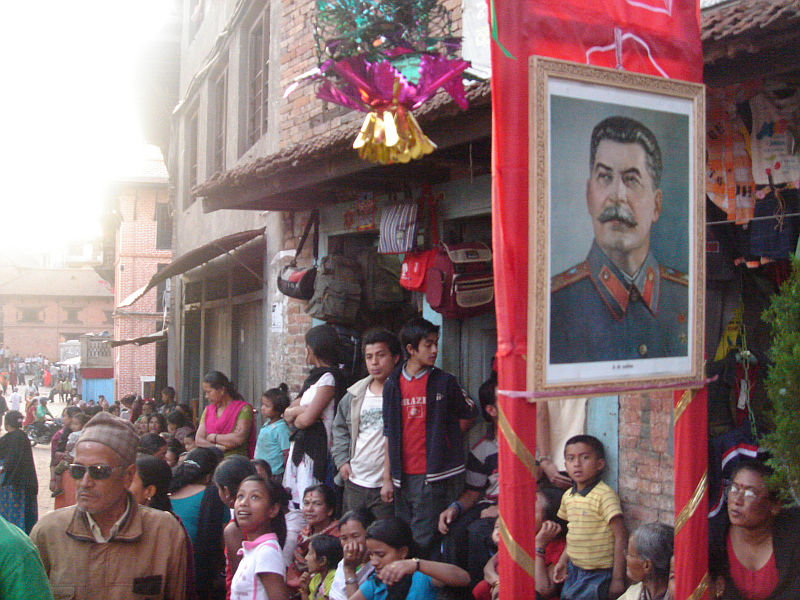
It turned out to be a different festival. The Maoists, along with a local affiliate Newar identity party, were celebrating their electoral victory with traditional music, traditional dance, red banners and portraits of Stalin, Mao, Marx and Lenin.

Dattatreya Temple square (also called Tachupal) was once surrounded by Maths, or Hindu ashram-style centres of residential learning. Students came from all over the region to learn traditional Ayurvedic (herbal) medicine in the ornately carved wooden buildings. Now, Pujari Math is a woodcarving museum, and another of the Maths has been transformed into a high-priced tourist restaurant.

New gods were being worshipped in the old square. It was high time for a shower and a pot of tea. We drifted through the narrow streets floating among political icons, Buddhist statues and Hindu gods back to the Bhadgaon Guest House.


---Thanks to Sudarshan for correcting some of the deity information.

Friday, November 23, 2007

Friday Faces

wrinkles in time
Leh, Ladakh


I just came from the Jamma Masjid ("Friday Mosque") in the main square of downtown Leh. Friday is the best time to take photos, because it's the special day for Muslim prayers.

I love the way identities are so confusing in Ladakh. People who "look Muslim" turn out to be Buddhist and vice versa. It totally messes with my preconceptions.

My favourites are the old-timers with ravine-filled faces and traditional clothing. When I was much younger, I used to hear people describe the elderly as "beautiful" and thought "yeah right, who would really want to look like that? They are just being polite...."

But now I really find it hard to take interest in photographing most younger people. The older people really are more beautiful.

This afternoon at 1.30 prayers, I was only able to photograph men. (Women generally pray in the home, at least in this area.) I haven't been able to upload today's photos of the old timers yet. So here are some more wonderful Ladakhi faces with the invariable Ladakhi smile.

Can you believe I've never been to the Taj Mahal?
I can't.

After all these years in India, I have been to so many places... but still not the Taj Mahal, definitely the most famous UNESCO World Heritage site in India, if not the whole world.
While browsing the UNESCO website (looking for information about protected rock carvings - the ASI director for Leh swears that such things are not protected by UNESCO, which of course, is not true) - I decided to list all the World Heritage sites I have visited.

Tamil Nadu:
Brihadeshwar Temple
Mahabalipuram monuments including the "Shore Temple"

Maharahstra:
Ellora Caves
Ajanta Caves
Victoria Terminus (recently renamed "Chhatrapati Shivaji Terminus," which peeves me, because Queen Victoria's people built it....it has nothing to do with Shivaji, he was dead a long time before this building was erected; why should he get credit?)

Bihar:
Mahabodhi Temple

Delhi:
The Red Fort

Nepal:
Pashupatinath Temple (foreigners not allowed inside..but they want your money anyway)
Kathmandu Durbar Square (foreigners not allowed in Kumari Ghar or most temples. They still hit you up for entrance fees. Somehow they have it worked out that this makes sense)
Patan Durbar Square (same policy - foreigners not allowed inside temples. Indians, who technically are foreign, are allowed - just not white people)
Bhaktapur Durbar Square (same - foreigners not allowed inside temples)
Boudhanath Stupa
Swayambunath Stupa
Changu Narayan Temple

I have consistently lodged my own one-woman protest at the discriminatory Nepali sites, by never, ever paying the price for buildings I'm not allowed into. (Makes perfect sense to me.) Instead, I have enjoyed the surrounding areas without paying, and now know all the secret back entrances to each of the sites. Write me for details. I don't support places that claim to represent the heritage of "all the peoples of the world, irrespective of the territory on which they are located," and then discriminate based on race. I welcome you do the same.

All the other places listed do charge more for foreigners, but at least the access is equal for all. If I'm going to pay five times as much, I should be able to see the place - that seems more than fair.

The Bus Is Back

Good news, budget Himalayan travellers. The Kathmandu-Lhasa Express is back on the road (as of January).

Too bad the same cannot be said of Nepali politics. Yesterday was originally meant to be the historic elections. It passed without a peep as political infighting continues and fresh violence erupts in the Terai region.

Here's more about the bus:

The bus service ran into trouble soon after its start in 2005 and remained suspended. Though resumed again for a short period in 2006, it has been closed since spring.

Officials in Nepal blame the closure on the Chinese reluctance to issue visas.

Beijing issued visas only to tourists travelling in groups, that too after stringent scrutiny. Travellers had to submit details of their itinerary and accommodation and the bus service was shut down by China on the eve of demonstrations in Tibet or anniversaries of historic days.

The revival of the flagging bus service coincides with the start of the Visit China campaign by Beijing to mark 2008 when it hosts the Olympic Games.

Nepal's state-owned Sajha Yatayat will run the weekly service from Kathmandu, like it did in the past. The pact will be a shot in the arm for the floundering state service, most of whose buses have not been running for over a year after an agitation by employees.

The one-way fare for the three-day trip will be $70.

Full news story here.