Showing posts with label dasain. Show all posts

Saturday, October 09, 2010

Meanwhile, back in the Valley

Harvest Home
Body in NYC, mind in Nepal

I'm sitting in an East Village cafe, watching the corner grocery try to array produce in an attempt at a "harvest season" display.  Somewhere, outside of Manhattan's concrete canyons, leaves are changing colour, chrysanthemums are blooming and roadside stands are setting out sheaves of Indian corn and piles of pumpkins.  And all over Nepal, it's Dasain time - the nine-day festival dedicated to goddess Durga, in her local Nepali incarnation as Taleju Bhavani.  
The narrow streets of Kathmandu's old town are crammed with shoppers buying holiday gifts, and all the accoutrement required for a Nepali Hindu holiday (special food, sweets, and lots and lots of marigolds).  All this under a blazingly blue sky - weatherwise, it's the perfect season to be in Nepal.

This nine-day goddess festival ("Navratri") is celebrated throughout the Hindu world, taking on local characteristics in each region.  In Maharashtra (India), the holiday is called Dussehra, marked by  glowing paper lanterns.  Mysore (in Karnataka, near Bangalore) has its famous Dasara procession complete with elephants, a palace glowing with oil lamps and fairy lights, and the descendant of the former Maharajahs presiding.  On most every street corner in Calcutta, you will find pandals (platforms with decorated deity statues) for Durga, with ceremonies and devotional music ongoing throughout the holiday, till the clay statues are submerged in the Hooghly river on the tenth and final day.  In the Kullu Valley of Himachal Pradesh, the local goddesses are brought down from their respective temples and paraded on palanquins through the town. 

Dasain is the uniquely Nepali form of Navratri. Nepali festivals are tied to the seasonal agricultural cycle, reflecting the centrality of farming in many Nepali communities.  Each of the nine days is full of significance and traditional observances.  On Ghatasthapana, sprouted wheat grains are planted in a pot, and kept in a dark place in the household.  On the tenth day of Dashami, the beautiful spring-green sprouts (called "jamara") are plucked and worn, as a sign of new growth and regeneration, along with "tikka" (the red kumkum powder) on the forehead.

Nepalis having a genius for time-warping, the nine days and nights of Dasain magically extend to two weeks, even a month in some cases. Workers who have migrated from their remote villages to larger towns to find employment are packed onto rickety buses, crossing dusty and bumpy roads to make the pilgrimage home for the festival.  For many, is their one chance in the year to see their family and the old home place.   When a Nepali waiter, for instance, takes leave from his job to go home for Dasain, he returns whenever he returns - between over-capacity buses, unreliable vehicles, transport strikes and poor road conditions, he can't guarantee a definite date of return.  Most Nepali businesses are bound (by tradition as well as the powerful Maoist-led labour unions) to give each employee a full month's salary as Dasain bonus.

Most Nepalis don't consider their Dasain complete without the sacrifice of a goat.  In a traditional Hindu town like Bhaktapur, every house will have blood on the doorstep from the sacrifice, usually done on the ninth day of Navami.

As a visitor to Nepal, Dasain can be frustrating - transportation is crammed full, shops open and close erratically, most government offices (including those for trekking permits) are closed, and tourist restaurants and many hotels are running on a skeleton crew.  The best way to spend Dasain is to relax, forget your goals and travel checklist, befriend some Nepalis and get invited to their home.  You will enjoy  the traditional foods, and receive the blessings of  tikka and jamara from the family elders. 

Don't forget to bring a present (almost anything is appreciated, but sweets are always appropriate), visibly relish the food that is served, and demonstrate real interest in the holiday and its traditions.  For all the breathtaking mountain vistas, everyday life in Nepal is marked by simple pleasures and of course, the ever-present Nepali smile.

Sunday, October 22, 2006

Diwali walli* goes Nepali

Festivus maximus
Kathmandu and Lalitpur, Nepal


*Wallah: someone who is particularly expert at or specializes in a certain activity or profession. Walli: feminine of Wallah.


Everything happens at once, all the time, here. We're now in the middle of yet another cluster of festival days. This one is Diwali, aka Tihar, the Hindu festival of lights and Lakshmi, goddess of wealth and abundance. Some things are closed, some are open for business, many look deceptively open yet are operating on skeleton crew.
Naturally, all government offices are closed. In fact, I think they were literally closed more days than they were open this month.

Bunches of dressed-up, beaming people roam the streets, butter-lamps are lit at in doorways at dusk, children make the rounds singing and drumming deusi-bailo (a sort of Newari trick-or-treating from door to door) in the evenings. Every home and shop has a rangoli (sort of mandala-design invitation to the goddess, painted with cow dung, coloured powder, lamps and flower petals) at the front door - a painted pathway to guide Lakshmi as she enters to bless the residence. Everywhere you can hear the sounds of ringing puja bells, and Newari panchbhaje bands go from door to door playing their distinctive, reedy ceremonial music. A few months ago I wrote about the snake holiday (Naag Panchami). I can really hear the snake spirit in the sounds of the long, narrow Newari horns.

New Newaris
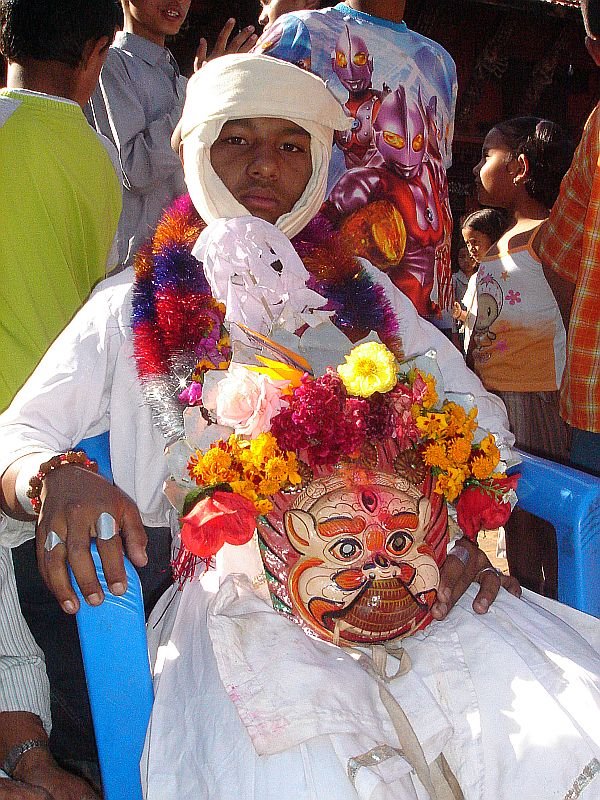
Today I am rushing to get some prints made for Pramochan, one of the (the many) Newari masked dancers I photographed this past Dasain season. On Dasain day, I received tikka and jamara (red powder on the forehead and sprigs of barley behind the ear) from Pramochan's father. Tikka and jamara are a sort of blessing given from elders to juniors on Dasain day. So, Pramochan's familiy (all five of whom live in a traditional Nepali wooden house, which looks like a hayloft with a five-foot ceiling) have invited me to Mha Puja. (Yet another puja!)

I love the tradition of jamara, which is (as far as I know) unique to Nepal. On the first day of Dasain, the lady of the house plants seeds of barley, rice or corn, in a bed of sand, in a special niche inside the home. The seeds are then covered and allowed to sprout secretly in warmth and darkness. It's during these nine days that the goddess Durga is symbolically fighting evil. On the tenth day, Vijaya Dashami, the jamara is uncovered and revealed to have grown into long, bright green grassy stalks. The stalks are then ritually harvested and bestowed upon juniors by the family elders.

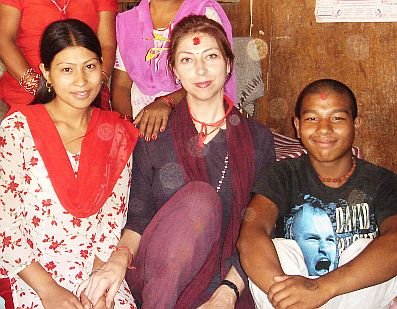
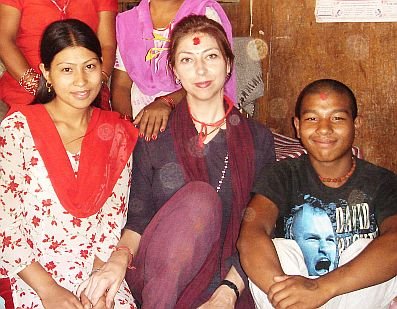
Everyone walks around town with an enormous red dot (made of red kumkum powder, rice and yogurt) on their foreheads and chartreuse sprigs sprouting from their hair like feathers (see photo below). Nepalis absolutely love tikka and jamara ("sooooo beauty-full") and seemed very proud to be seen with me, once I was properly marked.

Today's festivity, Mha Puja, is done only by the Newari community on the occasion of Newari New Year (it's now 1126). This ceremony honours and blesses the individual's body for the coming year. Fortunately I have a Newari and Nepali interpreter and hope to find out more about it. I am bringing the prints as a present for the family. (Others might get away with bringing a box of sweets, but as a foreigner with a digital camera, I am honour-bound to provide free prints to the family. I think it's a tradeoff for the stigma they might otherwise receive of associating with a foreigner.)

Rituals in transfigured time
Here in Nepal, we are running three simultaneous calendars. The business calendar is (sort of) the "English" or Gregorian calendar. Then there's the Vikram Sambat or Nepali Hindu calendar, in which it's 2063 and the new year is in April. It is quite common for buildings to boast of having been "established in 2059" (my Australian friend Dave took a photo of this - he thought it was a typo), or for people to say "the conference will begin after 10 Bhadra."

When yet another time cycle, the Newari calendar, starts tomorrow, and it will be 1127. The Newari new year is figured from our AD 867, when legend has it that a Newari Jyapu (farmer caste) discovered a riverbed of gold, and thus paid off everyone's debts. A good way to make a fresh start.

Now if I could just make some money and pay off a few of my debts...guess I will be offering Lakshmi extra marigolds and butter lamps for that one.

New widgets on the block!
Feeds, widgets, clusters, tags, bookmarklets, clouds, sprinkles, aggregators, badges. I'm just now learning about the galaxy of nifty blog features and how they procreate.

I've added a couple of new widgets (nifty code dropped into my template to do cool things) to the blog site. The SirenLocator Map (requires Flash, I think) should show online viewers as they appear, and even reveal a map of their nation (for those unclear on geography).

Scroll down and you will find the Current Moon Phase, essential for life in Nepal and other parts of Asia.

My SirenDelicious feed shows my favourite items and headlines saved to Del.icio.us. And Global Voices headlines feed show selected headers from the Nepali and Indian blogosphere.

Coming soon: my very own tag cloud, and a Newsvine widget. Oh, and I've finally caught up and gotten myself a YouTube account, but some stupid folk singer already snatched the name Sirensongs....so SirenTV will be appearing as "SirensongsIndia." Maybe someday I'll figure out how to upload my many videos directly to this site.

Wednesday, October 04, 2006

Goats' head soup

Dead and kicking
Bhaktapur, Nepal-

Just saw my first goat sacrifice yesterday, and am still recovering.

I was under the naive impression that they held the poor thing down, slit its throat and let the blood drain out while the animal just kind of faded away. Nope. One guy holds it up by the horns and yanks its head back, another guy holds it by its tail, lifting it off the ground. The idea is to get the blood to SPURT and PUMP out onto the vehicle (usually car, tractor or motorbike) that is being .... well, christened is definitely not the right word. ("Inaugurated," maybe.)
Then as the goat screams and kicks in the air they carry it round the bike in a circle to get ALL Corners covered by blood.

If you stand too close you are in danger of getting spurted on, for real. Fresh blood is the reddest red you can imagine, it almost hurts your eyes. I used to have a bright red nail polish that was the same colour but you never see it elsewhere in nature. Not that bright.

Finally they brutally sever the head (at this point the throat is torn wide> open and you can almost see the heart still pumping) and put the head in the front adorning the ground. The body lies kicking and thrashing beside the vehicle.

I love all animals, but goats really have sass and personality, and this really bothered me. According to an American Hindu scholar who was with me, the scriptures say it is not a sin to eat meat as long as it was sacrificed to a god. But does sacrificing it in order to safeguard your vehicle count as religious? or at all spiritual?

Everywhere we went, at literally every corner of Bhaktapur, there were machines and vehicles adorned not just with pools of blood but what looked like clear plastic tubing. These turned out to be the washed strung-up entrails of the animal, draped like a festive garland over the radiator grill or handlebars. I purposely missed the sacrifice of a water buffalo last night in front of Brahmayani Peeth temple, but I did talk to the Navadurga Dancers who were required to drink the blood straight from the animal's neck. Their white ritual gowns were soaked pink like tie-dye. It is still really hot here in the daytime (okay, pretty hot - nothing like India though) so I am tired from walking all over town. Time to go shower. I have loads of photos to download, too.

Wednesday, September 27, 2006

Dancing days are here again

Lost in a masquerade
Lalitpur, Nepal

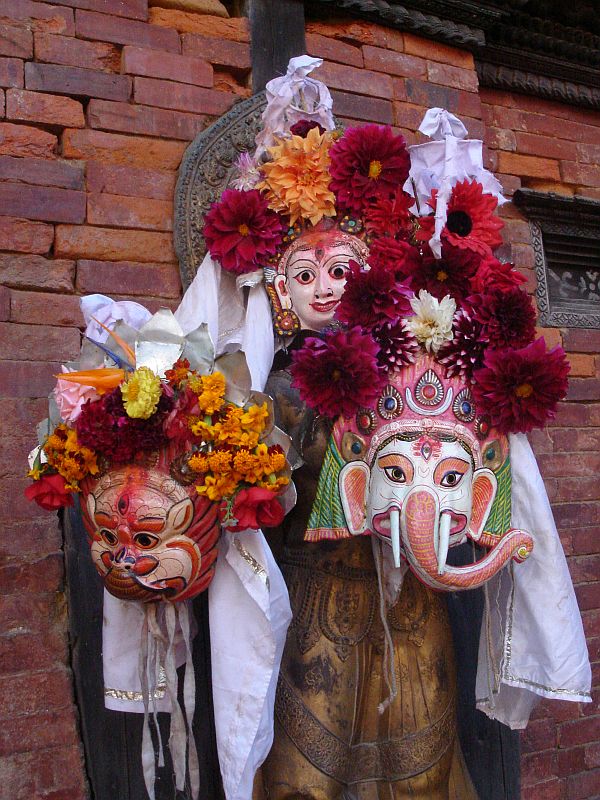
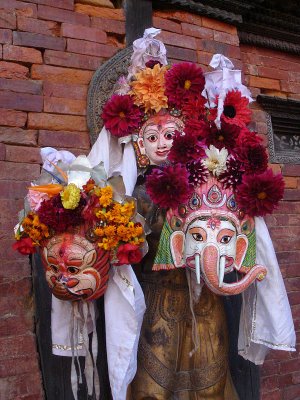
Indra Jatra, Dasain and Kartik Purnima mean it's time for the ritual masked dances of the Newari people. I'm currently engrossed in tracking them down (obscure, community-based, secretive besides the language problems) and documenting them. Last night I went to Lalitpur (Patan) to see the Ashtamatrika (Eight Goddesses) dance of the Newari Buddhist community. I only have time to upload one photo right now (before running to Immigration).

I have seen lots of masked dancing by now, and I think the Ashtamatrikas are the most exciting yet. They seem to be the most classically influenced, and the most ritualized. These dances were begun in the 1600s on the orders of the Lalitpur king (at that time it was one of the rival 3 kingdoms of the Kathamandu Valley), who was a great devotee of the eight guardian goddesses.

The transformation of the dancers, as soon as they don the mask, is really astonishing. They assume a hands-on-hips stance and begin trembling with shakti.

Hundreds of people from the community turn out and follow the Goddesses on their journey from Nakabahil (courtyard of the dance-god) to the courtyard of Taleju Bhavani Temple, where the gothic gables tower over the dancing devis.

I was the only foreigner there. It amazed me that so few outside people know about the vibrant, living culture of the valley, especially since it's been going on continually for the past four hundred years.

Last night there was a power cut, so we were marching through the cobblestoned streets in candlelight - it felt like the dances must have one hundred years ago.

Getting your goat

Dasain Days
Bhrikutimandap, Kathmandu, Nepal

Finally, the weather cleared yesterday, after a weekend of seemingly interminable drizzle and rain and mud. Billowing white clouds now hang over the green hills that surround Kathmandu, and it's hot at mid-day.

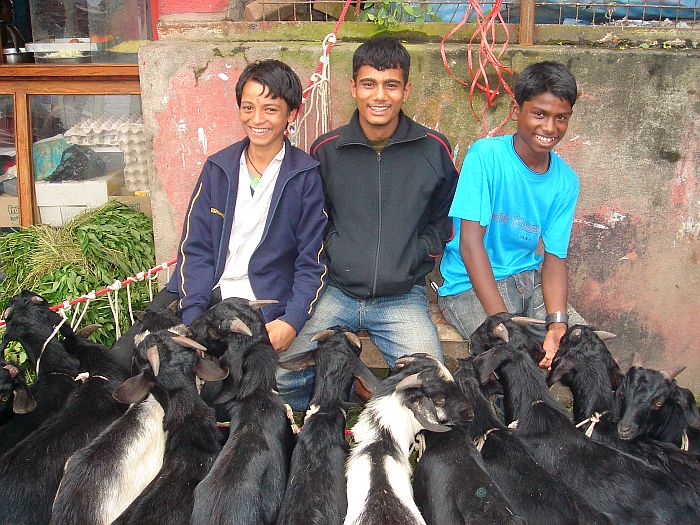
On my way to Immigration, I passed an impromptu open-air goat market - the sidewalk was transformed into a musky-smelling barnyard, with all sizes and colours of goats nibbling at green fodder suspended from rope ties. They were adorable! But sadly, all are doomed. They have all been brought in from the surrounding villages to be bought as sacrificial offerings for the Dasain holiday. If all goes as planned, each and every one (all male goats) will have their throats slit and their blood offered to the goddess Taleju Bhavani, a manifestation of Durga. The unwanted goats will go back to the hills.

I had romantic notions of topi-wearing hill-dwellers herding the goats, on foot, over valley and dale into the big city for market - a sort of annual pilgrimage. Actually, the goat-keepers rent a mini-van (for about 500NRs a day,or $7.00 US) and load the goats inside; as many as 20 goats are crammed into the little vehicle. They pick up uncooperative goats by the horns (in one hand) and the back-scruff (in the other) and toss them in.

The hundreds of goats there were distinguished by some numerical system scrawled onto their horns, and sometimes, blotches of coloured dye on their shaggy coats. One shyster tried to sell me a goat for 3000NRs (about $50), but it turned out the correct price was 160NRS for 4 kg.

The goats are weighed (or as they say here, "weighted") across the road on a medieval-looking contraption that is a combination of a seesaw and swingset. The balances are big enough for a couple of humans to stand in - in fact, it looks like the thing they use to weigh the accused with in Monty Python & the Holy Grail ("I am NOT a witch, and this is not my nose, it's a false one!"). There were a few regulation weights there to balance the goats, but they also used a chunk of cinder block.

If the goats had any inkling of their fate, they seemed pretty resigned to it.

On the other side of the road were an especially handsome looking gaggle of goats, with long shaggy coats, twisted ornamental horns, and an extra swatch of shag hanging between their eyes like overgrown bangs. They seemed like the cool, laid-back hippy goats. Turned out they are a special kind of mountain goat called "Changra," but they don't cost any more than the other goats. I scratched them behind the ears, ruffled their fringed bangs and said a silent prayer for them to be reborn as humans (hopefully, vegetarian humans).

Immigrant Song
At Immigration, they told me that in order to stay in the country on a three-month student visa, I need the following things:
-$750 deposited in my name in a Nepali bank account. This is to prove I have $250 a month to cover my expenses for the three months's time;
-a receipt of fees paid and enrollment from the dance academy in Bhaktapur (which means I have to pay the teacher in advance, usually not a good idea);
-Letter of recommendation from the Nepali Ministry of Education (this is known to take a month or more - sometimes tourist visas run out just waiting for it);
-Various copies of my passport, visa and application itself (not a big deal).
-After the initial submission of the bank statement, you then have to show another just to prove you still have the money (that you didn't just borrow it in order to make a false statement).

$250 a month is quite reasonable for living expenses in Nepal; the problem is, getting it all together at the same time (plus the school fees).

They give you a nicely printed list of all these things (guidelines for foreign researchers and students)... in Nepali script! Talk about missing the point.

All this has to be accomplished within the next 30 days, and about 10 of them are official holidays. Nepal maa, din din ne, ek naya mela aunchhu (in Nepal, every day a new festival is coming).