Showing posts with label ritual. Show all posts

Monday, October 27, 2008

Dance the night away

Naach your average dance
Patan, Nepal

Kartik Naach,
the Nepali annual dance cycle depicting scenes from Hindu mythology (but danced by Newar Buddhist dancers) begins Oct. 31st in Patan's Durbar Square.


Kartik Naach is an eight-day series of dance-dramas instituted several hundred years ago by King Siddhinarasimha Malla. Though Patan's population was primarily Buddhist, the Hindu king hired the Buddhist dancers to portray Hindu stories.

Especially popular is the final night, when the tale of Narasimha disembowelling Hiranyakashipu is re-enacted to what can only be called mass hysteria from the crowd. (I would imagine this scenario is especially prominent because it's the namesake of the originating King Siddhinarasimha.)

All dances are free and open to the public, and take place on the Kartik Dabali platform in front of the famous Patan Museum from about 7pm to 9pm.


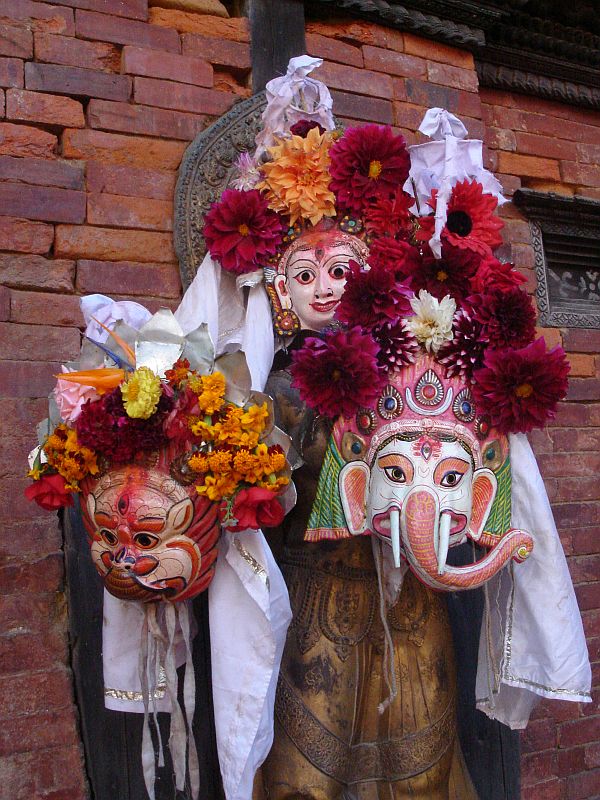
Here is a photo from the 2006 Kartik Naach depicting Lakshmi and Brahma Padmanabhasana (seated on the lotus from Vishnu's navel!).

I wrote to my Newar Charya dance teacher Raju Sakya about the origins of Kartik Naach. Here is part of his answer;

The King is Siddhinarasingha Malla who instituted and started for 15 days and his son SriNivas Malla elaborate it with other opera and dances for 1 month.But today in this century only for 8 days and some of the dance and dance parts are already lost or dissapeared with modern age. We have to preserve it but it's already missing . Let's hope and try to do revise and research on it.

Happy Deepawali and Nepal Sambat 1129 \Mhapuja.May Mata Laxmi bless us.

Sunday, February 24, 2008

Jezebel Spirit

Went down to the crossroads
The Spirit World via Kathmandu, Nepal

Long-term Siren watchers (shout out to C Drake, Tim Makins, Jayanthi, George, Carter, Sarasvati, KulluKid and Martin! in the house) know of my standing fascination with the nexus of human and divine.

That is, spiritual
embodiment/channelling/possession/incarnation of the human body, in its
myriad forms; from the semi-theatrical devotional (Bharatanatyam and other devotional dances) to current folk phenomena (Nepal's "Buddha Boy") to ritual incarnation traditions (Nepal's Kumari and Tibet's Tulku reincarnation system - HH Dalai Lama being the best current example).

I'm going to blame it all on my youthful fascination with anthro-filmmaker Maya Deren, who did extensive work with the Haitian Vodouns, and wrote the seminal book about that belief system, Divine Horsemen.

This was one reason Hinduism always made so much sense to me, intuitively. How could God be completely separate, outside of and apart from us? Hinduism (and Tibetan Buddhis
m, among others) has this great ongoing tradition of living humans embodying the divine. They walk among us! (In fact, in Hinduism and Buddhism, we already are god, we just have to realize it. But I digress.)

Fortunately I've been able to track down, witness and photograph many manifestations of these various traditions - the Tibetan State Nechung Oracle at Dharamsala (my photo below), Newar Astamatrika masked dance and its attendant "possession" rituals, Bhaktapur's ferocious NavaDurga dancers (photos forbidden there, though), Theyyam ritual god dances of North Kerala, Nepal's Ram Bomjom (the so-called Buddha Boy) back when he was under the tree in Bara district in southern Nepal, the Thiksey Monastery oracle (who danced waving swords on a 3-storey ledge and threw chhang on me) and dinner with (as well as blessings from) 2 of the 3 Kathmandu Kumaris, just to name a few.

There is a Hindu concept of the teertha, which means (in one interpretation) "meeting place" or crossroads . People who are into sacred geometry, vaastu, feng shui and architecture study the bricks-and-mortar manifestations of these teerthas. I'm more interested in the walking ones.

And the (never-ending) quest continues.


This poorly-written article from the Mangalorean is the first I've heard of a Dakshina Kannada (southern Karnataka) tradition known as Bhootaradhana, or "honouring the ghosts and spirits."

The rituals, costumes and traditions seem to be
close to that of North Kerala's Theyyam, which makes sense because they are in a geographically adjoining area. (My photo of Bhagavati Theyyam in Payyanur, above.)

The origin of the cult can be traced from ancestor worship, mother goddess, serpent and trees are incorporated. (Mangalorean photo at right.) There are certain spirits originated from Hindu God Shiva who sends the Bootas or Ganas to earth and ask them to receive offerings from human beings.
...The Bhootas are those spirits which once long back in time used to be in blood and flesh like any human being but nevertheless they were endowed with special and extra-human powers to do and undo things as per their will.... The event is called Bhootaradhane or Bhoota Kola. The season of Bhootaradhane begins usually by the first week of February which also signals the arrival of summer. The Bhootaradhane of various bhootas might go up to May 15. The first couple of bhootas to arrive on the scene are Kallurti and Panjurli.... Regional Resources Centre at MGM College Udupi has an entire library of audio and video and documentary evidence of the various bhootas in Dakshina Kannada and the neighboring Kasargod district in Kerala.

If anyone out there has more information about this tradition, or (even better) has ever witnessed a Bhootaradhane festival, I would love to hear about it.

And, if anyone has a correction or clarification about the Hindu (or any other) tradition to share - please do so, politiely. I am certainly open to corrections, but be nice. After all I am just a gori, and at a genetic disadvantage. The only stuff like this my people do is snake-handling and speaking in tongues (and we don't get to wear cool costumes). The Old Testament god doesn't approve of people looking too good.

Monday, July 16, 2007

Chariots of the gods

The gods must be lazy
Kathmandu, Nepal


Finally, the towering chariot of Rato Machhendranath, a Buddhist Bodhisattva figure who is traditionally regarded as bringer of the seasonal rains, was pulled to its resting place in Jawalkahel, Patan.

At last, after a delay of nearly 1.5 months (and even for Nepal, that is a big delay), the traditional Bhoto ceremony took place, with the Patan Kumari (one of the Kathmandu Valley's living goddesses) giving her blessings.

The eight-storey Rath (Chariot) of the deity, assembled of archaic wooden parts and a whole lot of bamboo and pine boughs lashed together, resembled a beserk Christmas tree careening through the crowded streets. Its massive wheels are about 2 metres, or 7 feet, high, each painted with the trademark "Kathmandu eyes." Now that's a big wheel.

Tradition clashed with modernity (literally) when the pine-topped peak scraped telephone and power lines. I wondered about the symbolism of the great piney tower. Sure, you could say it is phallic, but I saw more of a beacon. It's like they've constructed a literal skyscraper, maybe to reach cloudward and beseech the rain gods to come on down to earth. Maybe poking at the clouds with a big earthbound finger.

Such a primordial mega-spectacle takes a great deal of communal involvement and coordination every year. I could really see the practical role that such festivals play in bringing all parts of a diverse community together. Certain elements of the festival have traditionally been allocated to various castes and families, and this is a chance for them all to cooperate in a show of unity, sweat, incense, animal sacrifice, and heave-ho.

While the men pull the chariot en masse with giant ropes, the women now have an active role in the procession - linking hands as a security line to prevent onlookers from getting too near the crushing wheels. In Indian tradition the elderly and destitute used to throw themselves under the wheels, hoping for an auspicious death at the mercy of the gods. Don't know if they ever did that here in Nepal.

However, the rain gods may not be pleased. This year for the first time since the 7th century (!), the appointed Prime Minister, GP Koirala, presided over the Bhoto puja, rather than the King (or the Crown Prince).

While the papers are full of gloating crows like "King stripped of his cultural privileges," "Adieu monarchy" and so on, nowhere is addressed the issue of who decides these things.

Who, after all, gets to decide who participates in this ritual of primeval fertility and festivity?
Did the King decide not to go for security reasons (a wise move, really, considering all the anti-monarchy protests outside the palace on His Majesty's birthday)? Did the rain god Indra come to the high priest in a dream and demand the king's absence? Or did the Patan Guthi (community organization in charge of the event) just decide somehow?

Or, as I suspect, was this at least partially a cowardly kowtow to Prachanda and the Maoists, who have "vowed" to abolish the monarchy (not that it's up to them, or the political parties, to decide - supposedly, it is up to the people of Nepal. Supposedly). Prachanda's Young Communist League, a sort of Red Guard formed in the past 8 months, have been very active in the Valley, with all sorts of extortion, abductions and protection rackets. My Nepali friends say that because of the YCL, they do not feel as safe after dark as they did even six months before.

At any rate, it makes little sense for a Prime Minister of a proclaimed "secular" state to preside at an ancient ritual that represents Buddhist, Hindu and folk religions all rolled (literally) into one.

Let the King take his place in the rituals, for Peetha's sake. That's what Hindu monarchs are for, after all - Ritual,
ceremony and tradition.

Monsooner or later
Thank all the gods (and there's one on every street corner here), the monsoon appears to have at last set in, in earnest. That means, it rains at least once a day for at least an hour. Not the non-stop type of downpour we'll be getting in, say, Dharamsala, which has the second highest rainfall in all of India (after Darjeeling, I think). Back when Alex Frater wrote Chasing the Monsoon, Cherrapunji was #1. I guess shifting weather patterns have something to do with it.

It's wetter, cloudier, and the days are cooler. Bad for photos, but good for walking around exploring.

My friends in the Sakya community say Sajani Sakya, the (perhaps former) Living Goddess of Bhaktapur (reported here last week), is still touring India with her parents. Right now she is said to be in Gujarat. I am hoping to interview her when she returns to Nepal.

Two ancient traditions broken in one week. It may be hard to fathom the significance of this if you are sitting in America (perhaps London would be more sympathetic). But Nepal is a country that often appears to exist for the sole purpose of festivals and religious observances; a place where the old gods and devis still walk the streets and are brought to life with these seasonal cycles. I personally think there's plenty of room for the Old Gods in the New Nepal.


Tuesday, March 20, 2007

Where the earth meets the sky

Singin' in the rain
McLeod Ganj, Dharamsala

Has it really been a week since I wrote on the blog? -- unbelievable.
Yet, there is the evidence, in front of my eyes, on the Tibetan Rigpa calendar
(another calendar to keep track of - in addition to Hindu and Newari dates).
It's the year 2134 in Tibetan time.

The weather is really crazy- today we had:
1-cloudy morning,
2-heavy rainfall, then
3-beautiful sun WHILE it was raining
4- a rainbow
5-a hailstorm while sun came out and
6-around 6pm, yet another hailstorm, this time literally the size of moth-balls. You could have put an ice bucket out on the terrace and filled it quickly. I really thought it might break the windows!
and finally -
7-More lovely sun and another rainbow, only to be followed by
8-a late-night shower.


Tibetan tradition, like Indian and Nepali tradition, does everything by astrology (they have their own system which is a cross between Chinese and Indian astrology). This year is "an obstacle year" for His Holiness the Dalai Lama. In fact, for anyone turning 73 their 73rd year is considered an 'obstacle' year. So, there are extra "long-life" ceremonies being offered for him, for the past week. I call it "extra special very auspicious healthy lucky long life merit puja" (a take-off on the way Indians love to embellish things!).

Yesterday was quite remarkable - about a thousand (literally) Tibetans came all the way from Nepal and western Tibet regions to offer stuff (elaborate hand-made gilded Buddha and deity statues, sacks of rice, potted flowers, precious sacred Tibetan texts printed on the traditional long-paper and wrapped in silk, hand-woven
carpets, bolts of brocade and so on).

Hundreds of the old folks dressed in their "traditional dress" which looks
like a rainbow-striped circus crossed with Native Americans from outer space (don't know how else to describe it, really).

Sacred Stomping

As HH came into the temple, they started dancing. Tibetan folk dances look a great deal like Native American dances (small steps from side to side, moving in a circle and spiral). Like a lot of folk dances, the individual steps were not so remarkable - it's when seen in a large group that it really makes an impact. The ladies looked like a moving, shifting wall of rainbow colours. The men, in their heavy boots, stamp and whirl with long sleeves outstretched, resembling eagles' wingspans.

They dance in a large circle, facing the centre, where a single drummer (always male) pounds the very simple beat - again, a lot like Native American music. It feels very shamanic and tribal. Of course, now in addition to the drummer there is a
videographer. So, at least one thing has changed in the tradition. I reflected on how they probably used to dance around a fire. Now, they dance around a camera!

They always sing while dancing. The men start their vocals, low and earthy. Then after a verse or so the women come in with their soaring singing and it sounds like the sky meeting the earth. What it must be like to see these dances on the open steppes under the endless blue sky of Tibet!

Most of the dancers were 50 yrs old or older, and one probably never sees such a gathering of traditional Tibetan attire even in Tibet, these days.

Wizards of Weather
To get my photographer's press pass for tomorrow's Extra Special Lucky Puja, I had to go allll the way down to "the library," which is the name for Lower Upper Dharamsala where the Tibetan Govt. offices are. (There's Lower Dharamsala, Upper Dharamsala / McLeod Ganj, and then what I call "lower Upper Dharamsala" below the temple, "Middle Upper Dharamsala" and "upper Upper Dharamsala" - above the main road). I was helped by a sweet-natured fifty-something Tibetan woman named Sonam Wangmo. It turns out she attended NYU on a Fullbright scholarship.

We discussed the crazy weather (always a fecund topic for conversation here) and she casually mentioned, "You know, maybe we should call a Ngagpa. Do you know what a Ngagpa is?" (pronounced "nakpa").

I did indeed. "A Ngagpa is a kind of Tibetan sorcerer or wizard."

"Yes, they can stop the rain - or make it rain, or snow. They can control the weather."

"Perhaps you should have one on staff!" I half-joked. Really, it would be a good idea.

"Yes...but you know," she added on second thought, "we do need the rain. Water is such a problem always here in Dharamsala." It is one of the weirdnesses of the locale that a place receiving so much rainfall (#2 rainfall in India, after Cherrapunji) also suffers from water shortages.

The whole conversation was very matter-of-fact -- as though Sonam had been discussing the pros and cons of hiring a particularly difficult plumber.

It is really lightning out and I have to walk back to the village before it starts raining AGAIN!

Wednesday, March 14, 2007

Western disturbance

Under the rainbow
McLeod Ganj, Dharamsala

"A Western disturbance," the papers say, is causing severe precipitation all over the subcontinent - even in the desert of Rajasthan, and normally arid south India. My Chinese friend is on her way to Jammu and Kashmir on a government bus, but she must be snowed-in, because the paper says the J&K Highway is closed for snowfall.

Here, we just got beating down hard rain, several hailstorms, and severe, cable-snapping winds.

There are two advantages to such crappy weather - one, everyone looks like hell so there is no need to fix my hair, or even shower or wash my hair - it's too cold to even take my clothes off (even for a hot shower). Most people are sleeping with their clothes, gloves and hats on anyway. Makeup is a long-foregone pretension and dirty hair is hidden under my fake-fur hat (the kind we used to call, in the hip-hop days, a "Kremlin hat"). I am wearing my heaviest pair of (cotton) pants, a t-shirt, my cotton chupa, and a flannel nightshirt over it all, with the fleece jacket zipped up all day long. Many people appear to be wearing every item of clothing they own.

The second advantage is that, since the rain is so cold and hard and relentless, fewer people show up for teachings, and that means if you are an early bird (I am not), you can get a good seat very near to the Dalai Lama. Or, at least near enough to sit under his benevolent "blessing" hand as he walks by on the ways in and out.

There's also the fact that such frigid weather makes me crave starchy foods. I hope my body is burning it off with the constant walking up and down steep hills and staircases. Dharamsala is not a place for the physically challenged - or even for those with a serious knee problem.

Finally, last night
Finally. The rain finally stopped last night - just in time for the Long Life Ceremony this morning, for HH the Dalai Lama. An amazing double rainbow came out over the Kangra Valley, just around 6pm, before sunset.

This morning's (thankfully dry) Long Life Ceremony was graced by none other than HH the Karmapa (head of the Kagyu lineage), HH Sakya Trizin (head of the Sakya lineage), and the head of the Nyingma lineage (whose name always escapes me). It turned out (news to me) that some people, even foreigners, had come and saved seats upstairs the night before (usually upstairs is only for monks). Some people arrived as early as 5.30 AM to ensure their seating. Live and learn.

The ceremony featured "special appearances by" not only the Nechung Oracle but two more traditional oracles of other regions of Tibet, representing Amdo, Kham and U Tsang. Evidently there are no less than four oracles residing in McLeod and many more traditionally in Tibet and Bhutan. Each "channels" or manifests a different god when they go into trance. Though I didn't get upstairs, my Taiwanese friend got video of the oracles. When they collapse after the trance, they are immediately carried out like corpses feet-first.

(At left: Nechung Oracle manifesting the god Dorje Drakden in a trance at the Nechung Monastery, March 7 2007)


After the ceremony, HH had private (that is, about 100 people at a time) audiences for the Russians, Ukrainians, Mongolians and new Tibetans. The explanation I got was that he gives these audiences for countries where he cannot travel freely (like Russia) because of the country's relations with China. However, I know he did go to Mongolia just last year. Not fair!

Also, I heard later that a German girl snuck in with the Russians. You have to get a piece of paper from security - but they don't know who's Russian and who isn't. Then the whole crowd of 100 or so Russians goes together and has to show passports. But, because there are so many people, they don't really examine all passports - just look to see if the face matches the picture inside.

Okay, now I know the deal.

Mongolians, Russians and Ukrainians all understand Russian - so they get audience together. Everything is translated from Tibetan into Russian.

I caught two Ukrainian kids as they emerged glowing from the HH residence. What did he say?

"It was very short - less than half an hour," Sergei said. "But he said that in general, it was better for people to stay with their own religion, the religion they were born into. To change religions arbitrarily creates confusion and misunderstanding for a lot of people. But, if you do want to be Buddhist and practice Buddhism, it is very important to study - and study well. To really understand the concepts and what they mean - not just go through the motions. And His Holiness was very serious when he said this - not joking, like in the teachings!"

On the road, for real
At rainbow time (6 pm), I was in the Shangri-la restaurant, run by the monks of a monastery. In America, a restaurant where you are waited on by monks would be some kind of novelty theme chain (with a cutesy name like "The Monkery").

I was with Lama Sherab Gyaltsen, the monk who prostrated all the way from Lhasa to BodhGaya, India. Sherab speaks no English at all, but was accompanied by a translating friend, Passang. (Passang is another monk. Most Tibetan names are bi-gendered, that is, Passang, Tenzin, Tashi and so on can be either male or female.)


Back in January, I went to find Sherab on the Patna-Gaya Highway in Bihar. I had read an Indian news report about the "Tibetan monk crawling from Lhasa for world peace" and wanted to interview him and photograph him for myself. I spent two amazing days with him, his two Tibetan companions and the Bihari villagers, who lined the roads to alternately stare and support him - bringing him foodstuffs and water at day's end. They seemed to regard him as a modern-day yogi-saint or "tapaswi" (one who does severe devotional austerities) out of some Vedic-era mythology. Certainly they did not hesitate to "pranam" him (devotional salute) and instantly recognized what he was doing as in the Indian tradition of devotion.

Sherab was explaining how he got permission, from the Chinese government, to exit Chinese Tibet and enter Nepal while prostrating. He had to get some kind of special religious-pilgrimage visa - lots of paperwork. People from his home town of Dege, Kham district had to vouch for him ("he really is a monk and devotee, he is not just escaping, he is for real" and so on). The fact that he is from Kham - now considered part of Qinghai province or China proper - helps a lot. People dwelling in Lhasa or other parts of the TAR ("Tibetan Autonomous Region") are considered more of a political risk and have a harder time getting travel documents.

I had my trusty laptop Tawanda with me, and made a disk for Sherab of all the photos and videos I'd taken of him while he was literally "on the road." He insisted on buying me dinner, and paying for all the CDs (a welcome change from most Indians and Nepalis, who expect YOU, the rich firang, to pay for everything) and requested a second CD of the videos "for my mother."
Sherab had gotten press notices from the BBC, Times of India, Asian Age, Jagran Dainik and a few other Hindi language papers. However, I was special - according to him - because they were all Indian. (The BBC sent a local Hindi-speaking correspondent.) I was "the only English person" who had come to see him.

On our way home
It's always with a combination of sadness and relief that I watch the crowds pack up and go home after a teaching. Sadness, because it's so great to be in huge (if sometimes maddening) crowds of people who have converged for such an elevated cause. I mean, contrast 7,000 people coming together to receive Buddhist teachings from a Nobel laureate with the energy of 7,000 people - for example - gathered at music festival to get drunk and get laid. Or at a political convention, or a football game.

Relief, because finally I will be able to walk down the street and end up where I had originally intended to go, without several people sidetracking me - and will be able to get a table in one of the dimly-lit, always crowded restaurants of McLeod Ganj, where people huddle against the chill drinking Hot Lemon Ginger and catch up on who's going where, which Rinpoche is in town and who's getting teachings from whom.

And, of course, the next reading of the Oracle or Oracles.

Thursday, November 09, 2006

Blue skies, burnt out

Substandard subtitle
Kathmandu, Nepal

I'm officially burned out. Between the requisite appearances and celebrations of the holiday season, lots of late nights in crowded temple squares trying to photograph masked gods, lots of pilgrimages to holy sites of all stripes, and all the immigration rigamarole (which finally resolved - guess I need to do a thanksgiving puja now) I just do not feel creative. Actually I have been creating and documenting things all along, and now, just have no energy to upload and share them!

So here are just a few photos. About 10 days ago, I took a walk with my friend Jessamine down to Pashupati Temple.

This Brahmin pujari (ritual priest) in the photo is preparing offerings of rice balls, bananas, incense and so on for a memorial ceremony or shraddhanjali.

Pashupati temple is one of the most sacred in Hinduism, the most sacred in Nepal and seat of the national patron deity Pashupatinath (lord of the beasts, a manifestation of Shiva). This temple is the most prominent place to be cremated (here on the Bagmati River) or to hold the required memorial pujas for loved ones and family members.There is a special place just up the river bank for cremation of nobility. At the time of the 2001 Royal Massacre, there were so many royal bodies that special ghats (body platforms) had to be built just to accomodate all the cremations.

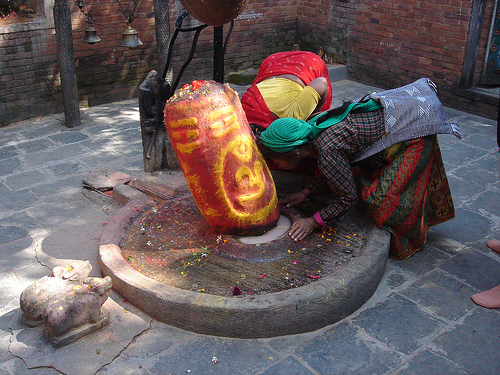
These are traditionally-dressed Nepali ladies (probably from the Gurung or Tamang ethnic group) worshipping the lingam, or sacred symbolic phallus, of Kirateshwor Mahadev, a manifestation of Shiva. The Kirateshwor temple is at the top of a flight of stone steps near Pashupati temple, but unlike Pashupati is open to foreigners and non-Hindus. The copper vessel hanging over the lingam is filled with holy water and "bathes" it continually.

This lingam-stone appears to be naturally formed, but someone has carved an OM symbol on it.

What looks like little stone bunnies next to the lingam are Nandis. They represent Lord Shiva's animal vehicle of choice, or vahana. Murugan rides on a peacock, Durga on a lion, Saraswati on a swan, and for some reason, Shiva chose a bullock. I guess he wasn't in a hurry.


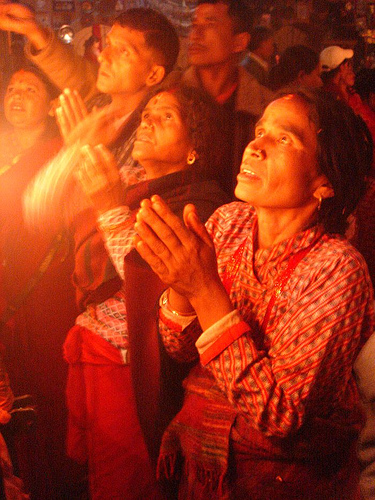
The people in the next photo are Newaris, worshipping on Kartik Purnima - the special full moon that just passed on Sunday - at the Chobar Temple just outside Kathmandu. Like an amazing number of Nepali temples, Chobar has both Hindu and Buddhist deities. The Newaris have a special festival just for this full moon (actually they have a special festival for everything). It represents a unique opportunity for the women of the community.

If there are Newari couples who have separated or had disagreements over the past year, the women can come and offer five days' puja service at the temple. That means, they have to fast, ritually bathe every morning in the river, and not let anyone touch them, as they perform the pujas for the god. This year, there were about 41 women doing this sort of service at the Chobar temple.

At the end of the five days, the woman's husband can either come to "claim" her again, or leave her there. If he does not come, the woman is free to remarry with another person. Since divorce is rare and highly frowned upon in this society I wondered if there was any stigma on these women. My Newari companion told me that lots of them do remarry, also rare in this part of Asia. I wonder how many women secretly or not-so-secretly hope that the husband will not come for them!

Before I go completely supernova, I think I might head for Pokhara, the lazy hangout spot, for a few days. We have a new peace agreement - the Maoists get a "piece" of everything! And you thought The King (Mr Ten Percent) was bad. Maoists are still effectively running 80 percent of the country and hitting up local people for donations and accomodation. But there haven't been many strikes lately. In fact I had gotten so used to using "strike" as an excuse for being late, now I am disappointed at having to arrive in a timely fashion.

Here is a peaceful, contemplative image of a giant Buddha statue, from the entrance to Swayambunath Stupa. Funny how getting these peaceful, spiritual images is so much work, I just feel dirty and tired and gritty and exhausted by the time I get home. Someone needs to make a t-shirt: "Spirituality Is Not Pretty."

Sunday, October 22, 2006

Diwali walli* goes Nepali

Festivus maximus
Kathmandu and Lalitpur, Nepal


*Wallah: someone who is particularly expert at or specializes in a certain activity or profession. Walli: feminine of Wallah.


Everything happens at once, all the time, here. We're now in the middle of yet another cluster of festival days. This one is Diwali, aka Tihar, the Hindu festival of lights and Lakshmi, goddess of wealth and abundance. Some things are closed, some are open for business, many look deceptively open yet are operating on skeleton crew.
Naturally, all government offices are closed. In fact, I think they were literally closed more days than they were open this month.

Bunches of dressed-up, beaming people roam the streets, butter-lamps are lit at in doorways at dusk, children make the rounds singing and drumming deusi-bailo (a sort of Newari trick-or-treating from door to door) in the evenings. Every home and shop has a rangoli (sort of mandala-design invitation to the goddess, painted with cow dung, coloured powder, lamps and flower petals) at the front door - a painted pathway to guide Lakshmi as she enters to bless the residence. Everywhere you can hear the sounds of ringing puja bells, and Newari panchbhaje bands go from door to door playing their distinctive, reedy ceremonial music. A few months ago I wrote about the snake holiday (Naag Panchami). I can really hear the snake spirit in the sounds of the long, narrow Newari horns.

New Newaris
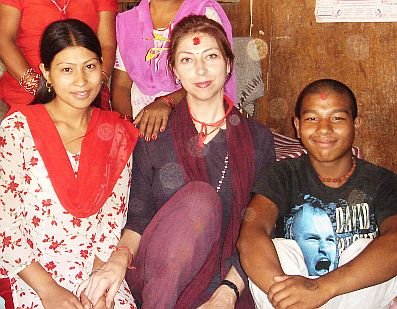
Today I am rushing to get some prints made for Pramochan, one of the (the many) Newari masked dancers I photographed this past Dasain season. On Dasain day, I received tikka and jamara (red powder on the forehead and sprigs of barley behind the ear) from Pramochan's father. Tikka and jamara are a sort of blessing given from elders to juniors on Dasain day. So, Pramochan's familiy (all five of whom live in a traditional Nepali wooden house, which looks like a hayloft with a five-foot ceiling) have invited me to Mha Puja. (Yet another puja!)

I love the tradition of jamara, which is (as far as I know) unique to Nepal. On the first day of Dasain, the lady of the house plants seeds of barley, rice or corn, in a bed of sand, in a special niche inside the home. The seeds are then covered and allowed to sprout secretly in warmth and darkness. It's during these nine days that the goddess Durga is symbolically fighting evil. On the tenth day, Vijaya Dashami, the jamara is uncovered and revealed to have grown into long, bright green grassy stalks. The stalks are then ritually harvested and bestowed upon juniors by the family elders.

Everyone walks around town with an enormous red dot (made of red kumkum powder, rice and yogurt) on their foreheads and chartreuse sprigs sprouting from their hair like feathers (see photo below). Nepalis absolutely love tikka and jamara ("sooooo beauty-full") and seemed very proud to be seen with me, once I was properly marked.

Today's festivity, Mha Puja, is done only by the Newari community on the occasion of Newari New Year (it's now 1126). This ceremony honours and blesses the individual's body for the coming year. Fortunately I have a Newari and Nepali interpreter and hope to find out more about it. I am bringing the prints as a present for the family. (Others might get away with bringing a box of sweets, but as a foreigner with a digital camera, I am honour-bound to provide free prints to the family. I think it's a tradeoff for the stigma they might otherwise receive of associating with a foreigner.)

Rituals in transfigured time
Here in Nepal, we are running three simultaneous calendars. The business calendar is (sort of) the "English" or Gregorian calendar. Then there's the Vikram Sambat or Nepali Hindu calendar, in which it's 2063 and the new year is in April. It is quite common for buildings to boast of having been "established in 2059" (my Australian friend Dave took a photo of this - he thought it was a typo), or for people to say "the conference will begin after 10 Bhadra."

When yet another time cycle, the Newari calendar, starts tomorrow, and it will be 1127. The Newari new year is figured from our AD 867, when legend has it that a Newari Jyapu (farmer caste) discovered a riverbed of gold, and thus paid off everyone's debts. A good way to make a fresh start.

Now if I could just make some money and pay off a few of my debts...guess I will be offering Lakshmi extra marigolds and butter lamps for that one.

New widgets on the block!
Feeds, widgets, clusters, tags, bookmarklets, clouds, sprinkles, aggregators, badges. I'm just now learning about the galaxy of nifty blog features and how they procreate.

I've added a couple of new widgets (nifty code dropped into my template to do cool things) to the blog site. The SirenLocator Map (requires Flash, I think) should show online viewers as they appear, and even reveal a map of their nation (for those unclear on geography).

Scroll down and you will find the Current Moon Phase, essential for life in Nepal and other parts of Asia.

My SirenDelicious feed shows my favourite items and headlines saved to Del.icio.us. And Global Voices headlines feed show selected headers from the Nepali and Indian blogosphere.

Coming soon: my very own tag cloud, and a Newsvine widget. Oh, and I've finally caught up and gotten myself a YouTube account, but some stupid folk singer already snatched the name Sirensongs....so SirenTV will be appearing as "SirensongsIndia." Maybe someday I'll figure out how to upload my many videos directly to this site.

Wednesday, October 04, 2006

Goats' head soup

Dead and kicking
Bhaktapur, Nepal-

Just saw my first goat sacrifice yesterday, and am still recovering.

I was under the naive impression that they held the poor thing down, slit its throat and let the blood drain out while the animal just kind of faded away. Nope. One guy holds it up by the horns and yanks its head back, another guy holds it by its tail, lifting it off the ground. The idea is to get the blood to SPURT and PUMP out onto the vehicle (usually car, tractor or motorbike) that is being .... well, christened is definitely not the right word. ("Inaugurated," maybe.)
Then as the goat screams and kicks in the air they carry it round the bike in a circle to get ALL Corners covered by blood.

If you stand too close you are in danger of getting spurted on, for real. Fresh blood is the reddest red you can imagine, it almost hurts your eyes. I used to have a bright red nail polish that was the same colour but you never see it elsewhere in nature. Not that bright.

Finally they brutally sever the head (at this point the throat is torn wide> open and you can almost see the heart still pumping) and put the head in the front adorning the ground. The body lies kicking and thrashing beside the vehicle.

I love all animals, but goats really have sass and personality, and this really bothered me. According to an American Hindu scholar who was with me, the scriptures say it is not a sin to eat meat as long as it was sacrificed to a god. But does sacrificing it in order to safeguard your vehicle count as religious? or at all spiritual?

Everywhere we went, at literally every corner of Bhaktapur, there were machines and vehicles adorned not just with pools of blood but what looked like clear plastic tubing. These turned out to be the washed strung-up entrails of the animal, draped like a festive garland over the radiator grill or handlebars. I purposely missed the sacrifice of a water buffalo last night in front of Brahmayani Peeth temple, but I did talk to the Navadurga Dancers who were required to drink the blood straight from the animal's neck. Their white ritual gowns were soaked pink like tie-dye. It is still really hot here in the daytime (okay, pretty hot - nothing like India though) so I am tired from walking all over town. Time to go shower. I have loads of photos to download, too.

Wednesday, September 27, 2006

Dancing days are here again

Lost in a masquerade
Lalitpur, Nepal

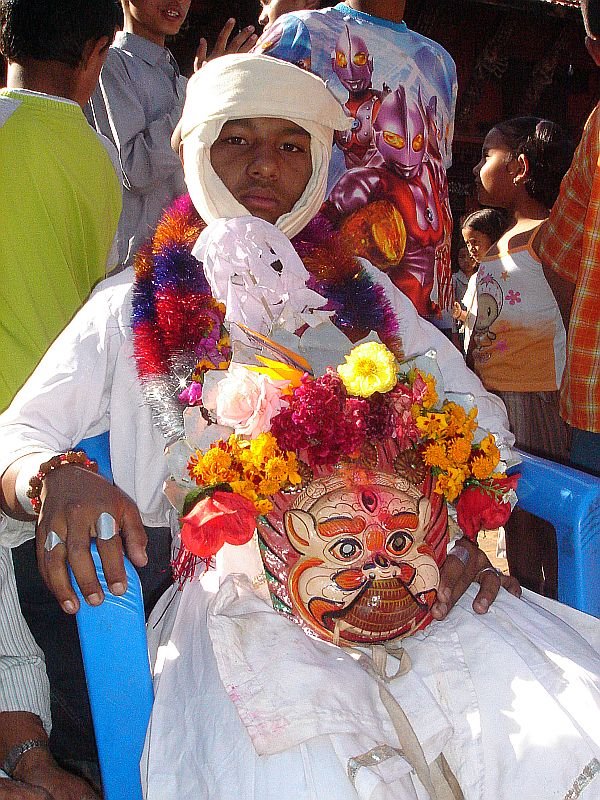
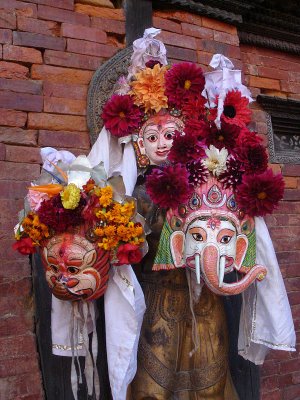
Indra Jatra, Dasain and Kartik Purnima mean it's time for the ritual masked dances of the Newari people. I'm currently engrossed in tracking them down (obscure, community-based, secretive besides the language problems) and documenting them. Last night I went to Lalitpur (Patan) to see the Ashtamatrika (Eight Goddesses) dance of the Newari Buddhist community. I only have time to upload one photo right now (before running to Immigration).

I have seen lots of masked dancing by now, and I think the Ashtamatrikas are the most exciting yet. They seem to be the most classically influenced, and the most ritualized. These dances were begun in the 1600s on the orders of the Lalitpur king (at that time it was one of the rival 3 kingdoms of the Kathamandu Valley), who was a great devotee of the eight guardian goddesses.

The transformation of the dancers, as soon as they don the mask, is really astonishing. They assume a hands-on-hips stance and begin trembling with shakti.

Hundreds of people from the community turn out and follow the Goddesses on their journey from Nakabahil (courtyard of the dance-god) to the courtyard of Taleju Bhavani Temple, where the gothic gables tower over the dancing devis.

I was the only foreigner there. It amazed me that so few outside people know about the vibrant, living culture of the valley, especially since it's been going on continually for the past four hundred years.

Last night there was a power cut, so we were marching through the cobblestoned streets in candlelight - it felt like the dances must have one hundred years ago.

Getting your goat

Dasain Days
Bhrikutimandap, Kathmandu, Nepal

Finally, the weather cleared yesterday, after a weekend of seemingly interminable drizzle and rain and mud. Billowing white clouds now hang over the green hills that surround Kathmandu, and it's hot at mid-day.

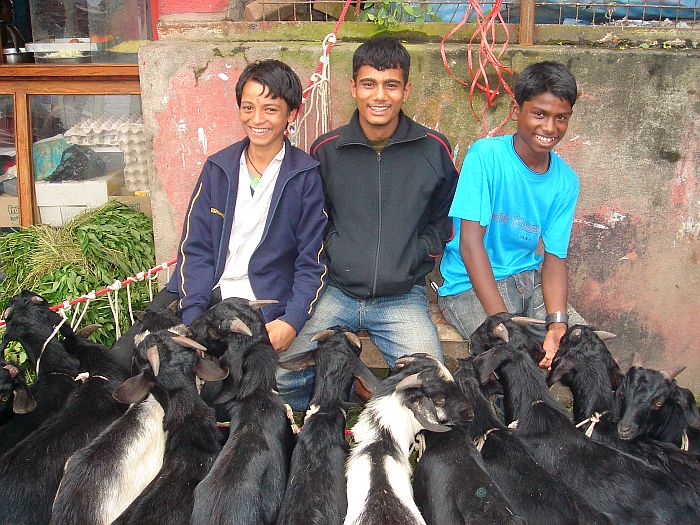
On my way to Immigration, I passed an impromptu open-air goat market - the sidewalk was transformed into a musky-smelling barnyard, with all sizes and colours of goats nibbling at green fodder suspended from rope ties. They were adorable! But sadly, all are doomed. They have all been brought in from the surrounding villages to be bought as sacrificial offerings for the Dasain holiday. If all goes as planned, each and every one (all male goats) will have their throats slit and their blood offered to the goddess Taleju Bhavani, a manifestation of Durga. The unwanted goats will go back to the hills.

I had romantic notions of topi-wearing hill-dwellers herding the goats, on foot, over valley and dale into the big city for market - a sort of annual pilgrimage. Actually, the goat-keepers rent a mini-van (for about 500NRs a day,or $7.00 US) and load the goats inside; as many as 20 goats are crammed into the little vehicle. They pick up uncooperative goats by the horns (in one hand) and the back-scruff (in the other) and toss them in.

The hundreds of goats there were distinguished by some numerical system scrawled onto their horns, and sometimes, blotches of coloured dye on their shaggy coats. One shyster tried to sell me a goat for 3000NRs (about $50), but it turned out the correct price was 160NRS for 4 kg.

The goats are weighed (or as they say here, "weighted") across the road on a medieval-looking contraption that is a combination of a seesaw and swingset. The balances are big enough for a couple of humans to stand in - in fact, it looks like the thing they use to weigh the accused with in Monty Python & the Holy Grail ("I am NOT a witch, and this is not my nose, it's a false one!"). There were a few regulation weights there to balance the goats, but they also used a chunk of cinder block.

If the goats had any inkling of their fate, they seemed pretty resigned to it.

On the other side of the road were an especially handsome looking gaggle of goats, with long shaggy coats, twisted ornamental horns, and an extra swatch of shag hanging between their eyes like overgrown bangs. They seemed like the cool, laid-back hippy goats. Turned out they are a special kind of mountain goat called "Changra," but they don't cost any more than the other goats. I scratched them behind the ears, ruffled their fringed bangs and said a silent prayer for them to be reborn as humans (hopefully, vegetarian humans).

Immigrant Song
At Immigration, they told me that in order to stay in the country on a three-month student visa, I need the following things:
-$750 deposited in my name in a Nepali bank account. This is to prove I have $250 a month to cover my expenses for the three months's time;
-a receipt of fees paid and enrollment from the dance academy in Bhaktapur (which means I have to pay the teacher in advance, usually not a good idea);
-Letter of recommendation from the Nepali Ministry of Education (this is known to take a month or more - sometimes tourist visas run out just waiting for it);
-Various copies of my passport, visa and application itself (not a big deal).
-After the initial submission of the bank statement, you then have to show another just to prove you still have the money (that you didn't just borrow it in order to make a false statement).

$250 a month is quite reasonable for living expenses in Nepal; the problem is, getting it all together at the same time (plus the school fees).

They give you a nicely printed list of all these things (guidelines for foreign researchers and students)... in Nepali script! Talk about missing the point.

All this has to be accomplished within the next 30 days, and about 10 of them are official holidays. Nepal maa, din din ne, ek naya mela aunchhu (in Nepal, every day a new festival is coming).