Showing posts with label delhi. Show all posts

Tuesday, February 01, 2011

What's your sign?

No Open Heads
Delhi

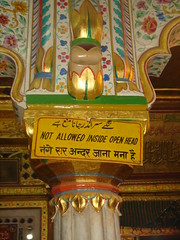
Continuing the "What's your sign" series...

This, seen in Nizamuddin Dargah, Delhi.

A Dargah is a mausoleum or tomb for a Muslim saint. Nizamuddin Dargah, constructed circa 1563,  houses the remains of Sufi saint Nizamuddin Auliya, as well as those of Amir Khusro and Jehan Ara Begum.  The tomb of Inayat Khan is in the same neighborhood, round the corner.  There's one area of the tombs into which women are not allowed (I can't remember which, but don't worry, signs are clearly posted).

Thursday evenings at the Dargah feature live Sufi Qawwali music from about 5pm, and continue only about two hours. Admission is always free.

The simplest way to reach the Dargah is just to hop in an autorickshaw and say, "Nizamuddin Dargah" (it's near to Humayan's Tomb, but every driver should know the Dargah).  You can also take Delhi's spiffy Metro to Central Secretariat, but you will still need to take an auto from there. 

Nizamuddin will immerse you in Delhi's rich medieval history of Sufis, Mughals and minarets.  As with Hindu temples, the road to a Muslim dargah is lined with stalls selling appropriate offerings. Rather than oil lamps and sindoor, they feature incense, roses and glittery green cloths to drape on the tomb.  The atmosphere is male-dominated, with some interesting exceptions.  At one stall I saw a woman, head demurely covered and carrying a basket, conversing with the stallkeeper. It didn't even take a second glance to see this was a transgendered person.  She was obviously well-known to the local merchants.  In a previous age, perhaps she would have been a court eunuch or even a court entertainer.  So much has been lost, in a time when Muslim culture is dominated by Taliban and ayatollahs.


Monday, March 15, 2010

On the curve


Jantar Mantar
Originally uploaded by Sirensongs
My entry to the Lonely Planet Photo Challenges contest, "Curves."

These fellows were perched on one of the sundials at Jantar Mantar, built by Maharajah Jai Singh II in Delhi circa 1764.

You can view the other contest entries on Flickr.com at
http://www.flickr.com/photos/tags/lpcurves/

Wednesday, November 19, 2008

Boots and all

Kathmandu and Delhi

I was wrong, they do have Merrell hiking boots over here - at least in Delhi. There is a Merrell "showroom" in Khan Market. Live and learn.


I'm currently enjoying my birthday present from the Sistren - a new pair of waterproof North Face hiking boots, size American Women's 9. Nothing like new kicks to give you a boost.

Thursday, April 03, 2008

Passing the torch

Updates - from....
New Delhi, India

April 17 is the day the Olympic Torch comes through New Delhi, on its way to Beijing. This will be a major day of protest action and here are suggestions from the March 10 Uprising organization on how you can get involved.

Already, one Indian torch-bearer (a Buddhist from Sikkim) has withdrawn from participation.

URGENT APPEAL TO INDIAN CITIZENS & OLYMPIC TORCH-BEARERS
Posted: 02 Apr 2008 05:27 AM CDT
When China ’s Torch Comes to India on April 17th - Speak out for Tibet .
We, the undersigned Tibetan individuals and organizations, appeal to all Indian citizens and, in particular, those people chosen to be Olympic torch-bearers, to speak out for the Tibetan people when China ’s Torch comes to India on April 17th.


At this critical moment, when countless Tibetans are suffering under a violent military crackdown by the Chinese government, we need to show that global citizens support the Tibetan people’s right to be free and to live their lives as they see fit.

The courageous actions taken by Tibetans inside Tibet over the past few weeks demonstrate that Tibetans have suffered unimaginably under a half century of Chinese rule. They are now risking everything and crying out for freedom. By speaking out when the Chinese government brings the Olympic Torch to India you will send a strong message to Tibetans, to the Chinese government, and to the world, that Indians support the Dalai Lama and the Tibetan people’s nonviolent struggle for freedom and justice.
There are so many ways for everyone to take action.

Torch-bearers can:- withdraw from the relay;
- wear a Free Tibet shirt or hold the Tibetan flag as they run with the torch;
- issue a statement in support of the Tibetan people before the Relay.

Indian citizens can:- join or organize a protest as the Torch passes through Delhi;
- wear a Free Tibet shirt or hold a Tibetan flag as the Torch passes by;
- plan a solidarity action in your town or city on April 17th.

As the Chinese government runs the Olympic torch around the world and attempts to whitewash its human rights violations and legitimize its illegal occupation of Tibet , tens of thousands of Tibetans and supporters will be speaking out to expose China ’s lies. Please join this global chorus of voices calling for justice for Tibet !

Monday, March 24, 2008

Torched


The Olympic Torch will be coming through New Delhi on April 17, on its way to Beijing. I imagine there will be an organized protest against China's human rights violations within Tibet. Best to check the Students for a Free Tibet website and get on their emailing list.
The Tibetan Marchers who departed from Dharamsala on March 10 also have a site with regular updates on their progress.


All over the world (including this morning in Greece) there are Tibetan and pro-Tibetan supporters protesting the Torch's planned route through Tibet. Here's a handy day by day guide to the Torch's round the world relay.

If you're stuck in a torch-less locale, you can at least phone, write, fax or email the International Olympics Committee (who keep insisting the Olympics are not political). Below are letter-writing guidelines courtesy Students for a Free Tibet.

Use the following talking points as a guideline when calling your NOC or drafting your own letter:
> Say you would like to leave a message with the President of the NOC. > If the Torch goes through Tibet it will likely cause further unrest, which would result in another heavy-handed crackdown and consequently more arrests, torture, and loss of life. > On humanitarian grounds alone, it is inconceivable that the Torch relay pass through Tibet at this time. > Please urge the IOC to immediately remove all Tibetan area from the Olympic torch relay route.

Here is a sample email/letter: To the President of the NOC of [insert country], As a citizen concerned about fundamental respect for human rights and dignity, I am deeply concerned that the International Olympic Committee and the organizers of the Beijing games are continuing with plans to carry the Olympic torch through Tibet. Right now in Tibet, there is no freedom of speech or movement and the entire nation is under martial law. International sources report that over a hundred Tibetans have been killed and hundreds more arrested or detained. As reports spread of arbitrary arrests, house-to-house raids, killings, and even beatings of schoolchildren, it is unthinkable that the IOC would continue to move forward with 'business as usual.' Allowing the torch to be carried through Tibet will greatly escalate tensions, giving the Chinese government an excuse to continue its violent crackdown, which will undoubtedly lead to more detentions and deaths.Allowing the torch through Tibet would indelibly tarnish not only the 2008 Olympics but the Olympic movement. The Olympic torch relay should be a celebration that unites people, not a propaganda exercise in which one people seeks to assert its dominance over another.
Tibetan people everywhere have made it clear that they do not want the Olympic torch to pass through their borders. The Chinese government's fervent desire to see the torch pass through Tibet is politically motivated, aimed at saving face despite the widespread protests, and asserting its sovereignty over Tibet. I urge you to place the needs of the Tibetan people and the values of the Olympic movement ahead of the Chinese authorities' desire to project an image of power and invincibility.
Please immediately appeal to the the IOC to withdraw the Tibetan Autonomous Region and the Tibetan provinces of Amdo and Kham - now annexed into China's Qinghai, Sichuan, Yunnan, and Gansu - from the Beijing Olympic Torch Relay route.
People, athletes and governments of conscience worldwide have responded with an outpouring of support for Tibetans inside Tibet. Please join us in saying "no torch through Tibet."
Thank you.
Sincerely,------------

Visit the web address below to tell your friends about this. Tell-a-friend!

Monday, January 28, 2008

I fell off

Resolution dissolution
Delhi to Dharamsala

Well, so much for my new year's resolution of blogging every single day. As we used to say Back In The Day, I "fell off" for a while.

Fortunately, in a few weeks it will be Losar (Tibetan Lunar New Year) and I will have a chance to resolve anew.

So as to end the mind-numbing suspense, yes, I was FINALLY granted the (very brief) visa extension, just long enough for me to get out of the country without a fine.

Then I was kidnapped by an emerging colony of underground artists deep in the bowels of Delhi's Lajpat Nagar and am only now emerging from the subterranean lair to tell the story.

Members of this collective include a Japanese public-art pirate and a Mandaya Indian stop-motion filmmaker. We've got Warhol's Factory beat all to hell, now all we need is drugs and money.

Seriously, this was my first experiment with the traveler's space-sharing project Couchsurfing. So far, so good.

Republican Parties
The road to procrastination is paved with good downloads. We had fully intended to attend the Republic Day parades in the morning. But, since we ended up watching the Bob Dylan interpretive-bio flick I'm Not There till about 2 in the morning, this was not to be.

Instead, Indian Republic Day (Jan. 26) was spent pigging out South Indian stylee at the Karnataka cultural center, then hanging out at Tamil Sangam auditorium with fantastic tribal folk dancers from Jharkhand, Madhya Pradesh, Lakshadweep, Andhra Pradesh, Gujarat, Meghalaya, Rajasthan and Punjab.

My favourites were the ethereal dancers from Bhopal, a hybrid of Masai warriors in full dress and characters from the movie The Fifth Element, swirling to hypnotic sounds of a dissonant gong.

As bus rides to Dharamsala ("I Mean McLeod Ganj") go, I had the absolute best 14-hour bus ride ever, crashed out in the cabin (driver's compartment). I managed to nab a 250Rs ($6.00) a night room at OM Hotel with a valley view.

I was miffed to see that the McLeod landmark Sunrise Chai stand is no more. (This place is a real institution on Bhagsu Road.) It's been replaced by - wait for it - a Kashmiri emporium ! Just what McLeod needs more of. The neighboring Moonlight Chai stand remains, but Sunrise will be sorely missed.

Now in Dharamsala ("I Mean McLeod Ganj") for just a couple days on an administrative mission. More news as it happens....

Sunday, January 20, 2008

Meals ready

Families , friends and food
Paharganj, Delhi

Since I am trapped here for a few days, thanks to the dilatory FRRO, I finally found the good food place.

I may have mentioned that Paharganj is the primary budget traveller's area in Delhi. This area is positively flooded with foreign tourists of all kinds, genuine neighborhood locals, and then the touts and insufferable rickshaw sharks that are only there to cheat the foreigners. It is good for certain things: cheap accomodation, meeting other foreigners, good internet with updated equipment, buying and selling used books, decent food (Indian, 'foreign' and Nepali), having a beer in a reputable rooftop bar. (Most Indian budget bars are not places a woman can go at all, let alone as a single person. )

There is a road near P-Ganj called Arakasham Road (aka "Ram Nagar") which features some more expensive, usually better quality, rooms in a less frantic, more "family" oriented atmosphere. There is scarce internet here and all the keyboards stick like hell. That's where I am now. It's mostly Indian families and some foreign tourists, who mostly flock to the upmarket Ajanta Hotel. (At $30 a night, I can't afford to stay there. I can only afford to have breakfast there.)

I like this particular hotel (Arya Tourist Lodge) for its "family" type qualities.

In India, "family" (as in "family restaurant") means "women friendly, not too sleazy." For one thing, some of the cheaper hotels (ie, in my budget range) rent rooms to gangs of young men who are looking for a place to party, drink, watch Hindi movies very loudly, smoke like chimneys and make noise all night long. "Family" hotels avoid renting to these guys.

For another, there is a woman working behind the desk here. A genuine auntie, with henna-orange hair, gold nose pin, Punjabi suit and a big smile. This adds to the wholesome environment. So do the Nepali room boys with their customary Nepali sweet shyness.

The owner, Mr Arya, is an old-school Brahmin whose dad started the operation. Dad's portrait hangs over the desk, garlanded with plastic flowers in memorial, keeping a watchful eye. In his office Mr Arya keeps his own watchful eye via closed-circuit cam on the front desk.

Occasionally he has to come to the rescue of the 2 desk managers, who don't speak so much English. He emerges seemingly at random from the sanctuary of his office to intervene when there is a misunderstanding. At first I just thought it was synchronicity. Then I saw the closed-circuit cams on his office computer screen.

Multani Dhanda
Anyway, after a few days of "Corn Flex Hot Milk" and "Banana Pange" from room service I finally found the good food place.

If you continue up Arakasham Road, you get more and more rickshaws annoying you and touts hissing "Yessss?" There is a vague smell of urine and cigarette smoke. The hotels get older and more run-down, and there are fewer foreigners.

Finally you turn the corner and are in a different world.

This road is called Multani Dhanda. Now, you are in a real Indian Neighborhood. You smell it immediately. Instead of urine, it smells like spices, cooking food and incense. Real people live here, not just fly-by-night drifters.

Unlike much of Arakasham Road, here there are women - of all ages. School girls hand in hand on their way home, grandmothers also hand in hand waddling from samosa stand to general store with their canes and saris, aunties running corner shops, young mothers with their kids.

The shops sell - rather than bus tours to Manali, soda pop and internet - the items required to sustain a normal Indian life. Dry fruits, gents' tailoring, Ayurvedic medicine (increasingly infiltrated by allopathic and international brand names), watch repair, mobile phone repair, dairy sweets and lassi, stationery, giant open sacks of corn flour and sesame seeds.

It's easy to make friends with local shopkeepers - there are very few foreigners here. The guy who runs the tailor shop won me over immediately as he was feeding a bunch of stray dogs. He bought chappati from the shop next door and milk packets, and the dogs actually took turns eating from a steel dish. "My best friends!" he said proudly, putting his hand over his heart and bowing. He looked for all the world like the Indian Airlines "maharajah" icon.

It was here that I found Grand Madras Hotel.


How to find good food -- for beginners

If you go to look for the Grand Madras, or a place like it, don't let the name mislead you. It is neither grand nor a proper "hotel." It is a tiny open-front shop that can seat all of 15 people, even by Indian seating arrangements. But it has all the signs I look for in good local food.

First of all, I look for a clean place (clean by the standards of someone living in India for 5 years. This means, you have to learn to distinguish between clean dirt and dirty dirt. Maybe that should be another post).

You want it to smell like food - not grease and sweat and stale air. For myself, as a pure vegetarian, I just look for south Indian. Yes, I am biased!

"Pure veg" as it's usually called means no eggs, meat, chicken or fish are used anywhere in the restaurant. I'm not sure, but I think this also used to be called "Brahmin meals." (You can still see places advertising 'Brahmin meals' in Kerala for example. I think that means it is actually cooked by a Brahmin man. Part of the Brahmin orthodoxy, found only in a few enclaves today, meant that an observant Brahmin must eat only food cooked by another Brahmin.)

"Vegetarian" (not 'pure veg') places can include eggs, but not chicken or fish.

All Indian veg-pure veg places also serve dairy products such as yogurt, milk and cheese. The concept of veganism is nearly unheard of in India. I love yogurt too much to ever be a vegan.

"Jain meals" or "Jain items available" means they are cooked with no onions or particular spices, which are prohibited by Jain custom. Saravana Bhavan advertises "Jain Sambhar Available" (sambhar is a spicy gravy). Since Jains are primarily an urban bunch, you don't see this much outside major cities and the Jain pilgrim circuit (I saw it also in Bihar near Jain historic sites).

And finally, "Non-Veg" means they serve eggs, fish, chicken and meat, with the exception of Beef, which is hard to find in India outside of star hotels. I saw one food place yesterday that openly advertised "Non Veg - No Beef Used Here." (they spelled it "Beaf")

Within non-veg, "Halal" is a particular type of preparation required by orthodox Muslims. It involves meat slaughtered in a certain way conforming to their rules, which I think involve the animal's welfare. Someone told me it means the animals should feel minimal pain upon slaughter. Maybe a reader out there can add something to this. Halal places are meat-places, heavy on the mutton, very often decked out in Islamic green colours and there is little for me to eat there.

There is far less possibility for contamination with vegetarian food than with meat, particularly in a humid environment (we are not in Ladakh anymore).

Vegetarian joints are also far less likely to allow smoking inside.


The Gods of Good Food
Signs of south Indian food: - South Indian names (names referring to south Indian gods like "Om Murugan," "Shri Balaji," anything with "Madras", or rather long names like "Saravana Bhavan". South Indian names frequently have lots of double letters in English).

-Pictures of south Indian gods. Ayyappan (always shown squatting with an "Okay" mudra), Murugan (youth carrying a spear, accompanied by a peacock) and Sri Venkateshwara - the one who looks like a space alien with a big Vee over his eyes.

(Before someone writes in saying "It's not a big vee, it's a blah blah blah and his eyes are covered because his gaze will incinerate the world, and he is not a space alien..." I know all these things, I am just trying to break it down for newcomers. Kausalya supraja rama purva sandhya pravartate and all that.)

-Guys wearing
lungis (the south Indian traditional men's dress, like a sarong).

-
Signs in the "squiggly" scripts of South India - Telugu, Malayalam, Tamil, Kannada. The letters don't look like ordinary North Indian script.

-And of course, it is a completely different cuisine, with rice-based dishes called
idly, dosa, masala dosa, uttappam, pongal, South Indian veg thali.

I also look for a place with some "transparency" (are they cooking out in the open? or down in some smelly basement with bad drainage?). A high turnover is a good sign of freshly made food.

Grand Madras Hotel is a good find. First of all, I can get idlys at any time (traditionally they are a morning dish only). Their Veg Thali is only 45Rs with refills. And, they have the delicious brewed South Indian coffee ("Madras coffee" to distinguish it from instant Nescafe).

Lassi lassie
Different regions have their specialities, and in an Indian metropolis you can sample them all in the same block. South India has its rice-based delicacies, but Punjabis make my favourite lassi (yogurt shake). On the opposite corner is the Amritsari Dhaba. A proper Punjabi lassi is verrrry thick and rich, with real rose water added and a big thick blob of yogurt- fat in the middle. (Rose flavouring, which is a bit like old ladies' perfume, is fairly common in Indian sweets - something unheard of in the west.) For 15Rs I get a big steel tumbler of gulab (rose) special lassi.

Now I'm hungry. You know where to find me!

Thursday, January 17, 2008

Delhi dilly dally

No new news
Delhi

I was just sure that if I went to the wireless place, I would be able to come up with something for today's blog. So far, it hasn't worked.

I spent today mailing my sisters' pashmina/wool shawls at the Guru Bangla Sahib GPO. Soooo many foreign writers have detailed the experience of the Indian post office, dare I try to join their ranks?

Then I went walking around Chanakyapuri in a vain attempt to find the International Youth Hostel.

It wasn't totally in vain, because after about 2 hours of walking and a rickshaw ride I did finally find it.

I also found Assam House, Orissa Bhavan, Arunachal Bhavan, Ashok Hotel where a wedding was taking place complete with uniformed marching band and white horse for the groom to ride in on; another youth center called Vishwa Yuvak Kendra, the Indonesian embassy and the embassy of the Holy See - in other words, of the Vatican. I didn't even know they had an embassy.

The Youth Hostel would be a great deal if you were doing an internship or working in some embassy in Chanakyapuri. As it is, it doesn't make any sense for me as it's the same expense as a hotel (about 350Rs per single room) and you would have to eat all your meals in their dining area, as there is nothing at all in walking distance.

The hotel says the police inspector / immigration officer/ whoever has still not come calling. At this rate the 2 week extension will be up before I even get papers declaring it was granted.

Here is a link to the news story I should be writing, if in fact I had been able to travel to Gujarat to see HH Dalai Lama.
http://www.phayul.com/news/article.aspx?article=Tibetans+happy+to+hold+fest+in+land+of+Gandhi&id=19056

Wednesday, January 16, 2008

Wednesday's children

....are crowding, as discreetly as they can, in the doorway of the Shiva DX Hotel on Arakasham Road.

They're all male ("of course," says a voice in my head) and range from ages 15 to late 40s. But even the older guys "feel" much younger...like a bunch of teenagers. The fact that they are skipping either school or work in the middle of the day probably contributes to that.

Normally, the chowkidar (doorman/watchman) would shoo them off. But even he doesn't have the heart to stop their viewing the India vs. Australia cricket match. From where they are standing, they can just see the Shiva DX Hotel's big flat-screen TV, nestled over in the corner of the glassy, glossy marble lobby, near the glass coffee table arrayed with today's newspapers.

I can't pretend to begin to understand cricket (seems to be baseball with more rules - and I don't even understand baseball. Having more rules is somehow considered "better" over here - complicated things are somehow conflated with intelligence). But it has dominated headlines here for the past week or so (that and The Ugly Car, of course).

Something about an Indian player supposedly insulting an Australian, or maybe it was the other way around, or maybe it was both. India was threatening to withdraw from the matches (don't beat me up if this is wrong...it's just what I can gather from the news which is rendered in code for those who already understand the game. Nothing is explained fresh in such a way that newcomers could learn about it).


Headlines announced that it was "a matter of Indian national honour" so this particular match is fraught with meaning. The doorway guys' faces are dead serious. They stand poised in various tense, macho stances with arms folded.

Even the desk man pretends not to notice the "room boys'" who are not on their "duty" quite as they should be...rather lingering around the flat screen as long as possible.

It's really nice to see this type of intersocial-group solidarity and cooperation. It's just too bad it only seems to emerge in opposition to something "outside."

Waiting game
The immigration office/policeman/whoever the authority figure is assigned to check up on me was meant to come over before 1pm today. At 1.15 there was still no sign. I tried explaining it to my desk guy, who nodded solemnly (I know he speaks very little English). I think I managed to get across that someone very important was going to come asking after me, and to expect a visit from "police," which probably scared the hell out of the guy.

Even at the FRRO, they could NOT explain to me (no matter how I phrased the question) whether I actually had to BE PRESENT at the hotel when the officer came, or whether the officer would just check in with registration to make sure I was signed in there, or whether the man in question was even a police officer, immigration officer or other type figure. The FRRO seemed to be suggesting that I sit in my hotel and not leave at all for "two three days." "Go back to your hotel and wait 2, 3 days" !

"Three days! I will have to leave sometime. What if the officer comes when I am not there?"

"When will you be there?" they asked.

Like it matters!

So I told them, Wednesday before 1pm. I'm sure when the guy finally shows up, it will be MY fault for not psychically knowing to be present when he arrived.


Tuesday, January 15, 2008

Kvetch Beyond Borders

Too tired for a clever subtitle
Delhi

Unless you are critically ill (say, recovering from malaria in the hospital), never, ever try for the in-country visa extension through the FRRO. Just bite the bullet and leave the country.

It takes forever - in this case, nearly 2 weeks - and though they tantalizingly leave open "amount of extension requested," in fact they never grant more than 2 weeks. So, it took me 2 weeks to get 2 more weeks. And, about five various office trips. The icing on the cake will be a personal visit from a police officer to my hotel tomorrow morning "sometime before 1pm" (sounds like waiting for the cable guy).

Supposedly this will help him with "verification of (my) activities" (I'm sitting in a hotel - I could actually be doing anything, not sure what this will prove).

After the ennervating morning at the RK Puram FRRO (I wish I could have taken photos...it was like Central Casting. Afghanis in full turbans, Africans with braided hair, women in burqas, Burmese monks in orange robes) I went for a long walk in Lodi Gardens. After watching a family of wild green parrots nestle down for the night (they live in a hollow tree), and playing with not one but two Basset hounds - plus a bunch of the less pedigreed local hounds who live in the park - I almost felt normal.

It's amusing the way the park signs prohibit "dogs without leash." There are so many strays living all over the park - and they're very friendly.

I was momentarily gripped by a fantasy of rounding up all the Lodi Gardens strays, getting them spayed/neutered/vaccinated by the volunteers of Vets Beyond Borders, giving them all names, registration numbers and collars (yes, it is crazy...I know) and starting a program called Dogs of Lodi Gardens.

Then I came to my senses, remembering what happened to the Dharamsala branch of Vets Beyond Borders. (Someday I will tell this story. Sorry, not now. The good part is that they are still operating successfully in a couple of Indian cities, but I am afraid to even talk about that for fear the successful programs will get shut down too. The short story was: it was too successful. They were making the Indian veterinarians look bad.)

Anyway - Lodi Gardens is home to some sweet stray dogs. The ice cream vendors have befriended them.
Maybe there's already a dog care program for the Lodi Gardens neighborhood - I know there is one for Khan Market area.
Living lawn mowers
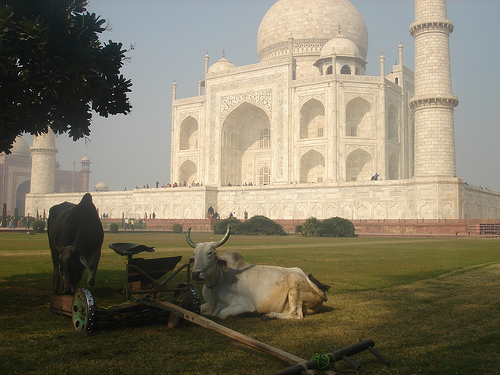
These beautiful bullocks (in America we call them "Brahma bulls") pull the old-fashioned grass cutter at the Taj Mahal, then eat the results.

I wish I had been able to get the whole Taj without including the ugly metal fence in foreground.
In a comment that would no doubt irritate proud "progressive" Indians, my Canadian friend said, upon seeing this scene: "now THAT, to me, is India."

Meaning: men and cows doing a job that most of the rest of the world does by machine, slowly, in a green, clean, sustainable fashion, in front of an ancient monument of genius. In America, we now consider this progress.

It's so alarming to hear agricultural specialists and progress wonks in the press crow about how many tractors there are now in the Punjab and how someday soon, "EVERY farm in India will have a tractor" (instead of bullocks).
No to Nano
I mean, India has always made such a big deal about doing everything on their own terms and in their own way...why are they racing to match the standards of the developed world in all the least desirable categories?

Is anyone even a nano-teenth as excited about, say, a new literacy plan or the reputed $100 laptop computer as they are about this damned Tata Nano budget car that has hogged the news all week long?

Suddenly there were no more problems in Pakistan (except the cross-town catfight between cousins Bilawal and Fatima) - only this rather ugly car.

Cheap cars are cheap for a reason, no one seems to have figured that out here yet. Just ask owners of the Ford Pinto. Any money you save on the front end you will end up spending on repairs, guaranteed. But don't listen to me...Americans know nothing about cars. ;-) or pollution. Or traffic, or gridlock, or about going into debt for life just to pay for your car habit.

A car - when you live in a place with ample public transportation - is an extravagant hole you will throw money into for the next 5 years. (A cheap car won't last longer than that.) At the end of that 5 years, you will have nothing for your investment. People have been driving (literally) round and round in this trap in America for decades and again, it is alarming to see other countries fall down the same rabbithole.
Thinking Americans (yes, admittedly we are a minority, ha ha) are going in the opposite direction. Everyone wants to move to a city or country with public transport so they can escape the car trap, with all its maintenance and monthly payments. It's a very costly illusion of freedom.
Anyway, rant over (for now). It just seems that if any country had the potential to figure out a truly progressive sustainable solution to such a problem (transportation) - a solution that suits their unique population and logistical needs - it would be India. Just copying the mistakes of the west in a cheaper form is nothing to applaud.

Monday, January 14, 2008

Pongal O Pongal!

Still in Delhi
PaharGanj/Ram Nagar

It's PONGAL, and I am not in Tamil Nadu! Not even close, not even in South India! However, I can still eat sweet pongal (and ghee pongal) at the Saravana Bhavan here on Connaught Place. (sigh)

'Thai Pongal', as it is popularly called in Tamil Nadu, is a thanksgiving ceremony celebrated by Tamil farmers to thank the spirits of nature, the sun and farm animals for their assistance in providing a successful harvest all through the year.

The festival is spread over four days, from the last day of 'Margazhi' to the third day of following month 'Thai' as 'Bhogi', 'Thai Pongal', 'Mattu Pongal' and 'Kannum Pongal'.

"We may have settled here, but we haven't forgotten our traditions. Almost all Tamils in Delhi celebrate Pongal the same way it is celebrated in Tamil Nadu," Natesan, secretary of Tamil Youth Cultural Association, told.


It's also Makar Sankranti, which has something to do with the movement of the sun throu
gh the Vedic zodiac, and the approach of spring. I believe the sun is entering the sign of Capricorn (in the Indian zodiac, which calculates differently from the Western one).

The best Makar Sankranti ever was at the Kalachakra 2 years ago. The whole town of Amaravati, Andhra Pradesh was alive with Tibetan and Buddhist festivity anyway, and then added to
that was the Makar Sankranti observance (dressed-up cows and bullocks, street musicians, and special, extra- elaborate kollam designs in front of doorways). Here's the best picture I got that day...it's one of my best "India" photos ever, IMHO.

Pongal is not just one day, but several, including my favourite, Mattu Pongal or the day to honour
cows and bullocks. In the Madurai area of Tamil Nadu, this has traditionally included a kind of bullfight or bull-run called Jallikettu. This year the whole area is up in arms (declaring a "black Pongal") because the Supreme Court has banned the practice, declaring it inhumane and cruel.

I have a suggestion - they should do what Nepalis do at Gai Jatra, and instead of using real cows, dress up humans as cows. Then they could see how much fun it is to be chased, poked , stabbed and have their tails pulled. It's quite amusing to see all the Madurai Hindus defend their "400 year old tradition" - what about the much older Hindu tradition (about 4000 years old) of honouring the cows?

Sunday, January 13, 2008

In stitches

I took my sisters' package to have it stitched for shipping. My friend Robert in California is fascinated by this uniquely Indian requirement and made me promise to blog about it.

All parcels to be sent through the mail are required to be sewn up in plain white cloth. Supposedly, this prevents theft. No one explains HOW it prevents theft...I suppose it makes it more difficult to open, but you could always just steal the whole thing.

First, I had to get an appropriate box. In this case, I had to go to a gents' tailor shop and buy a shirt-box for 15 Rs. (they wanted 20.)

Then, I folded the shawls into their separate plastic bags and sealed them with packing tape. THEN I put them into yet another plastic shopping bag and sealed it up too. You never know what kind of inclement conditions a package will be exposed to internationally.

Then I sealed up the shirt box on all sides, with brown shipping tape.

The tailor said a place called Rainbow Shipping and Parcels could stitch it, just up the corner. Most touristed places will have lots of shops for this, but any ordinary tailor should be able to do it, and probably for less money.

The Nepali boys working there wrap the box in off-white coloured cheese cloth, just like wrapping a present. But instead of taping it shut, they bunch up the excess cloth and sew it closed with white thick thread.

The stitching cost 50Rs. (they asked for 75.)

Then, I took a black Magic Marker and write the "TO" address in big block letters on the front, and my FROM address on the back.

The Nepalis (who were all neighbors from Nawaparsi, near Lumbini in the Terai region of southern Nepal) recommended I go to Bangla Sahib Gurudwara GPO.

I asked the (typically sweet, shy, polite) Nepali boys how they liked living in India. "Conditions are better," one said, "money is better, we are getting some 5000 Rs Indian a month. " That is about $120. In Nepal, they said, it would be much less for the same job. "But people are not so good here...more cheating...more lying...." he said, shaking his head and frowning.

I knew that Nepalis will not eat anything (I mean, almost anything) other than momos and Dal Bhatt (a rice and vegetable thali prepared in Nepali style - heavy on the spiced potatos). "Where do you get your dal bhatt here in Paharganj?"

They directed me to the Everest Bakery and Cafe. "This is such good dal bhatt. All people working there are Nepali, and music is always Nepali!" they enthused.

It's also possible to have the Rainbow Shipping guys ship your parcel for you, but I just couldn't resist standing in another line.

Next stop: the GPO.

Saturday, January 12, 2008

The envelope, please

Land of legal limbo
Delhi

So here's the upshot (not the end!) of yesterday's Foreigners' Office story. (I am so sure you are fascinated....)

I returned (along with many others) to the Home Affairs Ministry at 4.30 pm to await my fate. While waiting I met some Ugandans, Pakistanis, and a Mexican Hare Krishna devotee wearing full dhoti and kasturi tilak. The Mexican man was married to an Indian citizen, but this didn't help his status much within the country.

An Indian-origin woman living in Miami, was having trouble getting an extension because she had now been a US citizen and passport holder for 37 years. The office claimed there was no proof of her Indian origin, which technically, I suppose, was true. Her US passport said "place of birth: INDIA," but "even that is not enough, they say."


All these people, including myself, were petitioning for permission to stay a bit longer on this visa. But one Norwegian couple were desperate just to get out, and couldn't even get the exit permission.

How had this happened? Why was it so difficult to get OUT of the country?

The Norwegian woman, who was in tears, explained the story to me. They had first been in Varanasi, where all their bags, passports and everything, had been stolen. The Norwegian Embassy had issued an emergency passport/travel document - but of course, this did not contain any evidence of their original proper Indian visas. Under such circumstances, you must get permission from Home Affairs before exiting the country.

As if it wasn't enough to be robbed blind, the man had then dislocated his shoulder in a surfing mishap down in Kerala. (I didn't know people surfed in Kerala; learn something new every day.) They were told they could not fly home directly from Kerala, but had to report to Delhi for exit permission.

I could see the lymph fluid (or something) oozing from his shoulder and seeping through his cotton shirt. He must have been in a great deal of pain. They wanted to leave the country for Norway right away.

As it was a Friday, the office claimed they would have to wait the entire weekend till Monday when the case could be reviewed properly. (I think I mentioned before that the office only accepts incoming applications from 9am to 12pm. The couple had made that deadline, but for some reason weren't going to be given a result the same day.)

Finally they were given the fateful sealed plain brown envelope, to be opened only by the FRRO in RK Puram, another part of town. They set off full of hope (and probably full of painkillers) at 4.45 pm in an Ambassador taxi.

The rest of us received our plain brown wrappers with instructions NOT to open them, and to report to RK Puram office on Monday morning. Which for many of us, means an entire weekend without valid papers. Fortunately, I've learned to live with a great degree of ambiguity.

Friday, January 11, 2008

Museum musing

Today, I had to go back to the FRRO on ManSingh Road. You turn in your papers (for request of visa extension) between 10 and 12 "only," wait till they accept them which usually takes till 2.30 or so, and return at 4.30pm.

I had two hours, so I went round the corner back to Gandhi Smriti. Today the power was on, and I enjoyed the exhaustive and state-of-the-art interactive museum upstairs on the first floor. There are all manner of multimedia displays and lots of great vintage film footage.

Still, the most effective parts of the museum are the most personal and the simplest. This time inside Gandhi's room, I noticed something in the corner I didn't see yesterday. Two pairs of the wooden sandals, and a walking stick. These weren't in a glass case, but just leaned up against a corner, as though Gandhi were coming right back for them. I just started crying.

Fortunately, there was a modern metal chair right there (maybe other people have been overcome seeing the room) and I sank down into it. The shy young museum guide in her khadi uniform was watching me from the corner, halfway pretending not to notice, and halfway curious. Finally she approached me.

"Which country?"

"I am from USA," I said, choking back tears.

"You are very inspired by Gandhiji?"

I nodded mutely, sniffing.

She smiled as knowingly as a 20 year old possibly could. "I think you are a friend of Gandhiji," she said, as though I were someone who had actually known him.

A friend of Gandhiji. I had to smile. "Yes, a friend." I was trying hard not to cry openly as I knew I had to look decent to go back to the Foreigner's Office and I didn't want to have a red nose and runny kajal down my face.

Ruby turned out to be a history major who was volunteering in her spare time. I was extremely heartened to hear that people are still majoring in history. All I have met since I arrived in India are engineering and B Comm students.

Anyway, the wireless place is closing now and I have to sign off.

Thursday, January 10, 2008

In the footsteps

Gandhi's Ghosts
Delhi

Thanks to my incredible lack of foresight, I have only a minute on the laptop battery this time, but that's enough to tell about a very overlooked, and centrally located, Delhi historical site.

Most guidebooks mention Raj Ghat, the location where Mahatma Gandhi was cremated. (This site was in the news in 2006 when George W. Bush paid a visit. Some people complained about the hypocrisy. I think, if anyone ever needed to get Gandhi's vibes, it would be Dubya.)

But very few guidebooks (none that I have yet seen) seem to mention Gandhi Smriti. This is the house and gardens where Gandhi was assassinated by a Hindu nationalist hardliner, and died on 30 January, 1947. The road is now called Tees January Marg (30th January Road). The building was formerly known as Birla House. For various reasons (explained in the exhibit) Gandhi stayed, for the final 144 days of his life, as a guest of the wealthy Birla industrialists, rather than among the poorer neighborhoods as was his habit.

Admission is free, which seems appropriate, but I certainly wouldn't mind paying a bit to support it.

It's more than worthy of your time. At the moment, Gandhi Smriti hosts an exhaustive photo exhibit of events leading up to the 1857 War of Independence (formerly called the Sepoy Mutiny). It all looked very informative but I just could not digest all the historical information in one standing - I was too overcome with Gandhi's vibe.

I'm neither one of those foreign Gandhi-worshippers who think he was a saint, nor one of the cynics who takes joy in poking holes in him. To me he was a man, and that makes what he achieved and represented all the more amazing.

I am also aware that some historians, and Indians, and Indian historians, say he and his contributions aren't all they were cracked up to be. I'm sure they have a point, and someday I will get around to reading the rebuttals. But today I just bathed in Gandhi's energy, which is still all over the room and garden.

Especially moving is a glass wall case holding his very few worldly possessions, including the famous pair of round eyeglasses. I got a weird flash-forward (or is it backward?) to John Lennon and his schoolboy specs.

In keeping with Hindu tradition (but rather eerie for those not accustomed to this) are the footsteps set in stone, in the shape of traditional wooden sandals. I think they are called paduka. They immortalize Gandhi's last walk from the ground-floor room, where he lived on a jute mat and mattress on the floor, to the garden for the final prayer meeting.

A flowering tree with vivid pink blooms grows right above the doorway, showering petals down on the path. I picked up a handful and placed one on each paduka. I was surprised that more offerings weren't there. The exact spot where Gandhi fell (uttering "hey Ram") is marked with a marble column.

The final panel in the Independence exhibit was headed, "Let it not be said that Gandhi was party to India's vivisection." He is then quoted as saying something along the lines of "I pray that God not let me see the division of India" (Partition of India and Pakistan). Since I am neither Indian, Pakistani, Bangladeshi, Muslim nor Hindu, I can't explain logically the very deep resistance and resentment I have always felt about the Partition. But at least I know I am not alone in my strong feelings.

A power cut stopped short my viewing of the indoor exhibits, which seemed strangely appropriate. And so, too, is my laptop battery cutting short this post.

Sunday, January 06, 2008

"Better than Disneyland"


Breaking in the newbies, aka, Day Tripper
Old Delhi

Really, really wiped out after a full day of sight-seeing (yes, sight-seeing - I've never done this in Delhi) with 2 brand newcomers, Jeff (Canada) and Susanna (Holland), both of whom just arrived at about 4am this morning. It was great fun to see India through the eyes of total newbies, and for my hard-earned local knowledge to be appreciated, but I am exhausted.


I set out a blueprint for "your first day in Delhi" at about 11am, and we followed it almost to the letter. I am glad to say it worked out very well, especially considering it was all stuff I've never done before.

Goes something like this:

1-Ignore the hotel's insistance that you take a taxi tour of the city (all day for "only" 750 Rs, or nearly $20 US). The rickshaws - auto and cycle - are a great intro to India and are part of the fun. And, we saved about $16 by taking them!

2- Autorickshaw to the Red Fort . --From Paharganj, 40Rs. According to Jeff, just the auto ride was "better than anything at Disneyland!" It was fun seeing the chaos, cows and oxcarts through the eyes of newcomers.

It was their first-ever auto ride - they had arrived from the airport in proper taxis.

3-Red Fort - for foreigners, 100Rs or $2.50. A good start, but frankly Humayan's Tomb is better in many ways. The Red Fort, though, is very centrally located and walking distance from 2 more attractions (below).
The secret no one tells you about the Red Fort is that the best part is outside. That gate, and those walls, extending forever it seems. Seeing it from the steps of the Jamma Masjid is awe inspiring. It's really all downhill from there!

4-Walk directly across the street (an adventure for Jeff and Susanna) dodging traffic to the Jain Temple and Bird Hospital. (Voluntary donation; I gave 10rs).

Note: if you are going into the Bird Hospital, do not leave your shoes at the temple gate like they ask you to. The birdhouse floors, as you can imagine, are filthy and wet.

The Bird Hospital housed many many pigeons, quite a few parakeets and the classic green wild parrot, and three forlorn peacocks/peahens. One, the steward told me, had been hit by a golf ball at the Delhi Golf Course. The other 2 had fractured legs from various mishaps.I especially liked the naive-folk wall murals depicting all the heinous fates that can befall a bird. Dog attacks, cat attacks, ceiling and desk fans, hunters, kite entanglement, and so on. I never would have thought of kite entanglement.

There's also a big mural on the office wall showing the Jain legend of a king who sacrificed his life to save a pigeon and a crow. The moment he died, the 2 birds automatically reverted to their true states - they were deities in disguise. The two deities (Indra, god of the heavens, and Varuna, the water god) blessed him and said they had come as birds to test him.

5-Walk most of the way to the Jamma Masjid, the biggest mosque in all India.

6-Finally give up a few 1000 feet from the Masjid entrance and get a cycle rickshaw directly to the gate. Otherwise, it is a long, long slog through a few acres of cheap sweaters and an open-air goat market. --30Rs for three people.

7-Have fun watching the bewilderment and awe on your friends' faces as we approach the enormous, overwhelming front steps of the mosque. It's actually more fortress-like than the Red Fort. "THIS," said Susanna, "is what you imagine India to be." Meaning, I think, ancient buildings, calls to prayer and loads and loads of people swarming every which way.

8-Entrance to the Masjid is free; but depending on the time of day, you must wait for the appropriate time. We had to wait some 30 minutes because prayers were going on. We managed to photograph some shy young ladies seated on the steps, but the elder Muslim ladies with their orange henna hair generally said "no."

Jeff and Susanna were mesmerized by the swarms of activity and people-watching. However, the mosque demands a 200Rs ($5) fee for each camera taken into the mosque. We thought this excessive and eventually decided to pay for only one camera, and share the results.

9-At this point it was 4.30 pm, so we wandered around the vast expanse of red sandstone enjoying that twilight haze. (I think it accompanies a mental haze, but that is still theory.)

10-Beat a retreat out the side entrance - to avoid the madness out front - and go via cycle rickshaw through Chandni Chowk's famous silver jewelry market and flower market, to Haldiram's for dinner. (The ride was an overpriced 50Rs, but we were very very tired at this point, and the driver was a good guide, pointing out stuff to us.)

The back alley markets below Chandni Chowk are fascinating in themselves, and had we not been so tired, we definitely would have gotten down from our chariot and walked around. Maybe some other day.

11-Watch as your friends' eyes widen at the crowds in Haldiram's. Order for them as they have no idea what most of the food is (in fact they requested that I order for them). Send one of them over to fight for a table and hold down the fort till the food comes.

This is the one thing that was not perfect in the day. Haldiram's was tooooo crowded, and I can get a better veg thali elsewhere for half the price (mine was 102Rs). Madan in Paharganj would have been much cheaper, closer to the hotel, and less frantic.

11-Autorickshaw back to Paharganj - perhaps overpriced at 60rs, considering we only paid 40rs to get there in the daytime, but it was nearly 7.30 everyone was asking outrageous prices. The traffic was pretty crazy at this point so the guy had to take a circuitous route.

As am I at this point, so I am signing off for now.

Friday, January 04, 2008

Tomb of the unknown Mughal


I go to the FRRO
Chanakyapuri & Nizamuddin, Delhi

After spending the better part of a day running from one office (used to be the Foreigners' Regional Registration office, but that shifted some three years ago...not reflected on maps of course) to another (yes, this is the FRRO but you need to go to yet another Foreigners' office, in another part of town) to yet a third (yes, this is the right office but despite the fact that we're all present and it's only 3pm, you will have to come back Monday between 10 and 12 only) - after such a day, what I wanted was a little escapism.

(Just in case you have to pay them a visit, the FRRO is currently out near the Hyatt Hotel in an area called Bhikaji Cama Place, Ramakrishna Puram. None of the guidebooks show this yet. They all show it as still in Hans Bhavan near Pragati Maidan. )

(
Long ago, back in the heady days of the early 80s, I owned an ancient James Brown 45rpm record called "Escapism (Parts 1 & 2)." For those of you who have never seen a 45rpm, Part 1 was on side 1 and part 2 was on what we used to call the B-side. James pronounced it eee-SKAY-pizm. It's probably worth a lot of money now, wherever it is. Other than a chance to mention James Brown, there is no point to this anecdote, so I will stop now.)

As I have mentioned before, Delhi has a lot in common with Washington, DC. Both cities are national capitols, obviously, but it goes beyond that. They share very well-planned streets, meticulous greenways, many museums, lots of white marble, and lots and LOTS of memorials.

Luckily, the third office (called Jaisalmer House, for the curious) was walking distance from the giant Arc-de-Triomphe-like
India Gate, which I had never seen properly, so I took a stroll. India Gate and surrounding well-groomed grounds were full of tourists, hawkers (selling everything from cotton candy to plastic beads to slices of star-fruit to my favourite orange popsicles), armed guards and police, and the crew of men erecting scaffolding and awnings for upcoming Republic Day (January 26).

Republic Day is an annual mega-spectacle of patriotism, pageantry and military might. I have never seen it on location - frankly you probably get a better view with less hassle on the national TV coverage. I love the way each state chooses a theme for their parade float. Bihar, surprisingly enough, usually chooses "the Buddha" rather than kidnapping or corruption, and Gujarat has chosen to stay away - so far- from the popular "communal violence" theme. I think this year the float will just be a giant mockup of Narendra Modi's big fat face with dozens of people wearing the Modi Mask riding aboard.

The India Gate is essentially a war memorial, engraved all over with names of Indian who gave their lives in various wars. I wondered if there were always so many armed guards - you can't even walk under the arch or touch the pillars (which are at a considerable distance from the arch itself). Are all national symbols being guarded so fiercely in today's terrorist environment? Or, was it just in the run-up to Republic Day?


For those of you who haven't been to India yet (like
my 2 sisters -though they say they are coming this year), watching the tent-masters erect these pavilions and awnings is a uniquely Indian experience. Very few buildings are large enough to house Indian crowds, so we just make a temporary "building" outdoors.

If you have seen the movie Monsoon Wedding, you have some idea of the process. Out of nowhere, a green field or dusty lot will be transformed with cloth walls and roofing (and sometimes even jute carpet flooring) for 1000s of people. Using bamboo poles, hand-made bamboo ladders, kilometres of jute rope and acres of cloth sheeting, the tent-wallahs were constructing awnings, railings and so on to protect 10s of thousands on Republic Day. A street dog had found a comfy bed, crashed out atop a coil of rope four feet high.

On the peacock lawn
Dusk was approaching and I realized I was a Delhi stone's throw from Humayan's Tomb, a World Heritage site that has been on my to-see list forever. So I splurged on yet another autorickshaw (40Rs from India Gate) to Nizamuddin.
Admission is supposed to be $5 for foreigners, but as they have set the rate at 250Rs it is now $6.00.

It's worth it. Humayan's Tomb was the first of its kind (Mughal four-quartered gardens with tombs) and evidently the prototype for the Taj Mahal. It's not just one tomb, it is an enormous enclave of geometric gardens, waterways, fountains and several giant tombs, built in the 1570s - any one of which would be worth seeing on its own. The purple haze of twilight gives the buildings a romantic, lost-civilization feel.

Since it was nearing closing time, I hurried through the first two mausoleums, which already felt like something from an orientalist Arabian Nights scenario - octagonal buildings of marble, onion domes, marble latticework windows surrounded by date palm trees. In fact I would recommend going in the morning - the complex opens at dawn - in hopes of seeing sunlight filter through the intricate patterns of lacey marble.

Then I caught a glimpse of the main attraction through the mammoth arched gateway. I couldn't help breathing "Ohhhh!"

The actual tomb of Humayan is a dream, glowing in red sandstone. It is elegant and ornate without ever being garish or baroque. Every one of its many marble-jali windows seemed to have a different geometric pattern, echoed in the marble inlays on the floor.

A gaggle of western art students emerged from the front archway, clutching their sketch books, now filled with the geometric designs. As the sun sank, a call to prayer went up from the neighboring DhamDhama Sikh Gurudwara, with its own dome visible just over the ancient fence. Okay, wrong religion historically, but to hear such devotional music in that setting at sunset really makes my spirit soar. Bright green parrots shrieked as they streaked around the sky.

I stuck around till well after closing time (it's so huge, how are they going to throw everyone out?). The cat-like cries of peacocks sounded across the lawn. Peacocks in a Mughal garden at sunset, it was just perfect. I crept around the edge of the wall toward the cries and watched them nesting for the night. I didn't even know they could really fly, but there they were in the treetops. I could see the S- curve of their necks against the sky.

On Global Voices
Yesterday's post about dynastic democracies made it to Global Voices. If I had known people were actually reading it, I would have put more work into it....

Wednesday, January 02, 2008

Delhi Days

A bunch of nice places I haven't managed to go yet on this visit
Delhi


When you are losing your sanity because of bureaucratic runarounds in Delhi (no names please), and suffering from post-Ladakhitis and the stench of the dead Yamuna, here are a few places to go where you can breathe relatively easily.

Lodi Gardens
in South Delhi. This is a lovely, clean, green space filled with trees, grass, dog walkers and Mughal mausoleums. Really classy. And it's in between two major historic sites, Safdarjung's Tomb and Humayan's Tomb. Admission is free to the Gardens.

The Hauz Khas Deer Park is another verdant, safe, shady relatively clean park, not as well known as others....I think there are even a few deer still there. There is a small admission fee (like 10Rs).

Hauz Khas is a semi-trendy neighborhood in South Delhi. (I like South Delhi, I just cannot afford to stay there.)
After your walk, you can complete the feeling of being in western Suburbia by visiting the local Pizza Hut. (!)

The Metro does not run directly to these locations; your best bet for Hauz Khas is to get in an autorickshaw. Humayan's Tomb is in an area called Nizamuddin, reachable by the #459 bus from Connaught Place.

Jantar Mantar is very centrally located, just walking distance from Connaught Place. Its array of salmon-coloured abstract formations, which look like modern sculpture, are actually a 300-year-old Mughal outdoor observatory. All kinds of sundials and stepped pyramidal formations dot the park like giant building blocks. I think there are still astronomers around who can read these instruments. At one time there were five Jantar Mantar ("Yantra Mantras") - in cluding Delhi, Jaipur, Udaipur, Varanasi. The largest is still in Jaipur.

Jantar Mantar has also become the place of choice for "staging a dharna" (holding a demonstration or protest).

There is a $2 (or about 90rs, which is actually now more than $2) admission fee for foreigners to JM...but I suggest trying the unmanned back gate.

Seven Cities in One
Delhi is just really, really vast and was made in a very ad-hoc way ( it is actually 7 historical cities adjoining one another and overlapping) so different areas vary wildly.

Another nice thing about Delhi is that there are enough foreigners living here residentially, for various non-touring reasons, that we do not excite so much attention. It is still definitely an Indian place - but a cosmopolitan one.

Delhi has gotten a reputation for crime, especially against women, so I am now careful to get home by about 9 or 10pm. The Metro, one of Delhi's star attractions for this budget traveler, stops running at 11pm.

Tuesday, January 01, 2008

Day One

Aap ka naya varsha mangalmayi ho
Delhi

Well, as karma would have it, I had breakfast with the Upper Middle Pathers this morning. Of course, they are lovely people. Sweet, considerate, and innocent. Two of them are studying pranayam and meditation at a Tibetan centre in NY City. A couple of older ones are variations of new age healers who are completely sincere.

Now I am a bit worried about them. They are all going home in about 5 weeks so they might make it out unscathed. They might even make it home (still) thinking that India is "awesome," as one of the younger ones said to me yesterday.

I think India Tourism got the right expression. Maybe not "awesome, " but "Incredible India" - as in, unbelievable. Works on many levels.

Wrap around
I finally managed to buy a couple of pashmina/wool shawls - for my sisters back home, not for me. I will probably spend most of the day tomorrow getting them "stitched" for shipping, and standing in line at the post office.

Sunday, December 30, 2007

Out come the freaks

The Demographics of Devotion
Majnu Ka Tilla, Delhi


I've often commented on HH the Dalai Lama's ability to bring together
a diverse range of people. The foreground and wake of any DL event is always evidence of Life's Rich Pageant.

And, here they are now, all around me. In the countdown days to the Mundgod event they are all coming in to roost.

A guy at the opposite breakfast table this morning looked like he was auditioning for the part of Merlin or Gandalf, with a long white scraggly beard and some kind of robe. There are always a few who look like extras from a Biblical period m
ovie (beard and sandals).

I used to be far more tolerant of this sort of thing. At one point, it was w
hat we foreigners in India were known for (dropping out and dressing like slobs).

Now I have personally experienced the damage this has done to our image abroad and am a bit impatient with it. Okay, we come to India to "do our own thing," but can we please c
omb our hair (this really seems to rankle Indians, westerners with messy hair) and just not dress in costume? -- Costumes that are some weird kind of pretentious parody of things we thought we would find in India? Foreign tourists and visitors in India are still living down the image that we all come here to have orgies and smoke charas. "Real" Indian guest houses (as opposed to ones geared towards foreigners) are often wary of foreign guests and we often get the slithery eyeball ("decadent westerners in our establishment! The decadent Indians are bad enough but at least they don't draw attention!").

What's Your Movie?
You can see the kind of "trip" each one is on from their trappings. One's
on an orange-clad spiritual Krishna kind of trip, another with his mysterious black thinks he's some kind of tantric master on the road to discovering Tibetan secrets.

Then there are the followers of the Upper Middle Path. They are well-groomed midwesterners or trendy Coasters and tend to travel in large groups with name badges, usually attached to some American or European dharma centre who has organized the trip. Excuse me, pilgrimage. They are on *pilgrimage.* I watched the blow-dried group this morning, led by their red-robed monk shepherd. They insisted he say grace in Tibetan before they ate their pancakes. God knows how many thousands of dollars they are paying for this packaged chaperoned India.

I suppose I shouldn't be mocking Americans who have an impulse to explore other cultures and travel abroad - after all I am one myself, and when you consider the great mall-going masses, really these folks
are quite refreshing. This group (UMP) tend to be extremely open, almost wide-eyed about the whole thing. But, just that whole thing of ... trying to turn EVERYTHING, even pancakes, into some significant religious experience to tell stories about back home.

Then there are the career
Buddhists in the know. They travel independently and always know the date HH is arriving, the date of the long-life puja and never fail to have some kind of inside information about some top-secret ribbon cutting event that ONLY Rinpoche so and so knows about, and he told them...but don't tell anyone....

There are also Buddhist clergy of all nationalities and robe-colours, it's almost like a monastic fashion show. Maroon, mustard, and grey are the most common, but you will also find orange, black and white for various Buddhist denominations. Australian and Taiwanese nuns, Ladakhi and American monks. Tibetans speaking English, Americans speaking Tibetan, Tibetans speaking Hindi to shopkeepers...


...and of course the French, who are visibly struggling, finally having to admit that French is NOT the most important language in the world. I enjoy seeing them limp along, struggling to be misunderstood by the locals who speak much better English.
Another way to spot the French is by the cigarette smoke - indoors. That, and the fact that they take forever to order in restaurants. Every little thing must be absolutely perfect and they ALWAYS have some special exception they want made ... and they NEVER are able to explain it in good English. Try not to get stuck with a French party in a restaurant, this will delay your order by a good 20 minutes to half hour.

Don't forget the inevitable and numerous beggars (all Indian, many able-bodied and young) who flock anywhere there is a hint of "religion" and foreign money. Please don't give them anything at all, no
t even food or attention.

Go (away), big orange
There is also a cadre of Indian beggar monks (aka the Stinky Orange monks) in bright orange robes. They are trading on the fact that everyone thinks they're Theravadins from Sri Lanka. But Theravadins are immaculately clean. You can smell these guys coming literally a dozen feet away. I am really not sure what denomination, if any, they fall under; some kind of generic Mahayana I suppose.

Traditionally, monks were supposed to beg for a living --but that took the form of sitting out in the road or going from home to home with a begging bowl and accepting whatever was pu
t into it, regardless. These guys accost foreigners and beg for cash. If you give them too little (10Rs) they complain and ask for more. I think they are actually a pimped begging gang sent out by their master, an unscrupulous "abbot" from Bodh Gaya. They turn over some of the money to their master and pocket what they can.

Thank all the gods for the Tibetan old-timers. They ground the whole event with a peaceful, smiling, uncomplaining presence. Their constantly whirring prayer-wheels
create a sort of vortex around them and even on the bus or in the market, many are continually chanting mantras. They and some of the Career Buddhists are the only people wearing Tibetan clothing. The young Tibetans, with short greased up hair and tight jeans, are all dressed like Hindi cinema stars.

Gimme a break
Whew! I need to go for a walk. Maybe down by the river...nope, stinks too bad, way too dirty. I mean the ground itself even, not just the water. All the parks will be jam packed as it's the Sunday following Christmas. There's always Lodi Gardens or Hauz Khas Deer Park.