Showing posts with label newari. Show all posts

Thursday, July 09, 2009

We can be superheroes

Just for one day
Kathmandu


The Lalit Kala campus reeks of urine.

That's my overwhelming impression of what should be Nepal's equivalent of the "Kids From Fame" high school. Lalit Kala ("Fine Arts") is a secondary school where classical music, singing, and fine (visual) arts are taught. The building is historic; several generations of Nepali royal court musicians used to house and practice there. But it's terribly dilapidated; the semi-modern toilet installed smack in the middle of the ground floor is only the beginning.

According to Raju who graduated from there 15 years before, absolutely not one thing has changed. Looking round the fine arts and sculpting studios was nothing short of depressing. Dimly lit, dusty, musty rooms; even the grimy brown anatomy skeleton was missing parts.

In case you haven't figured this out yet, money is not a problem in Nepal. There is plenty of money. It all goes into deep pockets! I had to wonder how a student could concentrate on anything, let alone fine arts, with such a reek coming into the old classrooms.

Raju and I performed briefly there on 15 May; we opened the end-of-term classical music show with the "Sodasa Lasya" (Sixteen Graces) item.

In order to dance the approximately 6-minute hymn, we still had to garb up in full Tantric dance gear; all this in one of the empty classrooms with no mirror. But I'm not complaining, it was my first Charya performance of any kind. Raju was dressed in the yellow gown of Manjushree; I wore the red attire of Vajrayogini.

I'm accustomed to 3-hour dressing sessions from Bharatanatyam, and Charya is quite a bit simpler in alankaram (decoration), but still involved:


-under trousers, -choli blouse, -full skirt, -mekhala (deccorative belt), -another kind of overskirt waist-piece, -a big full thavani (top part) that made me feel like a Catholic cardinal, -another top piece that fit around the breastbone, -and lots and lots of jewelery, including:

-Several sets of bangles,
-rings,
-heavy silver anklets,
-bells tied round the knees,
-about five different neckpieces including the tayo or oblong traditional Newari women's piece worn by the Kumari, and
-several strands of fake pearls.

Raju drew a "third eye" on my forehead using a black kajal pencil.

My favourite part is the crown, or muthi, also called kiriti. There are several different crowns meant to be worn for various deities; this time I was wearing the skull-garland crown of VajraYogini. The grinning kapilas look to western eyes very Tibetan, but in fact it's the other way round; Tantric Buddhism with its skull imagery came from India via Nepal before reaching Tibet.

Underneath the crown is a 3-tiered topknot hairpiece; an identical wig is worn by the Tibetan monks when they perform certain lama dances depicting the Dakinis. Then the crown is tied on with black threads in three different places.

The crown looked and felt a lot like a helmet. After donning all this magical bling, I felt like a superhero - cape, implement of power, helmet of invincibility, and shields. I have often mused on the similarity between Hindu deities and the Superheroes. Vishnu particularly seems like Superman (he rests in his Fortress of Solitude when not needed; he incarnates whenever a call for help is heard on Earth, has superhuman strength and takes different forms).

After three false starts (the sound guy couldn't cue the CD right), we finally danced. It is rather un-godly to stand on stage waiting for the music to start.

Somehow I think Kathmandu needs all the cutting-through energy of Vajrayogini to eliminate the corruption that allows a noble institution like Lalit Kala to fall into such decay.

 Related reading:
Gods, Men and Territory: Society and Culture in Kathmandu Valley
 The Glory of Nepal: A Mythological Guidebook to Kathmandu Valley Based on the Nepala-Mahatmya and Himavatkhanda 

Wednesday, February 11, 2009

Naya ghar ko puja


At least, I think that is how one would say "New house puja" in Nepali.
On Saturday, Raju and I walked out to Dallu (a neighborhood beneath the famous Buddhist heritage site Swayambhunath stupa) to the home of Sarvaghya Bajracharya, the eldest brother of Raju's dance guru Prajwalratna Bajracharya. (There were six children in the family. At about 40 years, Prajwal Ji is the youngest.)

Sarvaghya is a
Bajracharya by family/caste, and a "guruju" by trade. That is, he is an itinerant Newar Buddhist priest, going round to various Vihars or Buddhist temples (formerly monasteries long ago), performing ceremonies and reading ancient sutras as called upon.


(photo above: Newar Buddhist women prepare to worship the Prajnaparamita sutra at Kwa Bahal, Patan)

It was pitch black on the streets, as has become the norm these days. A few shopfronts stayed open with people congregating round candle
s and oil lamps. As if the people dwelling right on the open sewer of the Bagmati River weren't medieval enough, the lamplights reinforced my feeling that Nepal is going back into literal Dark Ages.

Like most urban Nepali dwellings, the residence was cramped and dark. The dim battery powered light showed the walls painted in a lurid turquoise. Sarvaghya sat on his bed (as guests we were given proper chairs, always a sign of respect). That afternoon, Mr Bajracharya had just been to a conclave of 21 other Bajracharya priests, at the Bidyeshwori temple just up the hill (one of my favourites - the home of AkashYogini or the Flying Space Vajrayogini).

The Buddhist community had honored 21 selected acting priests for their services. He held up a handsomely framed certificate that was in Newari language, but rendered in Devanagiri script, which means that I could sound out the words but had little idea what they meant.

Mr Bajracharya was very quiet, but understood more of my Sanskrit- and Nepali-sprinkled English than he let on. Raju acted as translator but often the priest understood my questions without translation.

I realized this was an ideal person to help inaugurate my new flat, and asked Raju to invite him to perform a New House Puja. He agreed, then we had a discussion about which exact puja of the dozens he knew would be appropriate. Sarvaghya decided something called "Kalasha puja" was ideal. The reason? Tara Puja is great, too, he said, but it is some three hours long. The Kalasha puja is "only" one and a half hours.

"the main aim of the kalasha puja is to make the deity present in the kalasha by means of sadhana and then through the abhisheka of the kalasha bring about participation in nirvana itself." (JK Locke, 1980)

We discussed where to get the necessary ingredients (I gave a 500Nrs -- about $7 USD - advance for the supplies - most likely rice, flowers, incense, various fruits and foods and oil lamps) and added that I wanted to get the classic Newar Buddhist Panch-Buddha signboard, as seen over countless doorways in Patan, to install over the
entrance. Deluxe ones are available on wooden board; more transportable ones are on paper, pasted up like posters and renewed every so often.

I guess I will blend all my South Asian influences and also have the lemon-and-green-chili charm strung up over the doorway, as well as a garland of mango leaves in south Indian style! Oh and don't forget the Kollam. That is going to be one crowded doorway for a few days.

It also remained for me to choose my Ishtadevata (Tibetan "Yidam") or personal protector deity to invoke at the puja. I have to acquire an image (ideally a thangka or bronze statue) to be present. Vajrayogini is my personal favourite, but seemed a bit incendiary for a house-blessing. Maybe Avalokiteshwara, the 1000-armed benevolent Buddha now believed to be incarnated by HH the Dalai Lama. Then again Avalokiteshwara is, technically speaking, not a Yidam but a bodhisattva.

And the way things have been going lately, maybe we should invite at least one very strong Dipala or Protector Deity.

Then I asked Sarvaghya to choose a Muhurttam for me, or the most auspicious, appropriate day and time for the ceremony. He reached over his shoulder to the wall behind, where a long, rectangular paper brochure hung. It was a Nepali ephemeris, a sort of almanac designed for just such a purpose - to indicate the phases and "houses" of the moon, and appropriate dates for various ceremonies but every activity imaginable (planting, marriage, operations, applying for jobs and so on).

The ideal time and date was determined to be at 9AM Tuesday the 17th of February, on Ashtami (the 8th day of the waning moon).

As we left the darkness and went back out into even greater darkness, I reflected - rather cornily I admit - on the conditions of Nepal generally these days.

All Darkness, no light, and no power. Blankets of air pollution choking us off from the redeeming views of Himalayas, ground pollution (in the form of uncollected garbage), incessant noise pollution, unspeakable water pollution. The five elements of air, space, water, earth and fire all unrepentantly violated. (All right, I am not sure exactly how Fire is being violated; give me a minute, I will come up with something. Burning plastic garbage is pretty bad.)

On the way back to town we stopped at the Bidhyeshwori temple to pay a visit to the Space Yogini, flying through the ether with legs like wings. (my picture at right)

Saturday, January 24, 2009

Charya for ya

Embedded
Writing from Kathmandu
Okay, here (embedded below) is the dance I just finished learning - the Manjushri Gita. Now I am polishing it and starting on the sloka for Vajrayogini.

My friend Rene said, "then you can have a recital!" No, little kids have recitals. Grownups have performances.
The video below shows the Majushri gita performed by members of Dance Mandal at a German Sacred Arts festival.

My first question was about the dancer's 'ardhamundi' or knee-bending posture. They don't seem to have much ardhamundi; but then coming from Bharatanatyam I am used to extreme knee bend and foot turnout.

Also, my teacher and I plan to alter the costume so that one can see more footwork and angika abhinaya (body expression). These jama costumes are nice, but a bit too Tibetan (ie, robelike and concealing). The priests in temple wear such voluminous gowns (albeit in white colour only), but the traditional sculptures and thangkas do not. Something more along the lines of the Odissi costume (right) is more flattering and more in keeping with the Newari artwork.

Monday, January 05, 2009

Graceland

Sixteen graces
Kathmandu

The available texts and source materials for Charya Nrtya are few. One given by my teacher, Raju Sakya of Nepal Dance Mandala, has Sanskrit text in Devanagiri script, as well as English translation; but strangely, no transliteration so that one can read the Sanskrit in English script. I say strangely, because the book's explanatory text is in English, and one must recite the Sanskrit lyrics in order to learn the dance.

Since I can read the Devanagiri, I decided to transliterate the lyrics. I haven't seen them written down anywhere else. Raju was quite delighted with my work and said "you must type up everything you have transliterated." I wonder if this is available elsewhere. With the state of traditional art forms in Nepal, perhaps not. Surely, the American students of the Portland (Oregon) Dance Mandal must have translated it in such a way, but it's not available elsewhere.

Anyway, the opening item everyone learns (after the Refuge Prayer, which Raju always calls the "Refugee Prayer" ) is the Sixteen Graces. Each item represents a principle as well as a manifest physical offering made to the gods during puja.

Om vajra vine hum....Lady of the Diamond Veena. (a veena is a sort of south Indian lute, related to the better- known north Indian sitar)

Om vajra banshe tra....Lady of the Diamond Flute. (a bansuri is the bamboo flute as played, for instance, by Lord Krishna)

Om vajra mridange hrin...Lady of the Diamond Drum. (Mridangam is the two-headed south Indian drum)

Om vajra muraje ah....(Muraje is a simple one-headed drum, like a snare)

Om vajra lasye hum...(Lasya literally means 'grace' but in this case indicates the Tin Chu, or simple cymbals used to keep time in the dance. In Bharatanatyam we called them Nattuvangam)

Om vajra male tra....(The mala is a garland of flowers. The same word, mala, is also used for a necklace of prayer beads)

Om vajra gite hrin....(Gite is song; in this case, the offering of sacred liturgical song or Charya Gita)

Om vajra nrtye ah....(nrtye is Dance itself.)

Om vajra pushpe hum....(pushpe is offering Flowers. The first Bharatanatyam item I ever learned was Pushpanjali, or flower offering)

Om vajra dhupe tra...(offering incense, or Dhoop)

Om vajravalokite hrin...(offering light; in India it is called Arati or removing darkness)

Om vajragandha ah....(offering perfume)

Om vajra darpane hum....(offering the mirror. This tradition has always intrigued me; mirrors are such a part of south Asian ritual but there are various explanations). First the mirror is shown to the audience, then the dancer looks into it herself with the Bhava of "Adbhutam" or Wonderment.


Om rasa vajra tra....(literally the "diamond taste." This is the classic Vajrayogini pose in which the dancer lifts the "skull cup," symbolically filled with blood, to her mouth)

Om sparse vajre hrin (the Diamond Touch. in this case, touching the Earth as in Bhumisparsa mudra)

Om dharmadhatu garbha ah. (the Diamond Womb-of-Mental-Events; this is shown by
"drawing" a circle with hands and feet. I do know that the Dharmadhatu Mandala is the basic mandala drawn ritually before any Newar house or building is established).

Translating and transliterating is always fun...but now it's time to go physically practice (spirit is willing, flesh can be weak).

Wednesday, December 10, 2008

Dance Archaeology

More ancient obscure art forms pursued
Kathmandu

Finally, after very patient and gentle persistence from the tireless Raju Sakya, I have resumed my Saturday morning lessons in the Newar Buddhist Charya Nritya. (I would say Nritya Dance, but that's redundant. Nritya means "dance.")

I've mentioned it a few times before, and like a lot of my external life so far it's been stop and start. But all those years of Bharatanatyam has given me a solid foundation for Charya - it's amazing how much of the classical dance stuff remains hard-wired after years of slackerdom.

Raju is a senior student of Prajwalratna Bajracharya, who now lives in Portland, Oregon USA and runs Nepal Dance Mandala. To my knowledge, he's the only Nepali teaching Charya abroad. There are a handful of non-Nepalis that teach Charya in their own countries, like
Lianne Takeuchi Hunt, Helen Appell, and Shahrazad.

Not that Charya is by any means a simple dance, but compared to the aerobic demands of Bharatanatyam, so far it's lower-impact. It's certainly more lasya (graceful and lyrical) than tandava (percussive and forceful).

With its Tribhangi (three-bends) posture, Charya most closely resembles Odissi dance, which, if I had had my druthers, is probably what I would have learned long ago. But Odissi teachers are hard to find in the American heartland, outside of perhaps California.


Space: the final frontier
I had planned on having dance class on one of the rooftop terraces of my guest house, since the weather is delightful during the days now. But Raju arrived in my small room and declared the space sufficient for dance. Westerners are quite spoiled in terms of studio space, not to mention facilities like wooden floors, wall mirrors and sound systems. Asian dancers usually manage to learn without any of these. At one point we were meant to make a complete oval around and come back to "first position;" we just kind of had to imagine it (dancing into the wall). And there is not room for us to dance simultaneously.

There are a number of suitable spaces (like yoga studios) in town, but they naturally all want a fee to rent for an hour or so - which doubles my class fee. Probably it's best to go ahead and rent a flat with an extra room, install a wall mirror and get on with it.

Now, to hunt for a flat (Nepali for "apartment"). Flat-hunting is always a drag, but winter should be a good time to look. With the increased load-shedding (power cuts), though, I don't want to be too far out of "town" or in too deserted an area. There's just too much darkness (in several ways) these days.
If you are within shouting distance, I am ideally looking for Lazimpat, Chhetrapati, Paknajol or Sorhakutte areas. Or something like that. I see no reason to pay more than 10,000 NRS at the most.

Baby steps
Every dance has its "first position;" in Charya, that is Suchi-Tribhangi. It looks like so many of the ancient Indian statues, with a graceful goddess poking one hip out.

The basic foot movements are Alida (to the right), Pratyalida (back to the left), Suchi (right foot back) and Vajrasuchi (left foot back), which together make a semi-circular closed step sequence called Mandala. The mudras (hand gestures) are similar to the south Indian ones, but much gentler. Raju is always telling me to relax my fingers (which took so long to get ramrod-straight!) and DROP my elbows (unhearin Bharatanatyam, 90 degree elbows is a cardinal rule!).

The first "item" I am learning, other than the Refuge Prayer (a sort of opening Mangalam), is "Sodasa Lasya" or Sixteen Graces. It's an opening item invoking the sixteen forms of offering, here personified as goddesses. For instance, flowers, incense, and song, rather than just be offered as such, are depicted as the Diamond Flower Devi, the Diamond Incense Devi and the Diamond Song Devi (Vajra Puspe Devi, Vajra Dhupe Devi, Vajra Gite Devi).

Why "Diamond" (Vajra or in Nepali pronunciation, Bajra)? In Vajrayana Buddhism diamond has a significance beyond being an expensive stone, or a girl's best friend. I'm still learning but I would imagine it involves being immutable, enduring, indestructible and pure - like the teachings of Vajrayana Buddhism.

Sorry I have no recent photos of Charya, let me poke around and find some.....! above is one I have lifted from Prajwal Sir's website.

Wednesday, June 25, 2008

Stee-rike

New Nepal? not yet
Kathmandu


Well, no Charya Nritya lessons for me last Saturday after all.

There was a transport strike (surprise! -- I have long since learned to ignore the ostensible "causes" behind such
disruptions). They seem pretty interchangeable, and produce no appreciable results.

My teacher, Raju Sakya, couldn't make it into the city from his home in the traditional Buddhist neighborhood of OkuBahal, Patan.

So common are the strikes (transport or otherwise...a transport strike pretty much makes it a general strike, since many people can't get to work) that there's now a website devoted to monitoring them. Check out Nepalbandh.com
You can't make this stuff up.

Rather like holidays and festivals in Nepal, bandhs/strikes are so run of the mill as to almost have become the norm rather than the exception.

None of the participants ever seem to have stopped to ask the question: are these strikes producing a result? any result at all? Are we any closer to achieving our goals or getting our demands met? Striking has become a Nepali reflex. When all you have is a hammer, everything looks like a nail.

For now I'm just watching Charya videos on Youtube and reading some of the (very scant) material available. Other than one tiny home made paperback here, there is no book (yet) about Newari Charya Nritya.


Oh, and for your viewing pleasure you can also check out the latest Load-shedding schedule on the NepalBandh site.

Friday, June 20, 2008

Charya Nritya

My Newari dance teacher called yesterday (see photo). We're going to re-start my long-delayed Newari Charya Nritya classes. Since we don't have a proper dance studio (with wooden floor and mirror), we'll be using the rooftop terrace of the Guest House. I hope they don't mind (people use it for yoga).

We have to start around 9am, because later it will be too hot.

Newari Charya Nritya is one of the last Buddhist devotional dances in the world, and possibly the last that is still being performed in situ as part of the traditional pujas.

Kandyan (Sri Lankan) Buddhist dance, like Indian Bharatanatyam has become a theatrical form and is no longer performed in the Buddhist temples. Tibetan Chham Dance must be performed only by ordained monks. Thai classical dance, as far as I know, portrays stories that are actually Hindu (despite the fact that Thailand is Buddhist). I think the same is true for Cambodia.

Probably only a few dozen Newar people in the Valley still know how to dance Charya. With its tribhangi posture and lyrical mudras, it most closely resembles Odissi.

Charya is sometimes confused with the more widely publicised masked dances of the Kathmandu Valley, as seen in so many colourful travelogues. Unlike them, Charya is a liturgical dance that is still performed by the Newari Buddhist priesthood.

I began Charya lessons two years ago with Raju, and learned only the opening item Refuge Prayer. Now I will begin the Sodasa Lasya item (which means something like "Sixteen Graces").


----------------
Now playing: Talking Heads - The Overload
via FoxyTunes

Thursday, November 09, 2006

Blue skies, burnt out

Substandard subtitle
Kathmandu, Nepal

I'm officially burned out. Between the requisite appearances and celebrations of the holiday season, lots of late nights in crowded temple squares trying to photograph masked gods, lots of pilgrimages to holy sites of all stripes, and all the immigration rigamarole (which finally resolved - guess I need to do a thanksgiving puja now) I just do not feel creative. Actually I have been creating and documenting things all along, and now, just have no energy to upload and share them!

So here are just a few photos. About 10 days ago, I took a walk with my friend Jessamine down to Pashupati Temple.

This Brahmin pujari (ritual priest) in the photo is preparing offerings of rice balls, bananas, incense and so on for a memorial ceremony or shraddhanjali.

Pashupati temple is one of the most sacred in Hinduism, the most sacred in Nepal and seat of the national patron deity Pashupatinath (lord of the beasts, a manifestation of Shiva). This temple is the most prominent place to be cremated (here on the Bagmati River) or to hold the required memorial pujas for loved ones and family members.There is a special place just up the river bank for cremation of nobility. At the time of the 2001 Royal Massacre, there were so many royal bodies that special ghats (body platforms) had to be built just to accomodate all the cremations.

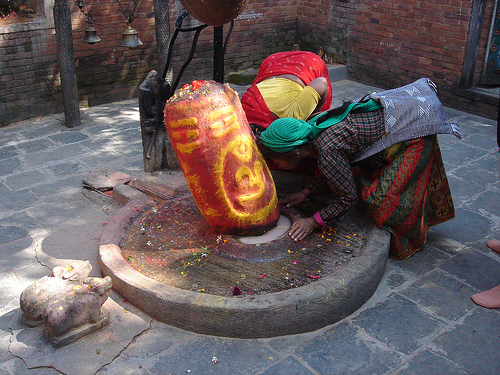
These are traditionally-dressed Nepali ladies (probably from the Gurung or Tamang ethnic group) worshipping the lingam, or sacred symbolic phallus, of Kirateshwor Mahadev, a manifestation of Shiva. The Kirateshwor temple is at the top of a flight of stone steps near Pashupati temple, but unlike Pashupati is open to foreigners and non-Hindus. The copper vessel hanging over the lingam is filled with holy water and "bathes" it continually.

This lingam-stone appears to be naturally formed, but someone has carved an OM symbol on it.

What looks like little stone bunnies next to the lingam are Nandis. They represent Lord Shiva's animal vehicle of choice, or vahana. Murugan rides on a peacock, Durga on a lion, Saraswati on a swan, and for some reason, Shiva chose a bullock. I guess he wasn't in a hurry.


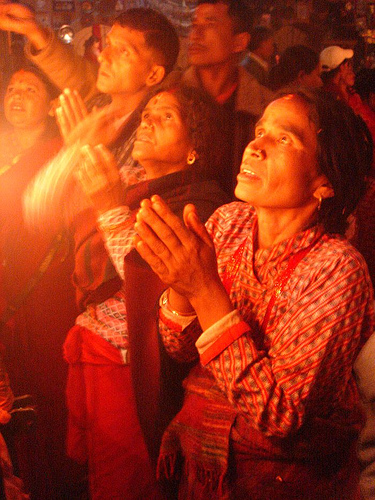
The people in the next photo are Newaris, worshipping on Kartik Purnima - the special full moon that just passed on Sunday - at the Chobar Temple just outside Kathmandu. Like an amazing number of Nepali temples, Chobar has both Hindu and Buddhist deities. The Newaris have a special festival just for this full moon (actually they have a special festival for everything). It represents a unique opportunity for the women of the community.

If there are Newari couples who have separated or had disagreements over the past year, the women can come and offer five days' puja service at the temple. That means, they have to fast, ritually bathe every morning in the river, and not let anyone touch them, as they perform the pujas for the god. This year, there were about 41 women doing this sort of service at the Chobar temple.

At the end of the five days, the woman's husband can either come to "claim" her again, or leave her there. If he does not come, the woman is free to remarry with another person. Since divorce is rare and highly frowned upon in this society I wondered if there was any stigma on these women. My Newari companion told me that lots of them do remarry, also rare in this part of Asia. I wonder how many women secretly or not-so-secretly hope that the husband will not come for them!

Before I go completely supernova, I think I might head for Pokhara, the lazy hangout spot, for a few days. We have a new peace agreement - the Maoists get a "piece" of everything! And you thought The King (Mr Ten Percent) was bad. Maoists are still effectively running 80 percent of the country and hitting up local people for donations and accomodation. But there haven't been many strikes lately. In fact I had gotten so used to using "strike" as an excuse for being late, now I am disappointed at having to arrive in a timely fashion.

Here is a peaceful, contemplative image of a giant Buddha statue, from the entrance to Swayambunath Stupa. Funny how getting these peaceful, spiritual images is so much work, I just feel dirty and tired and gritty and exhausted by the time I get home. Someone needs to make a t-shirt: "Spirituality Is Not Pretty."

Sunday, October 22, 2006

Diwali walli* goes Nepali

Festivus maximus
Kathmandu and Lalitpur, Nepal


*Wallah: someone who is particularly expert at or specializes in a certain activity or profession. Walli: feminine of Wallah.


Everything happens at once, all the time, here. We're now in the middle of yet another cluster of festival days. This one is Diwali, aka Tihar, the Hindu festival of lights and Lakshmi, goddess of wealth and abundance. Some things are closed, some are open for business, many look deceptively open yet are operating on skeleton crew.

Naturally, all government offices are closed. In fact, I think they were literally closed more days than they were open this month.

Bunches of dressed-up, beaming people roam the streets, butter-lamps are lit at in doorways at dusk, children make the rounds singing and drumming deusi-bailo (a sort of Newari trick-or-treating from door to door) in the evenings. Every home and shop has a rangoli (sort of mandala-design invitation to the goddess, painted with cow dung, coloured powder, lamps and flower petals) at the front door - a painted pathway to guide Lakshmi as she enters to bless the residence. Everywhere you can hear the sounds of ringing puja bells, and Newari panchbhaje bands go from door to door playing their distinctive, reedy ceremonial music. A few months ago I wrote about the snake holiday (Naag Panchami). I can really hear the snake spirit in the sounds of the long, narrow Newari horns.

New Newaris
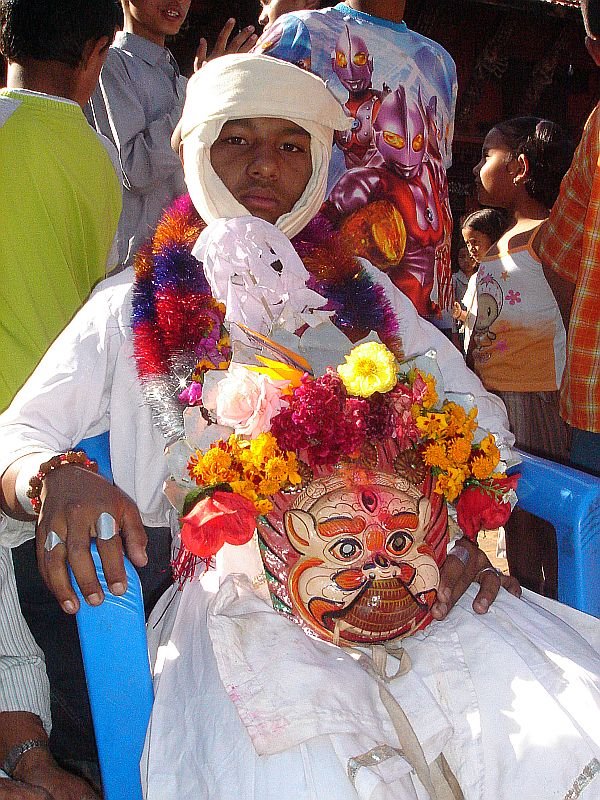
Today I am rushing to get some prints made for Pramochan, one of the (the many) Newari masked dancers I photographed this past Dasain season. On Dasain day, I received tikka and jamara (red powder on the forehead and sprigs of barley behind the ear) from Pramochan's father. Tikka and jamara are a sort of blessing given from elders to juniors on Dasain day. So, Pramochan's familiy (all five of whom live in a traditional Nepali wooden house, which looks like a hayloft with a five-foot ceiling) have invited me to Mha Puja. (Yet another puja!)

I love the tradition of jamara, which is (as far as I know) unique to Nepal. On the first day of Dasain, the lady of the house plants seeds of barley, rice or corn, in a bed of sand, in a special niche inside the home. The seeds are then covered and allowed to sprout secretly in warmth and darkness. It's during these nine days that the goddess Durga is symbolically fighting evil. On the tenth day, Vijaya Dashami, the jamara is uncovered and revealed to have grown into long, bright green grassy stalks. The stalks are then ritually harvested and bestowed upon juniors by the family elders.

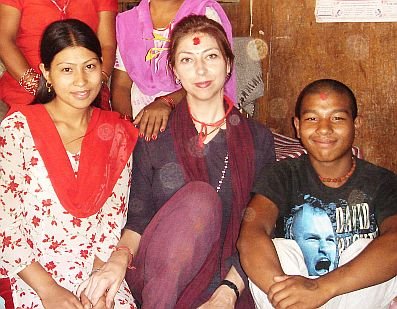
Everyone walks around town with an enormous red dot (made of red kumkum powder, rice and yogurt) on their foreheads and chartreuse sprigs sprouting from their hair like feathers (see photo below). Nepalis absolutely love tikka and jamara ("sooooo beauty-full") and seemed very proud to be seen with me, once I was properly marked.

Today's festivity, Mha Puja, is done only by the Newari community on the occasion of Newari New Year (it's now 1126). This ceremony honours and blesses the individual's body for the coming year. Fortunately I have a Newari and Nepali interpreter and hope to find out more about it. I am bringing the prints as a present for the family. (Others might get away with bringing a box of sweets, but as a foreigner with a digital camera, I am honour-bound to provide free prints to the family. I think it's a tradeoff for the stigma they might otherwise receive of associating with a foreigner.)

Rituals in transfigured time
Here in Nepal, we are running three simultaneous calendars. The business calendar is (sort of) the "English" or Gregorian calendar. Then there's the Vikram Sambat or Nepali Hindu calendar, in which it's 2063 and the new year is in April. It is quite common for buildings to boast of having been "established in 2059" (my Australian friend Dave took a photo of this - he thought it was a typo), or for people to say "the conference will begin after 10 Bhadra."

When yet another time cycle, the Newari calendar, starts tomorrow, and it will be 1127. The Newari new year is figured from our AD 867, when legend has it that a Newari Jyapu (farmer caste) discovered a riverbed of gold, and thus paid off everyone's debts. A good way to make a fresh start.

Now if I could just make some money and pay off a few of my debts...guess I will be offering Lakshmi extra marigolds and butter lamps for that one.

New widgets on the block!
Feeds, widgets, clusters, tags, bookmarklets, clouds, sprinkles, aggregators, badges. I'm just now learning about the galaxy of nifty blog features and how they procreate.

I've added a couple of new widgets (nifty code dropped into my template to do cool things) to the blog site. The SirenLocator Map (requires Flash, I think) should show online viewers as they appear, and even reveal a map of their nation (for those unclear on geography).

Scroll down and you will find the Current Moon Phase, essential for life in Nepal and other parts of Asia.

My SirenDelicious feed shows my favourite items and headlines saved to Del.icio.us. And Global Voices headlines feed show selected headers from the Nepali and Indian blogosphere.

Coming soon: my very own tag cloud, and a Newsvine widget. Oh, and I've finally caught up and gotten myself a YouTube account, but some stupid folk singer already snatched the name Sirensongs....so SirenTV will be appearing as "SirensongsIndia." Maybe someday I'll figure out how to upload my many videos directly to this site.

Wednesday, September 27, 2006

Dancing days are here again

Lost in a masquerade
Lalitpur, Nepal

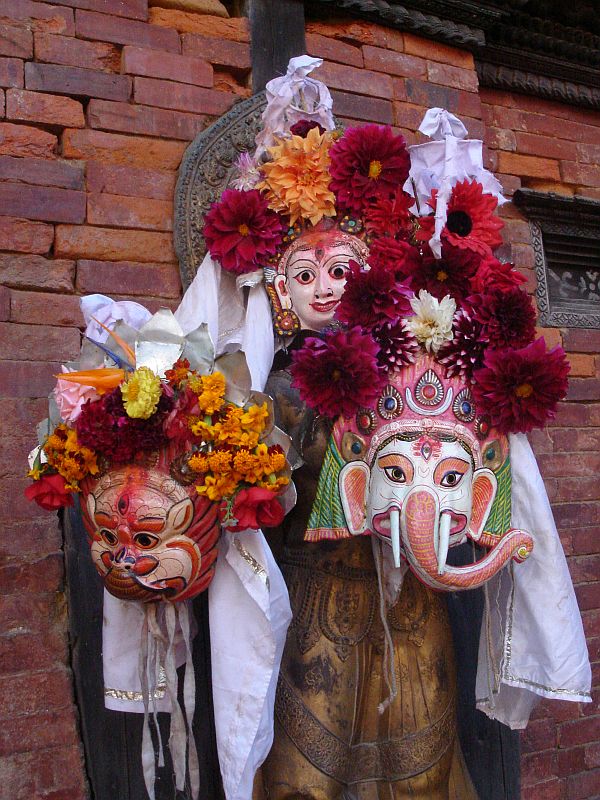
Indra Jatra, Dasain and Kartik Purnima mean it's time for the ritual masked dances of the Newari people. I'm currently engrossed in tracking them down (obscure, community-based, secretive besides the language problems) and documenting them. Last night I went to Lalitpur (Patan) to see the Ashtamatrika (Eight Goddesses) dance of the Newari Buddhist community. I only have time to upload one photo right now (before running to Immigration).

I have seen lots of masked dancing by now, and I think the Ashtamatrikas are the most exciting yet. They seem to be the most classically influenced, and the most ritualized. These dances were begun in the 1600s on the orders of the Lalitpur king (at that time it was one of the rival 3 kingdoms of the Kathamandu Valley), who was a great devotee of the eight guardian goddesses.

The transformation of the dancers, as soon as they don the mask, is really astonishing. They assume a hands-on-hips stance and begin trembling with shakti.

Hundreds of people from the community turn out and follow the Goddesses on their journey from Nakabahil (courtyard of the dance-god) to the courtyard of Taleju Bhavani Temple, where the gothic gables tower over the dancing devis.

I was the only foreigner there. It amazed me that so few outside people know about the vibrant, living culture of the valley, especially since it's been going on continually for the past four hundred years.

Last night there was a power cut, so we were marching through the cobblestoned streets in candlelight - it felt like the dances must have one hundred years ago.