Showing posts with label goddess. Show all posts

Saturday, October 09, 2010

Meanwhile, back in the Valley

Harvest Home
Body in NYC, mind in Nepal

I'm sitting in an East Village cafe, watching the corner grocery try to array produce in an attempt at a "harvest season" display.  Somewhere, outside of Manhattan's concrete canyons, leaves are changing colour, chrysanthemums are blooming and roadside stands are setting out sheaves of Indian corn and piles of pumpkins.  And all over Nepal, it's Dasain time - the nine-day festival dedicated to goddess Durga, in her local Nepali incarnation as Taleju Bhavani.  
The narrow streets of Kathmandu's old town are crammed with shoppers buying holiday gifts, and all the accoutrement required for a Nepali Hindu holiday (special food, sweets, and lots and lots of marigolds).  All this under a blazingly blue sky - weatherwise, it's the perfect season to be in Nepal.

This nine-day goddess festival ("Navratri") is celebrated throughout the Hindu world, taking on local characteristics in each region.  In Maharashtra (India), the holiday is called Dussehra, marked by  glowing paper lanterns.  Mysore (in Karnataka, near Bangalore) has its famous Dasara procession complete with elephants, a palace glowing with oil lamps and fairy lights, and the descendant of the former Maharajahs presiding.  On most every street corner in Calcutta, you will find pandals (platforms with decorated deity statues) for Durga, with ceremonies and devotional music ongoing throughout the holiday, till the clay statues are submerged in the Hooghly river on the tenth and final day.  In the Kullu Valley of Himachal Pradesh, the local goddesses are brought down from their respective temples and paraded on palanquins through the town. 

Dasain is the uniquely Nepali form of Navratri. Nepali festivals are tied to the seasonal agricultural cycle, reflecting the centrality of farming in many Nepali communities.  Each of the nine days is full of significance and traditional observances.  On Ghatasthapana, sprouted wheat grains are planted in a pot, and kept in a dark place in the household.  On the tenth day of Dashami, the beautiful spring-green sprouts (called "jamara") are plucked and worn, as a sign of new growth and regeneration, along with "tikka" (the red kumkum powder) on the forehead.

Nepalis having a genius for time-warping, the nine days and nights of Dasain magically extend to two weeks, even a month in some cases. Workers who have migrated from their remote villages to larger towns to find employment are packed onto rickety buses, crossing dusty and bumpy roads to make the pilgrimage home for the festival.  For many, is their one chance in the year to see their family and the old home place.   When a Nepali waiter, for instance, takes leave from his job to go home for Dasain, he returns whenever he returns - between over-capacity buses, unreliable vehicles, transport strikes and poor road conditions, he can't guarantee a definite date of return.  Most Nepali businesses are bound (by tradition as well as the powerful Maoist-led labour unions) to give each employee a full month's salary as Dasain bonus.

Most Nepalis don't consider their Dasain complete without the sacrifice of a goat.  In a traditional Hindu town like Bhaktapur, every house will have blood on the doorstep from the sacrifice, usually done on the ninth day of Navami.

As a visitor to Nepal, Dasain can be frustrating - transportation is crammed full, shops open and close erratically, most government offices (including those for trekking permits) are closed, and tourist restaurants and many hotels are running on a skeleton crew.  The best way to spend Dasain is to relax, forget your goals and travel checklist, befriend some Nepalis and get invited to their home.  You will enjoy  the traditional foods, and receive the blessings of  tikka and jamara from the family elders. 

Don't forget to bring a present (almost anything is appreciated, but sweets are always appropriate), visibly relish the food that is served, and demonstrate real interest in the holiday and its traditions.  For all the breathtaking mountain vistas, everyday life in Nepal is marked by simple pleasures and of course, the ever-present Nepali smile.

Sunday, March 22, 2009

Dry, dark and dirty

Round midnight
Kathmandu

In a country now famous for having no electricity, how is it that "a short circuit" around midnight caused a serious fire at the Sri Bagalamukhi temple in Patan Sunday night (March 16), destroying much of the carved-wooden pagoda style temple?

""The temple uses too many lights, which can sometime lead to short-circuits,"" an officer at Nepal Electricity Authority's Pulchowk office said."

Minor detail: There's no f**king electricity.

Bagalamukhi, one of the 10 Tantric Wisdom goddesses, is depicted as standing atop a demon, beating him down while snatching his tongue out of his mouth to silence him.

This image is sometimes interpreted as an exhibition of stambhana, the power to stun or paralyze one’s enemy into silence. This is one of the boons for which Bagalamukhi’s devotees worship her.

(her mantra translates as):
...Oh Goddess, paralyze the speech and feet of all evil people. Pull their tongue, destroy their intellect.

Perhaps, the Devi's own comment on suppression of the free press here in Nepal.

Shortly thereafter, the unbearable six-month dry spell finally broke, first with a smattering of rain on Wednesday night. The next day brought nothing but tantalizing rumbles of thunder and dry cracks of lightning. Thursday night, the electricity (which had gone off at 12 midnight) suddenly came BACK on at 12 again, only for a moment...then switched back off.

It wasn't till Friday afternoon we found out that Father John K. Locke, Jesuit scholar and father of Newar Buddhist studies, had died at precisely that time; midnight on Thursday night.

On Friday night I got another unpleasant surprise, in the form of my first Nepali groping. This one was a drive-by - two young men on a motorbike decided to take advantage of their speed and anonymity by grabbing my right breast as they sped past. Such incidents are well known and much-discussed among Indian travellers. Nepal, land of the Buddha and Tantra, is becoming another place where women have to go into Purdah - even in the middle of the tourist zone.

We still hadn't gotten a proper rain till Saturday afternoon, when it finally soaked the thirsty ground thoroughly.

The traditional rain god of the Valley is Rato Matchhendranath ("red lord of the fishes"); his worship is mandatory to bring the much-needed rains. Now that Nepal is "secular," I guess we have to worship Rato Prachandranath. He's the new Red God. Rather than being pulled round in a chariot, he's driven round in a limousine.


Related reading: Chinnamasta: The Aweful (sic) Buddhist and Hindu Tantric Goddess. (book reviews): An article from: The Journal of the American Oriental Society

Monday, February 02, 2009

Hymn to Her

Fun with liturgy
Kathmandu

Here's one of the Charya Giti I have been transliterating and, partially, translating. Not because I am good at it (I'm not really), but so that I can understand the dances I am learning. There are no English versions of these songs and poems. For those who've just tuned in, I am here studying the Newari Buddhist Charya Giti or Buddhist devotional dances.

Most of the lyrics I can "feel" but don't think my literal translation will do them justice. This is my attempt. There is a chance that this gita appears translated/literated in Kvaerne's 1977 Anthology of Buddhist Tantric Songs (Oslo) but as I can't locate this publication, I don't know.

My goal is to create an illustrated book of the Giti with Sanskrit, English phonetic and English translation, some background and illustrations of each Deity.

 
Sri Kurukulla Devi
Raga: Nata .... Tala: Jati
(the Raga is the South Asian equivalent of the key or "mode." This set of notes determines the "mood" of the melody much as the key does in western music - imagine playing "She Loves You" in Eminor instead of Emajor.
Tala is the rhythm or time signature of the piece. Again, imagine playing "She Loves You" in Waltz-time instead of 4/4. Changes everything. Every dance student must know their talas and ragas to some extent, though not as thoroughly as music and singing students.)Kurukulla
Tribhuvana jananii sri kurakullaa devii
Svetavarna makuta keshii trinayanaa
Mother of the three worlds, Sri Kurakulla goddess...
White-coloured with a crown of hair, three-eyed....

Namami devii sri kurakullikaa taraa
Chatura bhujaa karti khatpara shara dhanudharii

We bow to goddess Sri kurakulla the deliverer
Four-armed, holding chopper, knife, bow and arrow.
Rahu mastaka sthita nrtyapada dharii
Natha shodasha bhujaa aalikngana chun.
Tribhuvana vyapita niilavarna dehaa
Tumha varna devi anuttara sangama
Tempting Rahu (?), standing in a dance-pose
Permeating the three worlds, with blue-coloured body...
(This part confuses me. At one point she's red, at another blue....Sodasha means sixteen; the verse seems to say she has 16 arms but elsewhere she is described as "looking 16 years old.")
Piivad re mahaarasa sudrishta dehaa
Namami sri devii loka udharitaa
Drinking Maharasa (amrit), her form pleasing to see
I bow to the Goddess who uplifts the world
Bhanayikulishaa ratna giita charitaa
Namami sri devii loka udhaaritaa.
(This verse is an attribution stanza telling the name of the Gita composer; and again I bow to the goddess who uplifts the world.)

Here is more about Kurukulla from Vajranatha.com, which appears to be a cool and informative vajrayana web site.

And here is a fun "message from Kurukulla" which was received by Akkarri at Spontaneous Combustion. I especially liked this part:

"I am DANCING. This is to show you how to manifest divine energy for benefit of all....itting in uniform rows reciting rote attribute-lists of the results of human male ego-trips is not a Divine Activity, because it has nothing whatsoever to do with the acknowledgement of MY DANCE."

Related reading: 
Meditation auf Kurukulla 

Wednesday, January 07, 2009

Five sisters

Dancing down the dakinis
Kathmandu

People get excited (or maybe they are just being polite) when I tell them I am learning sacred Buddhist dance of the Newars. The actual classes are pretty mundane. It's like piano practice - not so much fun to watch.

Raju and I go up to the 7th floor rooftop terrace where the solar panels and newly-potted plants are kept. Invariably, someone has been partying up there so we have to sweep the concrete terrace of dust and cigarette butts. I wear black exercise pants and a black t-shirt. Raju wears street clothes (jeans and sweatshirts). The winter sun glares down on us, but in current temperatures (highs 64F) is welcome. In three months' time, we will be hiding from it.

On a relatively clear day, we can actually see snowcapped Himalayan mountains. Unfortunately, most days are hazey (even in winter) with pollution and we see only the green rolling hills of the valley.

From the 7th storey, Swayambhunath Temple on its legendary hill is clearly visible. So we turn toward Swayambhu's spires and recite the Padmanrtyeshwor prayer. I still haven't got this part down. In this part of the world, as in India, classes allow no time for warm-up exercises; you are expected to have already done that on your own.

If Raju has had time to stop by the ancient Patan Buddhist HQ, the Golden Temple (Kwa Bahal), he brings a pair of "tinchu" or ritual cymbals.

The strict sacred geometry of Kalakshetra-style Bharatanatyam is still (despite four or so years of running from it) in my muscles, brain and veins. It's kind of like having learned Hindi first, then trying to learn Nepali and constantly comparing Nepali to Hindi mentally.

In Charya, I'm supposed to emulate the watery, transitory Buddha nature of "anitya" (impermanence) as epitomised by the placid Buddha faces of local statues. Instead I keep overextended my legs and doing rigid mudras (hand gestures).

Everything in
Charya is more rounded and feminine ("lasya"). And after six years of keeping my hips in a straight line centered over my feet, now I must shift them endlessly back and forth like waves of the ocean. My teacher, who is male, looks a great deal more feminine and gentle than I while dancing.

For now we are both content with the idea that "you're still memorizing the steps,
" but I will have to transition into more gracefully flowing movements.

There is a place for
"tandava" (thunderous) movement in Charya -especially when depicting wrathful figures such as the Vajrayogini. Above is a photo of Lianne T. Hunt dancing the role.

The Vajrayogini is a sort of queen of the Dakinis. Last week I learnt four of her postures, all of which involve imbibing 'blood' from a 'skull-cup' and a lunging stance called "pratyalida." Most wrathful deities are always pictured in such a stance. These stances and postures can be seen dozens of times a day all over Kathmandu, in the windows of countless Thangka and statue shoppes.

Long before I came to Nepal or India, the Vajrayogini was in my life (found her in some book and the image really stayed with me). I have always felt the concept of Dakinis to be strangely familiar, and now am trying to learn more. Evidently everyone belongs to one of the "five families" of Dakinis which each relate to a particular klesha, or affliction. If you read this web page you will know about as much as I do. I have narrowed it down a bit, though- I am definitely not Padma. (Not enough interest in worldly things, for one.)


The drawing of Ratna Dakini is by Phyllis Glanville.

Monday, September 29, 2008

Graven images

Stoned
in Kathmandu

Yeah, I am so lame. I haven't blogged in nearly a month. But I have been playing Tour Guide to a number of friends tripping through the Du. Literally every time you go to an historic site, you see some new detail. Here are a few I've noticed this past month:

At the entrance to Mhyepi Ajima Buddhist temple. Just an archetypal female figure seated in something like Padmasana, and a bell to call her with. I like the way it's so worn down with centuries that nothing remains but the basic shape.


The torana (carved archway) of Sweto Kali or NarDevi temple, in the heart of Old Kathmandu. If you want to find her, the neighborhood is actually named after her (NarDevi). The white stuff on her mouth is milk-sweets (people "feed" her). Inside the temple are three more Devis. The torana is just a sort of "signboard" heralding the gods that live inside.


An unusually sensual statue of Sri Vishnu, Hindu god of preservation. He obviously seems "glad to see you." My friend Sean in California observed, "instead of sporting a Woody, he's sporting a Stoney."

Sunday, July 08, 2007

Goddess in progress

Stripped of divinity
Kathmandu, Nepal

Earlier this week, newspapers back home reported that the Kumari, one of Nepal's traditional "living goddesses," lost her title because she left the country. She traveled to America to promote a new British documentary about this Hindu-Buddhist tradition. Everyone wrote to me asking if I had heard anything about this.

Strangely, I have not seen a peep in the newspapers, which devote most of their space to controversies about the King's birthday (which was yesterday - that's another story). And, on the phone with my Newar Buddhist dance teacher (who is of the same caste as the girl), it was only when I brought up the subject that he acknowledged it.

The tradition holds that no Kumari can leave the Kathmandu Valley during her reign. The Valley forms a sort of sacred mandala and she is supposed to stay within those confines. It's for her own safety; plus that of the Valley, since she is considered an incarnation of the protector goddess.

Since no Kumari has ever left the Valley, much less gone abroad to an "impure" non-believing country, this issue has never come up before.

I was able to meet, receive blessings from, photograph and even have dinner with Sajani Sakya (the Kumari in question) twice last year. I am on speaking terms with one of her attendant-priests and will travel to Bhaktapur ("City of Devotion") next week to try and get the story.

One of the stories below quotes a priest as saying "We don't allow our Kumaris to visit an alien land." However, the story is wrong in saying that "several THOUSAND Hindus a day visit the temple to worship the Kumari." In Bhaktapur it is at most several hundred unless it's a holiday.

It could be that I will be here in Nepal when they select and enthrone a new Kumari, which would be quite an event.

Here is my photo of Sajani last Dasain (a big Hindu holiday) when she was being carried from house to house to give blessings. I still have the Jamara (sprouted rice sprigs) she gave me as part of the blessing.


Here are some links to related news stories:

Nepal "living goddess" loses status
One of Nepal's Living Goddesses stripped of status due to overseas trip
Nepal to unseat Living Goddess for US visit


Wednesday, September 27, 2006

Dancing days are here again

Lost in a masquerade
Lalitpur, Nepal

Indra Jatra, Dasain and Kartik Purnima mean it's time for the ritual masked dances of the Newari people. I'm currently engrossed in tracking them down (obscure, community-based, secretive besides the language problems) and documenting them. Last night I went to Lalitpur (Patan) to see the Ashtamatrika (Eight Goddesses) dance of the Newari Buddhist community. I only have time to upload one photo right now (before running to Immigration).

I have seen lots of masked dancing by now, and I think the Ashtamatrikas are the most exciting yet. They seem to be the most classically influenced, and the most ritualized. These dances were begun in the 1600s on the orders of the Lalitpur king (at that time it was one of the rival 3 kingdoms of the Kathamandu Valley), who was a great devotee of the eight guardian goddesses.

The transformation of the dancers, as soon as they don the mask, is really astonishing. They assume a hands-on-hips stance and begin trembling with shakti.

Hundreds of people from the community turn out and follow the Goddesses on their journey from Nakabahil (courtyard of the dance-god) to the courtyard of Taleju Bhavani Temple, where the gothic gables tower over the dancing devis.

I was the only foreigner there. It amazed me that so few outside people know about the vibrant, living culture of the valley, especially since it's been going on continually for the past four hundred years.

Last night there was a power cut, so we were marching through the cobblestoned streets in candlelight - it felt like the dances must have one hundred years ago.

Getting your goat

Dasain Days
Bhrikutimandap, Kathmandu, Nepal

Finally, the weather cleared yesterday, after a weekend of seemingly interminable drizzle and rain and mud. Billowing white clouds now hang over the green hills that surround Kathmandu, and it's hot at mid-day.

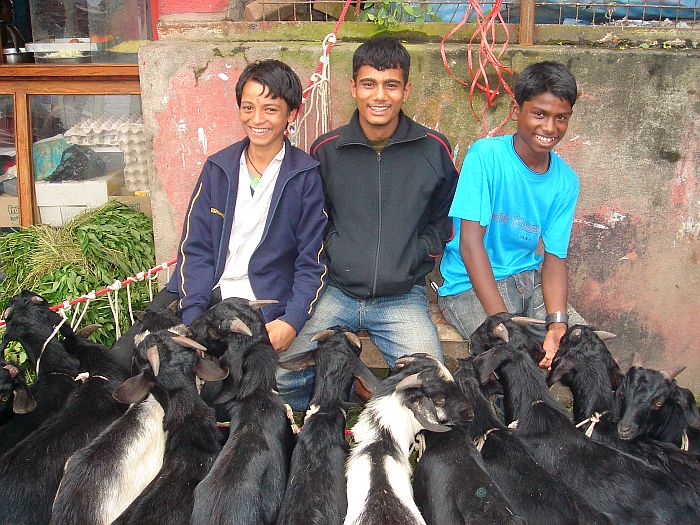
On my way to Immigration, I passed an impromptu open-air goat market - the sidewalk was transformed into a musky-smelling barnyard, with all sizes and colours of goats nibbling at green fodder suspended from rope ties. They were adorable! But sadly, all are doomed. They have all been brought in from the surrounding villages to be bought as sacrificial offerings for the Dasain holiday. If all goes as planned, each and every one (all male goats) will have their throats slit and their blood offered to the goddess Taleju Bhavani, a manifestation of Durga. The unwanted goats will go back to the hills.

I had romantic notions of topi-wearing hill-dwellers herding the goats, on foot, over valley and dale into the big city for market - a sort of annual pilgrimage. Actually, the goat-keepers rent a mini-van (for about 500NRs a day,or $7.00 US) and load the goats inside; as many as 20 goats are crammed into the little vehicle. They pick up uncooperative goats by the horns (in one hand) and the back-scruff (in the other) and toss them in.

The hundreds of goats there were distinguished by some numerical system scrawled onto their horns, and sometimes, blotches of coloured dye on their shaggy coats. One shyster tried to sell me a goat for 3000NRs (about $50), but it turned out the correct price was 160NRS for 4 kg.

The goats are weighed (or as they say here, "weighted") across the road on a medieval-looking contraption that is a combination of a seesaw and swingset. The balances are big enough for a couple of humans to stand in - in fact, it looks like the thing they use to weigh the accused with in Monty Python & the Holy Grail ("I am NOT a witch, and this is not my nose, it's a false one!"). There were a few regulation weights there to balance the goats, but they also used a chunk of cinder block.

If the goats had any inkling of their fate, they seemed pretty resigned to it.

On the other side of the road were an especially handsome looking gaggle of goats, with long shaggy coats, twisted ornamental horns, and an extra swatch of shag hanging between their eyes like overgrown bangs. They seemed like the cool, laid-back hippy goats. Turned out they are a special kind of mountain goat called "Changra," but they don't cost any more than the other goats. I scratched them behind the ears, ruffled their fringed bangs and said a silent prayer for them to be reborn as humans (hopefully, vegetarian humans).

Immigrant Song
At Immigration, they told me that in order to stay in the country on a three-month student visa, I need the following things:
-$750 deposited in my name in a Nepali bank account. This is to prove I have $250 a month to cover my expenses for the three months's time;
-a receipt of fees paid and enrollment from the dance academy in Bhaktapur (which means I have to pay the teacher in advance, usually not a good idea);
-Letter of recommendation from the Nepali Ministry of Education (this is known to take a month or more - sometimes tourist visas run out just waiting for it);
-Various copies of my passport, visa and application itself (not a big deal).
-After the initial submission of the bank statement, you then have to show another just to prove you still have the money (that you didn't just borrow it in order to make a false statement).

$250 a month is quite reasonable for living expenses in Nepal; the problem is, getting it all together at the same time (plus the school fees).

They give you a nicely printed list of all these things (guidelines for foreign researchers and students)... in Nepali script! Talk about missing the point.

All this has to be accomplished within the next 30 days, and about 10 of them are official holidays. Nepal maa, din din ne, ek naya mela aunchhu (in Nepal, every day a new festival is coming).