Showing posts with label bhaktapur. Show all posts

Sunday, April 27, 2008

Escape From Kathmandu

Power Places Part Three
Bhaktapur, Changu, and Kathmandu, Nepal

The morning after the insane tug-of-civil war that is Bisket Jatra in Bhaktapur (half the town goes to war with the other half the town trying to pull the chariot apart, or so it would seem), I met a couple of Americans who also wanted to go up to the hillside temple of Changu Narayan (one of the "Power Places of the Kathmandu Valley"). It is believed to be the very oldest temple in the valley, and also has the oldest inscription yet located here - from the 3rd century AD, in Licchavi script. (The Licchavis were one of the Indian Hindu dynasties who came up from Magadha way, I think.)
Lynette, Dave and I decided to do the ultra budget thing and catch the local bus up to Changu, rather than pay the inflated taxi prices (300NRs or five dollars! please, it costs 600 to go all the way back to Kathmandu. Changu is only 15 minutes away by car).

There are about five different bus stops (or 'bus stands' as they are called here - "tourist bus park," "Mini bus park" etc) in Bhaktapur, so to determine the right one, we had to wander through the hand-hewn brick and wood labyrinthes of Bhaktapur asking directions, which is part of the fun. "Changu bus stand?" is the best way to phrase the question. When we just said "Changu?" people pointed in the direction of Changu itself, which doesn't necessarily help you get the bus.

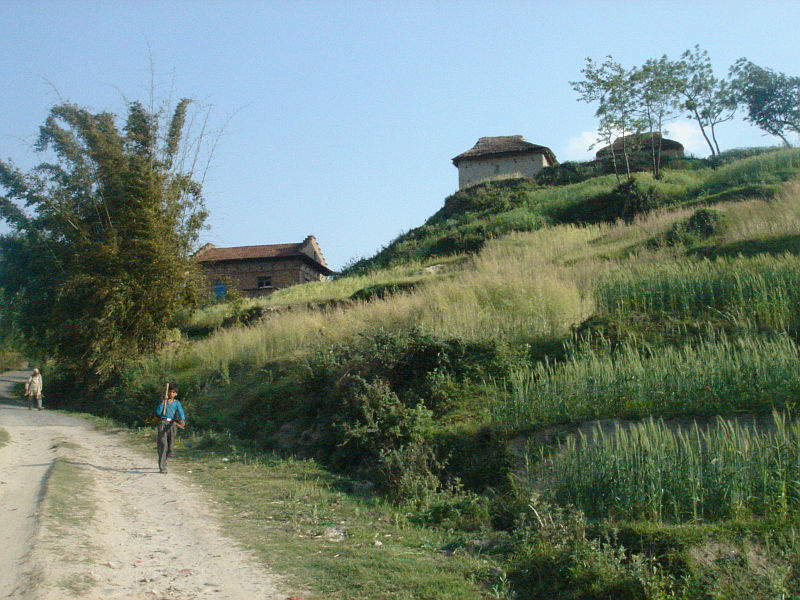
The road to Changu from Bhaktapur (the back road, not the driveable highway) would be a very nice walk - taking about 2 hours - if we had started early enough in the morning. As it was after 11am, it was already boiling hot. Don't be fooled by the clothing you see on the local people - they have the maddening ability to wear long sleeves, synthetic fibres, and even several layers, in the pre-monsoon swelter and barely break a sweat.

When we finally located the place everyone insisted was the "Changu bus stand," a taxi driver pulled up and did his very best to persuade us that in fact, there was NO bus to Changu. "No Changu bus. No bus. No bus today. Taxi, 300 Rs only." (By the way, the bus is 10NRs.) Instantly the shop owners, whose shop we were standing in front of, tried to get in on the act. They too insisted there was "no bus."
I had gotten the driver down to 200NRs and was trying to beat him down for 150 when we noticed a small crowd of people - women, children, and elderly - gathering on the corner diagonally opposite.

"I bet THAT's where the bus leaves from." I hopped across the smelly grey open sewer ditch and strode across the road. "Changu Bus?" I asked the young girls in kurta-surwal. They all nodded.
The taxi driver, as usual in such situations, displayed no trace of shame or embarassment at his "no bus" lies, shrugged and sped off.

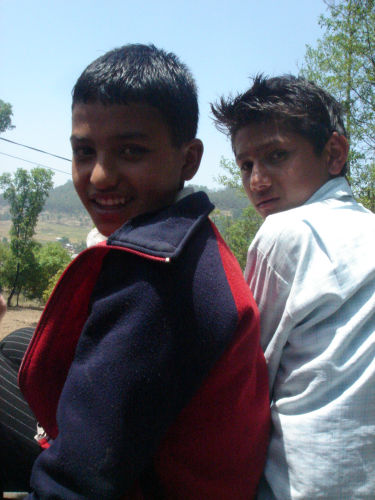
The bus was so crowded, we elected to sit on top. This is by far the best and best-ventilated way to travel, especially in hot sweaty summer, but is considered unorthodox for women. As foreign women, Lynette and I were somewhat exempt from the etiquette and clambered up the metal ladder to the bus roof - where the view is unsurpassed.


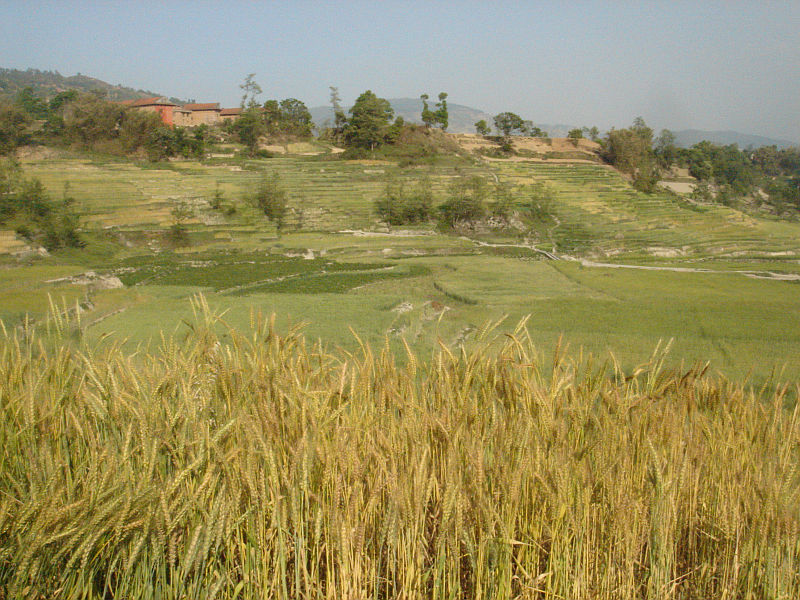
We were joined by half a dozen young boys till the tiny luggage-rack railing was crammed with humans. I made sure to get in the middle, sharing space with an empty red metal gas cylinder and a worn spare tire, where it seemed less likely I'd fall off. We need not have worried about falling - the bus creaked along slowly through wheat fields up the hillside.

Our fellow roof-riders seemed well-informed about the upcoming US elections and wanted to know "Who will be the next president of your country?" As usual in this part of the world, the name "Cleenton" evoked the most recognition - a trusted brand name on the subcontinent.

Changu Narayan has got to be one of the most reasonable entrance fees in all of Asia - 60NRs or exactly $1.00 US to see the oldest temple in the Valley (and the one best noted for its sculptures).
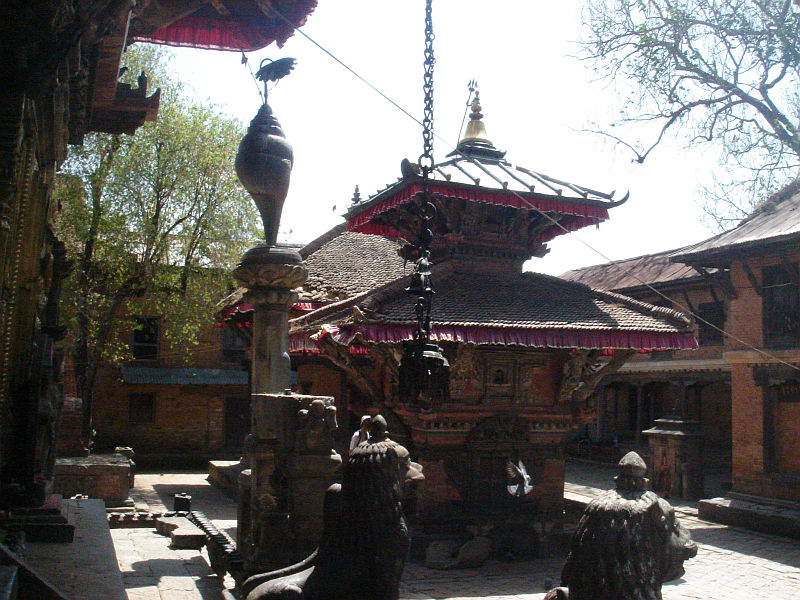
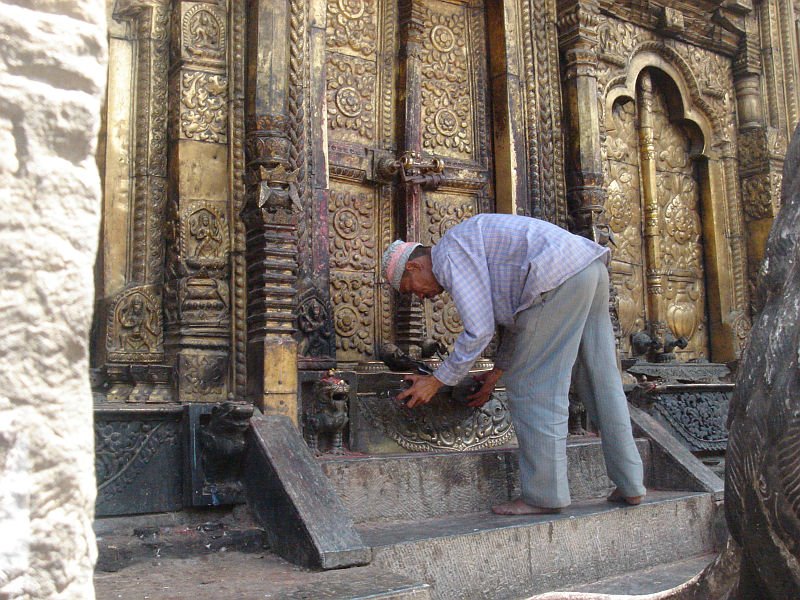
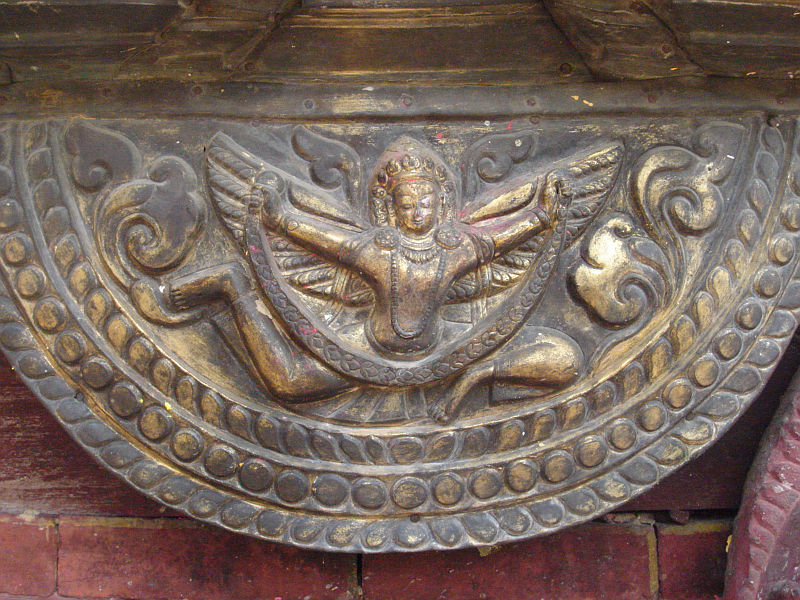
The last time I came was in September during the misty post-monsoon. I walked down from Telkot through damp pine forests that felt more like Scotland than Nepal. This ascent couldn't have been more different, in the hot dry season. However, it did mean this time I could take photos.

The isolated location of Changu Narayan means it's the least visited of the UNESCO World Heritage Sites in the Valley. It also means there are fewer tourists, which is both good and bad. It's never crowded, but ALL the attention of the shopkeepers, begging kids and touts was focused on US, the lone foreigners.


Changu displays a familiar Nepali combination - a rich upwelling of devotional energy manifested in myriad curlicues, psychedelic flourishes and startling chimeric beasts that defy description...lots of decay...and lots and lots of pigeon doo. In fact, a case could be made that the pigeon droppings rival the air pollution for destruction of the monuments. I can't support killing the pigeons outright, but I would definitely get behind a plan for pigeon birth control. (A few pigeons taking flight from the square in the morning light is nice. Hordes of them all over is a health and architectural hazard.)

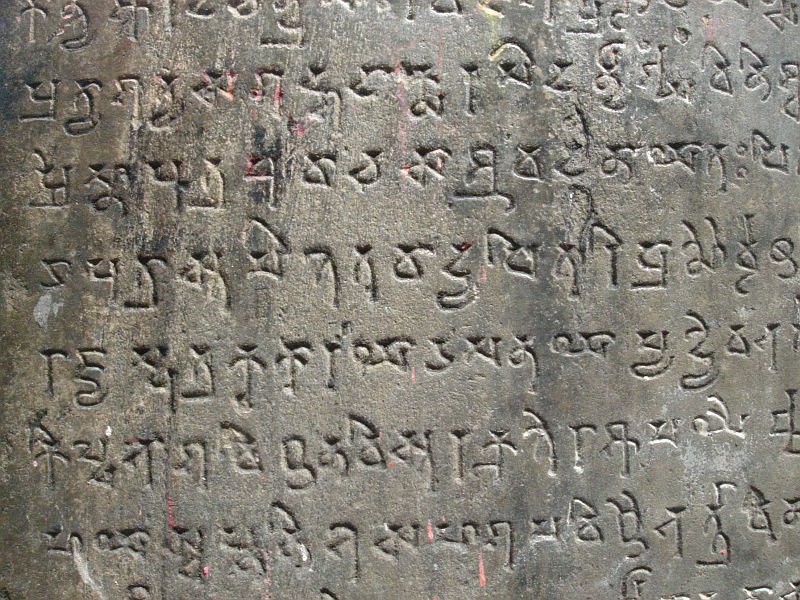
Despite the fact that I can't read it, I think the stone below is my favorite part of Changu. In the ancient and now disused Licchavi script, it supposedly relates the story of how a Licchavi king dissuaded his mother from sati, or widow's ritual suicide on the funeral pyre of her husband, and instead persuaded her to stay with him among the living because he would miss her. (Some proof that, despite what many would like to claim, sati was real, not an invention of the British or anti-Hindu propagandists.)
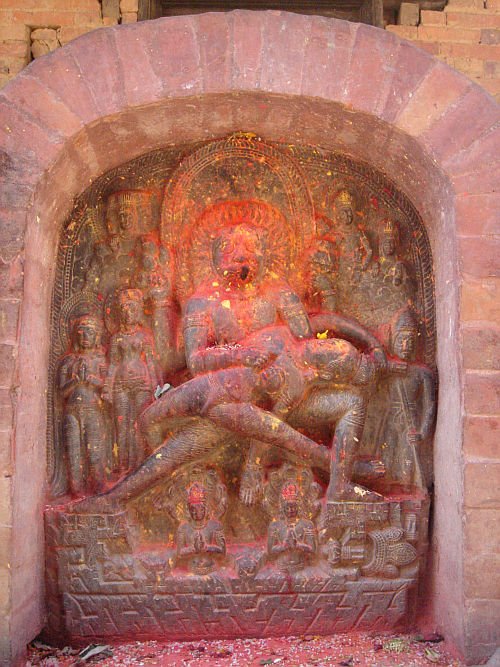
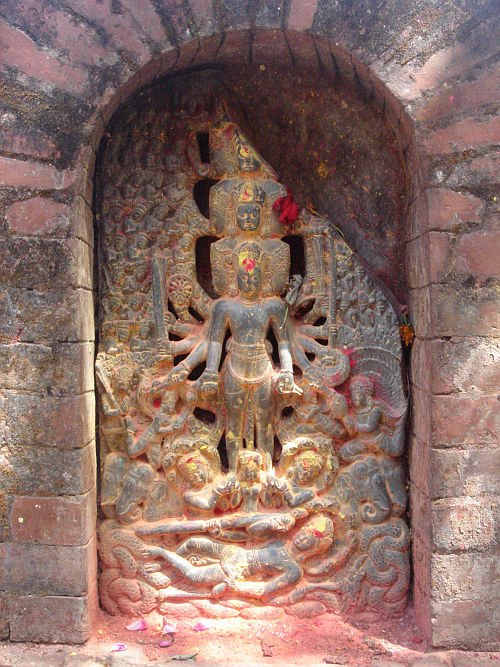
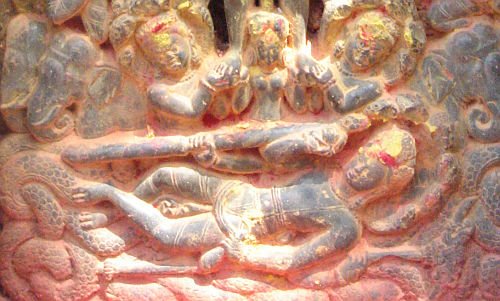
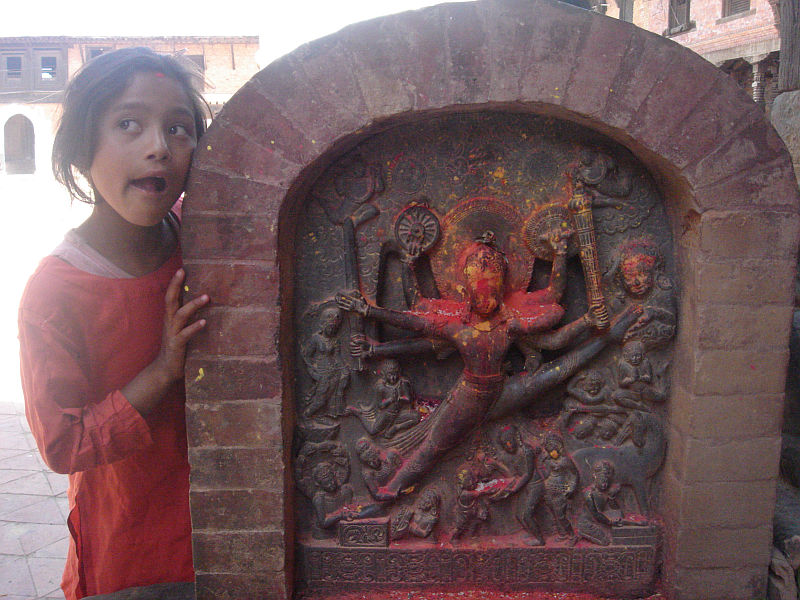
Narayan is one of the names of Lord Vishnu, who represents the "preserver or maintainer" form of the Godhead. This is the aspect of god traditionally meant to be embodied in the King of Nepal, though the current candidate seems to have been asleep at the switch. Though we weren't able to see the murti or statue inside ("Hindus only"), there are plenty of surrounding toranas (engraved and embossed metal archways), friezes, and sculptures. Most of them depict the various DasAvatar or ten earthly incarnations of Vishnu, including Lord Krishna, the dwarf manifestation whom I think was called Vamana, Parashurama, Narasingha the man-lion avatar disemboweling a nonbeliever (below), and what looks like Vishwarupa (the overwhelming all-encompassing universal form of God), a masterpiece of mind-boggling Hindu psychedelia depicting the three worlds (of the underworld, men and gods, below).

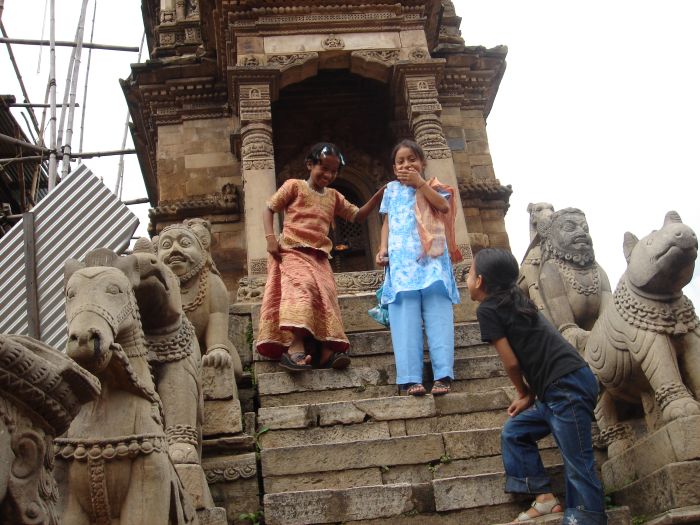
Despite having been damaged during an attempted robbery, the detailed cosmology of Vishwarupa is well worth a few minutes' contemplation. I'm afraid the photos really don't do the sculptures justice. There is a legend accompanying each of the statues - I know most of them and was able to bore Lynette and Dave with my know-it-all stories, but there is no printed guide available so you should bring a guidebook with details to Changu Narayan.


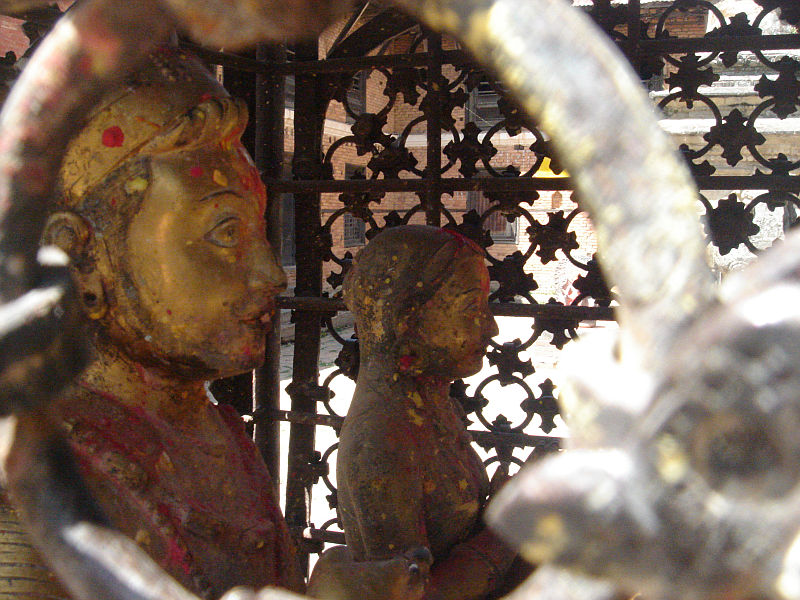
Isolated in their gilded cage are small statues of a former Licchavi King and Queen, possibly the ones who built the actual Changu Narayan temple (the site is believed to have been used for worship long before the building was erected). This is a common feature of Nepali temples - the patron king and queen immortalizing themselves in the kneeling posture of devotion, hands folded in salutation, facing the deity.


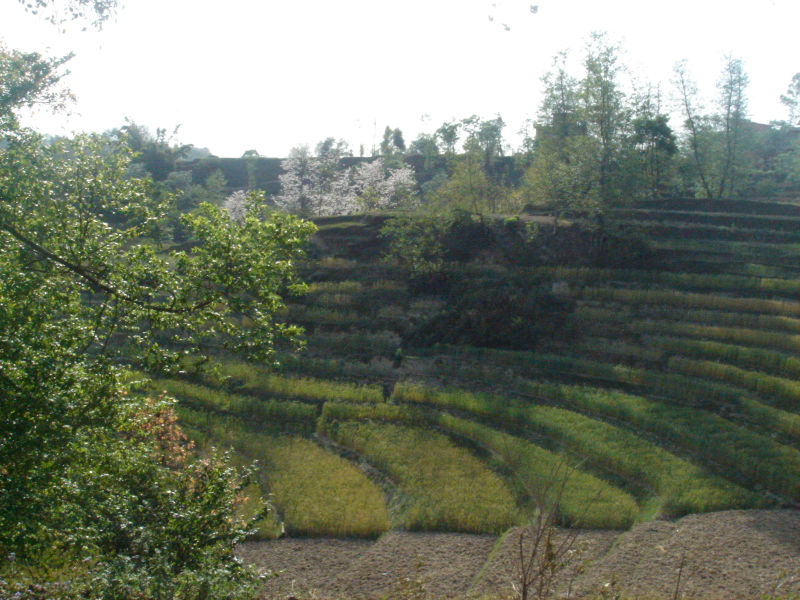
After a dreadful and very overpriced lunch at the neat, tidy garden style restaurant near the front gate (don't be fooled by the appearance - they do have a bathroom, though), we elected to walk the hour and half back down to Bhaktapur town, through the pine forest (the best part), windy wheat fields, and dusty small towns.


We knew we were near "town" when speeding vehicles threatened to knock us off the road into the ditch, and choked us with their fumes. Back in Bhaktapur, we were greeted by still more clanging cymbals, beating of drums and tooting of flutes. Was Bisket Jatra STILL going on?
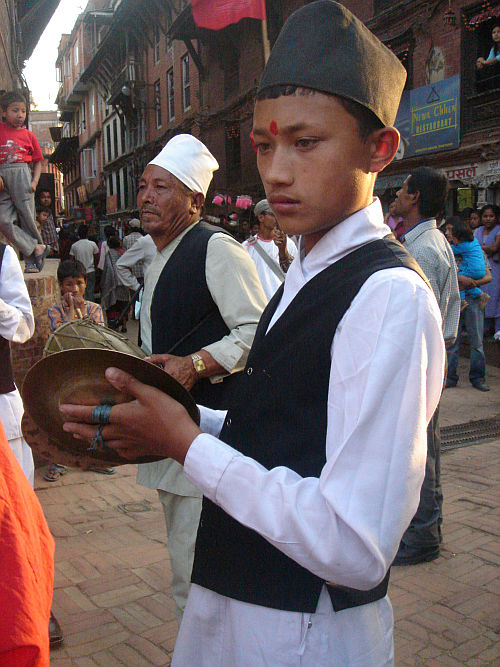
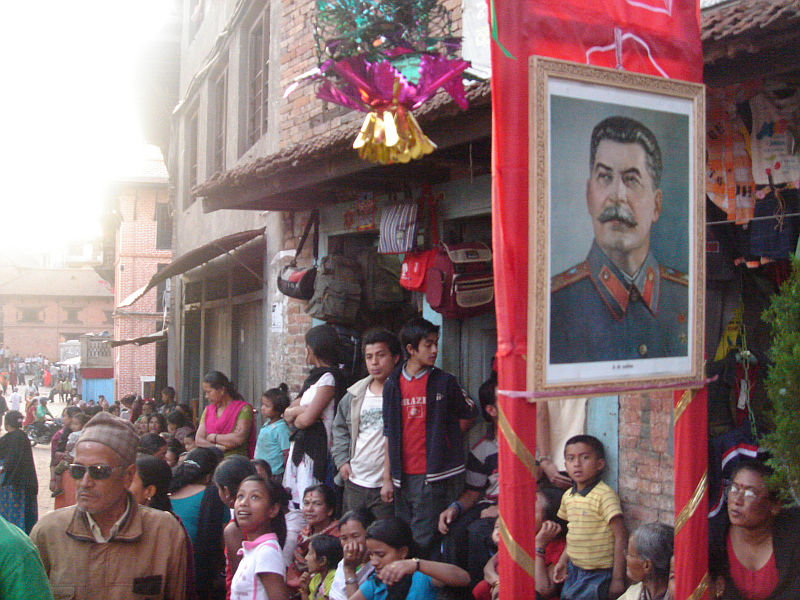
It turned out to be a different festival. The Maoists, along with a local affiliate Newar identity party, were celebrating their electoral victory with traditional music, traditional dance, red banners and portraits of Stalin, Mao, Marx and Lenin.

Dattatreya Temple square (also called Tachupal) was once surrounded by Maths, or Hindu ashram-style centres of residential learning. Students came from all over the region to learn traditional Ayurvedic (herbal) medicine in the ornately carved wooden buildings. Now, Pujari Math is a woodcarving museum, and another of the Maths has been transformed into a high-priced tourist restaurant.

New gods were being worshipped in the old square. It was high time for a shower and a pot of tea. We drifted through the narrow streets floating among political icons, Buddhist statues and Hindu gods back to the Bhadgaon Guest House.


---Thanks to Sudarshan for correcting some of the deity information.

Monday, April 21, 2008

Applied anthropology

"I was born a poor black child...then one day I heard my first Mantovani record, and realized - *these* are my people!"
- Steve Martin

White people just can't catch a break. If you stick with Strauss and the Civil War, you're a closed-minded ethnocentrist. However, if you express interest in some other culture, you're some kind of orientalist. I guess we should all just stay home and read De Bible, maybe join Daughters of the American Revolution.


I went out to Bhaktapur to exploit the natives this week. Here are some photos. Thank god I'll probably never make any money from them...then I'd be a neo colonialist.

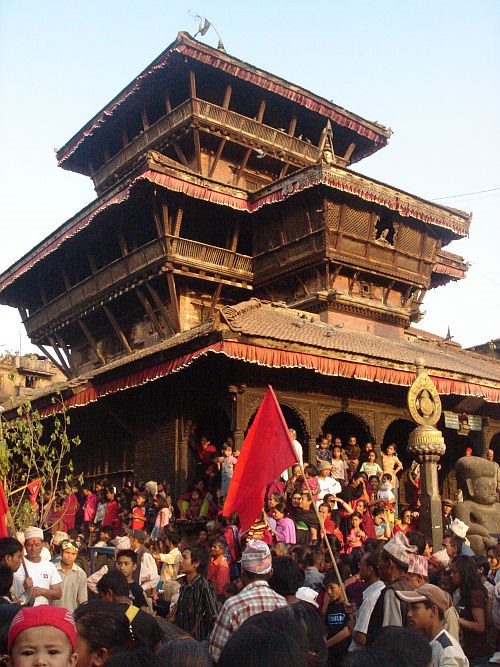
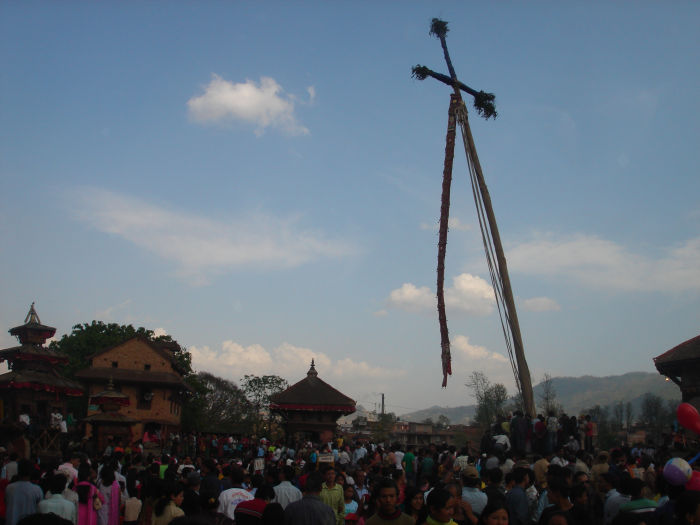
::Bisket Jatra is a nine-day blowout festival in Bhaktapur, the second Every day features a different event. This is the raising of the Lingo (Lingam), a sort of Maypole equivalent (fertility/phallic symbol). When the Jesuits arrived centuries ago in their attempts to convert the Newars, they were so happy to see the lingo - they thought Christianity had already come to Nepal. Boy were they wrong....
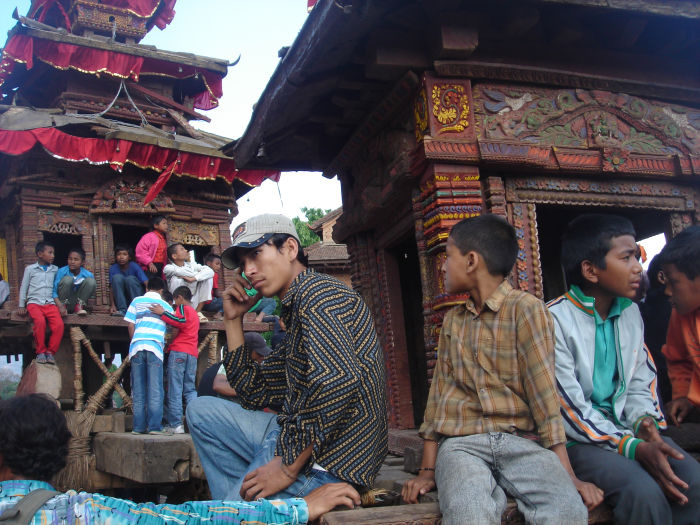
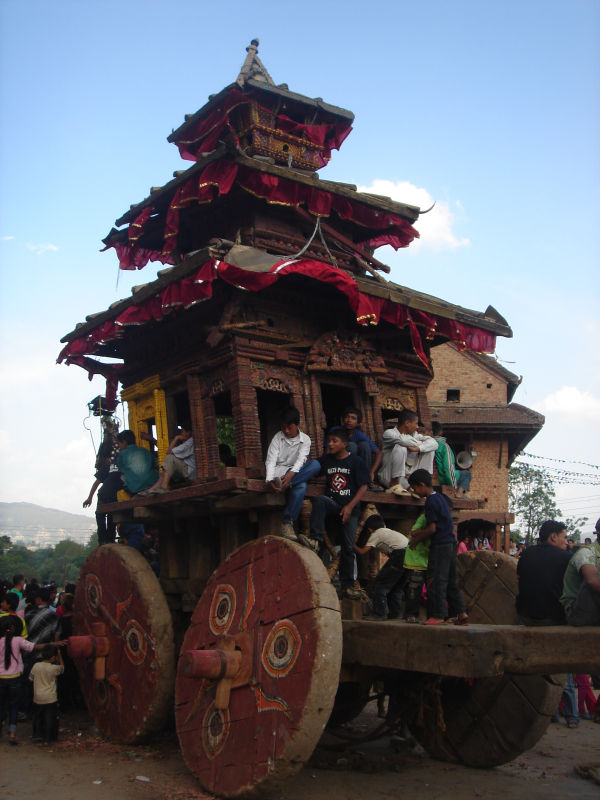
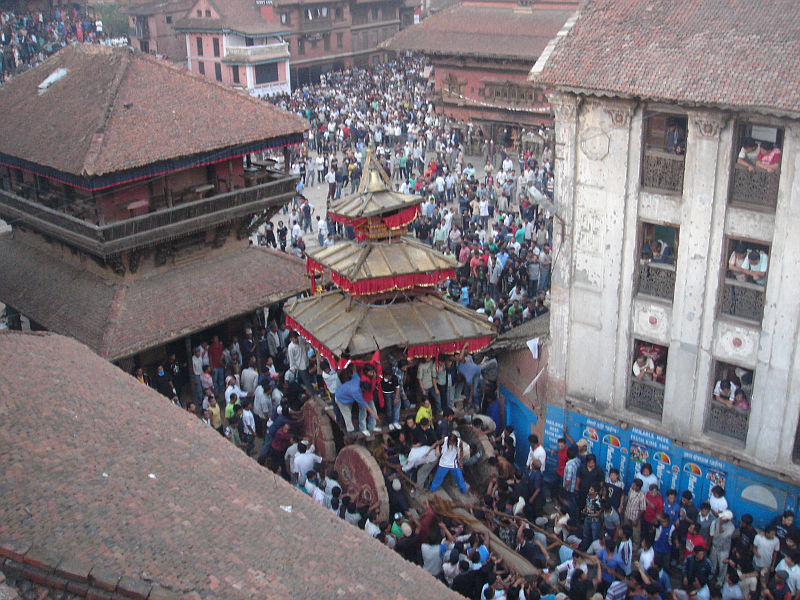
::One of the focal points of Bisket is the tug-of-war chariot pull between lower Bhaktapur and upper Bhaktapur. This ancient chariot gets nearly pulled apart like a rag doll. I've seen at least a dozen Hindu chariot pulls and I've never seen anything like Thursday night's chariot wars.

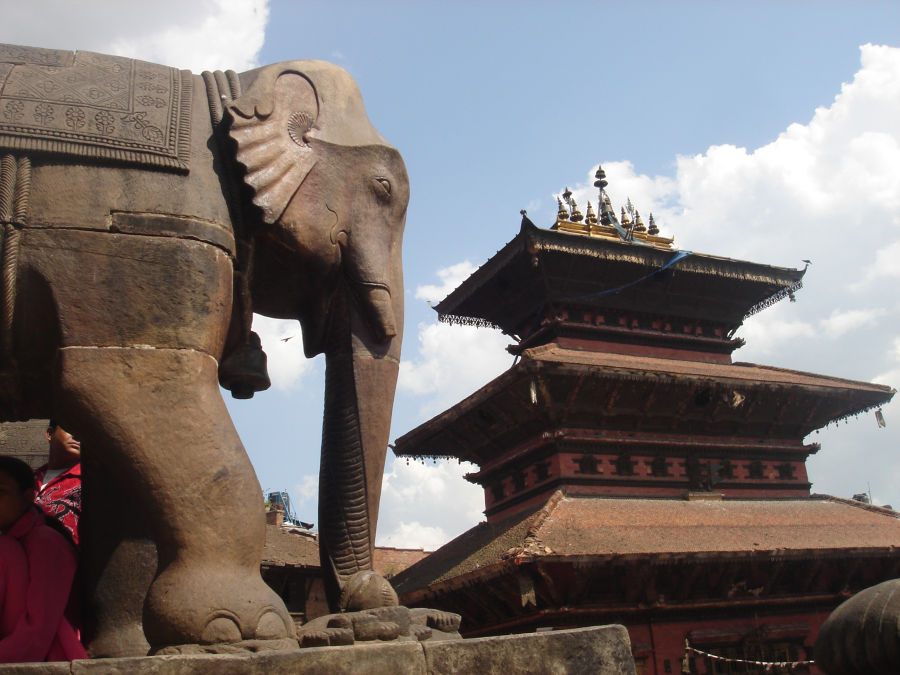
::One of the guardian elephants (nearly life-sized) on the steps of Nyatapola Temple, overlooking the Bhairab Mandir in Taumudhi Square.

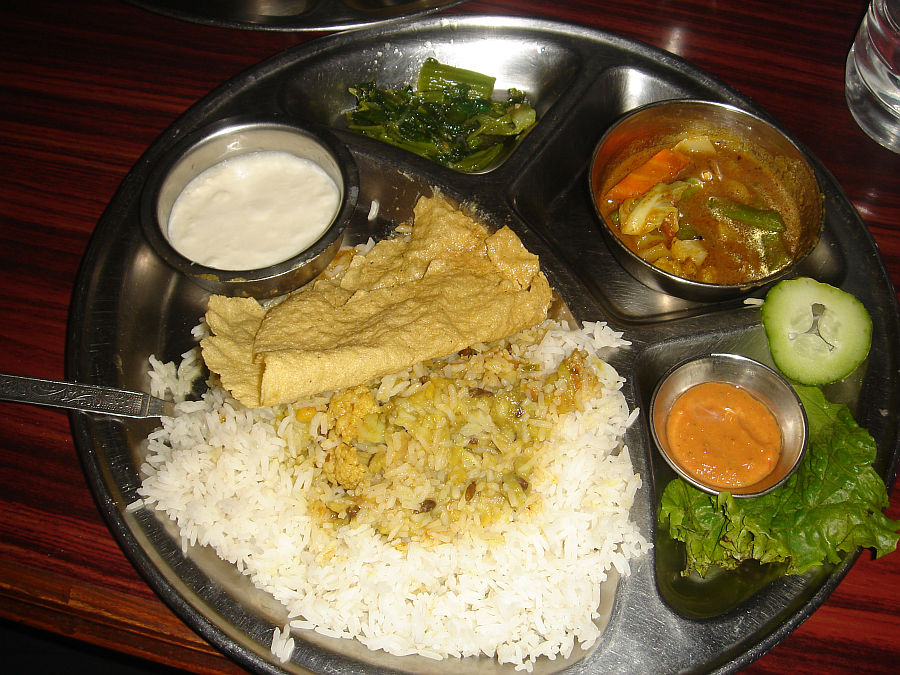
::Yummy daal bhatt - the Nepali national dish - at the Newa Family Restaurant in Sukul Dhoka - highly recommended. All this for 110NRS (about $1.50).
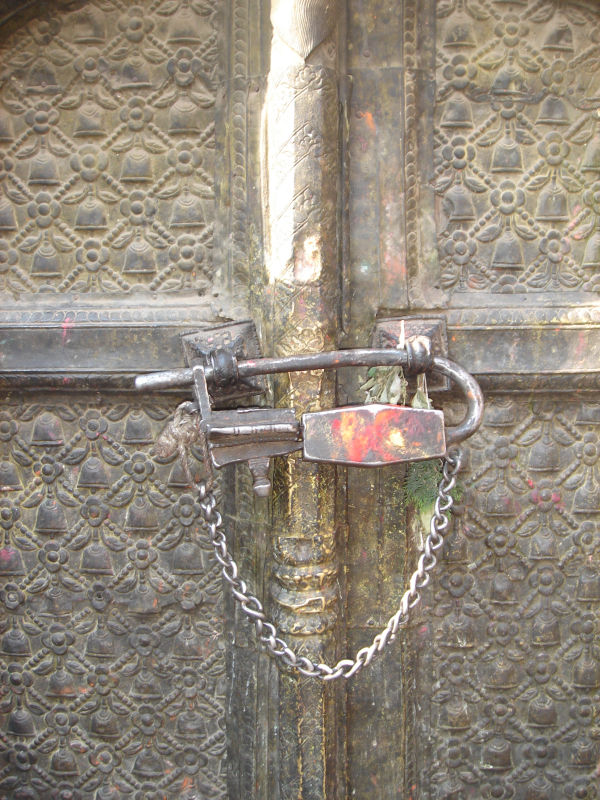
::The elaborate medieval style lock on a temple door.
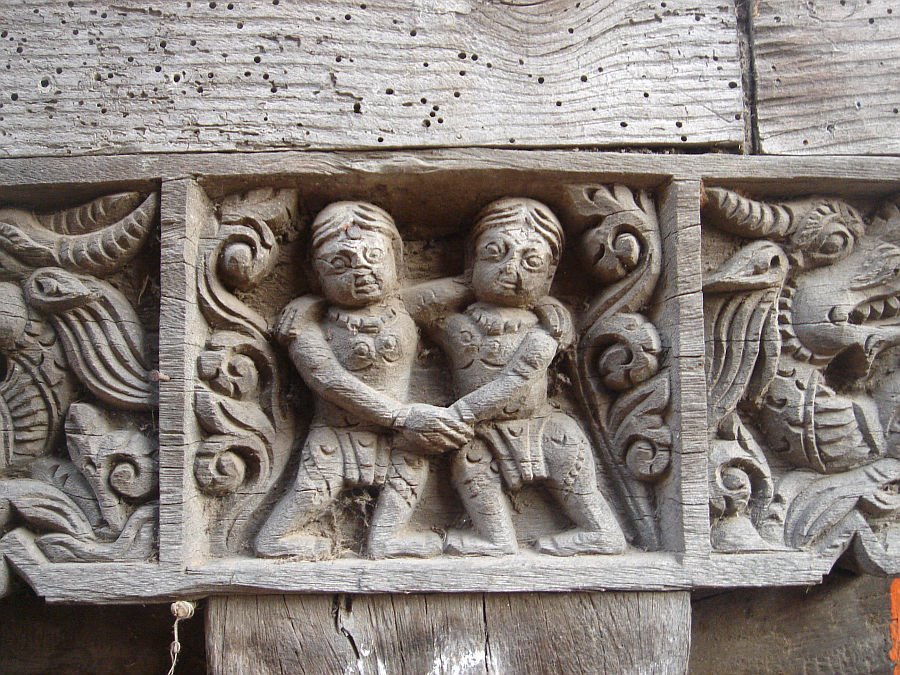
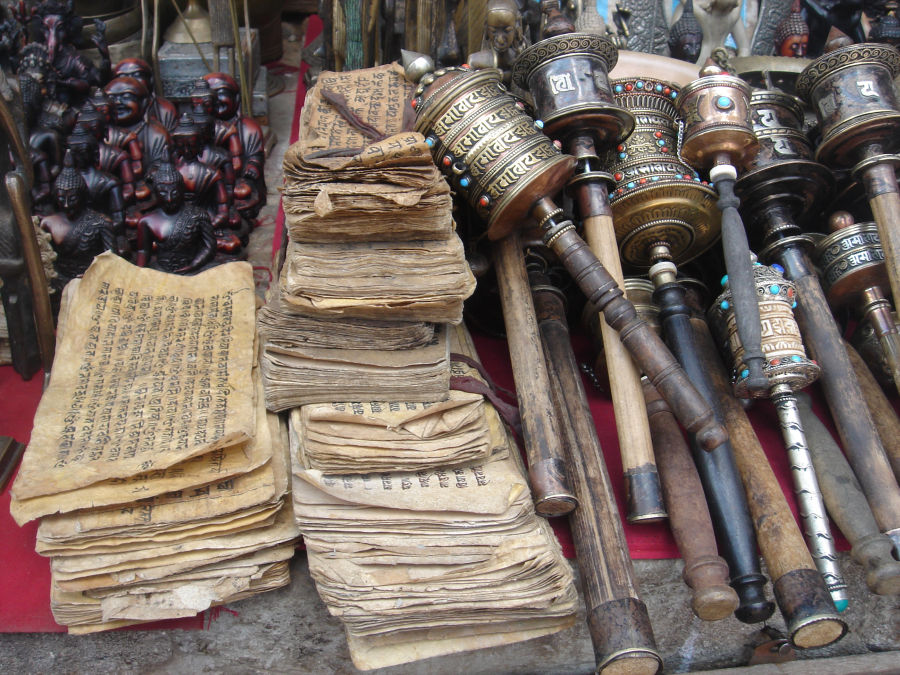
::The Newars created their own brilliant art, wood carvings (above), metal work and Paubha religious paintings. However, most of what sells in places like Kathmandu, Boudha and Bhaktapur is Tibetan, or should I say "Tibetan." All this is junk created by Nepalis and sold by Nepalis. The real Tibetans are all in hiding from the police these days.
A real Tibetan, for instance, would probably never leave a sutra lying out uncovered as seen above...or sell it for a souvenir. Tibetan script itself is considered sacred, not to mention religious writings.

I went to visit a Thangka shop (Thangkas are Tibetan traditional religious paintings) called "Refugee Camp Thangka Painting School."

"Where are the refugees?" I asked. Of course, there were none. All the paintings are done by Tamangs, also Himalayan Buddhists, who learned the art from Tibetans after the 1959 exile.

I asked where all the Tibetans were. One painter guy told me "they're all staying in their rooms these days...they are scared of the police." It didn't seem to bother him at all that his own painting master was being persecuted and driven into hiding.

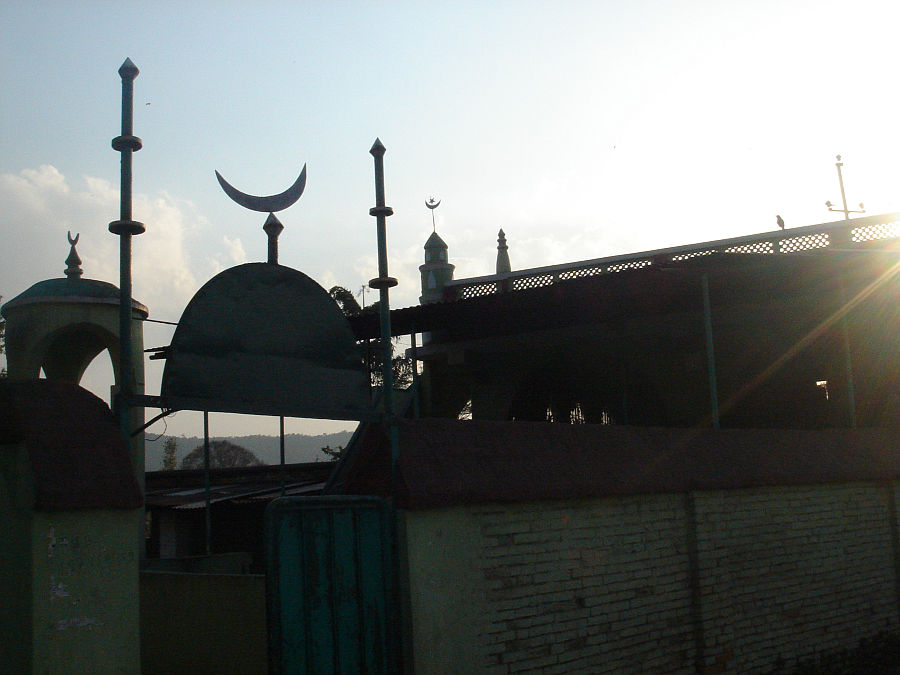
::Despite its image as an overwhelmingly Hindu traditional town, Bhaktapur also has at least one mosque and many Buddhist viharas, including one Theravada Buddhist vihara supported by a Thai donor.

Wednesday, April 16, 2008

Nepal Bhasha 101.5

Yesterday I reviewed some of my Nepali phrases with the sweet, shy kids who work at my guest house, Sunny Guest House in Bhaktapur.

In addition to saying "Nepalis are generally easygoing," I could have added, "and generally too humble and polite to correct you even if you are using their language incorrectly." Turns out some phrases I have used with success had unecessary or inappropriate words tacked on.

It's confusing, because the people are generally soooo polite, any attempt at all to speak Nepali is normally met with "you are speaking very good Nepali!"

Even when it's not exactly true.

This is in sharp contrast to India, which is more like France in that you'll get jumped on instantly and in no uncertain terms for language infractions.

However, we did get one bit of Viewer mail that had some more aggressive suggestions for learning Nepali. Does sarcasm usually work when attempting to assist someone genuinely interested in your culture, I wonder? Very Indian of you.

....or, perhaps I should attend school in the West and spend thousands of dollars to learn the correct attitude with which to approach another culture. One must be carefully taught to interact with natives, after all. Genuine, innocent unbridled enthusiasm not welcome in high-brow circles.


Fortunately, as I said, most (I have met a lot of them in four years) Nepalis are delighted at a bideshi's attempts to learn the language.

Phrase for today: "Ma Sunny Guest house maa Baschhu." (I am staying at Sunny Guest House.)

Monday, April 14, 2008

Nepali Bhasha 101

Handy Nepali Phrases
Bhaktapur, Nepal


Nepalis are generally easy people (unless they are agitating for a separate Nepali-speaking state in Sikkim, I suppose....or unless they are extorting money from local businessmen....or sacrificing animals...or kidnapping wealthy Indians...or beating up Tibetan protestors. Okay, I'm out)

... well, what I was going to say before my generalization was so rudely interrupted, was "Nepalis are generally easygoing people and Nepali is an easy language to learn." It's like a softer Hindi, with all the sharp edges rounded off. Just put Os where Hindi has As, Cha or Ho where Hindi has Hai, Na where Hindi has Nahin, and the suffix -nus where Hindi has -jiye and there you go - you're speaking Nepali.

(Not exactly, but pretty close.)

Oh yeah, and to speak Nepali, you have to drop the obligatory bossy attitude of Hindi. And the nasality. You have to smile to speak proper Nepali. You have to look down your nose at someone to speak proper Hindi.

It's Nepali and Hindu new year, and just days after the election, the mood here in the traditional Newar town of Bhaktapur is just delicious. Today was the last of a luxurious week of holidays declared because of the election. The new year's tradition is to wear a brand-new sari or other outfit (for unmarried girls, that is anyone under 20, it's a new kurta-salwar set; for young men it's a WWF t-shirt and brand new stonewashed jeans) - wear your new new year's clothes and stroll around town arm in arm with family, chatting and stopping on the corner to eat homemade ice cream. (It looks homemade to me... I stick with the juju dahi or King's Curd for which Bhaktapur is famous.)

Naya barsha ko shubh kamana! will win you a lot of points right now. It means "happy new year."

First of all, you have to get used to addressing hierarchically, and as family. There is a definite pecking order involving age, caste and other status markers; but for foreigners, who this mostly means acknowledging seniors, peers and youth.

Elder men (elder to you) are addressed as Dai, or perhaps Kaka (uncle). A man your age or younger is Bhai. A very elder man is Huzoor-bho (respected father). Elder women are Didi (big sister), Kaki (auntie) or Huzoor-amma (respected mother) , very elder women are Ajima (grandmother), and young ladies are Bahinee (daughter).

"Huzzoor!" is the most respectful way to answer the phone or address an elder or superior. It just means something like, "respect." Otherwise, people normally say "Namaste" here to foreigners. People here actually say namaste and put their folded hands, up like praying. Only a few people in tourist places do that in India.

Let's start with practical things.

"Kalaam koti yo?" means, "how much is this ink pen."

Common numerical responses include "das rupiyah," (ten rupees)
"pandara" (pron. 'pundarra') = 15 rupees
"bis" (beese) = twenty
"tis" (tees) = thirty
Ek sau (one hundred) or Ek sau pachas (150).

"Mahango chha!" means, "your price is too expensive!"

"Duitaa (dwee-taa) kalaam tis rupiyah dinus." = Please give me 2 ink pens for thirty rupees.

"Shasto price dinus" = give me the cheap price.

The shop owner may counter with "Yo shasto price chha." ("This is a cheap price." To which you retort indignantly, "Shasto chhaina!" --(it's not cheap! )

Theek (pron. teak, like teakwood) chha! means, okay, all right or good!
Theek chhaina (pron. "chinaa") naturally means, "this is not okay." I find myself saying this more often than I would like....

and the classic Nepali phrase,
"Ke garne? " (pronounced "kay garnay")
means, "what to do?" and translates as, "I give up - it's someone else's job. " Or, "this is NOT going to get fixed or done today so relax and forget about it."

Dinus (deenus) is polite for "please give." Linus (lee-nus) is polite for "please take." In "street" Nepali these polite forms are little used - there are more truncated forms - but I prefer them. I figure as a newcome to the language I should be more polite.

Oh, that reminds me of the useful polite command forms, which usually end in -nus (noose).

Bussnus = Please sit. I often have to use this as shopkeepers tend to jump up the second they see you even look in their doorway.
Sodhnnus = please listen.
Bolnus = please tell me
Lekhnus = please write. And so on.

"Nepal maa, saarbhai jaan dehri ramro" = Here in Nepal, everyone is very good. Another diplomatic point-scorer.

"Taxi khali chha?" = is this taxi free?
Answers: Chha! (yes it is!)
Chhaina! (pron. chinaa) - (no it's not!) - and these are usually uttered with an exclamation point.
"Maa airport jaanchu" means, I am going to the airport.

"Meter maa theek chha?" means, "will you go on the meter?"

"Tapai ko naam ke ho?" = what is your name. But for children, you should use the diminutive "Timi lai naam ke ho?"

"Yo deva naam ke ho?"
is one I use all the time when visiting temples. It means, "What is the name of this deity?"

"Yo bus Bhaktapur jaane?" means, is this bus going to Bhaktapur?
Bhai, yahe (yahay) rokiyay is a polite way to tell your taxi driver "stop here, brother."

"Bholi parsi chhaina -- Ahilay! Ahilay!" is very useful indeed. ("Tomorrow tomorrow NO - TODAY! TODAY!)

"Tapai lai vetera malai dehri kusi lagyu" is "I am very pleased to meet you."

More practical ones:
Koti kero bundho garne? (what time do you close here?)
and
Koti kero kullchha garne? (what time do you open?)

Of course, you have to understand the answer - but everyone knows number up to ten at least. (Nothing opens before 10, or Das Bhaje.)

Speaking of which, it's ahht bhaje (8pm) and time to close here in sleepy Bhaktapur.

Sunday, July 08, 2007

Goddess in progress

Stripped of divinity
Kathmandu, Nepal

Earlier this week, newspapers back home reported that the Kumari, one of Nepal's traditional "living goddesses," lost her title because she left the country. She traveled to America to promote a new British documentary about this Hindu-Buddhist tradition. Everyone wrote to me asking if I had heard anything about this.

Strangely, I have not seen a peep in the newspapers, which devote most of their space to controversies about the King's birthday (which was yesterday - that's another story). And, on the phone with my Newar Buddhist dance teacher (who is of the same caste as the girl), it was only when I brought up the subject that he acknowledged it.

The tradition holds that no Kumari can leave the Kathmandu Valley during her reign. The Valley forms a sort of sacred mandala and she is supposed to stay within those confines. It's for her own safety; plus that of the Valley, since she is considered an incarnation of the protector goddess.

Since no Kumari has ever left the Valley, much less gone abroad to an "impure" non-believing country, this issue has never come up before.

I was able to meet, receive blessings from, photograph and even have dinner with Sajani Sakya (the Kumari in question) twice last year. I am on speaking terms with one of her attendant-priests and will travel to Bhaktapur ("City of Devotion") next week to try and get the story.

One of the stories below quotes a priest as saying "We don't allow our Kumaris to visit an alien land." However, the story is wrong in saying that "several THOUSAND Hindus a day visit the temple to worship the Kumari." In Bhaktapur it is at most several hundred unless it's a holiday.

It could be that I will be here in Nepal when they select and enthrone a new Kumari, which would be quite an event.

Here is my photo of Sajani last Dasain (a big Hindu holiday) when she was being carried from house to house to give blessings. I still have the Jamara (sprouted rice sprigs) she gave me as part of the blessing.


Here are some links to related news stories:

Nepal "living goddess" loses status
One of Nepal's Living Goddesses stripped of status due to overseas trip
Nepal to unseat Living Goddess for US visit


Wednesday, October 04, 2006

Goats' head soup

Dead and kicking
Bhaktapur, Nepal-

Just saw my first goat sacrifice yesterday, and am still recovering.

I was under the naive impression that they held the poor thing down, slit its throat and let the blood drain out while the animal just kind of faded away. Nope. One guy holds it up by the horns and yanks its head back, another guy holds it by its tail, lifting it off the ground. The idea is to get the blood to SPURT and PUMP out onto the vehicle (usually car, tractor or motorbike) that is being .... well, christened is definitely not the right word. ("Inaugurated," maybe.)
Then as the goat screams and kicks in the air they carry it round the bike in a circle to get ALL Corners covered by blood.

If you stand too close you are in danger of getting spurted on, for real. Fresh blood is the reddest red you can imagine, it almost hurts your eyes. I used to have a bright red nail polish that was the same colour but you never see it elsewhere in nature. Not that bright.

Finally they brutally sever the head (at this point the throat is torn wide> open and you can almost see the heart still pumping) and put the head in the front adorning the ground. The body lies kicking and thrashing beside the vehicle.

I love all animals, but goats really have sass and personality, and this really bothered me. According to an American Hindu scholar who was with me, the scriptures say it is not a sin to eat meat as long as it was sacrificed to a god. But does sacrificing it in order to safeguard your vehicle count as religious? or at all spiritual?

Everywhere we went, at literally every corner of Bhaktapur, there were machines and vehicles adorned not just with pools of blood but what looked like clear plastic tubing. These turned out to be the washed strung-up entrails of the animal, draped like a festive garland over the radiator grill or handlebars. I purposely missed the sacrifice of a water buffalo last night in front of Brahmayani Peeth temple, but I did talk to the Navadurga Dancers who were required to drink the blood straight from the animal's neck. Their white ritual gowns were soaked pink like tie-dye. It is still really hot here in the daytime (okay, pretty hot - nothing like India though) so I am tired from walking all over town. Time to go shower. I have loads of photos to download, too.

Monday, August 28, 2006

Back to Bhaktapur

Country roads
Kathmandu & Bhaktapur, Nepal

I'm recovering rapidly from the microorganic close encounter. I can't wait to get out of Kathmandu (charmingly chaotic as it is, it's also very polluted) and seek out some of the roads less travelled - especially now that the weather's cooling off.

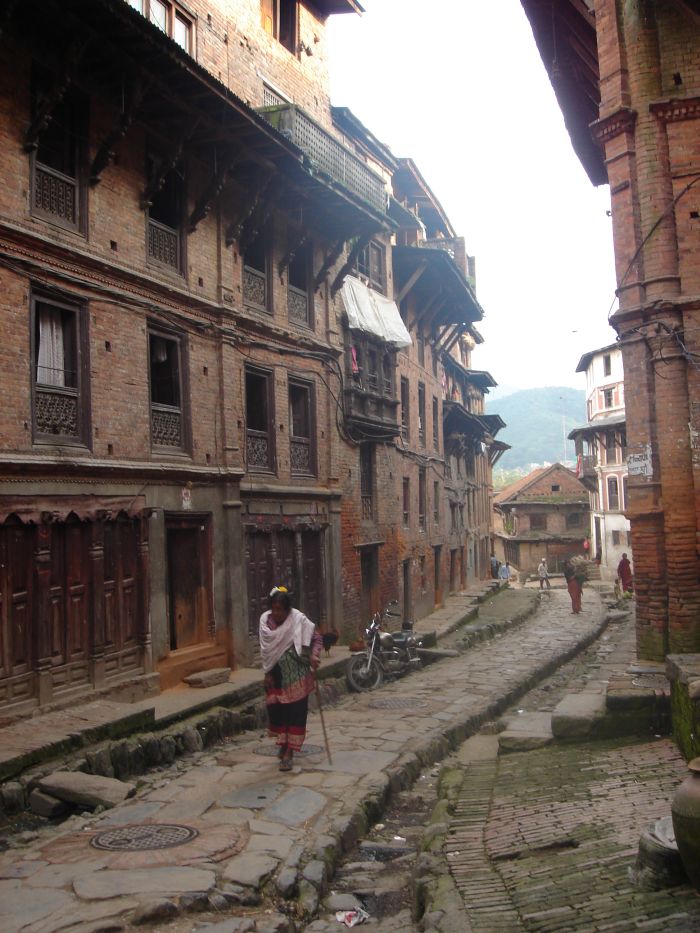
One such road leads to Bhaktapur, a sort of medieval tantric city frozen in a time-warp. No electric signboards, no heavy vehicles within city limits, no blaring music from shoppe corners and no modern, concrete buildings. In fact, there are no buildings more than 4 stories or so high - it's in the local code.

Bhaktapur was designed in the shape of a semi-mandala with the Eight Mother Goddesses (ashtamatrikas) at various corners, protecting the city. A goddess temple is the centrepiece and heart of the city. This protection is ritually renewed every year with the elaborate cycle of festivals and observances for the various protector deities. The old gods live on in Bhaktapur.

There are no paved, blacktop roads - all the roads and narrow winding lanes are cobblestone and brick. Even the newer buildings are built according to traditional form. There is nothing like a supermarket or mall, only the open air market on the square, with vegetables, jeans and t-shirts being sold on the sunbaked brick. The over-30 generation stride by with dignity wearing their traditional red-and-black Pataasi saris and earsfull of gold button-like rings. For the men, topi, walking stick, and kurta-salwar are de rigeur.


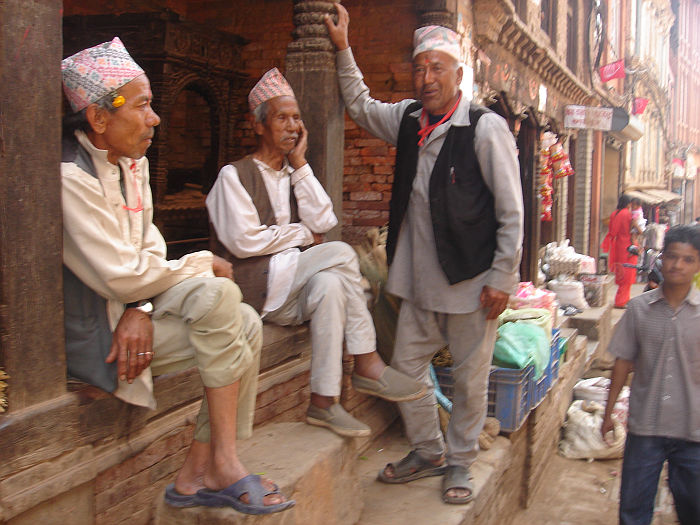
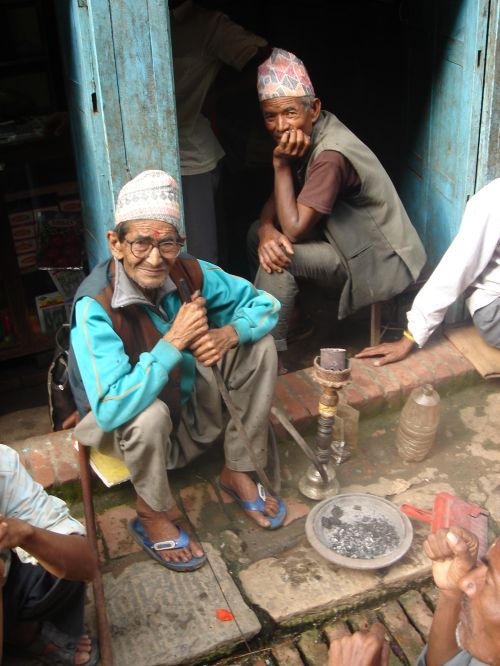
Every house has "an old folk" sitting out front. I can't imagine these people putting their elders away in a home. Even up to a very ripe age, they are active and doing work inside the home as well as out in the market. Women sit in the sunshine knitting hats and sweaters, processing yarn on spinning wheels, sifting rice, sorting lentils. Men are often seen herding small bunches of goats or sheep with a stick...but the elder gents are usually just chit-chatting or enjoying a hukka pipe.

Just one hour from Kathmandu by local bus, the bricks of Bhaktapur just ooze old-world charm. Probably the teenagers who live there are terribly bored - there is certainly nothing more racy or modern than the local internet cafe, for them. Many of the young people are busy learning the traditional arts of thangka (Buddhist religious scroll) painting, intricate woodcarving, mask-making, brasswork, and crafting traditional musical instruments.

Bhaktapur is home to the Nepali and Newari traditional arts, all of which are entertwined with the religious beliefs of the area. The Kathmandu University School of Music makes its home there in a brick bungalow complex by the riverside at Chuping Ghat. Their gardens, though modest, would not look out of place in the south of France - that is, if there were Hindu temples and shrines in the middle of the French courtyards.

Here are just a few of the 100s of photos I took while in Bhaktapur during Gai Jatra.

Kathmandu Weather Report: Wonderfully cool mornings till about 10, humid afternoons usually with cloud cover; afternoon rainfall,;pleasant evenings (after 6pm). The mosquitos are mostly gone now.