Sunday, August 31, 2008
Still haven't found what I'm looking for
Blogosphere
Sometime last year, DesiPundit ran a summary of a blogger's Greatest Attempted Hits. Most bloggers track USPs and referrals via something like Sitemeter; this guy (sorry, I can't remember his name) had listed the Top 20 Search Requests that had resulted in his page.
In other words, What People Were Really Looking For when they landed on his blog.
This week, I had some really interesting ones. I have taken out the weird machine-code between the keywords.
It's always gratifying when people look for "sirensongs" or "feringhee" or one of my other signature keywords. Heck, believe it or not, more than a few people even Google "Indologist at large."
I'm also pleased to see a number of people looking for Indian and related travel advice:
"dakshineswar temple"
"sudder street"calcutta backpacker accomodation
"dried foods ladakh"
"types of amoebas"
"bhutan altitude sickness death"
"licchavi democracy"
"meaning of teertha"
Or even names of my specific blogs or photos:
"organic orphanage"
"flower girl"
As usual, there are a few people looking for
"hot indian girls"
--who isn't? ;-)
Since I went to visit Ram Bomjom the "Buddha boy" a couple years ago, there are always requests for
bomjom location
"buddha boy" nepal
"mystic buddha boy meta"
Some appear very random indeed, and a bit confused:
"Geezer 2Bindia"
"Gandhi Seven Habits"
"pharma sutical"
But then there are more unusual requests, for
"caitlin derivation"
"what goddess of sri lanka believe in"
"love yourself in tibet alphabet"
and this week's favourite:
"uncut nepali men"
Wednesday, April 16, 2008
Et tu, Tawang?
News from Arunachal
Wellll, it seems Nepal, or the Nepalese Autonomous Region of China, is not the only Chinese "client state" toeing the line from Beijing, when it comes to permitting Tibetan protests.
This just in from rediff.com.
Authorities of (the Indian state) Arunachal Pradesh, bordering China, have declared the state 'sensitive' and 'a risky place' to hold any pro-Tibetan demonstrations.
Thanks Gods someone isn't taking it lying down.
"We are proud to be Indians, and the government should protect the interest of the people who have been living under the constant fear of a Chinese incursion. The 1962 Chinese aggression in which the People's Liberation Army came down to occupy Indian territory beyond Tawang and Bomdila in West Kameng district should not be allowed again," Padma Shri award-winning monk Thupten Phuntsok said.
"The people of Tawang and Tibet have a strong bond of religion and culture, and the government should also permit peaceful demonstrations in protest against the scores of Tibetans killed, tortured and maimed in Tibet by China," he added.
MLA Tsona Rinpocha from Tawang district said the policy of successive governments towards protection of the Sino-Indian border in Arunachal Pradesh had been 'weak'.
This isn't just the usual paranoia, folks:He cited the razing of a Buddha statue and occupation of seven kilometres of local grazing grounds in Samdurang Valley by China since 1986 to drive home his point.
Tuesday, January 15, 2008
Kvetch Beyond Borders
though they tantalizingly leave open "amount of extension requested," in fact they never grant more than 2 weeks. So, it took me 2 weeks to get 2 more weeks. And, about five various office trips. The icing on the cake will be a personal visit from a police officer to my hotel tomorrow morning "sometime before 1pm" (sounds like waiting for the cable guy).
full turbans, Africans with braided hair, women in burqas, Burmese monks in orange robes) I went for a long walk in Lodi Gardens. After watching a family of wild green parrots nestle down for the night (they live in a hollow tree), and playing with not one but two Basset hounds - plus a bunch of the less pedigreed local hounds who live in the park - I almost felt normal.
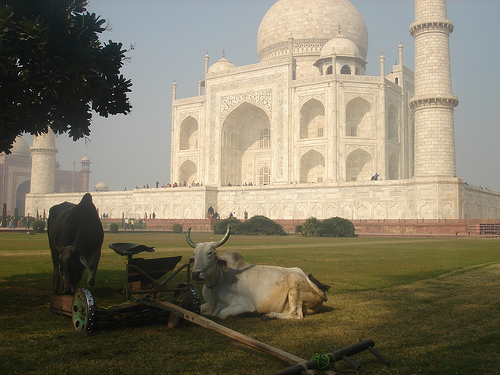
These beautiful bullocks (in America we call them "Brahma bulls") pull the old-fashioned grass cutter at the Taj Mahal, then eat the results.I wish I had been able to get the whole Taj without including the ugly metal fence in foreground.
I mean, India has always made such a big deal about doing everything on their own terms and in their own way...why are they racing to match the standards of the developed world in all the least desirable categories?
Saturday, January 12, 2008
The envelope, please
Delhi
So here's the upshot (not the end!) of yesterday's Foreigners' Office story. (I am so sure you are fascinated....)
I returned (along with many others) to the Home Affairs Ministry at 4.30 pm to await my fate. While waiting I met some Ugandans, Pakistanis, and a Mexican Hare Krishna devotee wearing full dhoti and kasturi tilak. The Mexican man was married to an Indian citizen, but this didn't help his status much within the country.
An Indian-origin woman living in Miami, was having trouble getting an extension because she had now been a US citizen and passport holder for 37 years. The office claimed there was no proof of her Indian origin, which technically, I suppose, was true. Her US passport said "place of birth: INDIA," but "even that is not enough, they say."
All these people, including myself, were petitioning for permission to stay a bit longer on this visa. But one Norwegian couple were desperate just to get out, and couldn't even get the exit permission.
How had this happened? Why was it so difficult to get OUT of the country?
The Norwegian woman, who was in tears, explained the story to me. They had first been in Varanasi, where all their bags, passports and everything, had been stolen. The Norwegian Embassy had issued an emergency passport/travel document - but of course, this did not contain any evidence of their original proper Indian visas. Under such circumstances, you must get permission from Home Affairs before exiting the country.
As if it wasn't enough to be robbed blind, the man had then dislocated his shoulder in a surfing mishap down in Kerala. (I didn't know people surfed in Kerala; learn something new every day.) They were told they could not fly home directly from Kerala, but had to report to Delhi for exit permission.
I could see the lymph fluid (or something) oozing from his shoulder and seeping through his cotton shirt. He must have been in a great deal of pain. They wanted to leave the country for Norway right away.
As it was a Friday, the office claimed they would have to wait the entire weekend till Monday when the case could be reviewed properly. (I think I mentioned before that the office only accepts incoming applications from 9am to 12pm. The couple had made that deadline, but for some reason weren't going to be given a result the same day.)
Finally they were given the fateful sealed plain brown envelope, to be opened only by the FRRO in RK Puram, another part of town. They set off full of hope (and probably full of painkillers) at 4.45 pm in an Ambassador taxi.
The rest of us received our plain brown wrappers with instructions NOT to open them, and to report to RK Puram office on Monday morning. Which for many of us, means an entire weekend without valid papers. Fortunately, I've learned to live with a great degree of ambiguity.
Thursday, January 10, 2008
In the footsteps
Delhi
Thanks to my incredible lack of foresight, I have only a minute on the laptop battery this time, but that's enough
to tell about a very overlooked, and centrally located, Delhi historical site. Most guidebooks mention Raj Ghat, the location where Mahatma Gandhi was cremated. (This site was in the news in 2006 when George W. Bush paid a visit. Some people complained about the hypocrisy. I think, if anyone ever needed to get Gandhi's vibes, it would be Dubya.)
But very few guidebooks (none that I have yet seen) seem to mention Gandhi Smriti. This is the house and gardens where Gandhi was assassinated by a Hindu nationalist hardliner, and died on 30 January, 1947. The road is now called Tees January Marg (30th January Road). The building was formerly known as Birla House. For various reasons (explained in the exhibit) Gandhi stayed, for the final 144 days of his life, as a guest of the wealthy Birla industrialists, rather than among the poorer neighborhoods as was his habit.
Admission is free, which seems appropriate, but I certainly wouldn't mind paying a bit to support it.
It's more than worthy of your time. At the moment, Gandhi Smriti hosts an exhaustive photo exhibit of events leading up to the 1857 War of Independence (formerly called the Sepoy Mutiny). It all looked very informative but I just could not digest all the historical information in one standing - I was too overcome with Gandhi's vibe.
I'm neither one of those foreign Gandhi-worshippers who think he was a saint, nor one of the cynics who takes joy in poking holes in him. To me he was a man, and that makes what he achieved and represented all the more amazing.
I am also aware that some historians, and Indians, and Indian historians, say he and his contributions aren't all they were cracked up to be. I'm sure they have a point, and someday I will get around to reading the rebuttals. But today I just bathed in Gandhi's energy, which is still all over the room and garden.
Especially moving is a glass wall case holding his very few worldly possessio
ns, including the famous pair of round eyeglasses. I got a weird flash-forward (or is it backward?) to John Lennon and his schoolboy specs. In keeping with Hindu tradition (but rather eerie for those not accustomed to this) are the footsteps set in stone, in the shape of traditional wooden sandals. I think they are called paduka. They immortalize Gandhi's last walk from the ground-floor room, where he lived on a jute mat and mattress on the floor, to the garden for the final prayer meeting.
A flowering tree with vivid pink blooms grows right above the doorway, showering petals down on the path. I picked up a handful and placed one on each paduka. I was surprised that more offerings weren't there. The exact spot where Gandhi fell (uttering "hey Ram") is marked with a marble column.
The final panel in the Independence exhibit was headed, "Let it not be said that Gandhi was party to India's vivisection." He is then quoted as saying something along the lines of "I pray that God not let me see the division of India" (Partition of India and Pakistan). Since I am neither Indian, Pakistani, Bangladeshi, Muslim nor Hindu, I can't explain logically the very deep resistance and resentment I have always felt about the Partition. But at least I know I am not alone in my strong feelings.
A power cut stopped short my viewing of the indoor exhibits, which seemed strangely appropriate. And so, too, is my laptop battery cutting short this post.
Friday, January 04, 2008
Tomb of the unknown Mughal
Chanakyapuri & Nizamuddin, Delhi
After spending the better
part of a day running from one office (used to be the Foreigners' Regional Registration office, but that shifted some three years ago...not reflected on maps of course) to another (yes, this is the FRRO but you need to go to yet another Foreigners' office, in another part of town) to yet a third (yes, this is the right office but despite the fact that we're all present and it's only 3pm, you will have to come back Monday between 10 and 12 only) - after such a day, what I wanted was a little escapism.(Just in case you have to pay them a visit, the FRRO is currently out near the Hyatt Hotel in an area called Bhikaji Cama Place, Ramakrishna Puram. None of the guidebooks show this yet. They all show it as still in Hans Bhavan near Pragati Maidan. )
(Long ago, back in the heady days of the early 80s, I owned an ancient James Brown 45rpm record called "Escapism (Parts 1 & 2)." For those of you who have never seen a 45rpm, Part 1 was on side 1 and part 2 was on
what we used to call the B-side. James pronounced it eee-SKAY-pizm. It's probably worth a lot of money now, wherever it is. Other than a chance to mention James Brown, there is no point to this anecdote, so I will stop now.)As I have mentioned before, Delhi has a lot in common with Washington, DC. Both cities are national capitols, obviously, but it goes beyond that. They share very well-planned streets, meticulous greenways, many museums, lots of white marble, and lots and LOTS of memorials.
Luckily, the third office (called Jaisalmer House, for the curious) was walking distance from the giant Arc-de-Triomphe-like India Gate, which I had never seen properly, so I took a stroll. India Gate and surrounding well-groomed grounds were full of tourists, hawkers (selling everything from cotton candy to plastic beads to slices of star-fruit to my favourite orange popsicles), armed guards and police, and the crew of men erecting scaffolding and awnings for upcoming Republic Day (January 26).
Republic Day is an annual mega-spectacle of patriotism, pageantry and military might.
I have never seen it on location - frankly you probably get a better view with less hassle on the national TV coverage. I love the way each state chooses a theme for their parade float. Bihar, surprisingly enough, usually chooses "the Buddha" rather than kidnapping or corruption, and Gujarat has chosen to stay away - so far- from the popular "communal violence" theme. I think this year the float will just be a giant mockup of Narendra Modi's big fat face with dozens of people wearing the Modi Mask riding aboard. The India Gate is essentially a war memorial, engraved all over with names of Indian who gave their lives in various wars. I wondered if there were always so many armed guards - you can't even walk under the arch or touch the pillars (which are at a considerable distance from the arch itself). Are all national symbols being guarded so fiercely in today's terrorist environment? Or, was it just in the run-up to Republic Day?
For those of you who haven't been to India yet (like my 2 sisters -though they say they are coming this year), watching the tent-masters erect these pavilions and awnings is a uniquely Indian experience. Very few buildings are large enough to house Indian crowds, so we just make a temporary "building" outdoors.
If you have seen the movie Monsoon Wedding, you have some idea of the process. Out of nowhere, a green field or dusty lot will be transformed with cloth walls and roofing (and sometimes even jute carpet flooring) for 1000s of people. Using bamboo poles, hand-made bamboo ladders, kilometres of jute rope and acres of cloth sheeting, the tent-wallahs were constructing awnings, railings and so on to protect 10s of thousands on Republic Day. A street dog had found a comfy bed, crashed out atop a coil of rope four feet high.
On the peacock lawn
Dusk was approaching and I realized I was a Delhi stone's throw from Humayan's Tomb, a World Heritage site
that has been on my to-see list forever. So I splurged on yet another autorickshaw (40Rs from India Gate) to Nizamuddin. Admission is supposed to be $5 for foreigners, but as they have set the rate at 250Rs it is now $6.00.It's worth it. Humayan's Tomb was the first of its kind (Mughal four-quartered gardens with tombs) and evidently the prototype for the Taj Mahal. It's not just one tomb, it is an enormous enclave of geometric gardens, waterways, fountains and several giant tombs, built in the 1570s - any one of which would be worth seeing on its own. The purple haze of twilight gives the buildings a romantic, lost-civilization feel.
Since it was nearing closing time, I hurried through the first two mausoleums, which already felt like something from an orientalist Arabian Nights scenario - octagonal buildings of marble, onion domes, marble latticework windows surrounded by date palm trees. In fact I would recommend going in the morning - the complex opens at dawn - in hopes of seeing sunlight filter through the intricate patterns of lacey marble.
Then I caught a glimpse of the main attraction through the mammoth arched gateway. I couldn't help breathing "Ohhhh!"
The actual tomb of Humayan is a dream, glowing in red sandstone. It is elegant and ornate without ever being garish or baroque. Every one of its many marble-jali windows seemed to have a different geometric pattern, echoed in the marble inlays on the floor.
A gaggle of western art students emerged from the front archway, clutching their sketch books, now filled with the geometric designs. As the sun sank, a call to prayer went up from the neighboring DhamDhama Sikh Gurudwara, with its own dome visible just over the ancient fence. Okay, wrong religion historically, but to hear such devotional music in that setting at sunset really makes my spirit soar. Bright green parrots shrieked as they streaked around the sky.
On Global Voices
Yesterday's post about dynastic democracies made it to Global Voices. If I had known people were actually reading it, I would have put more work into it....
Wednesday, January 02, 2008
Delhi Days
Delhi
When you are losing your sanity because of bureaucratic runarounds in Delhi (no names please), and suffering from post-Ladakhitis and
the stench of the dead Yamuna, here are a few places to go where you can breathe relatively easily.Lodi Gardens in South Delhi. This is a lovely, clean, green space filled with trees, grass, dog walkers and Mughal mausoleums. Really classy. And it's in between two major historic sites, Safdarjung's Tomb and Humayan's Tomb. Admission is free to the Gardens.
The Hauz Khas Deer Park is another verdant, safe, shady relatively clean park, not as well known as others....I think there are even a few deer still there. There is a small admission fee (like 10Rs).
Hauz Khas is a semi-trendy neighborhood in South Delhi. (I like South Delhi, I just cannot afford to stay there.) After your walk, you can complete the feeling of being in western Suburbia by visiting the local Pizza Hut. (!)
The Metro does not run directly to these locations; your best bet for Hauz Khas is to get in an autorickshaw. Humayan's Tomb is in an area called Nizamuddin, reachable by the #459 bus from Connaught Place.
Jantar Mantar is very centrally located, just walking distance from Connaught Place. Its array of salmon-coloured abstract formations, which look like modern sculpture, are actually a 300-year-old Mughal outdoor observatory. All kinds of sundials and stepped pyramidal formations dot the park like giant building blocks. I think there are still astronomers around who can read these instruments. At one time there were five Jantar Mantar ("Yantra Mantras") - in cluding Delhi, Jaipur, Udaipur, Varanasi. The largest is still in Jaipur.
Jantar Mantar has also become the place of choice for "staging a dharna" (holding a demonstration or protest).
There is a $2 (or about 90rs, which is actually now more than $2) admission fee for foreigners to JM...but I suggest trying the unmanned back gate.
Seven Cities in One
Delhi is just really, really vast and was made in a very ad-hoc way ( it is actually 7 historical cities adjoining one another and overlapping) so different areas vary wildly.
Another nice thing about Delhi is that there are enough foreigners living here residentially, for various non-touring reasons, that we do not excite so much attention. It is still definitely an Indian place - but a cosmopolitan one.
Delhi has gotten a reputation for crime, especially against women, so I am now careful to get home by about 9 or 10pm. The Metro, one of Delhi's star attractions for this budget traveler, stops running at 11pm.
Wednesday, December 05, 2007
A few of my favourite things
This morning I heard drums outside the guest house. Tsering said because
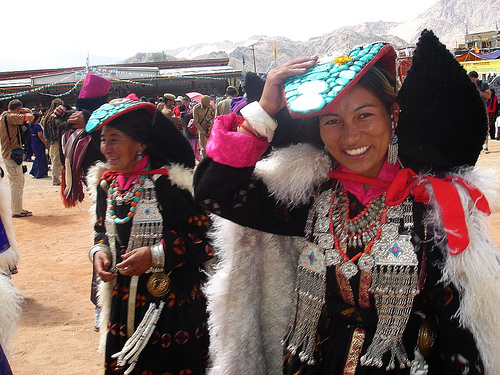
it is the first day of Ladakhi Losar (the New Year celebration which ends on the 10th), the traditional drummers are making the rounds.
Ladakh has its own sort of Buddhist caste system, and musicians are a distinct group known as the Mon. Dancers, singers and musicians used to be a separate caste in most parts of India. Tsering said they go around playing the daman (drum) and surna (a kind of clarinet or shenai) in every neighborhood asking for money.
"In the old days," he said, "we used to give only tsampa (barley) powder, chappati, food, like that. Now we are expected to give some cash," he smiled. How much? "Oh, ten, twenty rupees, like that." So it's a bit like Ladakhi trick-or-treating.
-a single file line of fuzzy grey donkeys, their colour identical to that of the surrounding mountains, trudging slowly up the street in search of some prime scavenging. They always remind me of the manger scene in the Christmas Story.
them are from Bihar, Nepal or UP. The brief conversations we were able to have (in my bad Hindi) confirmed this.-Old men and women selling baskets of dried apricots -- with faces that look also like dried apricots. Also, classic-looking elder men sitting in the afternoon sun in front of the mosque, with faces, hats, beards, and robes that bring to mind romanticized images of Silk Road traders.
-Glancing upward from almost anywhere around town and seeing the 400 year old Leh Palace originally built by (or rather, for) King Singge Namgyal. It's like a little mini-
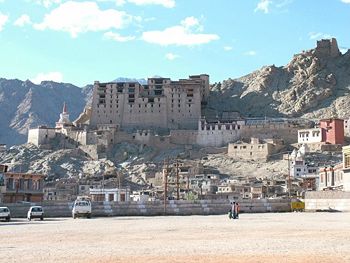
Potala just minutes away (in fact it is said to have been modeled on the Potala. Another version I heard said the Potala was modeled on Leh Palace!) (the Palace photo above is from Wikipedia). Higher still is the Tsemo Gompa, looking like a kid's bucket sandcastle after a wave hit it. A lone monk still climbs up once every morning and evening to look after the shrines and light lamps in the crumbling former monastery.
-Hitchhiking (still acceptable, common and safe here) . Distances are vast, and it's rare that a driver does not stop. Sometimes on a deserted road, drivers even stop voluntarily to ask if you are "okay." (No, it is not just because I am a foreign female - almost everyone thumbs a ride here in Ladakh.)
-Cheerful, confident women of all ages striding down the street, unaccompanied by men, with none of the "please don't hit me" body language shared by so many Indian women.
-Single women running businesses, including restaurants, all on their own. No men in sight. No one says anything, no one hassles them, and nobody blinks an eye.
-The wicker baskets (actually woven willow) used by the women to carry vegetables on their backs, to and from the Bazaar market.
-only washing my hair once a week. It's so cold, no one is looking and I just throw a hat on it every day, anyway!
Monday, December 03, 2007
Real Kashmiri Kawa
A big "lorry" or truck was parked in the main street, almost in front of the Buddhist Gompa. Two lines of people snaked out behind - one for women, the other for men. (This is "normal" in India, but it's the
first time I had noticed such line segregation in Ladakh.) Everyone - grandmothers, small children in school uniforms and so on - was holding every kind of vessel you could possibly imagine. Plastic pop bottles, stainless steel "tiffin" containers, old plastic jugs with handles, and so on.It was the dudh-wallah, or milkman, or in this case milk men. Men inside the covered truck bed dipped into old-fashioned metal milk cans, the kind Americans now think are quaint decorations for their front porches. Then they poured opaque white liquid into each container.
The lines were long (probably forty people in each line) and the process slow. Everyone was bundled up in a cross-cultural mix of cheap down vests, knit ski hats, woollen goncha robes and running shoes. The painted side of the blue-and-white truck said something like, "Ladakhi Valley Milk Concern, Chuchot Village." Chuchot village is about 1/2 hour away by bus.
I had already noticed the absence of milk in many stores. You can often buy the government-issued homogenized milk ("Amul Taaza") which comes in a plasticky box. For travling and for emergencies, which are frequent, there's milk powder (like Carnation instant milk). Also, the abi-les (grandmothers) who sell vegetables on the Main Bazaar sell milk in old plastic mineral water bottles. (They also sell blue kerosene the same way; hopefully they don't reuse the bottles for milk.)
I joined the women's line and started snapping photos. Actually, the men were much happier to have their photos taken. It's funny, before a certain age (before puberty) and after a certain age (maybe after 50), it is more "okay" to photograph women and girls. During the reproductive years, they feel obligated to be more demure.
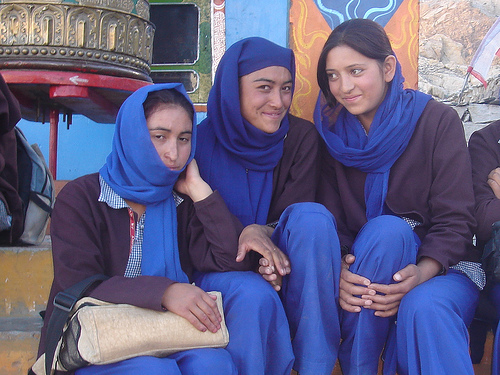
On the sidelines were three adorable little Muslim schoolgirls with green uniform crested blazers, book bags, and white headscarves. The headscarves
somehow make them more beautiful - like a frame for their faces. The little ones were being shepherded by an older (teenaged) girl in the same attire.I squatted down to their eye level and asked if I could photograph them. "Photo thik hai?" They agreed, but didn't look very comfortable. They are so serious in these photos... most of their natural beauty is hidden behind a sort of grimace. (!) I think more time is required to gain their trust.
I asked the older girl if I could then photograph her. "Sorry, no," she smiled. She looked sincerely regretful. All the girls had that handsome combination of Mongolian, Central Asian and Indian features, along with pink-white wind kissed cheeks, that adds up to uniquely "Ladakhi."
Now Nepal is actually inviting the famous/notorious Tibet Railway - widely recognized as a major factor in diminishing Tibetan presence within Tibet itself - to be extended to Nepali borders. I think Nepal thinks this means greater access to Chinese goods, and with that, greater ability to tell India to shove off. In your face India! Nyaah Nyaah Nyaah!
Thursday, November 29, 2007
Golden Years
Lama Watch: Amritsar, Punjab
Today HH the Dalai Lama opened a 4-day inter-faith conference at Amritsar.
This wasn't announced publicly (at least not up here) till a couple days ago - otherwise I would have made tracks to Punjab. Flights out of Leh were full!

Here is the adorable photo from Rediff.com news. Note the big, burly Khampa Tibetan security guards on either side of him, wearing the mandatory white kerchiefs required by the Golden Temple.
I especially enjoyed the comments the (presumably Indian) readers made, below the story.
Things like:
This man is truly a saint...
i think he is beyond religion..i am proud that India had the honour to Shelter...nay be blessed by his presence...
and
i always get smile to see him. he is wonderful human .
and, more politically, in response to a critical Chinese reader:
As far as I know, India as well as all Indians respect One China Policy. We can not understand why China or Chinese doubt this fact!! Only thing we request Chinese people is to respect and accept the social, religious and cultural freedom of different chinese communities such as Tibetans. Even his holyness Dalai Lama has accepted Chinese political authority over tibet. But he asks for cultural, social and religious freedom for his people. When will China understand this?
Back in the heady post-independence days of the 1950s, India was very pro-Communist. Many people seem to have imbibed a lot of pro-Communist and therefore pro-Chinese ideas at that time. A well-known example is N. Ram, editor of the major newspaper The Hindu, who is always printing pro-China and anti-DL stuff. It is heartening to me to see Indians articulate views like those of the readers above.
I just hope they extend the same respect to the Tibetan people at large, once the inevitable, unthinkable happens and this particular iconic DL incarnation is no more.
(Although I have been lucky enough to photograph HH a number of times, this wonderful photo above is not mine. It is by Manpreet Romana of GettyImages/Agence France Presse. I hope he/they don't mind my sharing it here. )
Successful succession?
People always ask me (once they find out I am, in fact, some kind of weird Dalai-Head whose life is mostly devoted to following the Dalai Lama around) ---they always ask me, "Has the Dalai Lama picked his successor yet?"
Some say, "I heard he may refuse to pick his successor." or, "Isn't there a prophecy that he will be the last Dalai Lama?"
Other people are a bit confused by the figure of 22-year-old HH the Gyalwa Karmapa, who is so often photographed holding hands with the Big DL.
"Is that monk going to be the new Dalai Lama someday?" several people have asked me. Which is sort of like saying, "When I die, will you take over being me?" The Karmapa has already been incarnated as The Karmapa. He can't change identities in mid-life. (He very well may, however, assume the de facto role of leadership of the Tibetan community.)
In fact, the Dalai Lamas have never named or hand-picked their successors, in the 600- or-so-years of the office. The tradition has always been that after the DL's passing ("leaving his body,") the inner circle of senior rinpoches and lamas (after a suitable period of a year or so) look for signs and omens, indicating where the newborn Lama will be found.
The high lamas examine their dreams, and they all have training in how to "read" the symbols in the universe. Things like "I saw a crane flying east" or "I had a dream about a lake near Taktser" all have an agreed-upon, shared meaning - or at least they did 60 years ago, in Tibetan monastic life.
Obviously, things are more complicated now, to say the least. (For more background, the best books to read are In Exile from the Land of Snows by John Avedon and Freedom In Exile by HH Dalai Lama).
This has led HHDL to announce that, following the tradition of conscious reincarnation, he will definitely choose NOT to be reborn in Chinese-occupied Tibet. "If my death comes when we are still in a refugee status, then logically my reincarnation will come outside Tibet," he said on the sidelines of an inter-faith meeting in the Sikh holy city.
That way, the Chinese government cannot hand-pick their own "Dalai Lama" and claim authenticity - they way they have with the 11th Panchen Lama.
The latest has HH saying that not only will he not be reincarnated in Chinese-occupied Tibet, he will perhaps "skip reincarnation" altogether, and choose for the first time to hand-pick a successor. The really hilarious bit is that the Chinese government condemned this statement as a "breach of religious protocol."
Like they would know. But the Dalai Lama has always maintained that it should be "up to the Tibetan people" whether the tradition of Dalai Lama should even be maintained.
Now he says it may be time for a radical break with tradition - In the most recent statements, HH announced there may be a public referendum on the issue when the time comes.
While the sun shines
In the meantime, HH is racking up the international frequent flyer points, meaning he is in India these days only about 50% of the time. I see him as a figure like Gandhi - a once in a generation icon of peace. So, I'll soon be on my way to see him in Karnataka, south India. There are lots of other places in India I'd like to go, but things like Khajuraho and the Taj Mahal will be there in 10 years, for sure. Unfortunately we can't say the same for HH.
Sunday, November 25, 2007
Ladakhi Lunchbox
Leh, Ladakh
It's lunchtime in Ladakh, and all the
tourist places (with salads, pizza, and lasagne) are closed, boarded up for the winter. Where do you eat? What do you eat? Most days, I get a delicious vegetarian thali at Leh Chen Restaurant, which is just a tiny hole in the wall on Fort Road. It's run by a Nepali family from Sindhupalchowk who have 2 beautiful little girls.
A "thali" is kind of like the old cafeteria lunch tray, with separated sections. I get rice; a "dal" or lentil (black, yellow, green - it changes) for protein; two types of vegetables (often it's potato-peas and eggplant), 2 chapati & one papad (that's homemade bread for all you non-Indians), pickle (mmmm.....) and hot water. It is traditional to drink hot water all day long here. It's also part of Tibetan medicine. Everywhere there are Tibetans, there's "chu skor" or hot water being served in big thermoses....all day long, all year long.
In traditional north Indian fashion, they also give me a side dish of raw onions and green chili. I don't touch these. A South Indian thali would have mandatory yogurt included.
All that, plus refills on the lentils, rice and papad, for 45 Rupees (about $1.15).
But that is Indo-Nepali food. What about real Ladakhi food?
It's hard to find traditional Ladakhi food in any restaurant. Most of the tourist trade and restaurant biz is run by Tibetans, Nepalis, and Indians. They serve good Indian food like the above veg thali, or Tibetan stuff like thukpa noodle soup, then-tuk (another kind of noodle soup), mo-mos (dumplings), ting-mo (steamed bread) and butter tea. ("gur gur cha").
Since the Women's Alliance kitchen closed down due to lack of participation (they had great food!), and since the Ladakh Festival is over (there was one vendor there with authentic Ladakhi food), there is only ONE place in town to get actual Ladakhi fare.
The Aluya Restaurant (stands for All Ladakh Unemployed Youth Alliance) is run by a few women, in the middle of the town square and is one of the only places you can always, always count on being open, from about 8AM till 7PM.
Ladakhi food is a lot like Tibetan, with a few more vegetables. It is all very filling, and starchy, and based on either buckwheat, wheat or barley (sorry, I don't know for sure which is really being used. Translation problems).
Here are some tradtional Ladakhi dishes I have tried:
Chu Tagi: a sort of bow-tie shaped pasta filled with potato and served with chunks of carrots, potato and sometimes local greens (which they erroneously call "spinach...." --it's more like collard greens) in a sauce.
Drue: another wheat pasta with sauce of ground apricots. Drue was never available when I visited. Sounds yummy though....
Skyue: yet another pasta shaped like little caps or gumdrops, with same vegetables in sauce as Chu Tagi. Chu Tagi tastes better to me, though....
and my very favourite which is NOT available at Aluya right now is, I think, called
Tsu Tsu: --it is a buckwheat pancake, served either with homemade apricot jam (in breakfast time) or with dal and pickles at lunch time. Tsu Tsu is a sort of Ladakhi Dosa - a crepe-like bread.
Always available for breakfast, though, is the heavy dark Ladakhi pita-type pocket bread, "khambir." It's served piping hot with butter and locally made apricot jam.
The regional staple (all over the Tibetan plateau) is Tsampa - roasted barley flour. I have developed a genuine taste for Tsampa. It gives you a slow-energy release that is really helpful especially in cold weather. Tsampa looks like chalk and always reminds me of being a kid when I used to sneak unbaked Pillsbury biscuit dough off the counter. Or, a bit like eating Play-Doh (didn't you ever try to eat it? come on!!).
Tsampa is used for everything; I dump it in the namkeen tea (another name for gurgur cha or salty buttery tea) and stir it in to make kind of a grainy milkshake. In the same way it is dumped into Chang or home made barley beer for fortification. You can also stir it into yogurt (for breakfast), or into your noodle soup for extra thickening.
I know Tibetan refugees who crossed the mountains into Nepal with nothing but bags of tsampa powder. They mix it with water to make a paste and it's enough to sustain them.
Snack pack
All varieties (--except the really good ones pitted sweet ones that Dzomsa sells in season) - of dried apricots, including apricot nuts, as well as raisins, peanuts and sometimes cashews from Tamil Nadu , be bought in bulk on the street....along with that disgusting dried yak cheese. I don't know how anyone eats this cheese, which is dried into hard bits of stringy...hard stringiness. I can't chew it at all.
Dzomo (the female version of a Dzo, or yak-cow hybrid) butter is sold on the street from mangey looking barrels covered in fur. I can't figure it out; it really looks like they have chopped off a dzo's leg, hollowed it out and filled it with this rank butter. What is the fur for?
Of course, the person selling the dzomo butter is always a rugged country person who can't explain it to me in English, either, so the mystery continues. Dzomo butter definitely has a tang and a gamey smell that repels me.
I mentioned Seabuckthorn juice before. It is full of antioxidants, and very bitter so some sugar must be added for drinking. I have seen the packaged juice in other Indian states. The commercial name is "Leh Berry." I wonder how much antioxidant is actually remaining after processing, though. Unfortunately the places serving homemade juice are closed now and it's available only in the packaged form.
Apricot Jam, Apricot Juice, Apricot Nuts and Seabuckthorn juice could potentially all be major exports from Ladakh. The jam is just out of this world...I cannot go back to eating that horrible red food-colouring jam (supposedly it's "Mixed Fruit") they serve everywhere in India, ever again!
Vanishing Victuals
The sad thing is that it's all you can do to find this food, outside of a Ladakhi home, anymore. Even small restaurants in rural areas and shops run by Ladakhis are not likely to have these things (except dried apricots, which are in every shop).
What they are guaranteed to have is:
-packaged Maggi Noodles. Experienced Indian travelers will groan at this. It's the Indian equivalent of Ramen Noodles. Instant noodles with a flavour packet.
-Sugary Indian tea or chai
-Chappati
-Every shop has pre-packaged manufactured snacks (aloo bhujia, namkeens, moong dal etc) from mainland India, which are wrapped in shiny colourful mylar plastic. The streets and gutters are littered with them!
Friday, November 23, 2007
Friday Faces
Leh, Ladakh
I just came from the Jamma Masjid ("Friday Mosque") in the main square of downtown Leh.
Friday is the best time to take photos, because it's the special day for Muslim prayers.I love the way identities are so confusing in Ladakh. People who "look Muslim" turn out to be Buddhist and vice versa. It totally messes with my preconceptions.
My favourites are the old-timers with ravine-filled faces and traditional clothing. When I was much younger, I used to hear people describe the elderly as "beautiful" and thought "yeah right, who would really want to look like that? They are just being polite...."
But now I really find it hard to take interest in photographing most younger people. The older people really are more beautiful.
This afternoon at 1.30 prayers, I was only able to photograph men. (Women generally pray in the home, at least in this area.) I haven't been able to upload today's photos of the old timers yet. So here are some more wonderful Ladakhi faces with the invariable Ladakhi smile.
Can you believe I've never been to the Taj Mahal?
I can't.
After all these years in India, I have been to so many places... but still not the Taj Mahal, definitely the most famous UNESCO World Heritage site in India,
if not the whole world.While browsing the UNESCO website (looking for information about protected rock carvings - the ASI director for Leh swears that such things are not protected by UNESCO, which of course, is not true) - I decided to list all the World Heritage sites I have visited.
Tamil Nadu:
Brihadeshwar Temple
Mahabalipuram monuments including the "Shore Temple"
Maharahstra:
Ellora Caves
Ajanta Caves
Victoria Terminus (recently renamed "Chhatrapati Shivaji Terminus," which peeves me, because Queen Victoria's people built it....it has nothing to do with Shivaji, he was dead a long time before this building was erected; why should he get credit?)
Bihar:
Mahabodhi Temple
Delhi:
The Red Fort
Nepal:
Pashupatinath Temple (foreigners not allowed inside..but they want your money anyway)
Kathmandu Durbar Square (foreigners not allowed in Kumari Ghar or most temples. They still hit you up for entrance fees. Somehow they have it worked out that this makes sense)
Patan Durbar Square (same policy - foreigners not allowed inside temples. Indians, who technically are foreign, are allowed - just not white people)
Bhaktapur Durbar Square (same - foreigners not allowed inside temples)
Boudhanath Stupa
Swayambunath Stupa
Changu Narayan Temple
I have consistently lodged my own one-woman protest at the discriminatory Nepali sites, by never, ever paying the price for buildings I'm not allowed into. (Makes perfect sense to me.) Instead, I have enjoyed the surrounding areas without paying, and now know all the secret back entrances to each of the sites. Write me for details. I don't support places that claim to represent the heritage of "all the peoples of the world, irrespective of the territory on which they are located," and then discriminate based on race. I welcome you do the same.
All the other places listed do charge more for foreigners, but at least the access is equal for all. If I'm going to pay five times as much, I should be able to see the place - that seems more than fair.
The Bus Is Back
Good news, budget Himalayan travellers. The Kathmandu-Lhasa Express is back on the road (as of January).
Too bad the same cannot be said of Nepali politics. Yesterday was originally meant to be the historic elections. It passed without a peep as political infighting continues and fresh violence erupts in the Terai region.
Here's more about the bus:The bus service ran into trouble soon after its start in 2005 and remained suspended. Though resumed again for a
short period in 2006, it has been closed since spring.
Officials in Nepal blame the closure on the Chinese reluctance to issue visas.
Beijing issued visas only to tourists travelling in groups, that too after stringent scrutiny. Travellers had to submit details of their itinerary and accommodation and the bus service was shut down by China on the eve of demonstrations in Tibet or anniversaries of historic days.
The revival of the flagging bus service coincides with the start of the Visit China campaign by Beijing to mark 2008 when it hosts the Olympic Games.
Nepal's state-owned Sajha Yatayat will run the weekly service from Kathmandu, like it did in the past. The pact will be a shot in the arm for the floundering state service, most of whose buses have not been running for over a year after an agitation by employees.
The one-way fare for the three-day trip will be $70.
Full news story here.
Saturday, November 03, 2007
Drought's about
Orme, Tennessee via Leh, Ladakh
Darkhorse from Nashville, Tennessee was kind enough to send this news story from my home state, regarding results of the severe drought down there:
Tennessee Town has run out of water
As twilight falls over this Tennessee town, Mayor Tony Reames drives up a dusty dirt road to the community's towering water tank and begins his nightly ritual in front of a rusty metal valve....Orme, about 40 miles west of Chattanooga and 150 miles northwest of Atlanta, is a town where the worst-case scenario has already come to pass: The water has run out....."You never get used to it," says Cheryl Evans, a 55-year-old who has lived in town all her life. "When you're used to having water and you ain't got it, it's strange. I can't tell you how many times I've turned on the faucet before remembering the water's been cut."
Dear Darkhorse:
For America, that is a shocker. An occasional power blackout in summer is one thing. But no water--!
Here in Ladakh, though, it's no biggie. Damn near all the water here is imported.
Every house that has "running" water has a big plastic Sintex tank on the roof. This has to be delivered and refilled by truck. All the water suppliers are private operators.
As far as I can tell, the "municipality" (city government) has no water infrastructure at all. Water runs all round the district and Leh Valley in literally ancient channels, dug centuries ago by locals to funnel the meltwater off the mountains for irrigation in what is otherwise a desert. This was the traditional version of "running water." Those lucky enough to live right by a stream (ie, not in the city) still wash their clothes, hair, and dishes from these channels.
However, with increased population, increased demand (including from foreign tourists) and increased pollution, it is now necessary for "safe" drinking water to be brought in from outside.
For the less fortunate, who cannot afford to buy/rent a tank and the monthly water refills, water is literally hand delivered. Every day I see bearded Kashmiri men pushing dolly carts loaded with oil barrels, jerry cans, plastic tanks, every possible available container of any size -- pushing these carts and up the streets. They are full of water and must be damned heavy. This is very hard work, sometimes they even have to push them uphill.
Every little family-run restaurant or ordinary home has to have water delivered this way. Every cup of tea I drink in such places has been carried in by hand in plastic can, then boiled before serving to me. The effort!
Now, with the freezing winter weather, most all the "running water" (piped down from the tank) has been cut off. In order to take a bath, I must get water in a bucket directly from the tank. That freezing water has to be heated on the propane stove. I only get one bucket to wash my hair, body and clothes in - even getting one bucket is difficult. Amazingly, I have learned to do this.
That's another story....the propane tanks. These red gas cylinders (which weigh about 16 kgs each) sustain life here. Electricity is unreliable, and very (comparatively) expensive anyway. To make a cup of tea or soup using electric energy would be extravagant. So, everyone except the ultra-poor has a gas burner and a government-issued (is Indian Oil and Indane Gas part of the goverment? I am not sure) red metal gas cylinder. (What do the ultra-poor do? They have kerosene stoves. These horrible, cheap kerosene burners like camp stoves, that take five tries to light. But they are far cheaper than the gas burner and cylinder.)
The cylinders must be acquired from Leh where they have been delivered from the "mainland" by truck, then ferried out to the villages via bus (most passing buses have a fleet of red cans on top, which are then tossed down by the Bus Boy), then lugged on the back of a villager....all the way to the home, monastery or tea shop. And here in the desert, distances are vast. (Thirty minutes is a short walk.)
This is pretty much the case all over India - the well-off people have water tanks. The poor go to the village hand pump and lug khumbhas back on their shoulders, several times a day.
So, when I had my tea at the monasteries this week, I really appreciated what a commodity this was. The water, the hot tea, the gas. It represents a very real expenditure of energy here.
Monday, October 22, 2007
Country Life
Dha, Ladakh, India
Hey, all you back-to-nature, organic, mother Earth types. Ever want to live in a village
with no electricity (only a bit of solar power), no running water, no roads, only composting toilets, no stores or commercial enterprises, no use for cash money, no hotels and no telephones? Have I got a hamlet for you! I just returned from spending nearly six days in a village called Dha, in Kargil district . I had to walk half an hour to the nearby Indian Army post to charge my camera battery. That's my major memory...that and the pristine turquoise-blue Indus river running down the narrow gorge. And, the guy who runs the guest house (cook, janitor, and host all in one) openly picking his nose while he was discussing what I wanted for dinner. And the crisp golden and red trees against the blue sky. And the smell of urine that hit me in the face when I walked in the guest house door. And the flawless golden bundles of freshly harvested millet. And the continually screaming baby! A mixed bag, for sure.
The occasion was a once-in-three-years (I think the technical term is triennial) festival of the Brokpa people who live up there (better known as "the Aryans"). It started off like a Nat Geo TV special and somewhere in the middle threatened to turn into Deliverance.
Anyway, I am still getting over the changes in altitude. From Leh (about 12,000 ft) I went seven hours on the 1970s bus up to Dha, which is only about 10,500 feet. Every 300 metres (1000 feet or so) will mess with your altitude. Fortunately, anti-nausea medication is over the counter here and is now part of my regular travel kit.
Thursday, October 11, 2007
On the Eve of Eid
Leh, Ladakh
Thubsten Sanfan (see previous post) says (through the interpreter) that he doesn't have the almanac for my birth year. Not that it was SO long ago. He has the records for the previous year, and the one before that, and the one following my year. Just not my year. Since I am going to be in the region for a while, we convinced him to go and look in his "library" or perhaps in the Men-Tse-Khang (Tibetan medicine headquarters) for the info.
Tibetan medicine and Ladakhi traditional medicine (known as Amchi) rely on a combination of natural herbs, psychological evaluation of "imbalances" and astrology. So, I figured the Men-Tse-Khang, who also do astrological analysis, should have some ephemera. (An astrological data book showing positions of the planets is called, in English, an Ephemeris.)
It's just about time for Eid el Fitr, the biggest Muslim holiday of the year that marks the end of Ramadan. Ninety-five percent of the Kashmiri merchants have packed up their shawls and jewelery into tin trunks, pulled down the metal gates on their shops and headed for Srinagar. Most of them have wives and family waiting for them there. I think a few Kashmiri and of course Ladakhi Muslims will be here to celebrate Eid.
Eid is a picturesque time; all the men put on spanking new kurtas and topis, and go around ritually embracing one another. Lots of smiles and general good will. My friend Parvez said it's mostly a domestic holiday, a visit to the mosque followed by lots of relatives and friends dropping by, bringing holiday food and feasting and sharing.
I'm getting my Restricted Area Permit together, thanks to the guys at good old Glacier Trek n Travel, to visit Dha-Hanu Valley, home of the last Aryan Buddhists. They will be celebrating their indigenous festival called BoNoNah, which occurs only once ever three years. As I am lucky enough to be here on the third year, it seemed too good to miss.
Sunday, October 07, 2007
Funeral for a yak
Chanspa, Leh, Ladakh
I just saw a yak die. It was so sad and horrible.
It was the beautiful, big black and white yak in the yard just down the road, the one I wrote about a few days ago. When I walked up, it was lying on its right side moaning, gnashing its teeth and gasping for breath.
"HREEEEEEEEEUGGGGHHHH!"
About six people, men and women, were standing around helplessly listening to the hideous groans. At first I though I had stumbled upon some secret harvest ritual of life-and-death (an annual semi-animistic yak sacrifice, perhaps). The beast is so huge and hearty, how could it be sick from natural causes? Had they sliced the yak's throat and left it to bleed? Would they do such a thing?
No. "Kya hua?" I asked the elder Ladakhi man in the yard. In English he said, "It ate the urea." Urea - the fertilizer? "Yes. The urea was left in the yard." He lit a cigarette with resignation and walked around to the yak's other side.
"HREEEEEEEEEEEEEEEEEEEEEUGGGGGHHHHHHHHHHHHH!!!!"screamed the yak. Its stomach was horribly bloated - ballooned into a big hump, looking like one of the surrounding mountains. It was still tied to its stake in the ground where it normally grazed. I thought it horrible that the animal would as it had lived, staked to the ground. I really wanted to leap the stone fence and cradle its enormous head just so it could die looking into someone's eyes. Maybe the people (for whom the yak was probably a considerable expense) would have thought a stupid foreigner was interfering.
And maybe I was, but I felt a real sense of waste and regret coming from the people. This was an unusually big and fine yak, and besides, one would have to be extraordinarily insensitive to not mourn the death of such a striking-looking creature.
I really look forward to seeing this yak every day. I felt like a new neighbor I'd barely gotten to know was dying in front of me, for such a stupid reason, and suffering so badly.
A man who was obviously the vet strode up, carrying two large vials of clear fluid and a giant syringe. He pushed various points on the yak's body and waved his hands in front of its eyes. Then he pronounced it "too late." The poison had been consumed hours ago and was now well on its way through the labyrinth of the poor animal's bowels.
"We could not get the doctor in time," a young Ladakhi lady wearing a headscarf said to me (of her own volition). "Because, it is Sunday."
Then with a mighty roaring moan, the yak's legs raised a bit, sticking straight out; stiffened all the way down to the hooves as though it was bracing itself against the pain, and shuddered into collapse. He was gone.
As the enormous eyes glazed over, I began to think of the next step. The efficacy of eating yak meat on this occasion became obvious. After all, how on earth would they get that bulky body out of the stonewalled yard? Ten men couldn't drag it and it would never fit through the gate. I remember when horses died on the boarding farm when I was a kid, they had to bring a bulldozer to dig the hole big enough, then drag the corpse over unceremoniously and dump it in. That wasn't even available here.
The men moved away. Two women brought out what looked like old flowered bedsheets and covered the body, flower-side down, white side up.
A grandmother in her heavy goncha robe, with long grey braids, thick frosty glasses and toboggan hat, wobbled off down the street. She wailed aloud and beat her chest as though a human had died.
I stumbled into the nearest restaurant, which is an upmarket affair with new-age music playing and lovely views from the terrace. I had to tell someone.
"A yak just died," I said bluntly to the table of young "granola" tourists, obviously mountain bikers and hikers, seated there. As if to back up my claims, the grandmother's wails could be heard behind me."
"The one over there?" said a guy wearing a hand-knit hat. "We saw it every day." I nodded.
"Are you all right?" another guy asked. I thought that was sweet. I must have looked really shaken up.
On the next table, a group of seven sparrows twittered merrily and pillaged the sugar bowl. An innocent Jersey cow calf grazed oblivious across the lane just a few feet from the dead beast. I listlessly drank my coffee and ate porridge, watching the dancing sparrows fight over sugar grains.
Back out on the street, a gentle chocolate-coloured cow was dozing in the sun. I bent down and offered her a scratch behind the ears and chin. Instead of snorting and pushing my hand away, she appeared hypnotized by the touch. She raised her chin far into the air so I could scratch further. I stroked her long, lush eyelashes and wiped some sleep from her liquid eyes.
A central teaching of Buddhism is that "all sentient beings," every living moving creature, share a basic desire to be free of pain, suffering and discomfort. Hinduism says, "May all beings be happy, peaceful and free" (lokah samastaha sukhino bhavatu).
I was angry that someone would leave an animal to graze where fertilizer had carelessly been kept. Yak and cow dung is such good fertilizer, I didn't know people really bothered with other substances here. The illusion of tradition and "being one with nature" in Ladakh started to break down.
When I came back up the path a few hours later, the men were hacking apart the body. One man dug a hole to store the parts in (in frozen winter the ground is as good as a fridge). The others wielded axes. The roots of the legs were the size of bloody tree stumps and I covered my nose against the smell.
.......................
Wikipedia says this about urea:
It was the first organic compound to be artificially synthesized from inorganic starting materials, thus dispelling the concept of vitalism.
Urea can be irritating to skin and eyes. Too high concentrations in the blood can cause damage to organs of the body. Low concentrations of urea such as in urine are not dangerous.
It has been found that urea can cause algal blooms to produce toxins, and urea in runoff from fertilizers may play a role in the increase of toxic blooms.[1]
Repeated or prolonged contact with urea in fertiliser form on the skin may cause dermatitis. The substance also irritates the eyes, the skin and the respiratory tract. The substance decomposes on heating above melting point producing toxic gases. Reacts violently with strong oxidants, nitrites, inorganic chlorides, chlorites and perchlorates causing fire and explosion hazard.