Showing posts with label classical dance. Show all posts

Saturday, August 29, 2009

Reconstructive criticism

Dancing in the semi-dark
Kathmandu and Patan

What's "authentic," what's not, who gets to decide that when it comes to "culture"? -Especially when one is a foreign interloper?

Perhaps it's far from an original question, but it continues to present itself. I continue to learn Newar Charya Nrtya, the Buddhist classical dance of Nepal, and to observe my own reactions to "authenticity," "tradition" and "updation."

Regardless of what the Chennai dance masters will tell you, nearly *all* the Indian "classical dances" were reconstructed from next-to-nothing. (Kerala's Kudiyattam is an exception, I believe, because it was continuously performed without a break in tradition.) That doesn't mean they are not classical, just that they are not as ancient, or entirely as ancient, as often fantasized.

I began to suspect this long ago when my Bharatanatyam teachers had trouble pinning down provenances and answering questions about origins. Given the Indian high esteem for ancient-ness (older the better), this was inconsistent. Being able to cite one's lineage and origin is, almost literally, everything.

(I know "literally" is a very overused word these days, excuse me....)

In trying to revise certain aspects (mostly, the costumes) of Newar Charya Nrtya, I have noticed the same principle applies for the dance that works when observing and learning from Buddhist art.

Sometimes newer is better...because it just looks better. (I know, "better" is a subjective statement. Bear with me.)

That is, the most ancient, "authentic" things sometimes are just too dilapidated to really be of much use. In looking at Buddhist monastery art, it is great to see the oldest paintings...but most of the time, they are barely visible.

Kathmandu and parts of India are full of newly constructed monasteries, some with vivid psychedelic artwork. I can actually get a better idea of forms, shapes and postures from observing and photographing these. It's for the art historians, I suppose, to narrate how the art has evolved. I would like to refer to the oldest artwork available - but it has to be available, and visible.

Are the new paintings "authentic"? They have been painted by modern persons who are students of an ancient, classical art form. "Classical" = there is a particular vocabulary, a canon, of images and styles that are "acceptable."

Until someone decides to throw in something new, that is. I now know this from experience.

Case in point: the costumes (and I know I am not the first - Shahrazad and my friend Margot are at least two that have done the same) that I have decided to revise. True, they are not what the National Academy is using, nor any of the (few) existing Charya dance troupes that I know of. "My" version of the costumes closely follows that of the thangkas, paubha and temple sculpture. So which is more authentic? I'm not Nepali.

When I approached my friend about putting together more "authentic costumes," she responded that there were "no authentic costumes."

Okay, perhaps there are no unchanged costumes handed down in style and form from 500 or 1000 years ago. What I want to achieve is a return, so to speak, to what SCA folks might call *period* materials.

That is, to eschew anything that could not have existed at the time of the dance's origin. (Within reason...I will use Lakme kajal the same way I use red Magic Marker for Bharatanatyam. If they had had red Magic Marker back then, they would have used it. Yes, this is inconsistent! You try using Alta and letting it dry while not getting red stains on your costume!)

This isn't for pedantic reasons...more aesthetic.

The angika abhinaya (body expression) of the basic movements had been obscured, partly by slack standards (where is your tribhangi??) and partly by the billowy costume.

Rather than wearing synthetic satins made in China or India with gold lame border, the original dancers wore veshti. For references, I have been photographing the temple roof struts and sculptures.

Is this nitpicking? Well, the temple sculptures and paintings all depict very specific postures with leg, arm, head and foot positions. If you can't see them, what's the point?

The school of wishful thinking

A return to the ancient, the original, the authentic...this was a big part of the Yuppie ethos, wasn't it? (As the brilliant humourist Cynthia Heimel said in the mid-80s, "You can't just eat maple syrup anymore. It has to be the purest maple syrup made by the cutest little old lady living in the quaintest tiny New England village, completely organic. And limited edition." (paraphrase)

Twenty years later, now that everything seemingly is a copy of a sample of a Xerox of a photocopy of an imitation of a bootleg, it's even more alluring.

"Do they have any dances that are like it used to be 1000 years ago??" my elder sister said on visiting my dance recital at a modern Nashville, Tennessee Hindu temple. I had to say, "not exactly," and watched her enthusiasm falter.

As I may have said before, t's only within the last 30 years that Charya has been performed publicly; previously it was restricted to Newar Buddhist temples. The mudras and songs that are the origin of modern Charya are still performed by the Vajracharya priests today.

An unbroken lineage of any kind is something to be proud of, for sure. But even what is now performed theatrically is not identical with the priestly performances.

Leaders of the New School
Getting Newars in-the-know to talk about this is gradual, hesitant and difficult - perhaps because they don't completely know themselves (only initiates can see most temple dances), perhaps because they hate to disappoint, or perhaps they are unwilling to acknowledge the reversions thinking foreigners will never know the difference.

Some Newars and other Nepalis even indignantly insist that the dance is"meant to be secret" and should not be revealed. If you need an example, just look at the comments on YouTube. "Such things should not be commercialized," one viewer fumed.

Dancers generally have never been known for their material wealth, and I imagine that the other Charya dancers sometimes fervently *wish* that the dance was "commercialized," if only to make a better living. Is merely presenting the dances on a stage, for a pittance, commercializing them?

Then there's the (apparent) fact that the dances, as presented for the past 30 years, are not identical with the esoteric rites. There is no revelation of Tantric secrets in a performance of modern Charya, though I may regret having said that when attempting to get funding for projects.

Even leaving aside the question of inclusion ( it goes without saying that women, not to mention foreigners, did not perform the ritual dances), there have been numerous alterations.

In two years of participation, I made a few practical observations. For one thing, I have seen many Newar bahal monasteries -- the space of many is far too small to perform even a scaled-down version of some modern Charya moves.

For another, I have seen numerous Bajracharya priests - with all due respect, they are unlikely to be performing some of the more acrobatic and yogic poses.

For yet another, the music presented for modern Charya often involves recorded female voices. This wouldn't be possible in traditional Newar practice; the women never did and still do not sing. Many recordings use non-traditional instruments, such as harmonium, and speed up the rhythm or add more percussion to make the song "perform" better.

This was reinforced by a visiting Chicago religion scholar who is studying the dances from a strictly scholarly standpoint. As a non-Newar non-initiate, he also has not seen the dances in the actual temples, but from his interviews with completely different sources than my own, had gathered much the same thing.

As my friend the Tibetan art dealer noted:
"My fake (replica) Khatvanga sold for more than the original one."

Why? was it just at the right place at the right time? Maybe it looked more like a Tibetan khatvanga is "supposed" to. A Tibetan lama would be unlikely to buy such an instrument from an art dealer. The contemporary lay-buyer of a khatvanga (a kind of Tibetan ritual implement - a kind of magic wand) would likely crave a certain aura around the artifact. Is that commercialization?

Maybe the new one really was "better." Or even, in its way, "more authentic."

Thursday, July 09, 2009

We can be superheroes

Just for one day
Kathmandu


The Lalit Kala campus reeks of urine.

That's my overwhelming impression of what should be Nepal's equivalent of the "Kids From Fame" high school. Lalit Kala ("Fine Arts") is a secondary school where classical music, singing, and fine (visual) arts are taught. The building is historic; several generations of Nepali royal court musicians used to house and practice there. But it's terribly dilapidated; the semi-modern toilet installed smack in the middle of the ground floor is only the beginning.

According to Raju who graduated from there 15 years before, absolutely not one thing has changed. Looking round the fine arts and sculpting studios was nothing short of depressing. Dimly lit, dusty, musty rooms; even the grimy brown anatomy skeleton was missing parts.

In case you haven't figured this out yet, money is not a problem in Nepal. There is plenty of money. It all goes into deep pockets! I had to wonder how a student could concentrate on anything, let alone fine arts, with such a reek coming into the old classrooms.

Raju and I performed briefly there on 15 May; we opened the end-of-term classical music show with the "Sodasa Lasya" (Sixteen Graces) item.

In order to dance the approximately 6-minute hymn, we still had to garb up in full Tantric dance gear; all this in one of the empty classrooms with no mirror. But I'm not complaining, it was my first Charya performance of any kind. Raju was dressed in the yellow gown of Manjushree; I wore the red attire of Vajrayogini.

I'm accustomed to 3-hour dressing sessions from Bharatanatyam, and Charya is quite a bit simpler in alankaram (decoration), but still involved:


-under trousers, -choli blouse, -full skirt, -mekhala (deccorative belt), -another kind of overskirt waist-piece, -a big full thavani (top part) that made me feel like a Catholic cardinal, -another top piece that fit around the breastbone, -and lots and lots of jewelery, including:

-Several sets of bangles,
-rings,
-heavy silver anklets,
-bells tied round the knees,
-about five different neckpieces including the tayo or oblong traditional Newari women's piece worn by the Kumari, and
-several strands of fake pearls.

Raju drew a "third eye" on my forehead using a black kajal pencil.

My favourite part is the crown, or muthi, also called kiriti. There are several different crowns meant to be worn for various deities; this time I was wearing the skull-garland crown of VajraYogini. The grinning kapilas look to western eyes very Tibetan, but in fact it's the other way round; Tantric Buddhism with its skull imagery came from India via Nepal before reaching Tibet.

Underneath the crown is a 3-tiered topknot hairpiece; an identical wig is worn by the Tibetan monks when they perform certain lama dances depicting the Dakinis. Then the crown is tied on with black threads in three different places.

The crown looked and felt a lot like a helmet. After donning all this magical bling, I felt like a superhero - cape, implement of power, helmet of invincibility, and shields. I have often mused on the similarity between Hindu deities and the Superheroes. Vishnu particularly seems like Superman (he rests in his Fortress of Solitude when not needed; he incarnates whenever a call for help is heard on Earth, has superhuman strength and takes different forms).

After three false starts (the sound guy couldn't cue the CD right), we finally danced. It is rather un-godly to stand on stage waiting for the music to start.

Somehow I think Kathmandu needs all the cutting-through energy of Vajrayogini to eliminate the corruption that allows a noble institution like Lalit Kala to fall into such decay.

 Related reading:
Gods, Men and Territory: Society and Culture in Kathmandu Valley
 The Glory of Nepal: A Mythological Guidebook to Kathmandu Valley Based on the Nepala-Mahatmya and Himavatkhanda 

Monday, January 26, 2009

All over the map

Fragmented attention span reflects reality; film at 11
In Kathmandu
Yes, this blog is schizophrenic, or at least inconsistent. One day I am blogging about an ancient dance form I am trying to learn and help preserve. The next, it's murdered journalists and civic unrest. A few days previous, it was Vedic Astrology.

That's just life here, at least for me. I came to get a visa, I stayed to study Charya Nrtya and in between translating the Sanskrit Giti and memorizing mudras I can't help but notice that the erstwhile Kingdom is falling apart. So every once in a while I collect a month's worth of such "real world" observations and throw them together.

I might write more often on such things, but there's really jack-all I can do about them, except cobble together such reports and share them here. After some recent correspondence with BFF Darkhorse in Nashville, I realized that the full picture of what's going on here in Nepal is not emerging in the MSM - even for observant internationally-conscious fellows such as my friend. Not for any nefarious reason, just that we're small, obscure and complicated. People tend to confuse us with both India and Tibet when in fact, we've never been either.

For instance, how many people heard about the new "secular" government's attempt to forcibly appoint their own priests at the most sacred Hindu temple in the country? (and yes, I am sure the Indian media has its biases - but who else reported on it??)


--or, the fact that we now have a Ministry of Cultural and State Reconstruction? (ominous, or what?)

I feel more optimistic, however, about my ability to learn, codify and transmit the Newar Charya dance. Not to turn my back on realpolitik, but my life has involved primarily arts and culture, and I don't like the writing on the wall (even if it is in Ranjana script).

No more king = no more royal patronage for the traditional arts and rituals (here the arts have always been intertwined with religion).
No foreign investors = no private money either.
No electricity = Nepali businesses are shutting down, so they can't contribute either.
Constant state of "emergency" = ordinary Nepalis have no time and energy for such things.
And direct government intervention in rituals and traditions = Cultural Revolution.

Living here, one begins to wonder whether anyone realizes there are precedents for all these things, in a number of countries just next door. Cambodian classical dance, for instance, is currently being revived after the Khmer Rouge's efforts to destroy even the dance masters. Now it is recognized by UNESCO as part of humankind's living intangible heritage. I hope that we can achieve the same status for Charya.

What does all this dance stuff have to do with the price of tea in China, Cambodia, Tibet or Nepal? A convenient answer comes from, of all places, Bob Dole (or at least his speech-writer).

"... We can know through the universal language of dance when we are moved, and when the quality of a people's art has touched our common humanity. That is the case with the Khmer classical dancers...there is something hopeful here in that dance. From the very presence of past holocaust, we take some comfort in these dancers and their renewed dedication to all that is good and noble and beautiful and lasting in the culture of Cambodia. Your grace inspires us. Through you, your nation and its traditions will live on after the barbarians of the recent past are remembered only in the nightmares of your brave people."
Robert Dole - U.S. Senator
(Remarks on the Khmer dance troupe performance, Cannon Rotunda, May 10, 1983)

Way past time to go. Internet prices here have gone up and I've already spent 400NRs on posting today.

Saturday, January 24, 2009

Charya for ya

Embedded
Writing from Kathmandu
Okay, here (embedded below) is the dance I just finished learning - the Manjushri Gita. Now I am polishing it and starting on the sloka for Vajrayogini.

My friend Rene said, "then you can have a recital!" No, little kids have recitals. Grownups have performances.
The video below shows the Majushri gita performed by members of Dance Mandal at a German Sacred Arts festival.

My first question was about the dancer's 'ardhamundi' or knee-bending posture. They don't seem to have much ardhamundi; but then coming from Bharatanatyam I am used to extreme knee bend and foot turnout.

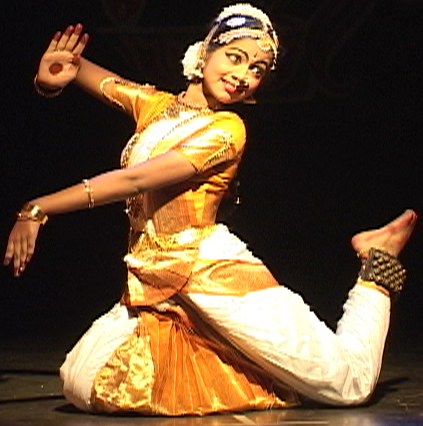
Also, my teacher and I plan to alter the costume so that one can see more footwork and angika abhinaya (body expression). These jama costumes are nice, but a bit too Tibetan (ie, robelike and concealing). The priests in temple wear such voluminous gowns (albeit in white colour only), but the traditional sculptures and thangkas do not. Something more along the lines of the Odissi costume (right) is more flattering and more in keeping with the Newari artwork.

Friday, January 09, 2009

Songs the Lord Taught Us

Googling the Giti
Kathmandu

It's such a struggle to get on line, half the time I can't remember what I came here for. Oh, that's right, I was going to post something about the Manjushree Charya dance.

In answer to your question, yes, this IS my idea of how to spend a Friday night. (Manjushree is pictured below.)

Obviously, to learn a dance one must know the music intimately. Charya Giti has some uncommon rhythms, even for someone accustomed to the many and varied talas of south Asia.

A quick Google of Charya Giti (the songs accompanying the dance) doesn't reveal much in the way of sources. Evidently there are some old (ancient) Bengali texts, some still found in Bangladesh, that are called Charya Giti.

Also, from the Google front-page there appears to be something in Oriya (Orissa state) with the same name. This would make sense, as Odissi is the "major" classical dance Charya most resembles, and Bengal as well as Assam and Orissa had Tantric Buddhist and Hindu practices at one time (and in some form, still do).

One of the only references to Charya Giti is from Bangladesh. Encylopedia of Modern Asia says in its Bangladesh - Music section:

Twelfth-century Buddhist poems called charya-giti (religious observance songs) and the thirteenth-century Gitagovinda (Songs of the Cowherder), a cycle of songs by the poet Jayadeva, bear the names of the specific melodic modes assigned to each song. Hindu and Buddhist kings in Bengal commissioned poets to compose raso, epic poems, in their honor, which were chanted by the poet-composers themselves.

The Dictionary of Indian Literature says:

Charya Giti aka Charya Pad: 1050-1200...earliest available relics of old Bangla discovered in a manuscript in Nepal in 1916 by Hariprasad Shastri....

Another fascinating section details how the Charya poets, at least in India, wrote under pseudonyms because their work was "much hated by the Brahmins and the elite," and how Charya giti were translated into Tibetan.

Wednesday, January 07, 2009

Five sisters

Dancing down the dakinis
Kathmandu

People get excited (or maybe they are just being polite) when I tell them I am learning sacred Buddhist dance of the Newars. The actual classes are pretty mundane. It's like piano practice - not so much fun to watch.

Raju and I go up to the 7th floor rooftop terrace where the solar panels and newly-potted plants are kept. Invariably, someone has been partying up there so we have to sweep the concrete terrace of dust and cigarette butts. I wear black exercise pants and a black t-shirt. Raju wears street clothes (jeans and sweatshirts). The winter sun glares down on us, but in current temperatures (highs 64F) is welcome. In three months' time, we will be hiding from it.

On a relatively clear day, we can actually see snowcapped Himalayan mountains. Unfortunately, most days are hazey (even in winter) with pollution and we see only the green rolling hills of the valley.

From the 7th storey, Swayambhunath Temple on its legendary hill is clearly visible. So we turn toward Swayambhu's spires and recite the Padmanrtyeshwor prayer. I still haven't got this part down. In this part of the world, as in India, classes allow no time for warm-up exercises; you are expected to have already done that on your own.

If Raju has had time to stop by the ancient Patan Buddhist HQ, the Golden Temple (Kwa Bahal), he brings a pair of "tinchu" or ritual cymbals.

The strict sacred geometry of Kalakshetra-style Bharatanatyam is still (despite four or so years of running from it) in my muscles, brain and veins. It's kind of like having learned Hindi first, then trying to learn Nepali and constantly comparing Nepali to Hindi mentally.

In Charya, I'm supposed to emulate the watery, transitory Buddha nature of "anitya" (impermanence) as epitomised by the placid Buddha faces of local statues. Instead I keep overextended my legs and doing rigid mudras (hand gestures).

Everything in
Charya is more rounded and feminine ("lasya"). And after six years of keeping my hips in a straight line centered over my feet, now I must shift them endlessly back and forth like waves of the ocean. My teacher, who is male, looks a great deal more feminine and gentle than I while dancing.

For now we are both content with the idea that "you're still memorizing the steps,
" but I will have to transition into more gracefully flowing movements.

There is a place for
"tandava" (thunderous) movement in Charya -especially when depicting wrathful figures such as the Vajrayogini. Above is a photo of Lianne T. Hunt dancing the role.

The Vajrayogini is a sort of queen of the Dakinis. Last week I learnt four of her postures, all of which involve imbibing 'blood' from a 'skull-cup' and a lunging stance called "pratyalida." Most wrathful deities are always pictured in such a stance. These stances and postures can be seen dozens of times a day all over Kathmandu, in the windows of countless Thangka and statue shoppes.

Long before I came to Nepal or India, the Vajrayogini was in my life (found her in some book and the image really stayed with me). I have always felt the concept of Dakinis to be strangely familiar, and now am trying to learn more. Evidently everyone belongs to one of the "five families" of Dakinis which each relate to a particular klesha, or affliction. If you read this web page you will know about as much as I do. I have narrowed it down a bit, though- I am definitely not Padma. (Not enough interest in worldly things, for one.)


The drawing of Ratna Dakini is by Phyllis Glanville.

Monday, January 05, 2009

Graceland

Sixteen graces
Kathmandu

The available texts and source materials for Charya Nrtya are few. One given by my teacher, Raju Sakya of Nepal Dance Mandala, has Sanskrit text in Devanagiri script, as well as English translation; but strangely, no transliteration so that one can read the Sanskrit in English script. I say strangely, because the book's explanatory text is in English, and one must recite the Sanskrit lyrics in order to learn the dance.

Since I can read the Devanagiri, I decided to transliterate the lyrics. I haven't seen them written down anywhere else. Raju was quite delighted with my work and said "you must type up everything you have transliterated." I wonder if this is available elsewhere. With the state of traditional art forms in Nepal, perhaps not. Surely, the American students of the Portland (Oregon) Dance Mandal must have translated it in such a way, but it's not available elsewhere.

Anyway, the opening item everyone learns (after the Refuge Prayer, which Raju always calls the "Refugee Prayer" ) is the Sixteen Graces. Each item represents a principle as well as a manifest physical offering made to the gods during puja.

Om vajra vine hum....Lady of the Diamond Veena. (a veena is a sort of south Indian lute, related to the better- known north Indian sitar)

Om vajra banshe tra....Lady of the Diamond Flute. (a bansuri is the bamboo flute as played, for instance, by Lord Krishna)

Om vajra mridange hrin...Lady of the Diamond Drum. (Mridangam is the two-headed south Indian drum)

Om vajra muraje ah....(Muraje is a simple one-headed drum, like a snare)

Om vajra lasye hum...(Lasya literally means 'grace' but in this case indicates the Tin Chu, or simple cymbals used to keep time in the dance. In Bharatanatyam we called them Nattuvangam)

Om vajra male tra....(The mala is a garland of flowers. The same word, mala, is also used for a necklace of prayer beads)

Om vajra gite hrin....(Gite is song; in this case, the offering of sacred liturgical song or Charya Gita)

Om vajra nrtye ah....(nrtye is Dance itself.)

Om vajra pushpe hum....(pushpe is offering Flowers. The first Bharatanatyam item I ever learned was Pushpanjali, or flower offering)

Om vajra dhupe tra...(offering incense, or Dhoop)

Om vajravalokite hrin...(offering light; in India it is called Arati or removing darkness)

Om vajragandha ah....(offering perfume)

Om vajra darpane hum....(offering the mirror. This tradition has always intrigued me; mirrors are such a part of south Asian ritual but there are various explanations). First the mirror is shown to the audience, then the dancer looks into it herself with the Bhava of "Adbhutam" or Wonderment.


Om rasa vajra tra....(literally the "diamond taste." This is the classic Vajrayogini pose in which the dancer lifts the "skull cup," symbolically filled with blood, to her mouth)

Om sparse vajre hrin (the Diamond Touch. in this case, touching the Earth as in Bhumisparsa mudra)

Om dharmadhatu garbha ah. (the Diamond Womb-of-Mental-Events; this is shown by
"drawing" a circle with hands and feet. I do know that the Dharmadhatu Mandala is the basic mandala drawn ritually before any Newar house or building is established).

Translating and transliterating is always fun...but now it's time to go physically practice (spirit is willing, flesh can be weak).

Monday, December 29, 2008

To the book depository!

Christmas raid on UNESCO
Jawalakhel, Patan, Nepal

FINALLY. Third time was the charm as Raju and I once again descended upon the UNESCO Kathmandu office, demanding the free publications and books that were so rightfully ours as authentic bearers and students of a dying cultural tradition (in our case, masked and other ritual dances of the Kathmandu Valley).


UNESCO is supposed to distribute their various publications (most of which are about development and architectual restoration) to the general public. As students of religious classical dance, we were more interested in the sector called "Intangible Heritage." This proved to be intangible indeed. Three separate visits all the way out to the Jawalakhel office had found the lights on, but nobody home. Last Sunday (Sunday is a working day in Nepal), we were told they would definitely be in on Dec. 24, Christmas Eve.

Arriving at 2pm Christmas Eve, we were told that in fact, the staff got that day off as well as Christmas Day and the following Friday. The real reason for democracy and secularism: More holidays!

At long last the day dawned when they were both open and in the office, though on this day, too, the librarian and periodicals person was not in. Evidently taking five days' leave for "Christmas" (Christians still constitute less than 10% of the country, but all offices that are even vaguely government-related get to close) wasn't enough; she had 3 more days coming to her.

After much smooth talking by my friend we scored these glossy bound publications:

Masked Dances of Nepal Mandal: (a bit troubling as only 26 of its 163 pages are translated into English, meaning there's a whole lot left untranslated - but I will take what I can get; English information about the dances is scarce)

Tiji Festival of Lo Manthang (more of a photographic booklet than book, but a good basic rundown of a Tibetan Buddhist cham dance ritual)

Intangible Cultural Heritage of Nepal: Future Directions (evidently the idea of supporting Intangible-Cultural heritage, that is rituals, dances, folk music and festivals, is less established than that of preserving material culture and they are still struggling for full financial support)

--and best of all, a 7-volume set called Cultural Portraits Handbook. This includes slim volumes dedicated to Swayambhunath, Bauddhanath, Patan, Bhaktapur, Hanuman Dhoka, Changu Narayan and Pashupati.

Score! We left quite chuffed with our "Christmas" packages full of books about ritual dances of Hinduism and Buddhism.

Wednesday, December 10, 2008

Dance Archaeology

More ancient obscure art forms pursued
Kathmandu

Finally, after very patient and gentle persistence from the tireless Raju Sakya, I have resumed my Saturday morning lessons in the Newar Buddhist Charya Nritya. (I would say Nritya Dance, but that's redundant. Nritya means "dance.")

I've mentioned it a few times before, and like a lot of my external life so far it's been stop and start. But all those years of Bharatanatyam has given me a solid foundation for Charya - it's amazing how much of the classical dance stuff remains hard-wired after years of slackerdom.

Raju is a senior student of Prajwalratna Bajracharya, who now lives in Portland, Oregon USA and runs Nepal Dance Mandala. To my knowledge, he's the only Nepali teaching Charya abroad. There are a handful of non-Nepalis that teach Charya in their own countries, like
Lianne Takeuchi Hunt, Helen Appell, and Shahrazad.

Not that Charya is by any means a simple dance, but compared to the aerobic demands of Bharatanatyam, so far it's lower-impact. It's certainly more lasya (graceful and lyrical) than tandava (percussive and forceful).

With its Tribhangi (three-bends) posture, Charya most closely resembles Odissi dance, which, if I had had my druthers, is probably what I would have learned long ago. But Odissi teachers are hard to find in the American heartland, outside of perhaps California.


Space: the final frontier
I had planned on having dance class on one of the rooftop terraces of my guest house, since the weather is delightful during the days now. But Raju arrived in my small room and declared the space sufficient for dance. Westerners are quite spoiled in terms of studio space, not to mention facilities like wooden floors, wall mirrors and sound systems. Asian dancers usually manage to learn without any of these. At one point we were meant to make a complete oval around and come back to "first position;" we just kind of had to imagine it (dancing into the wall). And there is not room for us to dance simultaneously.

There are a number of suitable spaces (like yoga studios) in town, but they naturally all want a fee to rent for an hour or so - which doubles my class fee. Probably it's best to go ahead and rent a flat with an extra room, install a wall mirror and get on with it.

Now, to hunt for a flat (Nepali for "apartment"). Flat-hunting is always a drag, but winter should be a good time to look. With the increased load-shedding (power cuts), though, I don't want to be too far out of "town" or in too deserted an area. There's just too much darkness (in several ways) these days.
If you are within shouting distance, I am ideally looking for Lazimpat, Chhetrapati, Paknajol or Sorhakutte areas. Or something like that. I see no reason to pay more than 10,000 NRS at the most.

Baby steps
Every dance has its "first position;" in Charya, that is Suchi-Tribhangi. It looks like so many of the ancient Indian statues, with a graceful goddess poking one hip out.

The basic foot movements are Alida (to the right), Pratyalida (back to the left), Suchi (right foot back) and Vajrasuchi (left foot back), which together make a semi-circular closed step sequence called Mandala. The mudras (hand gestures) are similar to the south Indian ones, but much gentler. Raju is always telling me to relax my fingers (which took so long to get ramrod-straight!) and DROP my elbows (unhearin Bharatanatyam, 90 degree elbows is a cardinal rule!).

The first "item" I am learning, other than the Refuge Prayer (a sort of opening Mangalam), is "Sodasa Lasya" or Sixteen Graces. It's an opening item invoking the sixteen forms of offering, here personified as goddesses. For instance, flowers, incense, and song, rather than just be offered as such, are depicted as the Diamond Flower Devi, the Diamond Incense Devi and the Diamond Song Devi (Vajra Puspe Devi, Vajra Dhupe Devi, Vajra Gite Devi).

Why "Diamond" (Vajra or in Nepali pronunciation, Bajra)? In Vajrayana Buddhism diamond has a significance beyond being an expensive stone, or a girl's best friend. I'm still learning but I would imagine it involves being immutable, enduring, indestructible and pure - like the teachings of Vajrayana Buddhism.

Sorry I have no recent photos of Charya, let me poke around and find some.....! above is one I have lifted from Prajwal Sir's website.