Showing posts with label india travel. Show all posts

Tuesday, February 01, 2011

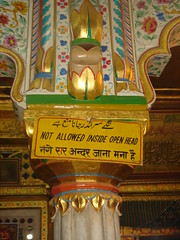
What's your sign?

No Open Heads
Delhi

Continuing the "What's your sign" series...

This, seen in Nizamuddin Dargah, Delhi.

A Dargah is a mausoleum or tomb for a Muslim saint. Nizamuddin Dargah, constructed circa 1563,  houses the remains of Sufi saint Nizamuddin Auliya, as well as those of Amir Khusro and Jehan Ara Begum.  The tomb of Inayat Khan is in the same neighborhood, round the corner.  There's one area of the tombs into which women are not allowed (I can't remember which, but don't worry, signs are clearly posted).

Thursday evenings at the Dargah feature live Sufi Qawwali music from about 5pm, and continue only about two hours. Admission is always free.

The simplest way to reach the Dargah is just to hop in an autorickshaw and say, "Nizamuddin Dargah" (it's near to Humayan's Tomb, but every driver should know the Dargah).  You can also take Delhi's spiffy Metro to Central Secretariat, but you will still need to take an auto from there. 

Nizamuddin will immerse you in Delhi's rich medieval history of Sufis, Mughals and minarets.  As with Hindu temples, the road to a Muslim dargah is lined with stalls selling appropriate offerings. Rather than oil lamps and sindoor, they feature incense, roses and glittery green cloths to drape on the tomb.  The atmosphere is male-dominated, with some interesting exceptions.  At one stall I saw a woman, head demurely covered and carrying a basket, conversing with the stallkeeper. It didn't even take a second glance to see this was a transgendered person.  She was obviously well-known to the local merchants.  In a previous age, perhaps she would have been a court eunuch or even a court entertainer.  So much has been lost, in a time when Muslim culture is dominated by Taliban and ayatollahs.


Saturday, October 09, 2010

Meanwhile, back in the Valley

Harvest Home
Body in NYC, mind in Nepal

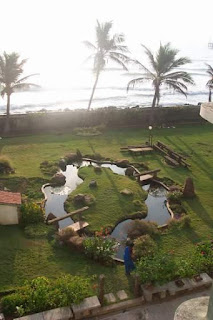
I'm sitting in an East Village cafe, watching the corner grocery try to array produce in an attempt at a "harvest season" display.  Somewhere, outside of Manhattan's concrete canyons, leaves are changing colour, chrysanthemums are blooming and roadside stands are setting out sheaves of Indian corn and piles of pumpkins.  And all over Nepal, it's Dasain time - the nine-day festival dedicated to goddess Durga, in her local Nepali incarnation as Taleju Bhavani.  
The narrow streets of Kathmandu's old town are crammed with shoppers buying holiday gifts, and all the accoutrement required for a Nepali Hindu holiday (special food, sweets, and lots and lots of marigolds).  All this under a blazingly blue sky - weatherwise, it's the perfect season to be in Nepal.

This nine-day goddess festival ("Navratri") is celebrated throughout the Hindu world, taking on local characteristics in each region.  In Maharashtra (India), the holiday is called Dussehra, marked by  glowing paper lanterns.  Mysore (in Karnataka, near Bangalore) has its famous Dasara procession complete with elephants, a palace glowing with oil lamps and fairy lights, and the descendant of the former Maharajahs presiding.  On most every street corner in Calcutta, you will find pandals (platforms with decorated deity statues) for Durga, with ceremonies and devotional music ongoing throughout the holiday, till the clay statues are submerged in the Hooghly river on the tenth and final day.  In the Kullu Valley of Himachal Pradesh, the local goddesses are brought down from their respective temples and paraded on palanquins through the town. 

Dasain is the uniquely Nepali form of Navratri. Nepali festivals are tied to the seasonal agricultural cycle, reflecting the centrality of farming in many Nepali communities.  Each of the nine days is full of significance and traditional observances.  On Ghatasthapana, sprouted wheat grains are planted in a pot, and kept in a dark place in the household.  On the tenth day of Dashami, the beautiful spring-green sprouts (called "jamara") are plucked and worn, as a sign of new growth and regeneration, along with "tikka" (the red kumkum powder) on the forehead.

Nepalis having a genius for time-warping, the nine days and nights of Dasain magically extend to two weeks, even a month in some cases. Workers who have migrated from their remote villages to larger towns to find employment are packed onto rickety buses, crossing dusty and bumpy roads to make the pilgrimage home for the festival.  For many, is their one chance in the year to see their family and the old home place.   When a Nepali waiter, for instance, takes leave from his job to go home for Dasain, he returns whenever he returns - between over-capacity buses, unreliable vehicles, transport strikes and poor road conditions, he can't guarantee a definite date of return.  Most Nepali businesses are bound (by tradition as well as the powerful Maoist-led labour unions) to give each employee a full month's salary as Dasain bonus.

Most Nepalis don't consider their Dasain complete without the sacrifice of a goat.  In a traditional Hindu town like Bhaktapur, every house will have blood on the doorstep from the sacrifice, usually done on the ninth day of Navami.

As a visitor to Nepal, Dasain can be frustrating - transportation is crammed full, shops open and close erratically, most government offices (including those for trekking permits) are closed, and tourist restaurants and many hotels are running on a skeleton crew.  The best way to spend Dasain is to relax, forget your goals and travel checklist, befriend some Nepalis and get invited to their home.  You will enjoy  the traditional foods, and receive the blessings of  tikka and jamara from the family elders. 

Don't forget to bring a present (almost anything is appreciated, but sweets are always appropriate), visibly relish the food that is served, and demonstrate real interest in the holiday and its traditions.  For all the breathtaking mountain vistas, everyday life in Nepal is marked by simple pleasures and of course, the ever-present Nepali smile.

Wednesday, September 22, 2010

Wo Is Me

In Patan's Durbar Square
Patan, Nepal 

Every time I visit Patan - usually to see my Charya dance master Raju Sakya, visit a tantric temple, or to check on some Charya ornaments hand-made by traditional artisans, I try to get in a trip to what I call the "House of Wo."


There's no signboard - in any language - over the tiny Newar food shop, which could serve as a textbook illustration of the phrase "hole in the wall," and if you don't know it you're unlikely to stumble upon the dimly-lit shop by chance.  The best way to find it is to go behind the famous Patan Durbar Square Krishna temple and look for Nepalis disappearing into the wooden-door storefront, between a jewelery shop and a bronze sculpture store.

The low ceilings and walls are blackened from decades of cooking smoke.  Strips of meat hang like party streamers, drying from the rafters. The tiny shop is invariably crowded; the few tables are usually filled, so I always sit on a wooden bench,  balancing my paper plate in my lap. 

The House of Wo is a family affair; on most days a voluminous matron sits on a low stool over the cooking stove, administering the sizzling griddle with grave authority and doling out Wo like a living Annapurna, the Hindu goddess of food.  On my most recent visit she was assisted by a younger woman kneading the rice dough. 

"Wo" is a Newar speciality, their version of south Indian Uttappam - a  thick rice-and-lentil pancake. The special Newar addition is pieces of fresh ginger.  Sometimes called "bara," Wo can be made with an egg cracked on top, or with meat, but I love the plain vegetarian version.  Also available are tikka aloo (spicy potatos, a Nepali staple), masala roasted soybeans with cilantro, chickpeas ("channa") and chiura (dry beaten rice, another Newar specialty which tastes like confetti to foreign tongues). 

Bottled soft drinks (like Coca-Cola from India, with the label in Hindi script) are available, but I recommend washing down Wo with Chang, or homemade rice beer. It's mild, smooth, never gives me a headache, and is very cheap.

The locals are invariably amused to see foreigners, and despite the crowded space, you'll be easily roped into a conversation with the characteristic Nepali smiles.  During my sisters' visit from America, we met a gaggle of college students from Koteshwor. They had come all the way from campus to visit the shop so they could pig out  and get a bit tipsy on chang within their student budgets while flirting with classmates. 

You can stuff your face silly at the Wo shoppe for 2 or 3 US dollars.  The crowded environment makes it difficult to enjoy the food with leisure, but the smiles and laughter - not to mention the food - more than make up for it.

I recommend combining a trip to the Patan Museum - which rightfully has a reputation as one of South Asia's finest museums - with a visit to the House of Wo.  Also on the same block of Patan Durbar Square, the Sundhara Hiti (sometimes called the Royal Bath) made famous by a scene in Bertolucci's Little Buddha - has just recently been reopened.

You can enjoy the Museum's luxurious gardens and umbrella'd outdoor cafe, peek at the psychedelic ornamentation of the Sundhara Hiti, then chow down with the locals round the Wo House cookstove.  At dusk the temple bells from Krishna Mandir will serenade you, and bhajans (devotional Hindu hymns)  will begin upstairs in the nearby Bhimsen Stan.  

All this writing about Patan, the City of Artists, reminds me that it's a nice place to spend more than one day. If you're moved to spend the night, try the ultra-cheap, friendly and clean Mahabauddha Peace Guest House in the neighborhood called Mahabauddha, which is walking distance from Patan Durbar Square.

Have an extra glass of chang for me!  After all, in Nepal, "Chang comes from within."

Tuesday, August 31, 2010

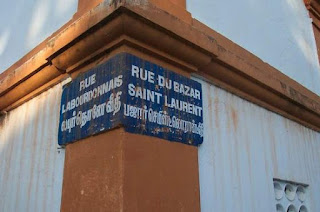
French twist

Rooms illai
Pondicherry (now Puduchery)

A month into following Mata Amritanandamayi's 2004 South Indian tour,  I landed in this former French colony for a week or so to recuperate from the extreme fatigue, sore joints, and pernicious headaches brought about by following a saint across India dawn to dusk.  But I almost never got a room.

After an unbelievable 4 hours of fruitless search for a room, any room where I won't get bedbugs (which BTW I have had twice, both times in Bangalore) - after 4 hours of "rooms illai, " ("there are no rooms"), the auto rickshaw driver was laughing and saying "you come my house? staying? no problem, wife is there!" with a genuine smile.


It was that bad. Pondicherry on a weekend in the high season is impossible (Pondy being a town of only 1/2 million, there are not so many options). Finally, I had him drive me out to the edge of town where lies a marble monstrosity masquerading as a 5-star hotel, the Hotel Mass (!?). Some kind of miracle got me the cheapest room in the house for 600Rs a night (some $15 USD). About 3 times what I usually pay, but I was in no position to argue. After a month of hostels and budget hotels, a hot shower is a nice change, and I have to admit, after months of the cultural "immersion" approach, I appreciated their greater fluency in English.


The winter tour was a lesson in why high season in India (December-January) is a hard time to wing it, in terms of traveling sans reservations.  A great number of tourists (Indian and otherwise) avail of the relatively cool weather.  Also, the south Indian harvest holiday Pongal (usually second week of January) guarantees trains and guest houses will be packed.  And the "Men In Black" - the pilgrims going to Sabarimala, Kerala for the god Ayyappan - fill the trains and buses in an impressive display of devotion, carrying their belongings for the entire six-week journey on their heads. 


The French quarter of Pondicherry manages to weave some famliar comforts - you can get a nice croissant and cafe au lait here, even a glass of wine - into the surrounding traditional Tamil town.  But it's still too damned hot.  From about 12 noon till 4pm, I'm useless.  A siesta culture is followed in which stores close between 12 and 3 generally.  And in classic French tradition, AC and fans are not too popular. (No wonder so many people died in the heat wave in France of 2003  - I bet no one would turn on the bloody fan.)

"Pondy" is a leisurely town, deriving much of its charm from its effortless integration of French and Tamil heritage. I had an entire conversation in French with 2 venerable old school Indian gentleman; it was disorienting to hear them say "oui, je sais, c'est quoi - sa?" while doing the Indian head-woggle.

It occurred to me that both the French and Tamils share a zeal for their respective mother tongues, and unshakeable faith in the supremacy of their mother cultures.  Perhaps in this they found a mutual respect that outlasted the relationship of colonizer and colonized.

And the Pondy weather is so hot, it would force even the French to shower daily.

This blog originally appeared in January 2004.
I spent my months in Pondicherry as an "inmate" at the Sri Aurbindo Ashram, which deserves a blog entry of its own.

Wednesday, June 02, 2010

Six degrees of segregation

Ladies First
All over India


Six months ago, I was unexpectedly re-immersed in American culture for the first time in seven years. After the initial shock wore off (for the first month everything sounded like I was underwater - I could tell people were speaking English, but it just didn't sound right - and my god, there's a lot of space here) I found myself trying to explain, to anyone who would listen (really. Anyone!) some of the distinct factors of life in India that aren't found in the west. One of the most prominent:  a degree of gender segregation.


Almost invariably, the American people I spoke to viewed this as a negative. Well, I loved it, and I suspect loads of other "foreign" women visiting India appreciated it too.


India is an extremely crowded place, and the way to accomodate local norms of personal modesty with the crowded reality is to separate men and women. If they were thrown together, in railway station queues, public buses, commuter trains and so on, there would be no avoiding shoving up against one another.  This would naturally lead to all sorts of problems.  "Naturally," I say, because India seems to take it for granted that men will not behave, which is refreshingly sensible. 


Without the Ladies' Compartment of the Mumbai commuter trains (photo above), how would women, who can't afford taxis and private autorickshaws, move back and forth to work, to relations' houses, and so on, unmolested and undisturbed? Ladies' Compartment gives them a great deal of dignity, and can even be, dare I say it, fun, as you can see in the photo. 


That is, it's as dignified as it can be, considering that you don't really get a seat. Overcrowding is the norm;  women, swathed in full six - and nine-yard saris, sitting in the floors or squatting on their heels. The younger ones (often wearing "Punjabi suits," which were once exclusive to Punjab and are now a national dress) climb to the upper berths, hunched against the ceilings.  The human density defies the laws of physics. Just when you think the doors must close, there is no more room, another person slides in somehow. It is an endearing trait of India that there's always room for one more.


"Ladies' Section" also applies to buses.  I understand this is changing somewhat in the more "modern" cities, but it's still the norm elsewhere.  Women get the front section of the bus; this is often not enforced until it gets very crowded, at which point the men must go to the back. I have seen men barked at, by passengers and conductors, and forced to move and make way for women. This is so that when a woman boards the crammed bus, she won't have to push her way through the men. Also, this accomodates women carrying babies or accompanied by children.


A sort of de facto women's and children's section seems to be the very front of the bus.  Here there is extra room for storing your bags, coming home from market.  On long distance bus trips you can even score a seat up front inside the driver's cabin (if you don't mind smelling the smoke of his bidis!). 
It did shock me that there seems to be no custom, among the women, of giving up one's seat to an elderly woman, or a woman with children. Some women looked surprised when I did this and their expression seemed to indicate that I was stupid for giving up the prized spot.


At least in South India, there is also a tradition of restaurants having a "Family Section." In practice, this mean's Ladies' Section. In these marked sections,  men do not sit unless accompanied by women (and usually children), the rare single woman can sit without inference or insult, and there is strictly no smoking.  The restaurant's other section often resembles a "gentlemen's club" (loud conversation, smoking).  


If you had told me ten years ago that I would willingly participate in, and even prefer, gender segregation, I would have called you crazy.  When I describe the system, Americans instantly assume the women are being separated because they are somehow inferior. I think the system honors the women; it actually protects them, and I personally benefited from this. 


"Separate but equal" may be impossible - the concept of "equality" being a strangely Western one.  While larger cities are adopting western standards, traditional India takes it as a given that men will be men, and women shouldn't have to put up with the ones they're not married to.

Wednesday, May 26, 2010

Are you experienced?


With the release of the Eat Pray Love (or is it Eat Love Pray?) major motion picture ("The amazing adventure of a middle-class white woman who talked her publisher into bankrolling a scripted adventure"), India-tripping is set to become a middle-class fad for the first time since the days of the 70s Overland Chapatti Express.  Except this time, instead of tie-dyed trippies, it will be mani-pedi suburban women seeking "adventure."  

It's always fun to watch the first-timers, fresh off the plane and perfectly accessorized, stumble over the inconvenient realities India inserts into their internal movies (Internal movie script: "Here I am, in front of the Taj Mahal. No, the Taj Mahal is for tourists; I'm not a tourist! Here I am in my spiritual clothes, being spiritual in an ashram.").   

But before they make the great voyage, clutching hand-bound blank books just brimming with the promise of fascinating journal entries,  there are questions. Lots of them.  After reading the India travel forums Indiamike.com and Lonely Planet's Thorn Tree (India branch) for years, here are some of the best, along with some of the best responses. 

Top 5 Stupidest Questions Ever Asked on Lonely Planet's
Thorn Tree India forum or IndiaMike
(and I am not making any of these up)
5. "Can you get a Starbucks Chai Latte in India?"
-This one, actually, left even me speechless.

4. "Is is safe to be seen publicly reading a copy of Salman Rushdie's Satanic Verses"?
-This is India, not Saudi Arabia. 
-No. In fact, you will be publicly dragged into the maidan and flayed alive by the angry mobs.

3. "What is the language spoken by the Babas and Sadhus of India?"
-According to my inlaws, it's Rupees.

--Yes, that's the language and the new mantra too!
---I think you are underestimating the sadhus. I am sure they are multilingual, and their dialects includes GBP, USD, JPY, DM etc.


2. "Would it be socially acceptable for me to listen to a Walkman or I-Pod with headphones on a train in India? I know the people are talkative and they might consider it anti-social?"
-I'd like to see the Ipod that could stop an Indian from asking questions.
 

and Number One....
1. "Is it true that in the Madras Zoo, you can see a Tamil Tiger?"
-Yes, they are readily identifiable by the blood on their hands. 


So, there you have it.  With the imminent arrival of the ELPs (Eat Love Pray crowd), I look forward to a new and better crop of victims contenders. 

Friday, May 21, 2010

Goatshead Revisited

Summer re-runs
Originally filed from Kathmandu

Every other "show" gets to run summer re-runs, why not me?  I wrote this list in 2005, and was reminded of it by Lorraine of  iTravelDame.com.  It's interesting to re-read this after nearly five years, and see what has changed.

Oh yeah, if you are planning on reading about Nepal, Arresting God in Kathmandu is really mediocre. I recommend Culture Shock: Nepal or its equivalent in the CultureSmart series.  And if it's tales you want, the Traveler's Tales: Nepal is a great place to start.

Okay, let's go down my previous list.
Things you take for granted over here:

Bargaining and haggling for everything
Specifically asking for “English newspaper”

Having neighbors who look like stills from National Geographic

Dishonesty (about prices, availability, life stories, when the work will be finished, etc.) and corner-cutting

Wondering how you will pay the $65.00 rent  (Nowadays, it's more like $100)

Channel-flipping from Nepali to Hindi to English to Tibetan within a few minutes’ conversation

Monks with cell phones

Papayas, figs and pomegranates are not a luxury (At that time there was a pomegranate tree growing in my front yard.  Upon my return to US, I found that pomegranates have become the trendy fruit-of-the-moment.)

A dozen Tibetan high lamas live within walking distance

Nobody has a license (for anything)

Never being cold

Being called “Didi” (big sister) in Nepal, “Chechi” or “Madama” in Kerala, “Akka” in Tamil Nadu, “Memsahib” in Calcutta, and either “Auntie” or “Madame” everywhere else

Prescription medicine without a prescription, or a doctor’s visit

Prescription medicine that costs $50.00 in the US costing $2.00, over the counter.

Every commercial building has a full time watchman and doorman in uniform

Vegetarian food, everywhere.

Constantly carrying an umbrella (for sun most days, and rain during monsoon) - And, I could have added, to keep the occasional aggressive street dog away.

Sandals, 365 days a year


Routinely meeting people who’ve just returned from, or are headed, to places considered dangerous by most of the world (Afghanistan, Egypt, Jaffna/northern Sri Lanka, Burma, Indonesia, Vietnam, Cambodia, trekking in western Nepal, etc.)

No spring, no fall, no changing colours; just hot season, rainy season and dry season (winter)

English teachers: pathethic losers at home, prestigious over here!

Permanently “homeless” people *not* being removed by police or housing authorities 

Handmade custom-tailored clothes available on most every corner (now, you just have to be able to communicate what you want!)

Ayurvedic and homeopathic medicine in every shop; aspirin is “English medicine”

Child labour (exception: Kerala)

Beggars with stump limbs and grotesque deformities become routine

Every week is a different religious holiday for a different religion


Flowers grow all year round 

Keeping a bottle of mineral water in the bathroom just to brush your teeth

Hershey’s is an import; Cadbury is domestic

Hot water is a luxury

Being able to identify someone’s religion or region by their headgear or dress

Buying everything, from underwear to a sweater to popcorn to a mirror, on the street

Goats, cows and packs of dogs on the sidewalk

Your washing machine and bathtub both are a plastic bucket

Instead of tossing your old sandals or broken umbrella, getting them repaired by the shy "lower-caste" guy on the corner

Doctor’s visit: Three dollars (and worth every penny, ha ha)

Being treated like a rich person (ie, ability to stroll into five star lobbies and dawdle around without security being alerted) just by virtue of being a “foreigner”

BYOTP (bring your own toilet paper) - I recommend wet-wipes. At first I thought it was froo-froo, but when I finally gave in they just made life so much easier.

Taking a bus for ten cents, or a taxi across town for a dollar- The buses can still be as little as ten cents' equivalent; taxis have gone up - most radically in Kathmandu. 

Automatic VIP status for foreigners- This is changing, but still remains to some extent.

Stores close for afternoon siesta

Stray dogs aren’t rounded up and euthanized, but are alternately kicked, beaten, fed and played with- I did learn that stray dogs are occasionally victims of a poisoning campaign by various municipal governments.  This is really inhumane and torturous way to kill the animals, and since all dogs are allowed to wander here, often affects pets as well.

Saving water in a bucket in your bathroom; at least one day a week there is no water supply- Still a very good idea, particularly in Nepal.

Keeping a flashlight, candles and a lighter handy for power cuts  -This may never change.


Everyone on your block knows your schedule and your entire life story

The temple down the road is “only” 300 years old

Internet cafes and public phones that work on nearly every corner

Waiting for “the boy” to bring something (towel, bucket, water, napkin, tea)

Goat and other carcasses, eyes still open, for sale on the road

Having conversations with persons of a dozen nationalities in one day (German, Japanese, Israeli, Dutch, Danish, Australian, Filipino, Indian, Italian, British, Brazilian, French, Korean, Swedish, Swiss, Nepali, Bhutanese) and being able to identify them right away by accent-    and/or dress.  For example, no one but Koreans would wear those silly duck-billed sun hats, and Israelis are prone to wear bright, clashing colours together.

Not having a phone in the house (residential landlines are rare)

Parking anywhere (with a motorbike or moped), usually for free (exception: Pune)

Waking up at 4am to the shattering cymbals and braying horns of Tibetan morning ritual music--(The best place to do this is Boudha, Kathmandu)

Being nearly grazed by passing cars, motorcycles, cycle rickshaws and bicycles a dozen times a day

Every woman has a pierced nose, some more than one piercing

The Bunch of Keys (they are always old-fashioned, long handled keys and your house always has at least 3 different locks), also suitable for use as a weapon

Taking off your shoes before entering most rooms

Wearing sunblock every day, all day and still getting tanned

Tea is a staple

Wearing a face mask against air pollution-  More than ever in Kathmandu. Air pollution keeps getting worse.

Couples holding hands now appear shocking-  Tourist couples, take note and please heed. We don't like PDA and that includes holding hands. 

Seeing headlines like “500 teachers abducted; whereabouts unknown” or “Maoists slay 5 in Birgunj” on a daily basis

Seeing police with riot shields and barbed wire road blocks on every other corner

Cracked feet 

Compulsively dark shops and restaurants (electricity is very expensive, and people try to conserve to the point of living in darkness)

101 Uses for coconut hair oil (makeup remover, body lotion, moisturizer) and Tiger Balm (congestion relief, headache cure, wakey-uppy)

Stepping over human and other excrement on the road; ability to identiy excrement (human from dog, and cow from horse from elephant) at a distance

Paying $1.00 for a latte is a splurge- This has definitely changed. It's now at least $2.00, which is the average daily wage of many. 


Monday, March 15, 2010

On the curve


Jantar Mantar
Originally uploaded by Sirensongs
My entry to the Lonely Planet Photo Challenges contest, "Curves."

These fellows were perched on one of the sundials at Jantar Mantar, built by Maharajah Jai Singh II in Delhi circa 1764.

You can view the other contest entries on Flickr.com at
http://www.flickr.com/photos/tags/lpcurves/

Wednesday, February 17, 2010

Palace intrigue

This is a blog entry was written in 2003 on my first of many visits to Kerala.


As a guest of the wife of Prince Thirunal of Travancore, the dynasty that ruled Kerala state for much of its history, I was invited for dinner and a stay at Kowdiar Palace. His wife, Gopika, is one of my dance teachers in Chennai; teaching the traditional feminine Kerala dance Mohini Attam.

Her mother in law, the Maharani, was a young princess when Independence broke up the royal lands and changed her world forever. Their culture has a matrilineal system and the women are very strong and relatively independent. They are direct descendants of Raja Ravi Varma, the famous indian painter (we sat in the dining room surrounded by some of his originals) and Swathi Thirunal, one of the 4 most famous south Indian (Carnatic)composers who wrote hundreds of compositions that are still popular.

This occasion necessitated my running out and buying a Kerala style sari (hand loom white cotton with gold border) and having the blouse made, in one hour - nearly impossible! - Total cost: about $14.00.

I stayed 3 nights in the guest house within the large palace grounds, where the servants instructed me not to leave my shoes outside the door,
as is the usual custom, because of the local wildlife. They are leather yes? The jackals surely will take them. You have jackals?, I asked, thinking he might just mean stray dogs. No, jackals. Cobra also. Careful Madam.

Jackals and cobras on the palace grounds; sleeping sweaty under a lace mosquito net; being served tea on the royal crest china, waking to the call of the whooping Koel bird, the snow shower of white blossoms beneath the plumeria tree heady with tropical perfume - I suddenly felt like a character in a Rudyard Kipling story. Some killjoy will probably have to write in accusing me of having "Orientalist fantasies."

The following day the Princess said, "Caroline, everyone is quite impressed with you" - because I had managed to get a blouse stitched in one hour. The ladies of the royal family all wanted to know what tailor I had found and how much I paid!

Strangest of all, the other Prince - the unmarried one - is a Carnatic classical singer who has performed in Nashville, and has sent me a flurry of emails since that evening. So maybe I will have royal email buddy.

more later, the nightly power cut is about to take place....

Related Reading: 
Drāvida and Kerala in the art of Travancore (Artibus Asiae)Political evolution in Kerala: Travancore, 1859-1938 

A Survey of Kerala History -