Showing posts with label temple. Show all posts

Monday, March 29, 2010

Between the babas

Backstage at Babastock
Kathmandu, Nepal


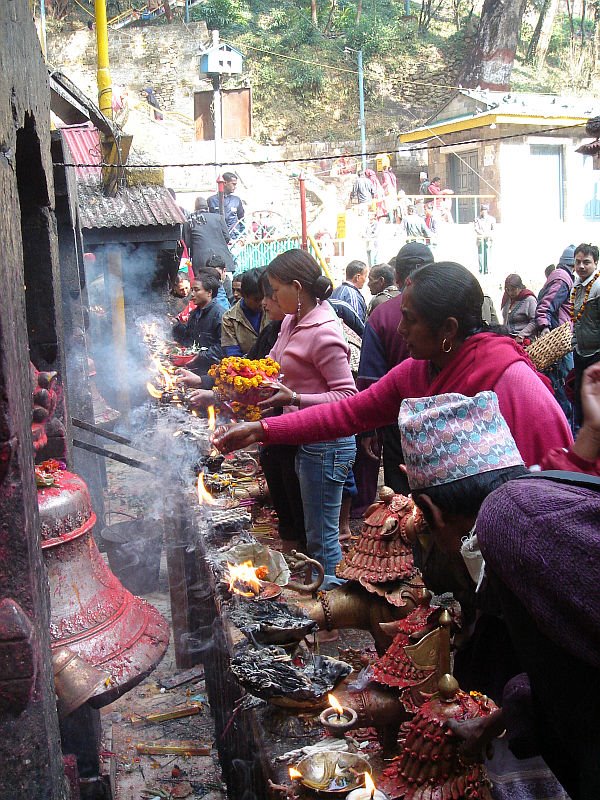
Ever wonder what those sadhus from Durbar Square - the ones who want money for photographs - do when they're not out begging for alms? They chillax backstage at Kathmandu's Pashupatinath Temple, in the babas' ashram.  These shots were taken just after Shivratri, 2009.
Backstage with Baba

Sadhus (male and female - females are called Sadhvis) come from India as well to be at Pashupati for Shivratri.
Tiffin Time for Baba
By tradition, the Nepal government was obliged to provide ganja, or at least subsidize its purchase, for the Hindu holiday Shivratri (which occurs annually in February). The new, non-Royal, non-Hindu government of Nepal may put a stop to that. Last year the newspaper featured reports of complaining Babas - they didn't receive the customary amount of rupees to subsidize the holiday smokfest.

I found the Pashupati Babas - while quite laid-back - to be also rather career-minded. Most of them make a few rupees as photographer's models. They all had the equivalent of press kits - a stash of carefully-preserved photos and even magazine clippings they had appeared in. The fellow below is showing off some of his portfolio.

Thursday, July 23, 2009

Fair to partly cloudy

Grey, green, gold, blue and white
Ranipauwa, Muktinath, Lower Mustang

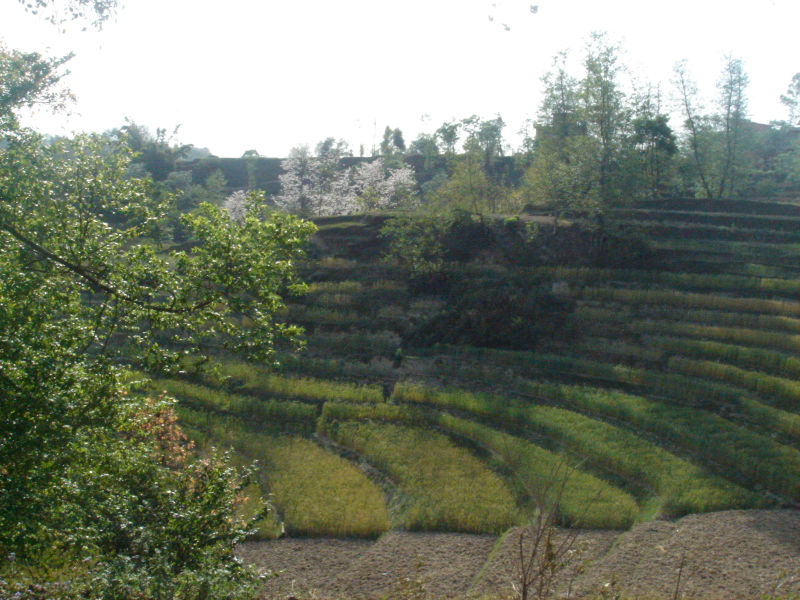
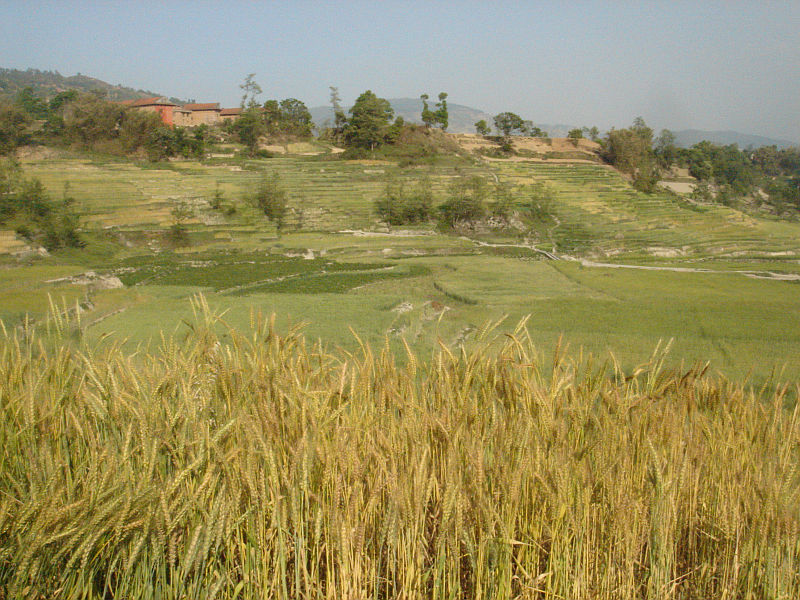
Those are the colours of the landscape up here at Muktinath (in the lower Mustang region), an elevation of about 12,000 feet. Grey are the mountains; green trees; blue skies, golden wheat and white clouds. It was a precarious plane ride (between mountains, from Pokhara to Jomsom), stopped at the Magic Bean coffee shop in Jomsom for java, before walking to the shared Jeep ride.

I recommend sitting on TOP of the Jeep from Jomsom to Ranipauwa. They do not give you a discount for doing so (the ride is still 500NRS for foreigners) but it is much more fun to have the wind in your hair than to be in the stuffy inside.

Waiting for the Jeep you will see a colourful mix of fellow travellers. The Hindu sadhus are refreshing as, unlike the city "pseudhus," they are genuine pilgrims and not out for spare change. There are Tibetans and Tibetan-descended Nepalis who are native to the lower Mustang region, random "other" Nepalis, a few clean-scrubbed Western volunteers who are eager to teach the locals English, and of course, what I call the Stick Men (over-equipped foreign trekkers with their two walking sticks, one in each hand).

The morning of the eclipse dawned grey and cloudy, as luck would have it; but it was still great to be in a quiet, sacred space.

I am waiting for the camera batteries to charge; then I can upload photos.

At this time of year the region is really empty. Of course there are a lot of monsoon clouds, but they clear off a couple times a day for great views of what I assume are the Dhaulagiris.

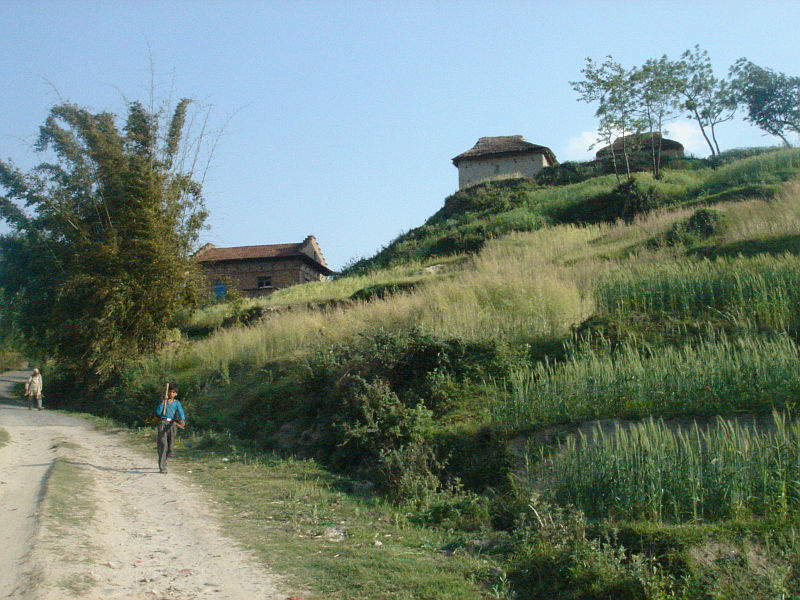
Ranipauwa (the base village for Muktinath temple) is surrounded by more traditional villages such as Dzong ("hilltop fortress"), Purang, Lubra, Khining and Jharkot, which is home to the Tibetan Medicine society, a large Sakya gompa and an ancient ruined fort. During these first 3 acclimitization days, my walks to these villages, through golden wheat fields and meadows of flowers, have been nothing short of enchanted.

The "happening spot" in "town" appears to be a place called Hotel Bob Marley which actually is decorated in 100 percent Bob Marley paraphernalia, if you can imagine that, and run by a Nepali transvestite (very nice eyeshadow). In season I guess it is full of drunk Aussie climbers. Now it's nice and empty.

Muktinath temple is actually a walled compound (a complex complex at that) encompassing various religious expressions. The "main" temple to which most people refer when they say Muktinath is a three-tiered pagoda-style structure shoved way up under the very last spot before the mountain turns to cliffside. It's surrounded by the cold mountain streams, 108 spouts coming out of the steep hillside, so it constantly feels cleansed and renewed.

I normally associate Himalayan mountainscapes with Shiva in the Hindu pantheon, so was surprised to find it is a Vaishnav Hindu temple (though most people will claim it is "both Hindu and Buddhist"). The temple darshan (opening and closing of the doors) is controlled by a Buddhist nun. I'm going to read up a bit on the temple history.

The temple is best known for its association with Shalagrams, the sacred stones with ammonite fossils inside, said to be manifestations of Vishnu's sudarshana chakra. The stones grow naturally in the nearby Kali Gandaki river. They are for sale down below in the town, but technically you are not supposed to buy them. I think you are meant to find them, or have them "come" to you.

Additionally there are a Hindu yagnashala (fire ceremony house) where fire pujas go on daily; three very old Buddhist gompas with mostly clay (not stone or metal) statuary; a Shiva temple with an unusual iconic image (not just a Shivalingam, but marble figures of Shiva and Parvati); mountain ponds suitable for bathing, and lots of Buddhist prayer wheels.

Everywhere there are these solar cooking ovens that were thoughtfully donated by some German NGO. Great idea - to cook with solar energy rather than using local firewood, which deforests the land, or kerosene which has to come from down below. Too bad I have yet to see anyone use even one of them.

Development people need to realize: you can suggest all you want, you can lead a horse to water, but people do what they want to do. Not what you want them to do. Even when it means killing the goose that laid the golden egg.

Related reading: 
Trekking North of Pokhara Jomsom, the Thak Kola Canyon and the Annapurna Sanctuary: No 2 (Nepal trail guide)

Tuesday, July 07, 2009

Turning over an old leaf

This is so cool
News from the Olds


I love the image of drinking in new knowledge from ancient palm leaf manuscripts. In some areas, palm leaves are still being painstakingly inscribed with sacred information.

Lontar is deeply venerated by Balinese, anyone who wishes to read lontar regularly needs to undergo a consecration ritual (mawinten) which must be performed by a brahman priest. Lontar cannot be sold or thrown away when damaged but it can be burned with proper ceremony and offerings.

A recent archaeological project collected palm-leaf manuscripts in the state of Chhatisgarh (formerly part of Orissa state).

In the first phase of a survey conducted by the National Mission for Manuscripts and assisted by locals, around 2,000 manuscripts have been collected from various archaeological and remote sites in Chhattisgarh...

But, how do the manuscripts contain words in "texts in Sanskrit, Oriya and Devnagiri" - since Devanagiri is a script, not a language? I think they mean that Devanagiri script was used to write the Sanskrit.

The photo at left shows an ancient manuscript in Kerala, in the possession of my friend Murali in Tiruvilwalmala, whose family have been Ayurvedic vaidyas for 17 generations.

I believe the script and language shown is ancient Tamil. (Someone know for sure?)

Originally, the pages would have been strung together with a thread through the central holes.

Hinduism Today's specialized news service, Hindu Press International, is where I saw this story, and a great source for all kinds of Hindu-related news items.

In the ongoing "pick on the foreigners" thread, Nepal's Pashupatinath temple has added insult to injury by charging perceived "foreigners" (read: people who don't look Nepali...so if you are Assamese Indian, or a Singapore Tamil, you are scot-free) double the previous entry fee - even though "foreigners" are prohibited from entering the actual temple, lest they pollute the hallowed grounds.

It's still okay to through plastic bags of trash into the nearby river and spit on the ground, though. No fines levied for that.

Monday, July 06, 2009

I'm back, sort of

Temple of the Sword-Wielding Goddess
Sankhu, Kathmandu valley

Ack, I am suffering from what has become my annual Monsoon Illness. Somehow, hard as I try, it gets me every July that I stay in Nepal. I have got to get out of here earlier next year.


Here are a few photos from my visit to the atmospheric, remote temple of the KhadgaVajrayogini
at Sankhu village, on the eastern edge of the Kathmandu Valley.


'Sankhu Vajrayogini' is one of the four guardian Vajrayoginis ("Adamantine Goddess") that stand watch over the Valley. The other three sisters are found at Pharping, Guhyeswari (foreigners not admitted), and Swayambhu at Bijeshwori.

I hope to make a complete tour (via bicycle) of all four Yogini temples and post a yatra-logue about the whole thing.

Photos of the murti were not permitted, but I found the people up at Sankhu temple to be welcoming and very, very proud of their goddess. The young girl below (who spoke excellent English) explained to me simply, "She is our Mother."

Wednesday, April 29, 2009

Heritage, or hate?

Religious or racist?
In Dailekh, Nepal


I'm not saying I have an answer. Just putting it out there.
Parkala Matha

Brahmin priests in Dailekh have padlocked temples of the district to protest a recent verdict of the district court.
...(a) court verdict three months ago imprisoned a Brahmin priest on the charge of untouchability.
On April 12, the court sentenced Dipak Upadhyay... for refusing to tie Raksha Bandhan (holy thread tied around the wrist on Janaipurnima day) to a dalit local.
...Claiming they have the right to perform religious rituals as per their wish, the Brahmin priests padlocked a dozen temples...
District chairman of Hindu Vedic Sanatan Parishad (HVSP), Tilak Rijal, said the priests did not need to perform religious rituals for all the people.
"Practicing untouchability" - that is, discriminating against those traditionally considered of lower Hindu castes - has been made a crime in India and Nepal, though in remote areas such behaviour largely goes unpunished, and many old ways are still observed.

So, is this religious freedom, or racism? Or, at the very least, illegal discrimination? Should the courts be able to tell houses of worship whom they must accomodate? How would we feel if it were a White Supremacist church (they do exist) refusing admission to someone of another race? Is that even a valid analogy? Many Hindu temples specify "Hindus Only"; however, the Dalits themselves are Hindus. Does this mean they have to admit all Hindus regardless of caste?

And if there is a tradition of excluding certain Hindus, how much does the tradition matter? That is, is it beyond the law ?

Just asking questions.
 Related reading:
  

Sunday, March 22, 2009

Dry, dark and dirty

Round midnight
Kathmandu

In a country now famous for having no electricity, how is it that "a short circuit" around midnight caused a serious fire at the Sri Bagalamukhi temple in Patan Sunday night (March 16), destroying much of the carved-wooden pagoda style temple?

""The temple uses too many lights, which can sometime lead to short-circuits,"" an officer at Nepal Electricity Authority's Pulchowk office said."

Minor detail: There's no f**king electricity.

Bagalamukhi, one of the 10 Tantric Wisdom goddesses, is depicted as standing atop a demon, beating him down while snatching his tongue out of his mouth to silence him.

This image is sometimes interpreted as an exhibition of stambhana, the power to stun or paralyze one’s enemy into silence. This is one of the boons for which Bagalamukhi’s devotees worship her.

(her mantra translates as):
...Oh Goddess, paralyze the speech and feet of all evil people. Pull their tongue, destroy their intellect.

Perhaps, the Devi's own comment on suppression of the free press here in Nepal.

Shortly thereafter, the unbearable six-month dry spell finally broke, first with a smattering of rain on Wednesday night. The next day brought nothing but tantalizing rumbles of thunder and dry cracks of lightning. Thursday night, the electricity (which had gone off at 12 midnight) suddenly came BACK on at 12 again, only for a moment...then switched back off.

It wasn't till Friday afternoon we found out that Father John K. Locke, Jesuit scholar and father of Newar Buddhist studies, had died at precisely that time; midnight on Thursday night.

On Friday night I got another unpleasant surprise, in the form of my first Nepali groping. This one was a drive-by - two young men on a motorbike decided to take advantage of their speed and anonymity by grabbing my right breast as they sped past. Such incidents are well known and much-discussed among Indian travellers. Nepal, land of the Buddha and Tantra, is becoming another place where women have to go into Purdah - even in the middle of the tourist zone.

We still hadn't gotten a proper rain till Saturday afternoon, when it finally soaked the thirsty ground thoroughly.

The traditional rain god of the Valley is Rato Matchhendranath ("red lord of the fishes"); his worship is mandatory to bring the much-needed rains. Now that Nepal is "secular," I guess we have to worship Rato Prachandranath. He's the new Red God. Rather than being pulled round in a chariot, he's driven round in a limousine.


Related reading: Chinnamasta: The Aweful (sic) Buddhist and Hindu Tantric Goddess. (book reviews): An article from: The Journal of the American Oriental Society

Saturday, January 17, 2009

Hindus, Hin-don'ts

Temple of doom
News from Puri

I'm not taking sides in this...I know better. Just stating the obvious; that this is going to keep on till somebody or a bunch of somebodies (probably in
south India) holds a referendum to "officially" redefine or define in the first place, since it was never defined in any scripture, what is a "Hindu."

It's not the first time the guardians of Puri's purity have been asleep the switch. Last year an Australian (I think) got in - which precipitated a ritual cleansing of the grounds - and around the same time there was a diplomatic faux pas when some Indonesian (presumably Balinese?) Hindus were not allowed in (guess they did not look Hindu enough...?).

At the time of the Indonesian incident, I read an Indian news report that such a conclave was being held, but never heard results.

Now I read of an incident involving the Thai Princess (--are Buddhists part of Hinduism? depends on who is counting, and why. In my experience, when it's to Hindu advantage, Buddhists are part of the "Om Kar Parivar") and another where a Bhubaneshwar temple was cleansed after a visit by someone - government minister in fact - from a "low caste." (not enough to be Hindu - you need to be the right kind of Hindu.)

The temple cleansing episodes remind me of the old story about Buddy Holly's family. Holly, the Texas rock legend, was very adamant about integration and socializing with Blacks. (It's okay to call them Black again...) This happened in a small town in the 1950s. Holly insisted on inviting some Black musicians in to his parents' house for dinner. After they left, he said, his parents "scrubbed the dishes five times with extra soap."

And why doesn't anyone fuss at the Parsees about the same issue? Well, for one thing, the Parsees are consistent!

Hey Balinese guys, next time "dress like a sadhu."


According to police, the foreign visitor, Sebastian, dressed like a sadhu. That made it difficult for security guards at the entrance to make out whether he is a Hindu or not. “He looked like a sadhu. He was wearing ochre robes of Hindu monks and yellow kurta with a shawl. He had also anointed sindur on forehead,” Singhadwar police station inspector-in-charge Arun Dalai.

Fearing more tension, the policemen escorted Sebastian out of the temple and detained him at the office of the Jagannath temple for hours.

Sunday, January 11, 2009

Tamaso maa jyotir gamaya*

The business of Buddha
News from Karnataka

Buddhism is a growth industry. In India, where most people are Buddhist for business purposes (catering mainly to foreign Buddhists), an astonishing
number of new structures, complexes and facilities are always going up in the name of the Tathagata.

I think it's mostly great; all the statue-carving (shilpas) and icon-painting gives employment to traditional artisans. And though religious conversion (even from Hinduism to Buddhism) is still a fiery topic in India, it definitely promotes good will toward the Dharma and its exponents.


One of the latest is Gulbarga, Karnataka, according to this Deccan Herald report. Hey, even HHDL will be there on January 19!

I think Gulbarga is better known for some Sufi Muslim tombs, and a fort. But Buddhist remains and relics and ruins are all over India, and continue to be revealed and revitalized.

Gulbarga offers a rich history of the earliest Buddhist settlement of Satavahana period, [2000 or so years ago]. One of the ancient sites here is in Kanaganahalli near Sannati, a famous Buddhist heritage site on the banks of river Bhima in Chitapur taluk.

The remains of stupas, major rock edicts of King Ashoka, mounds, slab inscriptions and statues are all found scattered in a small area within the revenue limits of Kanaganahalli. About five to six stupa remains are found in and around Sannati.

Meanwhile, back at the ranch
In the meantime, in case there was any doubt, Nepal now officially sucks. We only have power for 8 (eight) hours A DAY.

With all the chaos facing the nation, the dominant political party has occupied itself invading the Inner Sanctum of the nation's holiest shrine and trying to replace the 260-year-old traditional priests, who as per tradition came from south India, with Nepalis. One of whom just happens to have the same surname as the Prime Minister himself!


Lighting oil lamps is no longer a charming Hindu and Buddhist custom...it's a necessity.

*Sanskrit slok that means "Lead me from the darkness into the light"


Related reading:  
Buddhist Goddesses of India 

Saturday, January 10, 2009

Only For Hindus

Get lost, injee
Jan Bahal, Kathmandu

Today at the Seto Matysendranath Buddhist temple (S. M. is a Nepali version of Avalokiteshwara, the 1000-armed god of compassion) I was told that I couldn't stand in front of the deity because it was "only for Hindus."

"What?" I retorted. "This is a Buddhist temple, this is Lokiteshwara!" (his nickname)

Someone appeared and explained that it was arati time and in fact, no one could stand in the mandap during arati. Well, now, that's different.

Then I had a good conversation with some Newar locals who spoke English. It seems that "only for Hindus" is just a phrase people have learned that they now use to cover even Buddhist situations!

Wednesday, December 31, 2008

Unshakeable

Faces from Swayambhu
Kathmandu

Everyone knows I get boring and "spiritual" on holidays. Well, this new year is no exception.
Let's start 2009 off right. It is, after all, the last of the Aughts and oughta be done right.


Swayambhu, the famous "Buddha Eyes" temple (one of many, but probably the most famous one) is under restoration. I thought that was fitting for the New Year, even if it is the English new year. A few questions revealed that a local Nepali monastery (and some foreign well-wishers), not the government, was sponsoring the restoration.

Here are some photos and details from our recent trip to Swayambhunath temple (the sistren and I, that is).

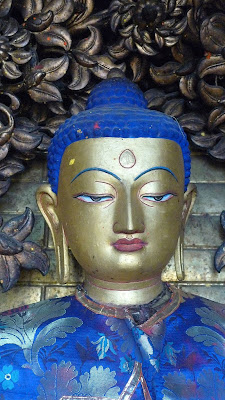
The blue Buddha is Akshobya, the "unshakeable" Buddha, to whom we will pray when the next earthquake rocks the Valley (just kidding. Well, not really kidding).

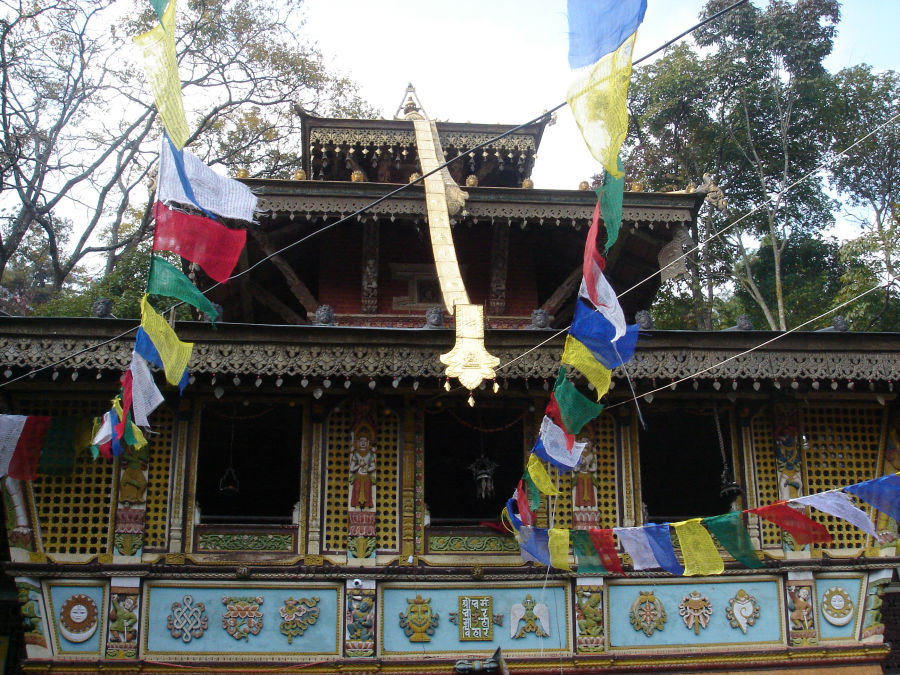
The elaborate carved archway at the top of the page shows Akshobya in the "bhumisparsa" (touching the earth) mudra with right hand, Dhyanam (meditation) with left hand.
This figure is holding his hands in the Dharmacakra mudra - the 'teaching' mudra aka "turning the wheel of dharma." This mudra is usually associated with Vairochana Buddha.
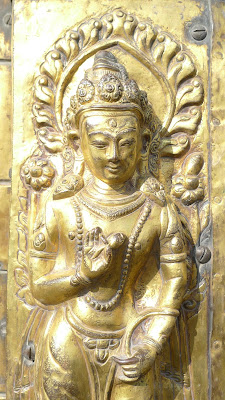
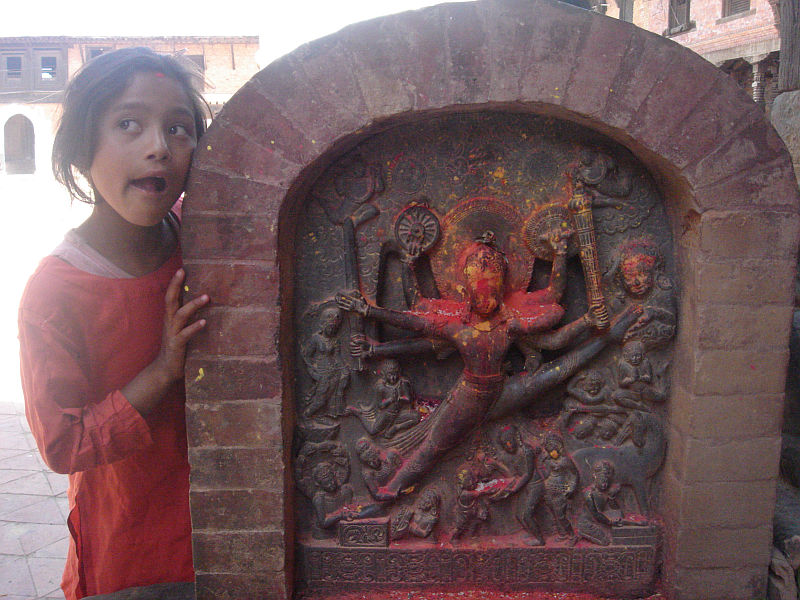
I am getting to be such a Buddha geek, I can instantly identify these Mudras (hand gestures). I know, you are yawning already.....!


The figure above is holding left hand in Nilotpala (holding lotus stem) and right hand in what would normally be called Gyana mudra (wisdom). But in the right hand he's holding some kind of...flower bud?? Maybe the other half of the lotus.

Here the left hand again is in Nilotpala, and the right is holding a Double Dorje with a hand gesture I haven't yet learned the name of. In Bharatanatyam it would be called Mukula, but I haven't seen this one in Charya.

Sunday, April 27, 2008

Escape From Kathmandu

Power Places Part Three
Bhaktapur, Changu, and Kathmandu, Nepal

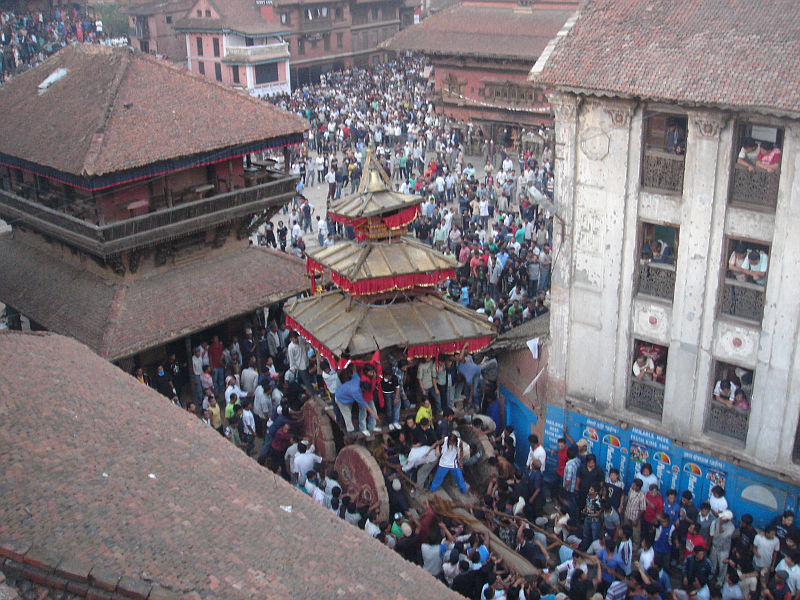
The morning after the insane tug-of-civil war that is Bisket Jatra in Bhaktapur (half the town goes to war with the other half the town trying to pull the chariot apart, or so it would seem), I met a couple of Americans who also wanted to go up to the hillside temple of Changu Narayan (one of the "Power Places of the Kathmandu Valley"). It is believed to be the very oldest temple in the valley, and also has the oldest inscription yet located here - from the 3rd century AD, in Licchavi script. (The Licchavis were one of the Indian Hindu dynasties who came up from Magadha way, I think.)
Lynette, Dave and I decided to do the ultra budget thing and catch the local bus up to Changu, rather than pay the inflated taxi prices (300NRs or five dollars! please, it costs 600 to go all the way back to Kathmandu. Changu is only 15 minutes away by car).

There are about five different bus stops (or 'bus stands' as they are called here - "tourist bus park," "Mini bus park" etc) in Bhaktapur, so to determine the right one, we had to wander through the hand-hewn brick and wood labyrinthes of Bhaktapur asking directions, which is part of the fun. "Changu bus stand?" is the best way to phrase the question. When we just said "Changu?" people pointed in the direction of Changu itself, which doesn't necessarily help you get the bus.

The road to Changu from Bhaktapur (the back road, not the driveable highway) would be a very nice walk - taking about 2 hours - if we had started early enough in the morning. As it was after 11am, it was already boiling hot. Don't be fooled by the clothing you see on the local people - they have the maddening ability to wear long sleeves, synthetic fibres, and even several layers, in the pre-monsoon swelter and barely break a sweat.

When we finally located the place everyone insisted was the "Changu bus stand," a taxi driver pulled up and did his very best to persuade us that in fact, there was NO bus to Changu. "No Changu bus. No bus. No bus today. Taxi, 300 Rs only." (By the way, the bus is 10NRs.) Instantly the shop owners, whose shop we were standing in front of, tried to get in on the act. They too insisted there was "no bus."

I had gotten the driver down to 200NRs and was trying to beat him down for 150 when we noticed a small crowd of people - women, children, and elderly - gathering on the corner diagonally opposite.

"I bet THAT's where the bus leaves from." I hopped across the smelly grey open sewer ditch and strode across the road. "Changu Bus?" I asked the young girls in kurta-surwal. They all nodded.
The taxi driver, as usual in such situations, displayed no trace of shame or embarassment at his "no bus" lies, shrugged and sped off.

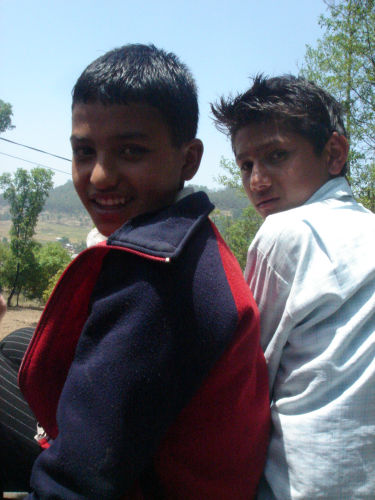
The bus was so crowded, we elected to sit on top. This is by far the best and best-ventilated way to travel, especially in hot sweaty summer, but is considered unorthodox for women. As foreign women, Lynette and I were somewhat exempt from the etiquette and clambered up the metal ladder to the bus roof - where the view is unsurpassed.


We were joined by half a dozen young boys till the tiny luggage-rack railing was crammed with humans. I made sure to get in the middle, sharing space with an empty red metal gas cylinder and a worn spare tire, where it seemed less likely I'd fall off. We need not have worried about falling - the bus creaked along slowly through wheat fields up the hillside.

Our fellow roof-riders seemed well-informed about the upcoming US elections and wanted to know "Who will be the next president of your country?" As usual in this part of the world, the name "Cleenton" evoked the most recognition - a trusted brand name on the subcontinent.

Changu Narayan has got to be one of the most reasonable entrance fees in all of Asia - 60NRs or exactly $1.00 US to see the oldest temple in the Valley (and the one best noted for its sculptures).


The last time I came was in September during the misty post-monsoon. I walked down from Telkot through damp pine forests that felt more like Scotland than Nepal. This ascent couldn't have been more different, in the hot dry season. However, it did mean this time I could take photos.

The isolated location of Changu Narayan means it's the least visited of the UNESCO World Heritage Sites in the Valley. It also means there are fewer tourists, which is both good and bad. It's never crowded, but ALL the attention of the shopkeepers, begging kids and touts was focused on US, the lone foreigners.


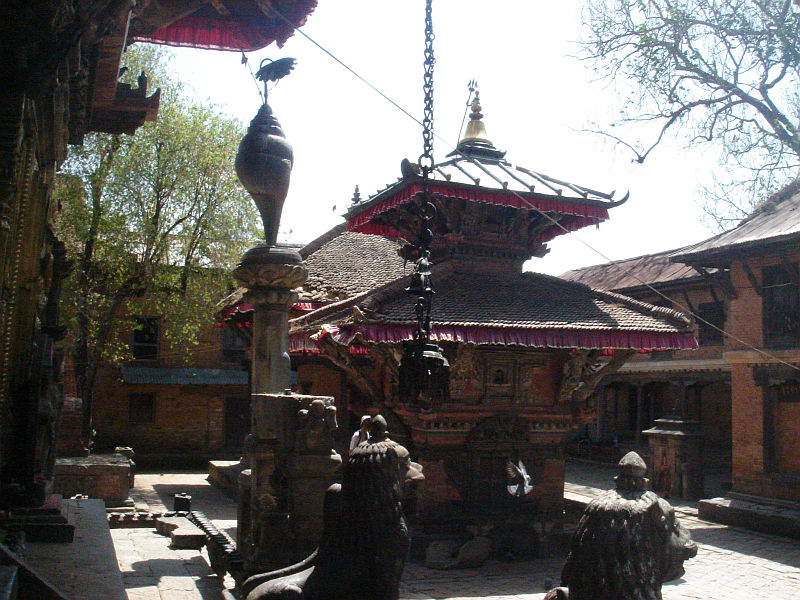
Changu displays a familiar Nepali combination - a rich upwelling of devotional energy manifested in myriad curlicues, psychedelic flourishes and startling chimeric beasts that defy description...lots of decay...and lots and lots of pigeon doo. In fact, a case could be made that the pigeon droppings rival the air pollution for destruction of the monuments. I can't support killing the pigeons outright, but I would definitely get behind a plan for pigeon birth control. (A few pigeons taking flight from the square in the morning light is nice. Hordes of them all over is a health and architectural hazard.)

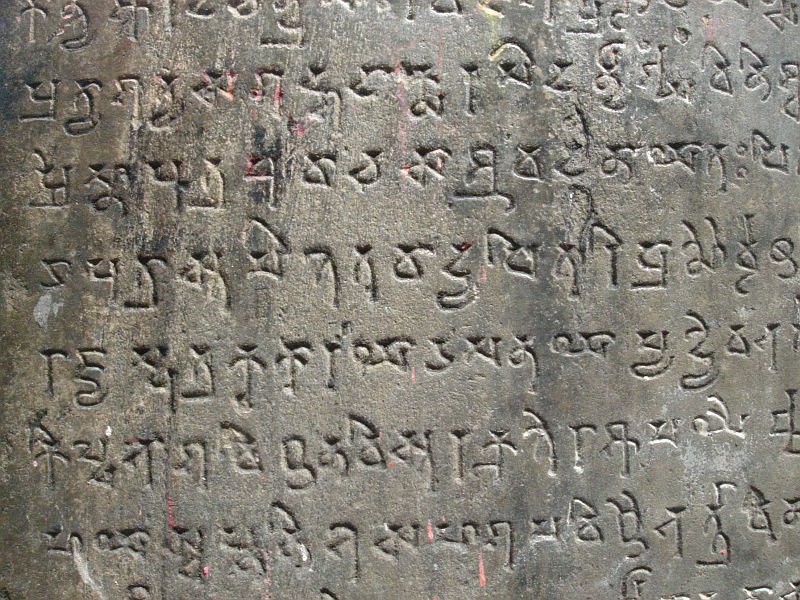
Despite the fact that I can't read it, I think the stone below is my favorite part of Changu. In the ancient and now disused Licchavi script, it supposedly relates the story of how a Licchavi king dissuaded his mother from sati, or widow's ritual suicide on the funeral pyre of her husband, and instead persuaded her to stay with him among the living because he would miss her. (Some proof that, despite what many would like to claim, sati was real, not an invention of the British or anti-Hindu propagandists.)
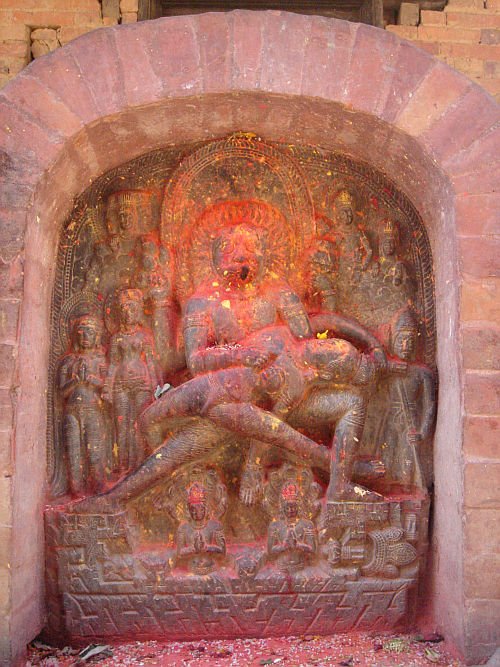
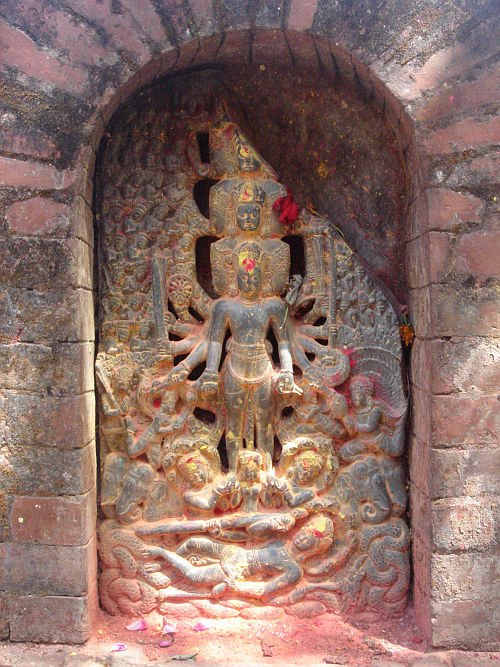
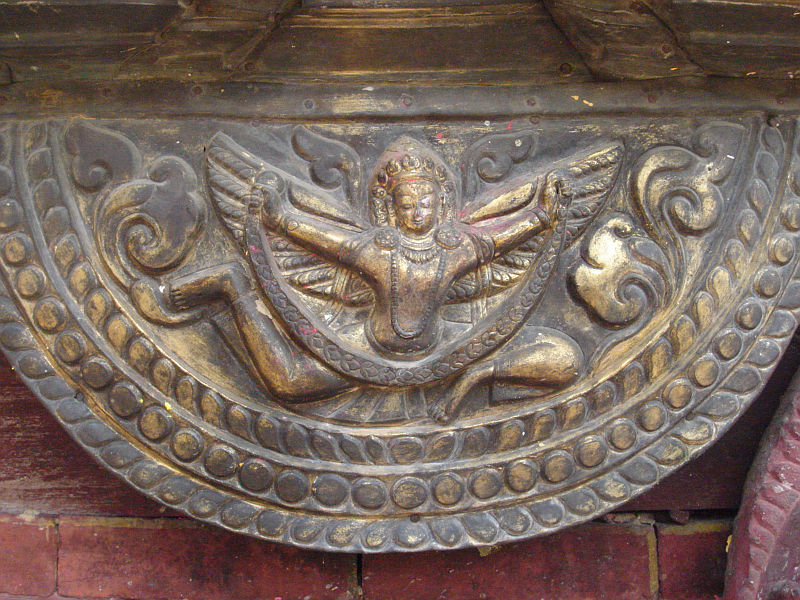
Narayan is one of the names of Lord Vishnu, who represents the "preserver or maintainer" form of the Godhead. This is the aspect of god traditionally meant to be embodied in the King of Nepal, though the current candidate seems to have been asleep at the switch. Though we weren't able to see the murti or statue inside ("Hindus only"), there are plenty of surrounding toranas (engraved and embossed metal archways), friezes, and sculptures. Most of them depict the various DasAvatar or ten earthly incarnations of Vishnu, including Lord Krishna, the dwarf manifestation whom I think was called Vamana, Parashurama, Narasingha the man-lion avatar disemboweling a nonbeliever (below), and what looks like Vishwarupa (the overwhelming all-encompassing universal form of God), a masterpiece of mind-boggling Hindu psychedelia depicting the three worlds (of the underworld, men and gods, below).

Despite having been damaged during an attempted robbery, the detailed cosmology of Vishwarupa is well worth a few minutes' contemplation. I'm afraid the photos really don't do the sculptures justice. There is a legend accompanying each of the statues - I know most of them and was able to bore Lynette and Dave with my know-it-all stories, but there is no printed guide available so you should bring a guidebook with details to Changu Narayan.


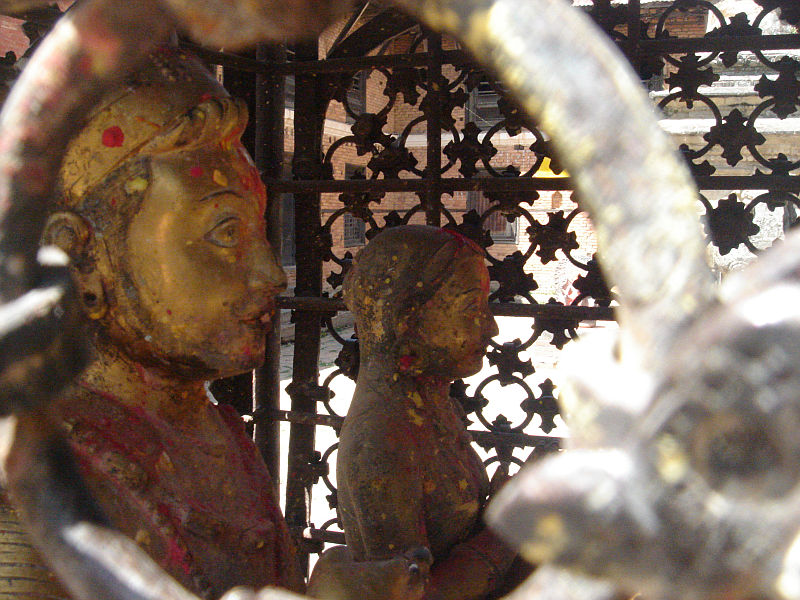
Isolated in their gilded cage are small statues of a former Licchavi King and Queen, possibly the ones who built the actual Changu Narayan temple (the site is believed to have been used for worship long before the building was erected). This is a common feature of Nepali temples - the patron king and queen immortalizing themselves in the kneeling posture of devotion, hands folded in salutation, facing the deity.


After a dreadful and very overpriced lunch at the neat, tidy garden style restaurant near the front gate (don't be fooled by the appearance - they do have a bathroom, though), we elected to walk the hour and half back down to Bhaktapur town, through the pine forest (the best part), windy wheat fields, and dusty small towns.
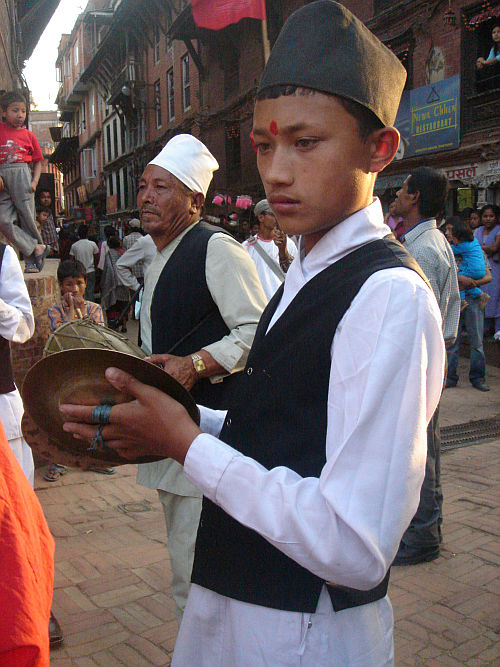

We knew we were near "town" when speeding vehicles threatened to knock us off the road into the ditch, and choked us with their fumes. Back in Bhaktapur, we were greeted by still more clanging cymbals, beating of drums and tooting of flutes. Was Bisket Jatra STILL going on?

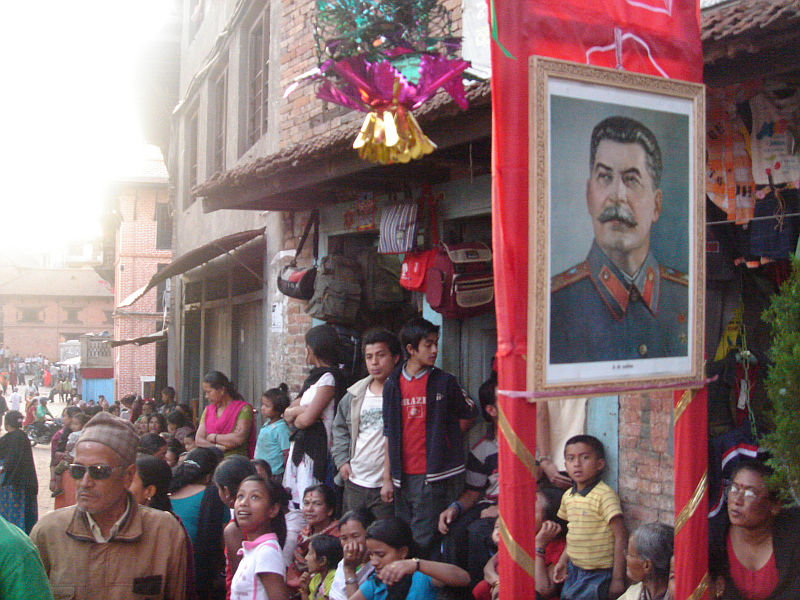
It turned out to be a different festival. The Maoists, along with a local affiliate Newar identity party, were celebrating their electoral victory with traditional music, traditional dance, red banners and portraits of Stalin, Mao, Marx and Lenin.

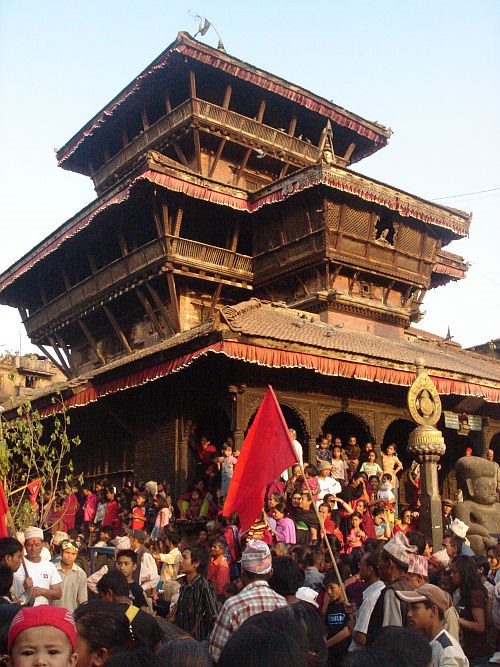
Dattatreya Temple square (also called Tachupal) was once surrounded by Maths, or Hindu ashram-style centres of residential learning. Students came from all over the region to learn traditional Ayurvedic (herbal) medicine in the ornately carved wooden buildings. Now, Pujari Math is a woodcarving museum, and another of the Maths has been transformed into a high-priced tourist restaurant.
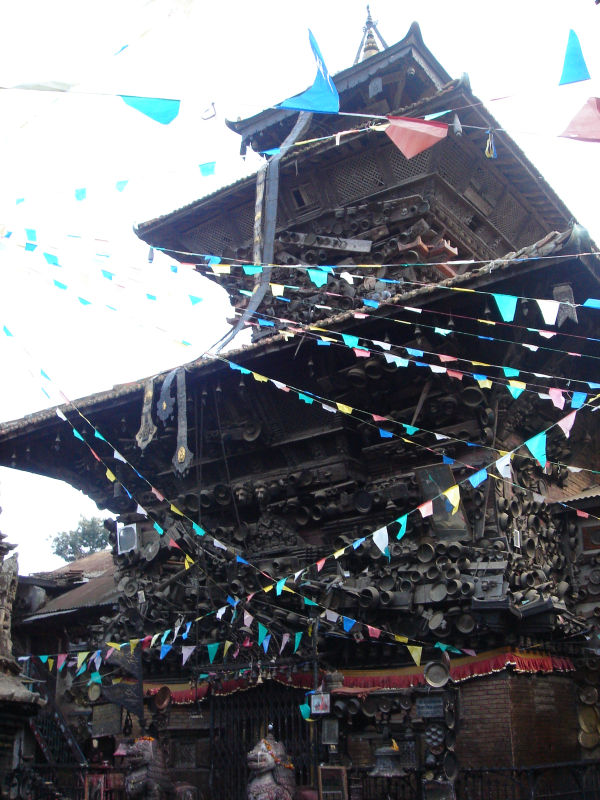
New gods were being worshipped in the old square. It was high time for a shower and a pot of tea. We drifted through the narrow streets floating among political icons, Buddhist statues and Hindu gods back to the Bhadgaon Guest House.


---Thanks to Sudarshan for correcting some of the deity information.

Wednesday, April 02, 2008

Mandala meanderings

Down in the Valley: Another Cultural Minute
Kathmandu Valley, Nepal
I haven't been meandering too much this trip....been in bed with a screaming migraine the past 3 days. But I would like to continue my Power Places of Kathmandu Valley series.
Tantric Hinduism was mostly wiped out or went underground in India, the land of its birth, centuries ago - by a resurgence of Brahmin orthodoxy and religious reforms. But it remained and remains alive and well in Nepal.
This has mixed results; the lovely sensual artwork celebrating human sexuality, along with the many bloody animal sacrifices.
The entire valley (and every city within the valley) is arranged as a mandala; that is, a ritual circular design with "power points" at key positions.
Here are my photos of a few more of the "Power Places of the Valley."

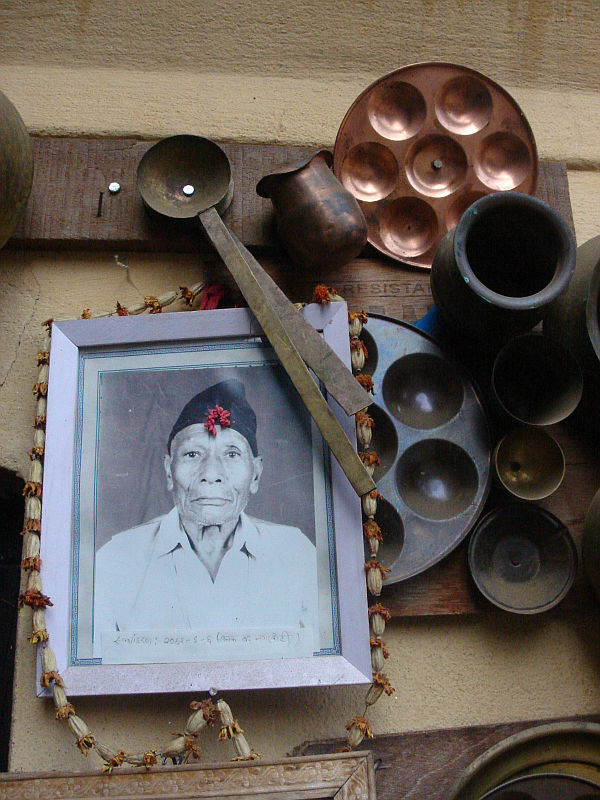
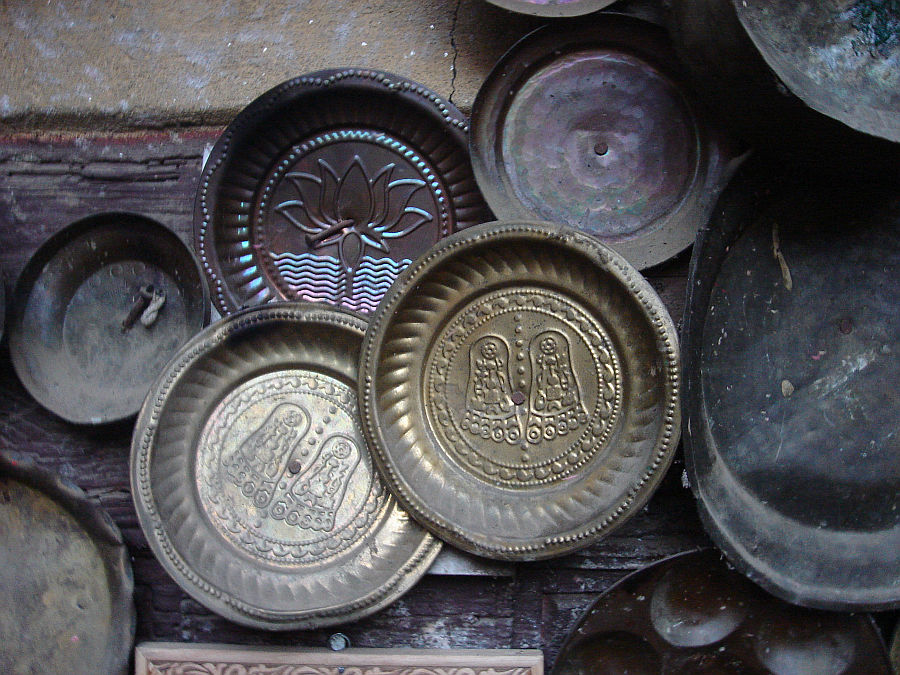
Chobar Adinath at first appears to be just another charming Newar style pagoda temple. But it's sacred to both Hindus and Buddhists, and inside the walls are covered with brass plates, pots, pans and photos of individuals. These are all homages to the deceased. The result feels very intimate; like being in someone's living room with the eyes of their ancestors peering down.


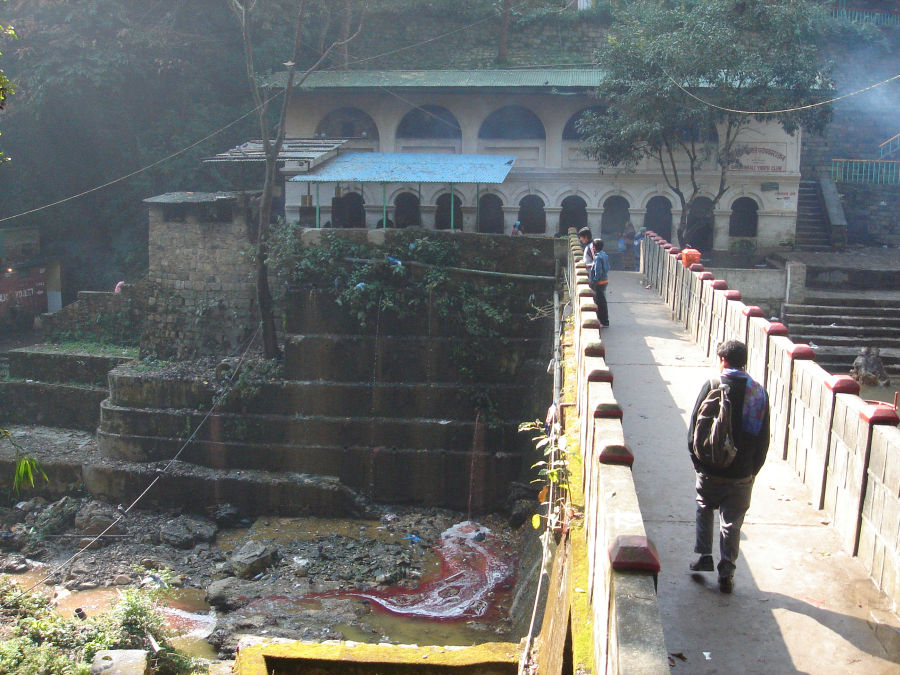
Dakshinakali, a Hindu temple located in a deep dark crevasse near Pharping, is the best known animal sacrifice temple, not only in Nepal but possibly in the world. It's not so much a temple building as a sprawling complex of bridges and platforms. Situated atop a small river, the water literally flows red most days (as you can see in the lower left-hand side of the river photo). Chickens, goats, sheep and so on are sacrificed by the dozens daily. Creates a powerful aura, but be prepared.

The hills and woodlands surrounding the grotto are strangely peaceful, green and beautiful, and if you climb to the hilltop, a quiet, less bloody Goddess temple awaits you. In general Dakshinakali is certainly a powerful antidote to the popular ideas of Hinduism as a nonviolent religion.


Pharping Vajra Yogini is just about the polar opposite, vibrationally, of Dakshinakali. It's a hillside temple to a Buddhist goddess, and unfortunately doesn't allow photos of the main deity figure. But the wooden pagoda structure gives a welcoming, cottage ambience, so that you really feel you are visiting the "house" of the devi. The Vajra Yogini is a very prominent figure in the region so if you are looking for the Vajra Yogini temple, be sure to specify which one - there are several.

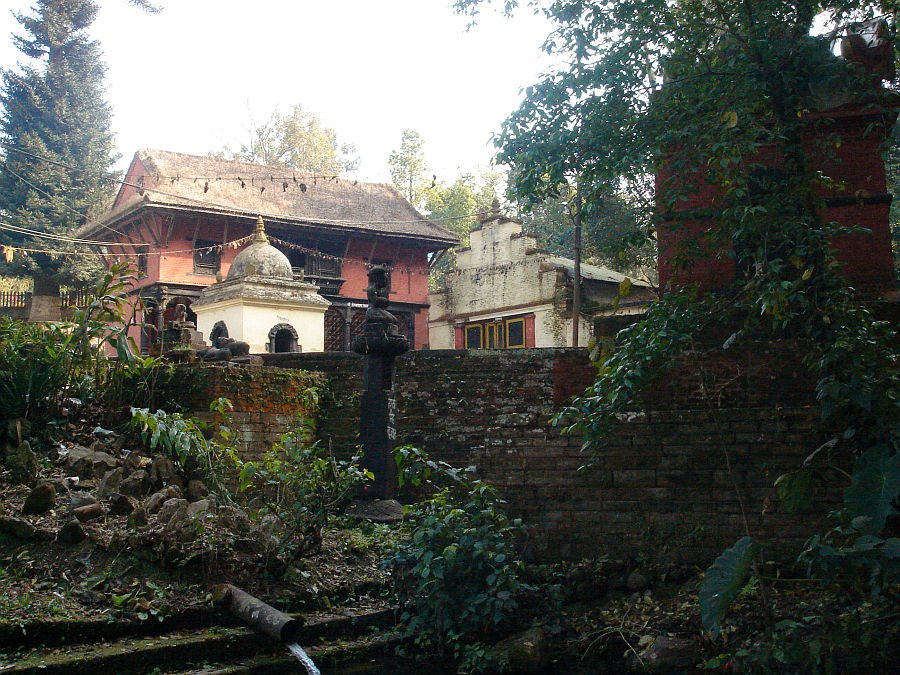
I could never get a photo that managed to capture the serenity of Pharping Sesh Narayana, a Vishnu temple which is nearby the Vajrayogini and up the road from Dakshinakali. Again, it feels more like a charming collection of cottages, surrounded by a goldfish pond and placidly grazing cows, than any formal house of worship. It's a very enchanting location. The small waterfalls and pools seem appropriate for a temple dedicated to the reclining "Adi Sesha" (ancient serpent) form of Lord Vishnu.


Time to go eat dinner. I guess there will have to be a Power Places Part 3.


Saturday, March 29, 2008

Eyes in the door

Power Places of Nepal: a cultural minute
Swaymabunath, Kathmandu, Nepal

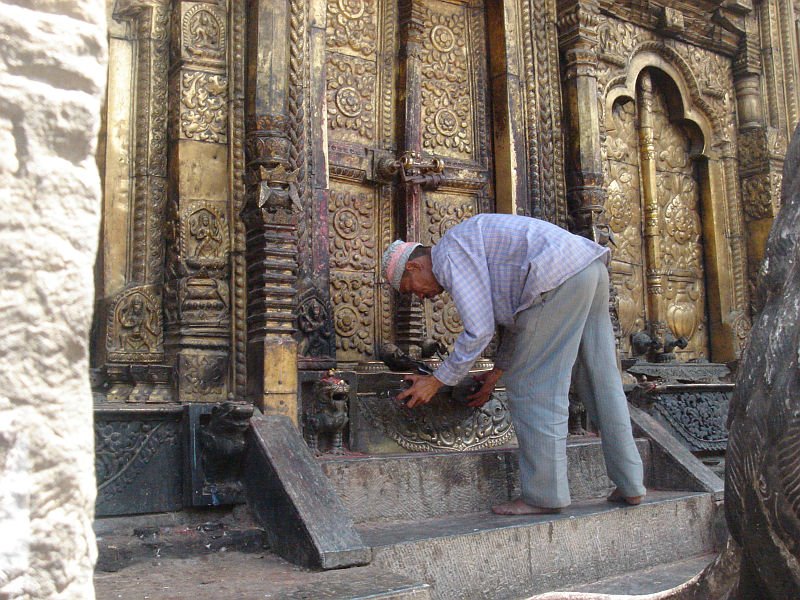
This is the doorway to the hilltop temple representing the element of Akash or Sky (there are five shrines, one for each element - Fire, Air, Earth, Water, and Space or Sky) at Swayambunath Buddhist stupa.

This temple's sanctum sanctorum contains an underground chamber opened only once a year, which can be entered only by specially initiated priests.
It sure does feel mysterious and arcane, standing in the mandap (front room) of the temple.

It is extremely dark in there; otherwise I would have better photos of the many brass figures and macabre wall paintings (nearly obscured by centuries of smoke from oil lamps).
I believe this same door can also be seen on the cover of Keith Dowman's coffee table book, Power Places of Nepal (which would make a great Christmas gift, hint hint).
Dowman lists 25 "power places" in the "Nepal Mandala" (there are undoubtedly lots more).
Hmm, just cause I'm tired of thinking about The Big Old Mean World for a minute, let's go on a quick Valley tour and see how many I've visited and photographed.

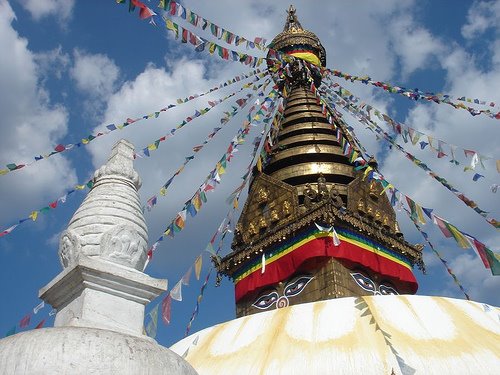
Swayambunath (ab0ve and below)::


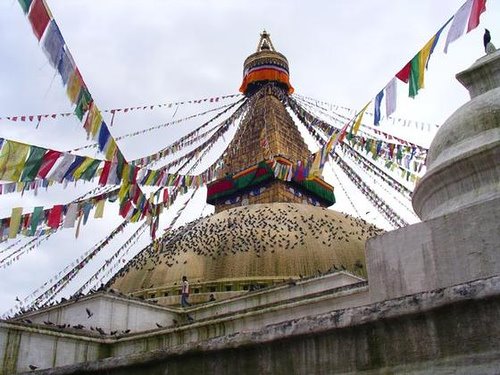
Boudhanath::


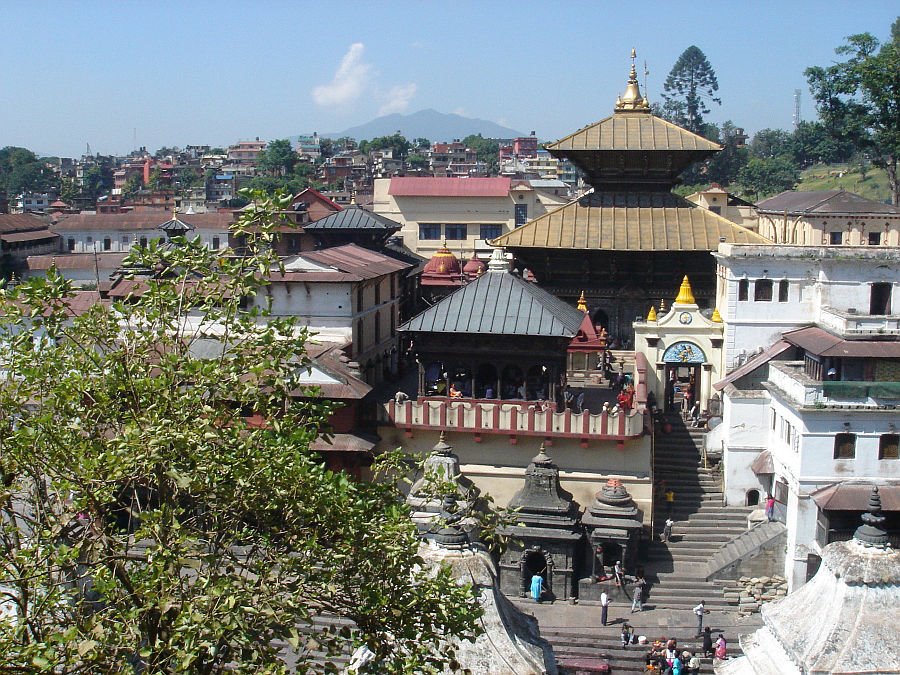
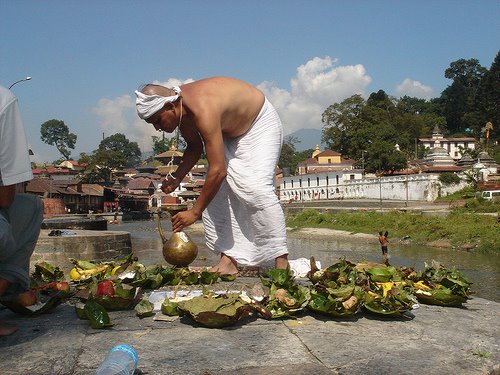
Pashupatinath::


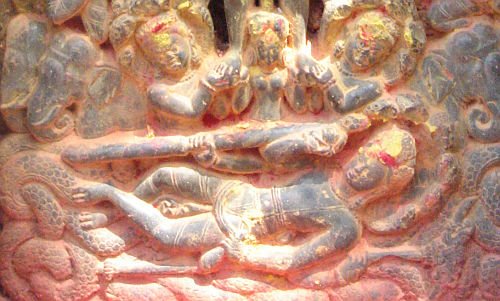
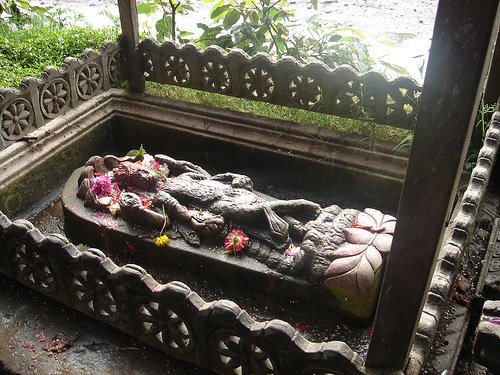
Buranilakanth (aka Buddhanilakanth): Officially 'non-Hindus' (aka, white people) are not allowed inside Buranilakanth to view the statue of the sleeping Vishnu, recling upon the ocean serpent. But there is a smaller replica statue of the Buranilakanth Adisesha in Bhaktapur, below:

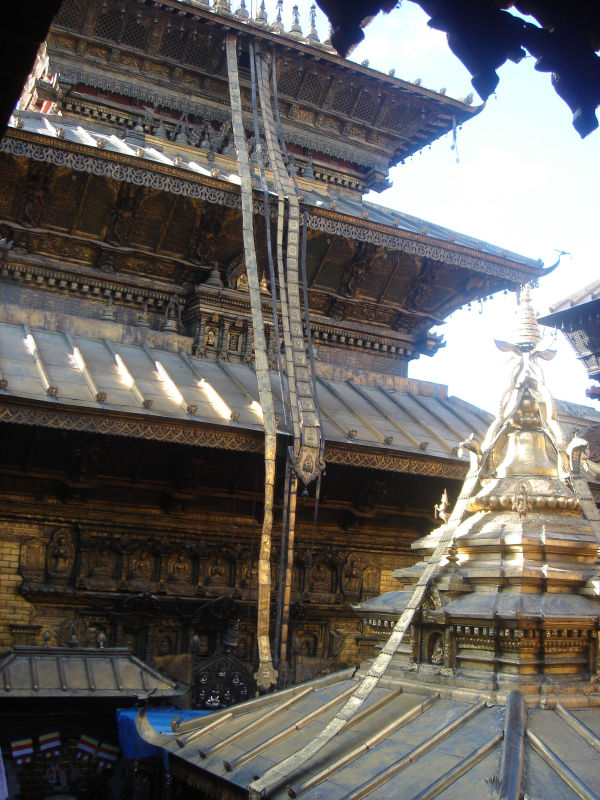
Kwa Baha (aka Patan's "Golden Temple")::

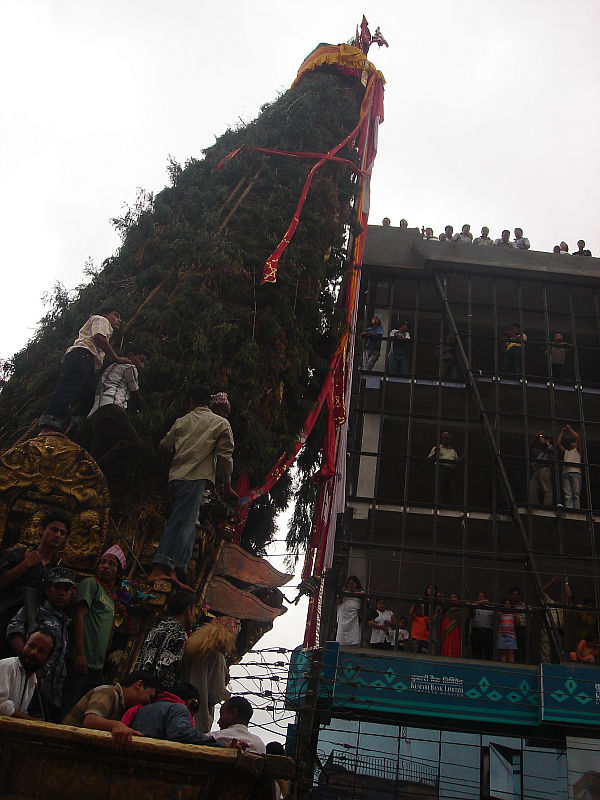
Rato Matsyendranath
:: Whie I admit to never having visited the actual temple of Rato Matsyendranath in Bungamati, I did witness the Most Insane Pulling Of His Five-Storey Chariot through the streets of Patan last year, like a mammoth Christmas tree on wheels scraping the rooftops and occasionally the power wires.

Kirtipur Bagh Bhairav Mandir:

Whew, I'm already tired. I still have to show you Chobar Adinath, Dakshinakali, Pharping Vajra Yogini, Sankhu Vajra Yogini, Bhaktapur Taleju, Pharping Sesh Narayana, Surya Vinayaka, Akasha Bhairava, Gokarneshvara, Teku Pachali Bhairav, Seto Matyendranath and Changu Narayana. I've been lucky enough to visit and photograph all but a few of these.
That will have to be another installation of the Cultural Minute.
This Cultural Minute was brought to you by the letter OM अ and the number १०८.