Showing posts with label art. Show all posts

Thursday, May 28, 2009

Art appreciation

As some of you know, I spent about four years travelling around India and Nepal, and about two of those were following HH the Dalai Lama to his many places of teaching and discourse throughout India.

Nowadays, some wags probably consider that stalking. There was a day when it was considered pilgrimage. That's what you do with saints, in the Hindu and Buddhist tradition. Saints don't stay in one place, they keep travelling. You follow them around.

Anyway, some of my favourite moments were in and around the teaching sites, where "Life's Rich Pageant" coalesces.

This photo was taken one morning in 2006 at Sarnath, Uttar Pradesh at the Central Institute of Tibetan Higher Studies, where everyone was queuing for the metal detector to get into teachings.

Last week, I received some Art Appreciation from a Flickr user named East Med Wanderer:

Great shot! All life is there - it has the quality of composition of one of the great master painters. And with a point and shoot - terrific!

Sometimes that's all it takes to make your day, or week. One of the great master painters probably would include the entire face of the purple-wearing woman at left, though - for compositional balance. That way, there would be two women facing each outside corner.

I can no longer post the larger versions of the photos - they kept getting stolen off the blog site. You can view (but not right-click) a larger version here.

Wednesday, April 29, 2009

Peace sign

I adore this hand-painted billboard, that I snapped near Guntur, Andhra Pradesh three years ago.

It depicts a Jain saint seated peacefully among animals, and (in Telugu script, but Sanskrit language) says "Ahimsa paramo dharma," or, "Nonviolence is the greatest religion." 

Ahimsa

Related reading:
Religion and Culture of the Jains.

Wednesday, December 31, 2008

Newartistry

Art and about
Kathmandu
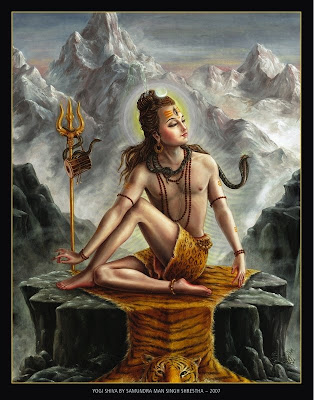
I was lucky enough to visit with a well-known painter of Hindu and Buddhist Tantric art, and didn't even write about it. Yet.

Samundra Man Singh Shrestha is so cool, he is friends with Robert Beer.

No, cooler than that - Robert Beer actually buys his (Samundra's) paintings. His most recent exhibit was at the Sacred Art & Sacred Space Auction in San Francisco.

He's also a good friend of my Charya dance teacher, which is why we went to hang out at Samundra's house in Lazimpat.

There are still plenty of painters in the Newar Poubha tradition, as well as in the Tibetan Thangka tradition. These traditons, like most classical schools, leave little or no room for innovation. Samundra has the technical ability to produce such works, but uses that background to render his own interpretations, particularly of Nepali Hindu gods and goddesses (Bhairab, Kaumari, and so on).

Samundra puts a lot of Rasa or Bhava (feeling or expression) into what could otherwise be static images with parameters set down by the Shastras (scriptures dictating artistic guidelines).

Anyway, I was too much of a bonehead to remember my camera that afternoon, so here is a wee example of his work. On the Tantricart.net website you can see more.

Tuesday, December 23, 2008

Time shift

Let's do the time warp again
Kathmandu

Last week, my Charya Nritya (Chacha Pyakhan if you speak Newari) teacher, Raju Sakya, and I were pushing our way through the sidewalk near Sundhara.

Pushing, not because Nepal is soooo heavily populated or because people are so rude (neither is the case) but because 2/3 of the walk space is taken up by sidewalk vendors. One of the first things the new Home Minister announced was a crackdown on "footpath" vendors. I guess what we're tripping over now are the vendors who can pay the new, requisite bribes.


Anyway, as we were negotiating our way toward the Ratna Park Tempo-Micro (mini-bus and share taxi) stand, we passed a lone Buddhist chaitya (aka stupa, chorten - Buddhist monument) in the middle of the sidewalk chaos.

In Kathamdu, it's hard to walk without tripping over such works of religious art - they are literally everywhere. But there was something distinctive about this chaitya.


The lines were more fluid, more flowery...I did not get a snap of it. But Raju, who is getting a Master's degree in Nepali art from Tribhuvan University, said "This is a Licchavi period chaitya."

The Licchavi period. Wow. That means it's at minimum 1,400 years old.

"Yes," said Raju, "from 6th or 7th century."

For just a second all the horns, shouting, spitting and pushing stopped. The Licchavi dynasty came from what's now Bihar state in India (I think; don't beat me up if I am wrong). Though they were Hindu, there was still plenty of Buddhist art flourishing during their reign.

This piece of ancient artwork is enclosed by just a cast iron railing; otherwise it's in the open air. It appears undamaged and has probably not changed for the 1500 or so years of its life.

Just the kind of stuff you can see any old day walking down the sidewalk in Kathmandu - if you can make enough space on the sidewalk. We pushed, darted, and maneuvered our way over to the micro-bus and headed for Patan (former Buddhist kingdom, now home to INGOs and expats).


Monday, September 29, 2008

Graven images

Stoned
in Kathmandu

Yeah, I am so lame. I haven't blogged in nearly a month. But I have been playing Tour Guide to a number of friends tripping through the Du. Literally every time you go to an historic site, you see some new detail. Here are a few I've noticed this past month:

At the entrance to Mhyepi Ajima Buddhist temple. Just an archetypal female figure seated in something like Padmasana, and a bell to call her with. I like the way it's so worn down with centuries that nothing remains but the basic shape.


The torana (carved archway) of Sweto Kali or NarDevi temple, in the heart of Old Kathmandu. If you want to find her, the neighborhood is actually named after her (NarDevi). The white stuff on her mouth is milk-sweets (people "feed" her). Inside the temple are three more Devis. The torana is just a sort of "signboard" heralding the gods that live inside.


An unusually sensual statue of Sri Vishnu, Hindu god of preservation. He obviously seems "glad to see you." My friend Sean in California observed, "instead of sporting a Woody, he's sporting a Stoney."

Thursday, July 10, 2008

Invasion

Score!
Kathmandu

There's a new addition to the narrow streets and alleyways of old Kathmandu. In among the Hindu and Buddhist icons, Maoist political graffiti, street signs in three scripts, and the famous "Kathmandu Eyes" appear various figures from the 1980s video-arcade classic, Space Invaders.

Sometimes orange, some turquoise, a rare one in black and white....the Invaders are the latest in the layers of urban kitsch to be absorbed by The Infernal City.

It's the latest in the travelling guerilla installation series "Invasion," instigated by a European artist who calls himself Invader. Invader's progress in his "reality game" is detailed on his own web site (complete with game score).

Having entered the "neighborhood" in Bangkok and dropping by Dhaka, Invader appears to have scored many successful "hits" here in the Mountain Former Kingdom, before moving on to Varanasi and perhaps (my guess for the next stop) Delhi.

I've had fun spotting the Invaders throughout old Kathmandu, and even more fun wondering how the heck he got them up there without interference. There's several in Thamel and at least one down by Ason Tole.

I especially like this installation at the Varanasi Hindu Ghats in India. Invader has also branched out into paintings, like this one also in Varanasi.

I've long joked that if an item remains stationery long enough in this part of the world, someone will start worshipping it. Perhaps someday we'll see tikka, jamara and marigold garlands round the Invader mosaics, just like those of Buddha and Bhairab.

Another art-guerilla is going round spray-painting the Matt Groening "Binky"Rabbit, familiar from Groening's Life In Hell comics. While it ain't Futura 2000, I am glad to see some kind of street culture emerging in Kathmandu, other than burning tyres and holding strikes, that is. (As theatre those long ago became redundant.)


----------------
Now playing: Dead Can Dance - Devorzhum
----------------
Now playing: Henry Wolff - Leaving the Body
via FoxyTunes -
Now playing: Dechen Shak-Dagsay - Lobön Rinpoche
via FoxyTunes

Tuesday, March 11, 2008

Georgia on my mind

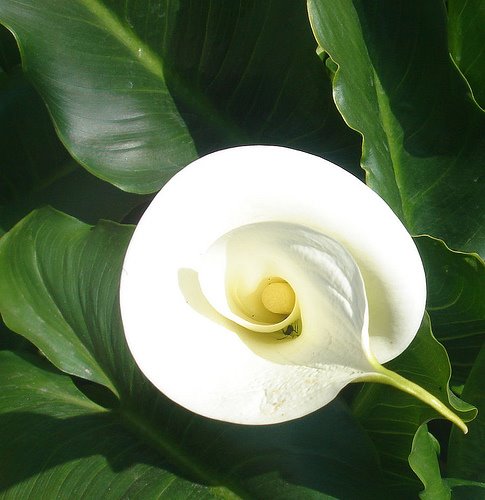
"I hate flowers. I paint them because they're cheaper than models and they don't move" - Georgia O'Keeffe (American artist and Scorpio)
----

Seen in a Baluwatar garden in Kathmandu.
(now some smart-ass is going to write in with some suggestion about white balance.)


Tuesday, August 28, 2007

Houses of the holy

Of monasteries and militaries
Leh, Ladakh

The past four days I've been on an exhausting tour of central Ladakhi monasteries (and I only saw about six of dozens that are here).

It's a wonderful change from the neo-Indian and Nepali monasteries, the vast majority of which were built post-Tibetan exile (from 1950s onward). A 1967 monastery would be a really old one in most of India (a few exceptions include the Nyima monastery in Rewalsar, Himachal - it's about 100 years old). These neo-monasteries are naturally built of reinforced concrete, tile and have glass in the windows - like all recent buildings in India.

Here, the monasteries average about 15th or 16th century. I decided early on that anything post 16th century was just a bit too new to make the visiting cut. Here in Ladakh there are so many to choose from.

These are the ultra-traditional monasteries, built of stucco, straw and wooden poplar beams, planned as a holy fastness high on distant hills, purposely isolated and difficult to reach.

My Tibetan friend Jamyang Norbu (in Dharamsala) told me how weird it was for Tibetans to see so many monks and monasteries right in the middle of a popular place like Dharamsala or Kathmandu. "Gompa" (Tibetan for monastery), Jamyang said, "means silent place. Lonely place. Monks should not be coming into town, eating in cafes, watching movies...in Tibet the monks were real monks. They stay in real gompa---" away, he explained, from the temptations and distractions of town.

It would certainly be difficult to get into much trouble at one of these gompas, unless it was for touching the sand mandala before it's finished. Usually the gompas rise up mirage-like from the desert, on a rock outcropping. These days, the Indian military presence guarantees an odd juxtaposition - most every monastery on its hill has a military base as a neighbor, down in the dusty valley. So, while you are chanting for world peace and turning prayer wheels, you have a birds-eye view of the military base with its dun-coloured barracks and olive soldiers trudging through the sand, dwarfed by the immensity of the landscape.

Most tourists like to get a small group of 4-5 people together and hire a taxi (ie, small van or jeep) to hop from one monastery to another. They are "close" on the map...which means, at least 10 kms away from one another down dusty, bumpy, largely unpaved tracks. This costs at least 1000Rs or $15 a day.

This does save time, and physical energy, but I like just getting the local bus (10-15rs), from "downtown" Leh, to the gompa in question, and trudging up the hill to the medieval fortress. Getting the bus means that I am more on my own time. I hate the feeling of having a driver waiting (they are always impatient, as though they have something better to do) and having the clock ticking. You just have to make sure, if you stay for the evening puja, that you don't miss the last bus back to Leh - usually at 6 or 7pm.

If you do, it's no big deal. In many gompas, you can just stay overnight, then catch a morning bus onto the next gompa. The primary monasteries unwind southeast and northwest of Leh along the National Leh-Kargil Highway. With the help of the local bus and a map, you can actually go gompa-trekking.

Admission to the gompas varies - about 15-30Rs per person, and they charge the same for foreigners as for Indians, which is refreshing.

So far I have visited Spituk, Phyang, Stok palace, Thiksey and the motherlode of Indian Buddhist artwork, Alchi Chuskor. My neck and shoulders are aching from looking up and craning my neck at wall paintings for hours at at time. You must bring a torch, because most of the gompas are not well lit, and do not expect to be able to take photography (flash or otherwise) in most of them - especially not Alchi, with its unique irreplaceable paintings. You can view a few photos at Hinduonnet.com. The Alchi paintings have a fluid Indian style so different from Tibetan Buddhist art.

At Spituk, the monks were completing a sand mandala, part of the special puja they are doing to find the new incarnation of their beloved high lama who passed away in 2003, Bakula Rinpoche. At Phyang, an enormous festival with thousands of people was in process, as the head of the Drikung Kagyu school was bestowing a special long-life blessing and phowa (transmission of consciousness at death) teachings that are given only every 12 years (in the Year of the Pig).

At Stok palace, the remnants of the Ladakhi royal family still live, where they were exiled by the invading Indian Dogras some 150 years before. After 900 years as an independent kingdom, Ladakh has been a part of India ever since. The king passed in 1987, but the Queen Mother Gyalmo Diskit Wangmo and her son, the crown prince, are still there. The palace caretaker declined our request for an interview. Little does he know, I am not so easily dissuaded!