Showing posts with label leh. Show all posts

Wednesday, May 14, 2008

Two Embryos Hypothesis Loan


Fun with Chinese Spam
Still in Kathmandu


Recently I began receiving emails in Chinese script.

I was wondering if it was misplaced spam, or perhaps replies to some of
the things I had written about Tibetans (according to the Sitemeter, I do have viewers in PRC).

The emails turned out to be a particularly dadaist kind of spam. (Even Britney Spears uses the word "surreal" now...someone has to stop.)


The latest one said this:

不動產二胎。缺錢找我。住宅貸款。二胎設定放款。代辦支客票貼現。 第一成功資融:0938-580-107 企業週轉金。救急速撥。1胎借款。放款快速。企業週轉金。 第一成功資融:0938-580-107 缺錢找我。代辦支票借款,公司戶支票。工商融.免保借款。建物所有權狀。誠信經營。

According to the AltaVista Babel Fish, this translates as:

Real estate two embryos. Is short of money looks for me. Housing loan. Two embryo hypotheses loan. Charge d'affaires passenger ticket discount. The first successful capital melts: 0938-580-107 enterprise circulating capital. Rescues dials rapidly. 1 embryo loan. Loans fast. Enterprise circulating capital. The first successful capital melts: 0938-580-107 are short of money looks for me. Charge d'affaires check loan, company household check. The industry and commerce melts. Exempts guarantees the loan. Building property rights shape. Good faith management.

- perhaps a Chinese version of the now-infamous African "Extremely urgent and confidential" scam.

Viewer Mail


A viewer named Per was nice enough to write in with the news that evidently, the Leh-Manali Highway is only "officially" open...not actually open.

(Those of you familiar with Indian travel will understand the difference.)


Evidently buses are not yet running up to Leh. (Per's message is under yesterday's Comments.)

Per also says the government bus is a good way to travel the Leh-Manali highway. My friend Dhami says the same. I guess the trick is to get a *tourist* government bus....not the budget government bus with wooden seats.

And as always on these trips, you absolutely must book early and get a seat in the front section of the bus, the farther forward, the better. Otherwise you will very likely not only be puking but literally flying up at every bump in the road, banging your head on the luggage rack (which is made extra low to accomodate Asian heights) and then slamming back down on the seat.

Of course, this (being in front) puts you within range of the deafening and constantly-employed horn. Take your pick!

You must also take your pick between sitting by the window (more fresh air, also more pollution, but if you are tall, knees will be wedged in the entire time) and sitting in the aisle (more leg-room, since Indian buses rarely accomodate people over 5'7").

Another subcontinental bus trip tip: Anti-nausea medicine is over the counter here. Get some.

Sunday, May 11, 2008

Open for business

Head out on the highway
News from Ladakh


It's open! The Leh-Manali Highway, magical, dramatic and sometimes torturous route from Himachal to Ladakh, is now open after six months of Himalayan snow.

For those of you who don't know, travel to Ladakh means either a flight on Air India or Air Deccan (about $150 one way) or about 2 days in a jeep (or bus, god forbid) from Manali to Leh.
The fastest jeep trip I ever heard of was 18 hours almost nonstop. When you're not throwing up, the scenery is supposed to be breathtaking.

Ladakh, being out of the monsoon shadow, is one of the few places not affected by the heavy rains and high humidity so common in this season in the rest of India. (Lahaul, Spiti and Kinnaur in Himachal are others, I am told.)

Saturday, December 22, 2007

So close to heaven

Snowblind
Kaspang, Ladakh

For today's entry I am nicking the title of a pre-existing book about the "Vanishing Himalayan Kingdoms" Sikkim, Bhutan, Nepal, Ladakh and Mustang. I have yet to read So Close to Heaven by Barbara Crossette, but it expresses so perfectly the feeling I have when up among the snow covered hills.

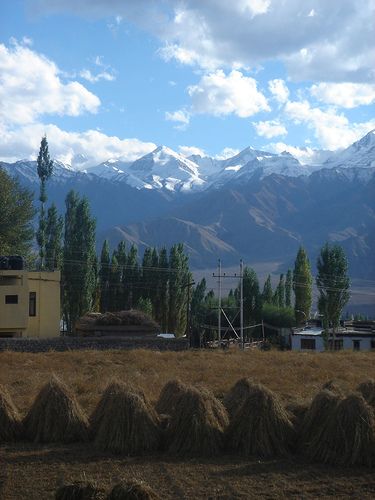
Green, gold, grey, white. I have seen the Ladakhi landscape completely change colours four times. When I arrived in August the valleys were lush and green. The green turned to amber gold. There are a few weeks before the serious snow when everything just appears grey. Now from Hemis onward the valleys are blinding white, and the Indus, still running turquoise, is edged in ice.

The picture above was taken from the roof
top of Chemdey Gompa near Serthi ("Sakti") village.

Changes in latitude, changes in attitude

I had such a perfect "last day in Ladakh" on Dec. 19th, with trips to Chemdey and TakTok gompas and cozy, glowing village homes, that I decided to extend my stay another 2 days, into the Winter Solstice. There was a special chaam (ritual masked dance) at Chemdey monastery, and I was invited. A special chaam dance at a monastery on the Solstice - I couldn't resist.

As luck would have it, yesterday I ended up with altitude sickness, which ruined the next 18 hours. How, after 4 months at 13,500 feet, did I end up with altitude sickness, you ask?

I was invited to visit a remote (really remote) mountain monastery called Kaspang, past a valley called Igu, way out past Karu village. "It is so beautiful!" enthused my friends. "You won't believe it."

When we arrived at Ig
u Village, the entire local populace appeared to be out in the winding street, except for a few kids with makeshift snowboards who were skating on the frozen river. It turned out to be a cremation and funeral. A young woman of the village had died - no more than 25 years old or so.

M
y friends and the driver could not be deterred from their mission to the monastery. So we drove through lanes that became increasingly less dirt and more snow. About 2 kms from the monastery, the road was just covered in snow - about 4 inches. Not bad to walk in, but too much for the car (not a jeep) to make it uphill.

My Ladakhi friends insisted we abandon the car and walk, uphill, for the next 2kms. After about 1000 feet it became painfully- literally painfully - obvious that we were up too high for me to go hiking.

"How high are we anyway?" I puffed, s
eeing sparkles like confetti before my eyes.

"Oh, about 15,000 feet" Dorje answered.

For a Ladakhi, that is no problem. For ordinary lowlanders, once you get about 10,000 feet, every 1000 feet or so requires a new adjustment period. If you don't believe me, just try it.

At this point we had been at 15,000 feet about 2 hours. We had gained about 1,500 feet from our starting point in Leh valley. I was suffering in a very real way from altitude. My Ladakhi friends, never having been in this situation themselves, refused to recognize it.

"Come on! It will take only half an hour!" I looked up at the gompa in the distance, which with its white walls against the white mountains, felt like a mirage. It was at least one and a half hour's walk by my speed - including breath-catching stops. My friends could have walked the whole thing in half an hour.

Blood singing in my ears, I turned and
looked back where we had walked. The entire panorama was just like Seven Years in Tibet or the Shangri-la movie of your choice - unbelievably austere, lonely, purified by aeons of snow which managed to be crunchy and soft at the same time. Amazingly, not so cold, especially when you are hiking. And no wind.

In the distance a lone man in a black
goncha robe was leading an equally black and mighty, shaggy dzo (yak hybrid) through a pass. They looked like ink hieroglyphs on white paper. There was no sign of habitation anywhere around them. The man and animal appeared to have emerged from nowhere - they must have been trudging for hours. I suddenly wished I was riding the ponderous dzo. The yaks and dzos are so deliberate and grave in their movements, they are almost like walking boulders.

I looked down. Tracks of mysterious animals made pie-crust patterns across the powder. Sometimes the tracks criss-crossed one another. The trident shape of a partridge or magpie's feet, what looked like the petite hopping of a snow rabbit, and one kind of track that appeared in sets of three. Must have been a galloping wolf.

Back to reality. "There's no way," I said. "I can't make it. Sorry to ruin all your fun." From the comments, it was o
bvious my companions just thought I was being a wimp. Literally, I would walk fifty feet and have to collapse onto a rock. Still, they thought I was malingering.

My head was spinning. I heard one of them say, "Come on, take a picture of me with the gompa behind!" (I was the only one with a camera (quite possibly the reason I was invited.)

Finally I got angry. This s*** is dangerous, and here they were joking around about it. "Can you not see," I hissed, "that I am SICK, and ready to collapse? I am NOT laughing. This is NOT a joke. I have every single symptom of altitude, and still you won't listen to me!!! We have to go down." As soon as I was able, I wheeled around and began backtracking firmly toward the car.
By the time we got back to Igu, we had been at 15,000 feet nearly 3 hours. It took nearly the next 24 hours to recover. Moral of the story if you are not Ladakhi: Don't go trekking with Ladakhis (or Tibetans) who are not professional guides. They think you are faking altitude sickness. In a way, it makes sense. They have never and probably will never experience it themselves, unless they
climb Everest. Moral of the story if you are Ladakhi: don't take foreigners up to 15,000 feet and then expect them to hike up a hill, unless you want to carry them back down.

Down to earth
When we finally got to Igu, we stopped at the house of a distant relative (all Ladakhis appear to be cousins of cousins of second cousins from their father's village). As if to prove my symptoms were real, I dropped my glass of butter tea on the floor. "I don't have coordination yet." Then I dropped a biscuit someone handed me. And I couldn't really hear anything anyone was saying - like being underwater. It's like being drunk without any of the fun.

Eventually, after seeing me move like a drunkard, my friends started to take the condition seriously. I am s
till pissed off that it ruined the last day and half in Ladakh. I did get to take a fun sleeping pill at home to help me sleep it off and recover, though.

Strike!
The very last day (today) was additionally ruined by the LUTF strike. All shops were closed till about 3pm. Altitude sickness, beautiful scenery, spilt butter tea and political strikes - all in all a very Ladakhi day or 2.

Lamawatch

After the teachings at Mundgod, Karnataka,
HH Dalai Lama will hoof it to Ahmedabad, the capital of Gujarat, to open a Tibet festival, make a bunch
of speeches and inaugurate a bunch of stuff. Here's the news item.

I am interested to see HH on Gandhi's home turf, which has been so wracked by communal violence. I wonder if any local groups will invite him to address the subject.

Here is a photo I took of HH at the Hindu Long-Life puja in Dharamsala, back in April. I wonder whether he is looking at me saying, "So good to see you!" or, "You again!!!" Or maybe, "Get outta my way already...."

The Magpie

The Bactrian Magpie is a local bird that chatters when agitated. It was also the name of a weekly newsletter that was the closest thing Ladakh had to a newspaper, till it was discontinued a few months ago.

Here is the kind of news item it might have carried if it were still in print.

December 20, 2007.
Ladakhis Demand Official Status for their Language

Last Thursday, several thousand Ladakhis staged a demonstration in the city of Jammu to demand that Ladakhi be added to the list of official Indian languages. Dressed in traditional costumes, over 2,000 people, carrying placards and flags, shouted that Ladakhi, also called Bhoti or Bhodi, should be included on the eighth schedule of the Indian national constitution, which lists the 18 official languages of India.

....Bhoti is an archaic form of Tibetan, and while it is not normally understood by the people of Tibet, its dialects are mutually understood by people in Leh, Kargil, Zangskar, and other regions of Ladakh—and to some extent beyond. According to Rizvi, scholars have been trying to develop a written form of Bhoti to correspond to colloquial Ladakhi, but as yet, the written form of the language is still Tibetan.

Wednesday, December 19, 2007

Flying on Friday

Winter wonderland
Leh/Shakti/Chemdey/Karu village
s, Ladakh

After a day of driving through snow-covered villages I am very tempted to change my ticket. But as it stands, I am flying Friday morning to Delhi. Farewell for now to the land of crazy pashmina goats (didn't write yet about my attack by a pashmina goat!), frozen rivers and very expensive internet.

As long as the sun is out, even December in Ladakh is a pristine fairyland, with monasteries perched like fairy-tale castles on solitary hills. And all those other cliches....:-)

But, I haven't washed my hair in more than
a week. Not that it matters, neither has anyone else...


I spy
You never know who is going to be an Indian intelligence officer in Ladakh (or perhaps, some other kind of intelligence officer, in which case they would be a spy). I have discovered that a number of things and establishments presenting themselves in an ordinary way are in fact intelligence operations.

It's kind of cool, because since I fully understand neither Hindi nor Ladakhi, I am not a high security risk. I did overhear the English words "body" and "spy" in an official conversation yesterday, though, in an official office with official officials. I was given strict instructions not to reveal the true identity of the office I was sitting in. Naturally, I wouldn't, but I think the Chinese and Pakistani governments probably know already. It made me wonder how many Chinese and Pakistani undercovers are walking around town. Not something I want to know too much about...I am a "spiritual investigative reporter" (thanks, Kullu Kid of IndiaMike.com) and prefer to keep it that way.
If you want to determine whether someone is "intelligence" I would recommend looking at the shoes. The shoes tell the whole story (with everyone, not just intelligence). Black, expensive shoes are a giveaway.

What do my shoes (slate-grey Merrell hiking boots, a donation from travel-mates Lisa & Jonah Nigro!) say? They are saying "I need a new pair." If anyone is coming over, I wear an American Boys' size 9.


Sunday, December 16, 2007

Trouble in paradise

Blue skies, no tsampa
Leh, Ladakh

I've been trying to wrap up my interview materials here in Leh for the past week. The interview session with the Principle of the Central Institute for Buddhist Higher Studies started off stiff and weird but turned out well.

Actually, I think the monk Kanchen Sonam, who was kind enough to come and pick me up in the monastery-owned car (one of four), is the man who really knows the inside story on the incarnation search for Bakula Rinpoche. No disrespect to his knowledge, but I think the principle was kind of a Buddhist spokesmodel. That is, he knew all the proper "acceptable" things to say to me, In English.

Anthropologists must have a handy jargon term for the phenomenon I keep encountering, but I just call it "assuming the worst." That is, whenever I approach a "native" informant (even with my rather non-corporate, non-mainstream appearance) they assume the absolute worst about me and my writing intentions. They launch into a pre-rehearsed speech (I can tell) about how modern, progressive and un-superstitious their people and ways are. How nobody believes in those old things any more. How all the people here are now educated .... blah, blah, blah.

In this case, I asked a direct question about "the search process for the new Bakula Rinpoche." I got a speech about how things were different now, you know the Dalai Lama himself is very scientific, we don't have any blind faith in Buddhism, etc.....

It takes a minimum of half an hour, usually, to crack this facade. They just assume I am a non-believing skeptical westerner there to mock their traditions. Usually, I have to do what we used to call, back in the hip-hop days, "dropping science."

That is, I have to violate what I consider a rule of interviewing (the interviewee should talk more than the interviewer) and demonstrate a bit of inside knowledge.

In this case, I think it was dropping the Sanskrit term "ishtadevata" (personal chosen deity). We were discussing the role of oracles in local Buddhist tradition, or trying to. I had to start throwing esoteric terms at him in order to prevent him explaining the whole thing from the ground up, which would have been redundant.

Finally, I got a genuine smile. Yes, she kind of understands, even though she is an Injee! "Yes, like an ishtadevata!" he repeated the magic word. In this way we finally came to an understanding, which went something like this (paraphrased): Science is all well and good and very very necessary. But we cannot discard all the old traditions, they have a science of their own. There is something to mystical traditions that is important to preserve, even if we cannot or do not yet consciously understand it.

Whew. Now, we are getting somewhere. The upshot of the conversation was: Yes, the search for the new Bakula has already begun. Since the passing of the Rinpoche, special pujas have been done, and a special mantra, designed to bring about his swift reincarnation, has been recited millions of times by the monks of all four monasteries and is still being recited every morning.

At this time, there are three boys who have come to the attention of the Spituk presiding authorities. Rather than go on a house-to-house search (as made famous in the movie Kundun), these boys came to the lamas' notice through reports. All three of the boys had shown special interest in Spituk Monastery, talking about it, insisting on visiting and so on. One of the boys had reportedly even pronounced Kushok Bakula Rinpoche's name (remember, the boys in question are about three).

One boy is from Nubra Valley, another from the remote Changtang region still inhabited by nomadic people. The third is actually of Tibetan (as opposed to Ladakhi) descent living in the Agling refugee camp outside of Leh.

At this time all three boys' names have been submitted to the Sras Rinpoche, who is heading the Bakula's monasteries in the meantime. He is conferring with other high lamas, including the Dalai Lama, about the matter. In case of any dispute, the final decision will rest with the Dalai Lama. A decision should be reached within the year.

Then, there will be an enthronement ceremony and much rejoicing. "We will invite you!"

All politics is local
It would be a real shame for the search for the new Rinpoche to fall prey to the local political infighting, but it does seem inevitable. As previously reported, the Buddhist political "scene" has for the past several years fragmented into various factions - so much so that, following the November 3rd "incident" at the main Gompa, the Ladakhi Buddhist Association office has remained completely closed. (Faction A and Faction B were fighting, the police were called, and shots were fired inside the Gompa grounds. This resulted in the rallies, protests and strikes mentioned earlier. What I really hate is that the people are practically forced to attend. Some try to make a statement by staying away entirely.)

My attempts to get quotes from local Buddhist "figures" about the Bakula situation and the role played by the Dalai Lama in local peacemaking have been so far thwarted. The LBA office is locked, and no one will even give me a name of a sometime or former or would-be LBA spokesperson to refer to . The Gompa itself (smack in the middle of downtown Leh) is being operated by a volunteer organization who are currently hosting a prayer ceremony.

I saw a notice on the bulletin board naming someone as General Secretary, so I started asking around for him. This caused a bit of consternation among the volunteers. They were just there volunteering and definitely didn't want any trouble.

"Who told you that was the secretary?" someone finally asked. Well, it says so on the board....I answered. "He is not the secretary. No one knows who is the secretary. Soon there will be new elections." But for now, no one's in charge and the whole thing is in disarray.

During the Dalai Lama's visit this year, he met with both Shi'a and Sunni Muslims and lauded them for getting along well locally, saying they were "an example for other communities." At the time I thought he meant Muslim infighting in other countries like Iraq and Pakistan. Now I think he was referring to the infighting in the Buddhist community, right here at home.


Friday, December 14, 2007

Laundry - the frozen treat

Washed up
Chanspa, Leh, Ladakh

It had to happen sometime. I had to do laundry in freezing weather, in a gurgling stream (melt-water coming down from the mountains), my hands red and freezing and numb, the water so cold the detergent barely dissolves.

I was surrounded by Ladakhis (men and women) doing the same thing. Other people came to fill up their jerry cans and big plastic jugs with the piped stream water. I am not sure where the piped water comes from - hopefully from some place where people are not doing laundry.

A sign painted in both English and Ladakhi says very clearly "Please do not wash clothing or vehicles here." Yet this is the community laundromat.

To do Ladakhi laundry, you will need:
-at least one plastic bucket (doubles as a way to carry the clothes to and from)
-gloves
-heavy duty plastic "post mortem" gloves to put over your cloth gloves, the kind my cousin the vet used to deliver foals; also perhaps the kind used to work with radioactive substances
-detergent
-a big piece of plastic or something to lay the clean clothes on while you are using the bucket to wash the rest of them. Or, you could throw them over the chain link fence...but they clung with the freeze immediately to the metal.

Before I had finished washing all the items, icicles were dripping from the clean pants on the fence.

Thursday, December 13, 2007

Here we go again

Anonymous cowards strike again
Location: The Indian Blogosphere

Here we go again.

No sooner do I remove the "sign in" bar to the comments ("this blog does not accept anonymous comments") than I start getting the Anonymous Cowards.

They are always anonymous. Evidently they don't believe their views will stand up to scrutiny. As soon as I saw the word "anonymous," I knew it was trouble. And they are ALWAYS critical -- there seem to be no anonymous compliments. Their only ability is to criticize and then run and hide behind mommy's skirts.

Judging from the tone (which usually compares me to some kind of colonialist or imperialist), judgmental phrasing, and quite often, the spelling (incomplete words, use of "u" for example) they are often either Indian, or that peculiar breed of westerner overcompensating for not being Indian. Not that it matters to me. It certainly seems to matter to the commenters, though.

Today, we get this bit of unsubtle judgment. I especially love the "you know":
Anonymous said...

Too much politicization may be bad but your comment about "quaint, Buddhist Ladakh" is a bit patronizing. You know, in the colonial times, the British used to view Indians as either "good, childlike" people (docile or traditional or religious) or "bad, childish" people (read politicized or rebellious or disobedient). Your view of "Buddhist" Ladakhis versus "political" Ladakhis is slipping, even if not intentionally, close to that sort of mentality.


Perhaps I should have put quote marks around the words "quaint, Buddhist." They are not my thoughts, but reflect the popular image of Ladakh - that is, this cute little pure land populated by monks in maroon robes. This is not my view - perhaps I did not make that clear - but the conventional one in much of popular imagination - including that of Indian tourists who seem to see the place as primarily a backdrop for their picturesque holidays.

Very few people four solid months here interviewing and living with the local families. My view of Ladakh and its Buddhist, Muslim, Hindu and Christian population is far more nuanced than that. It is my mistake to not have made that clear by saying, perhaps, "Ladakh, so long perceived as an innocent, quaint Buddhist land...."

Hopefully, this clarifies the original statement.

If you wish to be taken seriously please identify yourself. It was only a matter of a day or two, and the anonymous cowards start in again.....

We're going back to sign-ins, sorry. Cowards cannot be trusted to identify themselves and therefore carry on a mature conversation, preferring to run and hide.

Wednesday, December 12, 2007

Snow day

Obscured by clouds
Leh, Ladakh

The sun didn't rise yesterday. At least, that's what it looked and felt like. Complete, opaque, Liquid Paper impenetrable white sky.

Yesterday was also the Day After New Year's Day here. January 2nd is depressing pretty much anywhere, and Ladakh is no different. Most of the stores were still shut, the streets largely empty. Only a few people dropped by the house for Losar; the majority of them had visited on Dec. 10, the actual traditonal Ladakhi new year. (I get to celebrate three or four different new years over here. Newar New Year in Nepal is in October; then Ladakhi Losar, then "English New Year"; then Tibetan Losar in February; then Tamil and Hindu New Year in April.)

It was so bitterly cold I almost didn't leave the house at all. It was much more comforting just sitting in the kitchen in front of the gas heater with Dolkar. She had to make butter tea all day long for the past 2 days, for the Losar guests. I helped out by washing dishes and trying to keep the dining hall neat and clean.

However, the trade-off for all this bitter cold was SNOW - my first ever Indian snowfall. By the time I arrived home around 6.30pm, snow was falling like confetti on New Year, strangely appropriate.

In the morning, we were greeted with a Winter Wonderland. No more than a centimeter or 2 of snow...but it blanketed everything. Best of all, we were treated to a generous day of sunshine. The perfect combination - snow on the ground, sun in the sky.

Born again
Since the sun decided to show today, it was the perfect day to embark on the last leg of this particular Ladakh mission: taking the bus out to Spituk Gompa just outside town (nestled between a military air base and a bunch of other military posts). I am on the trail of a newly incarnated Rinpoche, or high Tibetan lama who has chosen to reincarnate in a particular place and time in order to help "all sentient beings."

In this case, it's particularly to help all Ladakhi sentient beings. The Lama in question is Kushok Bakula Rinpoche, who "left his body" only two years ago. Bakula, in addition to being a member of the royal family, an incarnate lama and a Geshe Lharampa educated in pre-invasion Tibet, was also prominent diplomat (he became the Indian Ambassador to Mongolia), educator, social reformer, and philanthropist. Bakula is practically worshipped as a god among many Ladakhis. His photo (with prominent brow, eyes and ears a great deal like Yoda or ET) peers down from many a Ladakhi shop counter and vehicle dashboard.

Like a lot of high lamas in Buddhist dominated areas, he got involved in politics as well. In addition to being worshipped and admired he definitely had his detractors. That bit doesn't overly concern me, though. I am interested in the process of Operation Tulku Search - finding the newly incarnated lama.

Spituk Gompa was one of the "home" monasteries of Bakula Rinpoche. As I got off the mini-bus, I noticed the government street sign was spelt "Spithup Gompa."

There appeared to be absolutely no one home. After fifteen minutes of walking around empty corridors yelling "Jullay? Azhang-le? Acho-le??" a monk carrying a tea tray spotted me. I had been directed to Lama Kanchen Sonam.

When I found Kanchen Sonam, he insisted his English was no good and I should actually speak with someone in the nearby village of Sabu.

But I persisted, and after dropping a few key words of Buddhist jargon that showed I knew more than the average tourist, he invited me in for tea and biscuits. We ended up having a long conversation (somehow, despite language differences) about Bakula's significance and life works. Kanchen was only 12 when he first came to Spituk some 15 years ago. Obviously Kanchen had known and looked up to Bakula all his life. "All people of Ladakh now are praying," he said, " for Bakula to come quickly."

I wanted to know: what exactly will they do to find the new Rinpoche? I know they had done some pujas. Will they use an oracle? Meditate, examine their dreams? When will they begin the search from house to house? How will they know where to start?


Kanchen said the Dalai Lama was consulted during his summer visit here. It was somehow determined that the new Rinpoche had already taken birth, somewhere here in Ladakh. There was a bit of controversy because the people of Mongolia, who also remember him so fondly, had insisted he would be reborn there.

Because he talked to me for so long, Kanchen was late to say his 4pm prayers. So, I had to help him empty and refill the offering bowls for afternoon worship. As if to discourage me from snooping around the gompa while he prayed, the electric lights went out promptly as he started chanting.

I caught a late bus back home to Leh. Kanchen and I are meeting tomorrow to consult with someone at the Central Institute for Buddhist Higher Studies about reincarnation. Someone who "has full English."

Friday, December 07, 2007

Uncommon ground


Democracy inaction
Leh, Ladakh

I spent several hours today talking with Abdul Ghani Sheikh, a Ladakhi Muslim writer, scholar and historian. He and his wife were extremely generous with their time (and with their namkeen tea and biscuits).

Our interview was delayed by a half hour because of a forced strike called throughout Leh. Coming into town I noticed every single shop was closed and shutters "downed." Only the Aluya restaurant had been "allowed" to stay open.


I asked one person if it was a "holiday," and they said yes. (People will just say anything to foreigners. ANYTHING at all to get you out of their face. )

Then I saw the riot police with their helmets, lathi canes, guns and bamboo riot shields (yes, here riot shields are made of bamboo). I asked them if it was a political strike. They also said yes.


Some holiday!


In a nutshell, the various factions of the Ladakh Buddhist Association are having a schism/war/leadership dispute and today was Faction B's turn to shut down the town. Last week Faction A had their chance.

When all the shops are shut, one must not mistake that for support of a cause or even interest in a cause. The shops are essentially forced to close by operatives of whatever political party wants to make a statement. Any shopkeeper not complying is threatened.

That way, there is no competition from business or socializing, and townspeople are essentially forced to either stay home or attend the "meeting" most of them care little about. As Jon Stewart would say, Democracy Inaction!

Mr Ghani Sheikh said, "The shopkeepers hate it, the people hate it. They lose business, they waste time this way. But it has become so common, now they are used to it. They just accept it as part of life now."

In Kathmandu, Kerala and Calcutta, this would not come as a surprise. But "even" quaint, Buddhist Ladakh has become overly politicized ground.

Wednesday, December 05, 2007

A few of my favourite things

Apple cheeks and dried apricots
Leh, Ladakh

This morning I heard drums outside the guest house. Tsering said because it is the first day of Ladakhi Losar (the New Year celebration which ends on the 10th), the traditional drummers are making the rounds.
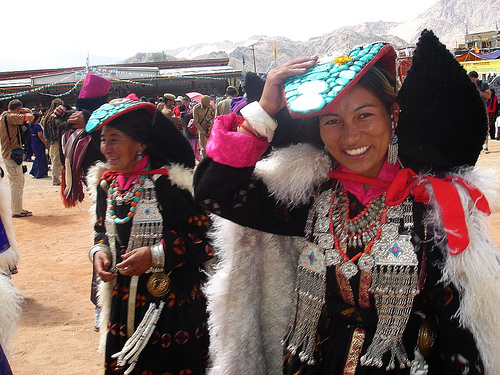

Ladakh has its own sort of Buddhist caste system, and musicians are a distinct group known as the Mon. Dancers, singers and musicians used to be a separate caste in most parts of India. Tsering said they go around playing the daman (drum) and surna (a kind of clarinet or shenai) in every neighborhood asking for money.


"In the old days," he said, "we used to give only tsampa (barley) powder, chappati, food, like that. Now we are expected to give some cash," he smiled. How much? "Oh, ten, twenty rupees, like that." So it's a bit like Ladakhi trick-or-treating.


The little things
I'm looking to fly outta here in the next week or so. Strangely, it is the same fare to fly to Jammu (and take the bus to Dharamsala) as to fly directly to Delhi.

Suddenly, all the signature little Ladakhi things I have come to take for granted for the past three and a half months are now jumping out at me. Even just sitting here typing and looking out the cybershop window, I see so many "little things" that are (perhaps unfortunately) Only In Ladakh.

-a single file line of fuzzy grey donkeys, their colour identical to that of the surrounding mountains, trudging slowly up the street in search of some prime scavenging. They always remind me of the manger scene in the Christmas Story.
-Bright new private school buses full of immaculate children in maroon blazers with matching knit caps, which match their apple cheeks. (The government school students and their buses don't look quite as new and shiny, naturally. Same healthy apple cheeks, though.)

-Delivery trucks whizzing by with letters hand painted in both blocky English and flowery Urdu script

-NO beggars on the street. This is not necessarily "only in Ladakh." Yes, I have certainly been in plenty of other small Indian towns, particularly in the South, that also have no beggars. But this is downtown in a major city - that is unusual.

In fact, there are a few beggars here in the summer time (high season for tourists). They all come from outside Ladakh, and they all move on (following the tourists) in November.

-Almost NO child labour to speak of. There are a (very) few under-16s that are working. I noticed that all of them are from Bihar, Nepal or UP. The brief conversations we were able to have (in my bad Hindi) confirmed this.

There is a 14 year old "doing for" Mr Yassin's auntie. He sleeps in their hallway. He stands out among the Ladakhis like a palm tree in New England maples. When I asked him "kahan se?" he said he is from a village called "Goondar" in Uttar Pradesh. He may even be younger than 14. He still hasn't lost his sweet, shy smile.

Though I don't envy his life, I have to think he's better off here than labouring somewhere in his home state. It's just a much gentler place in general. How else can one explain the Rajasthani shoemaker who has set up business on the corner with his two tiny children - one girl, one boy? It must be unbelievably cold for them here. I would love to find out what drove him so far from Rajasthan and what keeps him here.

-Bactrian Magpies- enormous black-and-white birds, the size of large crows but prettier, and native only to this area.

-Young Kashmiri and Ladakhi Muslim men, all with full beards and wearing the Kashmiri poncho-type overcoat, pushing the water dollies up and down the roads.

-Old men and women selling baskets of dried apricots -- with faces that look also like dried apricots. Also, classic-looking elder men sitting in the afternoon sun in front of the mosque, with faces, hats, beards, and robes that bring to mind romanticized images of Silk Road traders.

-Glancing upward from almost anywhere around town and seeing the 400 year old Leh Palace originally built by (or rather, for) King Singge Namgyal. It's like a little mini-Potala just minutes away (in fact it is said to have been modeled on the Potala. Another version I heard said the Potala was modeled on Leh Palace!) (the Palace photo above is from Wikipedia).
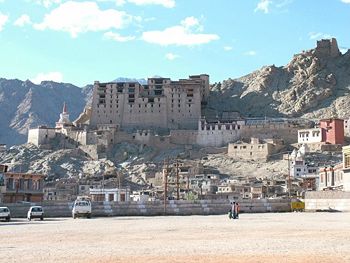
Higher still is the Tsemo Gompa, looking like a kid's bucket sandcastle after a wave hit it. A lone monk still climbs up once every morning and evening to look after the shrines and light lamps in the crumbling former monastery.

I have climbed the hill (in Tamil Nadu they would call it a mountain) a few times, and can only imagine what it was like hauling the bricks up there...400 years ago.

-Moonlight bouncing off the snowcapped mountains that surround the city

-Hitchhiking (still acceptable, common and safe here) . Distances are vast, and it's rare that a driver does not stop. Sometimes on a deserted road, drivers even stop voluntarily to ask if you are "okay." (No, it is not just because I am a foreign female - almost everyone thumbs a ride here in Ladakh.)

-Cheerful, confident women of all ages striding down the street, unaccompanied by men, with none of the "please don't hit me" body language shared by so many Indian women.
The young ladies coming home from school wear crested school blazers, baseball caps and slacks; older married women wear full-skirted gonchas with embroidered Kashmir shawls draped elegantly round their shouders. Unmarried young women wear Indian salwar-kameez, sweaters and shawls. They seem very uninhibited in their movements.

-Single women running businesses, including restaurants, all on their own. No men in sight. No one says anything, no one hassles them, and nobody blinks an eye.
-The hum of the noisy red kerosene generators. Since there is no power during the day, a few choice businesses have these alternative sources of power, which is the only reason I am typing now!
-Big piles of fur lining the sidewalks, in the form of peaceful, sleeping street dogs. The Leh Street Dog Program (sponsored by a French NGO) has taken care of many of them. It's so nice to see street dogs with healthy, fluffy fur - *not* riddled with mange and other skin diseases. They generally seem much less hassled than street dogs elsewhere.

You can identify the rabies-inoculated, spayed and neutered street dogs fairly easily. The Program takes a small triangular notch out of their ear, while they are still under anesthesia.

-The call of the mosque's muezzin, reminding the faithful to attend prayer 5 times a day. Since there are 2 major mosques here (Sunni and Shia), we actually hear the muezzin's call 10 times a day....the Shias go first, then about 15 minutes later we hear the Sunni muezzin. It's not always the same guys doing the call and some definitely sound more practiced than others.

There is one guy who gives his "call" at about 5.30 AM. Since I don't always get up that early, I have only heard him a few times....but it is worth getting up for. He really puts some artistry into his morning songs. To hear this as the sun is rising over the mountains is a cherished Ladakhi memory.

-The wicker baskets (actually woven willow) used by the women to carry vegetables on their backs, to and from the Bazaar market.
-Having total strangers, including little kids and old women, say "Jullay" on the street, with a big smile, and just keep walking. Unlike a lot of other places, they don't want anything...not to sell me anything, or "one pen please." They are just being polite.

and last but not least....

-only washing my hair once a week. It's so cold, no one is looking and I just throw a hat on it every day, anyway!

Monday, December 03, 2007

Real Kashmiri Kawa

The MilkMan Cometh
Leh, Ladakh
This morning, I rounded the corner from my guest house and came face to face with what looked like a Depression-era breadline.

A big "lorry" or truck was parked in the main street, almost in front of the Buddhist Gompa. Two lines of people snaked out behind - one for women, the other for men. (This is "normal" in India, but it's the first time I had noticed such line segregation in Ladakh.) Everyone - grandmothers, small children in school uniforms and so on - was holding every kind of vessel you could possibly imagine. Plastic pop bottles, stainless steel "tiffin" containers, old plastic jugs with handles, and so on.

It was the dudh-wallah, or milkman, or in this case milk men. Men inside the covered truck bed dipped into old-fashioned metal milk cans, the kind Americans now think are quaint decorations for their front porches. Then they poured opaque white liquid into each container.

The lines were long (probably forty people in each line) and the process slow. Everyone was bundled up in a cross-cultural mix of cheap down vests, knit ski hats, woollen goncha robes and running shoes. The painted side of the blue-and-white truck said something like, "Ladakhi Valley Milk Concern, Chuchot Village." Chuchot village is about 1/2 hour away by bus.

I had already noticed the absence of milk in many stores. You can often buy the government-issued homogenized milk ("Amul Taaza") which comes in a plasticky box. For travling and for emergencies, which are frequent, there's milk powder (like Carnation instant milk). Also, the abi-les (grandmothers) who sell vegetables on the Main Bazaar sell milk in old plastic mineral water bottles. (They also sell blue kerosene the same way; hopefully they don't reuse the bottles for milk.)

I joined the women's line and started snapping photos. Actually, the men were much happier to have their photos taken. It's funny, before a certain age (before puberty) and after a certain age (maybe after 50), it is more "okay" to photograph women and girls. During the reproductive years, they feel obligated to be more demure.

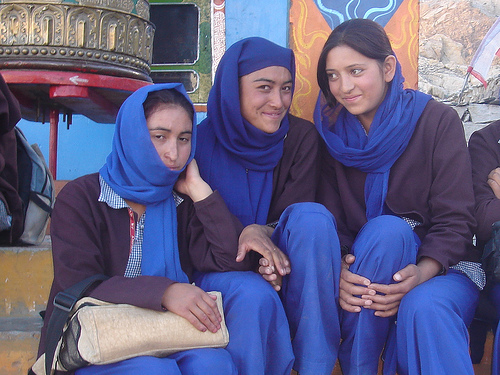
On the sidelines were three adorable little Muslim schoolgirls with green uniform crested blazers, book bags, and white headscarves. The headscarves somehow make them more beautiful - like a frame for their faces. The little ones were being shepherded by an older (teenaged) girl in the same attire.

I squatted down to their eye level and asked if I could photograph them. "Photo thik hai?" They agreed, but didn't look very comfortable. They are so serious in these photos... most of their natural beauty is hidden behind a sort of grimace. (!) I think more time is required to gain their trust.

I asked the older girl if I could then photograph her. "Sorry, no," she smiled. She looked sincerely regretful. All the girls had that handsome combination of Mongolian, Central Asian and Indian features, along with pink-white wind kissed cheeks, that adds up to uniquely "Ladakhi."
The girls in the photo above live in the Nubra Valley near Hunder. They were waiting for the school bus home. Now that I've gotten so many "nos" to photo requests, I feel extra lucky to have this beautiful picture.
Call for Kawa
I mentioned Kashmiri kawa before. It's a regional hot tea drink made from - depending on who you ask - saffron, green tea leaves, cinnamon, cardamom and almond. You can go into three different tea shops and get three different versions of Kawa. I have been served Kawa that ranged from an uplifting, exotic brew to what was just obviously black tea with a bit of cinnamon. Another shop (run by Tibetans) served hot water with crushed almonds and a few leaves of saffron - but no tea.
So I decided to ask Mr Yassin, owner of the TsoMori Hotel, what was REAL Kashmiri kawa. Mr Yassin is a Ladakhi Muslim whose family have roots long ago in Kashmir proper.
"Kawa is a special leaf," he said with animation, even a bit of vehemence. "Only one, two shops in the bazaar are selling this now. You go to that main general store, in the big burlap bags, there they are selling."

So Kawa is not green tea or black tea? "No, Kawa is Kawa. It is a special kind of green tea that comes from Assam, but it is not ordinary Assam tea. Long, twisty leaves, they look like snakes."

How do you make real Kashmiri kawa?

"You take the kawa leaves, the cinnamon bark and the elaichi (cardamom pods), and sugar, and boil them all together. Then you strain it into the glass of course."

What about the saffron, the famous product of Kashmir?

"After straining, you add two, three leaves of saffron. Enough to make the colour golden yellow. Then you crush the badam (almonds) and drop them in the glass.

It was important, he said, to brew the first three elements all together - if added later, the spices wouldn't give enough flavour, and the sugar wouldn't melt properly.

Though I am typing now with gloves on, my fingers are stiff with cold. I would love a glass of Real Kashmiri Kawa. Even a fake one would do.

The Chinese Province of Nepal ("Autonomous Region")
You read it here first. I predict this will be a reality within 10, 15 years.
Nepal has long been squashed as a little Switzerland country between two giant, billion-person superpowers (the "yam between two boulders" syndrome), playing China and India off one another, with varying bits of success and failure.

With the growing influence of the Maoists (mostly growing for lack of a better alternative), the fence-sitting scales appear to be tipping Northeastward.
Last month Nepal government announced they were dashing the hopes of Tibetan refugees now living within Nepal by refusing to cooperate with a US plan to offer 1,000 of the refugees asylum in America. To quote the news story:
China says there are no Tibetan refugees, only illegal immigrants who should be punished according to the law of the land.

Now Nepal is actually inviting the famous/notorious Tibet Railway - widely recognized as a major factor in diminishing Tibetan presence within Tibet itself - to be extended to Nepali borders. I think Nepal thinks this means greater access to Chinese goods, and with that, greater ability to tell India to shove off. In your face India! Nyaah Nyaah Nyaah!
What it really means is greater infiltration of Chinese people. If they need proof, they can just ask any of the Tibetans now living in Nepal what it's like to be such close "friends" with China.
Not only that, but China itself, which had previously disdained the Nepali Maoists as not proper Maoists, are now taking a special active interest in Nepal.
A high-level Chinese delegation which is in Nepal to assess the latest political developments, held a series of meetings with the political leaders. The seven-member team led by central politburo member of the Chinese Communist Party Wang Ziarui, on Sunday met the senior leaders of the Communist Party of Nepal (UML) and discussed the prospect of transforming Nepal as a "socialist nation".
China's claims to the Tibet region are based not only on supposed historical precedent ("it used to be part of China") but also cultural affiliation. Since Tibetan culture, according to them, has "always been" part of Chinese culture, logically they will lay claim to every area where Tibetan culture still survives, that has a convenient border with China. That means:
-within India: Arunachal Pradesh (birthplace of the 6th Dalai Lama), and Sikkim. According to an Arunachal Member of Indian Parliament, there are already Chinese troops inside Arunachal.
Ladakh is extremely well fortified now - after the Chinese made their point by commandeering Aksai Chin a few decades ago.
-Bhutan (there have been reports for the past several years of Chinese troops "accidentally" crossing the Bhutanese borders). Since India provides most of the muscle behind Bhutanese infrastructure, this would, for practical purposes, be equivalent to invading India.
-and of course, Nepal, particularly the remote Mustang region of Nepal (sometimes called "Little Tibet") where Tibetan Buddhist culture has survived, mostly unchanged, for centuries.
Some well-meaning European tourists this summer asked me about the heavy military presence in Ladakh. "Is it really necessary?" My answer: "Have you met the neighbors?"

Saturday, December 01, 2007

In the realm of a dying sun

Freakin freezin
Leh, Ladakh

The sun finally came out today, after 2 days of freezing grey watercolour skies. By the thermometer, it doesn't look so cold here. But remember, there is no running water, and no heating (unless you want to pay and extra $10 a day to have a propane heater placed in your room). The electricity is out all day long these days...no electric at all until 6pm. It cuts off again at 11pm. Evidently there's no insulation in the buildings (they are built like barns). ALL of the available heat comes from the Sun.

I only bathe every three days, or so. This is not as gross as its sounds. For one thing, it's impossible to sweat in this cold. For another, every "bath" has to be pulled up from the well (by the guest house employees) in a bucket, then poured into a vat on the propane stove for heating, then poured back into the plastic bucket and carried up to my room. Because this water is boiling, a bath requires yet another bucket of cold water (also drawn by hand of course) to be mixed to make bathing temperature water.

Then there's the ordeal of actually getting my clothes off in the freezing room. Baths must be taken while the sun is shining (if possible). After dark, it is just an invitation to pneumonia.

Don't ask about laundry.

Elemental
It reminds me of the April I spent in Tamil Nadu (never again!). When the power went out, of course, the fan went with it. I put a straw mat out on the terrace and prayed for wind from the nearby Bay of Bengal. It was easy to see how the elements became gods, long ago. The Wind God would be very, very welcome in Tamil Nadu. The Water God is frequently invoked all over India. And most of the hymns of the Brokpa people (the people I went to visit in Dha Village last month) begin with praise to the sun. Makes perfect sense to me!

Spruced up

Today the Main Bazaar is a bustle of colourful activity. It's nearly the Ladakhi New Year, or Losar. Shops that had been shut for a month are now open for holiday browsing. On the city streetcorners, young Kashmiri men sell piles of juniper branches to elderly Ladakhi women with grey braids. Fifty rupees a branch - pretty steep! I think I'll pick my own juniper.
Juniper is necessary for the rooftop shrine. Every Buddhist household has a rooftop shrine that looks like an evergreen bush, with khata or white scarves tied around it. Each year at the Losar New Year, a bunch of fresh juniper - considered cleansing and protective - must be installed on the household rooftop shrines. I don't know for sure, but am pretty confident that this must be accompanied by chanting, incense and other ritual.

Of course, putting a juniper branch on your roof to absorb negativity has nothing to do with Buddhism "proper." It is a pre-Buddhistic regional folk custom, like so many things in Tibetan Buddhism.

Fortunately, I will be here on Dec. 4 when Losar begins so "my" family - Tsering, Dolkar, Rinchen, Dorje and the two Angmos - will let me in on the fun!

Losar here in Ladakh runs from 4 December to 10 December.
Most of the Tibetan Buddhist community celebrates Losar in February. There is an historical reason for the early Ladakhi Losar. One of the ancient kings wanted to go to war with a neighboring kingdom. All the court advisors said that war should not be declared during the current year. So the king, being the king, decided to move the New Year forward so that when festivities were finished, he could go ahead and fight.

It's good to be the king.

Sunday, November 25, 2007

Ladakhi Lunchbox

Neighborhood munchies
Leh, Ladakh

It's lunchtime in Ladakh, and all the
tourist places (with salads, pizza, and lasagne) are closed, boarded up for the winter. Where do you eat? What do you eat?

Most days, I get a delicious vegetarian thali at Leh Chen Restaurant, which is just a tiny hole in the wall on Fort Road. It's run by a Nepali family from Sindhupalchowk who have 2 beautiful little girls.

A "thali" is kind of like the old cafeteria lunch tray, with separated sections. I get rice; a "dal" or lentil (black, yellow, green - it changes) for protein; two types of vegetables (often it's potato-peas and eggplant), 2 chapati & one papad (that's homemade bread for all you non-Indians), pickle (mmmm.....) and hot water. It is traditional to drink hot water all day long here. It's also part of Tibetan medicine. Everywhere there are Tibetans, there's "chu skor" or hot water being served in big thermoses....all day long, all year long.

In traditional north Indian fashion, they also give me a side dish of raw onions and green chili. I don't touch these. A South Indian thali would have mandatory yogurt included.

All that, plus refills on the lentils, rice and papad, for 45 Rupees (about $1.15).

But that is Indo-Nepali food. What about real Ladakhi food?

It's hard to find traditional Ladakhi food in any restaurant. Most of the tourist trade and restaurant biz is run by Tibetans, Nepalis, and Indians. They serve good Indian food like the above veg thali, or Tibetan stuff like thukpa noodle soup, then-tuk (another kind of noodle soup), mo-mos (dumplings), ting-mo (steamed bread) and butter tea. ("gur gur cha").

Since the Women's Alliance kitchen closed down due to lack of participation (they had great food!), and since the Ladakh Festival is over (there was one vendor there with authentic Ladakhi food), there is only ONE place in town to get actual Ladakhi fare.

The Aluya Restaurant (stands for All Ladakh Unemployed Youth Alliance) is run by a few women, in the middle of the town square and is one of the only places you can always, always count on being open, from about 8AM till 7PM.


Ladakhi food is a lot like Tibetan, with a few more vegetables. It is all very filling, and starchy, and based on either buckwheat, wheat or barley (sorry, I don't know for sure which is really being used. Translation problems).

Here are some tradtional Ladakhi dishes I have tried:
Chu Tagi: a sort of bow-tie shaped pasta filled with potato and served with chunks of carrots, potato and sometimes local greens (which they erroneously call "spinach...." --it's more like collard greens) in a sauce.
Drue: another wheat pasta with sauce of ground apricots. Drue was never available when I visited. Sounds yummy though....
Skyue: yet another pasta shaped like little caps or gumdrops, with same vegetables in sauce as Chu Tagi. Chu Tagi tastes better to me, though....

and my very favourite which is NOT available at Aluya right now is, I think, called
Tsu Tsu: --it is a buckwheat pancake, served either with homemade apricot jam (in breakfast time) or with dal and pickles at lunch time. Tsu Tsu is a sort of Ladakhi Dosa - a crepe-like bread.

Always available for breakfast, though, is the heavy dark Ladakhi pita-type pocket bread, "khambir." It's served piping hot with butter and locally made apricot jam.

The regional staple (all over the Tibetan plateau) is Tsampa - roasted barley flour. I have developed a genuine taste for Tsampa. It gives you a slow-energy release that is really helpful especially in cold weather. Tsampa looks like chalk and always reminds me of being a kid when I used to sneak unbaked Pillsbury biscuit dough off the counter. Or, a bit like eating Play-Doh (didn't you ever try to eat it? come on!!).

Tsampa is used for everything; I dump it in the namkeen tea (another name for gurgur cha or salty buttery tea) and stir it in to make kind of a grainy milkshake. In the same way it is dumped into Chang or home made barley beer for fortification. You can also stir it into yogurt (for breakfast), or into your noodle soup for extra thickening.


I know Tibetan refugees who crossed the mountains into Nepal with nothing but bags of tsampa powder. They mix it with water to make a paste and it's enough to sustain them.

Snack pack
All varieties (--except the really good ones pitted sweet ones that Dzomsa sells in season) - of dried apricots, including apricot nuts, as well as raisins, peanuts and sometimes cashews from Tamil Nadu , be bought in bulk on the street....along with that disgusting dried yak cheese. I don't know how anyone eats this cheese, which is dried into hard bits of stringy...hard stringiness. I can't chew it at all.

Dzomo (the female version of a Dzo, or yak-cow hybrid) butter is sold on the street from mangey looking barrels covered in fur. I can't figure it out; it really looks like they have chopped off a dzo's leg, hollowed it out and filled it with this rank butter. What is the fur for?

Of course, the person selling the dzomo butter is always a rugged country person who can't explain it to me in English, either, so the mystery continues. Dzomo butter definitely has a tang and a gamey smell that repels me.

I mentioned Seabuckthorn juice before. It is full of antioxidants, and very bitter so some sugar must be added for drinking. I have seen the packaged juice in other Indian states. The commercial name is "Leh Berry." I wonder how much antioxidant is actually remaining after processing, though. Unfortunately the places serving homemade juice are closed now and it's available only in the packaged form.

Apricot Jam, Apricot Juice, Apricot Nuts and Seabuckthorn juice could potentially all be major exports from
Ladakh. The jam is just out of this world...I cannot go back to eating that horrible red food-colouring jam (supposedly it's "Mixed Fruit") they serve everywhere in India, ever again!

Vanishing Victuals
The sad thing is that it's all you can do to find this food, outside of a Ladakhi home, anymore. Even small restaurants in rural areas and shops run by Ladakhis are not likely to have these things (except dried apricots, which are in every shop).

What they are guaranteed to have is:

-packaged Maggi Noodles. Experienced Indian travelers will groan at this. It's the Indian equivalent of Ramen Noodles. Instant noodles with a flavour packet.
-Sugary Indian tea or chai
-Chappati
-Every shop has pre-packaged manufactured snacks (aloo bhujia, namkeens, moong dal etc) from mainland India, which are wrapped in shiny colourful mylar plastic. The streets and gutters are littered with them!

Friday, November 23, 2007

Friday Faces

wrinkles in time
Leh, Ladakh


I just came from the Jamma Masjid ("Friday Mosque") in the main square of downtown Leh. Friday is the best time to take photos, because it's the special day for Muslim prayers.

I love the way identities are so confusing in Ladakh. People who "look Muslim" turn out to be Buddhist and vice versa. It totally messes with my preconceptions.

My favourites are the old-timers with ravine-filled faces and traditional clothing. When I was much younger, I used to hear people describe the elderly as "beautiful" and thought "yeah right, who would really want to look like that? They are just being polite...."

But now I really find it hard to take interest in photographing most younger people. The older people really are more beautiful.

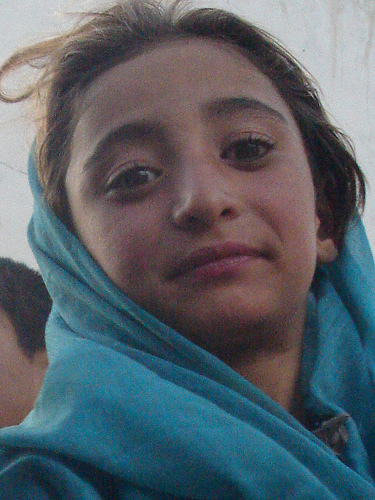
This afternoon at 1.30 prayers, I was only able to photograph men. (Women generally pray in the home, at least in this area.) I haven't been able to upload today's photos of the old timers yet. So here are some more wonderful Ladakhi faces with the invariable Ladakhi smile.

Can you believe I've never been to the Taj Mahal?
I can't.

After all these years in India, I have been to so many places... but still not the Taj Mahal, definitely the most famous UNESCO World Heritage site in India, if not the whole world.
While browsing the UNESCO website (looking for information about protected rock carvings - the ASI director for Leh swears that such things are not protected by UNESCO, which of course, is not true) - I decided to list all the World Heritage sites I have visited.

Tamil Nadu:
Brihadeshwar Temple
Mahabalipuram monuments including the "Shore Temple"

Maharahstra:
Ellora Caves
Ajanta Caves
Victoria Terminus (recently renamed "Chhatrapati Shivaji Terminus," which peeves me, because Queen Victoria's people built it....it has nothing to do with Shivaji, he was dead a long time before this building was erected; why should he get credit?)

Bihar:
Mahabodhi Temple

Delhi:
The Red Fort

Nepal:
Pashupatinath Temple (foreigners not allowed inside..but they want your money anyway)
Kathmandu Durbar Square (foreigners not allowed in Kumari Ghar or most temples. They still hit you up for entrance fees. Somehow they have it worked out that this makes sense)
Patan Durbar Square (same policy - foreigners not allowed inside temples. Indians, who technically are foreign, are allowed - just not white people)
Bhaktapur Durbar Square (same - foreigners not allowed inside temples)
Boudhanath Stupa
Swayambunath Stupa
Changu Narayan Temple

I have consistently lodged my own one-woman protest at the discriminatory Nepali sites, by never, ever paying the price for buildings I'm not allowed into. (Makes perfect sense to me.) Instead, I have enjoyed the surrounding areas without paying, and now know all the secret back entrances to each of the sites. Write me for details. I don't support places that claim to represent the heritage of "all the peoples of the world, irrespective of the territory on which they are located," and then discriminate based on race. I welcome you do the same.

All the other places listed do charge more for foreigners, but at least the access is equal for all. If I'm going to pay five times as much, I should be able to see the place - that seems more than fair.

The Bus Is Back

Good news, budget Himalayan travellers. The Kathmandu-Lhasa Express is back on the road (as of January).

Too bad the same cannot be said of Nepali politics. Yesterday was originally meant to be the historic elections. It passed without a peep as political infighting continues and fresh violence erupts in the Terai region.

Here's more about the bus:

The bus service ran into trouble soon after its start in 2005 and remained suspended. Though resumed again for a short period in 2006, it has been closed since spring.

Officials in Nepal blame the closure on the Chinese reluctance to issue visas.

Beijing issued visas only to tourists travelling in groups, that too after stringent scrutiny. Travellers had to submit details of their itinerary and accommodation and the bus service was shut down by China on the eve of demonstrations in Tibet or anniversaries of historic days.

The revival of the flagging bus service coincides with the start of the Visit China campaign by Beijing to mark 2008 when it hosts the Olympic Games.

Nepal's state-owned Sajha Yatayat will run the weekly service from Kathmandu, like it did in the past. The pact will be a shot in the arm for the floundering state service, most of whose buses have not been running for over a year after an agitation by employees.

The one-way fare for the three-day trip will be $70.

Full news story here.

Friday, November 09, 2007

Making light

A Blessed Diwali to All !

Sweets on the street
Leh, Ladakh
There aren't many Hindus here in Ladakh. Just a few shopkeepers (sweet shop and general store owners mostly), and men in the Army. The only Hindu temples are rather garish, brand-spanking-new concrete ones created to serve the Army men. They are painted bright comic-book colours and look jarring against the sombre grey landscape with its white-washed Buddhist chortens and occasional onion-domed mosques.

Where there are Hindus, though, there is colour, festivity and lots of sugar, and Leh is no exception. Today is Diwali, a festival of light, the most universally-observed Hindu holiday that is also honoured by Sikhs, Jains and anyone with a general sense of fun. (It's actually a series of days...but that kind of gets lost up here).

Yesterday many shops were closed, but sweets vendors had opened special stalls making fresh jalebis in the open-air cold, and displaying all manner of fancy boxed milky Indian confections. Stationers sell tinsely garlands and ropes of plastic flowers (since real ones aren't available here in the cold season). And print icons of the goddess Lakshmi, usually accompanied by Ganesh and Saraswati, beam benevolently from every corner.

(The photos on this page are taken from various past celebrations in Nepal and Kerala.)

Timing is everything
It wasn't easy to find a solid meal in town yesterday. I had a steaming bowl of vegetable thukpa (Tibetan noodle soup, 30Rs) with lots of cilantro in the tiny, gloomy Tibet Restaurant as dusk gathered. Across the room huddled a group of four British girls, who had clearly just arrived in Leh. They were warming their hands round cups of tea, nibbling naan and poring over their Lonely Planet guides. (The Lonely Planet section on Ladakh is terrible. Most everything in it is wrong. More about that later.)

I almost felt sorry for them. Why had they arrived so late in the season? Just a few weeks ago, the gold and copper leaves were sparkling like amber in the fall afternoons. Now the rows of flaming poplars are grey skeletons, though skies are still blue.

"Hi!" piped up one of them. "Would you like to join us?"

I pulled up a chair. "Have you just arrived?" I asked, out of politeness but completely unnecessarily.

Turns out they have been in India for six weeks, and already "done" Kerala, Mumbai and Rajasthan.

"We really wanted to see the Himalayas," said one, "even though obviously the timing isn't right...." Another one sneezed and asked the Tibetan Amala for a napkin.

As I heard their itinerary, I realised they had done everything backwards. Had they only reversed their schedule and done Ladakh six weeks ago, *then* headed southward for Rajasthan (which is just now in its best season) and eventually to Kerala in late November, they would have missed the Kerala monsoon rains (which they caught instead) and seen Ladakh in its full fall blaze and the end of harvest celebrations.

Just a little bit of research makes all the difference in your trip. India (and Nepal) covers a vast area, none of it uniform in weather or landscape. Going to a particular place at the right or wrong time can very simply determine whether it's miserable or magical. Earlier this September, I met a Dutch couple who had somehow been convinced to travel to Rajasthan for a camel safari...in mid-August.

Needless to say, the desert was scorching hot at that time. Some travel company had talked them into it.

And last August, a dear friend (who shall remain nameless) and I met up in Kathmandu. He eagerly asked where he could see "the mountains." Which mountains? He looked impatient. "The Himalayas, of course." I had to break the news to him.

He had managed to arrive at the absolute worst season for viewing. Unless you take a plane - and maybe even if you do - you will see no snowcapped Himalayas until second week of October. Most of the country is blanketed in monsoon clouds during summer. Then he admitted, "I didn't do any research before my trip."

I met a new friend at the Indian Embassy in Kathmandu this past summer. She desperately wanted to get out of Kathmandu and do some trekking. She too had arrived at the worst time - not only are the views concealed by clouds, but the trails are full of leeches during the wet season. She was actually in Nepal at the ideal time to be in Ladakh - summer. If she had reversed her trip and gone to India first, then Nepal, she could have landed up in the Mountain Kingdom's spectacular viewing weather (October-December).

Timing is everything. After seeing so man ill-timed disappointed travellers, I can recommend consulting the guidebook under the "When To Go" heading, check the weather on an internet site like Weather Underground (link at sidebar on left), and prioritize accordingly!