Showing posts with label agra. Show all posts

Monday, December 01, 2008

Sister act

Three for the Road
Delhi, Agra, Kathmandu, Patan, Lukla & Namche

It's been nearly 2 weeks, and I am still getting over my sisters' (one older, one younger) 17-day visit. Not that they are at all difficult, and they are both experienced travelers, but it was such a whirlwind tour that we were all breathless by its end (and not from altitude).

We had only 15 days (excluding the travel days) but managed to get in, in two different countries: no less than seven UNESCO World Heritage Sites including Taj Mahal, Agra Fort, Qutb Minar, Humayan's Tomb, Swayambhunath, Patan Durbar Square, and Sagarmatha National Park; a ride on the Indian sleeper train; visits to some home-cookin' restaurants in Delhi and Patan; rides on public buses, cycle rickshaws and auto rickshaws; seeing an elephant walking down Aurobindo Marg; watching a Hindu-Buddhist puja at Swayambhu; shopping for pashminas; seeing the Himalayan snowcapped mountains from a plane no less than three times; a trek to Namche Bazaar Solu Khumbu Region, a five-hour wait at the Lukla airport, and getting stuck in an authentic Kathmandu traffic jam near Ason Tole.

Somewhere in there we got to visit a bit - but not nearly enough.

Here are just a few photos.
with Newar women for Kartik Ekadashi puja at Swayambhunath temple, Nov.2
The 15-seater Sita Air flight to Lukla from KTM was only delayed by one hour, which compared to the return, seemed like nothing.

On the street in Agra.

With our most excellent host and Delhi guide, Tak Noguchi, at Qutb Minar complex.

Sleeper train to Agra!

Tuesday, January 15, 2008

Kvetch Beyond Borders

Too tired for a clever subtitle
Delhi

Unless you are critically ill (say, recovering from malaria in the hospital), never, ever try for the in-country visa extension through the FRRO. Just bite the bullet and leave the country.

It takes forever - in this case, nearly 2 weeks - and though they tantalizingly leave open "amount of extension requested," in fact they never grant more than 2 weeks. So, it took me 2 weeks to get 2 more weeks. And, about five various office trips. The icing on the cake will be a personal visit from a police officer to my hotel tomorrow morning "sometime before 1pm" (sounds like waiting for the cable guy).
Supposedly this will help him with "verification of (my) activities" (I'm sitting in a hotel - I could actually be doing anything, not sure what this will prove).

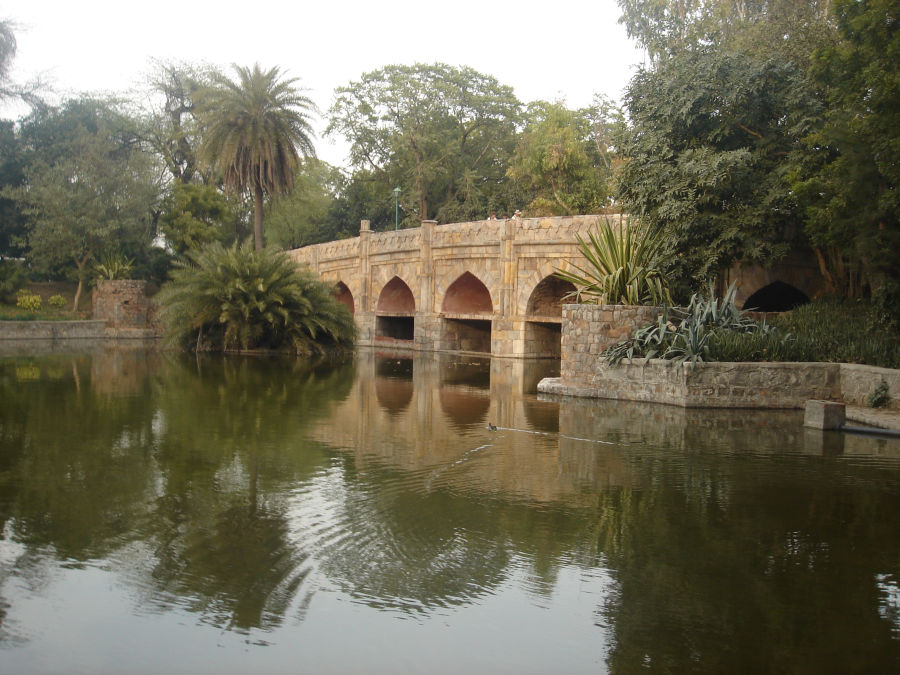
After the ennervating morning at the RK Puram FRRO (I wish I could have taken photos...it was like Central Casting. Afghanis in full turbans, Africans with braided hair, women in burqas, Burmese monks in orange robes) I went for a long walk in Lodi Gardens. After watching a family of wild green parrots nestle down for the night (they live in a hollow tree), and playing with not one but two Basset hounds - plus a bunch of the less pedigreed local hounds who live in the park - I almost felt normal.
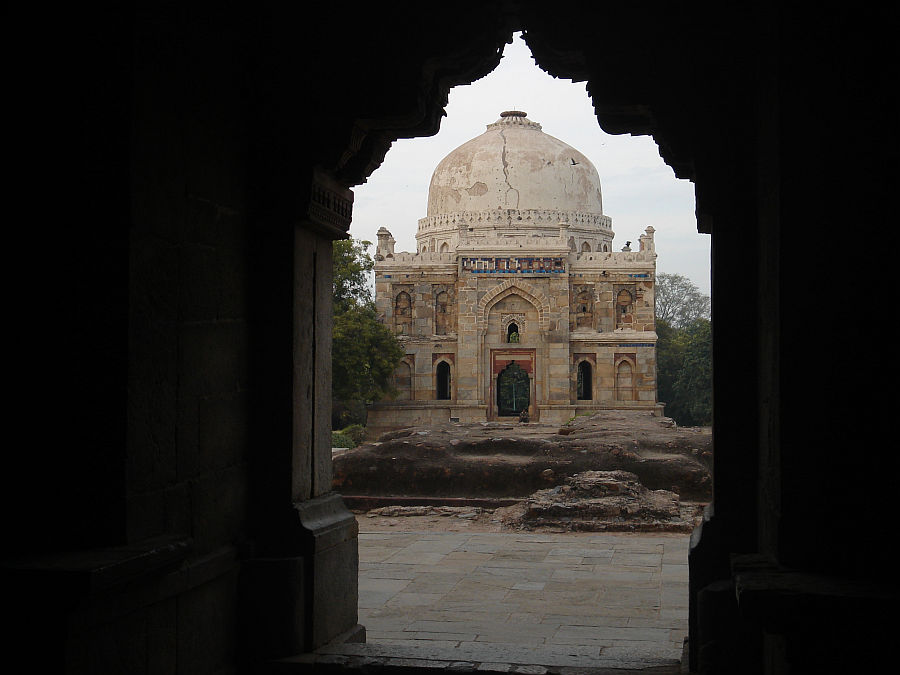
It's amusing the way the park signs prohibit "dogs without leash." There are so many strays living all over the park - and they're very friendly.

I was momentarily gripped by a fantasy of rounding up all the Lodi Gardens strays, getting them spayed/neutered/vaccinated by the volunteers of Vets Beyond Borders, giving them all names, registration numbers and collars (yes, it is crazy...I know) and starting a program called Dogs of Lodi Gardens.

Then I came to my senses, remembering what happened to the Dharamsala branch of Vets Beyond Borders. (Someday I will tell this story. Sorry, not now. The good part is that they are still operating successfully in a couple of Indian cities, but I am afraid to even talk about that for fear the successful programs will get shut down too. The short story was: it was too successful. They were making the Indian veterinarians look bad.)

Anyway - Lodi Gardens is home to some sweet stray dogs. The ice cream vendors have befriended them.
Maybe there's already a dog care program for the Lodi Gardens neighborhood - I know there is one for Khan Market area.
Living lawn mowers
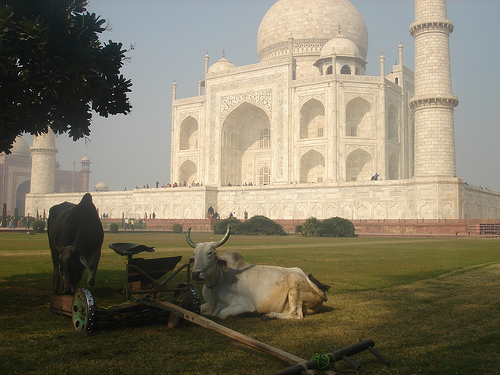
These beautiful bullocks (in America we call them "Brahma bulls") pull the old-fashioned grass cutter at the Taj Mahal, then eat the results.

I wish I had been able to get the whole Taj without including the ugly metal fence in foreground.
In a comment that would no doubt irritate proud "progressive" Indians, my Canadian friend said, upon seeing this scene: "now THAT, to me, is India."

Meaning: men and cows doing a job that most of the rest of the world does by machine, slowly, in a green, clean, sustainable fashion, in front of an ancient monument of genius. In America, we now consider this progress.

It's so alarming to hear agricultural specialists and progress wonks in the press crow about how many tractors there are now in the Punjab and how someday soon, "EVERY farm in India will have a tractor" (instead of bullocks).
No to Nano
I mean, India has always made such a big deal about doing everything on their own terms and in their own way...why are they racing to match the standards of the developed world in all the least desirable categories?

Is anyone even a nano-teenth as excited about, say, a new literacy plan or the reputed $100 laptop computer as they are about this damned Tata Nano budget car that has hogged the news all week long?

Suddenly there were no more problems in Pakistan (except the cross-town catfight between cousins Bilawal and Fatima) - only this rather ugly car.

Cheap cars are cheap for a reason, no one seems to have figured that out here yet. Just ask owners of the Ford Pinto. Any money you save on the front end you will end up spending on repairs, guaranteed. But don't listen to me...Americans know nothing about cars. ;-) or pollution. Or traffic, or gridlock, or about going into debt for life just to pay for your car habit.

A car - when you live in a place with ample public transportation - is an extravagant hole you will throw money into for the next 5 years. (A cheap car won't last longer than that.) At the end of that 5 years, you will have nothing for your investment. People have been driving (literally) round and round in this trap in America for decades and again, it is alarming to see other countries fall down the same rabbithole.
Thinking Americans (yes, admittedly we are a minority, ha ha) are going in the opposite direction. Everyone wants to move to a city or country with public transport so they can escape the car trap, with all its maintenance and monthly payments. It's a very costly illusion of freedom.
Anyway, rant over (for now). It just seems that if any country had the potential to figure out a truly progressive sustainable solution to such a problem (transportation) - a solution that suits their unique population and logistical needs - it would be India. Just copying the mistakes of the west in a cheaper form is nothing to applaud.

Tuesday, January 08, 2008

Taj mirage

Smog gets in your eyes
Agra, Uttar Pradesh

As fate would have it, I ended up being convinced to go along with my new friends to Agra, to see the Taj Mahal (for the first time). We just barely managed to catch the 4.15 train leaving from Nizamuddin Station in Delhi. I wouldn't recommend it for a longer journey (say, an 18-hour train ride), but "ordinary sleeper" is just fine for 3 hour trip and provided my friends with their first-ever Indian Railways experience, while I crashed out on the top bunk.

"Seeing" the Taj was only partially successful. Even when you're standing near it, it doesn't seem real, hazy as the polluted air is. The people who complain about the pollution in Agra are not exaggerating. It's all you can do to see or get a clear photo of the most famous monument in the world. At first, we thought it was just the north-Indian morning mist. So romantic!


After a few hours it became obvious that the mist was not going to burn off. It was semi-permanent haze. All our photos are in soft focus. This same pollution is evidently damaging the white marble permanently.

Perhaps something so hyped up can't help but be a disappointment. I have a few more grouses:

- Why is so much of the monument closed off? There are all kinds of upstairs balconies, adjacent buildings with turrets and towers and the four minarets. None of them are open for viewing (except the main rooms of the 2 flanking mosques, which in a way I liked better than the Taj itself).

-The museum, which is meant to be included in the huge ticket price (750Rs, about 300Rs more than it's worth) is closed now for repair. Of course, no one warns you of this when they sell you the ticket.

-The city immediately around the Taj ("Taj Ganj") is a very unpleasant, broken-down, dilapidated area. All manner of blocky concrete buildings have been allowed to spring up, which obscure any distant view (or any view at all) of the Taj itself. It certainly doesn't feel like the entrance way to one of the wonders of the architectural world, let alone to the universally recognized symbol of India. Ick.

-For ALL the money being dumped into it every single day, the waterways (an essential element of Mughal architecture) should have been restored by now. Fountains, channels, reflecting pools and so on.

-The explanatory plaques are so verbose and badly written as to be unreadable. I tried to read one of them twice and felt like I had been hit over the head with a thesaurus. I actually felt more confused after reading it than before.

-Inside the tomb itself there is absolutely no artificial light. You really can't see and appreciate the intricate stone inlay work the tomb is so famous for. And the centrepieces, which are the cenotaphs of the Emperor and his favourite wife, are nearly invisible. A wooden screen has been built around the original marble jali screen that prevents you from getting anywhere near the detailed work. Since you are not allowed to bring in any bags at all, none of us had our flashlights to illuminate the interior. Disappointing.

On the plus side:
-Everyone we encountered in Agra, including the persistent touts, were very kind and pleasant. The rickshaw pullers, the hotel guys, the police at the gate of the Taj, everyone was really lovely. Of course many were pushy with their sales technique, but they did take no for an answer...after about half an hour.

(However, they are allowed to solicit you right up to the bag check room at the Taj Gates. I mean, almost as you are checking in your bags, they are still pleading with you.)

-Best thing to do is arrive very early, about 7am, and wander around the outside rose garden at the West Gate. (Just pay the gardener, who appears magically from the mist, 50rs or so "as you like"). The mist (as opposed to smog) is still on the ground, the roses were in full bloom, and the Hindu temple next door set up a lovely wail of devotional music just as the sun was rising.

This was really the best moment of the day.

-You get great perspectives of the Taj itself by going into the 2 mosques flanking it from either side. They are warm brown sandstone and have the feeling of chocolate cakes placed next to the Taj's frothy wedding cake. Views of the Taj from inside these mosques are some of the more well-known images of the building.

-A community of craftsmen are still hard at work chipping and carving away, to restore various panels on the outbuildings. It is mind-boggling to watch the precise "chink, chink, chink" of the shilpas, changed so little since the days of Mumtaz Mahal. For some reason, the ASI has put up signs saying "construction and renovation work in progress, no photography allowed" - I can't imagine why not. India is the last place in the world that still has all the masters of these traditional skills, and watching them at work is a real delight for those of us from mass-produced societies.

So, we snapped some photos of the craftsmen anyway, before some fat bearded guy chased us off.

-Even when it is crowded, the structures are so vast that the people seem like scurrying ants. In fact some of the better photos we got show visitors floating through the oceans of marble terraces and platforms, dwarfed by the minarets and walls.

-I was also happy to see quite a few less-affluent Indians, who seemed to have come from villages, enjoying the Taj, dressed as they were in colourful Rajasthani turbans and flowing dhotis. One defense of the outrageously high entrance fee is that it "subsidizes the poor Indians." Of course, it is not my responsibility to do that, any more than it is an Indian tourist's job to subsidize poor Americans, but I was glad to see that perhaps the inflated foreign fees do help some less fortunate Indians enjoy such an experience. The Indian middle class do not seem eager to step forward and subsidize this activity themselves, as is their civic duty.

-One thing I didn't manage to do (this time) was cross the Yamuna river and view the Taj from that vantage point. An enterprising local was offering camel rides there over on the sandy river bank. Another guy is offering rowboat rides past the Taj from that side.

We did notice that, on the Taj side, down by the river bank, there were sandbagged soldiers with machine guns camped out. Sad, but a reality. Anything that is a symbol "of India" these days (like the India Gate I saw a few days ago) has to be carefully guarded.

From racing to get the train and then getting up so early, I was too burned out to take in the Agra Fort or Fatehpur Sikri. Maybe some other time. My friends and I were on a tight schedule but I think the best thing would be to rent a bicycle and explore all the historic monuments at a leisurely pace, for a day or two.