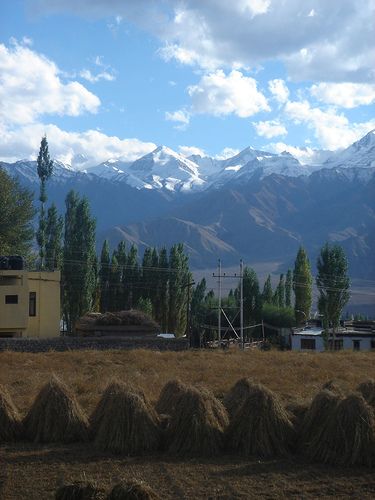
Showing posts with label losar. Show all posts

Thursday, February 19, 2009

Pressed

Unhappy new year
News From Tibet and diaspora
Waiting for HH
As I am usually what passes for a Tibetan-culture knowitall at most gatherings, foreign friends have been asking me: "So when is Losar?" (the Tibetan New Year celebration).

In 2009, Losar is supposed to be February 26. But this year, I don't know whether there will be any celebrations, or to what extent.

At least one sector of the Tibetan community feels Losar should not be observed with any festivity this year. This is partly due to the extreme state of distress in Tibet at the moment and partly to observe the 50th Anniversary of the Dalai Lama's escape from Tibet into India, and the Tibetan Uprising.

(If you would like to know more about the events of 1959, the Times of India has finally justified its existence by providing a handy online archive going back some 150 years with original news articles from the period.)

Of course, some don't agree; and I can definitely see the irony of asking a culture whose very survival is an achievement *not* to observe one of the major manifestations of said culture - even moreso when the Chinese government has tried to force ethnic Tibetans to celebrate the Chinese Lunar New Year instead.


No more questions!
Recently, the Chinese government made a big deal of "inviting foreign journalists to Tibet" (after expelling most of them last year) for a highly-orchestrated press trip to Lhasa. The trip included a visit to Drepung Monastery, which last year became a centre of Tibetan resistance.

I read two different accounts of the trip (some
excerpted below); the reporters from different news outlets appear to have spoken with many of the same people and gotten the same rehearsed responses. China defenders say things like, "You can't believe what you read; you should go there yourself." As if that were even possible for most people at the best of times, the Chinese government has now declared several Tibetan-majority areas off limits to visitors.

Those who do go - such as these various journalists - give very similar reports.
Every tourist account I have heard first or second-hand has reinforced these accounts (from one Indian tourist: "I was on a boat with a uniformed police officer; later I saw him in the monastery wearing monk's robes").

Tibet's religious life still bruised by riots (Reuters):
Inside, monks take patriotic education classes on Chinese law, alongside their Buddhist scripture studies, and were kept closeted away from visiting foreign journalists on a rare and tightly controlled government visit on Thursday.

In Tibet, it's just the facts, ma'am (MSNBC): In this account, one of the brave young monks who, last year, interrupted a similar government-arranged press trip, is now mysteriously transformed and recants:

-He said he no longer felt
the way he did last March, because he and the others realized they had been "misled by the wrong people" (he did not elaborate what he meant). Norgyal also maintained that he had been able to continue his religious studies although he did say the monks had been given "patriotic" study sessions, during which they learned about Chinese law and constitution.

At Drepung Monastery, Ngawang said his monks had also been studying the legal system. "We have legal knowledge sessions for all the monks," he said,
in order to ensure order in the monastery.
"We study the laws and the constitution so we understand the laws better and do not break them," he added. "The monks are also Chinese citizens."
A visit to TibetInfoNet gives an idea where some of the dwindling monastic population may have gone: "Nine monks sentenced; others committed suicide"


This week's Site for Sore Eyes

If you're one of the majority who will never physically get close to the sacred places mentioned above, you might want a virtual visit via Sacred-Destinations.com -which looks extremely cool, well-arranged and informative, and is certain to become one of my preferred time-wasting devices. 


Related Reading: 
Tibetans in Exile 1959-1969 : A Report on Ten Years of Rehabilitation in India 
Tibetans in Exile: The Democratic Vision 
 

Sunday, February 10, 2008

Still In Saigon

Another day in Samsara
Kathmandu, Nepal

That was always my favourite part of Apocalypse Now - the opening shot. Willard wakes up staring at the ceiling fan, and for a second everything is fine. Then he remembers where he is.

Sh*t, I'm STILL HERE.

I'm trying to remember a morning when I didn't wake up feeling that way. Like, if I could just get the mission over with, I could go home.

"Home," in this case, isn't Tennessee, or America. It's escape from Samsara.

Sorry for the not-posting thing. It's just that I've had a blinding migraine since Tuesday and can't get rid of it. Ibuprofen, paracetamol, the original Otis & Carla duets on the Stax label....nothing works.

Shangri-La behind concertina wire - this photo sums up the current mood of Kathmandu.

I feel like I'm reading the same newspaper every morning. Editorials by distressed, hand-wringing liberals saying things like, "The Maoists must stop their high-handedness, must cease and desist their abductions and extortionate ways and the rule of law must be restored." But they're not going to, and it won't be, and everyone seems to know that but no one wants to say it out loud, particularly in a country where so much of the economy depends on tourism.


Losar (the Lunar New Year) has just ended. Boudha was full of Tamang people in various forms of regional dress, singing and dancing Tamang and Tibetan folk songs around the Great Stupa. The Tamang are just one of the myriad ethnic groups (mostly Tibeto-Burman) that have lived in Nepal long, long before the "Hindians" invaded about 300 years ago.


Tibet and Tibetans have such a hold on the popular imagination, most people don't realize that Boudha is a Tamang neighborhood, and the Boudha Stupa is a Nepali stupa, built by Nepali Buddhists - Tamangs and Newars.

The Tibetans, though they have always come through the area on the old trade routes, became residents later, post-exile.

Tamangs still paint most of the Buddhist thangkas for sale in India and Nepal, carve the wooden chham dance masks, and make the mind-numbingly intricate metalcraft used in the Tibetan Buddhist rituals - all stuff that is associated with Tibetans.

Burning brains
Many people think the shrine immediately in front of the stupa entrance -- a ferocious, pot-bellied silver deity snacking on entrails - is the Tibetan god Mahakala. Other people have told me it's the Nepali god Bhairav.

It's actually not a god at all, but a local goddess named Ajima (Grandmother).

And if this migraine doesn't go away, I'm going to offer my brain to her in a skull cup, an extremely authentic one. My cranium feels like a short-wave radio jammed with conflicting frequencies.

Here are a few more images from my past week in the land-locked insurgency-wracked power-starved isolated Himalayan former kingdom.

--Oh sh*t, it's not uploading. I'm still here, all right.
Here, watch this space while I go bang my head against a 5,000 year old brick wall.


Saturday, February 09, 2008

Mouse in da house

Losar Greetings
Kathmandu, Nepal

Happy New Year of the Male Earth Mouse,
2135.


Wednesday, December 12, 2007

Snow day

Obscured by clouds
Leh, Ladakh

The sun didn't rise yesterday. At least, that's what it looked and felt like. Complete, opaque, Liquid Paper impenetrable white sky.

Yesterday was also the Day After New Year's Day here. January 2nd is depressing pretty much anywhere, and Ladakh is no different. Most of the stores were still shut, the streets largely empty. Only a few people dropped by the house for Losar; the majority of them had visited on Dec. 10, the actual traditonal Ladakhi new year. (I get to celebrate three or four different new years over here. Newar New Year in Nepal is in October; then Ladakhi Losar, then "English New Year"; then Tibetan Losar in February; then Tamil and Hindu New Year in April.)

It was so bitterly cold I almost didn't leave the house at all. It was much more comforting just sitting in the kitchen in front of the gas heater with Dolkar. She had to make butter tea all day long for the past 2 days, for the Losar guests. I helped out by washing dishes and trying to keep the dining hall neat and clean.

However, the trade-off for all this bitter cold was SNOW - my first ever Indian snowfall. By the time I arrived home around 6.30pm, snow was falling like confetti on New Year, strangely appropriate.

In the morning, we were greeted with a Winter Wonderland. No more than a centimeter or 2 of snow...but it blanketed everything. Best of all, we were treated to a generous day of sunshine. The perfect combination - snow on the ground, sun in the sky.

Born again
Since the sun decided to show today, it was the perfect day to embark on the last leg of this particular Ladakh mission: taking the bus out to Spituk Gompa just outside town (nestled between a military air base and a bunch of other military posts). I am on the trail of a newly incarnated Rinpoche, or high Tibetan lama who has chosen to reincarnate in a particular place and time in order to help "all sentient beings."

In this case, it's particularly to help all Ladakhi sentient beings. The Lama in question is Kushok Bakula Rinpoche, who "left his body" only two years ago. Bakula, in addition to being a member of the royal family, an incarnate lama and a Geshe Lharampa educated in pre-invasion Tibet, was also prominent diplomat (he became the Indian Ambassador to Mongolia), educator, social reformer, and philanthropist. Bakula is practically worshipped as a god among many Ladakhis. His photo (with prominent brow, eyes and ears a great deal like Yoda or ET) peers down from many a Ladakhi shop counter and vehicle dashboard.

Like a lot of high lamas in Buddhist dominated areas, he got involved in politics as well. In addition to being worshipped and admired he definitely had his detractors. That bit doesn't overly concern me, though. I am interested in the process of Operation Tulku Search - finding the newly incarnated lama.

Spituk Gompa was one of the "home" monasteries of Bakula Rinpoche. As I got off the mini-bus, I noticed the government street sign was spelt "Spithup Gompa."

There appeared to be absolutely no one home. After fifteen minutes of walking around empty corridors yelling "Jullay? Azhang-le? Acho-le??" a monk carrying a tea tray spotted me. I had been directed to Lama Kanchen Sonam.

When I found Kanchen Sonam, he insisted his English was no good and I should actually speak with someone in the nearby village of Sabu.

But I persisted, and after dropping a few key words of Buddhist jargon that showed I knew more than the average tourist, he invited me in for tea and biscuits. We ended up having a long conversation (somehow, despite language differences) about Bakula's significance and life works. Kanchen was only 12 when he first came to Spituk some 15 years ago. Obviously Kanchen had known and looked up to Bakula all his life. "All people of Ladakh now are praying," he said, " for Bakula to come quickly."

I wanted to know: what exactly will they do to find the new Rinpoche? I know they had done some pujas. Will they use an oracle? Meditate, examine their dreams? When will they begin the search from house to house? How will they know where to start?


Kanchen said the Dalai Lama was consulted during his summer visit here. It was somehow determined that the new Rinpoche had already taken birth, somewhere here in Ladakh. There was a bit of controversy because the people of Mongolia, who also remember him so fondly, had insisted he would be reborn there.

Because he talked to me for so long, Kanchen was late to say his 4pm prayers. So, I had to help him empty and refill the offering bowls for afternoon worship. As if to discourage me from snooping around the gompa while he prayed, the electric lights went out promptly as he started chanting.

I caught a late bus back home to Leh. Kanchen and I are meeting tomorrow to consult with someone at the Central Institute for Buddhist Higher Studies about reincarnation. Someone who "has full English."

Wednesday, December 05, 2007

A few of my favourite things

Apple cheeks and dried apricots
Leh, Ladakh

This morning I heard drums outside the guest house. Tsering said because it is the first day of Ladakhi Losar (the New Year celebration which ends on the 10th), the traditional drummers are making the rounds.


Ladakh has its own sort of Buddhist caste system, and musicians are a distinct group known as the Mon. Dancers, singers and musicians used to be a separate caste in most parts of India. Tsering said they go around playing the daman (drum) and surna (a kind of clarinet or shenai) in every neighborhood asking for money.


"In the old days," he said, "we used to give only tsampa (barley) powder, chappati, food, like that. Now we are expected to give some cash," he smiled. How much? "Oh, ten, twenty rupees, like that." So it's a bit like Ladakhi trick-or-treating.


The little things
I'm looking to fly outta here in the next week or so. Strangely, it is the same fare to fly to Jammu (and take the bus to Dharamsala) as to fly directly to Delhi.

Suddenly, all the signature little Ladakhi things I have come to take for granted for the past three and a half months are now jumping out at me. Even just sitting here typing and looking out the cybershop window, I see so many "little things" that are (perhaps unfortunately) Only In Ladakh.

-a single file line of fuzzy grey donkeys, their colour identical to that of the surrounding mountains, trudging slowly up the street in search of some prime scavenging. They always remind me of the manger scene in the Christmas Story.
-Bright new private school buses full of immaculate children in maroon blazers with matching knit caps, which match their apple cheeks. (The government school students and their buses don't look quite as new and shiny, naturally. Same healthy apple cheeks, though.)

-Delivery trucks whizzing by with letters hand painted in both blocky English and flowery Urdu script

-NO beggars on the street. This is not necessarily "only in Ladakh." Yes, I have certainly been in plenty of other small Indian towns, particularly in the South, that also have no beggars. But this is downtown in a major city - that is unusual.

In fact, there are a few beggars here in the summer time (high season for tourists). They all come from outside Ladakh, and they all move on (following the tourists) in November.

-Almost NO child labour to speak of. There are a (very) few under-16s that are working. I noticed that all of them are from Bihar, Nepal or UP. The brief conversations we were able to have (in my bad Hindi) confirmed this.


There is a 14 year old "doing for" Mr Yassin's auntie. He sleeps in their hallway. He stands out among the Ladakhis like a palm tree in New England maples. When I asked him "kahan se?" he said he is from a village called "Goondar" in Uttar Pradesh. He may even be younger than 14. He still hasn't lost his sweet, shy smile.

Though I don't envy his life, I have to think he's better off here than labouring somewhere in his home state. It's just a much gentler place in general. How else can one explain the Rajasthani shoemaker who has set up business on the corner with his two tiny children - one girl, one boy? It must be unbelievably cold for them here. I would love to find out what drove him so far from Rajasthan and what keeps him here.

-Bactrian Magpies- enormous black-and-white birds, the size of large crows but prettier, and native only to this area.

-Young Kashmiri and Ladakhi Muslim men, all with full beards and wearing the Kashmiri poncho-type overcoat, pushing the water dollies up and down the roads.

-Old men and women selling baskets of dried apricots -- with faces that look also like dried apricots. Also, classic-looking elder men sitting in the afternoon sun in front of the mosque, with faces, hats, beards, and robes that bring to mind romanticized images of Silk Road traders.

-Glancing upward from almost anywhere around town and seeing the 400 year old Leh Palace originally built by (or rather, for) King Singge Namgyal. It's like a little mini-Potala just minutes away (in fact it is said to have been modeled on the Potala. Another version I heard said the Potala was modeled on Leh Palace!) (the Palace photo above is from Wikipedia).

Higher still is the Tsemo Gompa, looking like a kid's bucket sandcastle after a wave hit it. A lone monk still climbs up once every morning and evening to look after the shrines and light lamps in the crumbling former monastery.

I have climbed the hill (in Tamil Nadu they would call it a mountain) a few times, and can only imagine what it was like hauling the bricks up there...400 years ago.

-Moonlight bouncing off the snowcapped mountains that surround the city

-Hitchhiking (still acceptable, common and safe here) . Distances are vast, and it's rare that a driver does not stop. Sometimes on a deserted road, drivers even stop voluntarily to ask if you are "okay." (No, it is not just because I am a foreign female - almost everyone thumbs a ride here in Ladakh.)

-Cheerful, confident women of all ages striding down the street, unaccompanied by men, with none of the "please don't hit me" body language shared by so many Indian women.
The young ladies coming home from school wear crested school blazers, baseball caps and slacks; older married women wear full-skirted gonchas with embroidered Kashmir shawls draped elegantly round their shouders. Unmarried young women wear Indian salwar-kameez, sweaters and shawls. They seem very uninhibited in their movements.

-Single women running businesses, including restaurants, all on their own. No men in sight. No one says anything, no one hassles them, and nobody blinks an eye.
-The hum of the noisy red kerosene generators. Since there is no power during the day, a few choice businesses have these alternative sources of power, which is the only reason I am typing now!
-Big piles of fur lining the sidewalks, in the form of peaceful, sleeping street dogs. The Leh Street Dog Program (sponsored by a French NGO) has taken care of many of them. It's so nice to see street dogs with healthy, fluffy fur - *not* riddled with mange and other skin diseases. They generally seem much less hassled than street dogs elsewhere.

You can identify the rabies-inoculated, spayed and neutered street dogs fairly easily. The Program takes a small triangular notch out of their ear, while they are still under anesthesia.

-The call of the mosque's muezzin, reminding the faithful to attend prayer 5 times a day. Since there are 2 major mosques here (Sunni and Shia), we actually hear the muezzin's call 10 times a day....the Shias go first, then about 15 minutes later we hear the Sunni muezzin. It's not always the same guys doing the call and some definitely sound more practiced than others.

There is one guy who gives his "call" at about 5.30 AM. Since I don't always get up that early, I have only heard him a few times....but it is worth getting up for. He really puts some artistry into his morning songs. To hear this as the sun is rising over the mountains is a cherished Ladakhi memory.

-The wicker baskets (actually woven willow) used by the women to carry vegetables on their backs, to and from the Bazaar market.
-Having total strangers, including little kids and old women, say "Jullay" on the street, with a big smile, and just keep walking. Unlike a lot of other places, they don't want anything...not to sell me anything, or "one pen please." They are just being polite.

and last but not least....

-only washing my hair once a week. It's so cold, no one is looking and I just throw a hat on it every day, anyway!

Saturday, December 01, 2007

In the realm of a dying sun

Freakin freezin
Leh, Ladakh

The sun finally came out today, after 2 days of freezing grey watercolour skies. By the thermometer, it doesn't look so cold here. But remember, there is no running water, and no heating (unless you want to pay and extra $10 a day to have a propane heater placed in your room). The electricity is out all day long these days...no electric at all until 6pm. It cuts off again at 11pm. Evidently there's no insulation in the buildings (they are built like barns). ALL of the available heat comes from the Sun.

I only bathe every three days, or so. This is not as gross as its sounds. For one thing, it's impossible to sweat in this cold. For another, every "bath" has to be pulled up from the well (by the guest house employees) in a bucket, then poured into a vat on the propane stove for heating, then poured back into the plastic bucket and carried up to my room. Because this water is boiling, a bath requires yet another bucket of cold water (also drawn by hand of course) to be mixed to make bathing temperature water.

Then there's the ordeal of actually getting my clothes off in the freezing room. Baths must be taken while the sun is shining (if possible). After dark, it is just an invitation to pneumonia.

Don't ask about laundry.

Elemental
It reminds me of the April I spent in Tamil Nadu (never again!). When the power went out, of course, the fan went with it. I put a straw mat out on the terrace and prayed for wind from the nearby Bay of Bengal. It was easy to see how the elements became gods, long ago. The Wind God would be very, very welcome in Tamil Nadu. The Water God is frequently invoked all over India. And most of the hymns of the Brokpa people (the people I went to visit in Dha Village last month) begin with praise to the sun. Makes perfect sense to me!

Spruced up

Today the Main Bazaar is a bustle of colourful activity. It's nearly the Ladakhi New Year, or Losar. Shops that had been shut for a month are now open for holiday browsing. On the city streetcorners, young Kashmiri men sell piles of juniper branches to elderly Ladakhi women with grey braids. Fifty rupees a branch - pretty steep! I think I'll pick my own juniper.
Juniper is necessary for the rooftop shrine. Every Buddhist household has a rooftop shrine that looks like an evergreen bush, with khata or white scarves tied around it. Each year at the Losar New Year, a bunch of fresh juniper - considered cleansing and protective - must be installed on the household rooftop shrines. I don't know for sure, but am pretty confident that this must be accompanied by chanting, incense and other ritual.

Of course, putting a juniper branch on your roof to absorb negativity has nothing to do with Buddhism "proper." It is a pre-Buddhistic regional folk custom, like so many things in Tibetan Buddhism.

Fortunately, I will be here on Dec. 4 when Losar begins so "my" family - Tsering, Dolkar, Rinchen, Dorje and the two Angmos - will let me in on the fun!

Losar here in Ladakh runs from 4 December to 10 December.
Most of the Tibetan Buddhist community celebrates Losar in February. There is an historical reason for the early Ladakhi Losar. One of the ancient kings wanted to go to war with a neighboring kingdom. All the court advisors said that war should not be declared during the current year. So the king, being the king, decided to move the New Year forward so that when festivities were finished, he could go ahead and fight.

It's good to be the king.