Showing posts with label kashmir. Show all posts

Wednesday, December 12, 2007

Snow day

Obscured by clouds
Leh, Ladakh

The sun didn't rise yesterday. At least, that's what it looked and felt like. Complete, opaque, Liquid Paper impenetrable white sky.

Yesterday was also the Day After New Year's Day here. January 2nd is depressing pretty much anywhere, and Ladakh is no different. Most of the stores were still shut, the streets largely empty. Only a few people dropped by the house for Losar; the majority of them had visited on Dec. 10, the actual traditonal Ladakhi new year. (I get to celebrate three or four different new years over here. Newar New Year in Nepal is in October; then Ladakhi Losar, then "English New Year"; then Tibetan Losar in February; then Tamil and Hindu New Year in April.)

It was so bitterly cold I almost didn't leave the house at all. It was much more comforting just sitting in the kitchen in front of the gas heater with Dolkar. She had to make butter tea all day long for the past 2 days, for the Losar guests. I helped out by washing dishes and trying to keep the dining hall neat and clean.

However, the trade-off for all this bitter cold was SNOW - my first ever Indian snowfall. By the time I arrived home around 6.30pm, snow was falling like confetti on New Year, strangely appropriate.

In the morning, we were greeted with a Winter Wonderland. No more than a centimeter or 2 of snow...but it blanketed everything. Best of all, we were treated to a generous day of sunshine. The perfect combination - snow on the ground, sun in the sky.

Born again
Since the sun decided to show today, it was the perfect day to embark on the last leg of this particular Ladakh mission: taking the bus out to Spituk Gompa just outside town (nestled between a military air base and a bunch of other military posts). I am on the trail of a newly incarnated Rinpoche, or high Tibetan lama who has chosen to reincarnate in a particular place and time in order to help "all sentient beings."

In this case, it's particularly to help all Ladakhi sentient beings. The Lama in question is Kushok Bakula Rinpoche, who "left his body" only two years ago. Bakula, in addition to being a member of the royal family, an incarnate lama and a Geshe Lharampa educated in pre-invasion Tibet, was also prominent diplomat (he became the Indian Ambassador to Mongolia), educator, social reformer, and philanthropist. Bakula is practically worshipped as a god among many Ladakhis. His photo (with prominent brow, eyes and ears a great deal like Yoda or ET) peers down from many a Ladakhi shop counter and vehicle dashboard.

Like a lot of high lamas in Buddhist dominated areas, he got involved in politics as well. In addition to being worshipped and admired he definitely had his detractors. That bit doesn't overly concern me, though. I am interested in the process of Operation Tulku Search - finding the newly incarnated lama.

Spituk Gompa was one of the "home" monasteries of Bakula Rinpoche. As I got off the mini-bus, I noticed the government street sign was spelt "Spithup Gompa."

There appeared to be absolutely no one home. After fifteen minutes of walking around empty corridors yelling "Jullay? Azhang-le? Acho-le??" a monk carrying a tea tray spotted me. I had been directed to Lama Kanchen Sonam.

When I found Kanchen Sonam, he insisted his English was no good and I should actually speak with someone in the nearby village of Sabu.

But I persisted, and after dropping a few key words of Buddhist jargon that showed I knew more than the average tourist, he invited me in for tea and biscuits. We ended up having a long conversation (somehow, despite language differences) about Bakula's significance and life works. Kanchen was only 12 when he first came to Spituk some 15 years ago. Obviously Kanchen had known and looked up to Bakula all his life. "All people of Ladakh now are praying," he said, " for Bakula to come quickly."

I wanted to know: what exactly will they do to find the new Rinpoche? I know they had done some pujas. Will they use an oracle? Meditate, examine their dreams? When will they begin the search from house to house? How will they know where to start?


Kanchen said the Dalai Lama was consulted during his summer visit here. It was somehow determined that the new Rinpoche had already taken birth, somewhere here in Ladakh. There was a bit of controversy because the people of Mongolia, who also remember him so fondly, had insisted he would be reborn there.

Because he talked to me for so long, Kanchen was late to say his 4pm prayers. So, I had to help him empty and refill the offering bowls for afternoon worship. As if to discourage me from snooping around the gompa while he prayed, the electric lights went out promptly as he started chanting.

I caught a late bus back home to Leh. Kanchen and I are meeting tomorrow to consult with someone at the Central Institute for Buddhist Higher Studies about reincarnation. Someone who "has full English."

Wednesday, December 05, 2007

A few of my favourite things

Apple cheeks and dried apricots
Leh, Ladakh

This morning I heard drums outside the guest house. Tsering said because it is the first day of Ladakhi Losar (the New Year celebration which ends on the 10th), the traditional drummers are making the rounds.


Ladakh has its own sort of Buddhist caste system, and musicians are a distinct group known as the Mon. Dancers, singers and musicians used to be a separate caste in most parts of India. Tsering said they go around playing the daman (drum) and surna (a kind of clarinet or shenai) in every neighborhood asking for money.


"In the old days," he said, "we used to give only tsampa (barley) powder, chappati, food, like that. Now we are expected to give some cash," he smiled. How much? "Oh, ten, twenty rupees, like that." So it's a bit like Ladakhi trick-or-treating.


The little things
I'm looking to fly outta here in the next week or so. Strangely, it is the same fare to fly to Jammu (and take the bus to Dharamsala) as to fly directly to Delhi.

Suddenly, all the signature little Ladakhi things I have come to take for granted for the past three and a half months are now jumping out at me. Even just sitting here typing and looking out the cybershop window, I see so many "little things" that are (perhaps unfortunately) Only In Ladakh.

-a single file line of fuzzy grey donkeys, their colour identical to that of the surrounding mountains, trudging slowly up the street in search of some prime scavenging. They always remind me of the manger scene in the Christmas Story.
-Bright new private school buses full of immaculate children in maroon blazers with matching knit caps, which match their apple cheeks. (The government school students and their buses don't look quite as new and shiny, naturally. Same healthy apple cheeks, though.)

-Delivery trucks whizzing by with letters hand painted in both blocky English and flowery Urdu script

-NO beggars on the street. This is not necessarily "only in Ladakh." Yes, I have certainly been in plenty of other small Indian towns, particularly in the South, that also have no beggars. But this is downtown in a major city - that is unusual.

In fact, there are a few beggars here in the summer time (high season for tourists). They all come from outside Ladakh, and they all move on (following the tourists) in November.

-Almost NO child labour to speak of. There are a (very) few under-16s that are working. I noticed that all of them are from Bihar, Nepal or UP. The brief conversations we were able to have (in my bad Hindi) confirmed this.


There is a 14 year old "doing for" Mr Yassin's auntie. He sleeps in their hallway. He stands out among the Ladakhis like a palm tree in New England maples. When I asked him "kahan se?" he said he is from a village called "Goondar" in Uttar Pradesh. He may even be younger than 14. He still hasn't lost his sweet, shy smile.

Though I don't envy his life, I have to think he's better off here than labouring somewhere in his home state. It's just a much gentler place in general. How else can one explain the Rajasthani shoemaker who has set up business on the corner with his two tiny children - one girl, one boy? It must be unbelievably cold for them here. I would love to find out what drove him so far from Rajasthan and what keeps him here.

-Bactrian Magpies- enormous black-and-white birds, the size of large crows but prettier, and native only to this area.

-Young Kashmiri and Ladakhi Muslim men, all with full beards and wearing the Kashmiri poncho-type overcoat, pushing the water dollies up and down the roads.

-Old men and women selling baskets of dried apricots -- with faces that look also like dried apricots. Also, classic-looking elder men sitting in the afternoon sun in front of the mosque, with faces, hats, beards, and robes that bring to mind romanticized images of Silk Road traders.

-Glancing upward from almost anywhere around town and seeing the 400 year old Leh Palace originally built by (or rather, for) King Singge Namgyal. It's like a little mini-Potala just minutes away (in fact it is said to have been modeled on the Potala. Another version I heard said the Potala was modeled on Leh Palace!) (the Palace photo above is from Wikipedia).

Higher still is the Tsemo Gompa, looking like a kid's bucket sandcastle after a wave hit it. A lone monk still climbs up once every morning and evening to look after the shrines and light lamps in the crumbling former monastery.

I have climbed the hill (in Tamil Nadu they would call it a mountain) a few times, and can only imagine what it was like hauling the bricks up there...400 years ago.

-Moonlight bouncing off the snowcapped mountains that surround the city

-Hitchhiking (still acceptable, common and safe here) . Distances are vast, and it's rare that a driver does not stop. Sometimes on a deserted road, drivers even stop voluntarily to ask if you are "okay." (No, it is not just because I am a foreign female - almost everyone thumbs a ride here in Ladakh.)

-Cheerful, confident women of all ages striding down the street, unaccompanied by men, with none of the "please don't hit me" body language shared by so many Indian women.
The young ladies coming home from school wear crested school blazers, baseball caps and slacks; older married women wear full-skirted gonchas with embroidered Kashmir shawls draped elegantly round their shouders. Unmarried young women wear Indian salwar-kameez, sweaters and shawls. They seem very uninhibited in their movements.

-Single women running businesses, including restaurants, all on their own. No men in sight. No one says anything, no one hassles them, and nobody blinks an eye.
-The hum of the noisy red kerosene generators. Since there is no power during the day, a few choice businesses have these alternative sources of power, which is the only reason I am typing now!
-Big piles of fur lining the sidewalks, in the form of peaceful, sleeping street dogs. The Leh Street Dog Program (sponsored by a French NGO) has taken care of many of them. It's so nice to see street dogs with healthy, fluffy fur - *not* riddled with mange and other skin diseases. They generally seem much less hassled than street dogs elsewhere.

You can identify the rabies-inoculated, spayed and neutered street dogs fairly easily. The Program takes a small triangular notch out of their ear, while they are still under anesthesia.

-The call of the mosque's muezzin, reminding the faithful to attend prayer 5 times a day. Since there are 2 major mosques here (Sunni and Shia), we actually hear the muezzin's call 10 times a day....the Shias go first, then about 15 minutes later we hear the Sunni muezzin. It's not always the same guys doing the call and some definitely sound more practiced than others.

There is one guy who gives his "call" at about 5.30 AM. Since I don't always get up that early, I have only heard him a few times....but it is worth getting up for. He really puts some artistry into his morning songs. To hear this as the sun is rising over the mountains is a cherished Ladakhi memory.

-The wicker baskets (actually woven willow) used by the women to carry vegetables on their backs, to and from the Bazaar market.
-Having total strangers, including little kids and old women, say "Jullay" on the street, with a big smile, and just keep walking. Unlike a lot of other places, they don't want anything...not to sell me anything, or "one pen please." They are just being polite.

and last but not least....

-only washing my hair once a week. It's so cold, no one is looking and I just throw a hat on it every day, anyway!

Monday, December 03, 2007

Real Kashmiri Kawa

The MilkMan Cometh
Leh, Ladakh
This morning, I rounded the corner from my guest house and came face to face with what looked like a Depression-era breadline.

A big "lorry" or truck was parked in the main street, almost in front of the Buddhist Gompa. Two lines of people snaked out behind - one for women, the other for men. (This is "normal" in India, but it's the first time I had noticed such line segregation in Ladakh.) Everyone - grandmothers, small children in school uniforms and so on - was holding every kind of vessel you could possibly imagine. Plastic pop bottles, stainless steel "tiffin" containers, old plastic jugs with handles, and so on.

It was the dudh-wallah, or milkman, or in this case milk men. Men inside the covered truck bed dipped into old-fashioned metal milk cans, the kind Americans now think are quaint decorations for their front porches. Then they poured opaque white liquid into each container.

The lines were long (probably forty people in each line) and the process slow. Everyone was bundled up in a cross-cultural mix of cheap down vests, knit ski hats, woollen goncha robes and running shoes. The painted side of the blue-and-white truck said something like, "Ladakhi Valley Milk Concern, Chuchot Village." Chuchot village is about 1/2 hour away by bus.

I had already noticed the absence of milk in many stores. You can often buy the government-issued homogenized milk ("Amul Taaza") which comes in a plasticky box. For travling and for emergencies, which are frequent, there's milk powder (like Carnation instant milk). Also, the abi-les (grandmothers) who sell vegetables on the Main Bazaar sell milk in old plastic mineral water bottles. (They also sell blue kerosene the same way; hopefully they don't reuse the bottles for milk.)

I joined the women's line and started snapping photos. Actually, the men were much happier to have their photos taken. It's funny, before a certain age (before puberty) and after a certain age (maybe after 50), it is more "okay" to photograph women and girls. During the reproductive years, they feel obligated to be more demure.

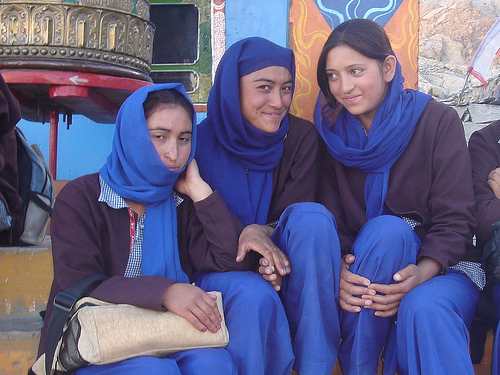
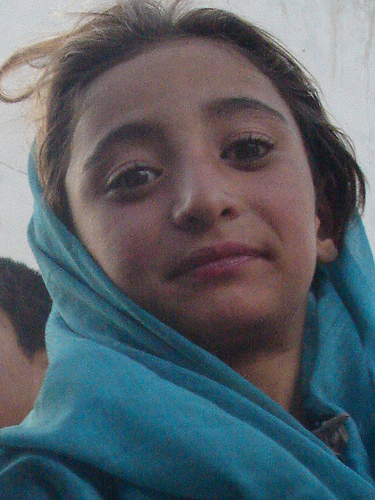
On the sidelines were three adorable little Muslim schoolgirls with green uniform crested blazers, book bags, and white headscarves. The headscarves somehow make them more beautiful - like a frame for their faces. The little ones were being shepherded by an older (teenaged) girl in the same attire.

I squatted down to their eye level and asked if I could photograph them. "Photo thik hai?" They agreed, but didn't look very comfortable. They are so serious in these photos... most of their natural beauty is hidden behind a sort of grimace. (!) I think more time is required to gain their trust.

I asked the older girl if I could then photograph her. "Sorry, no," she smiled. She looked sincerely regretful. All the girls had that handsome combination of Mongolian, Central Asian and Indian features, along with pink-white wind kissed cheeks, that adds up to uniquely "Ladakhi."
The girls in the photo above live in the Nubra Valley near Hunder. They were waiting for the school bus home. Now that I've gotten so many "nos" to photo requests, I feel extra lucky to have this beautiful picture.
Call for Kawa
I mentioned Kashmiri kawa before. It's a regional hot tea drink made from - depending on who you ask - saffron, green tea leaves, cinnamon, cardamom and almond. You can go into three different tea shops and get three different versions of Kawa. I have been served Kawa that ranged from an uplifting, exotic brew to what was just obviously black tea with a bit of cinnamon. Another shop (run by Tibetans) served hot water with crushed almonds and a few leaves of saffron - but no tea.
So I decided to ask Mr Yassin, owner of the TsoMori Hotel, what was REAL Kashmiri kawa. Mr Yassin is a Ladakhi Muslim whose family have roots long ago in Kashmir proper.
"Kawa is a special leaf," he said with animation, even a bit of vehemence. "Only one, two shops in the bazaar are selling this now. You go to that main general store, in the big burlap bags, there they are selling."

So Kawa is not green tea or black tea? "No, Kawa is Kawa. It is a special kind of green tea that comes from Assam, but it is not ordinary Assam tea. Long, twisty leaves, they look like snakes."

How do you make real Kashmiri kawa?

"You take the kawa leaves, the cinnamon bark and the elaichi (cardamom pods), and sugar, and boil them all together. Then you strain it into the glass of course."

What about the saffron, the famous product of Kashmir?

"After straining, you add two, three leaves of saffron. Enough to make the colour golden yellow. Then you crush the badam (almonds) and drop them in the glass.

It was important, he said, to brew the first three elements all together - if added later, the spices wouldn't give enough flavour, and the sugar wouldn't melt properly.

Though I am typing now with gloves on, my fingers are stiff with cold. I would love a glass of Real Kashmiri Kawa. Even a fake one would do.

The Chinese Province of Nepal ("Autonomous Region")
You read it here first. I predict this will be a reality within 10, 15 years.
Nepal has long been squashed as a little Switzerland country between two giant, billion-person superpowers (the "yam between two boulders" syndrome), playing China and India off one another, with varying bits of success and failure.

With the growing influence of the Maoists (mostly growing for lack of a better alternative), the fence-sitting scales appear to be tipping Northeastward.
Last month Nepal government announced they were dashing the hopes of Tibetan refugees now living within Nepal by refusing to cooperate with a US plan to offer 1,000 of the refugees asylum in America. To quote the news story:
China says there are no Tibetan refugees, only illegal immigrants who should be punished according to the law of the land.

Now Nepal is actually inviting the famous/notorious Tibet Railway - widely recognized as a major factor in diminishing Tibetan presence within Tibet itself - to be extended to Nepali borders. I think Nepal thinks this means greater access to Chinese goods, and with that, greater ability to tell India to shove off. In your face India! Nyaah Nyaah Nyaah!
What it really means is greater infiltration of Chinese people. If they need proof, they can just ask any of the Tibetans now living in Nepal what it's like to be such close "friends" with China.
Not only that, but China itself, which had previously disdained the Nepali Maoists as not proper Maoists, are now taking a special active interest in Nepal.
A high-level Chinese delegation which is in Nepal to assess the latest political developments, held a series of meetings with the political leaders. The seven-member team led by central politburo member of the Chinese Communist Party Wang Ziarui, on Sunday met the senior leaders of the Communist Party of Nepal (UML) and discussed the prospect of transforming Nepal as a "socialist nation".
China's claims to the Tibet region are based not only on supposed historical precedent ("it used to be part of China") but also cultural affiliation. Since Tibetan culture, according to them, has "always been" part of Chinese culture, logically they will lay claim to every area where Tibetan culture still survives, that has a convenient border with China. That means:
-within India: Arunachal Pradesh (birthplace of the 6th Dalai Lama), and Sikkim. According to an Arunachal Member of Indian Parliament, there are already Chinese troops inside Arunachal.
Ladakh is extremely well fortified now - after the Chinese made their point by commandeering Aksai Chin a few decades ago.
-Bhutan (there have been reports for the past several years of Chinese troops "accidentally" crossing the Bhutanese borders). Since India provides most of the muscle behind Bhutanese infrastructure, this would, for practical purposes, be equivalent to invading India.
-and of course, Nepal, particularly the remote Mustang region of Nepal (sometimes called "Little Tibet") where Tibetan Buddhist culture has survived, mostly unchanged, for centuries.
Some well-meaning European tourists this summer asked me about the heavy military presence in Ladakh. "Is it really necessary?" My answer: "Have you met the neighbors?"

Tuesday, November 06, 2007

State of the state

UT doesn't mean University of Tennessee
Leh, Ladakh

This morning, my guest house manager stopped in his tracks at the sight of a banana on my breakfast table.

"Where did you get that?"

At the Sabzi Mandi (vegetable market), of course.

"But they are closed!"

I got it yesterday. Closed? Why?

"Today it is a strike. Strike till 2pm. The LUTF."

Ah, the Ladakh Union Territory Front! I thought they had lost steam lately....but no, they still have the ability to paralyze the city, one of the signs of political success in India.

For the past 20 years or so, many Ladakhis have been agitating for Ladakh, which is currently part of the state of Jammu & Kashmir (J&K), to be declared a Union Territory. A Union Territory in Indian politics is a sort of in between state, neither quite fish nor fowl. Pondicherry is the most famous one; also Daman & Diu, Andaman Islands, Lakshadweep Islands, and there are a few others.

Union territories are usually historically and culturally unique pocket areas within a larger state, that maintain a separate identity. The Union Territories respond directly to the Central government in Delhi, not that of the surrounding greater state. In the case of Pondicherry, for instance, they have a certain degree of autonomy separate from surrounding and dominant Tamil Nadu.


I went out into the quiet, peaceful, empty streets. There were more policemen than civilians on the road. All the shop shutters (metal gates that pull down from above like garage doors) had been "downed." Shucks, there were more shops open on Eid day than there were this morning.

I asked the police officers when the strike would finish. One said "three pm," another just down the block said "2pm." It turned out the strike was a way to force everyone (more or less) to attend the LUTF speeches at the Polo Ground. So I headed toward the Polo Ground, the big open-air space where most public events are held here in Leh.

Several thousand people in attendance, mostly seated on the dusty ground in front of the concrete proscenium. Many carried cardboard placards in one hand, and spun Buddhist prayer wheels in the other. Fortunately the speaker would occasionally translate his Ladakhi words into English, so I could get the gist of them.

Essentially, the Ladakhis (at least these Ladakhis) do not feel much kinship with J&K state, and feel they have gotten the "stepmotherly treatment" from the Srinagar-based state government. Ladakh is a much larger land area than that of the rest of J&K, so this is used as evidence to rope in federal funds for the greater state. However, when it comes to dividing those funds, they feel Ladakh does not get its fair share. Also, the state government being based in Srinagar, and dominated by ethnic Kashmiris, with the official language of Urdu puts Ladakhis at a disadvantage in negotiations.

It is not a matter of Buddhist versus Muslim. There are plenty of Ladakhi Muslims, as I discovered back in August with my police story, who identify more as Ladakhi than Kashmiri.

I spoke with the LUTF leader and main speaker, who looked dignified in his maroon chuba robes. He asked me to come to the LUTF office this afternoon for a printed statement.

This is happening all over India - breakaway "aspirant states" wanting more autonomy and/or statehood status. New states are being created every few years (Jharkhand, Uttaranchal and Chhattisgarh are only about six years old, I think). The Telengana region of Andhra Pradesh has a similar movement. India's a big, diverse place and I am sure the lines have not been definitively drawn yet.


Thursday, October 11, 2007

On the Eve of Eid

Astrologers unavailable
Leh, Ladakh

Thubsten Sanfan (see previous post) says (through the interpreter) that he doesn't have the almanac for my birth year. Not that it was SO long ago. He has the records for the previous year, and the one before that, and the one following my year. Just not my year. Since I am going to be in the region for a while, we convinced him to go and look in his "library" or perhaps in the Men-Tse-Khang (Tibetan medicine headquarters) for the info.

Tibetan medicine and Ladakhi traditional medicine (known as Amchi) rely on a combination of natural herbs, psychological evaluation of "imbalances" and astrology. So, I figured the Men-Tse-Khang, who also do astrological analysis, should have some ephemera. (An astrological data book showing positions of the planets is called, in English, an Ephemeris.)

It's just about time for Eid el Fitr, the biggest Muslim holiday of the year that marks the end of Ramadan. Ninety-five percent of the Kashmiri merchants have packed up their shawls and jewelery into tin trunks, pulled down the metal gates on their shops and headed for Srinagar. Most of them have wives and family waiting for them there. I think a few Kashmiri and of course Ladakhi Muslims will be here to celebrate Eid.

Eid is a picturesque time; all the men put on spanking new kurtas and topis, and go around ritually embracing one another. Lots of smiles and general good will. My friend Parvez said it's mostly a domestic holiday, a visit to the mosque followed by lots of relatives and friends dropping by, bringing holiday food and feasting and sharing.


I'm getting my Restricted Area Permit together, thanks to the guys at good old Glacier Trek n Travel, to visit Dha-Hanu Valley, home of the last Aryan Buddhists. They will be celebrating their indigenous festival called BoNoNah, which occurs only once ever three years. As I am lucky enough to be here on the third year, it seemed too good to miss.

Wednesday, September 26, 2007

Yakz-N-the-Hood

People in my neighborhood
Leh, Ladakh

Well, I finally saw a yak. A great big beautiful black and white yak - or maybe a Dri (female yak). It had no horns; perhaps that is a trait of a Dri. It's absolutely huge, like a shaggy black-and-white tank, and is placidly grazing on the newly-harvested field down the lane from my guest house. (Wait, I think I used that phrase last week...placidly grazing camels!)

Since I can't get original photos onto the site from here, here is a stock photo.

In Ladakhi bioculture, nothing is ever wasted (even human waste gets composted for about a year, till it is non toxic, then used on fruit trees). So, after they finish cutting all the wheat or barley, the Ladakhis put the cows and yaks out to graze on the stubble and finish the job for them.


What was surprising was that it was a yak, a real yak and not a Dzo or Dzomo (yak-cow hybrid). In the last episode I related that the valleys are now still too hot for the yaks. But there has been a slight dip in the weather and perhaps this one was transferred from the upper elevations down to town.

<>I try to walk as much as possible down back-country lanes and away from main roads. The poplar leaves are falling and crunch golden under my feet. It's been so long since I smelled the smell of rotting deciduous leaves, it really feels like home in October. (Really - after a few years in the tropics you forget that trees elsewhere change colour).

Closing up shop
All the Kashmiri merchants are packing up and going back to Srinagar. If you are ever in doubt about which merchants are Kashmiri, they are the annoying ones that sit in front of their shoppes all day annoying you. I really love the contradiction between the obsequious, wheedling, oily tone of voice ("come have a look in my small shoppe madame???") and the resentful, frustrated and condescending facial expressions (which say, "you stupid foreigner, step inside like a bug into my spiderweb"). They never, ever seem to "get" that harassment does not equal salesmanship. Then they wonder why the foreigners and other tourists all go to the Tibetan and Ladakhi merchants. These other merchants give sincere smiles, and leave them alone to browse in silence. What a concept!

The fact that something does not work and never has worked is absolutely no obstacle to its continued practice in India. Doing things The Way They've Always Been Done is far more important than getting results.

I actually worked out a roundabout path from the guest house into town that bypasses all but one Kashmiri merchant on the Changspa road. Other foreign tourists I talked to had done the same.

<>Too bad, because the Kashimiri pashminas, sweaters, shawls, scarves and jewelery really are very nice. They just do not get the concept of "browsing."

Also, in case you need to identify them further, Kashmiri shoppes always have names like "Kashmiri Emporium," "Ancient Arts Antique Emporium," and my favourites: "Useless Wali Arts Emporium" and "Age of Old Era."

One shoppe I like to frequent because the owner does not resort to sidewalk touting is the cornily-named Antique Heaven, just off the main bazaar. Mr. Bhatt will not pressure me, will gladly show me anything I'm interested in with no pressure to buy, and loves to talk about Ladakh, Kashmir and the local political situations. He is extremely laid back, and a great source of information. I even go by his shoppe just to say hello (and as any experienced Indian traveller will tell you, that is saying a lot about a Kashmiri merchant).

Loads of restaurants are listed in the Lonely Planet, but for good service, good food, a good bathroom and the absolute best 360 degree view I go to Leh View Restaurant. The three-storey climb to the terrace was a real huffer and puffer when I first arrived, but now I am acclimated and trot up the stairs with ease. Everything I ate there (Vegetable Biryani for 70Rs or $1.50 reeks aromatically of cloves and all kinds of exotic spices) was great, the service is fast, it always looks clean and you can watch cricket games on TV in the downstairs room. Not to mention, one of the only decent bathrooms in town. A great bathroom here means, "the door locks, it doesn't stink and there is a sink - with SOAP!"

The rooftop terrace has stunning views of Leh Palace, Tsemo Gompa, the mountains, the golden-roofed Vihara across the street and even Shanti Stupa several miles away.

I noticed that during last week's Pakistan vs. India games, a lot of the Kashmiri Muslims (as opposed to Ladakhi Muslims or any other Indian Muslims) in various restaurants, shops etc. refused to stand for the Indian national anthem. They were rooting for Pakistan (they held their cheering at bay till the Indian tourists left the establishment in question, though). I thought maybe I was mistaken and asked them (when no one else was around) "who were you cheering for?" "Pakistan."

As soon as India won, the Kashmiris all poured out onto the street (all over Leh town) cursing. I was walking homeward when this happened and saw the crowds on the streets. I saw a Ladakhi kid start teasing a Kashmiri guy and decided to get home fast before something got out of hand. That is exactly the kind of thing that could start a rumble in an Indian neighborhood.

Ladakhi Libations
While in Ladakh, or anywhere in Kashmir, don't miss Kashmiri Kawa (also spelt Kehwa, Kahwa, etc). It's a Kashmiri hot drink made with saffron, crushed almonds, crushed cashews, cinnamon and sometimes green tea leaves (depends on where you go and who you ask). Leh View has very yummy Kahwa that is heavy on cinnamon. Only 15Rs (about thirty cents) for a glass.

A delicious drink that is a bit harder to come by is chang, the home-made Ladakhi barley beer. My guesthouse owner made it for a special puja last week, and I loved it - especially with a handful of tsampa or barley flour thrown in, making it like a grainy alcoholic milkshake. The Belgian guests at the dinner looked at me like I was some kind of intrepid adventurer just for trying it.

Another great unique Ladakhi drink is Seabuckthorn juice (aka Leh Berry juice or tsetsalu juice), reputed to have the highest level of Vitamin C and antioxidants of, well, anything. The juice of the tart, bright-orange berries, which grow only here in Ladakh, are mixed with a bit of sugar and served as a tangy drink. The Dzomsa, besides being a place to refill your water bottle, sells fresh glasses of this juice for 15Rs. Dzomsa also sells dried sweet apricots and roasted crunch, which make a great road snack.

I love the name of Hot Million Sweets and Snacks on the main bazaar - and they serve a really thick Punjabi-style lassi for 15Rs. However, the best samosas belong to Neha Sweets around the corner from the Big Mosque. One samosa, five rupees - you can pig out for 20Rs and a glass of tea to wash it down is another 5Rs. I like the big open picture windows, where I can watch people stroll by and even look up at the ancient Leh Palace on the hilltop.

The Big Mosque is a major neighborhood landmark. The muezzin's call is an easy way to tell the time of day. The mosque was built in 1666 as part of a deal between the Ladakhi Buddhist king (I think it was Sengge Namgyal) and the Mughals. The Mughals promised to defend independent Ladakh against Tibet, for a certain price. I have read in various places that the original Big Mosque (Jama Masjid) was built in a unique Central Asian-Ladakhi architectural style. More recently, it's been renovated to include onion domes, minarets and other more "Arabic" features.

My favourite internet place is Ancient Tracks Cyber Cafe right at the corner of Fort Road and the Main Bazaar. They are the only internet place downtown (or that I ever saw anywhere for that matter) who have a generator power backup. That means, when the power cuts out (at least once a day here), you can stay online. The Tibetan operators will offer you free tea if you stay long enough, especially during dinner time. I like the fact that it's run by women only. It completely changes the feel of the place. Plus, they are open the latest - open till 11pm.

The most centrally located pharmacy and medical shoppe- and a bit of Himalayan history - is Het Ram Vinay Kumar, whose Punjabi family has been trading here for about four generations - "since before the time of the Chinese aggression," Mr Kumar himself told me. He's the stern-looking man behind the desk. He told me that National Geographic featured the store in a story about exiled Tibetans in a 1960 issue.

In classic general store tradition, Het Ram sells a bit of everything, as do the other large old-timey general stores on the block (they used to call them Dry Goods Stores). Their jumbles of Tibetan khatag scarves, burlap sacks of spices, fabric for heavy goncha dresses, coils of rope, candles for power outages, bins of potatos and dusty boxes of L'oreal hair colour give the comfortable feeling: "we can scrounge up anything you need...just give us a minute." I felt like Mr Drucker from Green Acres would peep out from behind the counter.


That's it!
I finally realized who the Kashmiri Merchants remind me of....Green Acres' Mr. Haney.


.....
By the book
The most comprehensive bookstore in town is Ladakh Bookstore, just underneath Leh View Restaurant. Strolling through their aisles I feel almost like I'm in Delhi, or Barnes & Noble, and they accept credit cards (a rarity in Ladakh). However, they close up shop and leave for Punjab for the winter some time at end of September.


A more constant presence in the community is Leh Ling Books (Main Bazaar road), which is much more homespun but has a lot of the same stuff, in addition to kids' school supplies, blank notebooks, ink pens, maps, and greeting cards. Other great bookstores in town, some of which sell second-hand volumes, include the Bookworm and Otdan Books.

However, for a Ladakhi language-learning book - the kind used by primary school beginners - I searched in vain. The big bookstores had tourist pocket-phrase books in English script, and big unwieldy "Ladakhi-English-Urdu dictionaries."

I hit no less than five local stationery and bookshops (including shops that sold all kinds of Hindi, English and even Urdu learning books for schoolkids) and not ONE had a Ladakhi or even Tibetan script-learning book (Tibetan and Ladakhi share an alphabet). They all directed me to "Main Bazaar."

Surely Leh Ling would have it, I thought. Nope. Only one man in town, they said, "still" sold Ladakhi script-learning books - Thubsten Sanfan in the old bazaar.

I knew that there had been a struggle in the recent past about including Ladakhi language in the school curriculum - as opposed to Urdu, the official state language of J&K, but I thought it had emerged semi-victorious. Semi-, because now most public school education is in English medium, and the children can choose either Ladakhi, Urdu or (I think) Hindi as a second language. Ladakhi is not some obscure language - a great many of the signs are in Ladakhi Bodyig script. Most of the population is Buddhist and the script is the same for Tibetan, the sacred language of the area, which all Tibetan Buddhists should know how to read. I never thought it would be so difficult to find a Ladakhi script primer.

The old bazaar is a sort of more authentic, less exposed Main Bazaar, an alleyway running exactly parallel to the Main road but without the Kashmiri merchants, travel agents and junk stores. There are only real neighborhood stores here - tailors making salwar-kameez and Ladakhi gonchas, haircutters set up in tiny booths "for gents only" giving 40Rs cuts or shaves, a few butchers, a thangka-framer (a thangka is a sacred Buddhist scroll that must be mounted on brocade fabric), one tailor specializing in monk's maroon robes. I had to ask several times for Thubstan Sanfan, since there was no signboard in either Ladakhi or English.

Thubstan Sanfan Stationery was a tiny, dusty cubbyhole with nothing but the long skinny Tibetan scriptures on the shelves - nothing, not even a shopkeeper there, either. The shoppe was wide open and no caretaker to be seen. I thumbed through the mysterious books, deciphering an occasional letter, then decided to ask a neighbor where the proprietor was. The neighboring shopkeeper ran across the way to yet another shop, and brought back Thubstan Sanfan.

Mr Sanfan is a bit of a one-man industry. He publishes Ladakhi language calendars, reading primers, script primers, religious books and astrological references, in addition to running the religious supplies and thangka-mounting shop across the road. For 10Rs (about a quarter) I bought a bright yellow "Ladakhs Book Part I" which introduces me to the Tibetan/Ladakhi script.

Already, I can read simple one- or two-syllable words...but I haven't yet mastered the silent prefixes! As a spelling system, they are almost as annoying and illogical as English. Practicing Ladakhi script over and over is a good way to lull myself to sleep.

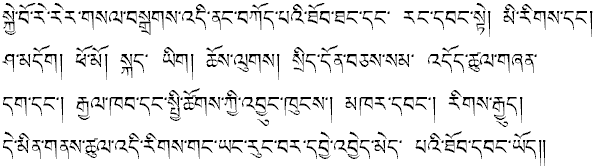
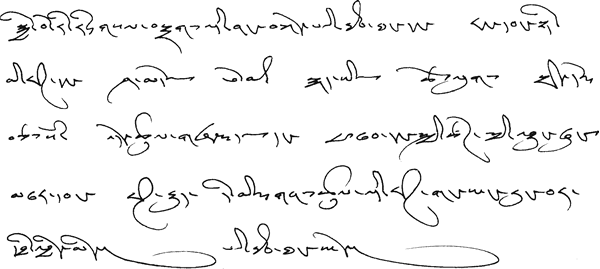
And for extra fun, there are actually 2 Tibetan scripts... U-chen (the everyday one I am learning) and the classical script, Gyuk Yig, sort of an elegant abstract version of U-chen. If I wanted to be an expert on Tibetan scripture, and thank god I don't, I would have to learn both.

Angmo will help me. She is the adorable nine year old niece of my guesthouse owners. I am really going to miss this place. Green Acres, we are there....


Above, and below, are examples of U-chen and GyukYig Scripts. What's written here is the 1st Article of the Universal Declaration of Human Rights, which reads:

All human beings are born free and equal in dignity and rights. They are endowed with reason and conscience and should act towards one another in a spirit of brotherhood.


Friday, August 17, 2007

Big sky country

Great wide open
Leh, Ladakh (India)
My lower back is really, really sore from sitting watching the Dalai Lama all day, my eyes are burning from the arid dusty air and I am too tired to think of a third thing to round out this paragraph. Oh yeah! My nose is full of crusty stuff.

His Holiness is teaching the "Lam Rim" scripture. Because I am sitting in the press section, have yet to hear the English translation. Maybe I will skip over to the "Foreigners" section tomorrow
It is wild to see the Dalai Lama in a Buddhist place. Usually, he appears in predominantly Hindu places and the Buddhists commute in. Here, most everyone is Buddhist. There are easily 30,000 people at every day's teaching.


Man, there is a lot of space out here. And a lot of dust. And a lot of sky!

It reminds me of a Halloween craft we did in kindergarten. We made a "starry sky" picture out of silver glitter, dropped onto blobs of glue, on black construction paper. But too much glitter always comes out of the tube, at first. We had to knock off the excess glitter into the waste can, and what was left was the "night sky." (Later I added a big yellow construction-paper cutout crescent moon.)


The night sky in Ladakh looks like the paper, before we knocked the extra glitter off. There are almost too many stars. I have a hard time identifying large constellations I know. But, a crescent moon rose last night.
Not of yellow construction paper, but a wafer-thin silver sliver.

Air conditioning of the gods

The most fun thing on this trip, so far, was also the cheapest. Returning from the teachings, the entire Choglam-Sa highway is packed bumper to bumper. I have to wait for the crowds to thin, and taxis want an outrageous 250Rs back to town. So, yesterday my German friends and I just hopped on top of a public bus, on the luggage rack. What fun! Who needs air conditioning, overpriced taxis, seat belts? Ten rupees for a panorama view of the valley and mountains. It really was much better than the hot, stuffy taxi stuck down among the exhaust fumes, or sitting inside the crowded bus itself. Of course, we had to constantly duck under the prayer flags that had been strung up across the roads for the Dalai Lama's visit.

Far from the madding crowd

One reason Ladakh does not "feel like" India is that it is just not crowded enough. Not that I am complaining. But at first, I really could not figure out what felt so weird. Almost lonely. Then it dawned on me....it was more like parts of southwest America; Arizona or New Mexico, to be exact.


My friend Gary warned me years ago that all the sensory overload of India would burn a hole in my brain, so that when I finally went somewhere quiet, I would miss the noise and clutter. Gary, you were right. I found myself looking around the relatively empty roads of Leh going, "where is IT?" and realizing I couldn't even define IT.

Another thing that doesn't feel like India is the absence of Hindus. There are a few. But I had been here five days before I saw my first Hindu temple ( a little tiny shrine).
It looks like one of the orange pyramidal ones the BJP put up in Buddhist places, just to say "we're here!"

Leh is the kind of place you can see minarets of a mosque superimposed with
Buddhist chortens and prayer flags, or sit in the Buddhist gompa and hear the Muezzin's call to prayer, and it feels totally normal.

Ladakh List
Definite must-brings for a trip to Ladakh:
1-Sunglasses
2-Sunblock
3-Lip balm, even better, sunscreen lip balm
4-Umbrella, or big floppy hat as sun protection

5-Eye drops - since I wear contacts, the aridity and dust is wreaking havoc
6-Trekking boots or chunky walking sandals
7-Jacket - evenings get nippy, though days are warm
8-Face moisturizer, which you will also have to put
inside your nose to keep it from crusting over, especially at bedtime
9- ORS (Oral Rehydration Salts, available at any pharmacy here for 15Rs). ORS have exactly what your body needs to replace fluids (potassium, sodium chloride etc) and are a literal lifesaver.

10-Lots and LOTS of water. Your water bottle can be refilled for 5Rs at the ecofriendly Dzomsa shops in town. If you feel weird, lightheaded, fatigued and cranky but don't know why, you are probably dehydrated.

11-Flashlight. The power goes out frequently, and if you are lucky the walk home to your guest house will be down a country road with few street lights.

12-Toilet paper. Guest house bathrooms do not have it, but will sell it at an inflated price.

Things that are totally useless here:
1-"Nice" shoes

2-Deodorant - you won't sweat-- or if you do it immediately dries into salt crystals on your skin

3-The talcum powder and astringent that are so needed in humid lower India. Again, you won't be sweating much

4-Tank tops, sleeveless blouses, singlets etc. show too much skin for local standards, and besides, you will either get a sunburn or freeze to death.

5-Your cell phone, unless you have post-paid. In Delhi, they happily sell you (ha ha) a SIM card saying it is good for all India. What they don't tell you is that in Ladakh and Kashmir (not Jammu), you must have a post-paid account; that is, you must be a resident with proof of address for billing. The prepaid cards are no good here. Of course, all tourists and most internationals have prepaid cards.

6-Alcohol. A disaster at this altitude, and not widely available anyway - rightly so.


Also, be warned - Internet is run by a cartel ("Ladakh Cyber Cafe Association") that has fixed prices at an obscene 90Rs an hour ($2.10). Not the place to play around tweaking the widgets on your homepage. And "photo uploading not allowed" - so, sharing the photos of this amazing place is quite difficult.

I appear to have missed all the really big Lama Dances with masks and costumes. In case you want to catch one, here is a calendar for next year.


Jeep 54 Where Are You?
Getting my press clearance to take photos of the Dalai Lama, when I am in a relatively podunk town like Leh or Bodh Gaya, means making friends with the police. Fortunately, this is easily done. I am the only foreign media person at these entire teachings, and probably one of the few the police have met all year.

What's not so easily done is catching the right guy in the office. The Superintendant of Police closed at 4pm (!) and the following day, Friday, was a holiday. God knows why, probably literally - in India, an unexpected holiday usually has something to do with religion. So I had to go to the main police station ("we never close").

It was an adventure but unfortunately, by the time I sat down to write about it last night, the net connections were down. Now, I am too tired. Maybe later.


The intrepid anthropologist in me never tires of poking into people's social dynamics. I discovered that among ethnic Ladakhis, there are both Muslims and Buddhists, and they feel themselves to be quite distinct from the ethnic Kashmiris. "He is
Kashmiri," one Ladakhi Muslim officer hissed to me, pointing out a Muslim guy on the street dressed in stereotypical beard and kurta-pyjama.

The kurta-wearing "Kashmiri" turned out to be another police officer, who helped me to get the pass, after a few bossy questions delivered in the usual accusatory style ("why did you not come earlier??") of the Indian "mainland."


Indeed, a lot of "Kashmiris" seem to have taken refuge here only as a resort from the violence in "Kashmir" proper. And they don't consider this Kashmir. One of the first things the kurta-wearing officer asked me was "Have you been to Kashmir?"

I thought we were in Kashmir, Sir.

"No, I mean Srinagar, real Kashmir. You should leave here immediately and go to Kashmir. Gulmarg, Dal Lake...." Then he started reminiscing about his homeland. Clearly, he felt Ladakh to be a hardship posting.

Lost tribe
I have also spent some time interviewing and photographing the "Indo-Iranian" Buddhists of Ladakh, the Brokpa people. Originally, they came from what is now Pakistan in Gilgit region. They speak a language called Dardi and have been Buddhist for many centuries. The Brokpa are supposed to be the last "Aryan" indigenous Buddhist people. (They actually call themselves Aryan, which in this case, just means originally from Iran.)

Since I can't upload my own photos, here is one cribbed from a Ladakhi tourist website.

The Brokpa traditional dress worn at the Dalai Lama's teachings is really distinctive, and their features set them well apart from the Mongolian-looking other Ladakhis. I am curious about the form of Buddhism they practice; it must date back, at least in part, to looooong ago when northwestern former India (now Pakistan) was Buddhist. Guru Rinpoche, the bearer of Buddhism into Tibet, was originally from Swat Valley, Pakistan.
Tibetan scriptures still refer to that area as "Ugyen" or "Oddiyana."

I went to the biggest bookstore in Leh looking for a book about the Brokpa. "Who?" said the Kashimiri Muslim guy at the desk. I pointed to a photo of one on a postcard (sold as proof of quaint tribal life in Ladakh).


"Oh, the Aryans? No, no books about them. Something-something in various books here and there, but nothing just about them." If they don't have it here, they don't have it anywhere.

Maybe no one could talk to the Brokpa. All the other foreigners take pictures of them from a safe distance with powerful zoom lenses. I guess there is one advantage to having a cheap camera...you are required to make contact with your subjects.

Sunday, August 12, 2007

Mountains of the moon

Lunar landing in Ladakh
Leh, Ladakh (Kashmir)

Joollay (Greetings in the local language) to all from sunny Leh, Ladakh. I can't wait to see my first yak! So far, it's only been donkeys and a few cows on the road.

Everything you have read about the stark moonscape of the surroundings here is true. It seems far too good (ie clean, quiet and peaceful) to be a part of India. You do feel a military presence at the airport, and in parts of town, because of proximity to China, but there is no real tension.

In fact the culture here is so distinct, it took seeing the vehicle license tags that say "JK #" to remind me that in fact, Ladakh is technically a part of Kashmir, that Indian state whose beautiful, lush name is now so associated with strife and violence. Ladakhis (predominantly Buddhist, many of ethnic Tibetan origin, speaking a distinct language) have little in common culturally with Kashmir, and there is a movement to form a separate state within India (Union Territory of Ladakh). It will never happen, IMHO, as for obvious reasons India is not keen to fragment the region further.

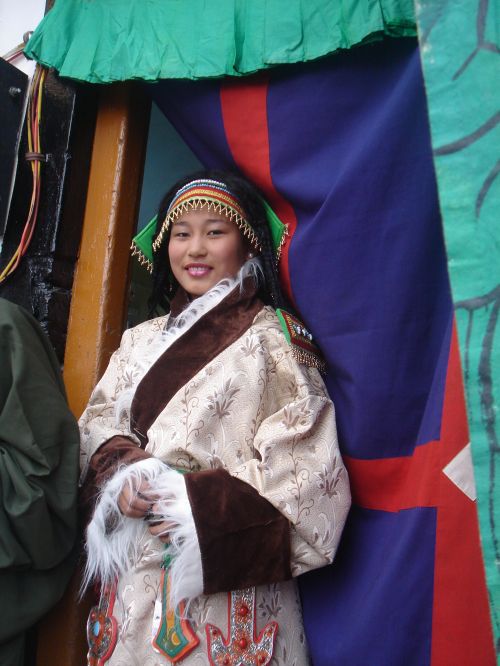
The tiny Rinpoche Bakula Airport is easily the cutest one in the land. It resembles a Tibetan monastery's visitor centre. We had to register as soon as we trooped off the plane, but all that meant was filling out a form ("Registration of foreigners, State of J&K) handed to me by a cute little Ladakhi lady in traditional dress. I didn't even have to show my passport.

Here they still employ the old disembarkation method, like in a 1940s adventure movie - we de-planed down a gangplank right onto the runway, surrounded by high winds and dramatic mountains. There's a definite "wow" factor, but we were discouraged from taking photos by the soldiers ("This technical airport ma'am," a reference to the sensitive location). But the soldiers mostly seem bored with their jobs, and amused by all the foreign tourists.

When we flew in this morning over Tibet-like navy blue and grey mountains, with snow peaks in the distance, it was cloudy - had the cozy, cottony feeling of a winter day. I thought I would not be able to see the famous Ladakhi blue skies, and collapsed from altitude (blood singing and heart pumping through my ears, gasping for breath) on my guest-house bed. (Shanti Guest House in Changspa - $5 a day, clean, quiet, family-run, shared bath with hot water only 2x a day. The inside looks like a marble Indian maharajah's bungalow, the outside like an old Tibetan house).

The padlock and key they gave me to lock up my room look like something from a Tibetan artefacts museum - a hand-carved, hand-molded piece of silver metal with an abstract key like an ancient amulet. Works just fine, though.
When I finally awoke at 5.30pm, the sun was glowing off the mountains and I could see what looks like an ancient monastery far, far on the peak of an Arizona-like jagged hill. Most of what I've seen of Leh so far is like a big garden. I realized that I had no mental concept of what Leh would look like and sure enough, when Francesca (Italian taxi mate) and I drove through town, it was over before we knew we were there. "There is no there there."

All the medical advice says to take it totally easy the first 2 days, so I am dutifully following. We are at 11,500 feet elevation and it's about 65 degrees in daytime. So nice to be in a place with no bugs and no sweating or humidity.

HH the Dalai Lama arrived today (actually, he already came on 31st July, but went to a place called Diskit to give teachings and is back now) and will begin teachings in Leh on 16th-19th. I expect he will give me that same look when he sees me perched with my camera (half glad to see you, half "are you STILL following me around??").


Independence Day
Let me just say, flying international is a hassle everywhere these days, and it was an extra-extra hassle flying from Nepal to India and then within India on the eve of the 60th Indian Independence Day celebrations. Triple and quadruple checking, interminable lines, lots of delays. I am quite amazed that I got on board with my nail clippers (though they did catch my sewing scissors, which had to be deposited with a crew member for security).

The papers are full of celebrations, historical retrospectives and congratulations, and the mood around Delhi was a cautious mix of pride and severely paranoid double-checking, and rightly so.
No one wants this moment in Indian history to be marred by terrorist action. All Delhi hotels are prohibiting any unauthorized visitors (that is, unregistered visitors to a room) -period -until after August 15. And every cybercafe had been instructed to demand not only that I show my ID, but present a photocopy of my passport. That's okay. I am actually heartened that they are taking it all seriously and doing their jobs.

According to the NDTV Independence Day polls, most Indians surveyed felt that "Corruption" was the #1 shame of India today. Other contenders surprisingly far down on the list included poverty, untouchability and dowry scandal. Gandhi is still ranked as India's #1 Icon, getting 58% of votes; the only person who came close to him in votes was Mother Theresa who got a pitiful 17%. The nouveau-riche modern Indian industrialists also offered in the poll (Mittal, Tata etc), whom the press so incessantly tout as modern Indian heros, seem to not have made much of an impression on the public.

Saturday, August 11, 2007

Off to Ladakh

Booked
Delhi, India

I was in Delhi just long enough to chill for 24 solid hours in the placid darkness of an AC hotel room, meet a fellow IndiaMike-er ("TNog") by chance in Saravana's, and book my JetAirways flight to Leh, Ladakh.

It was so simple and painless, it almost took my breath away. Ladakh has always seemed so distant and exotic, it's hard to believe it has an airport that accomodates jet planes.

Ladakh, literally "Land of High Passes" - Whee-ha! Twill be my first ever experience above 10,000 feet. Altitude sickness, here I come!

Friday, July 21, 2006

No direction home

Refugee Nation
Kathmandu, Nepal

Everyone knows about the Tibetan refugees; they are very high-profile and have a dramatic, romantic story. Tibetans
are still coming over the mountains - still escaping Chinese occupied Tibet. But probably 20% of the city of Kathmandu - maybe more - are some kind of refugee.

Besides the Tibetans, there are several
Bhutanese Refugee camps here in town. Meant to be temporary, like all such camps, the Bhutanese have been there nearly 16 years. King Wangchuk, an absolute if otherwise somewhat enlightened monarch in the neighboring mountain kingdom, kicked out lots of ethnic Nepalis who had been born and raised there (they were demanding things like "rights") in the early 1990s. The UN Human Rights Commission is here investigating the Bhutanese refugee camps this week; yesterday a bunch of protesting Bhutanis were arrested in front of the SAARC Secretariat.

Then there are Biharis - refugees from comparatively prosperous neighbor I
ndia. Ordinarily Nepalis go south to find work in India. There are some 1 million Nepalis working there now, largely as waiters or hotel staff; the stereotypical Nepali diaspora job is that of security guard ("bahadurs" - a Nepali word meaning courageous). These reverse Indian migrants are fleeing the state of Bihar, notorious for its poverty, violence and corruption. With their distinctive Indian features - prominent noses, enormous bushy moustaches, large, liquid eyes and unsmiling faces giving them a somewhat doleful look - they are easily spotted selling fruit from large bicycle baskets all over town. Every time I buy fruit, I ask them "what is your native place?" So far, they have all answered "Bihar." They are thrilled that I even know one or two cities in their state and that I have ridden through it, however briefly, on the train.

Yet another category of Indian refugee comes from Kashmir. Theirs is a diaspora of long standing. The Kashmiri conflict needs little introduction; because of it, green-eyed, fair-skinned Kashmiri men (known as much for their butter-tongued salesmanship as for their good looks) can be found in curio shops from Ladakh to Kerala. I would imagine the Kashimiri diaspora accounts for a good percentage of Nepal's very small Muslim minority.

Where are the Kashmiri or Bihari women who must have accompanied their men? Do they stay at home in purdah (Muslim seclusion of women), or tending children? or did they stay behind, leaving the men to dream of a day when they could earn enough money to return home and marry? A few days ago, I saw two tall, thin women dressed in the unmistakeable style of far northern India. Punjabi suit with churidhar pants, chunri (long scarf) pulled over the hair, no bindi on the forehead - that means, she's Muslim. The younger one could have been my sister, her features were so Caucasian. They were so exotic in these surroundings, I sprinted to catch up to them. "Place you are coming from?" I asked breathlessly. The elder one couldn't understand. "Kashmir," said the younger girl; "you are from?" "America."

The ladies were carrying water in what looked like old-fashioned plastic gasoline jugs, the kind with a handle on one side. Since there is no running water near their tiny flat, she told me they go to fetch water from a public tap some four times a day. They trudged up the sidewalk with the plastic jugs perched on one shoulder, heads held high.

Internal Affairs

Then there are the Internally Displaced Persons (IDPs) - those who've been flooding Kathmandu escaping the Maoist/RNA conflict in their villages for the last few years. The Kathmandu population has mushroomed recently, mostly young men fearing recruitment or death at the hands of either army. Many young women have fled as well. Some find gainful employment; some are driven to dance in the many strip bars in the tourist district; some turn to either outright prostitution or a "softer" kind involving a relatively wealthy city man or "foreign gentleman" they have met during their migration.

Still more Nepalis are just fleeing poverty and lack of opportunity in their rural districts, armed conflict or no. Maya is here with her 2 daughters and sick husband. The husband has TB and is just sort of acknowledged to be terminal. There is treatment for TB, but they seem to have accepted that he is dying. The husband just lies in bed all day (all he can do) while Maya and her daughters do a sort of hybrid job in Thamel, alternately selling small pocketbooks (the kind tourists use as money pouches) and when that fails, begging. Maya buys the bags wholesale for about 30NRs each and sell them for whatever they can get. If the tourist looks rich, they start at 500NRs (about $8.00). However, they will part with the bag for as little as 50NRs. The same bags are for sale in every single shop in Nepal; often for much better prices, but Maya and girls are counting on pity and immediacy (being in your face on the street, that is). I wonder to myself whether she purposely doesn't wash her girls properly for this reason.

Maya came here from Pokhara, the centrally located lake town, seeking treatment for her husband. They seem to have forgotten about that now and just accepted that he's dying. While we were talking to her, Maya started crying and said "I just wish someone would take her" (the baby) "back to America."

And of course, there are the expats...not tourists, but lifers. Foreigners who came for a season and stayed. They're all running from something - many seem to be running from conventional ideas of prosperity and all its confining trappings, as our Nepali neighbors are hoping to run toward them. They ran to a place where the human touch still counts, everything is not yet mass produced, and you can still ride a bicycle to work without getting run down by SUVs.

Most foreigners are involved in one or more charities, projects or volunteer work; like Renate, the Dutch Nepali resident and owner of the posh restaurant 1905 Kantipath. Renate is deliriously busy not only running his business, but with myriad projects and homegrown, small-scale charities which emphasize training and education.

Unlike India, the locals here don't seem to consider you "stupid" for wanting to help. And a heartening number of projects seem to do long-term, sustainable good.

I met Rachael as she was taping up

hand-written posters to the notice board of the posh Kathmandu Guest House. Rachael is a very low-budget traveller here from New Zealand. "I hope you don't mind eating here," she said quietly as we ducked into a dark, smelly local lunch joint where flies buzzed around the food counter. It turned out to be too dirty even for her, and we ate elsewhere. Her guest house is 150 NRs a day (about $2.00 US) and only has hot water from 8-10 in the morning. Rachael is trying to raise money for "her" family in the Langtang region. She met them while trekking, spent time with them and got to know their situation intimately. Rachael wants to collect $100 US to repair their leaking roof (especially now that it is monsoon) and is in the city collecting it - 100 NRs (that's about $1.50) at a time. Her sunspotted skin, worn out sandals and frequently stitched and re-stitched pants showed that she spent no money on herself.

If she can buy a sheet of corrugated tin, Rachael can take it up to Langtang, tied onto the roof of a bus. (Anything and everything can be tied onto the roof of a bus here - I've seen full-sized sofas transported this way. It was amazing to see the men get it up there; but then, this is a land where five-foot men carry full-sized fridges on their backs.) From there, she will have to hire local men to carry it up to the family house. She's also collecting money to build a wall that will protect the family's apple orchard seedlings from the local deer, goats and pigs.

With $150 US, the family can buy a water buffalo, which will enable them to start a small-scale dairy business providing yogurt and milk to their neighbors.

Everyone gets involved, everyone has a project. No one, it seems, "belongs" here. Therefore, we all do. It's strangely liberating, and creates an environment in which anyone can fit in. Politicized enough to be relevant, romantic enough to be picturesque, bohemian enough to be accepting, and very international - a slice of Manhattan's 1980s East Village transplanted to a rain soaked mountain kingdom - Whoops! kingdom-slash-modern democratic republic... in the monsoon clouds.