Showing posts with label muslim. Show all posts

Tuesday, February 01, 2011

What's your sign?

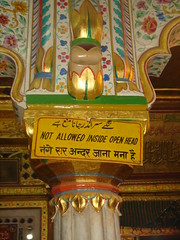
No Open Heads
Delhi

Continuing the "What's your sign" series...

This, seen in Nizamuddin Dargah, Delhi.

A Dargah is a mausoleum or tomb for a Muslim saint. Nizamuddin Dargah, constructed circa 1563,  houses the remains of Sufi saint Nizamuddin Auliya, as well as those of Amir Khusro and Jehan Ara Begum.  The tomb of Inayat Khan is in the same neighborhood, round the corner.  There's one area of the tombs into which women are not allowed (I can't remember which, but don't worry, signs are clearly posted).

Thursday evenings at the Dargah feature live Sufi Qawwali music from about 5pm, and continue only about two hours. Admission is always free.

The simplest way to reach the Dargah is just to hop in an autorickshaw and say, "Nizamuddin Dargah" (it's near to Humayan's Tomb, but every driver should know the Dargah).  You can also take Delhi's spiffy Metro to Central Secretariat, but you will still need to take an auto from there. 

Nizamuddin will immerse you in Delhi's rich medieval history of Sufis, Mughals and minarets.  As with Hindu temples, the road to a Muslim dargah is lined with stalls selling appropriate offerings. Rather than oil lamps and sindoor, they feature incense, roses and glittery green cloths to drape on the tomb.  The atmosphere is male-dominated, with some interesting exceptions.  At one stall I saw a woman, head demurely covered and carrying a basket, conversing with the stallkeeper. It didn't even take a second glance to see this was a transgendered person.  She was obviously well-known to the local merchants.  In a previous age, perhaps she would have been a court eunuch or even a court entertainer.  So much has been lost, in a time when Muslim culture is dominated by Taliban and ayatollahs.


Friday, November 23, 2007

Friday Faces

wrinkles in time
Leh, Ladakh


I just came from the Jamma Masjid ("Friday Mosque") in the main square of downtown Leh. Friday is the best time to take photos, because it's the special day for Muslim prayers.

I love the way identities are so confusing in Ladakh. People who "look Muslim" turn out to be Buddhist and vice versa. It totally messes with my preconceptions.

My favourites are the old-timers with ravine-filled faces and traditional clothing. When I was much younger, I used to hear people describe the elderly as "beautiful" and thought "yeah right, who would really want to look like that? They are just being polite...."

But now I really find it hard to take interest in photographing most younger people. The older people really are more beautiful.

This afternoon at 1.30 prayers, I was only able to photograph men. (Women generally pray in the home, at least in this area.) I haven't been able to upload today's photos of the old timers yet. So here are some more wonderful Ladakhi faces with the invariable Ladakhi smile.

Can you believe I've never been to the Taj Mahal?
I can't.

After all these years in India, I have been to so many places... but still not the Taj Mahal, definitely the most famous UNESCO World Heritage site in India, if not the whole world.
While browsing the UNESCO website (looking for information about protected rock carvings - the ASI director for Leh swears that such things are not protected by UNESCO, which of course, is not true) - I decided to list all the World Heritage sites I have visited.

Tamil Nadu:
Brihadeshwar Temple
Mahabalipuram monuments including the "Shore Temple"

Maharahstra:
Ellora Caves
Ajanta Caves
Victoria Terminus (recently renamed "Chhatrapati Shivaji Terminus," which peeves me, because Queen Victoria's people built it....it has nothing to do with Shivaji, he was dead a long time before this building was erected; why should he get credit?)

Bihar:
Mahabodhi Temple

Delhi:
The Red Fort

Nepal:
Pashupatinath Temple (foreigners not allowed inside..but they want your money anyway)
Kathmandu Durbar Square (foreigners not allowed in Kumari Ghar or most temples. They still hit you up for entrance fees. Somehow they have it worked out that this makes sense)
Patan Durbar Square (same policy - foreigners not allowed inside temples. Indians, who technically are foreign, are allowed - just not white people)
Bhaktapur Durbar Square (same - foreigners not allowed inside temples)
Boudhanath Stupa
Swayambunath Stupa
Changu Narayan Temple

I have consistently lodged my own one-woman protest at the discriminatory Nepali sites, by never, ever paying the price for buildings I'm not allowed into. (Makes perfect sense to me.) Instead, I have enjoyed the surrounding areas without paying, and now know all the secret back entrances to each of the sites. Write me for details. I don't support places that claim to represent the heritage of "all the peoples of the world, irrespective of the territory on which they are located," and then discriminate based on race. I welcome you do the same.

All the other places listed do charge more for foreigners, but at least the access is equal for all. If I'm going to pay five times as much, I should be able to see the place - that seems more than fair.

The Bus Is Back

Good news, budget Himalayan travellers. The Kathmandu-Lhasa Express is back on the road (as of January).

Too bad the same cannot be said of Nepali politics. Yesterday was originally meant to be the historic elections. It passed without a peep as political infighting continues and fresh violence erupts in the Terai region.

Here's more about the bus:

The bus service ran into trouble soon after its start in 2005 and remained suspended. Though resumed again for a short period in 2006, it has been closed since spring.

Officials in Nepal blame the closure on the Chinese reluctance to issue visas.

Beijing issued visas only to tourists travelling in groups, that too after stringent scrutiny. Travellers had to submit details of their itinerary and accommodation and the bus service was shut down by China on the eve of demonstrations in Tibet or anniversaries of historic days.

The revival of the flagging bus service coincides with the start of the Visit China campaign by Beijing to mark 2008 when it hosts the Olympic Games.

Nepal's state-owned Sajha Yatayat will run the weekly service from Kathmandu, like it did in the past. The pact will be a shot in the arm for the floundering state service, most of whose buses have not been running for over a year after an agitation by employees.

The one-way fare for the three-day trip will be $70.

Full news story here.

Tuesday, September 18, 2007

Big Valley

News from Nubra
Diskit, Nubra Valley, Ladakh


I am typing on the rock-like keyboard of the only internet available in the entire Nubra Valley. There are 2 terminals (c. about 1985) in the Community Information Centre here. I had to wait 2 days to get on line; yesterday the power was off all day. The day before, the operator wasn't around. I am typing as fast as possible before either the power cuts off again or the net connection fails.


Field and Stream

Nubra Valley has got to be one of the best-kept secrets in India. Peaceful villages, placidly grazing cows, burbling clear mountain streams, cheerful open-hearted peasantry working away in the fields like a Brueghel painting. Unfortunately, permits are given to foreigners for only 7 days at a time...that means, you spend one entire day on the bus here, and one entire day back, limiting your stay to five days, which is almost nothing. Still, it's worth it.


I made a gallant attempt at getting the Subdivisional Magistrate (a Ladakhi Buddhist woman) to extend my permit, on the basis of wanting to see completion of the Diskit Gompa's Yamantaka sand madala. But that extension is only possible for Indians (who also need a permit for this restricted area). As the Sikh sub-officer said, "No powers have been delegated to this location for the extension of permission to foreigners."


Yesterday I visited the official Yak Breeding Farm, only to find that all the yaks had been exported to the North Pullu grazing camp (about 5000 metres). Seems Nubra Valley, at only 3100 metres, is too hot and sunny for them....till December, when they are herded back down the Khardungla to Diskit. I was really disappointed, but it was a gorgeous, silent walk through the fields and streams to the Yak Farm.


Nubra valley, like Ladakh itself, is full of surprises. So is most of India. Unlike most of India, however, the surprises are pleasant. Like, getting a beautiful clean room with attached bath for 150Rs ($3.50) a night. Or, that the hotel "boys" are almond-eyed 16 year old Nepalis from Lumbini, who are thrilled that"didi" knows a few words of Nepali and will watch Indian Idol with them. Or, the fact that a brand new Sufi mosque has just opened in the valley. I have long been curious about the Indian Sufis, and now here they are next door, in a tiny valley a few miles from the Chinese border.


I spent three hours yesterday conversing with members of the local Shi'a community. When the Dalai Lama came to visit here, he made special trips to the various Mosques (all three of them - Sunni, Shi'a and Sufi). After the first hour or so I began to confuse the three S- sects, and everyone's name began to run together (Abbas Ali, Asaf Ali, Abdul Ali...) . but I am trying to get a picture of community relations in the area. As always, it's extremely complex and sensitive, especially around the issue of intermarriage.

Whoops - nearly lost this post when the power cut out. Better go before it happens again.

Thursday, January 11, 2007

Dust in the wind

Masking the truth
Bodh Gaya, Bihar (India)

Why did the Buddha choose to manifest in such a dusty, polluted, nasty place?

The answer is obvious: Because the place and its people really, really needed it.

Or, maybe not so obvious: at the time of the Buddha's historical life (about 500 years before Christ; that is, historical life, as opposed to his many thousands of other lives), perhaps Bodh Gaya, Bihar and Uttar Pradesh were not the dusty hell-holes they now are.

I have not written much lately; carpal tunnel syndrome keeps me off the computer for more than an hour a day (barely enough to answer emails). I'm in the middle of a trip to Buddhist India - first Sarnath, to see His Holiness the Dalai Lama teach and wander among the ruins of an ancient Buddhist monastic complex; then Bodh Gaya, Nalanda, Rajgir and possibly Sanchi; then finally, the Dalai Lama's teachings in Dharmsala (March 3-14).

It is weird, considering that Muslims destroyed the place about a thousand years ago, to sit among the peaceful ruins with chanting monks, and hear the local mosque's call of "AllahuAkbar." It's even weirder to encounter Muslim beggars (less common than Hindu beggars, but still to be found). I feel like saying, "Hey guy, why are you asking ME for money? I'm an infidel, the devil incarnate, a member of the degenerate West. You've got the one true way, the only true religion! How could an unbeliever like me possibly help you? There's the mosque, go talk to the big guy and tell him your problems."

Besides, your ancestors knocked down all the nice architecture in the area....don't blame me for the town being a smoggy, dusty pile of beggars. Enjoy the piles of rubble and your superior faith.
I have noticed that, at none of the ruins destroyed by the invaders - Sarnath nor Bodh Gaya nor Nalanda (at the time the largest university in the world, with 10,000 monk students) - at none of these is the truth about their demise told on the plaques or sign-boards. The origin, the rediscovering and reconstruction, yes - but the signs are strangely silent as to why these places (immense complexes of beauty) had to be restored in the first place. It was not natural decay, by a long shot.

In fact it's hard to imagine how the invaders (some Turkish, some Persian, some Afghani), without benefit of a modern wrecking ball, even managed to decimate such massive stone complexes. They must have had tremendous energy, and tremendous hatred, to tear down what amounts to a small city devoted to the study and worship of another faith.

What kind of PC history-rewriting campaign is going on, that no one is allowed to mention (for the public record) the destruction of temples, monasteries and Buddhist universities?

I understand that in early February a nearby small town has a Sufi festival with ecstatic saints, lots of singing and joyful music. Maybe I can catch some a different side - a more mystical one - of Islamic tradition there. At any rate, after Karmapa's departure there was an immense energy vacuum and I am ready to see a few local Buddhist sites, then push off to new horizons.