Showing posts with label karmapa. Show all posts

Thursday, February 03, 2011

The Great Game

Indo-Sino-Himalayan Intrigue!
Siddhbari and Dharamsala, India


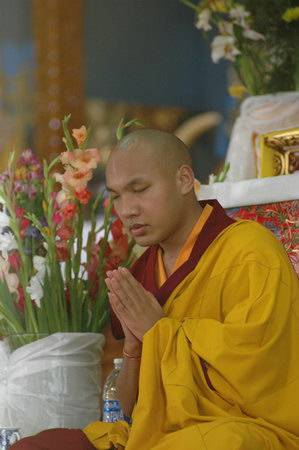
Why would the Himachal Pradesh monastery of  revered Tibetan lama HH Gyalwa Karmapa house a reported $1.6 million in various foreign currencies, including enormous amounts of Chinese yuan - why, except that the Karmapa must be "a Chinese spy"?

The traditional South Asian paranoia of the dreaded "foreign hand" has again reared its ugly sira in the Himachal police's January 27 raid on Gyuto Monastery, home to the Karmapa lama since he fled Chinese-controlled Tibet in 2000 at the age of fourteen.  Xenophobia, coupled with resentment and jealousy of the tremendous international money and attention focused on India's Tibetan refugees, would appear to be at the root of the Himachal state government's vitriolic attack on the Tibetan community. 
Despite their dispossessed status, the community and its religious institutions have brought Himachal Pradesh untold millions in tourist revenue.

Might the cash stash be explained by the fact that Karmapa's Kagyu denomination of Buddhists had only recently (December 22, 2010) concluded the enormous Kagyu Monlam international prayer festival, which draws donations from devotees and Buddhist foundations spanning the globe?  And could the Chinese yuan be explained by the fact that Karmapa has a sizeable Chinese devotee base? 

Unlike the Dalai Lama, the Karmapa is officially recognized by Beijing, even considering Karmapa's escape to India.   The annual Kagyu Monlam in Bodh Gaya is dominated by Chinese devotees, as anyone who's tried to find a seat under the otherwise-serene Bodhi Tree without getting elbowed by them can tell you.  (Also, visiting Tibetans from across the border give donations in Chinese currency.)

Nope, that's too simple, too easy - and far too logical. Karmapa must be "a Chinese spy."  This is the type of illogical elaboration that in the past led Indians to create mind-boggling, fantastically embellished art forms.  The results aren't so enthralling in realpolitik.

Today's news shows that Himachal Chief Minister Prem Kumar Dhumal is busy setting up intelligence cells to monitor the activities of the state's Tibetan population, which number in the thousands (India's Tibetan population in all states totals 94,200). Spying on the state's most prosperous community will surely lead to more troves of treasure. Tibetans have also been told to "stop protesting" and peacefully assembling and ordered to cooperate with the state's investigations.

Indians often wonder aloud why Tibetans don't just get with the program and become Indian citizens. This just wasn't possible, until very recently, when the Delhi High Court ruled that a Himachal Tibetan woman's application for citizenship must be honoured.  (The judge also ruled that a previously established policy denying Indian citizenship "by naturalisation under Section 6 (1) of the Citizenship Act to the Tibetans who entered India after March 1959 is erroneous and hereby quashed."  This would seem to open the door for Tibetans desiring enfranchised citizenship within India.)

Therefore, Tibetans are poised to become an integrated part of India. Dhumal's accusation puts Himachal behind the Indian national curve.

Not surprisingly, the most sensible statements are coming from the ever-unshakeable Karmapa himself.  His statement of February 2: 
“India had become a second homeland to the Tibetans. We all have taken refuge and settled here. The country, in contrast to communist China, is a democratic country that is based on the rule of law. Therefore, I trust that things will improve and truth will become clear in time. So please be at ease. There is no need to worry,” the Karmapa said.

And I believe him.  This type of malicious attack belongs to the backbiting India of yesterday, a nation so insecure that it saw enemies in the corners of its own eyes. India's embrace (albeit sometimes theoretical) of Tibetans, allotted by the idealist Nehru, set an international example.  The medieval accusations of  the Himachal government won't bear the scrutiny of modern light.

"Let the investigating agencies do their work. Truth will prevail."


Monday, April 28, 2008

Karmapa Chenno

The K-Man Cometh
News from Woodstock, NY


It's finally happening.

Those of you who are not on the dharma "circuit" have no idea what this means.

His Holiness the 17th Gyalwa Karmapa (Orgyen Trinley Dorje), the 22-year-old incarnate Tibetan Rinpoche widely believed to be the coming successor to the Dalai Lama (in terms of leadership in the Tibetan worldwide community), is finally coming to America - after years of hemming and hawing by the Indian government.

It's no exaggeration to say that Karmapa's dramatic escape from Chinese Tibet a few years ago, at the age of 16, could not possibly have been made up or embellished even by Hollywood. (Read Mick Brown's Dance of 17 Lives for the best account.)


Nor could the ensuing controversy over who was the "real" Karmapa (a rival emerged a few years later) have been invented by the most creative screenwriter...nor the ensuing dispute over his ability to take his traditional seat at Rumtek Monastery, Sikkim, north India.

In hopes of not offending China (who, after all, had already recognized him as the Karmapa, raised and groomed him for their own purposes before his escape - rather embarassing for the Chinese), the Indian government has severely limited the Karmapa's movements within India. The young incarnate lama has yet to travel overseas. So, this is big news.

Once the American press sees this guy, they are going to go wild. He is so young, cool and charismatic - here's a photo of him entering the Dalai Lama's Kalachakra temple in McLeod Ganj last year. (check out his Matrix shades. ;-) )


Karmapa to Visit America

--WOODSTOCK — The young Tibetan Buddhist leader that the Karma Triyana Dharmachakra Monastery on Meads Mountain Road was built for will finally come to America in mid-May. The 22-year-old Karmapa’s visit comes as the 49,000-square-foot monastery built for him comes to completion. The tour begins May 17 with a Manhattan apearance before the entourage comes to Woodstock May 19-22.

All monastery events are by invitation only. Public events will be held in New York City and New Jersey.

Thursday, November 29, 2007

Golden Years

Wish I was here
Lama Watch: Amritsar, Punjab


Today HH the Dalai Lama opened a 4-day inter-faith conference at Amritsar.
This wasn't announced publicly (at least not up here) till a couple days ago - otherwise I would have made tracks to Punjab. Flights out of Leh were full!


Here is the adorable photo from Rediff.com news. Note the big, burly Khampa Tibetan security guards on either side of him, wearing the mandatory white kerchiefs required by the Golden Temple.

I especially enjoyed the comments the (presumably Indian) readers made, below the story.
Things like:

This man is truly a saint...
i think he is beyond religion..i am proud that India had the honour to Shelter...nay be blessed by his presence...


and

i always get smile to see him. he is wonderful human .

and, more politically, in response to a critical Chinese reader:

As far as I know, India as well as all Indians respect One China Policy. We can not understand why China or Chinese doubt this fact!! Only thing we request Chinese people is to respect and accept the social, religious and cultural freedom of different chinese communities such as Tibetans. Even his holyness Dalai Lama has accepted Chinese political authority over tibet. But he asks for cultural, social and religious freedom for his people. When will China understand this?

Back in the heady post-independence days of the 1950s, India was very pro-Communist. Many people seem to have imbibed a lot of pro-Communist and therefore pro-Chinese ideas at that time. A well-known example is N. Ram, editor of the major newspaper The Hindu, who is always printing pro-China and anti-DL stuff. It is heartening to me to see Indians articulate views like those of the readers above.

I just hope they extend the same respect to the Tibetan people at large, once the inevitable, unthinkable happens and this particular iconic DL incarnation is no more.

(Although I have been lucky enough to photograph HH a number of times, this wonderful photo above is not mine. It is by Manpreet Romana of GettyImages/Agence France Presse. I hope he/they don't mind my sharing it here. )


Successful succession?
People always ask me (once they find out I am, in fact, some kind of weird Dalai-Head whose life is mostly devoted to following the Dalai Lama around) ---they always ask me, "Has the Dalai Lama picked his successor yet?"

Some say, "I heard he may refuse to pick his successor." or, "Isn't there a prophecy that he will be the last Dalai Lama?"

Other people are a bit confused by the figure of 22-year-old HH the Gyalwa Karmapa, who is so often photographed holding hands with the Big DL.

"Is that monk going to be the new Dalai Lama someday?" several people have asked me. Which is sort of like saying, "When I die, will you take over being me?" The Karmapa has already been incarnated as The Karmapa. He can't change identities in mid-life. (He very well may, however, assume the de facto role of leadership of the Tibetan community.)

In fact, the Dalai Lamas have never named or hand-picked their successors, in the 600- or-so-years of the office. The tradition has always been that after the DL's passing ("leaving his body,") the inner circle of senior rinpoches and lamas
(after a suitable period of a year or so) look for signs and omens, indicating where the newborn Lama will be found.

The high lamas examine their dreams, and they all have training in how to "read" the symbols in the universe. Things like "I saw a crane flying east" or "I had a dream about a lake near Taktser" all have an agreed-upon, shared meaning - or at least they did 60 years ago, in Tibetan monastic life.

Obviously, things are more complicated now, to say the least. (For more background, the best books to read are In Exile from the Land of Snows by John Avedon and Freedom In Exile by HH Dalai Lama).

This has led HHDL to announce that, following the tradition of conscious reincarnation, he will definitely choose NOT to be reborn in Chinese-occupied Tibet.
"If my death comes when we are still in a refugee status, then logically my reincarnation will come outside Tibet," he said on the sidelines of an inter-faith meeting in the Sikh holy city.

That way, the Chinese government cannot hand-pick their own "Dalai Lama" and claim authenticity - they way they have with the 11th Panchen Lama.

The latest has HH saying that not only will he not be reincarnated in Chinese-occupied Tibet, he will perhaps "skip reincarnation" altogether, and choose for the first time to hand-pick a successor. The really hilarious bit is that the Chinese government condemned this statement as a "breach of religious protocol."

Like they would know. But the Dalai Lama has always maintained that it should be "up to the Tibetan people" whether the tradition of Dalai Lama should even be maintained.

Now he says it may be time for a radical break with tradition - In the most recent statements, HH announced there may be a public referendum on the issue when the time comes.

While the sun shines
In the meantime, HH is racking up the international frequent flyer points, meaning he is in India these days only about 50% of the time. I see him as a figure like Gandhi - a once in a generation icon of peace. So, I'll soon be on my way to see him in Karnataka, south India. There are lots of other places in India I'd like to go, but things like Khajuraho and the Taj Mahal will be there in 10 years, for sure. Unfortunately we can't say the same for HH.


Sunday, December 31, 2006

Turning the wheel

Who was that masked biker?
Bodh Gaya, Bihar, India


I got a bike! Man, it has been more than three years since I rented a bike back in Mysore. Indian rental bikes are just standard cheapo upright "push-bikes," but they have an ingenious locking device. A steel ring locks into place round the back tire (here it's spelt "tyre") so it can't be moved when you park the bike. Of course, this would never work in Manhattan - guys would just come along with a van and load all the bikes inside. In nine years, I never did figure out a way to outwit Manhattan bike thieves.

This bike is 25Rs a day (about 50 cents) and is perfect for flat, dusty Bodh Gaya. It's fun chiming the bell as I weave through traffic. I do have to wear a mask - that is, an emissions mask. It's so common to see people wearing them here (elastic straps, fabric guard fitted over nose and face) that it seems positively normal now. People even sit around tables indoors having conversations wearing them, and never remove them. Between the burning garbage, the vehicle pollution and all the nasty smells, I think masks (or maybe the full burqa) are now mandatory in Indian cities.


I had to go to the bike place four times before I actually got a bike. First time (at 10AM) Satish said "no bike now, come back in one hour." I came back at 12.30 and still there was "no bike, come back after some time." I returned at 5.30. Satish said, "Oh, bike was here but you did not come, so he went away," - and told some totally irrevelant story about his brother going to the market to buy vegetables. "Come back after one half hour." Fourth time was the charm.


Better than champagne or confetti

See my n
ew story about the Tibetan vegetarian movement, on Phayul.com, the premier Tibetan news service.

Turn your scars into stars

It's Day Five of the 24th annual Kagyu Monlam, a nine-day world peace prayer festival here in Bodh Gaya, where the original Buddha gained enlightenment.
Each evening, His Holiness the 17th Karmapa has been delivering teachings at his newly inaugurated (and rather sumptuous) monastery. The usual enormous crowd showed up more than one hour early to go through security clearance and bag checks. Tonight's message was advice for the coming New Year.

Transform troubles into treasure
“The painful difficulties we have experienced in the past year are not to be put aside as too painful to be considered, nor to be ignored. Rather, difficulties and challenges should shape the contours of one’s life and character, and define the quality and vision of one’s life.

"For example, I personally have faced difficult and critical times in my life – particularly in the period from 1
999 to 2000," he said, referring to the time of his dramatic and dangerous escape from Chinese-occupied Tibet into exile in India. "Decisions and activities undertaken at that time were challenging and difficult - needless to say - as many of you are aware. Yet, looking back, the challenges I faced have become the adornment of my life. Maybe, if I had not gone through these difficulties, I would be more anonymous, less distinguished in my character. "So in this way, each one of us, if we face difficulties, must embrace difficulties in our lives as a blessing in disguise, so to speak – as lessons, things to be learned from. Then only the difficulties and hard times can adorn one’s life – only when one can find beneficial lessons in them.

"Ideally, your problems experienced in the past year should be used as fuel for greater development in the coming years, so they become attributes - so that they add to the expression of your human dignity, fullness, and repleteness. In that way, you are decorated and ornamented by learning from your difficulties.


"If you could take this approach to the past year’s problems, this would indeed be very precious.


Leave the past behind

"If you fail to do so - if you cannot transform your troubles - the next best approach is to put aside, to let go of problems of the past. Don’t bring them into the New Year. Do not let all old the baggage, burdens and problems come trailing you into the New Year. Come with a fresh start. In my own case, in 2006, guiding the Kagyu Monlam has had its own share of difficulties and challenges. But tonight, I come to you afresh – cleansed and crystal fresh.


"It’s my hope that you will resonate with that freshness, and preferably learn to make use of those difficulties to dignify and decorate your life. But if not, at least, say “goodbye” to them. You need room for the new events of the coming year. Do not enter the New Year already filled with things you can’t say goodbye to.

"We need to realize clearly that time does not control us, nor customs. The time and custom of the New Year is not going to dictate the change in our lives. That would be a very mistaken approach. Our own willingness, that we feel inspired and motivated to change – will bring the change from within ourselves. We can change any time we choose.

The reason for Dharma practice

"The principal purpose of Dharma practice, and the reason for the Buddha’s teachings, is to change our conditioned, habitual views. Our conditioned view is a fanatical fixation to whatever illusion or notion of reality we have. The Buddha’s teaching is to undo this – to help us understand the danger of that rigidity, that fixation. Do not use your Dharma practice to develop yet another view, and then become fixated on that view. Gradually, on our path, we go beyond any view. "In this way, when we approach Dharma practice and everyday activity, we should approach with attitude free of extreme fixations. In life we face challenges and difficulties. We should be conscious of the fact that there is room for flexibility, room for movement in each situation. We do not have to be stuck with the problem. By not becoming fixated or rigid, we begin to see room for possibilities.

"It is important to know, for Dharma practice, that we are not particularly trying to promote this view or that view. We already have enough views and enough opinions – we don’t need more. Especially, we don’t need to learn or have a new view that becomes fixated and concrete.


"We actually need a genuine experience of peace of mind, experience of state of stability of mind. We need greater mental capacity for what is good and authentic. This is not dependent on how long you’ve been practicing Dharma – rather, it depends on what, on a daily basis, is going on with one’s life and outlook. It depends on the attitude you are developing on a day to day, week to week, month to month basis. What depth and profundity of loving kindness and compassion have we been able to develop?


Take responsibility

"There are two very important things: First is proper guidance. Second, examples – examples of wholesome and virtuous activities and attitudes to be embraced. But direction and examples are not enough. These come from outside. One must recognize one’s
own pressing responsibility of embracing what must be embraced, and giving up what must be given up. "In terms of self-help, what to do? We literally feed ourselves three times a day, but even the food that we think is for ourselves feeds countless other living organisms. Seen this way, the sense of 'I' has no fixed reference that we can put our fingers on. That being so, maybe we should instead feed our minds three times a day - or at least, twice a day, for sustenance of mind, and maturity. Maybe we need mental vitamins!

Buddhas from abroad

"In conclusion, I would like to say that I’ve heard there are some 1,000 of you here from abroad. To me, you are like 1,000 Buddhas and Bodhisattvas. Actually, I don’t know what Buddhas are supposed to look like, but this time, the Buddhas have different shades of hair, some have golden hair; some are tall, some are short. I am so amazed with the varieties of the Buddhas, and the variety of ways the Buddha can manifest. That you have all come here, and participated sincerely and genuinely in the Kagyu Monlam, I feel strengthened by all your presence. I feel invigorated by your presence. I feel that because of you all, I must do more.


"For this show of strength and unity, I would like to thank you all. We are inseparably linked. You all are a source of benefit for me. In that spirit and on the eve of the New Year, I extend to you whole-hearted wishes of happiness, well-being and that we remain connected. If we experience happiness, we will do it together. If we experience suffering, we will do it together.

And with this, I wish you all the best.
Tashi Delek to all."

To the delight of the crowd, His Holiness said, “Happy New Year” in English. He bowed his head with hands pressed together in traditional "Namaste" salute, stood up, and strode off the stage waving "bye-bye" playfully like a small child.


Everyone poured out the giant red front doors, to be greeted by a surprise fireworks display. The red, blue, green and gold fireworks mingled with the red, blue, green and gold Tibetan archway. Under a near-full winter moon, Buddhas of all nations exchanged embraces and wishes for a Happy New Year.
This romantic scene was eventually disrupted by the reality of having to get out of the monastery - an Indian traffic jam of cycle rickshaws, mammoth tour buses, auto-rickshaws, pedestrians and beggars.

I hung back for a bit, circling the monastery clockwise on my new bike for good merit. When a space appeared, I weaved my way through the stalled vehicles and clouds of diesel fumes, down the unpaved road back to town.

HH the Karmapa photo courtesy of Kagyu Office website.

Monday, December 25, 2006

Christmas With the Big K

Instant Karma-Pa
BodhGaya, Bihar

I guess am one lucky dharma groupie. Not many people can say they got to shake the Dalai Lama's hand, and got a blessing from the Karmapa, all in the same week. I am here for the Monlam celebration and adjacent teachings of His Holiness the 17th Karmapa, who just managed to escape from China to India a few years ago. Again, it was a total accident; I turned up late and unregistered, but somehow managed to get ushered in with just a few other people, to present the kata scarf and receive Amrit Tibetan medicine pills. Gate-crasher in the houses of the holy, am I!

I Feel (Not So) Good
The bad news is, James Brown is dead. On Christmas Day, no less. Actually his hair died about thirty years ago (and was reborn on the head of Condoleeza Rice).


There is one guaranteed cure for depression or homesickness, for me anyway: to hear James Brown's Greatest Hits. The best 200Rs I ever spent (in Bangalore).

I hope he has a funky funeral, and is buried in one of his satin capes.

But seriously, I don't feel so good
I am suffering from some kind of carpal-tunnel syndrome. Numbness alternating with shooting pains in my right hand and arm mean I am unable to work on the computer for more than a few minutes. I have loads of wonderful photos from this Buddhist pilgrimage to share, and am sorry I can't get them to you sooner. Now I'm getting physiotherapy and massage at the Root Institute (a Buddhist school here).

Bodh Gaya is an oasis in the otherwise dusty and uninspiring plains of Bihar. The local people, most of whom are Hindu, appear to be thriving only on the business generated by local monasteries and Buddhist-related tourism. It's a very international place, as well, wealthy Buddhist pilgrims making a real contrast with the threadbare Biharis. Each Buddhist country (Bhutan, Japan, Taiwan, China, Taiwan, Thailand, Nepal, Vietnam, Korea, Burma, Tibet and so on) has a temple built in its characteristic style. Visiting them is sort of like going to an embassy for that particular country. There are also very cheap and nice rooms available in each monastery guest house. Unfortuantely they are all taken, as it is not only Monlam time but holiday season for everyone. The town is swamped with big tour groups from Burma, Sri Lanka and so on, many dressed in their distinctive national clothes.

Maybe I can create a field guide: Know Your Buddhists. That is, if my arm and hand improve.