Showing posts with label bihar. Show all posts

Wednesday, January 20, 2010

Updations

That's a word, in India. "Updations." They figure, if you can locate something in a location, why can't you update something with an updation? It is, in fact, grammatically correct.

It's the same logic that produced "pre-pone." If you can postpone something by moving it farther away in time, why not prepone something by making it more near? (That sentence, in fact, may not be grammatically correct.)

All of which raises the question: "What the hell is a 'Pone,' anyway?"

Anyway, this week's updation is of my Cool People Link Here links. I have dropped some that exist no more, and added a few new ones.

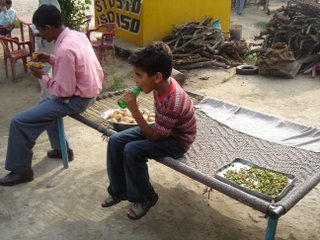
The photo has nothing to do with any of this. It's a man with his bicycle, crossing the vast dry Niranjana riverbed in Bihar, India.

Wednesday, February 11, 2009

Super Stupas

News from Nalanda

Holy Coolness! New stupas on the Bihari block!
This time it's near the famed former Nalanda University in a place called Ghorakatora.

Imposing Buddhist stupa discovered in Bihar

New Kerala Mon, 09 Feb 2009 06:09 AM PST
Patna, Feb 9 :
A huge Buddhist stupa has been discovered in Bihar's Nalanda district and archaeologists Monday said it could be the second largest such structure in the world.

Two winters ago (2007) after the Kagyu Monlam, I took a wild ride through the Bihar countryside to see the ongoing excavation of Kesaria stupa (one of my photos shown below).

Kesaria is huge - about 10 storeys. Some sources say it's the largest stupa in the world (and just think - there is not one tourist facility there and it's not even completely excavated).

Within 11 of the star-shaped niches are 11 seated Buddha statues. Every one of them has had its head lopped off. If I were in India, I would be too politically afraid to say "Muslim invaders did it." But I am in Nepal, so I can say it. It's true.

Amazingly, there is another almost identical to it in Bihar and even lesser known, called Nanda Laharia. I would imagine this "new" (old) stupa is very similar to both Nanda Laharia and Kesaria.


Since my visit to Bihar I have raved that the entire state is a treasure-trove of barely discovered Buddhist ruins. I think this is still just the tip of the iceberg.

Nalanda was at one time a world-renowned university for Buddhist studies, as well as a monastery. It would be politically incorrect to say what happened to it. In fact, you can visit the site yourself, see the destruction, and not see one single sign indicating what happened. Some mean nasty people tore it down and beheaded hundreds of monks. But we can't say who they were or where they came from. Then we might not get certain votes in the next election.

Nalanda was not the only one of its kind. Taxila (now in Pakistan), Odantapuri and Vikramashila were all major centres of religious education.

Even if it's for primarily commercial purposes, I am glad to see Indians rediscovering their Buddhist history and heritage. Vikramashila (in what is now Bengal) is once again in the news:

Vikramsila (Bhagalpur), Feb. 8: Another festival to celebrate the glory of the ancient university has come to an end today, but without any sign of reviving the seat of Buddhist learning. Governor R.L. Bhatia attended the inaugural ceremony of the three-day Vikramsila Mahotsav at Antichak near Kahalgaon on February 6, raising hope among local people for possible inclusion of the ruined university in the Buddhist tourism circuit.

...Excavated remains represent the ruins of Vikramsila Mahavihar, the celebrated university founded by Pala king Dharmapala in the late 8th or early 9th century. Vikramsila, one of the largest Buddhist universities spread across the bank of the Ganga, was six times bigger than Nalanda.

The story goes on to say how locals are eager for the Mahavihar (Great Monastery) to be restored and linked to what is called, in India, the "Buddhist Circuit" (historical and living pilgrimage route; read: Spiritual Tourism).


As an opportunity for India to increase tourist dollars without opening itself further, as some complain, to the sex, drugs and rock'n'roll decadence of the "evil west," Spiritual Tourism would seem to be ideal.

And back here in Nepal, Buddhist ruins from the 12th century are still being discovered. Here's a story about the site of Kakrebihar.
.... Kakrebihar, a site in remote Surkhet district in mid-western Nepal that during excavation by the country's archaeological department yielded a treasure trove of sculptures and stone carvings.
... the findings established the area as an important centre of Buddhist art.

The Kakrebihar mound is probably the biggest instance of rock architecture in Nepal. The ruins suggest a temple built in layers and decorated with images that illustrate the life of the Buddha, the founder of Buddhism, and his teachings.

Tuesday, December 23, 2008

Time shift

Let's do the time warp again
Kathmandu

Last week, my Charya Nritya (Chacha Pyakhan if you speak Newari) teacher, Raju Sakya, and I were pushing our way through the sidewalk near Sundhara.

Pushing, not because Nepal is soooo heavily populated or because people are so rude (neither is the case) but because 2/3 of the walk space is taken up by sidewalk vendors. One of the first things the new Home Minister announced was a crackdown on "footpath" vendors. I guess what we're tripping over now are the vendors who can pay the new, requisite bribes.


Anyway, as we were negotiating our way toward the Ratna Park Tempo-Micro (mini-bus and share taxi) stand, we passed a lone Buddhist chaitya (aka stupa, chorten - Buddhist monument) in the middle of the sidewalk chaos.

In Kathamdu, it's hard to walk without tripping over such works of religious art - they are literally everywhere. But there was something distinctive about this chaitya.


The lines were more fluid, more flowery...I did not get a snap of it. But Raju, who is getting a Master's degree in Nepali art from Tribhuvan University, said "This is a Licchavi period chaitya."

The Licchavi period. Wow. That means it's at minimum 1,400 years old.

"Yes," said Raju, "from 6th or 7th century."

For just a second all the horns, shouting, spitting and pushing stopped. The Licchavi dynasty came from what's now Bihar state in India (I think; don't beat me up if I am wrong). Though they were Hindu, there was still plenty of Buddhist art flourishing during their reign.

This piece of ancient artwork is enclosed by just a cast iron railing; otherwise it's in the open air. It appears undamaged and has probably not changed for the 1500 or so years of its life.

Just the kind of stuff you can see any old day walking down the sidewalk in Kathmandu - if you can make enough space on the sidewalk. We pushed, darted, and maneuvered our way over to the micro-bus and headed for Patan (former Buddhist kingdom, now home to INGOs and expats).


Tuesday, February 13, 2007

Rain Song

Mucking about
Patna, Bihar

It's raining here, as well as in most of the Northern region - Delhi, Varanasi and so on. Doesn't sound so strange, unless you realize that in this part of the world, at this time of year, it's virtually unheard of. It means puddles of muck to tiptoe around (there are no sidewalks to speak of), mouldy laundry and lots of grown men with mufflers tied round their heads under their chins, which makes them look sort of like a cross-dressing Babushka, or as if they've got them mumps.

Normally, Indian weather comes in extreme waves. The rainy season here is generally June-September. After November, there's not a drop (and I mean, not one) till the following monsoon. Also, crummy photography - they light just isn't there and the mist is bad for the digital camera.

So why have skies been grey and cloudy for the past week? It's a mystery. Meanwhile, Himachal in the mountains has received no snow, worrying the tourist industry, and in the UK they are freaked out by unprecedented snowfall. It's so (relatively) cold in Cambodia that people who've never owned a sweater are out shopping for them.

Here's a thought from Tricycle.com about the spirit of the rain.

The Supreme Water Spirit

The supreme water spirit Ocean covers the earth with clouds; the rain in each place is different, but the spirit has no thought of distinction.

Likewise, Buddha, sovereign of truth, extends clouds of great compassion in all directions, raining differently for each practitioner, yet without discriminating among them.

Saturday, February 10, 2007

The Wind in the Bodhi Tree

Everywhere a sign
Bodh Gaya, Bihar


All the signs seem to be pointing to my imminent departure from the Land of Enlightenment
(Bodh Gaya), at least for the moment. Two nights ago, I came to retrieve my bicycle and someone had inexplicably wrenched the chain off track, and twisted the handlebars. (It was parked in the closed lot of the Temple Management Committee offices.) It didn't get that way by itself.

It was 6.20 at night, just after sunset.
Minutes after getting the bike fixed with the help of the Committee watchmen (I gave them a tip), I was biking between brightly-lit Kalachakra Corner and Mohammed's restaurant. Just riding my b
ike, ho de do... stopped to get my bearings on a darker stretch of the road. "What the hell?" I yelled as out of nowhere, a kid ran up, grabbed my breasts from behind, then jumped onto a motorcycle (driven by another waiting guy) and sped off. I pedaled furiously after them, but they disappeared into main road traffic.

The police had to be convinced to file a report ("you were not
harmed, Madame, and your valueables were not stolen"). In my best Indian English, I insisted calmly but firmly- "Inspector, 'Eve-teasing' is a crime under Indian law. It is my duty to report such a crime. If you do not wish to help me, I must go to my Embassy." They reluctantly got out pen and paper.

The first five times I stated my intention to file a report, the SubInspector exclaimed "What?!" as though he didn't understand. Later it transpired that he actually spoke very good English. It was difficult to tell whether they were afraid to have such an incident go on record on their watch, just didn't want to lift a finger to do any work, or perhaps both.

I went directly to the Bodhi Tree and sat in total bliss. A group of Thai pilgrims has transformed the temple into a shining fairyland, strung with huge bunches of magenta orchids, golden banners, peacock feathers, chysanthemums, and real rock crystals strung inside the Vajrasana (where the Buddha actually sat). Some Hungarian Buddhists were having discussion with their teacher in their language, the sounds carrying images of gothic Transylvanian mountains to my ears. A Sri Lankan group in pristine white chanted soothing Pali verses. The wind blew leaves from the sacred tree, and I managed to scurry after two and pick them up from the marble floor.

I felt safe, loved, and not at all angry or even frustrated. It's true, I wasn't hurt physically, and maybe it served as a good warning - that the deserted areas even in and around the peopled ones are not safe.


Rude Awakening
The very next morning brought a knock on my door at 7.30AM. The monk-in-charge (Bhante Rashtrapala, a Bangladeshi) of the meditation centre had sent an orderly to fetch me. Though there is not a single other soul in the entire guest house, Bhante insisted I had to vacate ASAP. "There is a big group coming," he insisted. Okay, what day are they coming? "Different days, different times." And you can't tell me when the days and times are? Then he finally said - "You have been here 40 days, you cannot stay so long here - this is a tourist place" (it is? I thought it was a meditation centre and monastery). At that point two very reverent young Indian (or Bangladeshi) people came in and bowed solemnly to Bhante, heads touching the floor. "I have to talk to them now," he said, and dismissed me with an impatient wave of the hand. There was no arguing with him - I must be out by the 12th.

Well, that's final. Guess he has to make way for more appropriately subservient guests.
I returned to the police station to retrieve my copy of the FIR report. But the power was off and they couldn't make a photocopy.

Ni hao do you do?

The sitemeter is showing an increasing number of viewers from Mainland China - surprising, since I discuss His Holiness the Dalai Lama so much. Either the censorship is slipping, or these viewers know a way around the Great Firewall. Or, perhaps they are government spies, keeping an eye on radical upstarts like myself.


During the recent Monlam, I met an entire group of Karmapa devotees from Mainland China. This is quite remarkable, considering that following the Karmapa's escape from Chinese-held Tibet into India, China's official position is that the Karmapa is being misled and brainwashed by nefarious parties, and that in fact one should follow their "Karmapa" - a
n imposter with a similar name (they even gave him eyeglasses), currently stationed in West Bengal. Of course, these devotees could also be spies, or there could be spies among them. But I don't think so - I interviewed the group leader, who is a passionate vegetarian, and his friend who was sufficiently motivated to open a vegetarian restaurant in Beijing. Tibetan Buddhism is gaining popularity in China, along with Chinese government attempts to supplant authentic lamas and teachers with those of their own invention. They do the same with the Catholic church (they have their own, "official" Catholic church). I commend the Chinese Buddhists who are daring to think and act for themselves.

Just a little background on the continuing situation in Chinese-held Tibet; this, from an independent source published on Phayul.com.:

Beijing is continuing to crack down on expressions of Tibetan cultural identity and loyalty to the Dalai Lama. One source described how their attempts to promote Tibetan language in schools was shut down because officials saw it as a veiled attempt to promote Tibetan nationalism. In June 2006, the Chinese-controlled government in Tibet started yet another “anti-Dalai L
ama” campaign, requiring handwritten and verbal denunciations of His Holiness by Tibetans with government jobs. These same employees are forbidden to circumambulate the Linkhor or they will lose their salary; people who disobey have been confronted with surveillance photographs of them on the Linkhor. I heard one unconfirmed report that officials plan to turn the Barkhor area of Lhasa into a “living museum” by evicting over 2,000 families, thereby emptying the last remaining part of Lhasa that is still largely Tibetan. I address instances of economic discrimination against Tibetans in Section C below. All these examples point to a deliberate policy to simultaneously hold down the Tibetans while promoting the demographic primacy of ethnic Chinese.

And, more background, and an update on the responses from the Tibetan diaspora in this excellent Rolling Stone feature. I hope this author wrote under an assumed name - otherwise, he most definitely will never get another Chinese visa.

The Man's Still Banned

His Holiness the Dalai Lama is still banned in, among other places, Kenya and Cambodia. It's just pathetic what people will do for Chinese money. As my friend Ardith says, "I think his goodness frightens some people. "

Monday, February 05, 2007

Stalking the Wild Lama

Week In Review
Bodh Gaya, Bihar

This week, your intrepid reporter witnessed relics of the Buddha and his two primary disciples, Sariputra and Mogallana, displayed in diamond-encrusted cases, all the way from Sri Lanka. The relics arrived on a grand antique wagon drawn by four Belgian draft horses. The relics themselves, seen in closeup, looked like tiny chips of bone or tooth cushioned on cotton balls, inside the gleaming cases, which were inside a glass display box, which were inside the Mahabodhi Society Mahavihara.

The next day we saw HH the Dalai Lama enshrine those relics in the Mahabodhi Society Vihara in a solemn ceremony, made raucous with rude Indian male photographers . I thought they were going to knock over the jeweled boxes and send the relics flying into the crowd of monks. It does take a true Bodhisattva to live one's life in the near-constant presence of those snap-happy, pushing, shoving jerks without losing patience. The DL seemed quite amused at all the fuss, sometimes looking like he was suppressing laughter.

The following day the Dalai Lama opened a three-day conference, Buddhism in the 21st Century. After hearing the Bihar governor talk in Hindi for 15 minutes and end by shouting "Buddham Saranam Gacchami! Dharmam saranam Gacchami! Sangam saranam Gacchami!!"-- the DL told us, in perfect English that he insists on describing as "my broken English," that to be good Buddhists we can't "just shout mantras." We must be good people, be nice to one another and refrain from "cheating, stealing and lying."

He he he - I thought that was especially aimed at the Bihar government members who shared the platform. Then he blew everyone's mind by signing a few autographs (!) and shaking hands before being herded out the door under his usual yellow umbrella.

My right hand is still totally sore and goes numb a lot, from mouse injury...sorry I can't upload more. I did video some of the DL's speeches but just holding down the shutter-button made my hand go numb.


Faraway places


Iceland, Oman and Malta are three of the more exotic newcomers on the Sitemeter Viewers list this week.

Someone from Iceland actually read for half an hour. I would love to hear the impressions of a Scandinavian on their first trip to India!

Monday, January 29, 2007

Go Gaya

Travel tips for the "land of enlightenment"
Bodh Gaya, Bihar, India

A., an Indian viewer in Singapore, writes:

I would love to see the Bodh Gaya temple, marking the spot where the Buddha achieved enlightenment 2550 years ago. But it's in Bihar, the most lawless state of India. Is it safe, and is it worth risking Bihar for?

Yes, Bihar can be like the Wild Wild West without the cowboy hats. But you are among thousands of pilgrims and tourists each and every week, so you will not be alone. There are hassles, but most arrive and depart Bodh Gaya in complete safety.

The main pain-in-the-asana is the fact that the train does not go directly to Bodh Gaya itself - only to the sort-of nearby town of Gaya. Other than the train, there is virtually nothing in Gaya to keep you and everyone wants to get out ASAP. The local transport barons know this and capitalize on it.

In my case, literally about 200 western Buddhists, Tibetans and monks from all countries had been in UP for the Dalai Lama. En masse, we took a train from Varanasi to Gaya. The train was meant to depart VNS at 5.15 and arrive around 11am. Thanks to fog conditions, we ended up leaving VNS at 11.30 and arriving in afternoon!

Needless to say, after six hours we really got to know our fellow travellers on the platform.

At Gaya station, we descended on the auto-vultures who immediately tried to overwhelm us with exorbitant demands - taking advantage of the coming darkness. You should never travel from Gaya to Bodh Gaya after dark! even with other people).

Fortunately the Tibetan monks go all the time and knew the score. So I took a share auto with a bunch of monks who got the correct price. (They all speak Hindi and Tibetans do not bargain. Even the drivers are respectful to them.)

How much safer could a woman be?

We managed to get to Bodh Gaya by 4.30pm. Whew!

Once in Bodh Gaya you are home-free - it is quite the oasis, with lots of clean guest houses, good vegetarian restaurants and holy people from all traditions swanning round in their robes.

Sure, there is dust, some dirt and beggars. But it's a town quite well adjusted to travellers and foreigners. Women can move about freely there, but most stuff shuts at 9-10pm. My guesthouse gate shuts at 10pm. There is even an all-night cyber cafe with excellent speed - the Solar Cyber, next to the OM Restaurant on the main drag. Ask for Venu.

The BodhGaya temple is amazingly clean and peaceful, even while being continually used for worship. And - no entry fee for anyone! Open from 5am till 9pm every night.

The many international monasteries have cheap clean guesthouses - Burmese, Bhutanese, Thai, Bangladeshi, Japanese, Chinese and so on.

Enlightened eateries
Best eating bets: the aforementioned OM Restaurant is always uncomfortably crowded, but the food is unfailingly clean, excellent and cheap - and they are open late (10pm).

The (confusingly named) Tibet OM Restaurant, in the back of the Gelugpa "white monastery" near Kalachakra Maidan, has everything in terms of peace and quiet that the original OM does not. It's run by "Mama," the wonderful Tibetan woman and her son and daughter. Everything is made with lots of love, and you can chill out there in peace.

In early March, Mama packs up and heads north to see the Dalai Lama's teachings in Himachal. In fact, many of the Bodh Gaya activities and places are seasonal this way.

Kalyan Restaurant, entrance directly opposite the main temple and back down a lane, has excellent and clean food, including South Indian, and one of the only peaceful outdoor terraces in town.

Mohammad's on "Restaurant Row" near Kalakchakra Maidan has great food and is extremely popular, but I found it to suffer in atmosphere.

"Restaurant Row" is a bunch of half-tent, half-bricks and mud "buildings" that look temporary but in fact have been there for years. I think they were set up hastily for the 2003 Kalachakra and never dismantled. The Thai restaurant has been recommended.

Check out what I call the "Korean Embassy" in the group of shops just inside the temple gates. It's a mini Korean temple that offers traditional Korean yoga classes every morning at 8.30 for donation only! Leah, the Israeli girl who lives there, will serve you herbal tea.

Safety First
Bodh Gaya is a real haven and worth going through Bihar for; just take a few precautions.

--don't travel outside of Bodh Gaya, or between Bodh Gaya and Gaya, at night.

--Neighboring sites and villages such as Sujata, Dungeshawari Caves, Nalanda, Rajgir and NayaTaredhi are fine for day trips but get home before dark.

--I was advised by resident Tibetans not to even take the auto between Bodh Gaya and Gaya alone in the daytime - there are too many staged "accidents" and robberies.

--Take the plentiful and cheap cycle rickshaws round town. The autos (motorized, noisy rickshaws) tend to be more expensive and run by antisocial elements (advice from a local Indian).

--Shared autos (aka "Tempos") between Bodh Gaya and Gaya - safer because of the crowd - are 80Rs for the entire car, though the auto-sharks will always ask for much more. Pay no more than 20Rs per person.

--The best public toilet in town is the Reception Center just inside the temple gates. It's clean and always empty!

--Flat, highway-less Bodh Gaya is perfect for a bicycle. Rent one for 25Rs (about 50 cents) a day at Kundan Bazar, next door to the Hotel Embassy on the main drag. Kundan and his European wife Beatrix are a great source of local information and advice. The bike rental is just one of their many services, including new/used books (and book rental!), many foreign language books, a CD copying service, taxi booking, and cotton clothing. "The Kundans" also contribute to a number of local charities, such as a winter project to collect blankets for local street people - see more on their website here.

--After March, the weather becomes unbearably hot. Unless sweating is your sadhana, try to go in the winter time.

--Don't forget to check your shoes at the Shoe House by the gates - it's only 50paise (less than 2 cents). And, circle the Temple in the traditional clockwise direction - otherwise, you will be going against the current of dozens of pilgrims making the rounds!

--And last but not least, check the ground under the tree for fallen Bodhi leaves. They make a great free souvenir.

Sunday, January 21, 2007

Let It Bihar

The long and potholed road
Patna, Bihar

Two days of driving/bus riding through rural Bihar villages (Vaishali, Lalganj, Chakiya, Deoria, Keshariya and lots of nameless ones) was alternately enthralling in its simplicity, and scary.

The villages themselves are quiet, clean, and immaculate with their neatly swept mud houses. No horns, no traffic (at least no cars - only bicycles, pedestrians and ox carts), no pollution, no sewer smells, and if you are looking for the one place in India not yet invaded by Coke and Pepsi - this is it! No corporate logo signboards for hours at a time, nor any bottled water for 12 hours! I ate lots of oranges and drank lots of tea instead.

But, every couple hours, a gang of youths at a crossroads would blockade the car (cars are a definite occasion in those parts - a real novelty), even forcing it to stop with a bamboo pole and loudly, forcefully demanding god knows what from the terrified driver (who spoke not a work of English, and my Hindi is restricted to about 3 dozen words). Maybe they just wanted a lift, maybe baksheesh, but I really did not want to find out.

We managed to push through gangs like this three times - and that's just daytime travel. Shiva knows what night travel would be in rural Bihar!

The good news is that there are Buddhist ruins and sites still being excavated - significant ones. In 5-10 years Vaishali and Keshariya will be crowded with pilgrims.

Keshariya in particular is home to what appears to be the world's 2nd tallest, or possibly even tallest, stupa - originally 10 storeys high in mandala shape! At one time this was a truly awesome work, like a pyramid. It was originally built by Emperor Ashoka about 2000 years ago to commemorate the spot where the dying Buddha. surrounded by weeping disciples, gave away his only possession - his begging bowl.

It was a very loooooooonngggg drive there on potholed roads. Excavation appears to be moving at the proverbial snail's pace. The day I was there, not one archaeologist or worker was in evidence. Only1/3 of the structure has been revealed - the rest is still covered in about 2000 years of dust, mud and fully grown trees, which gives it a sort of romantic Jungle Book-Lost City appeal (while the tree roots are probably destroying it).

Photos to come, but Tawanda (my beloved Compaq Presario) is not recharging. Let's hope and pray that it's just a battery problem. I guess that means Delhi is the next stop, to get Tawanda revved up again.

State of the state
Bihar state is synonymous with kidnappings, banditry, poverty and corruption. Every week, the paper has an account of a prominent person's child, or even just successful middle-class person's, kidnapped and held for ransom. The headlines of the "Bihar Digest" section sometimes defy belief ("Child's fingers chopped off for stealing spinach"; "Son hacks mother to death").

The local government seems too busy with esoterica to do much about such things. When the most recent Chief Minister left office, he conducted a puja to exorcise spirits, and nailed all his ghosts to a tree in the front yard of the official residence. (This is not an allegation - these are his own words.) Last week the paper carried allegations, made by a rival, that a local politician was performing black magic ceremonies at the town's most prominent Hindu temple.

You can't make this stuff up. But it's after 9pm, which is late here. Maybe before I leave town, I can go peek at the Ghost Tree (in the yard of #1, Anne Marg).

Thursday, January 11, 2007

Dust in the wind

Masking the truth
Bodh Gaya, Bihar (India)

Why did the Buddha choose to manifest in such a dusty, polluted, nasty place?

The answer is obvious: Because the place and its people really, really needed it.

Or, maybe not so obvious: at the time of the Buddha's historical life (about 500 years before Christ; that is, historical life, as opposed to his many thousands of other lives), perhaps Bodh Gaya, Bihar and Uttar Pradesh were not the dusty hell-holes they now are.

I have not written much lately; carpal tunnel syndrome keeps me off the computer for more than an hour a day (barely enough to answer emails). I'm in the middle of a trip to Buddhist India - first Sarnath, to see His Holiness the Dalai Lama teach and wander among the ruins of an ancient Buddhist monastic complex; then Bodh Gaya, Nalanda, Rajgir and possibly Sanchi; then finally, the Dalai Lama's teachings in Dharmsala (March 3-14).

It is weird, considering that Muslims destroyed the place about a thousand years ago, to sit among the peaceful ruins with chanting monks, and hear the local mosque's call of "AllahuAkbar." It's even weirder to encounter Muslim beggars (less common than Hindu beggars, but still to be found). I feel like saying, "Hey guy, why are you asking ME for money? I'm an infidel, the devil incarnate, a member of the degenerate West. You've got the one true way, the only true religion! How could an unbeliever like me possibly help you? There's the mosque, go talk to the big guy and tell him your problems."

Besides, your ancestors knocked down all the nice architecture in the area....don't blame me for the town being a smoggy, dusty pile of beggars. Enjoy the piles of rubble and your superior faith.
I have noticed that, at none of the ruins destroyed by the invaders - Sarnath nor Bodh Gaya nor Nalanda (at the time the largest university in the world, with 10,000 monk students) - at none of these is the truth about their demise told on the plaques or sign-boards. The origin, the rediscovering and reconstruction, yes - but the signs are strangely silent as to why these places (immense complexes of beauty) had to be restored in the first place. It was not natural decay, by a long shot.

In fact it's hard to imagine how the invaders (some Turkish, some Persian, some Afghani), without benefit of a modern wrecking ball, even managed to decimate such massive stone complexes. They must have had tremendous energy, and tremendous hatred, to tear down what amounts to a small city devoted to the study and worship of another faith.

What kind of PC history-rewriting campaign is going on, that no one is allowed to mention (for the public record) the destruction of temples, monasteries and Buddhist universities?

I understand that in early February a nearby small town has a Sufi festival with ecstatic saints, lots of singing and joyful music. Maybe I can catch some a different side - a more mystical one - of Islamic tradition there. At any rate, after Karmapa's departure there was an immense energy vacuum and I am ready to see a few local Buddhist sites, then push off to new horizons.

Sunday, December 31, 2006

Turning the wheel

Who was that masked biker?
Bodh Gaya, Bihar, India


I got a bike! Man, it has been more than three years since I rented a bike back in Mysore. Indian rental bikes are just standard cheapo upright "push-bikes," but they have an ingenious locking device. A steel ring locks into place round the back tire (here it's spelt "tyre") so it can't be moved when you park the bike. Of course, this would never work in Manhattan - guys would just come along with a van and load all the bikes inside. In nine years, I never did figure out a way to outwit Manhattan bike thieves.

This bike is 25Rs a day (about 50 cents) and is perfect for flat, dusty Bodh Gaya. It's fun chiming the bell as I weave through traffic. I do have to wear a mask - that is, an emissions mask. It's so common to see people wearing them here (elastic straps, fabric guard fitted over nose and face) that it seems positively normal now. People even sit around tables indoors having conversations wearing them, and never remove them. Between the burning garbage, the vehicle pollution and all the nasty smells, I think masks (or maybe the full burqa) are now mandatory in Indian cities.


I had to go to the bike place four times before I actually got a bike. First time (at 10AM) Satish said "no bike now, come back in one hour." I came back at 12.30 and still there was "no bike, come back after some time." I returned at 5.30. Satish said, "Oh, bike was here but you did not come, so he went away," - and told some totally irrevelant story about his brother going to the market to buy vegetables. "Come back after one half hour." Fourth time was the charm.


Better than champagne or confetti

See my n
ew story about the Tibetan vegetarian movement, on Phayul.com, the premier Tibetan news service.

Turn your scars into stars

It's Day Five of the 24th annual Kagyu Monlam, a nine-day world peace prayer festival here in Bodh Gaya, where the original Buddha gained enlightenment.
Each evening, His Holiness the 17th Karmapa has been delivering teachings at his newly inaugurated (and rather sumptuous) monastery. The usual enormous crowd showed up more than one hour early to go through security clearance and bag checks. Tonight's message was advice for the coming New Year.

Transform troubles into treasure
“The painful difficulties we have experienced in the past year are not to be put aside as too painful to be considered, nor to be ignored. Rather, difficulties and challenges should shape the contours of one’s life and character, and define the quality and vision of one’s life.

"For example, I personally have faced difficult and critical times in my life – particularly in the period from 1
999 to 2000," he said, referring to the time of his dramatic and dangerous escape from Chinese-occupied Tibet into exile in India. "Decisions and activities undertaken at that time were challenging and difficult - needless to say - as many of you are aware. Yet, looking back, the challenges I faced have become the adornment of my life. Maybe, if I had not gone through these difficulties, I would be more anonymous, less distinguished in my character. "So in this way, each one of us, if we face difficulties, must embrace difficulties in our lives as a blessing in disguise, so to speak – as lessons, things to be learned from. Then only the difficulties and hard times can adorn one’s life – only when one can find beneficial lessons in them.

"Ideally, your problems experienced in the past year should be used as fuel for greater development in the coming years, so they become attributes - so that they add to the expression of your human dignity, fullness, and repleteness. In that way, you are decorated and ornamented by learning from your difficulties.


"If you could take this approach to the past year’s problems, this would indeed be very precious.


Leave the past behind

"If you fail to do so - if you cannot transform your troubles - the next best approach is to put aside, to let go of problems of the past. Don’t bring them into the New Year. Do not let all old the baggage, burdens and problems come trailing you into the New Year. Come with a fresh start. In my own case, in 2006, guiding the Kagyu Monlam has had its own share of difficulties and challenges. But tonight, I come to you afresh – cleansed and crystal fresh.


"It’s my hope that you will resonate with that freshness, and preferably learn to make use of those difficulties to dignify and decorate your life. But if not, at least, say “goodbye” to them. You need room for the new events of the coming year. Do not enter the New Year already filled with things you can’t say goodbye to.

"We need to realize clearly that time does not control us, nor customs. The time and custom of the New Year is not going to dictate the change in our lives. That would be a very mistaken approach. Our own willingness, that we feel inspired and motivated to change – will bring the change from within ourselves. We can change any time we choose.

The reason for Dharma practice

"The principal purpose of Dharma practice, and the reason for the Buddha’s teachings, is to change our conditioned, habitual views. Our conditioned view is a fanatical fixation to whatever illusion or notion of reality we have. The Buddha’s teaching is to undo this – to help us understand the danger of that rigidity, that fixation. Do not use your Dharma practice to develop yet another view, and then become fixated on that view. Gradually, on our path, we go beyond any view. "In this way, when we approach Dharma practice and everyday activity, we should approach with attitude free of extreme fixations. In life we face challenges and difficulties. We should be conscious of the fact that there is room for flexibility, room for movement in each situation. We do not have to be stuck with the problem. By not becoming fixated or rigid, we begin to see room for possibilities.

"It is important to know, for Dharma practice, that we are not particularly trying to promote this view or that view. We already have enough views and enough opinions – we don’t need more. Especially, we don’t need to learn or have a new view that becomes fixated and concrete.


"We actually need a genuine experience of peace of mind, experience of state of stability of mind. We need greater mental capacity for what is good and authentic. This is not dependent on how long you’ve been practicing Dharma – rather, it depends on what, on a daily basis, is going on with one’s life and outlook. It depends on the attitude you are developing on a day to day, week to week, month to month basis. What depth and profundity of loving kindness and compassion have we been able to develop?


Take responsibility

"There are two very important things: First is proper guidance. Second, examples – examples of wholesome and virtuous activities and attitudes to be embraced. But direction and examples are not enough. These come from outside. One must recognize one’s
own pressing responsibility of embracing what must be embraced, and giving up what must be given up. "In terms of self-help, what to do? We literally feed ourselves three times a day, but even the food that we think is for ourselves feeds countless other living organisms. Seen this way, the sense of 'I' has no fixed reference that we can put our fingers on. That being so, maybe we should instead feed our minds three times a day - or at least, twice a day, for sustenance of mind, and maturity. Maybe we need mental vitamins!

Buddhas from abroad

"In conclusion, I would like to say that I’ve heard there are some 1,000 of you here from abroad. To me, you are like 1,000 Buddhas and Bodhisattvas. Actually, I don’t know what Buddhas are supposed to look like, but this time, the Buddhas have different shades of hair, some have golden hair; some are tall, some are short. I am so amazed with the varieties of the Buddhas, and the variety of ways the Buddha can manifest. That you have all come here, and participated sincerely and genuinely in the Kagyu Monlam, I feel strengthened by all your presence. I feel invigorated by your presence. I feel that because of you all, I must do more.


"For this show of strength and unity, I would like to thank you all. We are inseparably linked. You all are a source of benefit for me. In that spirit and on the eve of the New Year, I extend to you whole-hearted wishes of happiness, well-being and that we remain connected. If we experience happiness, we will do it together. If we experience suffering, we will do it together.

And with this, I wish you all the best.
Tashi Delek to all."

To the delight of the crowd, His Holiness said, “Happy New Year” in English. He bowed his head with hands pressed together in traditional "Namaste" salute, stood up, and strode off the stage waving "bye-bye" playfully like a small child.


Everyone poured out the giant red front doors, to be greeted by a surprise fireworks display. The red, blue, green and gold fireworks mingled with the red, blue, green and gold Tibetan archway. Under a near-full winter moon, Buddhas of all nations exchanged embraces and wishes for a Happy New Year.
This romantic scene was eventually disrupted by the reality of having to get out of the monastery - an Indian traffic jam of cycle rickshaws, mammoth tour buses, auto-rickshaws, pedestrians and beggars.

I hung back for a bit, circling the monastery clockwise on my new bike for good merit. When a space appeared, I weaved my way through the stalled vehicles and clouds of diesel fumes, down the unpaved road back to town.

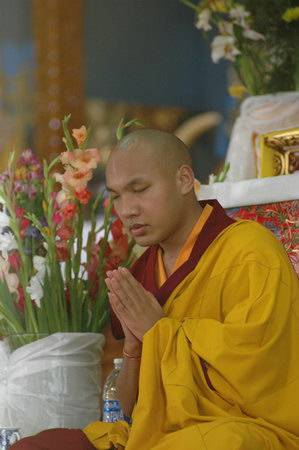
HH the Karmapa photo courtesy of Kagyu Office website.

Monday, December 25, 2006

Christmas With the Big K

Instant Karma-Pa
BodhGaya, Bihar

I guess am one lucky dharma groupie. Not many people can say they got to shake the Dalai Lama's hand, and got a blessing from the Karmapa, all in the same week. I am here for the Monlam celebration and adjacent teachings of His Holiness the 17th Karmapa, who just managed to escape from China to India a few years ago. Again, it was a total accident; I turned up late and unregistered, but somehow managed to get ushered in with just a few other people, to present the kata scarf and receive Amrit Tibetan medicine pills. Gate-crasher in the houses of the holy, am I!

I Feel (Not So) Good
The bad news is, James Brown is dead. On Christmas Day, no less. Actually his hair died about thirty years ago (and was reborn on the head of Condoleeza Rice).


There is one guaranteed cure for depression or homesickness, for me anyway: to hear James Brown's Greatest Hits. The best 200Rs I ever spent (in Bangalore).

I hope he has a funky funeral, and is buried in one of his satin capes.

But seriously, I don't feel so good
I am suffering from some kind of carpal-tunnel syndrome. Numbness alternating with shooting pains in my right hand and arm mean I am unable to work on the computer for more than a few minutes. I have loads of wonderful photos from this Buddhist pilgrimage to share, and am sorry I can't get them to you sooner. Now I'm getting physiotherapy and massage at the Root Institute (a Buddhist school here).

Bodh Gaya is an oasis in the otherwise dusty and uninspiring plains of Bihar. The local people, most of whom are Hindu, appear to be thriving only on the business generated by local monasteries and Buddhist-related tourism. It's a very international place, as well, wealthy Buddhist pilgrims making a real contrast with the threadbare Biharis. Each Buddhist country (Bhutan, Japan, Taiwan, China, Taiwan, Thailand, Nepal, Vietnam, Korea, Burma, Tibet and so on) has a temple built in its characteristic style. Visiting them is sort of like going to an embassy for that particular country. There are also very cheap and nice rooms available in each monastery guest house. Unfortuantely they are all taken, as it is not only Monlam time but holiday season for everyone. The town is swamped with big tour groups from Burma, Sri Lanka and so on, many dressed in their distinctive national clothes.

Maybe I can create a field guide: Know Your Buddhists. That is, if my arm and hand improve.

Friday, July 21, 2006

No direction home

Refugee Nation
Kathmandu, Nepal

Everyone knows about the Tibetan refugees; they are very high-profile and have a dramatic, romantic story. Tibetans
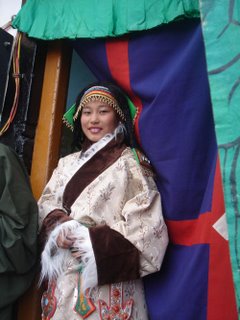
are still coming over the mountains - still escaping Chinese occupied Tibet. But probably 20% of the city of Kathmandu - maybe more - are some kind of refugee.

Besides the Tibetans, there are several
Bhutanese Refugee camps here in town. Meant to be temporary, like all such camps, the Bhutanese have been there nearly 16 years. King Wangchuk, an absolute if otherwise somewhat enlightened monarch in the neighboring mountain kingdom, kicked out lots of ethnic Nepalis who had been born and raised there (they were demanding things like "rights") in the early 1990s. The UN Human Rights Commission is here investigating the Bhutanese refugee camps this week; yesterday a bunch of protesting Bhutanis were arrested in front of the SAARC Secretariat.

Then there are Biharis - refugees from comparatively prosperous neighbor I
ndia. Ordinarily Nepalis go south to find work in India. There are some 1 million Nepalis working there now, largely as waiters or hotel staff; the stereotypical Nepali diaspora job is that of security guard ("bahadurs" - a Nepali word meaning courageous). These reverse Indian migrants are fleeing the state of Bihar, notorious for its poverty, violence and corruption. With their distinctive Indian features - prominent noses, enormous bushy moustaches, large, liquid eyes and unsmiling faces giving them a somewhat doleful look - they are easily spotted selling fruit from large bicycle baskets all over town. Every time I buy fruit, I ask them "what is your native place?" So far, they have all answered "Bihar." They are thrilled that I even know one or two cities in their state and that I have ridden through it, however briefly, on the train.

Yet another category of Indian refugee comes from Kashmir. Theirs is a diaspora of long standing. The Kashmiri conflict needs little introduction; because of it, green-eyed, fair-skinned Kashmiri men (known as much for their butter-tongued salesmanship as for their good looks) can be found in curio shops from Ladakh to Kerala. I would imagine the Kashimiri diaspora accounts for a good percentage of Nepal's very small Muslim minority.

Where are the Kashmiri or Bihari women who must have accompanied their men? Do they stay at home in purdah (Muslim seclusion of women), or tending children? or did they stay behind, leaving the men to dream of a day when they could earn enough money to return home and marry? A few days ago, I saw two tall, thin women dressed in the unmistakeable style of far northern India. Punjabi suit with churidhar pants, chunri (long scarf) pulled over the hair, no bindi on the forehead - that means, she's Muslim. The younger one could have been my sister, her features were so Caucasian. They were so exotic in these surroundings, I sprinted to catch up to them. "Place you are coming from?" I asked breathlessly. The elder one couldn't understand. "Kashmir," said the younger girl; "you are from?" "America."
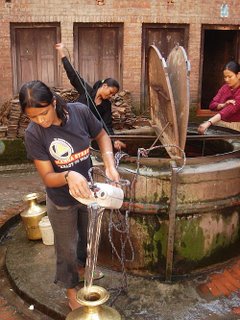
The ladies were carrying water in what looked like old-fashioned plastic gasoline jugs, the kind with a handle on one side. Since there is no running water near their tiny flat, she told me they go to fetch water from a public tap some four times a day. They trudged up the sidewalk with the plastic jugs perched on one shoulder, heads held high.

Internal Affairs

Then there are the Internally Displaced Persons (IDPs) - those who've been flooding Kathmandu escaping the Maoist/RNA conflict in their villages for the last few years. The Kathmandu population has mushroomed recently, mostly young men fearing recruitment or death at the hands of either army. Many young women have fled as well. Some find gainful employment; some are driven to dance in the many strip bars in the tourist district; some turn to either outright prostitution or a "softer" kind involving a relatively wealthy city man or "foreign gentleman" they have met during their migration.

Still more Nepalis are just fleeing poverty and lack of opportunity in their rural districts, armed conflict or no. Maya is here with her 2 daughters and sick husband. The husband has TB and is just sort of acknowledged to be terminal. There is treatment for TB, but they seem to have accepted that he is dying. The husband just lies in bed all day (all he can do) while Maya and her daughters do a sort of hybrid job in Thamel, alternately selling small pocketbooks (the kind tourists use as money pouches) and when that fails, begging. Maya buys the bags wholesale for about 30NRs each and sell them for whatever they can get. If the tourist looks rich, they start at 500NRs (about $8.00). However, they will part with the bag for as little as 50NRs. The same bags are for sale in every single shop in Nepal; often for much better prices, but Maya and girls are counting on pity and immediacy (being in your face on the street, that is). I wonder to myself whether she purposely doesn't wash her girls properly for this reason.

Maya came here from Pokhara, the centrally located lake town, seeking treatment for her husband. They seem to have forgotten about that now and just accepted that he's dying. While we were talking to her, Maya started crying and said "I just wish someone would take her" (the baby) "back to America."

And of course, there are the expats...not tourists, but lifers. Foreigners who came for a season and stayed. They're all running from something - many seem to be running from conventional ideas of prosperity and all its confining trappings, as our Nepali neighbors are hoping to run toward them. They ran to a place where the human touch still counts, everything is not yet mass produced, and you can still ride a bicycle to work without getting run down by SUVs.

Most foreigners are involved in one or more charities, projects or volunteer work; like Renate, the Dutch Nepali resident and owner of the posh restaurant 1905 Kantipath. Renate is deliriously busy not only running his business, but with myriad projects and homegrown, small-scale charities which emphasize training and education.

Unlike India, the locals here don't seem to consider you "stupid" for wanting to help. And a heartening number of projects seem to do long-term, sustainable good.

I met Rachael as she was taping up
hand-written posters to the notice board of the posh Kathmandu Guest House. Rachael is a very low-budget traveller here from New Zealand. "I hope you don't mind eating here," she said quietly as we ducked into a dark, smelly local lunch joint where flies buzzed around the food counter. It turned out to be too dirty even for her, and we ate elsewhere. Her guest house is 150 NRs a day (about $2.00 US) and only has hot water from 8-10 in the morning. Rachael is trying to raise money for "her" family in the Langtang region. She met them while trekking, spent time with them and got to know their situation intimately. Rachael wants to collect $100 US to repair their leaking roof (especially now that it is monsoon) and is in the city collecting it - 100 NRs (that's about $1.50) at a time. Her sunspotted skin, worn out sandals and frequently stitched and re-stitched pants showed that she spent no money on herself.

If she can buy a sheet of corrugated tin, Rachael can take it up to Langtang, tied onto the roof of a bus. (Anything and everything can be tied onto the roof of a bus here - I've seen full-sized sofas transported this way. It was amazing to see the men get it up there; but then, this is a land where five-foot men carry full-sized fridges on their backs.) From there, she will have to hire local men to carry it up to the family house. She's also collecting money to build a wall that will protect the family's apple orchard seedlings from the local deer, goats and pigs.

With $150 US, the family can buy a water buffalo, which will enable them to start a small-scale dairy business providing yogurt and milk to their neighbors.

Everyone gets involved, everyone has a project. No one, it seems, "belongs" here. Therefore, we all do. It's strangely liberating, and creates an environment in which anyone can fit in. Politicized enough to be relevant, romantic enough to be picturesque, bohemian enough to be accepting, and very international - a slice of Manhattan's 1980s East Village transplanted to a rain soaked mountain kingdom - Whoops! kingdom-slash-modern democratic republic... in the monsoon clouds.