Showing posts with label buddha. Show all posts

Wednesday, December 31, 2008

Unshakeable

Faces from Swayambhu
Kathmandu

Everyone knows I get boring and "spiritual" on holidays. Well, this new year is no exception.
Let's start 2009 off right. It is, after all, the last of the Aughts and oughta be done right.


Swayambhu, the famous "Buddha Eyes" temple (one of many, but probably the most famous one) is under restoration. I thought that was fitting for the New Year, even if it is the English new year. A few questions revealed that a local Nepali monastery (and some foreign well-wishers), not the government, was sponsoring the restoration.
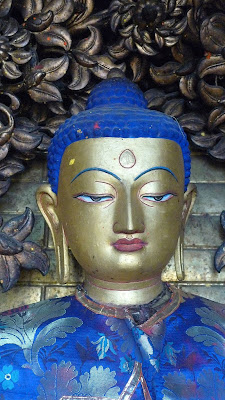
Here are some photos and details from our recent trip to Swayambhunath temple (the sistren and I, that is).

The blue Buddha is Akshobya, the "unshakeable" Buddha, to whom we will pray when the next earthquake rocks the Valley (just kidding. Well, not really kidding).

The elaborate carved archway at the top of the page shows Akshobya in the "bhumisparsa" (touching the earth) mudra with right hand, Dhyanam (meditation) with left hand.
This figure is holding his hands in the Dharmacakra mudra - the 'teaching' mudra aka "turning the wheel of dharma." This mudra is usually associated with Vairochana Buddha.
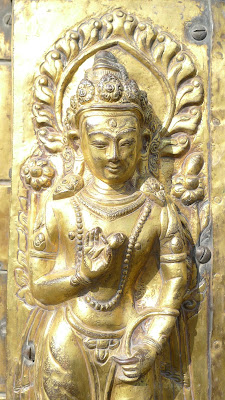
I am getting to be such a Buddha geek, I can instantly identify these Mudras (hand gestures). I know, you are yawning already.....!


The figure above is holding left hand in Nilotpala (holding lotus stem) and right hand in what would normally be called Gyana mudra (wisdom). But in the right hand he's holding some kind of...flower bud?? Maybe the other half of the lotus.

Here the left hand again is in Nilotpala, and the right is holding a Double Dorje with a hand gesture I haven't yet learned the name of. In Bharatanatyam it would be called Mukula, but I haven't seen this one in Charya.

Tuesday, December 23, 2008

Awake

Solstice season thoughts


Buddha in Glory
Center of all centers, core of cores,
almond,
that closes tightly in and sweetens,--

this entire world out to all the stars
is your fruit-flesh: we greet you.

Look, you feel how nothing any longer clings to you;
your husk is in infinity,

and there the strong juice stands and crowds.

And from outside a radiance assists it,
for high above,
your suns in full splendor
have wheeled blazingly around.
Yet already there's begun inside you

what lasts beyond the suns.


--Ranier Maria Rilke, translated by Edward Snow
from New Poems
Thanks to Rob Brezsny for featuring the Rilke poem this week.

Thursday, February 07, 2008

Mysterious ways

Turn and face the strange
Kathmandu, Nepal

Well, I won't be back in India on 16th February, after all. Turns out my heart-homegirl and living legend Ani
Tenzin Palmo (nee Diane Perry) is getting enthroned as a Je Tsun Ma right here in K-town on the 16th.

That's right, all holy an' stuff....a first for a western woman.

Tenzin Palmo's mission in this lifetime has been to revive the lost lineage of TogdenMas (kick-ass, hardcore longhaired female yoginis). This lineage was lost after the Tibetan Exile in 1959.

I was fortunate enough to meet Tenzin Palmo last year at the Tashi Dzong Monastery masked dances in Himachal Pradesh. She is best known via the biography written by Vickie MacKenzie, Cave In the Snow, which is a sort of end-users' manual for following your heart.

Everyone told her she couldn't do it, it had never been done before...against all the rules and traditions, blah blah blah....and here we are 25 years later getting enthroned, for crying out loud.

When I met her (photo above), while bathing in her considerable aura, all I could think was: Amazing, that a woman who spent 12 years in a snowbound cave in the Lahauli mountains is so totally normal - more well-adjusted than most of us.


The burning eye
Now I'm going to go off on the mystical tip. My friend Robert hates it when I do this....but Kathmandu is like that sometimes.

Thus I heard. On one occasion the Blessed One was living at Gaya, at Gayasisa, together with a thousand bhikkhus. There he addressed the bhikkhus.

"Bhikkhus, all is burning. And what is the all that is burning?

"The eye is burning, forms are burning, eye-consciousness is burning, eye-contact is burning, also whatever is felt as pleasant or painful or neither-painful-nor-pleasant that arises with eye-contact for its indispensable condition, that too is burning. Burning with what? Burning with the fire of lust, with the fire of hate, with the fire of delusion. I say it is burning with birth, aging and death, with sorrows, with lamentations, with pains, with griefs, with despairs.

"The ear is burning, sounds are burning...


"The nose is burning, odors are burning...


"The tongue is burning, flavors are burning...


"The body is burning, tangibles are burning...


"The mind is burning, ideas are burning, mind-consciousness is burning, mind-contact is burning, also whatever is felt as pleasant or painful or neither-painful-nor-pleasant that arises with mind-contact for its indispensable condition, that too is burning.


Burning with what? Burning with the fire of lust, with the fire of hate, with the fire of delusion. I say it is burning with birth, aging and death, with sorrows, with lamentations, with pains, with griefs, with despairs.


"Bhikkhus, when a noble follower who has heard (the truth) sees thus, he finds estrangement in the eye, finds estrangement in forms, finds estrangement in eye-consciousness, finds estrangement in eye-contact, and whatever is felt as pleasant or painful or neither-painful- nor-pleasant that arises with eye-contact for its indispensable condition, in that too he finds estrangement.


"He finds estrangement in the ear... in sounds...


"He finds estrangement in the nose... in odors...


"He finds estrangement in the tongue... in flavors...


"He finds estrangement in the body... in tangibles...


"He finds estrangement in the mind, finds estrangement in ideas, finds estrangement in mind-consciousness, finds estrangement in mind-contact, and whatever is felt as pleasant or painful or neither-painful-nor-pleasant that arises with mind-contact for its indispensable condition, in that too he finds estrangement.


"When he finds estrangement, passion fades out. With the fading of passion, he is liberated. When liberated, there is knowledge that he is liberated. He understands: 'Birth is exhausted, the holy life has been lived out, what can be done is done, of this there is no more beyond.'"


That is what the Blessed One said. The bhikkhus were glad, and they approved his words.


Now during his utterance, the hearts of those thousand bhikkhus were liberated from taints through clinging no more.

Thursday, January 11, 2007

Dust in the wind

Masking the truth
Bodh Gaya, Bihar (India)

Why did the Buddha choose to manifest in such a dusty, polluted, nasty place?

The answer is obvious: Because the place and its people really, really needed it.

Or, maybe not so obvious: at the time of the Buddha's historical life (about 500 years before Christ; that is, historical life, as opposed to his many thousands of other lives), perhaps Bodh Gaya, Bihar and Uttar Pradesh were not the dusty hell-holes they now are.

I have not written much lately; carpal tunnel syndrome keeps me off the computer for more than an hour a day (barely enough to answer emails). I'm in the middle of a trip to Buddhist India - first Sarnath, to see His Holiness the Dalai Lama teach and wander among the ruins of an ancient Buddhist monastic complex; then Bodh Gaya, Nalanda, Rajgir and possibly Sanchi; then finally, the Dalai Lama's teachings in Dharmsala (March 3-14).

It is weird, considering that Muslims destroyed the place about a thousand years ago, to sit among the peaceful ruins with chanting monks, and hear the local mosque's call of "AllahuAkbar." It's even weirder to encounter Muslim beggars (less common than Hindu beggars, but still to be found). I feel like saying, "Hey guy, why are you asking ME for money? I'm an infidel, the devil incarnate, a member of the degenerate West. You've got the one true way, the only true religion! How could an unbeliever like me possibly help you? There's the mosque, go talk to the big guy and tell him your problems."

Besides, your ancestors knocked down all the nice architecture in the area....don't blame me for the town being a smoggy, dusty pile of beggars. Enjoy the piles of rubble and your superior faith.
I have noticed that, at none of the ruins destroyed by the invaders - Sarnath nor Bodh Gaya nor Nalanda (at the time the largest university in the world, with 10,000 monk students) - at none of these is the truth about their demise told on the plaques or sign-boards. The origin, the rediscovering and reconstruction, yes - but the signs are strangely silent as to why these places (immense complexes of beauty) had to be restored in the first place. It was not natural decay, by a long shot.

In fact it's hard to imagine how the invaders (some Turkish, some Persian, some Afghani), without benefit of a modern wrecking ball, even managed to decimate such massive stone complexes. They must have had tremendous energy, and tremendous hatred, to tear down what amounts to a small city devoted to the study and worship of another faith.

What kind of PC history-rewriting campaign is going on, that no one is allowed to mention (for the public record) the destruction of temples, monasteries and Buddhist universities?

I understand that in early February a nearby small town has a Sufi festival with ecstatic saints, lots of singing and joyful music. Maybe I can catch some a different side - a more mystical one - of Islamic tradition there. At any rate, after Karmapa's departure there was an immense energy vacuum and I am ready to see a few local Buddhist sites, then push off to new horizons.

Friday, July 28, 2006

The Little Buddha

Kathmandu, Nepal

Wednesday was the beginning of nearly a week's ceremonies marking the enthronement of a newly incarnated Rinpoche, or Tibetan lama. Tharik Rinpoche is only six years old and so small, he has to be lifted up to bless the ritual mandalas in the prayer hall. I have to be up very early for the start of the enthronement ceremonies in Boudhanath tomorrow morning. Here are a few photos from Wednesday's arrival, by Rene Edde.

It takes uncountable lifetimes to become a tulku, or incarnate lama. Tharik Rinpoche (who was born in Himachal Pradesh, India) has been a Buddhist lama in his seven previous lifetimes, including, my printed invitation tells me, one lifetime as a female lama. His previous incarnation "left his body" in 1998 and the Sakya lineage community is thrilled to have "found" him again.