Showing posts with label tibetan. Show all posts

Thursday, February 03, 2011

The Great Game

Indo-Sino-Himalayan Intrigue!
Siddhbari and Dharamsala, India


Why would the Himachal Pradesh monastery of  revered Tibetan lama HH Gyalwa Karmapa house a reported $1.6 million in various foreign currencies, including enormous amounts of Chinese yuan - why, except that the Karmapa must be "a Chinese spy"?

The traditional South Asian paranoia of the dreaded "foreign hand" has again reared its ugly sira in the Himachal police's January 27 raid on Gyuto Monastery, home to the Karmapa lama since he fled Chinese-controlled Tibet in 2000 at the age of fourteen.  Xenophobia, coupled with resentment and jealousy of the tremendous international money and attention focused on India's Tibetan refugees, would appear to be at the root of the Himachal state government's vitriolic attack on the Tibetan community. 
Despite their dispossessed status, the community and its religious institutions have brought Himachal Pradesh untold millions in tourist revenue.

Might the cash stash be explained by the fact that Karmapa's Kagyu denomination of Buddhists had only recently (December 22, 2010) concluded the enormous Kagyu Monlam international prayer festival, which draws donations from devotees and Buddhist foundations spanning the globe?  And could the Chinese yuan be explained by the fact that Karmapa has a sizeable Chinese devotee base? 

Unlike the Dalai Lama, the Karmapa is officially recognized by Beijing, even considering Karmapa's escape to India.   The annual Kagyu Monlam in Bodh Gaya is dominated by Chinese devotees, as anyone who's tried to find a seat under the otherwise-serene Bodhi Tree without getting elbowed by them can tell you.  (Also, visiting Tibetans from across the border give donations in Chinese currency.)

Nope, that's too simple, too easy - and far too logical. Karmapa must be "a Chinese spy."  This is the type of illogical elaboration that in the past led Indians to create mind-boggling, fantastically embellished art forms.  The results aren't so enthralling in realpolitik.

Today's news shows that Himachal Chief Minister Prem Kumar Dhumal is busy setting up intelligence cells to monitor the activities of the state's Tibetan population, which number in the thousands (India's Tibetan population in all states totals 94,200). Spying on the state's most prosperous community will surely lead to more troves of treasure. Tibetans have also been told to "stop protesting" and peacefully assembling and ordered to cooperate with the state's investigations.

Indians often wonder aloud why Tibetans don't just get with the program and become Indian citizens. This just wasn't possible, until very recently, when the Delhi High Court ruled that a Himachal Tibetan woman's application for citizenship must be honoured.  (The judge also ruled that a previously established policy denying Indian citizenship "by naturalisation under Section 6 (1) of the Citizenship Act to the Tibetans who entered India after March 1959 is erroneous and hereby quashed."  This would seem to open the door for Tibetans desiring enfranchised citizenship within India.)

Therefore, Tibetans are poised to become an integrated part of India. Dhumal's accusation puts Himachal behind the Indian national curve.

Not surprisingly, the most sensible statements are coming from the ever-unshakeable Karmapa himself.  His statement of February 2: 
“India had become a second homeland to the Tibetans. We all have taken refuge and settled here. The country, in contrast to communist China, is a democratic country that is based on the rule of law. Therefore, I trust that things will improve and truth will become clear in time. So please be at ease. There is no need to worry,” the Karmapa said.

And I believe him.  This type of malicious attack belongs to the backbiting India of yesterday, a nation so insecure that it saw enemies in the corners of its own eyes. India's embrace (albeit sometimes theoretical) of Tibetans, allotted by the idealist Nehru, set an international example.  The medieval accusations of  the Himachal government won't bear the scrutiny of modern light.

"Let the investigating agencies do their work. Truth will prevail."


Monday, March 29, 2010

Dakinis of peace

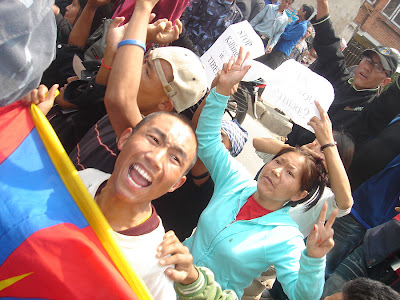
In the summer of 2008, I followed a group of Tibetan protestors in Kathmandu throughout their entire day - preparing banners, moving from their dwelling site to the protest site surreptitiously (Nepal police were expecting protests, so Tibetans in large groups were likely to be waylaid), and rehearsing nonviolent protest techniques.

Previous protests had involved struggle - the shouting demonstrators would approach the Chinese embassy or consulate and refuse to move. Most of the photos I (and so many other photographers) got were the same day after day - lots of pushing, pulling and gnashing of teeth.  Though I very much supported the demonstrators, I felt it was becoming predictable, and righteous anger is difficult to sustain day after day, for several hours, on an organized basis.

Protestors included Tibetan laypersons, always some monks, and usually a few nuns.

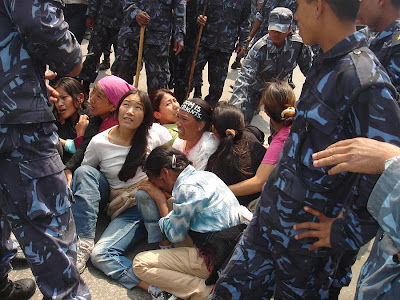
One day, there was an unusual number of nuns involved.  That day, the technique changed. The nuns just lay down on the pavement, shrouding themselves with Tibetan Snow Lion flags.  It was so unexpected, even the police started laughing.  Their gentle prostration turned everyone's expectations on their heads.

These nuns were so sweet, shy, and humble. I reflected on their daily lives in the Tibetan Buddhist world. They don't get many of the privileges afforded to the monks, and their education is often just learning to recite and memorize scripture without the higher teachings of philosophy.   Several projects (Kopan Monastery for Nuns in Nepal, and Tenzin Palmo's Dongyu Gatsal Ling Nunnery in north India) have begun to redress this situation, all with the blessings of HH the Dalai Lama. 

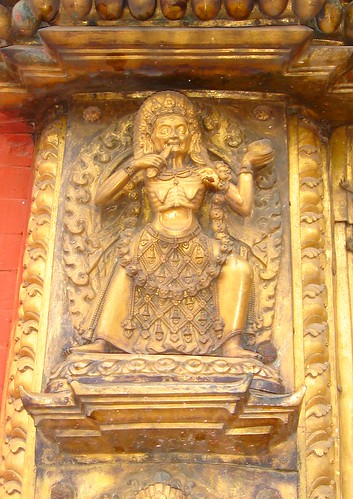
In Tibetan tradition,  Dakini (Tibetan Khandro) is a female embodiment of enlightened energy. Some Dakinis are full-fledged deities, but others are semi-divine and wear human bodies."The outer-outer dakini is a dakini in human form. She is a yogini, or Tantric practitioner in her own right." With or without the 'higher' philosophical teachings, the nuns naturally embodied the Enlightened Female Energy - Dakinis of Peace.

Please copy this photo and share it anywhere you like (just don't charge money for it).  Because my computer crashed shortly thereafter, this is the largest file I have for it, and it's too small to sell commercially. But when you look at it, see the Dakinis flying.

Related reading: 
.

Thursday, May 28, 2009

Art appreciation

As some of you know, I spent about four years travelling around India and Nepal, and about two of those were following HH the Dalai Lama to his many places of teaching and discourse throughout India.

Nowadays, some wags probably consider that stalking. There was a day when it was considered pilgrimage. That's what you do with saints, in the Hindu and Buddhist tradition. Saints don't stay in one place, they keep travelling. You follow them around.

Anyway, some of my favourite moments were in and around the teaching sites, where "Life's Rich Pageant" coalesces.

This photo was taken one morning in 2006 at Sarnath, Uttar Pradesh at the Central Institute of Tibetan Higher Studies, where everyone was queuing for the metal detector to get into teachings.

Last week, I received some Art Appreciation from a Flickr user named East Med Wanderer:

Great shot! All life is there - it has the quality of composition of one of the great master painters. And with a point and shoot - terrific!

Sometimes that's all it takes to make your day, or week. One of the great master painters probably would include the entire face of the purple-wearing woman at left, though - for compositional balance. That way, there would be two women facing each outside corner.

I can no longer post the larger versions of the photos - they kept getting stolen off the blog site. You can view (but not right-click) a larger version here.

Monday, February 02, 2009

Hymn to Her

Fun with liturgy
Kathmandu

Here's one of the Charya Giti I have been transliterating and, partially, translating. Not because I am good at it (I'm not really), but so that I can understand the dances I am learning. There are no English versions of these songs and poems. For those who've just tuned in, I am here studying the Newari Buddhist Charya Giti or Buddhist devotional dances.

Most of the lyrics I can "feel" but don't think my literal translation will do them justice. This is my attempt. There is a chance that this gita appears translated/literated in Kvaerne's 1977 Anthology of Buddhist Tantric Songs (Oslo) but as I can't locate this publication, I don't know.

My goal is to create an illustrated book of the Giti with Sanskrit, English phonetic and English translation, some background and illustrations of each Deity.

 
Sri Kurukulla Devi
Raga: Nata .... Tala: Jati
(the Raga is the South Asian equivalent of the key or "mode." This set of notes determines the "mood" of the melody much as the key does in western music - imagine playing "She Loves You" in Eminor instead of Emajor.
Tala is the rhythm or time signature of the piece. Again, imagine playing "She Loves You" in Waltz-time instead of 4/4. Changes everything. Every dance student must know their talas and ragas to some extent, though not as thoroughly as music and singing students.)Kurukulla
Tribhuvana jananii sri kurakullaa devii
Svetavarna makuta keshii trinayanaa
Mother of the three worlds, Sri Kurakulla goddess...
White-coloured with a crown of hair, three-eyed....

Namami devii sri kurakullikaa taraa
Chatura bhujaa karti khatpara shara dhanudharii

We bow to goddess Sri kurakulla the deliverer
Four-armed, holding chopper, knife, bow and arrow.
Rahu mastaka sthita nrtyapada dharii
Natha shodasha bhujaa aalikngana chun.
Tribhuvana vyapita niilavarna dehaa
Tumha varna devi anuttara sangama
Tempting Rahu (?), standing in a dance-pose
Permeating the three worlds, with blue-coloured body...
(This part confuses me. At one point she's red, at another blue....Sodasha means sixteen; the verse seems to say she has 16 arms but elsewhere she is described as "looking 16 years old.")
Piivad re mahaarasa sudrishta dehaa
Namami sri devii loka udharitaa
Drinking Maharasa (amrit), her form pleasing to see
I bow to the Goddess who uplifts the world
Bhanayikulishaa ratna giita charitaa
Namami sri devii loka udhaaritaa.
(This verse is an attribution stanza telling the name of the Gita composer; and again I bow to the goddess who uplifts the world.)

Here is more about Kurukulla from Vajranatha.com, which appears to be a cool and informative vajrayana web site.

And here is a fun "message from Kurukulla" which was received by Akkarri at Spontaneous Combustion. I especially liked this part:

"I am DANCING. This is to show you how to manifest divine energy for benefit of all....itting in uniform rows reciting rote attribute-lists of the results of human male ego-trips is not a Divine Activity, because it has nothing whatsoever to do with the acknowledgement of MY DANCE."

Related reading: 
Meditation auf Kurukulla 

Friday, January 02, 2009

Competitive spirit

If you participate in Flickr (the best photo-sharing service there is), log in now and go vote for my photo here.

My photo of the Tibetan nun protestors ("Snow lions of peace") is one of the final 10 selections for the Lonely Planet Publications challenge, "Events."

Thanks for playing!

Wednesday, November 26, 2008

This stuff works

I (didn't) read (or write) the news today, Oh Boy
Kathmandu

Yes, I have been back from Bara for a few days.

It took a couple days to recover from being in a Jeep with eight other people (men, women and children) who never, ever, ever stopped talking for 9 hours at a time. I had also caught a cold and sore throat while in the Tarai (sleeping outdoors under a tarp with other pilgrims). Then today, I had "gastric." So once again I am bad in not reporting right away about "Buddha Boy." Maybe his spiritual powers are keeping me from delivering a newsworthy report.

A news-junkie friend asked me a few months ago if I "read the news." I read different things, I told him.

This particular person prides himself on being well-informed. He gets up in the morning and, right away, turns on Google News and fills his mind with The World.
I used to do the same, with newspapers. They filled up some kind of void in the morning. Then I realized, to paraphrase the Rocky Horror Picture Show, that "the void was calling."

I didn't say as much, but I think meditation is even better than reading the news, in terms of connecting you with what's going on around you.

My friends Brother Martin and Lisa sent this today from Alternet.
Here's a link to the old (2004) Wall Street Journal article about same.
For thousands of years, Buddhist meditators have claimed that the simple act of sitting down and following their breath while letting go of intrusive thoughts can free one from the entanglements of neurotic suffering.
Now, scientists are using cutting-edge scanning technology to watch the meditating mind at work. They are finding that regular meditation has a measurable effect on a variety of brain structures related to attention -- an example of what is known as neuroplasticity, where the brain physically changes in response to an intentional exercise.


A rash of other studies in recent years meanwhile have found, for example, that practitioners of insight meditation (Vipassana) have noticeably thicker tissue in the prefrontal cortex (the region responsible for attention and control) and that experienced Tibetan monks practicing compassion meditation generate unusually strong and coherent gamma waves in their brains.

Monday, October 27, 2008

Whassup Ode Skool?!

A note from Flickr
Kathmandu


Back in February,
you may remember I attended the Tibetan New Year celebration Losar out in Boudha. The Tibetan community, like Ladakh, is a cinch for "beautiful old faces" photos.

One of them was this lovely white-bearded Gandalf of a Ngagpa, or non-celibate Nyingma yogi
. (Nyingma is one of the five Tibetan Buddhist schools and literally means, "Old School.") I wish I could have illuminated his face better, but it was still a good composition.


He spoke a bit of English and invited me up to see his monastery in Helambu (about five days' walk from Kathmandu).

Just yesterday, a
Flickr member named Joakkim wrote in with this note:

Hi I also met Lama Rechung is his name by the way, at his home in Helambu in 98. Read more about Rinpoche at
arobuddhism.org/encyclopaedia/shared/text/n/n rr_ph_01_eng...

The Rinpoche does not appear to have aged a great deal in the 10 years since Joakkim met him, if the website photos are any indication. There must be something to those Tantric Arts.

Time for a closing cliche: What a small world it truly is.

Here are a couple more photos I took that day. Old school indeed.

Wednesday, July 09, 2008

Lha Gyalo

....means "victory to the Gods" in Tibetan
Kathmandu

From my sickbed (severe, persistent giardia) I've been watching the, er, progress of various situations here in the 'Du (or as Tnog perceptively called it, the Mountain 'Du).

Having missed both HH Dalai Lama's birthday celebrations -- July 6 is now World Tibet Day - as well as the first in-exile birthday celebration of HM Gyanendra (he stayed in at his new downsized digs, the Nagarjun hunting lodge on the edge of town), I was delighted to see that, for once, due process - this time in the form of a Supreme Court verdict - seems to have worked in Nepal.

About two weeks ago, three Tibetan community leaders were imprisoned without charge. Most alarming was the fact that one of them (Kalsang Chung) was not at all involved in pro-Tibetan demonstrations and in fact was the director of the Tibetan Refugees' Reception Center (the first place new arrivals go when they've crossed the mountains, escaping Chinese Tibet).

Since I couldn't get any first-hand info, here are the news blurbs. Lha Gyalo!

Nepal court orders release of Tibetan leaders
Reuters via Yahoo! News Tue, 08 Jul 2008 6:46 AM PDT
Nepal's Supreme Court has ordered the release of three senior Tibetan refugee officials recently arrested in Katmandu and accused of involvement in anti-China activities.

Nepal: 3 Detained For Anti-China Protests Released
Scoop.co.nz Tue, 08 Jul 2008 8:19 PM PDT
8 July 2008 - The United Nations Office of the High Commissioner for Human Rights (OHCHR) in Nepal has welcomed the release of three people who had been detained under the country's Public Security Act (PSA).


Tibetans hail Nepal's release of three jailed leaders
IANS via Yahoo! India News Tue, 08 Jul 2008 5:06 AM PDT
Kathmandu, July 8 (IANS) Tibetans in Kathmandu Tuesday hailed the release of three jailed community leaders, including two women, after Nepal's Supreme Court ordered the government of Prime Minister Girija Prasad Koirala to free them.

Monday, June 02, 2008

Lost horizon

News from Uttarakhand & Kathmandu


I've been taking time off from blogging, worrying and other writing to compile some photos and paperwork for various photography festival submissions.

Meanwhile,

-Nepal's been officially declared a republic, The Federal Democratic Republic of Nepal. This followed the dramatic scenario, inside the Chinese-financed Baneshwor assembly hall, of the constituent assembly members taking oaths in their various "mother tongues." (It might be hard to appreciate the significance of this if you're not familiar with Nepali Khas Kuri nationalism and the old 'one nation, one king, one language' dictum),

-the King's been rumoured to have fled - some said to Nagarjun (another palace within a forest reserve on the edge of town), some said to Switzerland - then shown to still be in his counting house, presumably counting out his money from his various private business enterprises,

-six people were injured in small bombs around town last week (reportedly set by Royalist pro-Hindu nationalist parties)

-Angry protestors of many stripes thronged the palace gates just a few blocks away, insisting that the Monarchy's own dynastic flag be taken down and the National Nepali flag be hoisted. It was, though King G is still in da house.

-Those massive assemblies in the road, three across and three hundred feet long (photo above), are NOT a National Pride Parade. These are hapless commuters waiting six, seven hours and more in line in the boiling sun - for petrol (gasoline). Naturally this is a boon for the very small micro-businessman (soda pop and bhel puri vendors!).

-And, of course, in good Nepali tradition, the "government" gave itself a three-day holiday in honour of its own ratification.

None of this, of course, really means that anything at all will necessarily change. My Australian friend just came from Immigration, where he was given an (illegal) 2-month visa just for paying 1500 extra Nepali rupees. He was approached by a tout ("agent") outside the Maitighar office, who asked him "did he need anything?"

He said sure, I would like to go into meditation retreat and not come out for 2 months, instead of having to return here every 30 days. The tout took him inside, where they side-stepped the dozens of waiting law-abiding visitors and went straight to the counter. Voila, sixty days. (No one ever approaches ME for such things. I guess I look like a budget traveler.)

The most appreciable change of Maoist influence, for a foreign visitor, is the prices. There is now a 10% added "service charge" on any venue (hotel, bar, restaurant) of repute (ie, any place clean enough for most foreigners to eat). This, combined with the pre-existing 13% VAT (value added luxury) tax, means you pay 23% tax on every freaking thing.

This is new as of 2008, initiated (so I'm told my several hotel workers and owners) by the Maoist-run All Nepal Hotel & Restaurant Workers' union. (Their symbol is a white knife and fork crossed, in the manner of the hammer and sickle, against a red field.)

Sixty-six percent goes to the workers themselves. Another percentage goes to the business owner, ostensibly to cover expenses incurred by the workers such as broken dishes. In this part of the world, that normally comes out of the worker's own pocket - business owners do not build in the concept of incidental expenses to their pricing structure. If you (or your waiter) breaks something, the waiter normally pays for it out of the $2 or so he makes daily.

The remaining 3% or so goes to the Maoist party.

Though I don't like making an enforced donation to the party, I have to admit, this is basically a good thing. No wonder the Maoists became so popular. After all, the Seven "democratic" Parties and the palace have never done a thing for the workers.

On the border
The Return March to Tibet has been halted in its tracks, by the Indian police, and is now regrouping on the Indo-Chinese border in the mountains Uttarakhand state.

This in and of itself was expected. What was not expected was that all the march's food and supply trucks were impounded, making it difficult to continue in this remote area. Also, many (if not all - a few managed to hide in the bushes!) of the foreign supporters/ demonstrators/ media crew were arrested and given Quit India notices. This means they have 10 days to leave the country or face imprisonment. Basically, they are being deported.

Again, I halfway expected something like this. What no one expected was the charge against them. The foreigners were arrested on grounds of "violating their tourist visa by participating in religious activity."

Religious activity?? Since when is that illegal for anyone, including tourists, to engage in within India, of all places?

In a strange move, at a time when the government is promoting “Come to India - Walk with the Buddha” to attract foreign tourists to Buddhist circuit in the country, five foreigners have been given Quit India notice to leave the country within seven days “for participating in a religious activity”.

And if it is, what about the thousands of Chinese, Japanese, Korean, Thai, Burmese, Taiwanese, Bhutanese, and Cambodian Buddhist tourists who throng to India every year to participate in religious activities? There are thousands more foreigners of all nationalities in the ashrams of Vrindavan, Puttaparthi, Pondicherry, Ganeshpuri and Amritapuri.
“On tourist visa, you cannot take part in a religious activity. If we allow that, you will have people coming here to propagate their religion."

((WHAT? oh, you can't take part in Missionary Activity! That's a horse of a different colour.))


".... It’s only for travelling and sightseeing, etc. So, they have violated the visa rule by participation in the march,” said Ashim Khurana, joint secretary (Foreigners) in the ministry of home affairs.
...

...However, legal experts Times of India spoke to said the notice in this case seems to be illegal. “The Quit India Notice is a very serious matter. It’s used sparingly only in such cases where the person is a threat to the national security.


In this particular case, it seems to be totally wrong, biased and prejudiced. There is no law in the country which prevents people, including foreigners, from taking part in a protest march or a rally,” said Shilpi Jain, a lawyer who deals with immigration and visa-related cases.

On the tourist visa application, you are asked your purpose. "Religious pilgrimage" is one of the boxes available. I always check this, and specify "attending Buddhist teachings" since it's always true, and is certainly something I can't do elsewhere in the world. (At least, not with the Dalai Lama and Karmapa.)

I figured that openly participating in political activity was contrary to the terms of a tourist visa - I'm sure it is in most nations.

But, if someone can be deported for partcipating in religious activity, it doesn't bode well for anyone in India - foreign or Indian nationals.

The Indian government appears to be willfully conflating "religious activity" with MISSIONARY activity. Perhaps they don't believe that foreigners, or more specifically non-Asians, can actually be sincere practitioners of anything but proselytizing.

Saturday, May 24, 2008

Out of season

Mellowed out
Kathmandu

Everything's so mellow now here, now that "season" is over.
Unseasonable rains, perhaps a hangover from Cyclone Nargis, have made what's normally pre-monsoon mugginess quite cool and breezy. All the high-energy level goal-oriented tourists are gone (gotta cross alllll these things off our list so we can say we've done them all!). Now there are more long-termers ("I dunno, just thought I'd see the country, experience it, you know...."), NGO workers, doctoral students and English teachers. Actually they were always here, but now you can see them.


Looking Kathmandu
"Great, I'll see you at 11," I told my friend Shanda, whom I hadn't seen since an ashram in India, where we were all chastely attired in white sannyasi gear. "But I have to warn you - I'm looking verrrry Kathmandu."

In this case, Looking Kathmandu meant I was wearing a screen-printed hand-dyed t-shirt blouse with hippy bell-sleeves and a flaming Yin Yang symbol on it, a day pack made of Guatemala woven fibres, and some long dangly scarf thing from my hair. Kathmandu had finally gotten to me.


People who go to India hoping to relive the 60's are about 20 years too late. The
place to come is Nepal, specifically Kathmandu. It's one of the last places on earth you can still live in a guest house for as little as $1.50 a day, or if you should choose, wear tie-dye, dreadlocks and bikini tops without causing scandal or harassment, and without the sneering judgmental stares that is so much a part of foreign tourists' India experience. (Before anyone gets huffy, I take surveys. It's unanimous.)

(I can always tell when a woman has just come from India - she's still wearing the full punjabi suit and chunni. And I can always tell when someone hasn't been to India yet - they are still wearing spaghetti-strap tops and short skirts.)

At one point this winter, hashish (nominally "illegal") was more readily available than gasoline or electricity. Countless embroidery shops on Freak Street still churn out designs of the Freak Brothers, magic mushrooms and marijuana leaf logos. Multi-headed, many-armed Buddhist and Hindu god icons in shop windows merge seamlessly with posters of vintage psychedelia. And the ultra-specialist Bong Shop on Bhagavati Bahal is *not* a place run by Bangladeshis.


Other major Asian cities have been taken over by Hindi film music, techno and hip-hop sounds. That won't get you far in Kathmandu, where "Born to be Wild," "Purple Haze" and "Break On Through" blare from every bar in Thamel.

Oh, we also have demonstrators - lots of them - and a confrontational police force.

Yes, the dream lives on....at least the consumable, marketable elements of the dream with occasional flashes of utopian idealism, before the stick comes down.

Back in the real world
Back in the other Kathmandu (the newly politicized city where it still takes 10 days to get 5 days' work done) , it's surprisingly mellow, too. Following the earthquake in Sichuan Province (China/Tibet), the Tibetan government has asked all protestors to refrain from demonstrating for at least the coming week, in deference to the quake victims. However, the hunger strikers continue at Swayambhu. Here's a photo of some of the Kopan nuns taking their turn (they are on 24 hour rotating shifts).

The International Herald Tribune
ran an article declaring the "Chinese" earthquake has overnight turned the Chinese oppressors into victims and put a damper on the Tibetan voices of protest. What most people don't seem to realize is that Qiang prefecture/Sichuan province is part of northeastern Tibet, and thousands of Tibetans were also affected by the situation.

Equally disconcerting is the thinly disguised glee with which people are pronouncing the Beijing Olympics "safe" ("Earthquake mutes Tibetan voices").

All the same problems of inequity pre-existing in these areas of Chinese Tibet will extend to the post-quake situation (unequal access to resources, Han favouritism and so on).

Here is the statement from Students for a Free Tibet Delhi on the situation.
It is encouraging to see the incredible rescue efforts and increasingly open media reporting taking place in China, but we have heard almost no information about relief efforts in the affected Tibetan areas. However, on the day the earthquake struck, the regional government issued an urgent official document entitled “Combining work on anti-separatism and safeguarding stability with disaster relief work.” Considering the Chinese government's history of systematic oppression and disenfranchisement of Tibetans, we are gravely concerned that Tibetans impacted by the disaster will not receive equal consideration and assistance

----------------
Now playing: War - Low Rider
via FoxyTunes

Thursday, May 15, 2008

Coming attractions


Lamawatch continues
Dharamsala via Kathmandu
----------------
Now playing: Tenzin Dhondup - About the DraNyen
via FoxyTunes


I am very often asked, "When will the Dalai Lama be appearing publicly in India?"

This is question I always welcome; my eyes light
up like a little kid on Christmas morning.

I should really write the Complete Guide to Seeing HH in India - how to get a seat, what to bring and not to bring, how to register, where to stay and so on. It does require some planning, but unlike in the west, his public teachings in India are always free. (That's right. Five or 10 days with the Dalai Lama - for free.)

You can always get His Holiness' latest schedule updates at the Official Website.

And it pays to check every few weeks - there are always changes. He's in Germany now, but I am happy to report that HH will be back in Dharamsala later this summer.

It's very, very hard to believe that it will have been nearly ONE YEAR since I've actually seen him....but that's the way the river flows sometimes.

Teaching in Dharamsala (H.P.), India from August 4 to 6:
His Holiness will give teachings on Atisha's Lamp for the Path To Enlightenment (jangchup lam kyi drolma) at the request of a Korean group.

Teaching in Dharamsala (H.P.), India from September 25 to 27: His Holiness will give teachings on Je Tsongkhapa's The Great Treatise on the Stages of the Path to Enlightenment (lamrim chenmo) at the request of the The Tibetan Buddhist Center (Singapore). Contact: The Tibetan Buddhist Center (Singapore), 02-28 No. 1 New World Center, Singapore 209037 Singapore Tel: +65 6491 1027 Website: www.tibetanbc.org

Teaching in Dharamsala (H.P.), India from October 1 to 5: His Holiness will give teachings for Chinese Buddhists.

Lhasa letter

Another vicarious letter....am I getting lazy?
Lhasa via Dharamsala, India
via Kathmandu

My American friend Amy asked me "what are you hearing from Lhasa these days?" I was sorry to say I didn't have a direct contact to Lhasa, and that the Tibetans here report a near-total news blackout. The blog of Tibet activist Jamyang Norbu, though, has an anonymous letter on current living conditions in the city.

Norbu is a well-known author, one of the more lucid writers on the Tibet issue and former Tibetan freedom fighter. His blog is well worth a
visit.

Walking the streets of Lhasa, seeing big tea houses unusually empty and many shops still closed, makes you aware of how scared people are these days. Very few people stop on the street when they meet friends, because every gathering of people is cause for suspicion. A lot of people still stay at home because they are scared they will get arrested for no reason if they go out.

When you finally find someone not too scared to talk to you, you hear consistent, dramatic, disturbing and daunting stories that give you nightmares.

----------------
Now playing: Snow Lion of Peace
via FoxyTunes
.......

Blatant self-promotion, but for a good cause

I was thrilled to learn, late last night, that my photo of an elderly Tibetan demonstrator in Dharamsala had won in an international photography competition.

(Okay, I didn't get first place, I got first commendation - but we all received $200, and besides the winning picture - of a woman
interviewer in a burqa wielding a microphone - really was better.)

The contest, themed "Women and Communication," was organized by the Canadian organization World Association for Christian Communication.

Here are the specifications:
WOMEN AND COMMUNICATION
Photographs that capture women communicating; women's communication rights in action or photographs illustrating how women use communication to empower themselves.


Other winning photos hailed from Afghanistan, Honduras, Thailand, Maldives and Argentina.

In most of the other photos, the women were acting through various outlets of modern media (radio interview, public address, graffiti). In addition to carrying the flag, this woman was visibly praying. Like many elderly Tibetans, her mouth was constantly in motion breathing mantras. I am continually amazed at the Tibetan community's sincere belief that prayer is a definite, pro-active force in changing things.

This woman was probably a young girl at the time of exile and has grown old in India, hoping for return to her home. The day was pouring down rain and quite cold; still she made it out to what had in many ways become a very routine event with little or no signs of progress (that is, the annual Uprising Day vigil), to pray for change.

My gratitude to the woman in the photo, to WACC, to Rita Banerji of 50 Million Missing for alerting me to the contest, and to Cheryl Hurwitz of New York City who was visiting Dharamsala that day and was kind enough to loan me her camera.


----------------
Now playing:
Lama Gyurme & JeanPhillipe Rykiel - Calling the Lama from Afar via FoxyTunes

Wednesday, May 14, 2008

Letter from Almora

"Now Tibet is not so far"
Letter from Almora

----------------
Now playing: Tenzin Dhondup - About the DraNyen
via FoxyTunes


Tibetan activist Tenzin Tsundue, a key figure in the Return March to Tibet, writes from their most recent stop in Almora, Uttarakhand. This letter was forwarded from the group Return March to Tibet.

(The photo was taken at last
year's long life puja for His Holiness in Dharamsala.)


....................
Tenzin writes:

When I packed my sleeping bag that early morning before sunrise for this long journey, I placed a white (khatak) scarf at the alter of His Holiness and said I have decided, whatever happens, I will make my way through. Walking for almost 70 with 300 people covering more than 900 kilometers through Himachal, Punjab, Haryana, Delhi, UP, we reached Almora town yesterday in the Kumaon Mountains in the north Indian state of Uttrakhand. From here Tibet is not very far.

The March to Tibet began from Dharamsala on 10th March, the same day similar uprisings happened all around the world, organized by Tibetans and Tibet supporters, even in Tibet – a global Tibetan uprising. We started with 100 core marchers, on our way many more joined us. As we leave Almora tomorrow into the high mountain valleys towards Tibet, we are 300 marchers and eight support marchers who are foreigners from different countries, some of whom have been with us from Dharamsala.

All along the route the Indian people have welcomed us with warmth, cheered our spirit and in some places offered us water and shelter. At most places we spent our nights in Ashrams, Gurudwaras and schools, sometimes on empty grounds on the roadside....


The Marchers wake up at 4 am, after washing and packing sleeping bags, tents and mattresses, we have breakfast and start walking at 5 am. Usually walking for 6 to 7 hours a day we cover a distance of 20-25 kilometers, sometimes walking even 27 or 28 kilometers. The logistics and kitchen team move ahead in trucks and set up the camp. At many places water is luxury. .....
Most marchers are monks from the monasteries in south India; some old people who escaped from Tibet along with His Holiness the Dalai Lama in 1959, the eldest one being 78. The youngest are two 17 year old boys, born and brought up in India and have never seen Tibet. There are several young mothers who left behind their family in the care of their husbands. ... ongoing Tibetan protests in Kathmandu are highly appreciated understanding Nepalese police brutality.

We are now starting the last leg of the March. From Almora to the border is now barely 200 kilometers, and it will now be cold as we ascend higher into the Himalayas. I know returning to a homeland that is still under foreign occupation is not easy. Chinese military will of course guard the border with machine guns, even Indian police will find an excuse to stop us. Confrontation is inevitable, but we are not stopping. We may even have to camp at the border for a long time, might have to call for international support and participation. We march into uncertainty.

The March to Tibet is a process for us to return to our homeland and reclaim our right to be in our native land in freedom. Whatever happens, we have deep commitment to non-violence; we will not retaliate. We may be beaten, jailed or even shot at, but we are not giving up. And for me there is no other plan in life other than this March. For all of us marchers, this is our life commitment.

For daily updates and photos about the march and to read personal stories of the Marchers please visit: www.TibetanUprising.org

We have a number of non-Tibetan support Marchers who have been walking with us for a couple days or longer, and some right from the beginning.


If you are interested in joining please contact our coordinators: Sherab Woeser sherabwoeser@yahoo.com (cell phone: 0091-9418394426) and Lobsang Yeshi (cell phone: 0091-9410936742 / 9756969141).

If you are far away or can’t join us, you can help spread the word. Donations of sleeping bags, shoes and mattresses can be of great use. Your financial contribution can help feed the Marchers and give water to keep us going. I count for every Tibetan’s contribution towards this movement.

Bod Gyalo! (Victory to Tibet!)

Tenzin Tsundue, on the way to Tibet
May 13, 2008
Almora, Uttarakhand State, India

Monday, April 28, 2008

Karmapa Chenno

The K-Man Cometh
News from Woodstock, NY


It's finally happening.

Those of you who are not on the dharma "circuit" have no idea what this means.

His Holiness the 17th Gyalwa Karmapa (Orgyen Trinley Dorje), the 22-year-old incarnate Tibetan Rinpoche widely believed to be the coming successor to the Dalai Lama (in terms of leadership in the Tibetan worldwide community), is finally coming to America - after years of hemming and hawing by the Indian government.

It's no exaggeration to say that Karmapa's dramatic escape from Chinese Tibet a few years ago, at the age of 16, could not possibly have been made up or embellished even by Hollywood. (Read Mick Brown's Dance of 17 Lives for the best account.)


Nor could the ensuing controversy over who was the "real" Karmapa (a rival emerged a few years later) have been invented by the most creative screenwriter...nor the ensuing dispute over his ability to take his traditional seat at Rumtek Monastery, Sikkim, north India.

In hopes of not offending China (who, after all, had already recognized him as the Karmapa, raised and groomed him for their own purposes before his escape - rather embarassing for the Chinese), the Indian government has severely limited the Karmapa's movements within India. The young incarnate lama has yet to travel overseas. So, this is big news.

Once the American press sees this guy, they are going to go wild. He is so young, cool and charismatic - here's a photo of him entering the Dalai Lama's Kalachakra temple in McLeod Ganj last year. (check out his Matrix shades. ;-) )


Karmapa to Visit America

--WOODSTOCK — The young Tibetan Buddhist leader that the Karma Triyana Dharmachakra Monastery on Meads Mountain Road was built for will finally come to America in mid-May. The 22-year-old Karmapa’s visit comes as the 49,000-square-foot monastery built for him comes to completion. The tour begins May 17 with a Manhattan apearance before the entourage comes to Woodstock May 19-22.

All monastery events are by invitation only. Public events will be held in New York City and New Jersey.

Thursday, April 03, 2008

Scenes from an embassy

Embassy embarassment
Kathmandu, Nepal


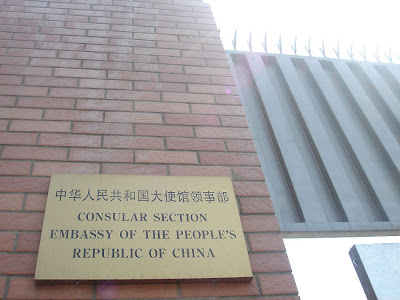
Pro-Tibetan Protests in front of the Consular section of the Chinese Embassy (Hattisar) had become an almost daily routine.

As of Tuesday the 1st, protests began in front of the actual Chinese Embassy building in Baluwatar (conveniently located down the block from the Prime Minister of Nepal's residence).


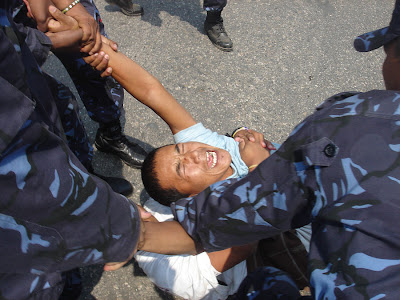
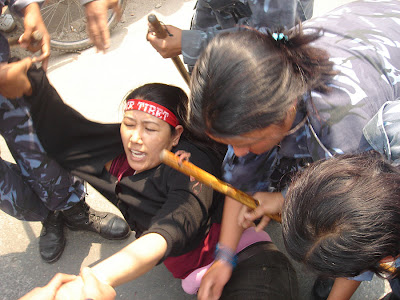
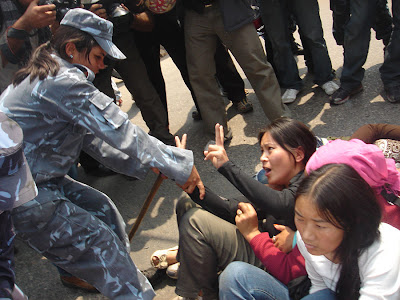
Here are some scenes from Monday's protest in Hattisar. Typically, the marchers approach the embassy's giant metal gates, holding banners and posters. The Nepal Police accost them, preventing them from approaching the gates. At this point the protestors sit down, "drop" or refuse to move, and the police drag them away.

On Monday, I noticed there were no monks in attendance. I asked a young English-speaking Tibetan girl about this. She, with her mother, was watching in tears.

"Some of them are monks," she said. "But they can't wear the monk dress. Police are arresting all monks and nuns on the road just for wearing the robes." So the monks were protesting in plainclothes. Indeed, I did notice quite a few protestors had the close-cropped monastic hair.


While the protestors shout and scream "stop the killing in Tibet, " "we want freedom in Tibet" and "Dalai Lama Zindabad" the police eventually apply the lathi (bamboo canes). Reporters and observers who'd been to many of the demos told me the police violence, while still including hair-pulling, even some face-punching, and lathi whacks, was actually reduced from that of a few days ago.


UN human rights observers in their trademark blue vests stood by watching. But they were denied entrance to the rooftop of a private house (next door to the Chinese Embassy) for better rooftop viewing. The Nepali homeowner said he "had been told not to" let anyone watch from the roof.

There were at least 2 dozen media members, both professional and amateur, in attendance, not to mention loads of ordinary Nepalis with cell phone cameras. Office workers peered down from the safety of first-floor windows while ground-floor shopkeepers slammed their metal gates shut.


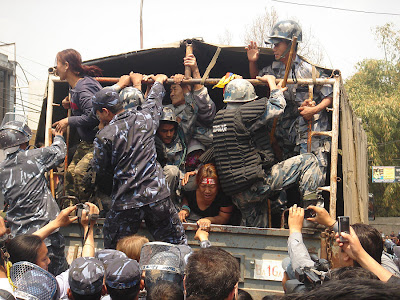
Protestors were piled into police vans and trucks, and taken to various police stations where they were jailed until nightfall.

Just when the police would drive off with a truckfull of screaming protestors, another scuffle would start up down the block, with another group appearing seemingly out of nowhere. This went on for about 2 hours - groups appearing, sitting down, getting rounded up and dragged off, trucked away then another small group appearing elsewhere.

I read one report that claimed "protestors attacked the Chinese Embassy." I find that hard to believe, as they are not allowed anywhere near the enormous metal gates of the compound.

Monday, March 24, 2008

Torched


The Olympic Torch will be coming through New Delhi on April 17, on its way to Beijing. I imagine there will be an organized protest against China's human rights violations within Tibet. Best to check the Students for a Free Tibet website and get on their emailing list.
The Tibetan Marchers who departed from Dharamsala on March 10 also have a site with regular updates on their progress.


All over the world (including this morning in Greece) there are Tibetan and pro-Tibetan supporters protesting the Torch's planned route through Tibet. Here's a handy day by day guide to the Torch's round the world relay.

If you're stuck in a torch-less locale, you can at least phone, write, fax or email the International Olympics Committee (who keep insisting the Olympics are not political). Below are letter-writing guidelines courtesy Students for a Free Tibet.

Use the following talking points as a guideline when calling your NOC or drafting your own letter:
> Say you would like to leave a message with the President of the NOC. > If the Torch goes through Tibet it will likely cause further unrest, which would result in another heavy-handed crackdown and consequently more arrests, torture, and loss of life. > On humanitarian grounds alone, it is inconceivable that the Torch relay pass through Tibet at this time. > Please urge the IOC to immediately remove all Tibetan area from the Olympic torch relay route.

Here is a sample email/letter: To the President of the NOC of [insert country], As a citizen concerned about fundamental respect for human rights and dignity, I am deeply concerned that the International Olympic Committee and the organizers of the Beijing games are continuing with plans to carry the Olympic torch through Tibet. Right now in Tibet, there is no freedom of speech or movement and the entire nation is under martial law. International sources report that over a hundred Tibetans have been killed and hundreds more arrested or detained. As reports spread of arbitrary arrests, house-to-house raids, killings, and even beatings of schoolchildren, it is unthinkable that the IOC would continue to move forward with 'business as usual.' Allowing the torch to be carried through Tibet will greatly escalate tensions, giving the Chinese government an excuse to continue its violent crackdown, which will undoubtedly lead to more detentions and deaths.Allowing the torch through Tibet would indelibly tarnish not only the 2008 Olympics but the Olympic movement. The Olympic torch relay should be a celebration that unites people, not a propaganda exercise in which one people seeks to assert its dominance over another.
Tibetan people everywhere have made it clear that they do not want the Olympic torch to pass through their borders. The Chinese government's fervent desire to see the torch pass through Tibet is politically motivated, aimed at saving face despite the widespread protests, and asserting its sovereignty over Tibet. I urge you to place the needs of the Tibetan people and the values of the Olympic movement ahead of the Chinese authorities' desire to project an image of power and invincibility.
Please immediately appeal to the the IOC to withdraw the Tibetan Autonomous Region and the Tibetan provinces of Amdo and Kham - now annexed into China's Qinghai, Sichuan, Yunnan, and Gansu - from the Beijing Olympic Torch Relay route.
People, athletes and governments of conscience worldwide have responded with an outpouring of support for Tibetans inside Tibet. Please join us in saying "no torch through Tibet."
Thank you.
Sincerely,------------

Visit the web address below to tell your friends about this. Tell-a-friend!

Thursday, March 20, 2008

Seeing red, and blue

Is that blood on your face, or just Holi colours?
Patan, Nepal

This morning, there was another attempted demonstration by pro-Tibetan protestors at the UN House in Patan. I didn't make it to the site in time (around 10.30 am).

An eyewitness who did make it, but asked not to be named, says it was very brief. The police acted so quickly in arresting the protestors this time that there was no violence. Basically, they just showed up (again in an attempt to deliver the memorandum, as below) and were immediately taken into custody.

When I arrived at Pulchowk, the street was still lined with dozens of Nepal's Men in Blue (police in riot gear). There will likely be no more actions for a day or so till their release of the Tibetan demonstrators - most of the leaders are incarcerated right now.

As I mentioned previously, Monday saw Nepal's most violent police intervention in a protest since the People's Uprising in 2006.

The latest I've heard about the Monday demonstrators is that nine were injured, including one monk named Tseten Dorjee who sustained serious head injuries. The wounded are dispersed between TU Teaching Hospital, Patan Hospital and Birendra Police Hospital. Above is a photo of an injured monk that appeared only in local paper the Nepali Times (not the "MSM"), so I will reproduce it here )(above). The photographer asked to remain anonymous.

The Tibetan protestors had been attempting to deliver a memorandum to the UN, requesting intervention in Tibet, when the Nepal police descended on them with not only bamboo canes but tear gas. Most of the serious injuries were from hurled tear gas cannisters.

Meanwhile, the UN themselves have issued a statement saying they did not request police "protection" from peaceful demonstrators and have or had no objection to receiving the petition. From what I've read, the Nepal police deny acting at the behest of Chinese Embassy, but I have yet to confirm that source.

On a lighter note, while on my way to the UN in Pulchowk, Patan today, I got splattered with a water balloon by a young Holi-gan who announced, "Happy Holi!" and ran away. What a coward, to throw it at my back. I actually felt a bit cheated that it was just a water balloon. Seems like a degraded version of Holi, just water instead of bright colours. I guess I should be glad it wasn't a teargas cannister.

Monday, March 17, 2008

No news is no news

Immigrant Songs continue; Protests Day 7
Kathmandu, Nepal


Didn't make it to any of the pro-Tibet actions today - I spent most of the day arguing with Nepali immigration. (Do you sense a theme here?)

While I was in Maitighar at the new Immigration office (it's been moved from the previous convenient Bhrikutimandap location), there was a major action at the UN offices just across the bridge in Pulchowk, Patan. I'm passing on these news reports.


Police in Nepal clash with Tibet protestors; 44 held

The protesters were demonstrating peacefully near the main U.N. office in Kathmandu, holding banners reading "Free Tibet" and demanding the United Nations investigate a Chinese crackdown on protests inside Tibet.
But police quickly moved in to break up the gathering, dragging protesters away and throwing them into the back of trucks that then took them to a nearby detention center.


Photo by my friend Prakash Mathema who works for Agence France Presse.

These kids in Beijing are brave souls:
Ethnic Tibetan students staged a candle-lit vigil in Beijing on Monday, saying it was to pray for the dead, hours before a midnight deadline warning anti-Chinese rioters in the Tibetan capital to surrender.

Police kept reporters well away from the peaceful protest by dozens of apparently ethnic Tibetan students gathered inside the Central University for Nationalities.
It was a small, rare show of defiance in the host city of this year's Olympic Games, where Communist Party authorities are especially eager to prevent public shows of dissent.
"It was only to pray for the souls of the dead," said an ethnic Tibetan student ....


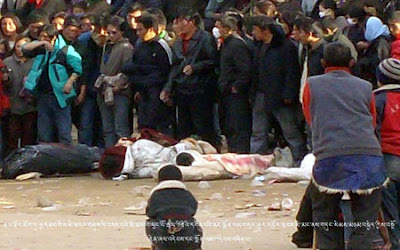
And courtesy of my Tibetan-speaking friend Amalia Rubin, who just returned from Lhasa a mere month ago, here is a photo e-smuggled out of Tibet, of the dead bodies in Ngawa. She writes:

This photo was recently sent to me by someone in Tibet. These are bodies in Ngawa. People shot by the police. These are REAL TIBETANS. REAL people being murdered.

Sunday, March 16, 2008

Drawing blood

Live from Boudha
Kathmandu, Nepal

This afternoon I witnessed a Tibetan monk beaten, along with two other protestors, during a nonviolent anti-China protest at Boudha Stupa.

The three protestors were just standing (with Tibetan flags) at the stupa entrance, between the New Nyingma Gompa and the Ajima shrine, chanting slogans. Totally nonviolent. In fact, they were there for so long it got routine and I went off for tea.

When I returned half an hour later (about 3.30 pm) they were still there, chanting "Dalai Lama Zindabad," "Hu Jintao Murdabad," ("long live the Dalai Lama," "death to Hu Jintao"), "UN Where Are you?" "stop the killing in Tibet," and so on. They were standing on a Chinese flag that one protestor told me they planned to set alight. That's about as violent as they got, planning to burn a flag.

I looked down for just a moment to adjust my camera. Out of nowhere I heard a sickening thud and people started running. I ducked under the porch of the Nyingma Temple (figuring that if I had to, I could go inside - surely they wouldn't trash the monastery and shrine). The Nepali boys went straight for the one monk of the three protestors - -with large 2x2 wooden sticks raining blows.

"Don't take pictures! Don't take pictures!" they yelled at anyone with a visible camera. Then, "This is not a place for protest! This is our God-place! Do not protest here!" in English. Which to me, sounded very rehearsed and conspicuous. In English? The attackers were local Nepali boys (from the Tamang community, if it matters).

Having a little sub-compact camera finally paid off as the professional photogs with their bulkier equipment were chased off and threatened by the attackers. I just stood behind a column on the mandap of the New Nyingma Gompa and snuck snaps.

The monk, his face painted with the red, blue, yellow and white of the Tibetan flag, lay motionless on the ground - I suppose he'd been trained to react that way to violence. The boys continued to whack him, with body blows to the back and front torso.

Some Tibetans tried to approach the monk to assist him. They, too, were attacked. A uniformed security guard, employee of the Nyingma gompa, stood by with hands behind his back.

Eventually the thugs disappeared and sympathetic persons could approach the monk. He was lucky they hadn't busted his ribs. The monk sustained only some bad abrasions to his face, which bled fluently through the face paint. Very slowly, with his friends sustaining him on either side, the monk began to walk. He must have had terrible bruises all over.

Two Tibetan helpers flanked the monk. I came over and suggested, "Shechen Clinic jaane." (It seemed better to go to the clinic of a local Tibetan monastery than to go to the Nepali-run hospital, which might not be sympathetic.) Slowly we all started moving down the unpaved lanes, toward Shechen.

Bystanders glanced up from their labour, looked aghast, clicked tongues and shook heads. The attackers had actually stooped to attacking a monk - a nonviolent monk. This was sure to rouse more anger in the community.

We were joined by another foreigner, a British man named Lewis. He had seen the whole thing too, and felt it important to accompany the monk and party down the lanes. It was less likely that the party would be attacked again if a couple of foreigners with cameras were walking beside them. (Indeed, the tradition of the sahib dies very hard.) Westerners are both assumed to be pro-Tibet and sympathetic, and simultaneously less susceptible to localized violence.

The fact that the attackers were local Tamangs confused me. Tamangs, a Tibeto-Burman people, share a language family, and more importantly, the same religion of Tibetan Buddhism with Tibetans. There are a number of Tamang monks as well as Tibetan in the area. Why would they attack the nonviolent protestors and monks?

When we reached Shechen, the doctor cleaned and dressed the monk's wounds. Luckily there was no serious injury. I took this chance to question the Tibetan compadre. The duo (and many other protesters in the area) turned out to be from Himachal, and came here with a coordinated group to launch nonviolent protests.

Tenzin and other Tibetans I spoke to believe the Tamang boys were paid by local Chinese contacts to carry out the beatings. They claim there have been a number of monks (at least eleven, according to the doctor at Shechen) injured in the same way, by local thugs on Chinese pay. It's true, there is a certain amount of rivalry between the Tamang and Tibetan communities - for one thing, the more recently-arrived Tibetans tend to be more prosperous and high profile. It's so sad that a bit of money and local rivalry could induce them to attack their co-religionists.
There were a few guys hanging round the Stupa who had "McLeodganj" written all over them. I cautiously approached them. One told me that there was another action planned for either the Chinese Embassy or the UN building in Pulchowk within the next hour, but they couldn't or wouldn't give a fixed time or place. The next time I looked, they had dispersed.
These days, there is a skirmish at the stupa every single evening. There is a routine march round the stupa Kora, or circumambulation path. After about 20 minutes of this, the procession attempts to leave the Stupa enclosure (a UNESCO World Heritage site) via the main gate. It seems a fitting symbol for the whole procedure - going round in circles, unable to find an outlet for their justifiable anger, then beaten back by local powers sympathetic to China.
Every night they are confronted by Nepali police in what's known locally as a "lathi charge" (raining blows with their bamboo canes, the subcontinental version of a billy club). The pro-Tibetan group is driven back (running, with that panic I know so well from a number of Indian stampedes) into the stupa enclosure.
I didn't see this, but in last night's skirmish several shops on the Main Road ("Boudha Tushal") were vandalized - bricks thrown through windows. Locals I spoke to claimed the shop owners were either Chinese, or locals functioning as Chinese spies, employees and sympathizers.
I'm waiting for a call from a photographer for Himal Media whose "stupa mole" will tell us if there's more activity tonight, but right now I'm exhausted.
Travel advice for Kathmandu: it helps to be white, and wear running shoes.