Showing posts with label buddhist. Show all posts

Thursday, February 03, 2011

The Great Game

Indo-Sino-Himalayan Intrigue!
Siddhbari and Dharamsala, India


Why would the Himachal Pradesh monastery of  revered Tibetan lama HH Gyalwa Karmapa house a reported $1.6 million in various foreign currencies, including enormous amounts of Chinese yuan - why, except that the Karmapa must be "a Chinese spy"?

The traditional South Asian paranoia of the dreaded "foreign hand" has again reared its ugly sira in the Himachal police's January 27 raid on Gyuto Monastery, home to the Karmapa lama since he fled Chinese-controlled Tibet in 2000 at the age of fourteen.  Xenophobia, coupled with resentment and jealousy of the tremendous international money and attention focused on India's Tibetan refugees, would appear to be at the root of the Himachal state government's vitriolic attack on the Tibetan community. 
Despite their dispossessed status, the community and its religious institutions have brought Himachal Pradesh untold millions in tourist revenue.

Might the cash stash be explained by the fact that Karmapa's Kagyu denomination of Buddhists had only recently (December 22, 2010) concluded the enormous Kagyu Monlam international prayer festival, which draws donations from devotees and Buddhist foundations spanning the globe?  And could the Chinese yuan be explained by the fact that Karmapa has a sizeable Chinese devotee base? 

Unlike the Dalai Lama, the Karmapa is officially recognized by Beijing, even considering Karmapa's escape to India.   The annual Kagyu Monlam in Bodh Gaya is dominated by Chinese devotees, as anyone who's tried to find a seat under the otherwise-serene Bodhi Tree without getting elbowed by them can tell you.  (Also, visiting Tibetans from across the border give donations in Chinese currency.)

Nope, that's too simple, too easy - and far too logical. Karmapa must be "a Chinese spy."  This is the type of illogical elaboration that in the past led Indians to create mind-boggling, fantastically embellished art forms.  The results aren't so enthralling in realpolitik.

Today's news shows that Himachal Chief Minister Prem Kumar Dhumal is busy setting up intelligence cells to monitor the activities of the state's Tibetan population, which number in the thousands (India's Tibetan population in all states totals 94,200). Spying on the state's most prosperous community will surely lead to more troves of treasure. Tibetans have also been told to "stop protesting" and peacefully assembling and ordered to cooperate with the state's investigations.

Indians often wonder aloud why Tibetans don't just get with the program and become Indian citizens. This just wasn't possible, until very recently, when the Delhi High Court ruled that a Himachal Tibetan woman's application for citizenship must be honoured.  (The judge also ruled that a previously established policy denying Indian citizenship "by naturalisation under Section 6 (1) of the Citizenship Act to the Tibetans who entered India after March 1959 is erroneous and hereby quashed."  This would seem to open the door for Tibetans desiring enfranchised citizenship within India.)

Therefore, Tibetans are poised to become an integrated part of India. Dhumal's accusation puts Himachal behind the Indian national curve.

Not surprisingly, the most sensible statements are coming from the ever-unshakeable Karmapa himself.  His statement of February 2: 
“India had become a second homeland to the Tibetans. We all have taken refuge and settled here. The country, in contrast to communist China, is a democratic country that is based on the rule of law. Therefore, I trust that things will improve and truth will become clear in time. So please be at ease. There is no need to worry,” the Karmapa said.

And I believe him.  This type of malicious attack belongs to the backbiting India of yesterday, a nation so insecure that it saw enemies in the corners of its own eyes. India's embrace (albeit sometimes theoretical) of Tibetans, allotted by the idealist Nehru, set an international example.  The medieval accusations of  the Himachal government won't bear the scrutiny of modern light.

"Let the investigating agencies do their work. Truth will prevail."


Monday, March 29, 2010

Dakinis of peace

In the summer of 2008, I followed a group of Tibetan protestors in Kathmandu throughout their entire day - preparing banners, moving from their dwelling site to the protest site surreptitiously (Nepal police were expecting protests, so Tibetans in large groups were likely to be waylaid), and rehearsing nonviolent protest techniques.

Previous protests had involved struggle - the shouting demonstrators would approach the Chinese embassy or consulate and refuse to move. Most of the photos I (and so many other photographers) got were the same day after day - lots of pushing, pulling and gnashing of teeth.  Though I very much supported the demonstrators, I felt it was becoming predictable, and righteous anger is difficult to sustain day after day, for several hours, on an organized basis.

Protestors included Tibetan laypersons, always some monks, and usually a few nuns.

One day, there was an unusual number of nuns involved.  That day, the technique changed. The nuns just lay down on the pavement, shrouding themselves with Tibetan Snow Lion flags.  It was so unexpected, even the police started laughing.  Their gentle prostration turned everyone's expectations on their heads.

These nuns were so sweet, shy, and humble. I reflected on their daily lives in the Tibetan Buddhist world. They don't get many of the privileges afforded to the monks, and their education is often just learning to recite and memorize scripture without the higher teachings of philosophy.   Several projects (Kopan Monastery for Nuns in Nepal, and Tenzin Palmo's Dongyu Gatsal Ling Nunnery in north India) have begun to redress this situation, all with the blessings of HH the Dalai Lama. 

In Tibetan tradition,  Dakini (Tibetan Khandro) is a female embodiment of enlightened energy. Some Dakinis are full-fledged deities, but others are semi-divine and wear human bodies."The outer-outer dakini is a dakini in human form. She is a yogini, or Tantric practitioner in her own right." With or without the 'higher' philosophical teachings, the nuns naturally embodied the Enlightened Female Energy - Dakinis of Peace.

Please copy this photo and share it anywhere you like (just don't charge money for it).  Because my computer crashed shortly thereafter, this is the largest file I have for it, and it's too small to sell commercially. But when you look at it, see the Dakinis flying.

Related reading: 
.

Thursday, July 23, 2009

Fair to partly cloudy

Grey, green, gold, blue and white
Ranipauwa, Muktinath, Lower Mustang

Those are the colours of the landscape up here at Muktinath (in the lower Mustang region), an elevation of about 12,000 feet. Grey are the mountains; green trees; blue skies, golden wheat and white clouds. It was a precarious plane ride (between mountains, from Pokhara to Jomsom), stopped at the Magic Bean coffee shop in Jomsom for java, before walking to the shared Jeep ride.

I recommend sitting on TOP of the Jeep from Jomsom to Ranipauwa. They do not give you a discount for doing so (the ride is still 500NRS for foreigners) but it is much more fun to have the wind in your hair than to be in the stuffy inside.

Waiting for the Jeep you will see a colourful mix of fellow travellers. The Hindu sadhus are refreshing as, unlike the city "pseudhus," they are genuine pilgrims and not out for spare change. There are Tibetans and Tibetan-descended Nepalis who are native to the lower Mustang region, random "other" Nepalis, a few clean-scrubbed Western volunteers who are eager to teach the locals English, and of course, what I call the Stick Men (over-equipped foreign trekkers with their two walking sticks, one in each hand).

The morning of the eclipse dawned grey and cloudy, as luck would have it; but it was still great to be in a quiet, sacred space.

I am waiting for the camera batteries to charge; then I can upload photos.

At this time of year the region is really empty. Of course there are a lot of monsoon clouds, but they clear off a couple times a day for great views of what I assume are the Dhaulagiris.

Ranipauwa (the base village for Muktinath temple) is surrounded by more traditional villages such as Dzong ("hilltop fortress"), Purang, Lubra, Khining and Jharkot, which is home to the Tibetan Medicine society, a large Sakya gompa and an ancient ruined fort. During these first 3 acclimitization days, my walks to these villages, through golden wheat fields and meadows of flowers, have been nothing short of enchanted.

The "happening spot" in "town" appears to be a place called Hotel Bob Marley which actually is decorated in 100 percent Bob Marley paraphernalia, if you can imagine that, and run by a Nepali transvestite (very nice eyeshadow). In season I guess it is full of drunk Aussie climbers. Now it's nice and empty.

Muktinath temple is actually a walled compound (a complex complex at that) encompassing various religious expressions. The "main" temple to which most people refer when they say Muktinath is a three-tiered pagoda-style structure shoved way up under the very last spot before the mountain turns to cliffside. It's surrounded by the cold mountain streams, 108 spouts coming out of the steep hillside, so it constantly feels cleansed and renewed.

I normally associate Himalayan mountainscapes with Shiva in the Hindu pantheon, so was surprised to find it is a Vaishnav Hindu temple (though most people will claim it is "both Hindu and Buddhist"). The temple darshan (opening and closing of the doors) is controlled by a Buddhist nun. I'm going to read up a bit on the temple history.

The temple is best known for its association with Shalagrams, the sacred stones with ammonite fossils inside, said to be manifestations of Vishnu's sudarshana chakra. The stones grow naturally in the nearby Kali Gandaki river. They are for sale down below in the town, but technically you are not supposed to buy them. I think you are meant to find them, or have them "come" to you.

Additionally there are a Hindu yagnashala (fire ceremony house) where fire pujas go on daily; three very old Buddhist gompas with mostly clay (not stone or metal) statuary; a Shiva temple with an unusual iconic image (not just a Shivalingam, but marble figures of Shiva and Parvati); mountain ponds suitable for bathing, and lots of Buddhist prayer wheels.

Everywhere there are these solar cooking ovens that were thoughtfully donated by some German NGO. Great idea - to cook with solar energy rather than using local firewood, which deforests the land, or kerosene which has to come from down below. Too bad I have yet to see anyone use even one of them.

Development people need to realize: you can suggest all you want, you can lead a horse to water, but people do what they want to do. Not what you want them to do. Even when it means killing the goose that laid the golden egg.

Related reading: 
Trekking North of Pokhara Jomsom, the Thak Kola Canyon and the Annapurna Sanctuary: No 2 (Nepal trail guide)

Monday, July 06, 2009

I'm back, sort of

Temple of the Sword-Wielding Goddess
Sankhu, Kathmandu valley

Ack, I am suffering from what has become my annual Monsoon Illness. Somehow, hard as I try, it gets me every July that I stay in Nepal. I have got to get out of here earlier next year.


Here are a few photos from my visit to the atmospheric, remote temple of the KhadgaVajrayogini
at Sankhu village, on the eastern edge of the Kathmandu Valley.


'Sankhu Vajrayogini' is one of the four guardian Vajrayoginis ("Adamantine Goddess") that stand watch over the Valley. The other three sisters are found at Pharping, Guhyeswari (foreigners not admitted), and Swayambhu at Bijeshwori.

I hope to make a complete tour (via bicycle) of all four Yogini temples and post a yatra-logue about the whole thing.

Photos of the murti were not permitted, but I found the people up at Sankhu temple to be welcoming and very, very proud of their goddess. The young girl below (who spoke excellent English) explained to me simply, "She is our Mother."

Thursday, May 28, 2009

Art appreciation

As some of you know, I spent about four years travelling around India and Nepal, and about two of those were following HH the Dalai Lama to his many places of teaching and discourse throughout India.

Nowadays, some wags probably consider that stalking. There was a day when it was considered pilgrimage. That's what you do with saints, in the Hindu and Buddhist tradition. Saints don't stay in one place, they keep travelling. You follow them around.

Anyway, some of my favourite moments were in and around the teaching sites, where "Life's Rich Pageant" coalesces.

This photo was taken one morning in 2006 at Sarnath, Uttar Pradesh at the Central Institute of Tibetan Higher Studies, where everyone was queuing for the metal detector to get into teachings.

Last week, I received some Art Appreciation from a Flickr user named East Med Wanderer:

Great shot! All life is there - it has the quality of composition of one of the great master painters. And with a point and shoot - terrific!

Sometimes that's all it takes to make your day, or week. One of the great master painters probably would include the entire face of the purple-wearing woman at left, though - for compositional balance. That way, there would be two women facing each outside corner.

I can no longer post the larger versions of the photos - they kept getting stolen off the blog site. You can view (but not right-click) a larger version here.

Wednesday, May 27, 2009

Nepal ra Buddhadharma ko blog chha

Just found a Buddhist blogsite with an incredible sidebar of Buddhist online resources. Yes, they (Enlightenment Ward) do link yours truly, somewhere down on the sidebar.

More relevant and regionally-related blogs - these should give some windows into what daily life "looks like" over here, in the city at least.

Mikel Dunham: I was really pleased to find this site; the author of Buddha's Warriors evidently lives here in the Mandu and is a very active commentator on contemporary Nepal including Nepolitics.

Morten Svenningsen: Tireless documentor of daily life including protests, bandhs, shutdowns and so forth here in Kathmandu.

Roaming Redde: my friend Rene's daily adventures living and teaching English among Tibetan monks here in Boudha.

Snow Lion Foundation: All-Tibet all the time website; news, articles and blog.

You're Welcome!

Monday, March 30, 2009

Punching Lamas

Nutshell synopsis:
It's a familiar formula that still never fails to jar and enrage: The Chinese as saviours of that which they have destroyed; protectors of that which they despise.

......
De-coding the cryptoganda

News from China


There's lots of "Panchen Lama" in the news this week, what with the Chinese government's Serf's Emancipation Day being forcibly observed in Tibet, and their "World Buddhist Forum" featuring their very own child star, the puppet Panchen Lama.

So, looks like it's time for my semi-annual Panchen Lama blog.


A Tale of Two Lamas
People often ask me: "Will the Panchen Lama be the next Dalai Lama?"

First of all, not really, as they're two separate offices. Once you've been recognized as a Panchen Lama, you cannot become a Dalai Lama and vice versa.

Second, depends on exactly to whom you're referring.

The PL usually referred to as the "real" one, Gedun Chokyi Nyima, at left, hasn't been seen since 1995.

The "PL" currently appearing at the Forum is a hand-picked Chinese stand-in, and he would become something like "a new Dalai Lama," if the Chinese government had their way.
A five-year-old boy was chosen by the Dalai Lama as successor to the 10th Panchen Lama in 1995, but he has disappeared from public view since his selection became known. China's critics ... called him the world's youngest political prisoner. (from the Boston Globe)
The Chinese puppet "Panchen Lama," known by Tibetan loyalists as "Panchen Zuma" or Fake Panchen, is being trotted out as the key guest at China's own "World Buddhist Forum."

Conspicious by their absence: all the world's most famous Buddhists, like His Holiness the 14th Dalai Lama, HH the Gyalwa Karmapa, and Vietnamese Rev. Thich Nhat Hanh, among others.

I wonder whether any of the participants in this "conference" disputed or boycotted the absence of HHDL - as Tutu, DeKlerk and many others are in the case of South Africa's failure to issue Him a visa for an international peace conference?

Of course, we all know it's not safe for the Dalai Lama to go to China. But it seems any real Buddhist leaders worth their mani mantras ought to boycott such a conference being held in China.

Like McCartney's post-Beatles re-education campaign to depict himself (rather than Lennon) as the real "artistic" one, the Chinese government continues to rewrite history and cast itself as a saviour and proponent of Buddhist culture and religion.

Note that many of these "news" stories are from the official Chinese press, such as People's Daily. I give you clips as they are delivered to me by Yahoo News Alerts (Keyword: Buddhist).

Experts: Protection of intangible Buddhist heritage in China significant
People's Daily Sun, 29 Mar 2009 23:13 PM PDT
Buddhist experts attending the World Buddhist Forum over the weekend called for enough attention to the protection and inheritance of the intangible Buddhist heritage. "Buddhist culture is an important part of the intangible cultural inheritage in China"....

What a nice statement. Too bad China was and is one of the prime destroyers of that intangible culture.

In a similar vein:

Chinese Buddhists urge international cooperation in scripture researches
China Economic Net
Sun, 29 Mar 2009 19:23 PM PDT
Buddhist experts attending the World Buddhist Forum here called for international cooperation in researching and protecting the Tripitaka, the encyclopedia of Buddhist culture.

And here are appearances by the stage-managed Chinese Panchen:

China's Panchen Lama criticizes "unscrupulous" foes
Boston Globe Fri, 27 Mar 2009 01:01 AM PDT
The young Tibetan anointed by China as its Buddhist figurehead for the region said Tibet faces assaults on stability from an "unscrupulous" individual, in what appeared to be a thinly veiled denunciation of the Dalai Lama.


Panchen Lama, businessmen weigh Buddhism's impact on business
China Economic Net

Sun, 29 Mar 2009 19:22 PM PDT
Singing, listening and taking notes, the 11th Panchen Lama, Bainqen Erdini Qoigyijabu, attended a forum Sunday here with businessmen and monks, where they discussed
Buddhist philosophies related to business.

I thought the Chinese kid's name was Gyancain Norbu...??

...and on the stories go...you can tell which news sources are China-approved and which are not by whether they specify "the China-backed Panchen." This Taiwanese paper carefully notes the irony of "officially atheist China turning to Buddhism":

China turns to Buddhism to calm Tibet, Taiwan tensions
Chinapost.com.tw Sat, 28 Mar 2009 18:18 PM PDT
WUXI, China -- The Beijing-backed Panchen Lama addressed an international Buddhist audience in English on Saturday, as officially atheist China turned to Buddhism as a balm for internal unrest and international tensions.


It's a familiar formula that still never fails to jar and enrage: The Chinese as saviours of that which they have destroyed; protectors of that which they despise.

Related reading: 

Himalayan Tragedy: The Story of Tibet's Panchen Lamas 

Thursday, February 19, 2009

Pressed

Unhappy new year
News From Tibet and diaspora
Waiting for HH
As I am usually what passes for a Tibetan-culture knowitall at most gatherings, foreign friends have been asking me: "So when is Losar?" (the Tibetan New Year celebration).

In 2009, Losar is supposed to be February 26. But this year, I don't know whether there will be any celebrations, or to what extent.

At least one sector of the Tibetan community feels Losar should not be observed with any festivity this year. This is partly due to the extreme state of distress in Tibet at the moment and partly to observe the 50th Anniversary of the Dalai Lama's escape from Tibet into India, and the Tibetan Uprising.

(If you would like to know more about the events of 1959, the Times of India has finally justified its existence by providing a handy online archive going back some 150 years with original news articles from the period.)

Of course, some don't agree; and I can definitely see the irony of asking a culture whose very survival is an achievement *not* to observe one of the major manifestations of said culture - even moreso when the Chinese government has tried to force ethnic Tibetans to celebrate the Chinese Lunar New Year instead.


No more questions!
Recently, the Chinese government made a big deal of "inviting foreign journalists to Tibet" (after expelling most of them last year) for a highly-orchestrated press trip to Lhasa. The trip included a visit to Drepung Monastery, which last year became a centre of Tibetan resistance.

I read two different accounts of the trip (some
excerpted below); the reporters from different news outlets appear to have spoken with many of the same people and gotten the same rehearsed responses. China defenders say things like, "You can't believe what you read; you should go there yourself." As if that were even possible for most people at the best of times, the Chinese government has now declared several Tibetan-majority areas off limits to visitors.

Those who do go - such as these various journalists - give very similar reports.
Every tourist account I have heard first or second-hand has reinforced these accounts (from one Indian tourist: "I was on a boat with a uniformed police officer; later I saw him in the monastery wearing monk's robes").

Tibet's religious life still bruised by riots (Reuters):
Inside, monks take patriotic education classes on Chinese law, alongside their Buddhist scripture studies, and were kept closeted away from visiting foreign journalists on a rare and tightly controlled government visit on Thursday.

In Tibet, it's just the facts, ma'am (MSNBC): In this account, one of the brave young monks who, last year, interrupted a similar government-arranged press trip, is now mysteriously transformed and recants:

-He said he no longer felt
the way he did last March, because he and the others realized they had been "misled by the wrong people" (he did not elaborate what he meant). Norgyal also maintained that he had been able to continue his religious studies although he did say the monks had been given "patriotic" study sessions, during which they learned about Chinese law and constitution.

At Drepung Monastery, Ngawang said his monks had also been studying the legal system. "We have legal knowledge sessions for all the monks," he said,
in order to ensure order in the monastery.
"We study the laws and the constitution so we understand the laws better and do not break them," he added. "The monks are also Chinese citizens."
A visit to TibetInfoNet gives an idea where some of the dwindling monastic population may have gone: "Nine monks sentenced; others committed suicide"


This week's Site for Sore Eyes

If you're one of the majority who will never physically get close to the sacred places mentioned above, you might want a virtual visit via Sacred-Destinations.com -which looks extremely cool, well-arranged and informative, and is certain to become one of my preferred time-wasting devices. 


Related Reading: 
Tibetans in Exile 1959-1969 : A Report on Ten Years of Rehabilitation in India 
Tibetans in Exile: The Democratic Vision 
 

Wednesday, February 11, 2009

Naya ghar ko puja


At least, I think that is how one would say "New house puja" in Nepali.
On Saturday, Raju and I walked out to Dallu (a neighborhood beneath the famous Buddhist heritage site Swayambhunath stupa) to the home of Sarvaghya Bajracharya, the eldest brother of Raju's dance guru Prajwalratna Bajracharya. (There were six children in the family. At about 40 years, Prajwal Ji is the youngest.)

Sarvaghya is a
Bajracharya by family/caste, and a "guruju" by trade. That is, he is an itinerant Newar Buddhist priest, going round to various Vihars or Buddhist temples (formerly monasteries long ago), performing ceremonies and reading ancient sutras as called upon.


(photo above: Newar Buddhist women prepare to worship the Prajnaparamita sutra at Kwa Bahal, Patan)

It was pitch black on the streets, as has become the norm these days. A few shopfronts stayed open with people congregating round candle
s and oil lamps. As if the people dwelling right on the open sewer of the Bagmati River weren't medieval enough, the lamplights reinforced my feeling that Nepal is going back into literal Dark Ages.

Like most urban Nepali dwellings, the residence was cramped and dark. The dim battery powered light showed the walls painted in a lurid turquoise. Sarvaghya sat on his bed (as guests we were given proper chairs, always a sign of respect). That afternoon, Mr Bajracharya had just been to a conclave of 21 other Bajracharya priests, at the Bidyeshwori temple just up the hill (one of my favourites - the home of AkashYogini or the Flying Space Vajrayogini).

The Buddhist community had honored 21 selected acting priests for their services. He held up a handsomely framed certificate that was in Newari language, but rendered in Devanagiri script, which means that I could sound out the words but had little idea what they meant.

Mr Bajracharya was very quiet, but understood more of my Sanskrit- and Nepali-sprinkled English than he let on. Raju acted as translator but often the priest understood my questions without translation.

I realized this was an ideal person to help inaugurate my new flat, and asked Raju to invite him to perform a New House Puja. He agreed, then we had a discussion about which exact puja of the dozens he knew would be appropriate. Sarvaghya decided something called "Kalasha puja" was ideal. The reason? Tara Puja is great, too, he said, but it is some three hours long. The Kalasha puja is "only" one and a half hours.

"the main aim of the kalasha puja is to make the deity present in the kalasha by means of sadhana and then through the abhisheka of the kalasha bring about participation in nirvana itself." (JK Locke, 1980)

We discussed where to get the necessary ingredients (I gave a 500Nrs -- about $7 USD - advance for the supplies - most likely rice, flowers, incense, various fruits and foods and oil lamps) and added that I wanted to get the classic Newar Buddhist Panch-Buddha signboard, as seen over countless doorways in Patan, to install over the
entrance. Deluxe ones are available on wooden board; more transportable ones are on paper, pasted up like posters and renewed every so often.

I guess I will blend all my South Asian influences and also have the lemon-and-green-chili charm strung up over the doorway, as well as a garland of mango leaves in south Indian style! Oh and don't forget the Kollam. That is going to be one crowded doorway for a few days.

It also remained for me to choose my Ishtadevata (Tibetan "Yidam") or personal protector deity to invoke at the puja. I have to acquire an image (ideally a thangka or bronze statue) to be present. Vajrayogini is my personal favourite, but seemed a bit incendiary for a house-blessing. Maybe Avalokiteshwara, the 1000-armed benevolent Buddha now believed to be incarnated by HH the Dalai Lama. Then again Avalokiteshwara is, technically speaking, not a Yidam but a bodhisattva.

And the way things have been going lately, maybe we should invite at least one very strong Dipala or Protector Deity.

Then I asked Sarvaghya to choose a Muhurttam for me, or the most auspicious, appropriate day and time for the ceremony. He reached over his shoulder to the wall behind, where a long, rectangular paper brochure hung. It was a Nepali ephemeris, a sort of almanac designed for just such a purpose - to indicate the phases and "houses" of the moon, and appropriate dates for various ceremonies but every activity imaginable (planting, marriage, operations, applying for jobs and so on).

The ideal time and date was determined to be at 9AM Tuesday the 17th of February, on Ashtami (the 8th day of the waning moon).

As we left the darkness and went back out into even greater darkness, I reflected - rather cornily I admit - on the conditions of Nepal generally these days.

All Darkness, no light, and no power. Blankets of air pollution choking us off from the redeeming views of Himalayas, ground pollution (in the form of uncollected garbage), incessant noise pollution, unspeakable water pollution. The five elements of air, space, water, earth and fire all unrepentantly violated. (All right, I am not sure exactly how Fire is being violated; give me a minute, I will come up with something. Burning plastic garbage is pretty bad.)

On the way back to town we stopped at the Bidhyeshwori temple to pay a visit to the Space Yogini, flying through the ether with legs like wings. (my picture at right)

Super Stupas

News from Nalanda

Holy Coolness! New stupas on the Bihari block!
This time it's near the famed former Nalanda University in a place called Ghorakatora.

Imposing Buddhist stupa discovered in Bihar

New Kerala Mon, 09 Feb 2009 06:09 AM PST
Patna, Feb 9 :
A huge Buddhist stupa has been discovered in Bihar's Nalanda district and archaeologists Monday said it could be the second largest such structure in the world.

Two winters ago (2007) after the Kagyu Monlam, I took a wild ride through the Bihar countryside to see the ongoing excavation of Kesaria stupa (one of my photos shown below).

Kesaria is huge - about 10 storeys. Some sources say it's the largest stupa in the world (and just think - there is not one tourist facility there and it's not even completely excavated).

Within 11 of the star-shaped niches are 11 seated Buddha statues. Every one of them has had its head lopped off. If I were in India, I would be too politically afraid to say "Muslim invaders did it." But I am in Nepal, so I can say it. It's true.

Amazingly, there is another almost identical to it in Bihar and even lesser known, called Nanda Laharia. I would imagine this "new" (old) stupa is very similar to both Nanda Laharia and Kesaria.


Since my visit to Bihar I have raved that the entire state is a treasure-trove of barely discovered Buddhist ruins. I think this is still just the tip of the iceberg.

Nalanda was at one time a world-renowned university for Buddhist studies, as well as a monastery. It would be politically incorrect to say what happened to it. In fact, you can visit the site yourself, see the destruction, and not see one single sign indicating what happened. Some mean nasty people tore it down and beheaded hundreds of monks. But we can't say who they were or where they came from. Then we might not get certain votes in the next election.

Nalanda was not the only one of its kind. Taxila (now in Pakistan), Odantapuri and Vikramashila were all major centres of religious education.

Even if it's for primarily commercial purposes, I am glad to see Indians rediscovering their Buddhist history and heritage. Vikramashila (in what is now Bengal) is once again in the news:

Vikramsila (Bhagalpur), Feb. 8: Another festival to celebrate the glory of the ancient university has come to an end today, but without any sign of reviving the seat of Buddhist learning. Governor R.L. Bhatia attended the inaugural ceremony of the three-day Vikramsila Mahotsav at Antichak near Kahalgaon on February 6, raising hope among local people for possible inclusion of the ruined university in the Buddhist tourism circuit.

...Excavated remains represent the ruins of Vikramsila Mahavihar, the celebrated university founded by Pala king Dharmapala in the late 8th or early 9th century. Vikramsila, one of the largest Buddhist universities spread across the bank of the Ganga, was six times bigger than Nalanda.

The story goes on to say how locals are eager for the Mahavihar (Great Monastery) to be restored and linked to what is called, in India, the "Buddhist Circuit" (historical and living pilgrimage route; read: Spiritual Tourism).


As an opportunity for India to increase tourist dollars without opening itself further, as some complain, to the sex, drugs and rock'n'roll decadence of the "evil west," Spiritual Tourism would seem to be ideal.

And back here in Nepal, Buddhist ruins from the 12th century are still being discovered. Here's a story about the site of Kakrebihar.
.... Kakrebihar, a site in remote Surkhet district in mid-western Nepal that during excavation by the country's archaeological department yielded a treasure trove of sculptures and stone carvings.
... the findings established the area as an important centre of Buddhist art.

The Kakrebihar mound is probably the biggest instance of rock architecture in Nepal. The ruins suggest a temple built in layers and decorated with images that illustrate the life of the Buddha, the founder of Buddhism, and his teachings.

Monday, February 02, 2009

Hymn to Her

Fun with liturgy
Kathmandu

Here's one of the Charya Giti I have been transliterating and, partially, translating. Not because I am good at it (I'm not really), but so that I can understand the dances I am learning. There are no English versions of these songs and poems. For those who've just tuned in, I am here studying the Newari Buddhist Charya Giti or Buddhist devotional dances.

Most of the lyrics I can "feel" but don't think my literal translation will do them justice. This is my attempt. There is a chance that this gita appears translated/literated in Kvaerne's 1977 Anthology of Buddhist Tantric Songs (Oslo) but as I can't locate this publication, I don't know.

My goal is to create an illustrated book of the Giti with Sanskrit, English phonetic and English translation, some background and illustrations of each Deity.

 
Sri Kurukulla Devi
Raga: Nata .... Tala: Jati
(the Raga is the South Asian equivalent of the key or "mode." This set of notes determines the "mood" of the melody much as the key does in western music - imagine playing "She Loves You" in Eminor instead of Emajor.
Tala is the rhythm or time signature of the piece. Again, imagine playing "She Loves You" in Waltz-time instead of 4/4. Changes everything. Every dance student must know their talas and ragas to some extent, though not as thoroughly as music and singing students.)Kurukulla
Tribhuvana jananii sri kurakullaa devii
Svetavarna makuta keshii trinayanaa
Mother of the three worlds, Sri Kurakulla goddess...
White-coloured with a crown of hair, three-eyed....

Namami devii sri kurakullikaa taraa
Chatura bhujaa karti khatpara shara dhanudharii

We bow to goddess Sri kurakulla the deliverer
Four-armed, holding chopper, knife, bow and arrow.
Rahu mastaka sthita nrtyapada dharii
Natha shodasha bhujaa aalikngana chun.
Tribhuvana vyapita niilavarna dehaa
Tumha varna devi anuttara sangama
Tempting Rahu (?), standing in a dance-pose
Permeating the three worlds, with blue-coloured body...
(This part confuses me. At one point she's red, at another blue....Sodasha means sixteen; the verse seems to say she has 16 arms but elsewhere she is described as "looking 16 years old.")
Piivad re mahaarasa sudrishta dehaa
Namami sri devii loka udharitaa
Drinking Maharasa (amrit), her form pleasing to see
I bow to the Goddess who uplifts the world
Bhanayikulishaa ratna giita charitaa
Namami sri devii loka udhaaritaa.
(This verse is an attribution stanza telling the name of the Gita composer; and again I bow to the goddess who uplifts the world.)

Here is more about Kurukulla from Vajranatha.com, which appears to be a cool and informative vajrayana web site.

And here is a fun "message from Kurukulla" which was received by Akkarri at Spontaneous Combustion. I especially liked this part:

"I am DANCING. This is to show you how to manifest divine energy for benefit of all....itting in uniform rows reciting rote attribute-lists of the results of human male ego-trips is not a Divine Activity, because it has nothing whatsoever to do with the acknowledgement of MY DANCE."

Related reading: 
Meditation auf Kurukulla 

Sunday, January 11, 2009

Tamaso maa jyotir gamaya*

The business of Buddha
News from Karnataka

Buddhism is a growth industry. In India, where most people are Buddhist for business purposes (catering mainly to foreign Buddhists), an astonishing
number of new structures, complexes and facilities are always going up in the name of the Tathagata.

I think it's mostly great; all the statue-carving (shilpas) and icon-painting gives employment to traditional artisans. And though religious conversion (even from Hinduism to Buddhism) is still a fiery topic in India, it definitely promotes good will toward the Dharma and its exponents.


One of the latest is Gulbarga, Karnataka, according to this Deccan Herald report. Hey, even HHDL will be there on January 19!

I think Gulbarga is better known for some Sufi Muslim tombs, and a fort. But Buddhist remains and relics and ruins are all over India, and continue to be revealed and revitalized.

Gulbarga offers a rich history of the earliest Buddhist settlement of Satavahana period, [2000 or so years ago]. One of the ancient sites here is in Kanaganahalli near Sannati, a famous Buddhist heritage site on the banks of river Bhima in Chitapur taluk.

The remains of stupas, major rock edicts of King Ashoka, mounds, slab inscriptions and statues are all found scattered in a small area within the revenue limits of Kanaganahalli. About five to six stupa remains are found in and around Sannati.

Meanwhile, back at the ranch
In the meantime, in case there was any doubt, Nepal now officially sucks. We only have power for 8 (eight) hours A DAY.

With all the chaos facing the nation, the dominant political party has occupied itself invading the Inner Sanctum of the nation's holiest shrine and trying to replace the 260-year-old traditional priests, who as per tradition came from south India, with Nepalis. One of whom just happens to have the same surname as the Prime Minister himself!


Lighting oil lamps is no longer a charming Hindu and Buddhist custom...it's a necessity.

*Sanskrit slok that means "Lead me from the darkness into the light"


Related reading:  
Buddhist Goddesses of India 

Saturday, January 10, 2009

Only For Hindus

Get lost, injee
Jan Bahal, Kathmandu

Today at the Seto Matysendranath Buddhist temple (S. M. is a Nepali version of Avalokiteshwara, the 1000-armed god of compassion) I was told that I couldn't stand in front of the deity because it was "only for Hindus."

"What?" I retorted. "This is a Buddhist temple, this is Lokiteshwara!" (his nickname)

Someone appeared and explained that it was arati time and in fact, no one could stand in the mandap during arati. Well, now, that's different.

Then I had a good conversation with some Newar locals who spoke English. It seems that "only for Hindus" is just a phrase people have learned that they now use to cover even Buddhist situations!

Friday, January 09, 2009

Songs the Lord Taught Us

Googling the Giti
Kathmandu

It's such a struggle to get on line, half the time I can't remember what I came here for. Oh, that's right, I was going to post something about the Manjushree Charya dance.

In answer to your question, yes, this IS my idea of how to spend a Friday night. (Manjushree is pictured below.)

Obviously, to learn a dance one must know the music intimately. Charya Giti has some uncommon rhythms, even for someone accustomed to the many and varied talas of south Asia.

A quick Google of Charya Giti (the songs accompanying the dance) doesn't reveal much in the way of sources. Evidently there are some old (ancient) Bengali texts, some still found in Bangladesh, that are called Charya Giti.

Also, from the Google front-page there appears to be something in Oriya (Orissa state) with the same name. This would make sense, as Odissi is the "major" classical dance Charya most resembles, and Bengal as well as Assam and Orissa had Tantric Buddhist and Hindu practices at one time (and in some form, still do).

One of the only references to Charya Giti is from Bangladesh. Encylopedia of Modern Asia says in its Bangladesh - Music section:

Twelfth-century Buddhist poems called charya-giti (religious observance songs) and the thirteenth-century Gitagovinda (Songs of the Cowherder), a cycle of songs by the poet Jayadeva, bear the names of the specific melodic modes assigned to each song. Hindu and Buddhist kings in Bengal commissioned poets to compose raso, epic poems, in their honor, which were chanted by the poet-composers themselves.

The Dictionary of Indian Literature says:

Charya Giti aka Charya Pad: 1050-1200...earliest available relics of old Bangla discovered in a manuscript in Nepal in 1916 by Hariprasad Shastri....

Another fascinating section details how the Charya poets, at least in India, wrote under pseudonyms because their work was "much hated by the Brahmins and the elite," and how Charya giti were translated into Tibetan.

Monday, January 05, 2009

Graceland

Sixteen graces
Kathmandu

The available texts and source materials for Charya Nrtya are few. One given by my teacher, Raju Sakya of Nepal Dance Mandala, has Sanskrit text in Devanagiri script, as well as English translation; but strangely, no transliteration so that one can read the Sanskrit in English script. I say strangely, because the book's explanatory text is in English, and one must recite the Sanskrit lyrics in order to learn the dance.

Since I can read the Devanagiri, I decided to transliterate the lyrics. I haven't seen them written down anywhere else. Raju was quite delighted with my work and said "you must type up everything you have transliterated." I wonder if this is available elsewhere. With the state of traditional art forms in Nepal, perhaps not. Surely, the American students of the Portland (Oregon) Dance Mandal must have translated it in such a way, but it's not available elsewhere.

Anyway, the opening item everyone learns (after the Refuge Prayer, which Raju always calls the "Refugee Prayer" ) is the Sixteen Graces. Each item represents a principle as well as a manifest physical offering made to the gods during puja.

Om vajra vine hum....Lady of the Diamond Veena. (a veena is a sort of south Indian lute, related to the better- known north Indian sitar)

Om vajra banshe tra....Lady of the Diamond Flute. (a bansuri is the bamboo flute as played, for instance, by Lord Krishna)

Om vajra mridange hrin...Lady of the Diamond Drum. (Mridangam is the two-headed south Indian drum)

Om vajra muraje ah....(Muraje is a simple one-headed drum, like a snare)

Om vajra lasye hum...(Lasya literally means 'grace' but in this case indicates the Tin Chu, or simple cymbals used to keep time in the dance. In Bharatanatyam we called them Nattuvangam)

Om vajra male tra....(The mala is a garland of flowers. The same word, mala, is also used for a necklace of prayer beads)

Om vajra gite hrin....(Gite is song; in this case, the offering of sacred liturgical song or Charya Gita)

Om vajra nrtye ah....(nrtye is Dance itself.)

Om vajra pushpe hum....(pushpe is offering Flowers. The first Bharatanatyam item I ever learned was Pushpanjali, or flower offering)

Om vajra dhupe tra...(offering incense, or Dhoop)

Om vajravalokite hrin...(offering light; in India it is called Arati or removing darkness)

Om vajragandha ah....(offering perfume)

Om vajra darpane hum....(offering the mirror. This tradition has always intrigued me; mirrors are such a part of south Asian ritual but there are various explanations). First the mirror is shown to the audience, then the dancer looks into it herself with the Bhava of "Adbhutam" or Wonderment.


Om rasa vajra tra....(literally the "diamond taste." This is the classic Vajrayogini pose in which the dancer lifts the "skull cup," symbolically filled with blood, to her mouth)

Om sparse vajre hrin (the Diamond Touch. in this case, touching the Earth as in Bhumisparsa mudra)

Om dharmadhatu garbha ah. (the Diamond Womb-of-Mental-Events; this is shown by
"drawing" a circle with hands and feet. I do know that the Dharmadhatu Mandala is the basic mandala drawn ritually before any Newar house or building is established).

Translating and transliterating is always fun...but now it's time to go physically practice (spirit is willing, flesh can be weak).

Wednesday, December 31, 2008

Unshakeable

Faces from Swayambhu
Kathmandu

Everyone knows I get boring and "spiritual" on holidays. Well, this new year is no exception.
Let's start 2009 off right. It is, after all, the last of the Aughts and oughta be done right.


Swayambhu, the famous "Buddha Eyes" temple (one of many, but probably the most famous one) is under restoration. I thought that was fitting for the New Year, even if it is the English new year. A few questions revealed that a local Nepali monastery (and some foreign well-wishers), not the government, was sponsoring the restoration.

Here are some photos and details from our recent trip to Swayambhunath temple (the sistren and I, that is).

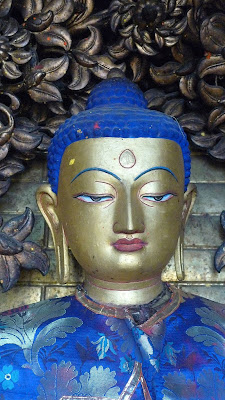
The blue Buddha is Akshobya, the "unshakeable" Buddha, to whom we will pray when the next earthquake rocks the Valley (just kidding. Well, not really kidding).

The elaborate carved archway at the top of the page shows Akshobya in the "bhumisparsa" (touching the earth) mudra with right hand, Dhyanam (meditation) with left hand.
This figure is holding his hands in the Dharmacakra mudra - the 'teaching' mudra aka "turning the wheel of dharma." This mudra is usually associated with Vairochana Buddha.
I am getting to be such a Buddha geek, I can instantly identify these Mudras (hand gestures). I know, you are yawning already.....!


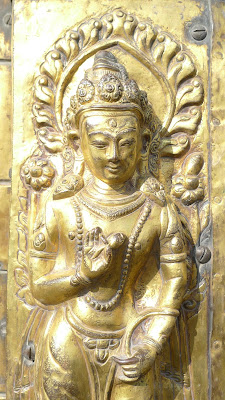
The figure above is holding left hand in Nilotpala (holding lotus stem) and right hand in what would normally be called Gyana mudra (wisdom). But in the right hand he's holding some kind of...flower bud?? Maybe the other half of the lotus.

Here the left hand again is in Nilotpala, and the right is holding a Double Dorje with a hand gesture I haven't yet learned the name of. In Bharatanatyam it would be called Mukula, but I haven't seen this one in Charya.