Showing posts with label immigration. Show all posts

Monday, March 17, 2008

No news is no news

Immigrant Songs continue; Protests Day 7
Kathmandu, Nepal


Didn't make it to any of the pro-Tibet actions today - I spent most of the day arguing with Nepali immigration. (Do you sense a theme here?)

While I was in Maitighar at the new Immigration office (it's been moved from the previous convenient Bhrikutimandap location), there was a major action at the UN offices just across the bridge in Pulchowk, Patan. I'm passing on these news reports.


Police in Nepal clash with Tibet protestors; 44 held

The protesters were demonstrating peacefully near the main U.N. office in Kathmandu, holding banners reading "Free Tibet" and demanding the United Nations investigate a Chinese crackdown on protests inside Tibet.
But police quickly moved in to break up the gathering, dragging protesters away and throwing them into the back of trucks that then took them to a nearby detention center.


Photo by my friend Prakash Mathema who works for Agence France Presse.

These kids in Beijing are brave souls:
Ethnic Tibetan students staged a candle-lit vigil in Beijing on Monday, saying it was to pray for the dead, hours before a midnight deadline warning anti-Chinese rioters in the Tibetan capital to surrender.

Police kept reporters well away from the peaceful protest by dozens of apparently ethnic Tibetan students gathered inside the Central University for Nationalities.
It was a small, rare show of defiance in the host city of this year's Olympic Games, where Communist Party authorities are especially eager to prevent public shows of dissent.
"It was only to pray for the souls of the dead," said an ethnic Tibetan student ....


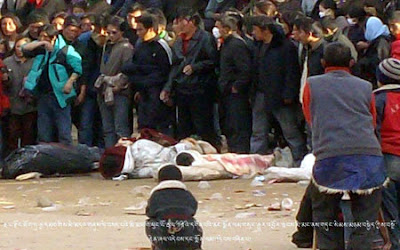
And courtesy of my Tibetan-speaking friend Amalia Rubin, who just returned from Lhasa a mere month ago, here is a photo e-smuggled out of Tibet, of the dead bodies in Ngawa. She writes:

This photo was recently sent to me by someone in Tibet. These are bodies in Ngawa. People shot by the police. These are REAL TIBETANS. REAL people being murdered.

Tuesday, January 15, 2008

Kvetch Beyond Borders

Too tired for a clever subtitle
Delhi

Unless you are critically ill (say, recovering from malaria in the hospital), never, ever try for the in-country visa extension through the FRRO. Just bite the bullet and leave the country.

It takes forever - in this case, nearly 2 weeks - and though they tantalizingly leave open "amount of extension requested," in fact they never grant more than 2 weeks. So, it took me 2 weeks to get 2 more weeks. And, about five various office trips. The icing on the cake will be a personal visit from a police officer to my hotel tomorrow morning "sometime before 1pm" (sounds like waiting for the cable guy).

Supposedly this will help him with "verification of (my) activities" (I'm sitting in a hotel - I could actually be doing anything, not sure what this will prove).

After the ennervating morning at the RK Puram FRRO (I wish I could have taken photos...it was like Central Casting. Afghanis in full turbans, Africans with braided hair, women in burqas, Burmese monks in orange robes) I went for a long walk in Lodi Gardens. After watching a family of wild green parrots nestle down for the night (they live in a hollow tree), and playing with not one but two Basset hounds - plus a bunch of the less pedigreed local hounds who live in the park - I almost felt normal.

It's amusing the way the park signs prohibit "dogs without leash." There are so many strays living all over the park - and they're very friendly.

I was momentarily gripped by a fantasy of rounding up all the Lodi Gardens strays, getting them spayed/neutered/vaccinated by the volunteers of Vets Beyond Borders, giving them all names, registration numbers and collars (yes, it is crazy...I know) and starting a program called Dogs of Lodi Gardens.

Then I came to my senses, remembering what happened to the Dharamsala branch of Vets Beyond Borders. (Someday I will tell this story. Sorry, not now. The good part is that they are still operating successfully in a couple of Indian cities, but I am afraid to even talk about that for fear the successful programs will get shut down too. The short story was: it was too successful. They were making the Indian veterinarians look bad.)

Anyway - Lodi Gardens is home to some sweet stray dogs. The ice cream vendors have befriended them.
Maybe there's already a dog care program for the Lodi Gardens neighborhood - I know there is one for Khan Market area.
Living lawn mowers
These beautiful bullocks (in America we call them "Brahma bulls") pull the old-fashioned grass cutter at the Taj Mahal, then eat the results.

I wish I had been able to get the whole Taj without including the ugly metal fence in foreground.
In a comment that would no doubt irritate proud "progressive" Indians, my Canadian friend said, upon seeing this scene: "now THAT, to me, is India."

Meaning: men and cows doing a job that most of the rest of the world does by machine, slowly, in a green, clean, sustainable fashion, in front of an ancient monument of genius. In America, we now consider this progress.

It's so alarming to hear agricultural specialists and progress wonks in the press crow about how many tractors there are now in the Punjab and how someday soon, "EVERY farm in India will have a tractor" (instead of bullocks).
No to Nano
I mean, India has always made such a big deal about doing everything on their own terms and in their own way...why are they racing to match the standards of the developed world in all the least desirable categories?

Is anyone even a nano-teenth as excited about, say, a new literacy plan or the reputed $100 laptop computer as they are about this damned Tata Nano budget car that has hogged the news all week long?

Suddenly there were no more problems in Pakistan (except the cross-town catfight between cousins Bilawal and Fatima) - only this rather ugly car.

Cheap cars are cheap for a reason, no one seems to have figured that out here yet. Just ask owners of the Ford Pinto. Any money you save on the front end you will end up spending on repairs, guaranteed. But don't listen to me...Americans know nothing about cars. ;-) or pollution. Or traffic, or gridlock, or about going into debt for life just to pay for your car habit.

A car - when you live in a place with ample public transportation - is an extravagant hole you will throw money into for the next 5 years. (A cheap car won't last longer than that.) At the end of that 5 years, you will have nothing for your investment. People have been driving (literally) round and round in this trap in America for decades and again, it is alarming to see other countries fall down the same rabbithole.
Thinking Americans (yes, admittedly we are a minority, ha ha) are going in the opposite direction. Everyone wants to move to a city or country with public transport so they can escape the car trap, with all its maintenance and monthly payments. It's a very costly illusion of freedom.
Anyway, rant over (for now). It just seems that if any country had the potential to figure out a truly progressive sustainable solution to such a problem (transportation) - a solution that suits their unique population and logistical needs - it would be India. Just copying the mistakes of the west in a cheaper form is nothing to applaud.

Wednesday, September 27, 2006

Getting your goat

Dasain Days
Bhrikutimandap, Kathmandu, Nepal

Finally, the weather cleared yesterday, after a weekend of seemingly interminable drizzle and rain and mud. Billowing white clouds now hang over the green hills that surround Kathmandu, and it's hot at mid-day.

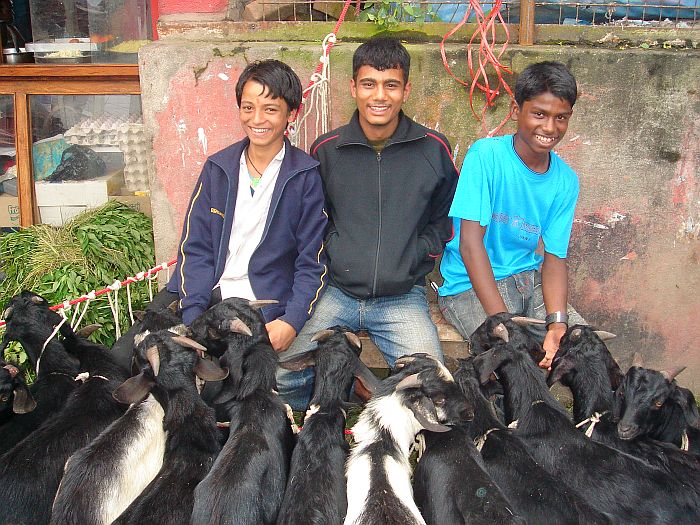
On my way to Immigration, I passed an impromptu open-air goat market - the sidewalk was transformed into a musky-smelling barnyard, with all sizes and colours of goats nibbling at green fodder suspended from rope ties. They were adorable! But sadly, all are doomed. They have all been brought in from the surrounding villages to be bought as sacrificial offerings for the Dasain holiday. If all goes as planned, each and every one (all male goats) will have their throats slit and their blood offered to the goddess Taleju Bhavani, a manifestation of Durga. The unwanted goats will go back to the hills.

I had romantic notions of topi-wearing hill-dwellers herding the goats, on foot, over valley and dale into the big city for market - a sort of annual pilgrimage. Actually, the goat-keepers rent a mini-van (for about 500NRs a day,or $7.00 US) and load the goats inside; as many as 20 goats are crammed into the little vehicle. They pick up uncooperative goats by the horns (in one hand) and the back-scruff (in the other) and toss them in.

The hundreds of goats there were distinguished by some numerical system scrawled onto their horns, and sometimes, blotches of coloured dye on their shaggy coats. One shyster tried to sell me a goat for 3000NRs (about $50), but it turned out the correct price was 160NRS for 4 kg.

The goats are weighed (or as they say here, "weighted") across the road on a medieval-looking contraption that is a combination of a seesaw and swingset. The balances are big enough for a couple of humans to stand in - in fact, it looks like the thing they use to weigh the accused with in Monty Python & the Holy Grail ("I am NOT a witch, and this is not my nose, it's a false one!"). There were a few regulation weights there to balance the goats, but they also used a chunk of cinder block.

If the goats had any inkling of their fate, they seemed pretty resigned to it.

On the other side of the road were an especially handsome looking gaggle of goats, with long shaggy coats, twisted ornamental horns, and an extra swatch of shag hanging between their eyes like overgrown bangs. They seemed like the cool, laid-back hippy goats. Turned out they are a special kind of mountain goat called "Changra," but they don't cost any more than the other goats. I scratched them behind the ears, ruffled their fringed bangs and said a silent prayer for them to be reborn as humans (hopefully, vegetarian humans).

Immigrant Song
At Immigration, they told me that in order to stay in the country on a three-month student visa, I need the following things:
-$750 deposited in my name in a Nepali bank account. This is to prove I have $250 a month to cover my expenses for the three months's time;
-a receipt of fees paid and enrollment from the dance academy in Bhaktapur (which means I have to pay the teacher in advance, usually not a good idea);
-Letter of recommendation from the Nepali Ministry of Education (this is known to take a month or more - sometimes tourist visas run out just waiting for it);
-Various copies of my passport, visa and application itself (not a big deal).
-After the initial submission of the bank statement, you then have to show another just to prove you still have the money (that you didn't just borrow it in order to make a false statement).

$250 a month is quite reasonable for living expenses in Nepal; the problem is, getting it all together at the same time (plus the school fees).

They give you a nicely printed list of all these things (guidelines for foreign researchers and students)... in Nepali script! Talk about missing the point.

All this has to be accomplished within the next 30 days, and about 10 of them are official holidays. Nepal maa, din din ne, ek naya mela aunchhu (in Nepal, every day a new festival is coming).