Showing posts with label culture. Show all posts

Saturday, August 29, 2009

Reconstructive criticism

Dancing in the semi-dark
Kathmandu and Patan

What's "authentic," what's not, who gets to decide that when it comes to "culture"? -Especially when one is a foreign interloper?

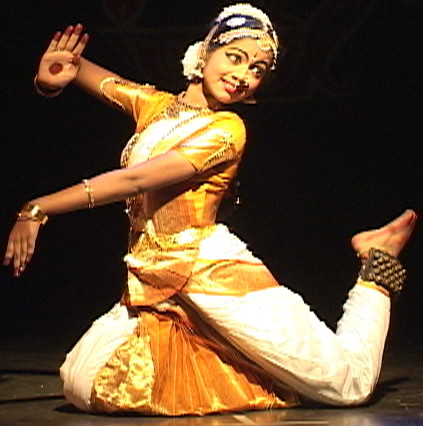
Perhaps it's far from an original question, but it continues to present itself. I continue to learn Newar Charya Nrtya, the Buddhist classical dance of Nepal, and to observe my own reactions to "authenticity," "tradition" and "updation."

Regardless of what the Chennai dance masters will tell you, nearly *all* the Indian "classical dances" were reconstructed from next-to-nothing. (Kerala's Kudiyattam is an exception, I believe, because it was continuously performed without a break in tradition.) That doesn't mean they are not classical, just that they are not as ancient, or entirely as ancient, as often fantasized.

I began to suspect this long ago when my Bharatanatyam teachers had trouble pinning down provenances and answering questions about origins. Given the Indian high esteem for ancient-ness (older the better), this was inconsistent. Being able to cite one's lineage and origin is, almost literally, everything.

(I know "literally" is a very overused word these days, excuse me....)

In trying to revise certain aspects (mostly, the costumes) of Newar Charya Nrtya, I have noticed the same principle applies for the dance that works when observing and learning from Buddhist art.

Sometimes newer is better...because it just looks better. (I know, "better" is a subjective statement. Bear with me.)

That is, the most ancient, "authentic" things sometimes are just too dilapidated to really be of much use. In looking at Buddhist monastery art, it is great to see the oldest paintings...but most of the time, they are barely visible.

Kathmandu and parts of India are full of newly constructed monasteries, some with vivid psychedelic artwork. I can actually get a better idea of forms, shapes and postures from observing and photographing these. It's for the art historians, I suppose, to narrate how the art has evolved. I would like to refer to the oldest artwork available - but it has to be available, and visible.

Are the new paintings "authentic"? They have been painted by modern persons who are students of an ancient, classical art form. "Classical" = there is a particular vocabulary, a canon, of images and styles that are "acceptable."

Until someone decides to throw in something new, that is. I now know this from experience.

Case in point: the costumes (and I know I am not the first - Shahrazad and my friend Margot are at least two that have done the same) that I have decided to revise. True, they are not what the National Academy is using, nor any of the (few) existing Charya dance troupes that I know of. "My" version of the costumes closely follows that of the thangkas, paubha and temple sculpture. So which is more authentic? I'm not Nepali.

When I approached my friend about putting together more "authentic costumes," she responded that there were "no authentic costumes."

Okay, perhaps there are no unchanged costumes handed down in style and form from 500 or 1000 years ago. What I want to achieve is a return, so to speak, to what SCA folks might call *period* materials.

That is, to eschew anything that could not have existed at the time of the dance's origin. (Within reason...I will use Lakme kajal the same way I use red Magic Marker for Bharatanatyam. If they had had red Magic Marker back then, they would have used it. Yes, this is inconsistent! You try using Alta and letting it dry while not getting red stains on your costume!)

This isn't for pedantic reasons...more aesthetic.

The angika abhinaya (body expression) of the basic movements had been obscured, partly by slack standards (where is your tribhangi??) and partly by the billowy costume.

Rather than wearing synthetic satins made in China or India with gold lame border, the original dancers wore veshti. For references, I have been photographing the temple roof struts and sculptures.

Is this nitpicking? Well, the temple sculptures and paintings all depict very specific postures with leg, arm, head and foot positions. If you can't see them, what's the point?

The school of wishful thinking

A return to the ancient, the original, the authentic...this was a big part of the Yuppie ethos, wasn't it? (As the brilliant humourist Cynthia Heimel said in the mid-80s, "You can't just eat maple syrup anymore. It has to be the purest maple syrup made by the cutest little old lady living in the quaintest tiny New England village, completely organic. And limited edition." (paraphrase)

Twenty years later, now that everything seemingly is a copy of a sample of a Xerox of a photocopy of an imitation of a bootleg, it's even more alluring.

"Do they have any dances that are like it used to be 1000 years ago??" my elder sister said on visiting my dance recital at a modern Nashville, Tennessee Hindu temple. I had to say, "not exactly," and watched her enthusiasm falter.

As I may have said before, t's only within the last 30 years that Charya has been performed publicly; previously it was restricted to Newar Buddhist temples. The mudras and songs that are the origin of modern Charya are still performed by the Vajracharya priests today.

An unbroken lineage of any kind is something to be proud of, for sure. But even what is now performed theatrically is not identical with the priestly performances.

Leaders of the New School
Getting Newars in-the-know to talk about this is gradual, hesitant and difficult - perhaps because they don't completely know themselves (only initiates can see most temple dances), perhaps because they hate to disappoint, or perhaps they are unwilling to acknowledge the reversions thinking foreigners will never know the difference.

Some Newars and other Nepalis even indignantly insist that the dance is"meant to be secret" and should not be revealed. If you need an example, just look at the comments on YouTube. "Such things should not be commercialized," one viewer fumed.

Dancers generally have never been known for their material wealth, and I imagine that the other Charya dancers sometimes fervently *wish* that the dance was "commercialized," if only to make a better living. Is merely presenting the dances on a stage, for a pittance, commercializing them?

Then there's the (apparent) fact that the dances, as presented for the past 30 years, are not identical with the esoteric rites. There is no revelation of Tantric secrets in a performance of modern Charya, though I may regret having said that when attempting to get funding for projects.

Even leaving aside the question of inclusion ( it goes without saying that women, not to mention foreigners, did not perform the ritual dances), there have been numerous alterations.

In two years of participation, I made a few practical observations. For one thing, I have seen many Newar bahal monasteries -- the space of many is far too small to perform even a scaled-down version of some modern Charya moves.

For another, I have seen numerous Bajracharya priests - with all due respect, they are unlikely to be performing some of the more acrobatic and yogic poses.

For yet another, the music presented for modern Charya often involves recorded female voices. This wouldn't be possible in traditional Newar practice; the women never did and still do not sing. Many recordings use non-traditional instruments, such as harmonium, and speed up the rhythm or add more percussion to make the song "perform" better.

This was reinforced by a visiting Chicago religion scholar who is studying the dances from a strictly scholarly standpoint. As a non-Newar non-initiate, he also has not seen the dances in the actual temples, but from his interviews with completely different sources than my own, had gathered much the same thing.

As my friend the Tibetan art dealer noted:
"My fake (replica) Khatvanga sold for more than the original one."

Why? was it just at the right place at the right time? Maybe it looked more like a Tibetan khatvanga is "supposed" to. A Tibetan lama would be unlikely to buy such an instrument from an art dealer. The contemporary lay-buyer of a khatvanga (a kind of Tibetan ritual implement - a kind of magic wand) would likely crave a certain aura around the artifact. Is that commercialization?

Maybe the new one really was "better." Or even, in its way, "more authentic."

Thursday, February 12, 2009

In the pink

the Underwear Underground
News from India

It's time for what has become the annual update on the Great Indian Valentine's Day Controversy.

In case you have only recently joined us, self-styled "defenders of Indian culture" have protested, often violently, against the de facto adoption of Valentine's Day into the calendar of many and varied Indian festivals.

And it's not just "Hindu nationalists" - reports indicate Muslim hardliners as equally incensed. Looks like a great opportunity for interfaith bonding against a mutually recognized "threat."

Mind you, no one in the pro-VD camp is suggesting that VD be an official, government holiday...the cultural curmudgeons just don't want private citizens strolling hand-in-hand or sending valentine cards.

The recent Mangalore pub incident has the Moral Police back in the headlines, major. (As Richard Gere, Shilpa Shetty and Khushboo can tell you, they are not to be trifled with.)

This year, there's a very creative response - the Pink Chaddi Campaign from the Consortium of Loose, Forward & Pub-Going Women. PCC asks participants to send a pair of pink women's undies (any size, style or fabric) to the head office of the Moral Police - mailing address found here.

No, Valentine's Day is not a part of traditional India. Neither are televisions, cell phones, DVD players or cars. Or speaking English, for that matter. Or cricket. What a great idea - let's get rid of all those, too!

Even in America, I personally always found "V D" to be an obnoxious holiday, regardless of one's relationship status. If you are not attached, VD sucks for obvious reasons. Even if you are, it puts insane pressure on the relationship to prove itself visually and materially. Yuck! But if someone chooses to celebrate it in whatever fashion, that is their choice. My anti-Valentine's friends and I used to have an annual "Love Stinks" party, the apex of which was playing the J. Geils anthem at full volume.

One of the Ram Sene's threats is "tie or die" - that any couple found holding hands or "canoodling" on the 14th will be forced (by them) to marry then and there on the spot. OR ELSE.


Now, despite the death threat, let's try to look at this in a positive way. What a great opportunity for all the gay and lesbian Indian couples who otherwise could never marry! Now's their chance!

Subhamoy Das of About.com Hinduism has thoughtfully provided an overview of (shock!) romantic love stories found in the annals of traditional Hinduism. The image at right is one of the more G-rated depictions found in "traditional" art.


Perhaps no other faith glorifies the idea of love between the sexes as Hinduism. This is evident from the amazing variety of mythical love stories that abounds Sanskrit literature, which is undoubtedly one of the richest treasure hoards of exciting love tales.


Let's face it, the western Cupid is just a cheap, cherubic ripoff of the god Kamadeva.

Thursday, February 05, 2009

High lonesome sound

Down from the mountain, part 2
Kathmandu


Last night's UNESCO bash, the opening ceremony and performance for the three-day mini-festival Music of the Gods: the Intangible Heritage of Nepal's Musical Castes, was like a Himalayan hootenanny.


UNESCO is an organization better known for preserving architecture and works of material art. However in 2003 they passed a resolution to begin work on restoring and preserving "intangible heritage" - music and dance.

Last night they had gathered traditional Nepali folk musicians from remote areas; for some of them it was their first trip ever into Kathmandu. Folk musicians and dancers are of various traditionally "lower" castes such as Badi, Gandarbha and Damai.

I really enjoyed one fellow whose music, except for being in Nepali, sounded just like Old Time American, and the 22-year-old Gandharba girl who had carved and created her own sarangi (Nepali fiddle).

By the end everyone was dancing, including the grey-haired expat crowd, in a celebration of Nepali pride. I like the way Nepali pride never seems to verge on arrogance, unlike some nationalities I won't mention here.

As a Tennessee native, I have long noticed the similarities between Nepali folk and Appalachian folk music. Especially, the sound of the sarangi is so much like the Old Time Fiddle. Even the melodies are eerily similar. After talking to Sean from UNESCO I find that great minds think and hear alike, and there is now something called the Mountain Music Project linking these musicians of these two traditions. Check it out!

Monday, December 29, 2008

To the book depository!

Christmas raid on UNESCO
Jawalakhel, Patan, Nepal

FINALLY. Third time was the charm as Raju and I once again descended upon the UNESCO Kathmandu office, demanding the free publications and books that were so rightfully ours as authentic bearers and students of a dying cultural tradition (in our case, masked and other ritual dances of the Kathmandu Valley).


UNESCO is supposed to distribute their various publications (most of which are about development and architectual restoration) to the general public. As students of religious classical dance, we were more interested in the sector called "Intangible Heritage." This proved to be intangible indeed. Three separate visits all the way out to the Jawalakhel office had found the lights on, but nobody home. Last Sunday (Sunday is a working day in Nepal), we were told they would definitely be in on Dec. 24, Christmas Eve.

Arriving at 2pm Christmas Eve, we were told that in fact, the staff got that day off as well as Christmas Day and the following Friday. The real reason for democracy and secularism: More holidays!

At long last the day dawned when they were both open and in the office, though on this day, too, the librarian and periodicals person was not in. Evidently taking five days' leave for "Christmas" (Christians still constitute less than 10% of the country, but all offices that are even vaguely government-related get to close) wasn't enough; she had 3 more days coming to her.

After much smooth talking by my friend we scored these glossy bound publications:

Masked Dances of Nepal Mandal: (a bit troubling as only 26 of its 163 pages are translated into English, meaning there's a whole lot left untranslated - but I will take what I can get; English information about the dances is scarce)

Tiji Festival of Lo Manthang (more of a photographic booklet than book, but a good basic rundown of a Tibetan Buddhist cham dance ritual)

Intangible Cultural Heritage of Nepal: Future Directions (evidently the idea of supporting Intangible-Cultural heritage, that is rituals, dances, folk music and festivals, is less established than that of preserving material culture and they are still struggling for full financial support)

--and best of all, a 7-volume set called Cultural Portraits Handbook. This includes slim volumes dedicated to Swayambhunath, Bauddhanath, Patan, Bhaktapur, Hanuman Dhoka, Changu Narayan and Pashupati.

Score! We left quite chuffed with our "Christmas" packages full of books about ritual dances of Hinduism and Buddhism.

Saturday, May 24, 2008

Out of season

Mellowed out
Kathmandu

Everything's so mellow now here, now that "season" is over.
Unseasonable rains, perhaps a hangover from Cyclone Nargis, have made what's normally pre-monsoon mugginess quite cool and breezy. All the high-energy level goal-oriented tourists are gone (gotta cross alllll these things off our list so we can say we've done them all!). Now there are more long-termers ("I dunno, just thought I'd see the country, experience it, you know...."), NGO workers, doctoral students and English teachers. Actually they were always here, but now you can see them.


Looking Kathmandu
"Great, I'll see you at 11," I told my friend Shanda, whom I hadn't seen since an ashram in India, where we were all chastely attired in white sannyasi gear. "But I have to warn you - I'm looking verrrry Kathmandu."

In this case, Looking Kathmandu meant I was wearing a screen-printed hand-dyed t-shirt blouse with hippy bell-sleeves and a flaming Yin Yang symbol on it, a day pack made of Guatemala woven fibres, and some long dangly scarf thing from my hair. Kathmandu had finally gotten to me.


People who go to India hoping to relive the 60's are about 20 years too late. The
place to come is Nepal, specifically Kathmandu. It's one of the last places on earth you can still live in a guest house for as little as $1.50 a day, or if you should choose, wear tie-dye, dreadlocks and bikini tops without causing scandal or harassment, and without the sneering judgmental stares that is so much a part of foreign tourists' India experience. (Before anyone gets huffy, I take surveys. It's unanimous.)

(I can always tell when a woman has just come from India - she's still wearing the full punjabi suit and chunni. And I can always tell when someone hasn't been to India yet - they are still wearing spaghetti-strap tops and short skirts.)

At one point this winter, hashish (nominally "illegal") was more readily available than gasoline or electricity. Countless embroidery shops on Freak Street still churn out designs of the Freak Brothers, magic mushrooms and marijuana leaf logos. Multi-headed, many-armed Buddhist and Hindu god icons in shop windows merge seamlessly with posters of vintage psychedelia. And the ultra-specialist Bong Shop on Bhagavati Bahal is *not* a place run by Bangladeshis.


Other major Asian cities have been taken over by Hindi film music, techno and hip-hop sounds. That won't get you far in Kathmandu, where "Born to be Wild," "Purple Haze" and "Break On Through" blare from every bar in Thamel.

Oh, we also have demonstrators - lots of them - and a confrontational police force.

Yes, the dream lives on....at least the consumable, marketable elements of the dream with occasional flashes of utopian idealism, before the stick comes down.

Back in the real world
Back in the other Kathmandu (the newly politicized city where it still takes 10 days to get 5 days' work done) , it's surprisingly mellow, too. Following the earthquake in Sichuan Province (China/Tibet), the Tibetan government has asked all protestors to refrain from demonstrating for at least the coming week, in deference to the quake victims. However, the hunger strikers continue at Swayambhu. Here's a photo of some of the Kopan nuns taking their turn (they are on 24 hour rotating shifts).

The International Herald Tribune
ran an article declaring the "Chinese" earthquake has overnight turned the Chinese oppressors into victims and put a damper on the Tibetan voices of protest. What most people don't seem to realize is that Qiang prefecture/Sichuan province is part of northeastern Tibet, and thousands of Tibetans were also affected by the situation.

Equally disconcerting is the thinly disguised glee with which people are pronouncing the Beijing Olympics "safe" ("Earthquake mutes Tibetan voices").

All the same problems of inequity pre-existing in these areas of Chinese Tibet will extend to the post-quake situation (unequal access to resources, Han favouritism and so on).

Here is the statement from Students for a Free Tibet Delhi on the situation.
It is encouraging to see the incredible rescue efforts and increasingly open media reporting taking place in China, but we have heard almost no information about relief efforts in the affected Tibetan areas. However, on the day the earthquake struck, the regional government issued an urgent official document entitled “Combining work on anti-separatism and safeguarding stability with disaster relief work.” Considering the Chinese government's history of systematic oppression and disenfranchisement of Tibetans, we are gravely concerned that Tibetans impacted by the disaster will not receive equal consideration and assistance

----------------
Now playing: War - Low Rider
via FoxyTunes

Friday, May 16, 2008

Smiling peasants make your day

First world images of the majority
Kathmandu


I'm preparing to enter another international photo contest - two, actually.

One appears to be (judging by past winners) really big on smiling peasantry. Toothless old ladies in traditional headdress. Happy poor people. Friendly natives.

I admit to having a lot of these cliches in my portfolio...should be a shoo-in. ;-)

Here are just a few I have shortlisted.


Monday, April 21, 2008

Applied anthropology

"I was born a poor black child...then one day I heard my first Mantovani record, and realized - *these* are my people!"
- Steve Martin

White people just can't catch a break. If you stick with Strauss and the Civil War, you're a closed-minded ethnocentrist. However, if you express interest in some other culture, you're some kind of orientalist. I guess we should all just stay home and read De Bible, maybe join Daughters of the American Revolution.


I went out to Bhaktapur to exploit the natives this week. Here are some photos. Thank god I'll probably never make any money from them...then I'd be a neo colonialist.

::Bisket Jatra is a nine-day blowout festival in Bhaktapur, the second Every day features a different event. This is the raising of the Lingo (Lingam), a sort of Maypole equivalent (fertility/phallic symbol). When the Jesuits arrived centuries ago in their attempts to convert the Newars, they were so happy to see the lingo - they thought Christianity had already come to Nepal. Boy were they wrong....
::One of the focal points of Bisket is the tug-of-war chariot pull between lower Bhaktapur and upper Bhaktapur. This ancient chariot gets nearly pulled apart like a rag doll. I've seen at least a dozen Hindu chariot pulls and I've never seen anything like Thursday night's chariot wars.

::One of the guardian elephants (nearly life-sized) on the steps of Nyatapola Temple, overlooking the Bhairab Mandir in Taumudhi Square.

::Yummy daal bhatt - the Nepali national dish - at the Newa Family Restaurant in Sukul Dhoka - highly recommended. All this for 110NRS (about $1.50).
::The elaborate medieval style lock on a temple door.

::The Newars created their own brilliant art, wood carvings (above), metal work and Paubha religious paintings. However, most of what sells in places like Kathmandu, Boudha and Bhaktapur is Tibetan, or should I say "Tibetan." All this is junk created by Nepalis and sold by Nepalis. The real Tibetans are all in hiding from the police these days.

A real Tibetan, for instance, would probably never leave a sutra lying out uncovered as seen above...or sell it for a souvenir. Tibetan script itself is considered sacred, not to mention religious writings.

I went to visit a Thangka shop (Thangkas are Tibetan traditional religious paintings) called "Refugee Camp Thangka Painting School."

"Where are the refugees?" I asked. Of course, there were none. All the paintings are done by Tamangs, also Himalayan Buddhists, who learned the art from Tibetans after the 1959 exile.

I asked where all the Tibetans were. One painter guy told me "they're all staying in their rooms these days...they are scared of the police." It didn't seem to bother him at all that his own painting master was being persecuted and driven into hiding.

::Despite its image as an overwhelmingly Hindu traditional town, Bhaktapur also has at least one mosque and many Buddhist viharas, including one Theravada Buddhist vihara supported by a Thai donor.

Wednesday, April 16, 2008

Nepal Bhasha 101.5

Yesterday I reviewed some of my Nepali phrases with the sweet, shy kids who work at my guest house, Sunny Guest House in Bhaktapur.

In addition to saying "Nepalis are generally easygoing," I could have added, "and generally too humble and polite to correct you even if you are using their language incorrectly." Turns out some phrases I have used with success had unecessary or inappropriate words tacked on.

It's confusing, because the people are generally soooo polite, any attempt at all to speak Nepali is normally met with "you are speaking very good Nepali!"

Even when it's not exactly true.

This is in sharp contrast to India, which is more like France in that you'll get jumped on instantly and in no uncertain terms for language infractions.

However, we did get one bit of Viewer mail that had some more aggressive suggestions for learning Nepali. Does sarcasm usually work when attempting to assist someone genuinely interested in your culture, I wonder? Very Indian of you.

....or, perhaps I should attend school in the West and spend thousands of dollars to learn the correct attitude with which to approach another culture. One must be carefully taught to interact with natives, after all. Genuine, innocent unbridled enthusiasm not welcome in high-brow circles.


Fortunately, as I said, most (I have met a lot of them in four years) Nepalis are delighted at a bideshi's attempts to learn the language.

Phrase for today: "Ma Sunny Guest house maa Baschhu." (I am staying at Sunny Guest House.)

Sunday, February 24, 2008

Jezebel Spirit

Went down to the crossroads
The Spirit World via Kathmandu, Nepal

Long-term Siren watchers (shout out to C Drake, Tim Makins, Jayanthi, George, Carter, Sarasvati, KulluKid and Martin! in the house) know of my standing fascination with the nexus of human and divine.

That is, spiritual
embodiment/channelling/possession/incarnation of the human body, in its
myriad forms; from the semi-theatrical devotional (Bharatanatyam and other devotional dances) to current folk phenomena (Nepal's "Buddha Boy") to ritual incarnation traditions (Nepal's Kumari and Tibet's Tulku reincarnation system - HH Dalai Lama being the best current example).

I'm going to blame it all on my youthful fascination with anthro-filmmaker Maya Deren, who did extensive work with the Haitian Vodouns, and wrote the seminal book about that belief system, Divine Horsemen.

This was one reason Hinduism always made so much sense to me, intuitively. How could God be completely separate, outside of and apart from us? Hinduism (and Tibetan Buddhis
m, among others) has this great ongoing tradition of living humans embodying the divine. They walk among us! (In fact, in Hinduism and Buddhism, we already are god, we just have to realize it. But I digress.)

Fortunately I've been able to track down, witness and photograph many manifestations of these various traditions - the Tibetan State Nechung Oracle at Dharamsala (my photo below), Newar Astamatrika masked dance and its attendant "possession" rituals, Bhaktapur's ferocious NavaDurga dancers (photos forbidden there, though), Theyyam ritual god dances of North Kerala, Nepal's Ram Bomjom (the so-called Buddha Boy) back when he was under the tree in Bara district in southern Nepal, the Thiksey Monastery oracle (who danced waving swords on a 3-storey ledge and threw chhang on me) and dinner with (as well as blessings from) 2 of the 3 Kathmandu Kumaris, just to name a few.

There is a Hindu concept of the teertha, which means (in one interpretation) "meeting place" or crossroads . People who are into sacred geometry, vaastu, feng shui and architecture study the bricks-and-mortar manifestations of these teerthas. I'm more interested in the walking ones.

And the (never-ending) quest continues.


This poorly-written article from the Mangalorean is the first I've heard of a Dakshina Kannada (southern Karnataka) tradition known as Bhootaradhana, or "honouring the ghosts and spirits."

The rituals, costumes and traditions seem to be
close to that of North Kerala's Theyyam, which makes sense because they are in a geographically adjoining area. (My photo of Bhagavati Theyyam in Payyanur, above.)

The origin of the cult can be traced from ancestor worship, mother goddess, serpent and trees are incorporated. (Mangalorean photo at right.) There are certain spirits originated from Hindu God Shiva who sends the Bootas or Ganas to earth and ask them to receive offerings from human beings.
...The Bhootas are those spirits which once long back in time used to be in blood and flesh like any human being but nevertheless they were endowed with special and extra-human powers to do and undo things as per their will.... The event is called Bhootaradhane or Bhoota Kola. The season of Bhootaradhane begins usually by the first week of February which also signals the arrival of summer. The Bhootaradhane of various bhootas might go up to May 15. The first couple of bhootas to arrive on the scene are Kallurti and Panjurli.... Regional Resources Centre at MGM College Udupi has an entire library of audio and video and documentary evidence of the various bhootas in Dakshina Kannada and the neighboring Kasargod district in Kerala.

If anyone out there has more information about this tradition, or (even better) has ever witnessed a Bhootaradhane festival, I would love to hear about it.

And, if anyone has a correction or clarification about the Hindu (or any other) tradition to share - please do so, politiely. I am certainly open to corrections, but be nice. After all I am just a gori, and at a genetic disadvantage. The only stuff like this my people do is snake-handling and speaking in tongues (and we don't get to wear cool costumes). The Old Testament god doesn't approve of people looking too good.

Friday, August 17, 2007

Big sky country

Great wide open
Leh, Ladakh (India)
My lower back is really, really sore from sitting watching the Dalai Lama all day, my eyes are burning from the arid dusty air and I am too tired to think of a third thing to round out this paragraph. Oh yeah! My nose is full of crusty stuff.

His Holiness is teaching the "Lam Rim" scripture. Because I am sitting in the press section, have yet to hear the English translation. Maybe I will skip over to the "Foreigners" section tomorrow
It is wild to see the Dalai Lama in a Buddhist place. Usually, he appears in predominantly Hindu places and the Buddhists commute in. Here, most everyone is Buddhist. There are easily 30,000 people at every day's teaching.


Man, there is a lot of space out here. And a lot of dust. And a lot of sky!

It reminds me of a Halloween craft we did in kindergarten. We made a "starry sky" picture out of silver glitter, dropped onto blobs of glue, on black construction paper. But too much glitter always comes out of the tube, at first. We had to knock off the excess glitter into the waste can, and what was left was the "night sky." (Later I added a big yellow construction-paper cutout crescent moon.)


The night sky in Ladakh looks like the paper, before we knocked the extra glitter off. There are almost too many stars. I have a hard time identifying large constellations I know. But, a crescent moon rose last night.
Not of yellow construction paper, but a wafer-thin silver sliver.

Air conditioning of the gods

The most fun thing on this trip, so far, was also the cheapest. Returning from the teachings, the entire Choglam-Sa highway is packed bumper to bumper. I have to wait for the crowds to thin, and taxis want an outrageous 250Rs back to town. So, yesterday my German friends and I just hopped on top of a public bus, on the luggage rack. What fun! Who needs air conditioning, overpriced taxis, seat belts? Ten rupees for a panorama view of the valley and mountains. It really was much better than the hot, stuffy taxi stuck down among the exhaust fumes, or sitting inside the crowded bus itself. Of course, we had to constantly duck under the prayer flags that had been strung up across the roads for the Dalai Lama's visit.

Far from the madding crowd

One reason Ladakh does not "feel like" India is that it is just not crowded enough. Not that I am complaining. But at first, I really could not figure out what felt so weird. Almost lonely. Then it dawned on me....it was more like parts of southwest America; Arizona or New Mexico, to be exact.


My friend Gary warned me years ago that all the sensory overload of India would burn a hole in my brain, so that when I finally went somewhere quiet, I would miss the noise and clutter. Gary, you were right. I found myself looking around the relatively empty roads of Leh going, "where is IT?" and realizing I couldn't even define IT.

Another thing that doesn't feel like India is the absence of Hindus. There are a few. But I had been here five days before I saw my first Hindu temple ( a little tiny shrine).
It looks like one of the orange pyramidal ones the BJP put up in Buddhist places, just to say "we're here!"

Leh is the kind of place you can see minarets of a mosque superimposed with
Buddhist chortens and prayer flags, or sit in the Buddhist gompa and hear the Muezzin's call to prayer, and it feels totally normal.

Ladakh List
Definite must-brings for a trip to Ladakh:
1-Sunglasses
2-Sunblock
3-Lip balm, even better, sunscreen lip balm
4-Umbrella, or big floppy hat as sun protection

5-Eye drops - since I wear contacts, the aridity and dust is wreaking havoc
6-Trekking boots or chunky walking sandals
7-Jacket - evenings get nippy, though days are warm
8-Face moisturizer, which you will also have to put
inside your nose to keep it from crusting over, especially at bedtime
9- ORS (Oral Rehydration Salts, available at any pharmacy here for 15Rs). ORS have exactly what your body needs to replace fluids (potassium, sodium chloride etc) and are a literal lifesaver.

10-Lots and LOTS of water. Your water bottle can be refilled for 5Rs at the ecofriendly Dzomsa shops in town. If you feel weird, lightheaded, fatigued and cranky but don't know why, you are probably dehydrated.

11-Flashlight. The power goes out frequently, and if you are lucky the walk home to your guest house will be down a country road with few street lights.

12-Toilet paper. Guest house bathrooms do not have it, but will sell it at an inflated price.

Things that are totally useless here:
1-"Nice" shoes

2-Deodorant - you won't sweat-- or if you do it immediately dries into salt crystals on your skin

3-The talcum powder and astringent that are so needed in humid lower India. Again, you won't be sweating much

4-Tank tops, sleeveless blouses, singlets etc. show too much skin for local standards, and besides, you will either get a sunburn or freeze to death.

5-Your cell phone, unless you have post-paid. In Delhi, they happily sell you (ha ha) a SIM card saying it is good for all India. What they don't tell you is that in Ladakh and Kashmir (not Jammu), you must have a post-paid account; that is, you must be a resident with proof of address for billing. The prepaid cards are no good here. Of course, all tourists and most internationals have prepaid cards.

6-Alcohol. A disaster at this altitude, and not widely available anyway - rightly so.


Also, be warned - Internet is run by a cartel ("Ladakh Cyber Cafe Association") that has fixed prices at an obscene 90Rs an hour ($2.10). Not the place to play around tweaking the widgets on your homepage. And "photo uploading not allowed" - so, sharing the photos of this amazing place is quite difficult.

I appear to have missed all the really big Lama Dances with masks and costumes. In case you want to catch one, here is a calendar for next year.


Jeep 54 Where Are You?
Getting my press clearance to take photos of the Dalai Lama, when I am in a relatively podunk town like Leh or Bodh Gaya, means making friends with the police. Fortunately, this is easily done. I am the only foreign media person at these entire teachings, and probably one of the few the police have met all year.

What's not so easily done is catching the right guy in the office. The Superintendant of Police closed at 4pm (!) and the following day, Friday, was a holiday. God knows why, probably literally - in India, an unexpected holiday usually has something to do with religion. So I had to go to the main police station ("we never close").

It was an adventure but unfortunately, by the time I sat down to write about it last night, the net connections were down. Now, I am too tired. Maybe later.


The intrepid anthropologist in me never tires of poking into people's social dynamics. I discovered that among ethnic Ladakhis, there are both Muslims and Buddhists, and they feel themselves to be quite distinct from the ethnic Kashmiris. "He is
Kashmiri," one Ladakhi Muslim officer hissed to me, pointing out a Muslim guy on the street dressed in stereotypical beard and kurta-pyjama.

The kurta-wearing "Kashmiri" turned out to be another police officer, who helped me to get the pass, after a few bossy questions delivered in the usual accusatory style ("why did you not come earlier??") of the Indian "mainland."


Indeed, a lot of "Kashmiris" seem to have taken refuge here only as a resort from the violence in "Kashmir" proper. And they don't consider this Kashmir. One of the first things the kurta-wearing officer asked me was "Have you been to Kashmir?"

I thought we were in Kashmir, Sir.

"No, I mean Srinagar, real Kashmir. You should leave here immediately and go to Kashmir. Gulmarg, Dal Lake...." Then he started reminiscing about his homeland. Clearly, he felt Ladakh to be a hardship posting.

Lost tribe
I have also spent some time interviewing and photographing the "Indo-Iranian" Buddhists of Ladakh, the Brokpa people. Originally, they came from what is now Pakistan in Gilgit region. They speak a language called Dardi and have been Buddhist for many centuries. The Brokpa are supposed to be the last "Aryan" indigenous Buddhist people. (They actually call themselves Aryan, which in this case, just means originally from Iran.)

Since I can't upload my own photos, here is one cribbed from a Ladakhi tourist website.

The Brokpa traditional dress worn at the Dalai Lama's teachings is really distinctive, and their features set them well apart from the Mongolian-looking other Ladakhis. I am curious about the form of Buddhism they practice; it must date back, at least in part, to looooong ago when northwestern former India (now Pakistan) was Buddhist. Guru Rinpoche, the bearer of Buddhism into Tibet, was originally from Swat Valley, Pakistan.
Tibetan scriptures still refer to that area as "Ugyen" or "Oddiyana."

I went to the biggest bookstore in Leh looking for a book about the Brokpa. "Who?" said the Kashimiri Muslim guy at the desk. I pointed to a photo of one on a postcard (sold as proof of quaint tribal life in Ladakh).


"Oh, the Aryans? No, no books about them. Something-something in various books here and there, but nothing just about them." If they don't have it here, they don't have it anywhere.

Maybe no one could talk to the Brokpa. All the other foreigners take pictures of them from a safe distance with powerful zoom lenses. I guess there is one advantage to having a cheap camera...you are required to make contact with your subjects.

Monday, July 16, 2007

Chariots of the gods

The gods must be lazy
Kathmandu, Nepal


Finally, the towering chariot of Rato Machhendranath, a Buddhist Bodhisattva figure who is traditionally regarded as bringer of the seasonal rains, was pulled to its resting place in Jawalkahel, Patan.

At last, after a delay of nearly 1.5 months (and even for Nepal, that is a big delay), the traditional Bhoto ceremony took place, with the Patan Kumari (one of the Kathmandu Valley's living goddesses) giving her blessings.

The eight-storey Rath (Chariot) of the deity, assembled of archaic wooden parts and a whole lot of bamboo and pine boughs lashed together, resembled a beserk Christmas tree careening through the crowded streets. Its massive wheels are about 2 metres, or 7 feet, high, each painted with the trademark "Kathmandu eyes." Now that's a big wheel.

Tradition clashed with modernity (literally) when the pine-topped peak scraped telephone and power lines. I wondered about the symbolism of the great piney tower. Sure, you could say it is phallic, but I saw more of a beacon. It's like they've constructed a literal skyscraper, maybe to reach cloudward and beseech the rain gods to come on down to earth. Maybe poking at the clouds with a big earthbound finger.

Such a primordial mega-spectacle takes a great deal of communal involvement and coordination every year. I could really see the practical role that such festivals play in bringing all parts of a diverse community together. Certain elements of the festival have traditionally been allocated to various castes and families, and this is a chance for them all to cooperate in a show of unity, sweat, incense, animal sacrifice, and heave-ho.

While the men pull the chariot en masse with giant ropes, the women now have an active role in the procession - linking hands as a security line to prevent onlookers from getting too near the crushing wheels. In Indian tradition the elderly and destitute used to throw themselves under the wheels, hoping for an auspicious death at the mercy of the gods. Don't know if they ever did that here in Nepal.

However, the rain gods may not be pleased. This year for the first time since the 7th century (!), the appointed Prime Minister, GP Koirala, presided over the Bhoto puja, rather than the King (or the Crown Prince).

While the papers are full of gloating crows like "King stripped of his cultural privileges," "Adieu monarchy" and so on, nowhere is addressed the issue of who decides these things.

Who, after all, gets to decide who participates in this ritual of primeval fertility and festivity?
Did the King decide not to go for security reasons (a wise move, really, considering all the anti-monarchy protests outside the palace on His Majesty's birthday)? Did the rain god Indra come to the high priest in a dream and demand the king's absence? Or did the Patan Guthi (community organization in charge of the event) just decide somehow?

Or, as I suspect, was this at least partially a cowardly kowtow to Prachanda and the Maoists, who have "vowed" to abolish the monarchy (not that it's up to them, or the political parties, to decide - supposedly, it is up to the people of Nepal. Supposedly). Prachanda's Young Communist League, a sort of Red Guard formed in the past 8 months, have been very active in the Valley, with all sorts of extortion, abductions and protection rackets. My Nepali friends say that because of the YCL, they do not feel as safe after dark as they did even six months before.

At any rate, it makes little sense for a Prime Minister of a proclaimed "secular" state to preside at an ancient ritual that represents Buddhist, Hindu and folk religions all rolled (literally) into one.

Let the King take his place in the rituals, for Peetha's sake. That's what Hindu monarchs are for, after all - Ritual,
ceremony and tradition.

Monsooner or later
Thank all the gods (and there's one on every street corner here), the monsoon appears to have at last set in, in earnest. That means, it rains at least once a day for at least an hour. Not the non-stop type of downpour we'll be getting in, say, Dharamsala, which has the second highest rainfall in all of India (after Darjeeling, I think). Back when Alex Frater wrote Chasing the Monsoon, Cherrapunji was #1. I guess shifting weather patterns have something to do with it.

It's wetter, cloudier, and the days are cooler. Bad for photos, but good for walking around exploring.

My friends in the Sakya community say Sajani Sakya, the (perhaps former) Living Goddess of Bhaktapur (reported here last week), is still touring India with her parents. Right now she is said to be in Gujarat. I am hoping to interview her when she returns to Nepal.

Two ancient traditions broken in one week. It may be hard to fathom the significance of this if you are sitting in America (perhaps London would be more sympathetic). But Nepal is a country that often appears to exist for the sole purpose of festivals and religious observances; a place where the old gods and devis still walk the streets and are brought to life with these seasonal cycles. I personally think there's plenty of room for the Old Gods in the New Nepal.


Saturday, March 24, 2007

Photo okay?

Intercultural multimedial etiquettisms
Whew, for someone who hasn't done much since Thursday, I sure am exhausted. Think I will recycle some viewer mail I received last week, from Ron in Missouri.

Ron writes:
Hello Sirensongs - I was referred to you by a member of Virtualtourist.

I'm a street photographer. I love photographing people in candid situations. My experience is limited to the western United States and Vietnam.

I am wondering about any special customs about photographing women in India, things I might not be familiar with. I notice that there are very few photographs of women in the website galleries that I have found. Much of my work is in open markets and at fairs and like events, so I frequently photograph vendors, then return with copies of the pictures to give them the next day. I try to establish relationships in this way, rather than just pointing a camera at people and then disappearing.

Anyway, I'm going to Gujarat in two weeks, my first trip to India, and any advice would be appreciated. I have enjoyed reading your travelogues.

Dear Ron:
Like everything Indian, the issue is complex and not without contradictions.

On the one hand, most of the culture adores (literally) images and imagery, everything from home movies to pictures of film stars to icons of the gods.

On the other hand, there are traditional concepts of modesty to deal with, as well as complicated inter-gender relations - that is, as a woman, it is much easier and less "intrusive" for me to photograph another woman than for a man to do so.
(You get mixed messages, too. The Bihari ladies at left are waving and yelling, "No photo!" - but still smiling playfully. They are "supposed to" be modest and shy, as a cultural expectation, but may actually enjoy a little attention - if no one is looking!)

Additionally, there's the perception of "rich" foreigner "taking something" from the local. All these things must be considered.

In general, when someone is in a public place doing a public job, (ie, selling things in the market or on the sidewalk, or working on the farm) I consider them "fair game" - but always approach them with a smile, and making the "click click" motion indicate, "Photo okay??" Again, this is much easier for me as a woman - it is never misunderstood as a "come-on."

Sometimes women will say no and dismiss me with a wave of the hand. More often, they will smile and indicate yes (the various 'head woggles' of south Asia can be confusing to newcomers, though).

Occasionally (very) they will demand money - I do not give money to them as I think it fosters a whole range of unhealthy reactions.

Also, sometimes they will indicate that they want you to give them a copy of the photo. Never promise "yes" unless you absolutely can do it and intend to. Otherwise, they think you're just another foreigner who does not keep promises.

Most often, I indicate "sorry, not possible" and shake my head. ("Not possible" is Indian English, understood by all.)

When I'm in one place long enough, though, I do as you suggested and return photos to the models, who are usually delighted.

Whenever feasible (if crowds are not too rowdy), I do show them the digital image in the viewfinder. More often than not this is met with a big smile and loud laughter. It is much appreciated, since many people have never seen a photo of themselves.

It also serves to bond with people and give something back to them.

A couple more things :
-Muslims in general, and Muslim women in particular, are very touchy about being photographed. Their religion officially frowns on any image-creation (though personally, they may enjoy it), and the women especially bear the brunt of extreme "modesty" requirements.

They may say yes, though, if you ask politely. I think it's more difficult for a man to photograph a Muslim woman. One exception is Muslim kids - boys and girls. They usually have no objection to being photographed!

Another thing to keep in mind:
Oftentimes, people will be engaged in activities on the street or sidewalk that are, in fact, private - washing kids, bathing themselves, cooking or doing laundry. (see photo at left)

This is the nature of lower-class Indian housing -a great deal of it is out in the open; lots of people live in lean-tos and sheds, half on the street and so on. Many people have to bathe at the public pump and have no privacy.

Try to be sensitive with anyone, but especially women, in such situations. Again, the kids usually have no objection at all and enjoy it!

And one more thing: Please check out and perhaps contribute to, after your trip, the
Flickr.com group "50 Million Missing" - dedicated to representing the Indian women and girls who are "missing" in India's ongoing gender-wars.
Thanks for writing, and happy snapping!

Sunday, October 22, 2006

Diwali walli* goes Nepali

Festivus maximus
Kathmandu and Lalitpur, Nepal


*Wallah: someone who is particularly expert at or specializes in a certain activity or profession. Walli: feminine of Wallah.


Everything happens at once, all the time, here. We're now in the middle of yet another cluster of festival days. This one is Diwali, aka Tihar, the Hindu festival of lights and Lakshmi, goddess of wealth and abundance. Some things are closed, some are open for business, many look deceptively open yet are operating on skeleton crew.

Naturally, all government offices are closed. In fact, I think they were literally closed more days than they were open this month.

Bunches of dressed-up, beaming people roam the streets, butter-lamps are lit at in doorways at dusk, children make the rounds singing and drumming deusi-bailo (a sort of Newari trick-or-treating from door to door) in the evenings. Every home and shop has a rangoli (sort of mandala-design invitation to the goddess, painted with cow dung, coloured powder, lamps and flower petals) at the front door - a painted pathway to guide Lakshmi as she enters to bless the residence. Everywhere you can hear the sounds of ringing puja bells, and Newari panchbhaje bands go from door to door playing their distinctive, reedy ceremonial music. A few months ago I wrote about the snake holiday (Naag Panchami). I can really hear the snake spirit in the sounds of the long, narrow Newari horns.

New Newaris
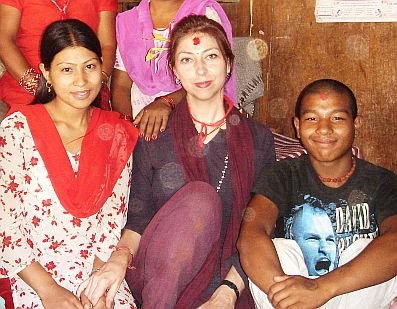
Today I am rushing to get some prints made for Pramochan, one of the (the many) Newari masked dancers I photographed this past Dasain season. On Dasain day, I received tikka and jamara (red powder on the forehead and sprigs of barley behind the ear) from Pramochan's father. Tikka and jamara are a sort of blessing given from elders to juniors on Dasain day. So, Pramochan's familiy (all five of whom live in a traditional Nepali wooden house, which looks like a hayloft with a five-foot ceiling) have invited me to Mha Puja. (Yet another puja!)

I love the tradition of jamara, which is (as far as I know) unique to Nepal. On the first day of Dasain, the lady of the house plants seeds of barley, rice or corn, in a bed of sand, in a special niche inside the home. The seeds are then covered and allowed to sprout secretly in warmth and darkness. It's during these nine days that the goddess Durga is symbolically fighting evil. On the tenth day, Vijaya Dashami, the jamara is uncovered and revealed to have grown into long, bright green grassy stalks. The stalks are then ritually harvested and bestowed upon juniors by the family elders.

Everyone walks around town with an enormous red dot (made of red kumkum powder, rice and yogurt) on their foreheads and chartreuse sprigs sprouting from their hair like feathers (see photo below). Nepalis absolutely love tikka and jamara ("sooooo beauty-full") and seemed very proud to be seen with me, once I was properly marked.

Today's festivity, Mha Puja, is done only by the Newari community on the occasion of Newari New Year (it's now 1126). This ceremony honours and blesses the individual's body for the coming year. Fortunately I have a Newari and Nepali interpreter and hope to find out more about it. I am bringing the prints as a present for the family. (Others might get away with bringing a box of sweets, but as a foreigner with a digital camera, I am honour-bound to provide free prints to the family. I think it's a tradeoff for the stigma they might otherwise receive of associating with a foreigner.)

Rituals in transfigured time
Here in Nepal, we are running three simultaneous calendars. The business calendar is (sort of) the "English" or Gregorian calendar. Then there's the Vikram Sambat or Nepali Hindu calendar, in which it's 2063 and the new year is in April. It is quite common for buildings to boast of having been "established in 2059" (my Australian friend Dave took a photo of this - he thought it was a typo), or for people to say "the conference will begin after 10 Bhadra."

When yet another time cycle, the Newari calendar, starts tomorrow, and it will be 1127. The Newari new year is figured from our AD 867, when legend has it that a Newari Jyapu (farmer caste) discovered a riverbed of gold, and thus paid off everyone's debts. A good way to make a fresh start.

Now if I could just make some money and pay off a few of my debts...guess I will be offering Lakshmi extra marigolds and butter lamps for that one.

New widgets on the block!
Feeds, widgets, clusters, tags, bookmarklets, clouds, sprinkles, aggregators, badges. I'm just now learning about the galaxy of nifty blog features and how they procreate.

I've added a couple of new widgets (nifty code dropped into my template to do cool things) to the blog site. The SirenLocator Map (requires Flash, I think) should show online viewers as they appear, and even reveal a map of their nation (for those unclear on geography).

Scroll down and you will find the Current Moon Phase, essential for life in Nepal and other parts of Asia.

My SirenDelicious feed shows my favourite items and headlines saved to Del.icio.us. And Global Voices headlines feed show selected headers from the Nepali and Indian blogosphere.

Coming soon: my very own tag cloud, and a Newsvine widget. Oh, and I've finally caught up and gotten myself a YouTube account, but some stupid folk singer already snatched the name Sirensongs....so SirenTV will be appearing as "SirensongsIndia." Maybe someday I'll figure out how to upload my many videos directly to this site.

Wednesday, September 27, 2006

Dancing days are here again

Lost in a masquerade
Lalitpur, Nepal

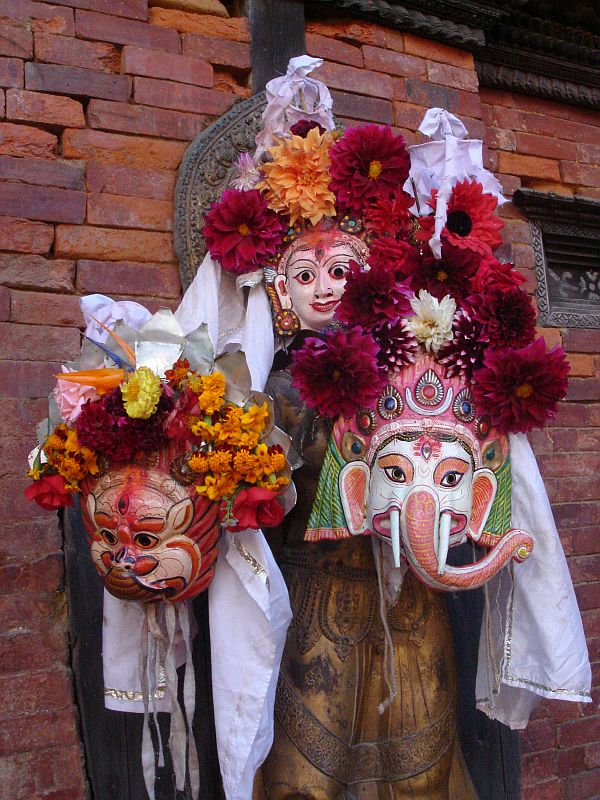
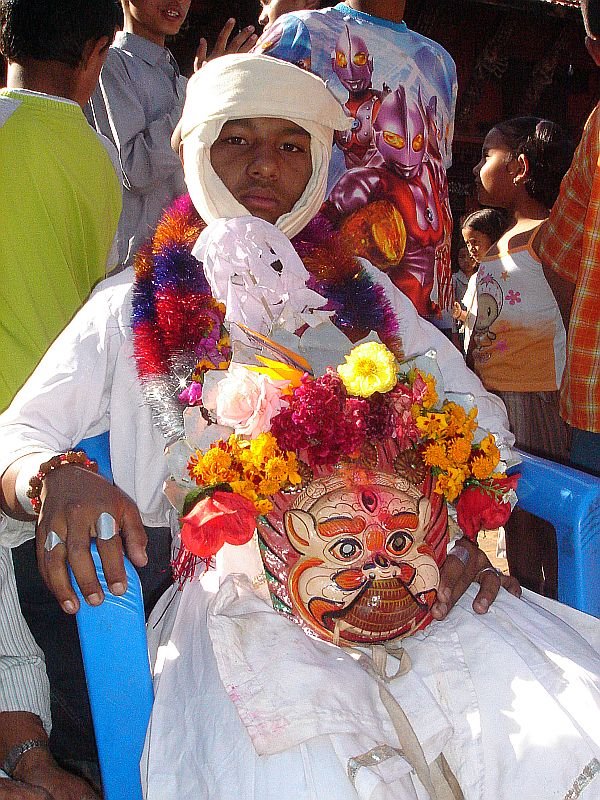
Indra Jatra, Dasain and Kartik Purnima mean it's time for the ritual masked dances of the Newari people. I'm currently engrossed in tracking them down (obscure, community-based, secretive besides the language problems) and documenting them. Last night I went to Lalitpur (Patan) to see the Ashtamatrika (Eight Goddesses) dance of the Newari Buddhist community. I only have time to upload one photo right now (before running to Immigration).

I have seen lots of masked dancing by now, and I think the Ashtamatrikas are the most exciting yet. They seem to be the most classically influenced, and the most ritualized. These dances were begun in the 1600s on the orders of the Lalitpur king (at that time it was one of the rival 3 kingdoms of the Kathamandu Valley), who was a great devotee of the eight guardian goddesses.

The transformation of the dancers, as soon as they don the mask, is really astonishing. They assume a hands-on-hips stance and begin trembling with shakti.

Hundreds of people from the community turn out and follow the Goddesses on their journey from Nakabahil (courtyard of the dance-god) to the courtyard of Taleju Bhavani Temple, where the gothic gables tower over the dancing devis.

I was the only foreigner there. It amazed me that so few outside people know about the vibrant, living culture of the valley, especially since it's been going on continually for the past four hundred years.

Last night there was a power cut, so we were marching through the cobblestoned streets in candlelight - it felt like the dances must have one hundred years ago.