Showing posts with label protest. Show all posts

Monday, March 29, 2010

Dakinis of peace

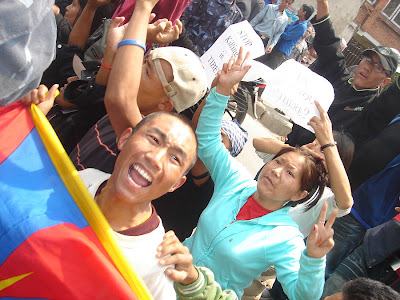
In the summer of 2008, I followed a group of Tibetan protestors in Kathmandu throughout their entire day - preparing banners, moving from their dwelling site to the protest site surreptitiously (Nepal police were expecting protests, so Tibetans in large groups were likely to be waylaid), and rehearsing nonviolent protest techniques.

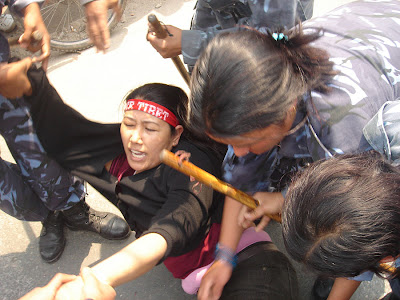
Previous protests had involved struggle - the shouting demonstrators would approach the Chinese embassy or consulate and refuse to move. Most of the photos I (and so many other photographers) got were the same day after day - lots of pushing, pulling and gnashing of teeth.  Though I very much supported the demonstrators, I felt it was becoming predictable, and righteous anger is difficult to sustain day after day, for several hours, on an organized basis.

Protestors included Tibetan laypersons, always some monks, and usually a few nuns.

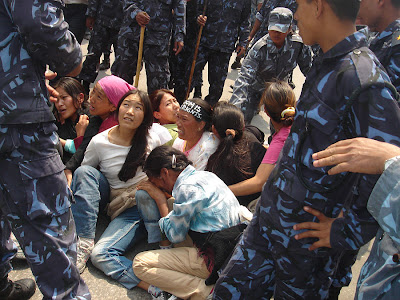
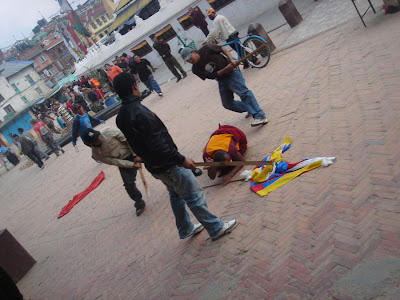
One day, there was an unusual number of nuns involved.  That day, the technique changed. The nuns just lay down on the pavement, shrouding themselves with Tibetan Snow Lion flags.  It was so unexpected, even the police started laughing.  Their gentle prostration turned everyone's expectations on their heads.

These nuns were so sweet, shy, and humble. I reflected on their daily lives in the Tibetan Buddhist world. They don't get many of the privileges afforded to the monks, and their education is often just learning to recite and memorize scripture without the higher teachings of philosophy.   Several projects (Kopan Monastery for Nuns in Nepal, and Tenzin Palmo's Dongyu Gatsal Ling Nunnery in north India) have begun to redress this situation, all with the blessings of HH the Dalai Lama. 

In Tibetan tradition,  Dakini (Tibetan Khandro) is a female embodiment of enlightened energy. Some Dakinis are full-fledged deities, but others are semi-divine and wear human bodies."The outer-outer dakini is a dakini in human form. She is a yogini, or Tantric practitioner in her own right." With or without the 'higher' philosophical teachings, the nuns naturally embodied the Enlightened Female Energy - Dakinis of Peace.

Please copy this photo and share it anywhere you like (just don't charge money for it).  Because my computer crashed shortly thereafter, this is the largest file I have for it, and it's too small to sell commercially. But when you look at it, see the Dakinis flying.

Related reading: 
.

Thursday, February 12, 2009

This just in

Undies For Fundies
Karnataka, India

This just in: Fundies Buckle Under Onslaught Of Undies
Whoo hoooo! Free, nonviolent expression works.

Wednesday, April 16, 2008

Et tu, Tawang?

Another one bites the dust
News from Arunachal

Wellll, it seems Nepal, or the Nepalese Autonomous Region of China, is not the only Chinese "client state" toeing the line from Beijing, when it comes to permitting Tibetan protests.

This just in from rediff.com.


Authorities of (the Indian state) Arunachal Pradesh, bordering China, have declared the state 'sensitive' and 'a risky place' to hold any pro-Tibetan demonstrations.

Thanks Gods someone isn't taking it lying down.

"We are proud to be Indians, and the government should protect the interest of the people who have been living under the constant fear of a Chinese incursion. The 1962 Chinese aggression in which the People's Liberation Army came down to occupy Indian territory beyond Tawang and Bomdila in West Kameng district should not be allowed again," Padma Shri award-winning monk Thupten Phuntsok said.

"The people of Tawang and Tibet have a strong bond of religion and culture, and the government should also permit peaceful demonstrations in protest against the scores of Tibetans killed, tortured and maimed in Tibet by China," he added.

MLA Tsona Rinpocha from Tawang district said the policy of successive governments towards protection of the Sino-Indian border in Arunachal Pradesh had been 'weak'.

This isn't just the usual paranoia, folks:

He cited the razing of a Buddha statue and occupation of seven kilometres of local grazing grounds in Samdurang Valley by China since 1986 to drive home his point.

Thursday, April 03, 2008

Scenes from an embassy

Embassy embarassment
Kathmandu, Nepal


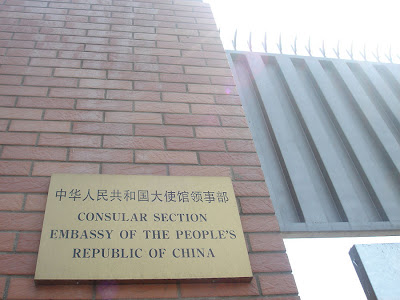
Pro-Tibetan Protests in front of the Consular section of the Chinese Embassy (Hattisar) had become an almost daily routine.

As of Tuesday the 1st, protests began in front of the actual Chinese Embassy building in Baluwatar (conveniently located down the block from the Prime Minister of Nepal's residence).


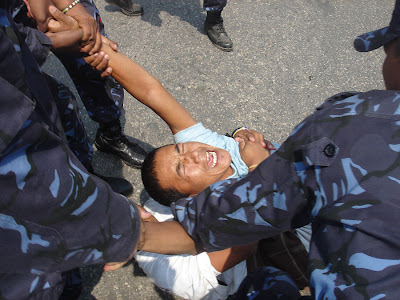
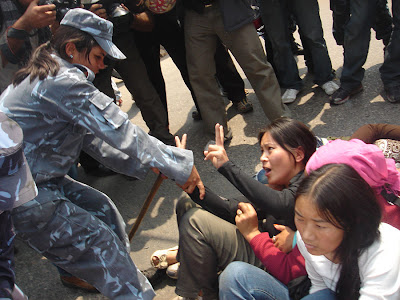
Here are some scenes from Monday's protest in Hattisar. Typically, the marchers approach the embassy's giant metal gates, holding banners and posters. The Nepal Police accost them, preventing them from approaching the gates. At this point the protestors sit down, "drop" or refuse to move, and the police drag them away.

On Monday, I noticed there were no monks in attendance. I asked a young English-speaking Tibetan girl about this. She, with her mother, was watching in tears.

"Some of them are monks," she said. "But they can't wear the monk dress. Police are arresting all monks and nuns on the road just for wearing the robes." So the monks were protesting in plainclothes. Indeed, I did notice quite a few protestors had the close-cropped monastic hair.


While the protestors shout and scream "stop the killing in Tibet, " "we want freedom in Tibet" and "Dalai Lama Zindabad" the police eventually apply the lathi (bamboo canes). Reporters and observers who'd been to many of the demos told me the police violence, while still including hair-pulling, even some face-punching, and lathi whacks, was actually reduced from that of a few days ago.


UN human rights observers in their trademark blue vests stood by watching. But they were denied entrance to the rooftop of a private house (next door to the Chinese Embassy) for better rooftop viewing. The Nepali homeowner said he "had been told not to" let anyone watch from the roof.

There were at least 2 dozen media members, both professional and amateur, in attendance, not to mention loads of ordinary Nepalis with cell phone cameras. Office workers peered down from the safety of first-floor windows while ground-floor shopkeepers slammed their metal gates shut.


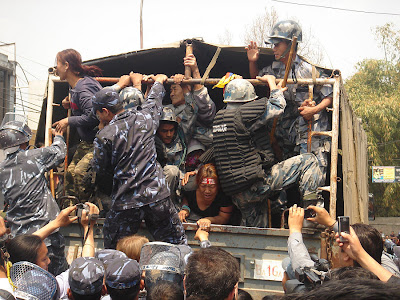
Protestors were piled into police vans and trucks, and taken to various police stations where they were jailed until nightfall.

Just when the police would drive off with a truckfull of screaming protestors, another scuffle would start up down the block, with another group appearing seemingly out of nowhere. This went on for about 2 hours - groups appearing, sitting down, getting rounded up and dragged off, trucked away then another small group appearing elsewhere.

I read one report that claimed "protestors attacked the Chinese Embassy." I find that hard to believe, as they are not allowed anywhere near the enormous metal gates of the compound.

Thursday, March 20, 2008

Seeing red, and blue

Is that blood on your face, or just Holi colours?
Patan, Nepal

This morning, there was another attempted demonstration by pro-Tibetan protestors at the UN House in Patan. I didn't make it to the site in time (around 10.30 am).

An eyewitness who did make it, but asked not to be named, says it was very brief. The police acted so quickly in arresting the protestors this time that there was no violence. Basically, they just showed up (again in an attempt to deliver the memorandum, as below) and were immediately taken into custody.

When I arrived at Pulchowk, the street was still lined with dozens of Nepal's Men in Blue (police in riot gear). There will likely be no more actions for a day or so till their release of the Tibetan demonstrators - most of the leaders are incarcerated right now.

As I mentioned previously, Monday saw Nepal's most violent police intervention in a protest since the People's Uprising in 2006.

The latest I've heard about the Monday demonstrators is that nine were injured, including one monk named Tseten Dorjee who sustained serious head injuries. The wounded are dispersed between TU Teaching Hospital, Patan Hospital and Birendra Police Hospital. Above is a photo of an injured monk that appeared only in local paper the Nepali Times (not the "MSM"), so I will reproduce it here )(above). The photographer asked to remain anonymous.

The Tibetan protestors had been attempting to deliver a memorandum to the UN, requesting intervention in Tibet, when the Nepal police descended on them with not only bamboo canes but tear gas. Most of the serious injuries were from hurled tear gas cannisters.

Meanwhile, the UN themselves have issued a statement saying they did not request police "protection" from peaceful demonstrators and have or had no objection to receiving the petition. From what I've read, the Nepal police deny acting at the behest of Chinese Embassy, but I have yet to confirm that source.

On a lighter note, while on my way to the UN in Pulchowk, Patan today, I got splattered with a water balloon by a young Holi-gan who announced, "Happy Holi!" and ran away. What a coward, to throw it at my back. I actually felt a bit cheated that it was just a water balloon. Seems like a degraded version of Holi, just water instead of bright colours. I guess I should be glad it wasn't a teargas cannister.

Monday, March 17, 2008

No news is no news

Immigrant Songs continue; Protests Day 7
Kathmandu, Nepal


Didn't make it to any of the pro-Tibet actions today - I spent most of the day arguing with Nepali immigration. (Do you sense a theme here?)

While I was in Maitighar at the new Immigration office (it's been moved from the previous convenient Bhrikutimandap location), there was a major action at the UN offices just across the bridge in Pulchowk, Patan. I'm passing on these news reports.


Police in Nepal clash with Tibet protestors; 44 held

The protesters were demonstrating peacefully near the main U.N. office in Kathmandu, holding banners reading "Free Tibet" and demanding the United Nations investigate a Chinese crackdown on protests inside Tibet.
But police quickly moved in to break up the gathering, dragging protesters away and throwing them into the back of trucks that then took them to a nearby detention center.


Photo by my friend Prakash Mathema who works for Agence France Presse.

These kids in Beijing are brave souls:
Ethnic Tibetan students staged a candle-lit vigil in Beijing on Monday, saying it was to pray for the dead, hours before a midnight deadline warning anti-Chinese rioters in the Tibetan capital to surrender.

Police kept reporters well away from the peaceful protest by dozens of apparently ethnic Tibetan students gathered inside the Central University for Nationalities.
It was a small, rare show of defiance in the host city of this year's Olympic Games, where Communist Party authorities are especially eager to prevent public shows of dissent.
"It was only to pray for the souls of the dead," said an ethnic Tibetan student ....


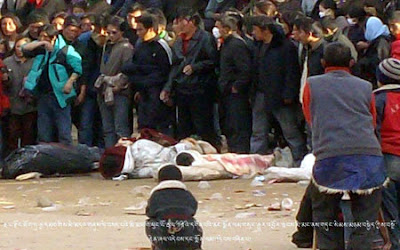
And courtesy of my Tibetan-speaking friend Amalia Rubin, who just returned from Lhasa a mere month ago, here is a photo e-smuggled out of Tibet, of the dead bodies in Ngawa. She writes:

This photo was recently sent to me by someone in Tibet. These are bodies in Ngawa. People shot by the police. These are REAL TIBETANS. REAL people being murdered.

Sunday, March 16, 2008

Drawing blood

Live from Boudha
Kathmandu, Nepal

This afternoon I witnessed a Tibetan monk beaten, along with two other protestors, during a nonviolent anti-China protest at Boudha Stupa.

The three protestors were just standing (with Tibetan flags) at the stupa entrance, between the New Nyingma Gompa and the Ajima shrine, chanting slogans. Totally nonviolent. In fact, they were there for so long it got routine and I went off for tea.

When I returned half an hour later (about 3.30 pm) they were still there, chanting "Dalai Lama Zindabad," "Hu Jintao Murdabad," ("long live the Dalai Lama," "death to Hu Jintao"), "UN Where Are you?" "stop the killing in Tibet," and so on. They were standing on a Chinese flag that one protestor told me they planned to set alight. That's about as violent as they got, planning to burn a flag.

I looked down for just a moment to adjust my camera. Out of nowhere I heard a sickening thud and people started running. I ducked under the porch of the Nyingma Temple (figuring that if I had to, I could go inside - surely they wouldn't trash the monastery and shrine). The Nepali boys went straight for the one monk of the three protestors - -with large 2x2 wooden sticks raining blows.
"Don't take pictures! Don't take pictures!" they yelled at anyone with a visible camera. Then, "This is not a place for protest! This is our God-place! Do not protest here!" in English. Which to me, sounded very rehearsed and conspicuous. In English? The attackers were local Nepali boys (from the Tamang community, if it matters).

Having a little sub-compact camera finally paid off as the professional photogs with their bulkier equipment were chased off and threatened by the attackers. I just stood behind a column on the mandap of the New Nyingma Gompa and snuck snaps.

The monk, his face painted with the red, blue, yellow and white of the Tibetan flag, lay motionless on the ground - I suppose he'd been trained to react that way to violence. The boys continued to whack him, with body blows to the back and front torso.

Some Tibetans tried to approach the monk to assist him. They, too, were attacked. A uniformed security guard, employee of the Nyingma gompa, stood by with hands behind his back.

Eventually the thugs disappeared and sympathetic persons could approach the monk. He was lucky they hadn't busted his ribs. The monk sustained only some bad abrasions to his face, which bled fluently through the face paint. Very slowly, with his friends sustaining him on either side, the monk began to walk. He must have had terrible bruises all over.

Two Tibetan helpers flanked the monk. I came over and suggested, "Shechen Clinic jaane." (It seemed better to go to the clinic of a local Tibetan monastery than to go to the Nepali-run hospital, which might not be sympathetic.) Slowly we all started moving down the unpaved lanes, toward Shechen.

Bystanders glanced up from their labour, looked aghast, clicked tongues and shook heads. The attackers had actually stooped to attacking a monk - a nonviolent monk. This was sure to rouse more anger in the community.

We were joined by another foreigner, a British man named Lewis. He had seen the whole thing too, and felt it important to accompany the monk and party down the lanes. It was less likely that the party would be attacked again if a couple of foreigners with cameras were walking beside them. (Indeed, the tradition of the sahib dies very hard.) Westerners are both assumed to be pro-Tibet and sympathetic, and simultaneously less susceptible to localized violence.

The fact that the attackers were local Tamangs confused me. Tamangs, a Tibeto-Burman people, share a language family, and more importantly, the same religion of Tibetan Buddhism with Tibetans. There are a number of Tamang monks as well as Tibetan in the area. Why would they attack the nonviolent protestors and monks?

When we reached Shechen, the doctor cleaned and dressed the monk's wounds. Luckily there was no serious injury. I took this chance to question the Tibetan compadre. The duo (and many other protesters in the area) turned out to be from Himachal, and came here with a coordinated group to launch nonviolent protests.

Tenzin and other Tibetans I spoke to believe the Tamang boys were paid by local Chinese contacts to carry out the beatings. They claim there have been a number of monks (at least eleven, according to the doctor at Shechen) injured in the same way, by local thugs on Chinese pay. It's true, there is a certain amount of rivalry between the Tamang and Tibetan communities - for one thing, the more recently-arrived Tibetans tend to be more prosperous and high profile. It's so sad that a bit of money and local rivalry could induce them to attack their co-religionists.
There were a few guys hanging round the Stupa who had "McLeodganj" written all over them. I cautiously approached them. One told me that there was another action planned for either the Chinese Embassy or the UN building in Pulchowk within the next hour, but they couldn't or wouldn't give a fixed time or place. The next time I looked, they had dispersed.
These days, there is a skirmish at the stupa every single evening. There is a routine march round the stupa Kora, or circumambulation path. After about 20 minutes of this, the procession attempts to leave the Stupa enclosure (a UNESCO World Heritage site) via the main gate. It seems a fitting symbol for the whole procedure - going round in circles, unable to find an outlet for their justifiable anger, then beaten back by local powers sympathetic to China.
Every night they are confronted by Nepali police in what's known locally as a "lathi charge" (raining blows with their bamboo canes, the subcontinental version of a billy club). The pro-Tibetan group is driven back (running, with that panic I know so well from a number of Indian stampedes) into the stupa enclosure.
I didn't see this, but in last night's skirmish several shops on the Main Road ("Boudha Tushal") were vandalized - bricks thrown through windows. Locals I spoke to claimed the shop owners were either Chinese, or locals functioning as Chinese spies, employees and sympathizers.
I'm waiting for a call from a photographer for Himal Media whose "stupa mole" will tell us if there's more activity tonight, but right now I'm exhausted.
Travel advice for Kathmandu: it helps to be white, and wear running shoes.

Tuesday, October 02, 2007

Burma's burning

Mind on Myanmar ----
Body in Leh, Ladakh, J&K India


At left is a photo of my friends, some Burmese monks now studying in New Nalanda University, Bihar. Although Buddhism has not been a majority religion in India for about 1000 years, India remains a centre of Buddhist learning. These Burmese monks have come to study the sacred, ancient Pali language here.

Thoughts of the brave monks and civilians still in Burma, who are being killed while protesting the Burmese junta, are on my mind. This is the only Burma-related photo I have.


All the banks, schools and government offices are closed here today.

It's Gandhi Jayanthi, or Mohandas K. "Mahatma" Gandhi's birthday - a major national holiday throughout India. Gandhi is revered throughout India for obvious reasons, but especially in Buddhist areas for his commitment to non-violence (his photo is up in shoppes all over Dharamsala, next to the Dalai Lama's).

Ahimsa or non-violence (including vegetarianism) is a central concept in Buddhism, first developed by the Jains, and later adopted by some Hindus. Jains were especially prominent in Gandhi's homestate of Gujarat and it is believed they were a great influence on his philosophy.

There have been several recent attempts to malign Gandhi's saintly image by "telling the truth" about his personal life and relations with his family. Who cares - the guy never claimed to be a saint (that was thrust upon him, as was his role in Indian history - read the bio, he just wanted to be a middle class lawyer) and no one is perfect.

Nor need they be. The bottom line (as with Dr. Martin Luther King Jr., who was later shown to have had affairs and such) is, "is the world generally a better place because of this person?" Who could answer "no"? (by the way, if your answer is "no," for either one, please do not write to me. I mean it.)

I think a lot of modern Indians have a great need to show how "modern," "progressive" and irreligious they are by knocking down sacred cows and icons. Perhaps I would feel the same if I had grown up in such an icon-worshipping, hierarchical environment. I saw the same stuff happen at the Dalai Lama press conference in Andhra Pradesh. Wow, I sure was impressed with the "impartiality" those commie "reporters" (propagandists) showed by being disrespectful and rude to the Dalai Lama! Really demonstrated open-mindedness and progressive thinking!

Reactionary is reactionary - regardless of the direction in which you're reacting.

Burma bummer
However, I digress. Today's headlines were - I hate the word ironic, it is so overused. I'll just say the headlines regarding the situation in Burma (Myanmar) would be horrifying on any day, but especially today.

Hundreds killed, thousands arrested (includes photo of dead monk floating in river)
In photos: Burma crackdown (mostly shots of blocked city streets - looks like Kathmandu)
photos from Flickr members in Burma now
Burmese monks "to be sent away" to distant mass prisons
Satellite imagery shows Burmese plight
Losing hope inside a Burmese monastery

Okay, I'm going to say one last thing regarding armchair critics of Gandhi, King, HH the Dalai Lama, whoever. Actually, Teddy Roosevelt (26th US President) is going to say it.
“It is not the critic who counts; not the man who points out how the strong man stumbles, or where the doer of deeds could have done them better. The credit belongs to the man who is actually in the arena, whose face is marred by dust and sweat and blood, who strives valiantly; who errs and comes short again and again; because there is not effort without error and shortcomings; but who does actually strive to do the deed; who knows the great enthusiasm, the great devotion, who spends himself in a worthy cause, who at the best knows in the end the triumph of high achievement and who at the worst, if he fails, at least he fails while daring greatly. So that his place shall never be with those cold and timid souls who know neither victory nor defeat.”