Showing posts with label monk. Show all posts

Monday, October 27, 2008

Whassup Ode Skool?!

A note from Flickr
Kathmandu


Back in February,
you may remember I attended the Tibetan New Year celebration Losar out in Boudha. The Tibetan community, like Ladakh, is a cinch for "beautiful old faces" photos.

One of them was this lovely white-bearded Gandalf of a Ngagpa, or non-celibate Nyingma yogi
. (Nyingma is one of the five Tibetan Buddhist schools and literally means, "Old School.") I wish I could have illuminated his face better, but it was still a good composition.


He spoke a bit of English and invited me up to see his monastery in Helambu (about five days' walk from Kathmandu).

Just yesterday, a
Flickr member named Joakkim wrote in with this note:

Hi I also met Lama Rechung is his name by the way, at his home in Helambu in 98. Read more about Rinpoche at
arobuddhism.org/encyclopaedia/shared/text/n/n rr_ph_01_eng...

The Rinpoche does not appear to have aged a great deal in the 10 years since Joakkim met him, if the website photos are any indication. There must be something to those Tantric Arts.

Time for a closing cliche: What a small world it truly is.

Here are a couple more photos I took that day. Old school indeed.

Thursday, March 20, 2008

Seeing red, and blue

Is that blood on your face, or just Holi colours?
Patan, Nepal

This morning, there was another attempted demonstration by pro-Tibetan protestors at the UN House in Patan. I didn't make it to the site in time (around 10.30 am).

An eyewitness who did make it, but asked not to be named, says it was very brief. The police acted so quickly in arresting the protestors this time that there was no violence. Basically, they just showed up (again in an attempt to deliver the memorandum, as below) and were immediately taken into custody.

When I arrived at Pulchowk, the street was still lined with dozens of Nepal's Men in Blue (police in riot gear). There will likely be no more actions for a day or so till their release of the Tibetan demonstrators - most of the leaders are incarcerated right now.

As I mentioned previously, Monday saw Nepal's most violent police intervention in a protest since the People's Uprising in 2006.

The latest I've heard about the Monday demonstrators is that nine were injured, including one monk named Tseten Dorjee who sustained serious head injuries. The wounded are dispersed between TU Teaching Hospital, Patan Hospital and Birendra Police Hospital. Above is a photo of an injured monk that appeared only in local paper the Nepali Times (not the "MSM"), so I will reproduce it here )(above). The photographer asked to remain anonymous.

The Tibetan protestors had been attempting to deliver a memorandum to the UN, requesting intervention in Tibet, when the Nepal police descended on them with not only bamboo canes but tear gas. Most of the serious injuries were from hurled tear gas cannisters.

Meanwhile, the UN themselves have issued a statement saying they did not request police "protection" from peaceful demonstrators and have or had no objection to receiving the petition. From what I've read, the Nepal police deny acting at the behest of Chinese Embassy, but I have yet to confirm that source.

On a lighter note, while on my way to the UN in Pulchowk, Patan today, I got splattered with a water balloon by a young Holi-gan who announced, "Happy Holi!" and ran away. What a coward, to throw it at my back. I actually felt a bit cheated that it was just a water balloon. Seems like a degraded version of Holi, just water instead of bright colours. I guess I should be glad it wasn't a teargas cannister.

Sunday, March 16, 2008

Drawing blood

Live from Boudha
Kathmandu, Nepal

This afternoon I witnessed a Tibetan monk beaten, along with two other protestors, during a nonviolent anti-China protest at Boudha Stupa.

The three protestors were just standing (with Tibetan flags) at the stupa entrance, between the New Nyingma Gompa and the Ajima shrine, chanting slogans. Totally nonviolent. In fact, they were there for so long it got routine and I went off for tea.

When I returned half an hour later (about 3.30 pm) they were still there, chanting "Dalai Lama Zindabad," "Hu Jintao Murdabad," ("long live the Dalai Lama," "death to Hu Jintao"), "UN Where Are you?" "stop the killing in Tibet," and so on. They were standing on a Chinese flag that one protestor told me they planned to set alight. That's about as violent as they got, planning to burn a flag.

I looked down for just a moment to adjust my camera. Out of nowhere I heard a sickening thud and people started running. I ducked under the porch of the Nyingma Temple (figuring that if I had to, I could go inside - surely they wouldn't trash the monastery and shrine). The Nepali boys went straight for the one monk of the three protestors - -with large 2x2 wooden sticks raining blows.
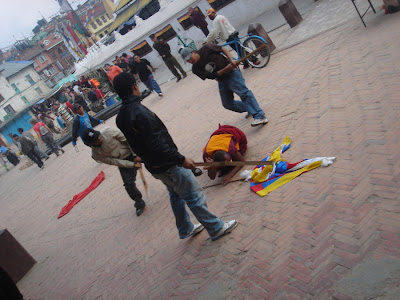
"Don't take pictures! Don't take pictures!" they yelled at anyone with a visible camera. Then, "This is not a place for protest! This is our God-place! Do not protest here!" in English. Which to me, sounded very rehearsed and conspicuous. In English? The attackers were local Nepali boys (from the Tamang community, if it matters).

Having a little sub-compact camera finally paid off as the professional photogs with their bulkier equipment were chased off and threatened by the attackers. I just stood behind a column on the mandap of the New Nyingma Gompa and snuck snaps.

The monk, his face painted with the red, blue, yellow and white of the Tibetan flag, lay motionless on the ground - I suppose he'd been trained to react that way to violence. The boys continued to whack him, with body blows to the back and front torso.

Some Tibetans tried to approach the monk to assist him. They, too, were attacked. A uniformed security guard, employee of the Nyingma gompa, stood by with hands behind his back.

Eventually the thugs disappeared and sympathetic persons could approach the monk. He was lucky they hadn't busted his ribs. The monk sustained only some bad abrasions to his face, which bled fluently through the face paint. Very slowly, with his friends sustaining him on either side, the monk began to walk. He must have had terrible bruises all over.

Two Tibetan helpers flanked the monk. I came over and suggested, "Shechen Clinic jaane." (It seemed better to go to the clinic of a local Tibetan monastery than to go to the Nepali-run hospital, which might not be sympathetic.) Slowly we all started moving down the unpaved lanes, toward Shechen.

Bystanders glanced up from their labour, looked aghast, clicked tongues and shook heads. The attackers had actually stooped to attacking a monk - a nonviolent monk. This was sure to rouse more anger in the community.

We were joined by another foreigner, a British man named Lewis. He had seen the whole thing too, and felt it important to accompany the monk and party down the lanes. It was less likely that the party would be attacked again if a couple of foreigners with cameras were walking beside them. (Indeed, the tradition of the sahib dies very hard.) Westerners are both assumed to be pro-Tibet and sympathetic, and simultaneously less susceptible to localized violence.

The fact that the attackers were local Tamangs confused me. Tamangs, a Tibeto-Burman people, share a language family, and more importantly, the same religion of Tibetan Buddhism with Tibetans. There are a number of Tamang monks as well as Tibetan in the area. Why would they attack the nonviolent protestors and monks?

When we reached Shechen, the doctor cleaned and dressed the monk's wounds. Luckily there was no serious injury. I took this chance to question the Tibetan compadre. The duo (and many other protesters in the area) turned out to be from Himachal, and came here with a coordinated group to launch nonviolent protests.

Tenzin and other Tibetans I spoke to believe the Tamang boys were paid by local Chinese contacts to carry out the beatings. They claim there have been a number of monks (at least eleven, according to the doctor at Shechen) injured in the same way, by local thugs on Chinese pay. It's true, there is a certain amount of rivalry between the Tamang and Tibetan communities - for one thing, the more recently-arrived Tibetans tend to be more prosperous and high profile. It's so sad that a bit of money and local rivalry could induce them to attack their co-religionists.
There were a few guys hanging round the Stupa who had "McLeodganj" written all over them. I cautiously approached them. One told me that there was another action planned for either the Chinese Embassy or the UN building in Pulchowk within the next hour, but they couldn't or wouldn't give a fixed time or place. The next time I looked, they had dispersed.
These days, there is a skirmish at the stupa every single evening. There is a routine march round the stupa Kora, or circumambulation path. After about 20 minutes of this, the procession attempts to leave the Stupa enclosure (a UNESCO World Heritage site) via the main gate. It seems a fitting symbol for the whole procedure - going round in circles, unable to find an outlet for their justifiable anger, then beaten back by local powers sympathetic to China.
Every night they are confronted by Nepali police in what's known locally as a "lathi charge" (raining blows with their bamboo canes, the subcontinental version of a billy club). The pro-Tibetan group is driven back (running, with that panic I know so well from a number of Indian stampedes) into the stupa enclosure.
I didn't see this, but in last night's skirmish several shops on the Main Road ("Boudha Tushal") were vandalized - bricks thrown through windows. Locals I spoke to claimed the shop owners were either Chinese, or locals functioning as Chinese spies, employees and sympathizers.
I'm waiting for a call from a photographer for Himal Media whose "stupa mole" will tell us if there's more activity tonight, but right now I'm exhausted.
Travel advice for Kathmandu: it helps to be white, and wear running shoes.

Sunday, December 30, 2007

Out come the freaks

The Demographics of Devotion
Majnu Ka Tilla, Delhi


I've often commented on HH the Dalai Lama's ability to bring together
a diverse range of people. The foreground and wake of any DL event is always evidence of Life's Rich Pageant.

And, here they are now, all around me. In the countdown days to the Mundgod event they are all coming in to roost.

A guy at the opposite breakfast table this morning looked like he was auditioning for the part of Merlin or Gandalf, with a long white scraggly beard and some kind of robe. There are always a few who look like extras from a Biblical period m
ovie (beard and sandals).

I used to be far more tolerant of this sort of thing. At one point, it was w
hat we foreigners in India were known for (dropping out and dressing like slobs).

Now I have personally experienced the damage this has done to our image abroad and am a bit impatient with it. Okay, we come to India to "do our own thing," but can we please c
omb our hair (this really seems to rankle Indians, westerners with messy hair) and just not dress in costume? -- Costumes that are some weird kind of pretentious parody of things we thought we would find in India? Foreign tourists and visitors in India are still living down the image that we all come here to have orgies and smoke charas. "Real" Indian guest houses (as opposed to ones geared towards foreigners) are often wary of foreign guests and we often get the slithery eyeball ("decadent westerners in our establishment! The decadent Indians are bad enough but at least they don't draw attention!").

What's Your Movie?
You can see the kind of "trip" each one is on from their trappings. One's
on an orange-clad spiritual Krishna kind of trip, another with his mysterious black thinks he's some kind of tantric master on the road to discovering Tibetan secrets.

Then there are the followers of the Upper Middle Path. They are well-groomed midwesterners or trendy Coasters and tend to travel in large groups with name badges, usually attached to some American or European dharma centre who has organized the trip. Excuse me, pilgrimage. They are on *pilgrimage.* I watched the blow-dried group this morning, led by their red-robed monk shepherd. They insisted he say grace in Tibetan before they ate their pancakes. God knows how many thousands of dollars they are paying for this packaged chaperoned India.

I suppose I shouldn't be mocking Americans who have an impulse to explore other cultures and travel abroad - after all I am one myself, and when you consider the great mall-going masses, really these folks
are quite refreshing. This group (UMP) tend to be extremely open, almost wide-eyed about the whole thing. But, just that whole thing of ... trying to turn EVERYTHING, even pancakes, into some significant religious experience to tell stories about back home.

Then there are the career
Buddhists in the know. They travel independently and always know the date HH is arriving, the date of the long-life puja and never fail to have some kind of inside information about some top-secret ribbon cutting event that ONLY Rinpoche so and so knows about, and he told them...but don't tell anyone....

There are also Buddhist clergy of all nationalities and robe-colours, it's almost like a monastic fashion show. Maroon, mustard, and grey are the most common, but you will also find orange, black and white for various Buddhist denominations. Australian and Taiwanese nuns, Ladakhi and American monks. Tibetans speaking English, Americans speaking Tibetan, Tibetans speaking Hindi to shopkeepers...


...and of course the French, who are visibly struggling, finally having to admit that French is NOT the most important language in the world. I enjoy seeing them limp along, struggling to be misunderstood by the locals who speak much better English.
Another way to spot the French is by the cigarette smoke - indoors. That, and the fact that they take forever to order in restaurants. Every little thing must be absolutely perfect and they ALWAYS have some special exception they want made ... and they NEVER are able to explain it in good English. Try not to get stuck with a French party in a restaurant, this will delay your order by a good 20 minutes to half hour.

Don't forget the inevitable and numerous beggars (all Indian, many able-bodied and young) who flock anywhere there is a hint of "religion" and foreign money. Please don't give them anything at all, no
t even food or attention.

Go (away), big orange
There is also a cadre of Indian beggar monks (aka the Stinky Orange monks) in bright orange robes. They are trading on the fact that everyone thinks they're Theravadins from Sri Lanka. But Theravadins are immaculately clean. You can smell these guys coming literally a dozen feet away. I am really not sure what denomination, if any, they fall under; some kind of generic Mahayana I suppose.

Traditionally, monks were supposed to beg for a living --but that took the form of sitting out in the road or going from home to home with a begging bowl and accepting whatever was pu
t into it, regardless. These guys accost foreigners and beg for cash. If you give them too little (10Rs) they complain and ask for more. I think they are actually a pimped begging gang sent out by their master, an unscrupulous "abbot" from Bodh Gaya. They turn over some of the money to their master and pocket what they can.

Thank all the gods for the Tibetan old-timers. They ground the whole event with a peaceful, smiling, uncomplaining presence. Their constantly whirring prayer-wheels
create a sort of vortex around them and even on the bus or in the market, many are continually chanting mantras. They and some of the Career Buddhists are the only people wearing Tibetan clothing. The young Tibetans, with short greased up hair and tight jeans, are all dressed like Hindi cinema stars.

Gimme a break
Whew! I need to go for a walk. Maybe down by the river...nope, stinks too bad, way too dirty. I mean the ground itself even, not just the water. All the parks will be jam packed as it's the Sunday following Christmas. There's always Lodi Gardens or Hauz Khas Deer Park.

Sunday, December 16, 2007

Trouble in paradise

Blue skies, no tsampa
Leh, Ladakh

I've been trying to wrap up my interview materials here in Leh for the past week. The interview session with the Principle of the Central Institute for Buddhist Higher Studies started off stiff and weird but turned out well.

Actually, I think the monk Kanchen Sonam, who was kind enough to come and pick me up in the monastery-owned car (one of four), is the man who really knows the inside story on the incarnation search for Bakula Rinpoche. No disrespect to his knowledge, but I think the principle was kind of a Buddhist spokesmodel. That is, he knew all the proper "acceptable" things to say to me, In English.

Anthropologists must have a handy jargon term for the phenomenon I keep encountering, but I just call it "assuming the worst." That is, whenever I approach a "native" informant (even with my rather non-corporate, non-mainstream appearance) they assume the absolute worst about me and my writing intentions. They launch into a pre-rehearsed speech (I can tell) about how modern, progressive and un-superstitious their people and ways are. How nobody believes in those old things any more. How all the people here are now educated .... blah, blah, blah.

In this case, I asked a direct question about "the search process for the new Bakula Rinpoche." I got a speech about how things were different now, you know the Dalai Lama himself is very scientific, we don't have any blind faith in Buddhism, etc.....

It takes a minimum of half an hour, usually, to crack this facade. They just assume I am a non-believing skeptical westerner there to mock their traditions. Usually, I have to do what we used to call, back in the hip-hop days, "dropping science."

That is, I have to violate what I consider a rule of interviewing (the interviewee should talk more than the interviewer) and demonstrate a bit of inside knowledge.

In this case, I think it was dropping the Sanskrit term "ishtadevata" (personal chosen deity). We were discussing the role of oracles in local Buddhist tradition, or trying to. I had to start throwing esoteric terms at him in order to prevent him explaining the whole thing from the ground up, which would have been redundant.

Finally, I got a genuine smile. Yes, she kind of understands, even though she is an Injee! "Yes, like an ishtadevata!" he repeated the magic word. In this way we finally came to an understanding, which went something like this (paraphrased): Science is all well and good and very very necessary. But we cannot discard all the old traditions, they have a science of their own. There is something to mystical traditions that is important to preserve, even if we cannot or do not yet consciously understand it.

Whew. Now, we are getting somewhere. The upshot of the conversation was: Yes, the search for the new Bakula has already begun. Since the passing of the Rinpoche, special pujas have been done, and a special mantra, designed to bring about his swift reincarnation, has been recited millions of times by the monks of all four monasteries and is still being recited every morning.

At this time, there are three boys who have come to the attention of the Spituk presiding authorities. Rather than go on a house-to-house search (as made famous in the movie Kundun), these boys came to the lamas' notice through reports. All three of the boys had shown special interest in Spituk Monastery, talking about it, insisting on visiting and so on. One of the boys had reportedly even pronounced Kushok Bakula Rinpoche's name (remember, the boys in question are about three).

One boy is from Nubra Valley, another from the remote Changtang region still inhabited by nomadic people. The third is actually of Tibetan (as opposed to Ladakhi) descent living in the Agling refugee camp outside of Leh.

At this time all three boys' names have been submitted to the Sras Rinpoche, who is heading the Bakula's monasteries in the meantime. He is conferring with other high lamas, including the Dalai Lama, about the matter. In case of any dispute, the final decision will rest with the Dalai Lama. A decision should be reached within the year.

Then, there will be an enthronement ceremony and much rejoicing. "We will invite you!"

All politics is local
It would be a real shame for the search for the new Rinpoche to fall prey to the local political infighting, but it does seem inevitable. As previously reported, the Buddhist political "scene" has for the past several years fragmented into various factions - so much so that, following the November 3rd "incident" at the main Gompa, the Ladakhi Buddhist Association office has remained completely closed. (Faction A and Faction B were fighting, the police were called, and shots were fired inside the Gompa grounds. This resulted in the rallies, protests and strikes mentioned earlier. What I really hate is that the people are practically forced to attend. Some try to make a statement by staying away entirely.)

My attempts to get quotes from local Buddhist "figures" about the Bakula situation and the role played by the Dalai Lama in local peacemaking have been so far thwarted. The LBA office is locked, and no one will even give me a name of a sometime or former or would-be LBA spokesperson to refer to . The Gompa itself (smack in the middle of downtown Leh) is being operated by a volunteer organization who are currently hosting a prayer ceremony.

I saw a notice on the bulletin board naming someone as General Secretary, so I started asking around for him. This caused a bit of consternation among the volunteers. They were just there volunteering and definitely didn't want any trouble.

"Who told you that was the secretary?" someone finally asked. Well, it says so on the board....I answered. "He is not the secretary. No one knows who is the secretary. Soon there will be new elections." But for now, no one's in charge and the whole thing is in disarray.

During the Dalai Lama's visit this year, he met with both Shi'a and Sunni Muslims and lauded them for getting along well locally, saying they were "an example for other communities." At the time I thought he meant Muslim infighting in other countries like Iraq and Pakistan. Now I think he was referring to the infighting in the Buddhist community, right here at home.


Wednesday, November 14, 2007

Breathing space

Taking a breather
Leh, Ladakh and environs

I've been talking about leaving Ladakh for a few weeks...yet keep finding reasons to stay. Here is another one.

Ladakh is a great place to breathe.

In most of India (ironically the home of yogic deep breathing or pranayama), you really don't want to breathe too deeply. Either the air is horribly polluted, or there are dreadful smells nearby if you breathe more than superficially. After a while, you forget that you are not breathing properly.

I knew a guy in New York that said incense was bad for meditation, because you breathe in too much smoke that way. Obviously, he had never been to India. Compared to what you normally breathe here, incense smoke is benign, and pleasant.

Once you adjust to altitude and catch your breath, Ladakh has plenty of deep breathing space. Here is an exercise that is great for Ladakh:

"Now and again, it is necessary to seclude yourself among deep mountains and hidden valleys to restore your link to the source of life.

"Breathe in and let yourself soar to the ends of the universe; breathe out and let the cosmos back inside.

"Next, breathe up all the fecundity and vibrancy of the earth.

"Finally, blend the breath of heaven and the breath of the earth with that of your own, becoming the breathe of life itself."

- Morihei Ueshiba Osensei

Last week, in honour of both my birthday and Halloween, I spent 6 days in various remote monasteries in Leh valley area. I attended the Thiksey GuStor masked dancing ritual and festival, and visited Shey Gompa (which includes a ruined palace, the former home of the Ladakhi kings), Stakna Gompa (a Drukpa Kagyu monastery, patronized by the kings of Bhutan) and the out-of-the-way Matho Gompa, famous for its tradition of Oracles, or monks who become "possesed" by a protector deity and answer questions about the future.
Here are a few random photos.

You know that Incredible India tourism ad that shows the monks blowing horns at dawn? It was made at Thiksey Monastery. This is how it looks in real life. I think they only wear the yellow hats if you are from India Tourism!

Here (below) are two of the dozens of masked dancers at Thiksey Gustor. At the end of the ritual, the Torma, or gruesomely-shaped barley cakes that represent sacrifices to negative forces (they used to be real animal sacrifices, back in the bad old days) are brought outside, thrown over a cliff and burned, amid much fanfare and dancing.
This old timer gladly posed for me at Thiksey, whirling his prayer wheel. And, he did not ask for money! (below). I am quite fond of this traditional Ladakhi hat. It serves absolutely no practical purpose (doesn't keep your head warm, or keep the sun or wind off) - it's just a goofy kind of top hat with horns. Very jaunty.
Thiksey Gompa is very easily reached by a half-hour or so's bus ride (15 Rs, or about 45 cents) from the New Bus Stand. Buses leave all day long and the last one back to Leh is at about 5 or 6pm (no one knows for sure). In season, Thiksey has a fantastic guest house, well furnished with beautiful views (a bit pricey at 300Rs or $8.00 for single occupancy), and a good restaurant (run by Nepali staff) that has a killer veg thali for 45Rs. I was there the very last day of the guest house season....when they shut the water off and the Nepalis went south. Quite sad, really. There is also a family-run guest house in the village but then you must climb up the steep hillside to the gompa every day. (However, it is much cheaper than 300Rs.)

During GuStor, Thiksey, like most monasteries during their annual festival, becomes the epicentre of social life in the area. Locals descend en masse, as much to pay respects to the gods and lamas as to socialize. (This is especially evident in the behaviour of the younger people.) Vendors set up stalls and tents in the village below the monastery, selling plastic wares, mo-mos, simple food and tea, and playing Hindi film music. This gives a carnival atmosphere and I noticed several younger people getting intoxicated (outside the monastery, of course).

Below is one of the dancers after the torma-burning. Peek a boo!

Tuesday, August 28, 2007

Houses of the holy

Of monasteries and militaries
Leh, Ladakh

The past four days I've been on an exhausting tour of central Ladakhi monasteries (and I only saw about six of dozens that are here).

It's a wonderful change from the neo-Indian and Nepali monasteries, the vast majority of which were built post-Tibetan exile (from 1950s onward). A 1967 monastery would be a really old one in most of India (a few exceptions include the Nyima monastery in Rewalsar, Himachal - it's about 100 years old). These neo-monasteries are naturally built of reinforced concrete, tile and have glass in the windows - like all recent buildings in India.

Here, the monasteries average about 15th or 16th century. I decided early on that anything post 16th century was just a bit too new to make the visiting cut. Here in Ladakh there are so many to choose from.

These are the ultra-traditional monasteries, built of stucco, straw and wooden poplar beams, planned as a holy fastness high on distant hills, purposely isolated and difficult to reach.

My Tibetan friend Jamyang Norbu (in Dharamsala) told me how weird it was for Tibetans to see so many monks and monasteries right in the middle of a popular place like Dharamsala or Kathmandu. "Gompa" (Tibetan for monastery), Jamyang said, "means silent place. Lonely place. Monks should not be coming into town, eating in cafes, watching movies...in Tibet the monks were real monks. They stay in real gompa---" away, he explained, from the temptations and distractions of town.

It would certainly be difficult to get into much trouble at one of these gompas, unless it was for touching the sand mandala before it's finished. Usually the gompas rise up mirage-like from the desert, on a rock outcropping. These days, the Indian military presence guarantees an odd juxtaposition - most every monastery on its hill has a military base as a neighbor, down in the dusty valley. So, while you are chanting for world peace and turning prayer wheels, you have a birds-eye view of the military base with its dun-coloured barracks and olive soldiers trudging through the sand, dwarfed by the immensity of the landscape.

Most tourists like to get a small group of 4-5 people together and hire a taxi (ie, small van or jeep) to hop from one monastery to another. They are "close" on the map...which means, at least 10 kms away from one another down dusty, bumpy, largely unpaved tracks. This costs at least 1000Rs or $15 a day.

This does save time, and physical energy, but I like just getting the local bus (10-15rs), from "downtown" Leh, to the gompa in question, and trudging up the hill to the medieval fortress. Getting the bus means that I am more on my own time. I hate the feeling of having a driver waiting (they are always impatient, as though they have something better to do) and having the clock ticking. You just have to make sure, if you stay for the evening puja, that you don't miss the last bus back to Leh - usually at 6 or 7pm.

If you do, it's no big deal. In many gompas, you can just stay overnight, then catch a morning bus onto the next gompa. The primary monasteries unwind southeast and northwest of Leh along the National Leh-Kargil Highway. With the help of the local bus and a map, you can actually go gompa-trekking.

Admission to the gompas varies - about 15-30Rs per person, and they charge the same for foreigners as for Indians, which is refreshing.

So far I have visited Spituk, Phyang, Stok palace, Thiksey and the motherlode of Indian Buddhist artwork, Alchi Chuskor. My neck and shoulders are aching from looking up and craning my neck at wall paintings for hours at at time. You must bring a torch, because most of the gompas are not well lit, and do not expect to be able to take photography (flash or otherwise) in most of them - especially not Alchi, with its unique irreplaceable paintings. You can view a few photos at Hinduonnet.com. The Alchi paintings have a fluid Indian style so different from Tibetan Buddhist art.

At Spituk, the monks were completing a sand mandala, part of the special puja they are doing to find the new incarnation of their beloved high lama who passed away in 2003, Bakula Rinpoche. At Phyang, an enormous festival with thousands of people was in process, as the head of the Drikung Kagyu school was bestowing a special long-life blessing and phowa (transmission of consciousness at death) teachings that are given only every 12 years (in the Year of the Pig).

At Stok palace, the remnants of the Ladakhi royal family still live, where they were exiled by the invading Indian Dogras some 150 years before. After 900 years as an independent kingdom, Ladakh has been a part of India ever since. The king passed in 1987, but the Queen Mother Gyalmo Diskit Wangmo and her son, the crown prince, are still there. The palace caretaker declined our request for an interview. Little does he know, I am not so easily dissuaded!

Wednesday, March 14, 2007

Western disturbance

Under the rainbow
McLeod Ganj, Dharamsala

"A Western disturbance," the papers say, is causing severe precipitation all over the subcontinent - even in the desert of Rajasthan, and normally arid south India. My Chinese friend is on her way to Jammu and Kashmir on a government bus, but she must be snowed-in, because the paper says the J&K Highway is closed for snowfall.

Here, we just got beating down hard rain, several hailstorms, and severe, cable-snapping winds.

There are two advantages to such crappy weather - one, everyone looks like hell so there is no need to fix my hair, or even shower or wash my hair - it's too cold to even take my clothes off (even for a hot shower). Most people are sleeping with their clothes, gloves and hats on anyway. Makeup is a long-foregone pretension and dirty hair is hidden under my fake-fur hat (the kind we used to call, in the hip-hop days, a "Kremlin hat"). I am wearing my heaviest pair of (cotton) pants, a t-shirt, my cotton chupa, and a flannel nightshirt over it all, with the fleece jacket zipped up all day long. Many people appear to be wearing every item of clothing they own.

The second advantage is that, since the rain is so cold and hard and relentless, fewer people show up for teachings, and that means if you are an early bird (I am not), you can get a good seat very near to the Dalai Lama. Or, at least near enough to sit under his benevolent "blessing" hand as he walks by on the ways in and out.

There's also the fact that such frigid weather makes me crave starchy foods. I hope my body is burning it off with the constant walking up and down steep hills and staircases. Dharamsala is not a place for the physically challenged - or even for those with a serious knee problem.

Finally, last night
Finally. The rain finally stopped last night - just in time for the Long Life Ceremony this morning, for HH the Dalai Lama. An amazing double rainbow came out over the Kangra Valley, just around 6pm, before sunset.

This morning's (thankfully dry) Long Life Ceremony was graced by none other than HH the Karmapa (head of the Kagyu lineage), HH Sakya Trizin (head of the Sakya lineage), and the head of the Nyingma lineage (whose name always escapes me). It turned out (news to me) that some people, even foreigners, had come and saved seats upstairs the night before (usually upstairs is only for monks). Some people arrived as early as 5.30 AM to ensure their seating. Live and learn.

The ceremony featured "special appearances by" not only the Nechung Oracle but two more traditional oracles of other regions of Tibet, representing Amdo, Kham and U Tsang. Evidently there are no less than four oracles residing in McLeod and many more traditionally in Tibet and Bhutan. Each "channels" or manifests a different god when they go into trance. Though I didn't get upstairs, my Taiwanese friend got video of the oracles. When they collapse after the trance, they are immediately carried out like corpses feet-first.

(At left: Nechung Oracle manifesting the god Dorje Drakden in a trance at the Nechung Monastery, March 7 2007)


After the ceremony, HH had private (that is, about 100 people at a time) audiences for the Russians, Ukrainians, Mongolians and new Tibetans. The explanation I got was that he gives these audiences for countries where he cannot travel freely (like Russia) because of the country's relations with China. However, I know he did go to Mongolia just last year. Not fair!

Also, I heard later that a German girl snuck in with the Russians. You have to get a piece of paper from security - but they don't know who's Russian and who isn't. Then the whole crowd of 100 or so Russians goes together and has to show passports. But, because there are so many people, they don't really examine all passports - just look to see if the face matches the picture inside.

Okay, now I know the deal.

Mongolians, Russians and Ukrainians all understand Russian - so they get audience together. Everything is translated from Tibetan into Russian.

I caught two Ukrainian kids as they emerged glowing from the HH residence. What did he say?

"It was very short - less than half an hour," Sergei said. "But he said that in general, it was better for people to stay with their own religion, the religion they were born into. To change religions arbitrarily creates confusion and misunderstanding for a lot of people. But, if you do want to be Buddhist and practice Buddhism, it is very important to study - and study well. To really understand the concepts and what they mean - not just go through the motions. And His Holiness was very serious when he said this - not joking, like in the teachings!"

On the road, for real
At rainbow time (6 pm), I was in the Shangri-la restaurant, run by the monks of a monastery. In America, a restaurant where you are waited on by monks would be some kind of novelty theme chain (with a cutesy name like "The Monkery").

I was with Lama Sherab Gyaltsen, the monk who prostrated all the way from Lhasa to BodhGaya, India. Sherab speaks no English at all, but was accompanied by a translating friend, Passang. (Passang is another monk. Most Tibetan names are bi-gendered, that is, Passang, Tenzin, Tashi and so on can be either male or female.)


Back in January, I went to find Sherab on the Patna-Gaya Highway in Bihar. I had read an Indian news report about the "Tibetan monk crawling from Lhasa for world peace" and wanted to interview him and photograph him for myself. I spent two amazing days with him, his two Tibetan companions and the Bihari villagers, who lined the roads to alternately stare and support him - bringing him foodstuffs and water at day's end. They seemed to regard him as a modern-day yogi-saint or "tapaswi" (one who does severe devotional austerities) out of some Vedic-era mythology. Certainly they did not hesitate to "pranam" him (devotional salute) and instantly recognized what he was doing as in the Indian tradition of devotion.

Sherab was explaining how he got permission, from the Chinese government, to exit Chinese Tibet and enter Nepal while prostrating. He had to get some kind of special religious-pilgrimage visa - lots of paperwork. People from his home town of Dege, Kham district had to vouch for him ("he really is a monk and devotee, he is not just escaping, he is for real" and so on). The fact that he is from Kham - now considered part of Qinghai province or China proper - helps a lot. People dwelling in Lhasa or other parts of the TAR ("Tibetan Autonomous Region") are considered more of a political risk and have a harder time getting travel documents.

I had my trusty laptop Tawanda with me, and made a disk for Sherab of all the photos and videos I'd taken of him while he was literally "on the road." He insisted on buying me dinner, and paying for all the CDs (a welcome change from most Indians and Nepalis, who expect YOU, the rich firang, to pay for everything) and requested a second CD of the videos "for my mother."
Sherab had gotten press notices from the BBC, Times of India, Asian Age, Jagran Dainik and a few other Hindi language papers. However, I was special - according to him - because they were all Indian. (The BBC sent a local Hindi-speaking correspondent.) I was "the only English person" who had come to see him.

On our way home
It's always with a combination of sadness and relief that I watch the crowds pack up and go home after a teaching. Sadness, because it's so great to be in huge (if sometimes maddening) crowds of people who have converged for such an elevated cause. I mean, contrast 7,000 people coming together to receive Buddhist teachings from a Nobel laureate with the energy of 7,000 people - for example - gathered at music festival to get drunk and get laid. Or at a political convention, or a football game.

Relief, because finally I will be able to walk down the street and end up where I had originally intended to go, without several people sidetracking me - and will be able to get a table in one of the dimly-lit, always crowded restaurants of McLeod Ganj, where people huddle against the chill drinking Hot Lemon Ginger and catch up on who's going where, which Rinpoche is in town and who's getting teachings from whom.

And, of course, the next reading of the Oracle or Oracles.