Showing posts with label kali. Show all posts

Monday, February 02, 2009

Hymn to Her

Fun with liturgy
Kathmandu

Here's one of the Charya Giti I have been transliterating and, partially, translating. Not because I am good at it (I'm not really), but so that I can understand the dances I am learning. There are no English versions of these songs and poems. For those who've just tuned in, I am here studying the Newari Buddhist Charya Giti or Buddhist devotional dances.

Most of the lyrics I can "feel" but don't think my literal translation will do them justice. This is my attempt. There is a chance that this gita appears translated/literated in Kvaerne's 1977 Anthology of Buddhist Tantric Songs (Oslo) but as I can't locate this publication, I don't know.

My goal is to create an illustrated book of the Giti with Sanskrit, English phonetic and English translation, some background and illustrations of each Deity.

 
Sri Kurukulla Devi
Raga: Nata .... Tala: Jati
(the Raga is the South Asian equivalent of the key or "mode." This set of notes determines the "mood" of the melody much as the key does in western music - imagine playing "She Loves You" in Eminor instead of Emajor.
Tala is the rhythm or time signature of the piece. Again, imagine playing "She Loves You" in Waltz-time instead of 4/4. Changes everything. Every dance student must know their talas and ragas to some extent, though not as thoroughly as music and singing students.)Kurukulla
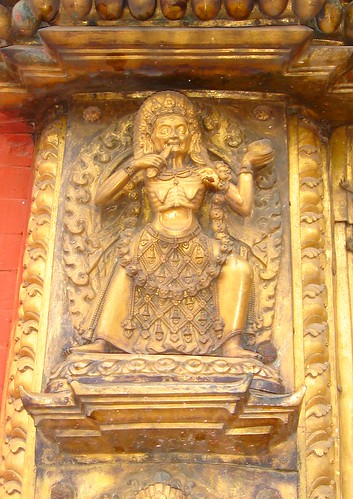
Tribhuvana jananii sri kurakullaa devii
Svetavarna makuta keshii trinayanaa
Mother of the three worlds, Sri Kurakulla goddess...
White-coloured with a crown of hair, three-eyed....

Namami devii sri kurakullikaa taraa
Chatura bhujaa karti khatpara shara dhanudharii

We bow to goddess Sri kurakulla the deliverer
Four-armed, holding chopper, knife, bow and arrow.
Rahu mastaka sthita nrtyapada dharii
Natha shodasha bhujaa aalikngana chun.
Tribhuvana vyapita niilavarna dehaa
Tumha varna devi anuttara sangama
Tempting Rahu (?), standing in a dance-pose
Permeating the three worlds, with blue-coloured body...
(This part confuses me. At one point she's red, at another blue....Sodasha means sixteen; the verse seems to say she has 16 arms but elsewhere she is described as "looking 16 years old.")
Piivad re mahaarasa sudrishta dehaa
Namami sri devii loka udharitaa
Drinking Maharasa (amrit), her form pleasing to see
I bow to the Goddess who uplifts the world
Bhanayikulishaa ratna giita charitaa
Namami sri devii loka udhaaritaa.
(This verse is an attribution stanza telling the name of the Gita composer; and again I bow to the goddess who uplifts the world.)

Here is more about Kurukulla from Vajranatha.com, which appears to be a cool and informative vajrayana web site.

And here is a fun "message from Kurukulla" which was received by Akkarri at Spontaneous Combustion. I especially liked this part:

"I am DANCING. This is to show you how to manifest divine energy for benefit of all....itting in uniform rows reciting rote attribute-lists of the results of human male ego-trips is not a Divine Activity, because it has nothing whatsoever to do with the acknowledgement of MY DANCE."

Related reading: 
Meditation auf Kurukulla 

Wednesday, October 03, 2007

Calcutta Calling

3 Days in the Haze? - Viewer mail
Leh, Ladakh


Harry from Pune writes:

Got your email address from BootsnAll Travel Forums.

I am traveling for the first time to Calcutta (currently live in Pune India about 100 miles south of Mumbai) next month and hope to spend 3 days there on my way to Bhutan and Nepal. Can you advise what are the places to be seen in Kolkatta in 3 days.

Thanks and awaiting your answer.


Dear Harry: Namaskaram and Jullay from Ladakh!:

If you were coming from any other city, I would say, "prepare yourself for air pollution." However, Pune just might be the one city even more polluted than Calcutta.
You should feel right at home in that regard. ;-)

Definitely, there is much to see in Calcutta in 3 days. I highly recommend the Victoria Memorial and Calcutta History Museum there, which are walking distance from Sudder St., the "usual" tourist guest-house spot. (It is full of hassles, like all Indian tourist spots. But, you will meet interesting people who are doing volunteer work there.)

The India Museum,
also just round the corner on Chowringhee from Sudder, is a must-see. Allow several hours for this museum, which includes a transplanted and reconstructed Buddhist stupa-torana from Sanchi, MP, and one of the most frightening Tibetan wrathful-goddess statues I've ever seen.


The
Aurobindo Birthplace is (I think) on Shakespeare Sarani, also walking distance from Sudder. You can see the Rabindranath Tagore home which is now part of Rabindra Bharathi in a different section of town. The former home of Swami Vivekananda is also open now, but I did not personally visit there.

Park Street is the chic, hang-out and shopping street. The Barista coffee bar is there, as well as Oxford Books and several upscale restaurants. Last I heard they were thinking of renaming it after Mother Theresa. Doesn't seem like an appropriate choice to be named for an austere nun.

I feel no trip to Calcutta is complete without a visit to its spiritual heart, the
Dakshineswar Kali Mandir in northern Calcutta, better known as Sri Ramakrishna's temple. (stock photo at left.) The best thing to do is go for evening arati and stay at one of the guest houses there - Holy Nest Guest House is very nice. You can take the Metro to the next-to-last stop, but then you must take a taxi to Dakshineswar (for some reason, pronounced DakINeswar without the H).

Then in the morning, go to morning arati or fire-puja at 5am, (very moving with bhajan-singing); check out the rooms in which Sri Ramakrishna and Sarada Devi used to live. Later take the boat ride (in a traditional distinctive Bengali-style boat) across the Hooghly River, to
Belur Math. Belur Math, the ashram and HQ of the Ramakrishna monastic order, is a fantastically atmospheric place, not to mention the wonderful architecture of warm, brown African sandstone. The 5-year-old Ramakrishna/Vivekandanda/Sarada Devi museum there is great and very worth seeing, containing things like the famous brown robe you see in every photo of Vivekananda! Swami Vivekananda's memorial is also at Belur Math.

Getting around Calcutta:
you have more choices than any other Indian city. Walking, cycle rickshaw, foot rickshaw, Metro, local commuter above-ground train, local bus, Ambassador taxi and in some areas, autorickshaw. The trick is that each has their limitations. Autoricks are only allowed in certain zones, for instance, as are foot ricks.

As much as possible, try to take the Calcutta Metro. It is a world away from the rest of Cal - modern, clean and timely. Even air conditioned! Calcutta is perhaps the last place in the world you can take a wooden, hand-pulled rickshaw to the gleaming, modern subway.


As a foreigner and history buff, I found the colonial graveyards very intriguing, with their elaborate Victorian headstones all overgrown with greener
y. There are also several historic churches - the Armenian church, one of the last remnants of the formerly flourishing Armenian community of Calcutta, and St Paul's Cathedral, at the end of the Maidan near Victoria Memorial, which has fantastic stained-glass windows by the famous PreRaphaelite artist, Sir Edmund Burne Jones.

The Mother House,
the HQ of Mother Theresa's Missionaries of Charity, includes Mother Theresa's tomb. This is walking distance from Sudder Street.

Some of my favourite Calcutta moments came at very non-tourist places. To stand on the
Howrah Bridge, for instance, at sunset, and feel the bridge groan under the relentless weight of commuters (two, four legged and wheeled) as the dark comes and the air turns purple with dusk, is to feel part of the immensity of humanity. (If you don't like that cliche, use another. You get the idea.)

The famous
Kalighat temple is the polar opposite of Dakshineswar - more bloody and less "spiritual." Expect "priests" to hit you up for "donation" or "puja" money even before you reach the actual temple gates. Be prepared to smell and perhaps see goat sacrifices.

Mother Theresa's famous
Home for the Dying Destitute is very nearby Kalighat temple, but I did not personally visit there. However, half the foreign people on Sudder Street (you can detect them by the idealistic gleam in their eyes) are volunteering there, if you want to share a ride. Or, you can take spotless, silvery the Metro directly to the Kalighat area. It's a good opportunity to reflect on the simultaneously medieval, colonial, and modern worlds that still co-exist in Calcutta.

Photo of Hooghly at dusk by Paul Wagner.
Photo of temple from Calcutta Tourism site.