Showing posts with label india. Show all posts

Thursday, July 07, 2011

Fun Facts About Food Poisoning

Did you know...

That food poisoning can be accompanied by not only the usual vomiting, but violently itchy, raised rashes over 75% of your body surface including the scalp?

I found this out the hard way yesterday.  Was it the roadside dosa? The extra cube of ice chucked into the carrot juice at the Besant Nagar (very posh neighborhood) juice stand? 

Whatever it was...I'm still recovering.  Thank you, antihistamine tablets and topical gels.

Sunday, July 03, 2011

Poitu vare

Death of a micro-philanthropist
Triplicane, Chennai, Tamil Nadu

It's been a sobering day in Tiruvallikeni (aka Triplicane,Chennai- aka the Trip Hood) as I discovered Robert Purser, author of the now-semi-famous website Street Kids of Madras,who had been AWOL for some years, had died in an accidental fall from a ladder in America.   

At first this seemed impossible ("Mister Robert" was always overly cautious) and I suspected it might even be a ruse to get rid of the street kids' constant demands for money (it's been 10 years now - 10 years of endless "relatives who need surgery," and the usual stories).

But no, I checked with V. Prabhakaran at the bookstore (one of the Good Guys) and he showed me an obituary mailed by Robert's sister in El Dorado, California.  Robert fell from a 15-foot ladder on June 24, 2008 while trimming trees on his property.

I hadn't heard from Robert since about May 2008. A number of Western Indophiles had written me, asking what had become of him.  Since my last visit to Chennai in 2006,  he had continued supporting the kids, even sending Prabhakaran 7000Rs or nearly $180 monthly (according to Prabhakaran) and Nagamma, who lives on the street constantly abused by her ne'er do well husband 1800 (a very respectible sum considering the husband may have earned 2000 a month at work, if he even worked). 

Today, Nagamma was sporting an\open wound over her left brow, and a black eye.  I asked what had happened and she replied, "Fighting."  Prabhakaran says it's her husband who constantly beats her.  Shehas one child, a boy about 1.5 years old now.  

 Robert always said 'if anything happens to me, you have to make sure the kids get my money,' but Prabhu produced a letter from the sister saying there was no provision made.

Though Robert's website became somewhat legendary among Indophiles and backpackers, Robert himself hated India.   He once told me, "I enjoy being with the kids. I have never enjoyed India."  Yet his observations and insights about the country and its street denizens were astute.   His page "Am I Doing Any Good?" should be read by anyone hoping to "change things in India."

In case you're wondering, the kids are all still there - but they are no longer kids. 

Kumar is driving a rickshaw. Prabhu still lives with his grandmother (who must be over 80 now) in Jaiz Complex and works at a printer shoppe.  Beautiful Mumtaz has been married with 2 kids for years, with a husband and proper house (those of you who know Triplicane will know what this means).  Mari likewise has been married with 3 kids.  Jennifer is still, amazingly, unmarried (she was so beautiful and sweet!) and working in Mylapore at a print shoppe as well.  Prabhakaran, the Good Guy who runs the tabloid magazine stall, is still the responsible big brother on his block, keeping the straight and narrow, raising his 8-year-old son and shooing away the glue-sniffing teenagers. 

And Vela still lives on the streets, acting as "native tour guide" for her many Mister Roberts who appear fresh each season in front of the Broadlands Lodge.  Vela was always the most clever of the kids, and has managed to line up a few "sponsors." 

  In short, not much has changed in Triplicane except the "Magarajah" restaurant has been replaced with a pseudo-posh "Hotel Firdouse," which is not nearly as good.

Sad and weird news from India - so what else is new??

Thursday, February 03, 2011

The Great Game

Indo-Sino-Himalayan Intrigue!
Siddhbari and Dharamsala, India


Why would the Himachal Pradesh monastery of  revered Tibetan lama HH Gyalwa Karmapa house a reported $1.6 million in various foreign currencies, including enormous amounts of Chinese yuan - why, except that the Karmapa must be "a Chinese spy"?

The traditional South Asian paranoia of the dreaded "foreign hand" has again reared its ugly sira in the Himachal police's January 27 raid on Gyuto Monastery, home to the Karmapa lama since he fled Chinese-controlled Tibet in 2000 at the age of fourteen.  Xenophobia, coupled with resentment and jealousy of the tremendous international money and attention focused on India's Tibetan refugees, would appear to be at the root of the Himachal state government's vitriolic attack on the Tibetan community. 
Despite their dispossessed status, the community and its religious institutions have brought Himachal Pradesh untold millions in tourist revenue.

Might the cash stash be explained by the fact that Karmapa's Kagyu denomination of Buddhists had only recently (December 22, 2010) concluded the enormous Kagyu Monlam international prayer festival, which draws donations from devotees and Buddhist foundations spanning the globe?  And could the Chinese yuan be explained by the fact that Karmapa has a sizeable Chinese devotee base? 

Unlike the Dalai Lama, the Karmapa is officially recognized by Beijing, even considering Karmapa's escape to India.   The annual Kagyu Monlam in Bodh Gaya is dominated by Chinese devotees, as anyone who's tried to find a seat under the otherwise-serene Bodhi Tree without getting elbowed by them can tell you.  (Also, visiting Tibetans from across the border give donations in Chinese currency.)

Nope, that's too simple, too easy - and far too logical. Karmapa must be "a Chinese spy."  This is the type of illogical elaboration that in the past led Indians to create mind-boggling, fantastically embellished art forms.  The results aren't so enthralling in realpolitik.

Today's news shows that Himachal Chief Minister Prem Kumar Dhumal is busy setting up intelligence cells to monitor the activities of the state's Tibetan population, which number in the thousands (India's Tibetan population in all states totals 94,200). Spying on the state's most prosperous community will surely lead to more troves of treasure. Tibetans have also been told to "stop protesting" and peacefully assembling and ordered to cooperate with the state's investigations.

Indians often wonder aloud why Tibetans don't just get with the program and become Indian citizens. This just wasn't possible, until very recently, when the Delhi High Court ruled that a Himachal Tibetan woman's application for citizenship must be honoured.  (The judge also ruled that a previously established policy denying Indian citizenship "by naturalisation under Section 6 (1) of the Citizenship Act to the Tibetans who entered India after March 1959 is erroneous and hereby quashed."  This would seem to open the door for Tibetans desiring enfranchised citizenship within India.)

Therefore, Tibetans are poised to become an integrated part of India. Dhumal's accusation puts Himachal behind the Indian national curve.

Not surprisingly, the most sensible statements are coming from the ever-unshakeable Karmapa himself.  His statement of February 2: 
“India had become a second homeland to the Tibetans. We all have taken refuge and settled here. The country, in contrast to communist China, is a democratic country that is based on the rule of law. Therefore, I trust that things will improve and truth will become clear in time. So please be at ease. There is no need to worry,” the Karmapa said.

And I believe him.  This type of malicious attack belongs to the backbiting India of yesterday, a nation so insecure that it saw enemies in the corners of its own eyes. India's embrace (albeit sometimes theoretical) of Tibetans, allotted by the idealist Nehru, set an international example.  The medieval accusations of  the Himachal government won't bear the scrutiny of modern light.

"Let the investigating agencies do their work. Truth will prevail."


Tuesday, February 01, 2011

What's your sign?

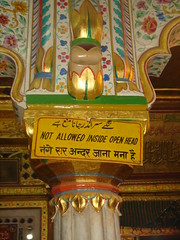
No Open Heads
Delhi

Continuing the "What's your sign" series...

This, seen in Nizamuddin Dargah, Delhi.

A Dargah is a mausoleum or tomb for a Muslim saint. Nizamuddin Dargah, constructed circa 1563,  houses the remains of Sufi saint Nizamuddin Auliya, as well as those of Amir Khusro and Jehan Ara Begum.  The tomb of Inayat Khan is in the same neighborhood, round the corner.  There's one area of the tombs into which women are not allowed (I can't remember which, but don't worry, signs are clearly posted).

Thursday evenings at the Dargah feature live Sufi Qawwali music from about 5pm, and continue only about two hours. Admission is always free.

The simplest way to reach the Dargah is just to hop in an autorickshaw and say, "Nizamuddin Dargah" (it's near to Humayan's Tomb, but every driver should know the Dargah).  You can also take Delhi's spiffy Metro to Central Secretariat, but you will still need to take an auto from there. 

Nizamuddin will immerse you in Delhi's rich medieval history of Sufis, Mughals and minarets.  As with Hindu temples, the road to a Muslim dargah is lined with stalls selling appropriate offerings. Rather than oil lamps and sindoor, they feature incense, roses and glittery green cloths to drape on the tomb.  The atmosphere is male-dominated, with some interesting exceptions.  At one stall I saw a woman, head demurely covered and carrying a basket, conversing with the stallkeeper. It didn't even take a second glance to see this was a transgendered person.  She was obviously well-known to the local merchants.  In a previous age, perhaps she would have been a court eunuch or even a court entertainer.  So much has been lost, in a time when Muslim culture is dominated by Taliban and ayatollahs.


Tuesday, August 31, 2010

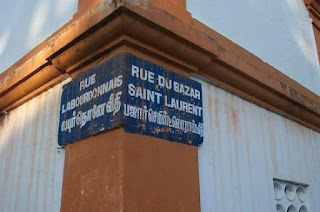
French twist

Rooms illai
Pondicherry (now Puduchery)

A month into following Mata Amritanandamayi's 2004 South Indian tour,  I landed in this former French colony for a week or so to recuperate from the extreme fatigue, sore joints, and pernicious headaches brought about by following a saint across India dawn to dusk.  But I almost never got a room.

After an unbelievable 4 hours of fruitless search for a room, any room where I won't get bedbugs (which BTW I have had twice, both times in Bangalore) - after 4 hours of "rooms illai, " ("there are no rooms"), the auto rickshaw driver was laughing and saying "you come my house? staying? no problem, wife is there!" with a genuine smile.


It was that bad. Pondicherry on a weekend in the high season is impossible (Pondy being a town of only 1/2 million, there are not so many options). Finally, I had him drive me out to the edge of town where lies a marble monstrosity masquerading as a 5-star hotel, the Hotel Mass (!?). Some kind of miracle got me the cheapest room in the house for 600Rs a night (some $15 USD). About 3 times what I usually pay, but I was in no position to argue. After a month of hostels and budget hotels, a hot shower is a nice change, and I have to admit, after months of the cultural "immersion" approach, I appreciated their greater fluency in English.


The winter tour was a lesson in why high season in India (December-January) is a hard time to wing it, in terms of traveling sans reservations.  A great number of tourists (Indian and otherwise) avail of the relatively cool weather.  Also, the south Indian harvest holiday Pongal (usually second week of January) guarantees trains and guest houses will be packed.  And the "Men In Black" - the pilgrims going to Sabarimala, Kerala for the god Ayyappan - fill the trains and buses in an impressive display of devotion, carrying their belongings for the entire six-week journey on their heads. 


The French quarter of Pondicherry manages to weave some famliar comforts - you can get a nice croissant and cafe au lait here, even a glass of wine - into the surrounding traditional Tamil town.  But it's still too damned hot.  From about 12 noon till 4pm, I'm useless.  A siesta culture is followed in which stores close between 12 and 3 generally.  And in classic French tradition, AC and fans are not too popular. (No wonder so many people died in the heat wave in France of 2003  - I bet no one would turn on the bloody fan.)

"Pondy" is a leisurely town, deriving much of its charm from its effortless integration of French and Tamil heritage. I had an entire conversation in French with 2 venerable old school Indian gentleman; it was disorienting to hear them say "oui, je sais, c'est quoi - sa?" while doing the Indian head-woggle.

It occurred to me that both the French and Tamils share a zeal for their respective mother tongues, and unshakeable faith in the supremacy of their mother cultures.  Perhaps in this they found a mutual respect that outlasted the relationship of colonizer and colonized.

And the Pondy weather is so hot, it would force even the French to shower daily.

This blog originally appeared in January 2004.
I spent my months in Pondicherry as an "inmate" at the Sri Aurbindo Ashram, which deserves a blog entry of its own.

Wednesday, May 26, 2010

Are you experienced?


With the release of the Eat Pray Love (or is it Eat Love Pray?) major motion picture ("The amazing adventure of a middle-class white woman who talked her publisher into bankrolling a scripted adventure"), India-tripping is set to become a middle-class fad for the first time since the days of the 70s Overland Chapatti Express.  Except this time, instead of tie-dyed trippies, it will be mani-pedi suburban women seeking "adventure."  

It's always fun to watch the first-timers, fresh off the plane and perfectly accessorized, stumble over the inconvenient realities India inserts into their internal movies (Internal movie script: "Here I am, in front of the Taj Mahal. No, the Taj Mahal is for tourists; I'm not a tourist! Here I am in my spiritual clothes, being spiritual in an ashram.").   

But before they make the great voyage, clutching hand-bound blank books just brimming with the promise of fascinating journal entries,  there are questions. Lots of them.  After reading the India travel forums Indiamike.com and Lonely Planet's Thorn Tree (India branch) for years, here are some of the best, along with some of the best responses. 

Top 5 Stupidest Questions Ever Asked on Lonely Planet's
Thorn Tree India forum or IndiaMike
(and I am not making any of these up)
5. "Can you get a Starbucks Chai Latte in India?"
-This one, actually, left even me speechless.

4. "Is is safe to be seen publicly reading a copy of Salman Rushdie's Satanic Verses"?
-This is India, not Saudi Arabia. 
-No. In fact, you will be publicly dragged into the maidan and flayed alive by the angry mobs.

3. "What is the language spoken by the Babas and Sadhus of India?"
-According to my inlaws, it's Rupees.

--Yes, that's the language and the new mantra too!
---I think you are underestimating the sadhus. I am sure they are multilingual, and their dialects includes GBP, USD, JPY, DM etc.


2. "Would it be socially acceptable for me to listen to a Walkman or I-Pod with headphones on a train in India? I know the people are talkative and they might consider it anti-social?"
-I'd like to see the Ipod that could stop an Indian from asking questions.
 

and Number One....
1. "Is it true that in the Madras Zoo, you can see a Tamil Tiger?"
-Yes, they are readily identifiable by the blood on their hands. 


So, there you have it.  With the imminent arrival of the ELPs (Eat Love Pray crowd), I look forward to a new and better crop of victims contenders. 

Monday, March 15, 2010

On the curve


Jantar Mantar
Originally uploaded by Sirensongs
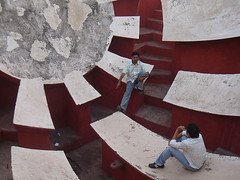
My entry to the Lonely Planet Photo Challenges contest, "Curves."

These fellows were perched on one of the sundials at Jantar Mantar, built by Maharajah Jai Singh II in Delhi circa 1764.

You can view the other contest entries on Flickr.com at
http://www.flickr.com/photos/tags/lpcurves/

Saturday, March 06, 2010

In my neighbourhood


Kumar Shubankar
Originally uploaded by Sirensongs
Shubankar lived downstairs from me in Koregaon Park, Pune - where the restaurant bombing just happened on Valentine's Day. He lived in a traditional "joint family," with a bit of a twist - the husband and wife (Shubankar's parents) had moved in with the *wife's* parents, rather than with the husband's as per tradition.

The family were my landlords, it was their building. They were entirely accustomed to having foreigners come and go, they just asked that I be in before 11 or so.

Shubankar was all dressed up for his school Fancy Dress Competition as Chhatrapati Shivaji, the Marathi leader and hero of not only the Marathi region but Hindus everywhere.

He won the contest, so I took these photos and not only printed them for the family, but took them to be laminated and mounted with a stand.

This type of remembrance will make you very popular with Indian friends and landlords. It really is all about the family.

Tuesday, March 02, 2010

English lessons

The Aura of Auroville
Pillaichavady, Tamil Nadu

This is a journal entry from my time teaching English in a small town in Tamil Nadu, 2004.

Distances in and around Auroville are vast, and most local people do not have access to motorized transport. For me, a delightful highlight of life here are the local hitchikers on the verdant Auroville red-dirt roads. Usually women and small children, they stand on the roadside, armed with school bags, a bucket of fish, or a basket of vegetables, and flag down zooming scooters, mopeds and motorcycles.

Enge po kirrai? I ask in my limited Tamil. Kuilapalayam, Edaiyanchaady or Periyarrmudialarchavady , the polysyllabic village names come tumbling from their mouths. I scoot forward so they can hop onto the back (sometimes as many as 3 schoolgirls sitting behind on the pillion). Naturally, this slows down my own commute, but I don't mind....the village ladies with their crooked teeth, nose discs of gold and bright floral saris, the tiny school kids whose chubby little arms clutch round my tummy,
their squeals of fear or delight each time we hit a bump in the road - my being a few minutes late for class seems a small price.

Yesterday a tiny boy wearing a red puja mark on his forehead flagged me down on the Boommayapalayam back road at 7:15 AM. He was on his way to school, and took the opportunity to both practice his English (what is your name? My name is Danil. Where are you going? I go to New Creation School in Kuilapalaym) and instruct me in Tamil - as we passed things (tree, cow, dog) he yelled out the English and Tamil names.

Danil was not well-dressed and was very tiny. It brings a tear to a middle-aged eye to see such eagerness to learn and so much sweetness. It was easily an hour's walk to his school, but there he was trudging down the road bright and early.

My Language Lab English classes are a mixed bag. One class will be a runaway success with everyone yelling out answers and getting into it - the next will have a bunch of dud, dead spots where lose momentum and the kids begin to lose itnerest (begin to chat amongst themselves, etc). It's still very gratifying - but the new car smell (novelty of an American teacher) has worn off a bit, which means, I must figure out the challenge of actually teaching them, not just entertaining them.

Today some of the girls tried to stand up when I came into the room and I insisted they sit down (traditional respect for the teacher, but it was alarming to me).

I try to get them to talk about their lives and their world - instead of just repeating the lines about shoppes, prices and places in their textbooks. The last 2 assignments I gave: write a story about yourself and your day.

"My name is Vijayalakshmi, I live in Boomayapalayam. My house is behind the banana tree...
...I am eating rice every day. I am watching the television every day.
...Every day I go to work in Auroville at the Health centre, then I go home. "

They are too polite to tell me when they are bored or don't understand. Once I even asked them do you like this exercise, or do you want to do something else? and was met with blank stares - then I realized that, probably in their entire lives, no one had ever asked them what they WANTED to do. As they see it, a teacher, particularly, is supposed to be giving orders - not engaging in some kind of touchy-feely dialogue.

Friday, February 05, 2010

Calcutta: the Great Unwashed

Hi, everyone. I'm too freaked out by all the blank space and white bread to write much now that I'm back in the States. So I am resorting to re-runs.

This blog originally appeared as a Lonely Planet "Don't Forget to Write" entry in December, 2003.
It was one of several entries I wrote about Calcutta, so don't flip on me if I left something out.


India has a genius for complicating things, and I'm not exactly straightforward and clutter-free myself to begin with.

Your faithful correspondent came North to Calcutta see the Kali Pujas (Oct 25-28, 2003), decided to stay a few days to volunteer at Mother Theresa's homes, and, as though in reward for this altruistic decision, promptly got deathly ill - a very nasty 6-day bout with diarrhea, cramps, indigestion, nausea, etc., and had to resort to a short round of antibiotics.

To further complicate things, when I became well enough to stagger past the ever-present gauntlet of Calcutta's professional beggars down to the local net joint, I found there was a SNAFU with my usually trusty email account.

Mother Teresa's home for mentally handicapped kids (Shishu Bhavan) was pretty amazing and unexpectedly fun, if you can ignore the smell of antiseptic floor wash (barely masking that of urine and feces). You should see the way these kids, many of whom are autistic or worse, light up when you just strum a few chords on a beat up old guitar and sing "Old MacDonald."

Calcutta - (India's second largest city, which in terms of sheer numbers, is quite a statement) is simultaneously the most medieval and most modern place I've yet visited here. Where else in the world can you take a foot rickshaw (yes, with huge wooden spoke wheels and a snowy-bearded barefoot man trundling you along the street) - a foot rickshaw, past limbless beggars and snarling street dogs, to the gleaming, punctual, immaculate, safe, uncrowded, *air-conditioned*(!) Metro station?!

In the Indian tradition of religious assimilation, Mother Teresa has been added to the local pantheon of saints and deities. The ferocious Kali Ma stares you down from nearly every street-corner shrine, alternating with Durga, who smiles benignly while spearing a demon. Amidst what must have seemed pagan idolatry to her, Therese's wrinkled walnut of a face has earned an enduring place of honour.

The city has been awash with activity honoring her recent beatification; everything from a Mother Teresa film festival (mostly documentaries and one docudrama starring Geraldine Chaplin), a ceremony for the first official veneration of her relics (including a few drops of blood - don't even want to know how they acquired that), and various cultural ceremonies, mostly featuring acoustic guitar renditions of "Amazing Grace" sung in Bengali.

Park Street - the hip, happening yuppie street with all the bars, trendy shops and nightclubs - has officially, and not quite appropriately, been dubbed Mother Therese Avenue. Calcutta municipal corporation seems to have a real sense of humour in this area; in the midst of a somewhat perverse PC renaming orgy, they also rechristened Calcutta's most commercial thoroughfare "Lenin Street." The US and British consulates both reside on what's now called "Ho Chi Minh Avenue." (I'm not sure what significance, if any, to read into the fact that these names appear only on maps and signs, but never in the local parlance.)

The post-colonial purport behind this nomme-nouveau frenzy (which seems to have primarily benefited the sign-painters and map printers) strangely didn't stop several streets from being renamed with, of all things, British names. Thus the former Theatre Road, rather than being named after a worthy Bengali playwright, of which there are many, became "Shakespeare Sarani." Another street, albeit a small one, swapped the decidedly British "Middleton Row" for the equally Limey "Sir William Jones Sarani." And one can only wonder what nationalist purpose was served by giving the name "James Hickey Sarani" to the former Dacres Lane.

I've found it surprisingly difficult to leave Calcutta, described by...well, some old writer whose name escapes me as being composed of "new mud, old mud and more mud." Repetitive, but accurate. Weather here, which was monsoon marsh and dripping humidity upon my arrival, has greatly improved, as has my health.

Give Calcutta a chance to first entrap you with its bewildering network of former cowpaths impersonating actual streets, or prevent your plane from departing due to poor visibility, and you'll find it eventually ensnares you with its unique charm - a sort of "creme de la grime." It ranks with Rome as an eternal, infernal city.

Recommended in Calcutta:
Kolkata Film Festival
Victoria Memorial including the Calcutta History Museum
Dakshineswar Kali Temple
Park Street British Cemetery
Howrah Bridge at dusk
Asiatic Society Museum
(no admission for foreigners without passport)
Indian Museum on Chowringhee (Nehru) Street


Wednesday, January 20, 2010

Updations

That's a word, in India. "Updations." They figure, if you can locate something in a location, why can't you update something with an updation? It is, in fact, grammatically correct.

It's the same logic that produced "pre-pone." If you can postpone something by moving it farther away in time, why not prepone something by making it more near? (That sentence, in fact, may not be grammatically correct.)

All of which raises the question: "What the hell is a 'Pone,' anyway?"

Anyway, this week's updation is of my Cool People Link Here links. I have dropped some that exist no more, and added a few new ones.

The photo has nothing to do with any of this. It's a man with his bicycle, crossing the vast dry Niranjana riverbed in Bihar, India.

Thursday, January 14, 2010

Pongal O Pongal!

(The following column originally appeared January, 2008.)

Today is PONGAL, and I am not in Tamil Nadu! Not even close, not even in South India! Where can I possibly eat sweet pongal or ghee pongal? Guess I will have to experiment with recipes at home.

'Thai Pongal', as it is popularly called in Tamil Nadu, is a thanksgiving ceremony celebrated by Tamil farmers to thank the spirits of nature, the sun and farm animals for their assistance in providing a successful harvest all through the year.
The festival is spread over four days, from the last day of 'Margazhi' to the third day of following month 'Thai' as 'Bhogi', 'Thai Pongal', 'Mattu Pongal' and 'Kannum Pongal'.
"We may have settled here, but we haven't forgotten our traditions. Almost all Tamils in Delhi celebrate Pongal the same way it is celebrated in Tamil Nadu," Natesan, secretary of Tamil Youth Cultural Association, told.
It's also Makar Sankranti, which involves the movement of the sun through the Jyotish (Vedic) zodiac, and the approach of spring. I believe the sun is entering the sign of Capricorn (the Jyotish or Indian zodiac calculates differently from the Western one).

The best Makar Sankranti ever was at the Kalachakra initiation in 2006. The whole town of Amaravati, Andhra Pradesh was alive with Tibetan and Buddhist festivity anyway, and then added to
that was the Makar Sankranti observance (dressed-up cows and bullocks, street musicians, and special, extra- elaborate kollam designs in front of doorways). Here's the best picture I got that day...it's one of my best "India" photos ever.

Pongal is not just one day, but several, including my favourite, Mattu Pongal or the day to honour
cows and bullocks. In the Madurai area of Tamil Nadu, this has traditionally included a kind of bullfight or bull-run called Jallikettu. In 2008 the whole area was up in arms (declaring a "black Pongal") because the Supreme Court has banned the practice, declaring it inhumane and cruel.

I have a suggestion - they should do what Nepalis do at Gai Jatra, and instead of using real cows, dress up humans as cows. Then they could see how much fun it is to be chased, poked , stabbed and have their tails pulled. It's quite amusing to see all the Madurai Hindus defend their "400 year old tradition" - what about the much older Hindu tradition (about 4000 years old) of honouring the cows?


Related reading: 
 

Tuesday, July 07, 2009

Turning over an old leaf

This is so cool
News from the Olds


I love the image of drinking in new knowledge from ancient palm leaf manuscripts. In some areas, palm leaves are still being painstakingly inscribed with sacred information.

Lontar is deeply venerated by Balinese, anyone who wishes to read lontar regularly needs to undergo a consecration ritual (mawinten) which must be performed by a brahman priest. Lontar cannot be sold or thrown away when damaged but it can be burned with proper ceremony and offerings.

A recent archaeological project collected palm-leaf manuscripts in the state of Chhatisgarh (formerly part of Orissa state).

In the first phase of a survey conducted by the National Mission for Manuscripts and assisted by locals, around 2,000 manuscripts have been collected from various archaeological and remote sites in Chhattisgarh...

But, how do the manuscripts contain words in "texts in Sanskrit, Oriya and Devnagiri" - since Devanagiri is a script, not a language? I think they mean that Devanagiri script was used to write the Sanskrit.

The photo at left shows an ancient manuscript in Kerala, in the possession of my friend Murali in Tiruvilwalmala, whose family have been Ayurvedic vaidyas for 17 generations.

I believe the script and language shown is ancient Tamil. (Someone know for sure?)

Originally, the pages would have been strung together with a thread through the central holes.

Hinduism Today's specialized news service, Hindu Press International, is where I saw this story, and a great source for all kinds of Hindu-related news items.

In the ongoing "pick on the foreigners" thread, Nepal's Pashupatinath temple has added insult to injury by charging perceived "foreigners" (read: people who don't look Nepali...so if you are Assamese Indian, or a Singapore Tamil, you are scot-free) double the previous entry fee - even though "foreigners" are prohibited from entering the actual temple, lest they pollute the hallowed grounds.

It's still okay to through plastic bags of trash into the nearby river and spit on the ground, though. No fines levied for that.

Thursday, May 28, 2009

Art appreciation

As some of you know, I spent about four years travelling around India and Nepal, and about two of those were following HH the Dalai Lama to his many places of teaching and discourse throughout India.

Nowadays, some wags probably consider that stalking. There was a day when it was considered pilgrimage. That's what you do with saints, in the Hindu and Buddhist tradition. Saints don't stay in one place, they keep travelling. You follow them around.

Anyway, some of my favourite moments were in and around the teaching sites, where "Life's Rich Pageant" coalesces.

This photo was taken one morning in 2006 at Sarnath, Uttar Pradesh at the Central Institute of Tibetan Higher Studies, where everyone was queuing for the metal detector to get into teachings.

Last week, I received some Art Appreciation from a Flickr user named East Med Wanderer:

Great shot! All life is there - it has the quality of composition of one of the great master painters. And with a point and shoot - terrific!

Sometimes that's all it takes to make your day, or week. One of the great master painters probably would include the entire face of the purple-wearing woman at left, though - for compositional balance. That way, there would be two women facing each outside corner.

I can no longer post the larger versions of the photos - they kept getting stolen off the blog site. You can view (but not right-click) a larger version here.

Wednesday, April 29, 2009

Peace sign

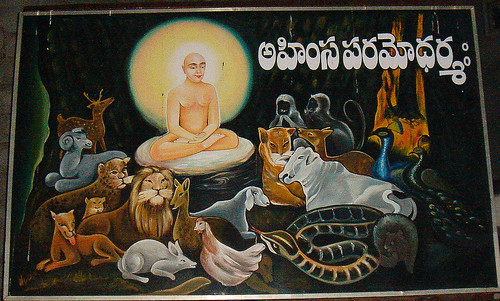
I adore this hand-painted billboard, that I snapped near Guntur, Andhra Pradesh three years ago.

It depicts a Jain saint seated peacefully among animals, and (in Telugu script, but Sanskrit language) says "Ahimsa paramo dharma," or, "Nonviolence is the greatest religion." 

Ahimsa

Related reading:
Religion and Culture of the Jains.

Monday, April 06, 2009

Survey says....

And, hooray for our side
News from India


At last! Sex and Power, the book by Rita Banerji (creator of the 50 Million Missing project for Indian women) has been released!

It's now available on Amazon.com and last week, was #1 on the Bestseller list of Crosswords (one of India's largest bookstore chains).

The 50 Million Missing project began as a photo collection and has now become an international campaign to stop "India's silent genocide," the selective elimination of female infants and fetuses.

You can easily help the project by taking their Gender attitudes survey.

It only takes four minutes to complete the 50 Million Missing project's gender survey.

Rita says:
1. They don't give their names (it's anonymous) 2. Don't think too much. Just answer. 3. Takes less than 4 mintues 4. Don't forget to click 'submit' at the end

Here's the link
http://www.my3q.com/home2/252/the50millionmissing/survey.phtml

 Related reading: 
Women in Ancient & Medieval India (History of Science, Philosophy & Culture in Indian Civilization)

Tuesday, March 31, 2009

What's your sign?

I am almost afraid to ask. What is a leprosy BIBING hall?

Could they mean a sort of dining hall, as in, "imbibing"?

Seen near Tapoban, upper Rishikesh, UP.

Vegging out

Where to eat, continued
Kathmandu

Last week was remarkable in that I met two pure vegetarians who were not foreigners. (A foreign Buddhist or yoga person is more likely to be vegetarian than a local Hindu or Buddhist.)

Ravi is a Nepali by way of India (family of Marwari Jains), and Nikesh is an Indian Brahmin who owns a business in Nepal. Naturally, the subject came up: where do you eat?

Most places in town accomodate vegetarians well. But for the purist, there are very few dedicated vegetarian restaurants. In this case, dedicated means not even having meat products on premises. In the strictest sense ("Pure Veg" as they say in south India), it means not even using eggs.

Thamel's Israel-Middle Eastern restaurant, OR2K, is veg but uses lots of egg. Newari and other Nepali restaurants will make a veg set meal, but sometimes cook items in the same pan that's used to cook meat, resulting in ingestion of meat essences and flavours.

With branches in many parts of town (Putalisadak, New Road) and a main hall at Tripureshwor right by Bluebird, Angan is probably the best all-around pure veg restaurant in town. They cover a range of Indian cuisines from North to South to West (Gujarati dhokla!) to East (Bengali sandesh sweets) and have a large, airy, clean dining hall up and downstairs in Tripureshwor. The other locations are more cramped and have more limited selections. Their Rava Dosa Plain is exceptional, the sambar great. They are a branch of (I think) India's Bikanerwala.

Not surprisingly, the pure-veg restaurants in town are all (as far as I know) Indian-owned. My favourite is Trishna Mitai in Lazimpat, before Shangri La. They are Bengali-owned (telltale icon of Dakshineswar over the counter) but do feature good south Indian dishes such as Uttappam and Idly, as well as samosa-chat-chai. I especially like the grandmother who sits in a chair behind the corner and gives me a beautiful smile. She never fails to wear sari and a pure chandan hand-painted tilak.

Two more pure veg Indian shoppes are Dudh Sagar on Kantipath, just opposite Mandala Books (they do have idly, wada, dosa and uttappam!) and Bandar's, a Rajasthani-owned small diner off New Road by Pyukhan Marg. Bandar's may be the only place in town to try Rajasthani Thali.

One Thamel spot that guarantees they use no egg is Shree Lal's House of Vegetarian. Though they seem very sincere, the food I got (dal makhani) was mediocre.

Two more sources of veg food (don't know whether they use egg, though) are the Kopan Monastery canteen way up on Kopan hill, and the Rabsel guesthouse run by Shechen Monastery. In Thamel there's also the old standby Pilgrim's Bookstore Cafe - always shanti, always veg - and the Himalayan Buddhist Meditation Centre cafe which has now moved to Tridevi Marg near Kesar Mahal.

Related reading:


Monday, March 30, 2009

Party line

Indian media-watchers will have a familiar response to this headline:

12:07, March 29, 2009

When I saw this, I immediately said, "It HAS to be The Hindu."

And, so it was.

The democratic reform in China's Tibet Autonomous Region abolished the theocratic system, did away with feudal serfdom and slavery, emancipated about a million serfs, and laid the basis for the modern development of the region as a part of the Chinese socialist system, an Indian newspaper said Saturday.

The reform in 1959 brought forward China's project of freeing a million serfs, said a leading editorial published by The Hindu, one of India's major English newspapers, which echoed the celebration of Tibet's first Serfs Emancipation Day, an official annual holiday, and denounced the Dalai Lama's past persecution of the Tibetan people.
....

The Hindu, otherwise a well-regarded and venerable established paper, has an extremely pro-China and pro-Communist editor. I heard he gets free trips to China courtesy their government to keep printing anti-Dalai Lama crap like this. 

Related reading:  
India and Tibet; a history of the relations which have subsisted by Francis Younghusband
 

Thursday, February 26, 2009

Still missing

The 50 Million Missing International Campaign project on Flickr.com continues (despite my absence of nearly a year) to raise awareness of Indian women's situation in what has become a silent gender war.

Sex-selective abortions (female-fetuses only), female infanticide (killing baby girls immediately after birth), and dowry deaths are just two of the factors that have skewed India's gender ratio (aka "sex ratio" or number of women vs. number of men in the population) to dangerous lows. Discussions on these issues and what to do about them continue here.


Due to a traditional preference for sons, daughters are regularly dispensed with through selective abortions and the practice of infanticide. The medical journal Lancet recently announced that about a 1000,000 female fetuses are aborted in India each year. In the state of Kerala, India's most literate state, it is estimated that about 25000 new born infant girls are annually killed. The figures of female infanticide in Bihar are far worse. There, mid-wives admit to being paid to kill at least half of all baby girls they birth. It is also estimated that at least 25000 women are annually murdered by their in-laws and husbands, after being subject to extended physical and mental torture for reasons of dowry. This is India's silent genocide, and it is time for it to STOP.


And, the (now 2,078) international members continue to upload photos that show the breathtaking expanse covered by Indian women and their lives, such as the one above, contributed by Ahinsajain , or the one at left, by BagLady. The project has now collected and catalogued some 13,583 such photos, with dozens more uploaded daily.

Founder Rita Banerji's original goal was to attempt to collect one photo to represent each of some 50 million estimated Indian women who have vanished from the population as a result of such practices.

Sign the petition here, and visit the group's own website.