Showing posts with label hindu. Show all posts

Saturday, October 09, 2010

Meanwhile, back in the Valley

Harvest Home
Body in NYC, mind in Nepal

I'm sitting in an East Village cafe, watching the corner grocery try to array produce in an attempt at a "harvest season" display.  Somewhere, outside of Manhattan's concrete canyons, leaves are changing colour, chrysanthemums are blooming and roadside stands are setting out sheaves of Indian corn and piles of pumpkins.  And all over Nepal, it's Dasain time - the nine-day festival dedicated to goddess Durga, in her local Nepali incarnation as Taleju Bhavani.  
The narrow streets of Kathmandu's old town are crammed with shoppers buying holiday gifts, and all the accoutrement required for a Nepali Hindu holiday (special food, sweets, and lots and lots of marigolds).  All this under a blazingly blue sky - weatherwise, it's the perfect season to be in Nepal.

This nine-day goddess festival ("Navratri") is celebrated throughout the Hindu world, taking on local characteristics in each region.  In Maharashtra (India), the holiday is called Dussehra, marked by  glowing paper lanterns.  Mysore (in Karnataka, near Bangalore) has its famous Dasara procession complete with elephants, a palace glowing with oil lamps and fairy lights, and the descendant of the former Maharajahs presiding.  On most every street corner in Calcutta, you will find pandals (platforms with decorated deity statues) for Durga, with ceremonies and devotional music ongoing throughout the holiday, till the clay statues are submerged in the Hooghly river on the tenth and final day.  In the Kullu Valley of Himachal Pradesh, the local goddesses are brought down from their respective temples and paraded on palanquins through the town. 

Dasain is the uniquely Nepali form of Navratri. Nepali festivals are tied to the seasonal agricultural cycle, reflecting the centrality of farming in many Nepali communities.  Each of the nine days is full of significance and traditional observances.  On Ghatasthapana, sprouted wheat grains are planted in a pot, and kept in a dark place in the household.  On the tenth day of Dashami, the beautiful spring-green sprouts (called "jamara") are plucked and worn, as a sign of new growth and regeneration, along with "tikka" (the red kumkum powder) on the forehead.

Nepalis having a genius for time-warping, the nine days and nights of Dasain magically extend to two weeks, even a month in some cases. Workers who have migrated from their remote villages to larger towns to find employment are packed onto rickety buses, crossing dusty and bumpy roads to make the pilgrimage home for the festival.  For many, is their one chance in the year to see their family and the old home place.   When a Nepali waiter, for instance, takes leave from his job to go home for Dasain, he returns whenever he returns - between over-capacity buses, unreliable vehicles, transport strikes and poor road conditions, he can't guarantee a definite date of return.  Most Nepali businesses are bound (by tradition as well as the powerful Maoist-led labour unions) to give each employee a full month's salary as Dasain bonus.

Most Nepalis don't consider their Dasain complete without the sacrifice of a goat.  In a traditional Hindu town like Bhaktapur, every house will have blood on the doorstep from the sacrifice, usually done on the ninth day of Navami.

As a visitor to Nepal, Dasain can be frustrating - transportation is crammed full, shops open and close erratically, most government offices (including those for trekking permits) are closed, and tourist restaurants and many hotels are running on a skeleton crew.  The best way to spend Dasain is to relax, forget your goals and travel checklist, befriend some Nepalis and get invited to their home.  You will enjoy  the traditional foods, and receive the blessings of  tikka and jamara from the family elders. 

Don't forget to bring a present (almost anything is appreciated, but sweets are always appropriate), visibly relish the food that is served, and demonstrate real interest in the holiday and its traditions.  For all the breathtaking mountain vistas, everyday life in Nepal is marked by simple pleasures and of course, the ever-present Nepali smile.

Monday, March 29, 2010

Between the babas

Backstage at Babastock
Kathmandu, Nepal


Ever wonder what those sadhus from Durbar Square - the ones who want money for photographs - do when they're not out begging for alms? They chillax backstage at Kathmandu's Pashupatinath Temple, in the babas' ashram.  These shots were taken just after Shivratri, 2009.
Backstage with Baba

Sadhus (male and female - females are called Sadhvis) come from India as well to be at Pashupati for Shivratri.
Tiffin Time for Baba
By tradition, the Nepal government was obliged to provide ganja, or at least subsidize its purchase, for the Hindu holiday Shivratri (which occurs annually in February). The new, non-Royal, non-Hindu government of Nepal may put a stop to that. Last year the newspaper featured reports of complaining Babas - they didn't receive the customary amount of rupees to subsidize the holiday smokfest.

I found the Pashupati Babas - while quite laid-back - to be also rather career-minded. Most of them make a few rupees as photographer's models. They all had the equivalent of press kits - a stash of carefully-preserved photos and even magazine clippings they had appeared in. The fellow below is showing off some of his portfolio.

Thursday, January 14, 2010

Pongal O Pongal!

(The following column originally appeared January, 2008.)

Today is PONGAL, and I am not in Tamil Nadu! Not even close, not even in South India! Where can I possibly eat sweet pongal or ghee pongal? Guess I will have to experiment with recipes at home.

'Thai Pongal', as it is popularly called in Tamil Nadu, is a thanksgiving ceremony celebrated by Tamil farmers to thank the spirits of nature, the sun and farm animals for their assistance in providing a successful harvest all through the year.
The festival is spread over four days, from the last day of 'Margazhi' to the third day of following month 'Thai' as 'Bhogi', 'Thai Pongal', 'Mattu Pongal' and 'Kannum Pongal'.
"We may have settled here, but we haven't forgotten our traditions. Almost all Tamils in Delhi celebrate Pongal the same way it is celebrated in Tamil Nadu," Natesan, secretary of Tamil Youth Cultural Association, told.
It's also Makar Sankranti, which involves the movement of the sun through the Jyotish (Vedic) zodiac, and the approach of spring. I believe the sun is entering the sign of Capricorn (the Jyotish or Indian zodiac calculates differently from the Western one).

The best Makar Sankranti ever was at the Kalachakra initiation in 2006. The whole town of Amaravati, Andhra Pradesh was alive with Tibetan and Buddhist festivity anyway, and then added to
that was the Makar Sankranti observance (dressed-up cows and bullocks, street musicians, and special, extra- elaborate kollam designs in front of doorways). Here's the best picture I got that day...it's one of my best "India" photos ever.

Pongal is not just one day, but several, including my favourite, Mattu Pongal or the day to honour
cows and bullocks. In the Madurai area of Tamil Nadu, this has traditionally included a kind of bullfight or bull-run called Jallikettu. In 2008 the whole area was up in arms (declaring a "black Pongal") because the Supreme Court has banned the practice, declaring it inhumane and cruel.

I have a suggestion - they should do what Nepalis do at Gai Jatra, and instead of using real cows, dress up humans as cows. Then they could see how much fun it is to be chased, poked , stabbed and have their tails pulled. It's quite amusing to see all the Madurai Hindus defend their "400 year old tradition" - what about the much older Hindu tradition (about 4000 years old) of honouring the cows?


Related reading: 
 

Thursday, July 23, 2009

Fair to partly cloudy

Grey, green, gold, blue and white
Ranipauwa, Muktinath, Lower Mustang

Those are the colours of the landscape up here at Muktinath (in the lower Mustang region), an elevation of about 12,000 feet. Grey are the mountains; green trees; blue skies, golden wheat and white clouds. It was a precarious plane ride (between mountains, from Pokhara to Jomsom), stopped at the Magic Bean coffee shop in Jomsom for java, before walking to the shared Jeep ride.

I recommend sitting on TOP of the Jeep from Jomsom to Ranipauwa. They do not give you a discount for doing so (the ride is still 500NRS for foreigners) but it is much more fun to have the wind in your hair than to be in the stuffy inside.

Waiting for the Jeep you will see a colourful mix of fellow travellers. The Hindu sadhus are refreshing as, unlike the city "pseudhus," they are genuine pilgrims and not out for spare change. There are Tibetans and Tibetan-descended Nepalis who are native to the lower Mustang region, random "other" Nepalis, a few clean-scrubbed Western volunteers who are eager to teach the locals English, and of course, what I call the Stick Men (over-equipped foreign trekkers with their two walking sticks, one in each hand).

The morning of the eclipse dawned grey and cloudy, as luck would have it; but it was still great to be in a quiet, sacred space.

I am waiting for the camera batteries to charge; then I can upload photos.

At this time of year the region is really empty. Of course there are a lot of monsoon clouds, but they clear off a couple times a day for great views of what I assume are the Dhaulagiris.

Ranipauwa (the base village for Muktinath temple) is surrounded by more traditional villages such as Dzong ("hilltop fortress"), Purang, Lubra, Khining and Jharkot, which is home to the Tibetan Medicine society, a large Sakya gompa and an ancient ruined fort. During these first 3 acclimitization days, my walks to these villages, through golden wheat fields and meadows of flowers, have been nothing short of enchanted.

The "happening spot" in "town" appears to be a place called Hotel Bob Marley which actually is decorated in 100 percent Bob Marley paraphernalia, if you can imagine that, and run by a Nepali transvestite (very nice eyeshadow). In season I guess it is full of drunk Aussie climbers. Now it's nice and empty.

Muktinath temple is actually a walled compound (a complex complex at that) encompassing various religious expressions. The "main" temple to which most people refer when they say Muktinath is a three-tiered pagoda-style structure shoved way up under the very last spot before the mountain turns to cliffside. It's surrounded by the cold mountain streams, 108 spouts coming out of the steep hillside, so it constantly feels cleansed and renewed.

I normally associate Himalayan mountainscapes with Shiva in the Hindu pantheon, so was surprised to find it is a Vaishnav Hindu temple (though most people will claim it is "both Hindu and Buddhist"). The temple darshan (opening and closing of the doors) is controlled by a Buddhist nun. I'm going to read up a bit on the temple history.

The temple is best known for its association with Shalagrams, the sacred stones with ammonite fossils inside, said to be manifestations of Vishnu's sudarshana chakra. The stones grow naturally in the nearby Kali Gandaki river. They are for sale down below in the town, but technically you are not supposed to buy them. I think you are meant to find them, or have them "come" to you.

Additionally there are a Hindu yagnashala (fire ceremony house) where fire pujas go on daily; three very old Buddhist gompas with mostly clay (not stone or metal) statuary; a Shiva temple with an unusual iconic image (not just a Shivalingam, but marble figures of Shiva and Parvati); mountain ponds suitable for bathing, and lots of Buddhist prayer wheels.

Everywhere there are these solar cooking ovens that were thoughtfully donated by some German NGO. Great idea - to cook with solar energy rather than using local firewood, which deforests the land, or kerosene which has to come from down below. Too bad I have yet to see anyone use even one of them.

Development people need to realize: you can suggest all you want, you can lead a horse to water, but people do what they want to do. Not what you want them to do. Even when it means killing the goose that laid the golden egg.

Related reading: 
Trekking North of Pokhara Jomsom, the Thak Kola Canyon and the Annapurna Sanctuary: No 2 (Nepal trail guide)

Tuesday, July 07, 2009

Turning over an old leaf

This is so cool
News from the Olds


I love the image of drinking in new knowledge from ancient palm leaf manuscripts. In some areas, palm leaves are still being painstakingly inscribed with sacred information.

Lontar is deeply venerated by Balinese, anyone who wishes to read lontar regularly needs to undergo a consecration ritual (mawinten) which must be performed by a brahman priest. Lontar cannot be sold or thrown away when damaged but it can be burned with proper ceremony and offerings.

A recent archaeological project collected palm-leaf manuscripts in the state of Chhatisgarh (formerly part of Orissa state).

In the first phase of a survey conducted by the National Mission for Manuscripts and assisted by locals, around 2,000 manuscripts have been collected from various archaeological and remote sites in Chhattisgarh...

But, how do the manuscripts contain words in "texts in Sanskrit, Oriya and Devnagiri" - since Devanagiri is a script, not a language? I think they mean that Devanagiri script was used to write the Sanskrit.

The photo at left shows an ancient manuscript in Kerala, in the possession of my friend Murali in Tiruvilwalmala, whose family have been Ayurvedic vaidyas for 17 generations.

I believe the script and language shown is ancient Tamil. (Someone know for sure?)

Originally, the pages would have been strung together with a thread through the central holes.

Hinduism Today's specialized news service, Hindu Press International, is where I saw this story, and a great source for all kinds of Hindu-related news items.

In the ongoing "pick on the foreigners" thread, Nepal's Pashupatinath temple has added insult to injury by charging perceived "foreigners" (read: people who don't look Nepali...so if you are Assamese Indian, or a Singapore Tamil, you are scot-free) double the previous entry fee - even though "foreigners" are prohibited from entering the actual temple, lest they pollute the hallowed grounds.

It's still okay to through plastic bags of trash into the nearby river and spit on the ground, though. No fines levied for that.

Monday, July 06, 2009

I'm back, sort of

Temple of the Sword-Wielding Goddess
Sankhu, Kathmandu valley

Ack, I am suffering from what has become my annual Monsoon Illness. Somehow, hard as I try, it gets me every July that I stay in Nepal. I have got to get out of here earlier next year.


Here are a few photos from my visit to the atmospheric, remote temple of the KhadgaVajrayogini
at Sankhu village, on the eastern edge of the Kathmandu Valley.


'Sankhu Vajrayogini' is one of the four guardian Vajrayoginis ("Adamantine Goddess") that stand watch over the Valley. The other three sisters are found at Pharping, Guhyeswari (foreigners not admitted), and Swayambhu at Bijeshwori.

I hope to make a complete tour (via bicycle) of all four Yogini temples and post a yatra-logue about the whole thing.

Photos of the murti were not permitted, but I found the people up at Sankhu temple to be welcoming and very, very proud of their goddess. The young girl below (who spoke excellent English) explained to me simply, "She is our Mother."

Wednesday, April 29, 2009

Heritage, or hate?

Religious or racist?
In Dailekh, Nepal


I'm not saying I have an answer. Just putting it out there.
Parkala Matha

Brahmin priests in Dailekh have padlocked temples of the district to protest a recent verdict of the district court.
...(a) court verdict three months ago imprisoned a Brahmin priest on the charge of untouchability.
On April 12, the court sentenced Dipak Upadhyay... for refusing to tie Raksha Bandhan (holy thread tied around the wrist on Janaipurnima day) to a dalit local.
...Claiming they have the right to perform religious rituals as per their wish, the Brahmin priests padlocked a dozen temples...
District chairman of Hindu Vedic Sanatan Parishad (HVSP), Tilak Rijal, said the priests did not need to perform religious rituals for all the people.
"Practicing untouchability" - that is, discriminating against those traditionally considered of lower Hindu castes - has been made a crime in India and Nepal, though in remote areas such behaviour largely goes unpunished, and many old ways are still observed.

So, is this religious freedom, or racism? Or, at the very least, illegal discrimination? Should the courts be able to tell houses of worship whom they must accomodate? How would we feel if it were a White Supremacist church (they do exist) refusing admission to someone of another race? Is that even a valid analogy? Many Hindu temples specify "Hindus Only"; however, the Dalits themselves are Hindus. Does this mean they have to admit all Hindus regardless of caste?

And if there is a tradition of excluding certain Hindus, how much does the tradition matter? That is, is it beyond the law ?

Just asking questions.
 Related reading:
  

Tuesday, January 27, 2009

Celebrate Saraswati - Geek Girls Unite


Another excuse to close the office
Kathmandu

January 31 is Sree Panchami, the day to honour Sri Saraswati, goddess of learning and wisdom. (Last year it was February 8.)

Wear yellow and bring yellow flowers to the Saraswati shrine (if you need one, you can borrow one of mine...they are all over Kathmandu.) It's considered the most auspicious day to begin learning anything, especially to read or write a new language.

The following prayer is recited on this day:

Yaa Kundendu tushaara haaradhavalaa, Yaa shubhravastraavritha|
veenavara dandamanditakara,
Yaa shwetha padmaasana||

Yaa brahmaachyutha shankara prabhritibhir Devaisadaa Vanditha|
Saa Maam Paatu Saraswatee Bhagavatee Nihshesha jaadyaapahaa||

--English Translation:

"May Goddess Saraswati,

who is fair like the jasmine-colored moon,
and whose pure white garland is like frosty dew drops;
who is adorned in radiant white attire,
on whose beautiful arm rests the veena,
and whose throne is a white lotus;
who is surrounded and respected by the Gods, protect me.
May you fully remove my lethargy, sluggishness, and ignorance."
Saraswati, the goddess of knowledge and arts, represents the free flow of wisdom and consciousness.


--Saraswati painting courtesy
Exotic India.


Saraswati's archetype appears elsewhere in world culture. For instance, Lisa Simpson represents very much the same archetype (Goddess of learning, wisdom and knowledge).

In the western pantheon (we actually do have one), she would be Athena, goddess of learning and wisdom; though Athena is also equated with war, which both Lisa Simpson and Saraswati would emphatically disown.

And I have heard that the Tibetan version of Saraswati is Tsering-Ma.

Saturday, January 17, 2009

Hindus, Hin-don'ts

Temple of doom
News from Puri

I'm not taking sides in this...I know better. Just stating the obvious; that this is going to keep on till somebody or a bunch of somebodies (probably in
south India) holds a referendum to "officially" redefine or define in the first place, since it was never defined in any scripture, what is a "Hindu."

It's not the first time the guardians of Puri's purity have been asleep the switch. Last year an Australian (I think) got in - which precipitated a ritual cleansing of the grounds - and around the same time there was a diplomatic faux pas when some Indonesian (presumably Balinese?) Hindus were not allowed in (guess they did not look Hindu enough...?).

At the time of the Indonesian incident, I read an Indian news report that such a conclave was being held, but never heard results.

Now I read of an incident involving the Thai Princess (--are Buddhists part of Hinduism? depends on who is counting, and why. In my experience, when it's to Hindu advantage, Buddhists are part of the "Om Kar Parivar") and another where a Bhubaneshwar temple was cleansed after a visit by someone - government minister in fact - from a "low caste." (not enough to be Hindu - you need to be the right kind of Hindu.)

The temple cleansing episodes remind me of the old story about Buddy Holly's family. Holly, the Texas rock legend, was very adamant about integration and socializing with Blacks. (It's okay to call them Black again...) This happened in a small town in the 1950s. Holly insisted on inviting some Black musicians in to his parents' house for dinner. After they left, he said, his parents "scrubbed the dishes five times with extra soap."

And why doesn't anyone fuss at the Parsees about the same issue? Well, for one thing, the Parsees are consistent!

Hey Balinese guys, next time "dress like a sadhu."


According to police, the foreign visitor, Sebastian, dressed like a sadhu. That made it difficult for security guards at the entrance to make out whether he is a Hindu or not. “He looked like a sadhu. He was wearing ochre robes of Hindu monks and yellow kurta with a shawl. He had also anointed sindur on forehead,” Singhadwar police station inspector-in-charge Arun Dalai.

Fearing more tension, the policemen escorted Sebastian out of the temple and detained him at the office of the Jagannath temple for hours.

Tuesday, January 13, 2009

Eppady sugam?

Ivite nalla sugam
In Kathmandu

It's time for the annual Pongal-Makar Sankranti photos!


Something about the light in south India makes photography there very special.


I haven't been far enough south to celebrate Pongal (or to learn any new Tamil phrases) in several years; that makes me sad.

But I can still taste the Ghee Pongal from my last visit to Saravana Bhavan!

Sunday, January 11, 2009

Tamaso maa jyotir gamaya*

The business of Buddha
News from Karnataka

Buddhism is a growth industry. In India, where most people are Buddhist for business purposes (catering mainly to foreign Buddhists), an astonishing
number of new structures, complexes and facilities are always going up in the name of the Tathagata.

I think it's mostly great; all the statue-carving (shilpas) and icon-painting gives employment to traditional artisans. And though religious conversion (even from Hinduism to Buddhism) is still a fiery topic in India, it definitely promotes good will toward the Dharma and its exponents.


One of the latest is Gulbarga, Karnataka, according to this Deccan Herald report. Hey, even HHDL will be there on January 19!

I think Gulbarga is better known for some Sufi Muslim tombs, and a fort. But Buddhist remains and relics and ruins are all over India, and continue to be revealed and revitalized.

Gulbarga offers a rich history of the earliest Buddhist settlement of Satavahana period, [2000 or so years ago]. One of the ancient sites here is in Kanaganahalli near Sannati, a famous Buddhist heritage site on the banks of river Bhima in Chitapur taluk.

The remains of stupas, major rock edicts of King Ashoka, mounds, slab inscriptions and statues are all found scattered in a small area within the revenue limits of Kanaganahalli. About five to six stupa remains are found in and around Sannati.

Meanwhile, back at the ranch
In the meantime, in case there was any doubt, Nepal now officially sucks. We only have power for 8 (eight) hours A DAY.

With all the chaos facing the nation, the dominant political party has occupied itself invading the Inner Sanctum of the nation's holiest shrine and trying to replace the 260-year-old traditional priests, who as per tradition came from south India, with Nepalis. One of whom just happens to have the same surname as the Prime Minister himself!


Lighting oil lamps is no longer a charming Hindu and Buddhist custom...it's a necessity.

*Sanskrit slok that means "Lead me from the darkness into the light"


Related reading:  
Buddhist Goddesses of India 

Saturday, January 10, 2009

Only For Hindus

Get lost, injee
Jan Bahal, Kathmandu

Today at the Seto Matysendranath Buddhist temple (S. M. is a Nepali version of Avalokiteshwara, the 1000-armed god of compassion) I was told that I couldn't stand in front of the deity because it was "only for Hindus."

"What?" I retorted. "This is a Buddhist temple, this is Lokiteshwara!" (his nickname)

Someone appeared and explained that it was arati time and in fact, no one could stand in the mandap during arati. Well, now, that's different.

Then I had a good conversation with some Newar locals who spoke English. It seems that "only for Hindus" is just a phrase people have learned that they now use to cover even Buddhist situations!

Tuesday, January 06, 2009

Lush life

Planted
Kathmandu

Always suspected this, but then I have a definite tendency toward idealizing the wild and remote. Now a study confims it....

Fifty-five percent of plants - that's a lot of greens that aren't just goat fodder.

[KATHMANDU] Nepal may have more plants of medicinal importance than previously estimated, according to new research

The researchers found that up to 55 per cent of plants in the region had medicinal value compared to an average of 21–28 per cent described in the articles. The study — published online in the Journal of Ethnobiology and Ethnomedicine last month (2 December) — was supplemented by four field trips to the western districts of Nepal in 2006–2008, to verify the data.

You may know the Hindu myth (story, legend, Purana - don't beat me up for using the wrong word, please) about Hanuman going to the Himalayas to fetch a special herbal medicine for an ailing Lord Ram. When he couldn't locate the exact plant, Hanuman (with his incredible strength) lifted the entire mountain and carried it back to south India where Lord Ram was in battle.

The story is usually pictured with Hanuman ferrying the green gumdrop mountain in one hand, like a waiter with a tray of iced tea. (In the other hand he holds his mace.)

As though getting to the plants and getting them down from the mountains weren't challenge enough, the socio-political situation, with all the work and transport stoppages, in addition to lack of electricity, should make it near-impossible to get these plants from their homes down to the plains and do anything with them. The Abode Of Snows will hold its medicinal secrets a bit longer.


Had a cute picture of Hanuman and the mountain, but they're not adding today. ? Another Himalayan Mystery.

Wednesday, December 31, 2008

Newartistry

Art and about
Kathmandu
I was lucky enough to visit with a well-known painter of Hindu and Buddhist Tantric art, and didn't even write about it. Yet.

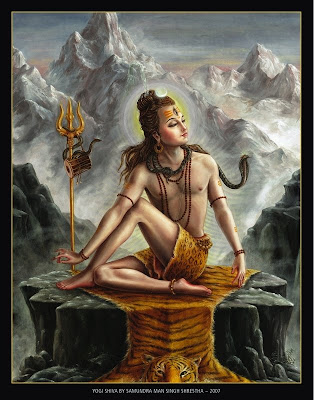
Samundra Man Singh Shrestha is so cool, he is friends with Robert Beer.

No, cooler than that - Robert Beer actually buys his (Samundra's) paintings. His most recent exhibit was at the Sacred Art & Sacred Space Auction in San Francisco.

He's also a good friend of my Charya dance teacher, which is why we went to hang out at Samundra's house in Lazimpat.

There are still plenty of painters in the Newar Poubha tradition, as well as in the Tibetan Thangka tradition. These traditons, like most classical schools, leave little or no room for innovation. Samundra has the technical ability to produce such works, but uses that background to render his own interpretations, particularly of Nepali Hindu gods and goddesses (Bhairab, Kaumari, and so on).

Samundra puts a lot of Rasa or Bhava (feeling or expression) into what could otherwise be static images with parameters set down by the Shastras (scriptures dictating artistic guidelines).

Anyway, I was too much of a bonehead to remember my camera that afternoon, so here is a wee example of his work. On the Tantricart.net website you can see more.

Saturday, December 27, 2008

In the dark

Dark ages
Chakupat, Patan, Nepal

Yikes. Power cuts just INCREASED AGAIN to almost 16 hours a day. The New Nepal is looking more and more like the Old Nepal - as in, 50 years ago, before electricity arrived.

Ason Tole
, the ancient crossroads of the Tibetan-Indian trade route, did look very magical with absolutely no electric lighting to compete with the glowing oil lamps of the temples. If it weren't for getting mowed down by motorbikes, I could almost imagine I was in the middle ages.

This afternoon, after my Charya nrtya class with Raju, we took the Patan Dhoka bus down to Chakupat to visit the
Nagarjun Institute in Patan. I got a copy of the only English translation (sort of - a summary really) of the Swayambhu Purana.

Here in Nepal there is a tradition that even before the historical Buddha, Gautama Buddha who lived approximately 2500 years ago, there were other, Adi-Buddhas (ancient, primordial buddhas). This Purana ("purana" means "old story") relates the Buddhist history of Nepal in this manner.

I personally think that since Buddhism had to co-exist with the Hindu kingdoms at that time they were amping up the ancient-ness - you know how in Hinduism everything has to be sooooooooooooooooo ancient.
Min Bahadur Sakya, one of the foremost Newar Buddhist scholars, was quite forthcoming about the adaptive aspect of the stories. Special thanks to him and his son Milan Sakya for sitting in the dark, illumined only by a dim battery-powered lamp, for about an hour discussing this subject with me.

Anyway, my net time is running out today, more later.

Tuesday, December 23, 2008

Time shift

Let's do the time warp again
Kathmandu

Last week, my Charya Nritya (Chacha Pyakhan if you speak Newari) teacher, Raju Sakya, and I were pushing our way through the sidewalk near Sundhara.

Pushing, not because Nepal is soooo heavily populated or because people are so rude (neither is the case) but because 2/3 of the walk space is taken up by sidewalk vendors. One of the first things the new Home Minister announced was a crackdown on "footpath" vendors. I guess what we're tripping over now are the vendors who can pay the new, requisite bribes.


Anyway, as we were negotiating our way toward the Ratna Park Tempo-Micro (mini-bus and share taxi) stand, we passed a lone Buddhist chaitya (aka stupa, chorten - Buddhist monument) in the middle of the sidewalk chaos.

In Kathamdu, it's hard to walk without tripping over such works of religious art - they are literally everywhere. But there was something distinctive about this chaitya.


The lines were more fluid, more flowery...I did not get a snap of it. But Raju, who is getting a Master's degree in Nepali art from Tribhuvan University, said "This is a Licchavi period chaitya."

The Licchavi period. Wow. That means it's at minimum 1,400 years old.

"Yes," said Raju, "from 6th or 7th century."

For just a second all the horns, shouting, spitting and pushing stopped. The Licchavi dynasty came from what's now Bihar state in India (I think; don't beat me up if I am wrong). Though they were Hindu, there was still plenty of Buddhist art flourishing during their reign.

This piece of ancient artwork is enclosed by just a cast iron railing; otherwise it's in the open air. It appears undamaged and has probably not changed for the 1500 or so years of its life.

Just the kind of stuff you can see any old day walking down the sidewalk in Kathmandu - if you can make enough space on the sidewalk. We pushed, darted, and maneuvered our way over to the micro-bus and headed for Patan (former Buddhist kingdom, now home to INGOs and expats).


Monday, December 22, 2008

Days of our lives

Calling all culture geeks and India-heads! The new Hindu Festival Calendar 2009 is out, courtesy About.com Hinduism. It's more oriented toward India than Nepal, but is pretty inclusive. Of course there are always myriad celebrations and regional variations that don't make it to the general calendars. But, if you are planning to be in Tiruvannamalai for Shivratri (for example), this is a big help.

There's also an explanation of the calendar and its relation to the English (Gregorian) one.

Here is the January listing.
Of special importance to Nepal visitors will be the Dasain schedule. It's well known how difficult it is to get anything done at this time.

These observances get earlier and earlier every year. I read a few months ago about how the Jyotishis (Joshis in Nepal) are discussing how to adjust the calendar. At the rate the lunar calendar is progressing, or I suppose regressing, pretty soon the harvest-themed festivals such as Dasain will be in August. That just won't do.

Monday, October 27, 2008

Dance the night away

Naach your average dance
Patan, Nepal

Kartik Naach,
the Nepali annual dance cycle depicting scenes from Hindu mythology (but danced by Newar Buddhist dancers) begins Oct. 31st in Patan's Durbar Square.


Kartik Naach is an eight-day series of dance-dramas instituted several hundred years ago by King Siddhinarasimha Malla. Though Patan's population was primarily Buddhist, the Hindu king hired the Buddhist dancers to portray Hindu stories.

Especially popular is the final night, when the tale of Narasimha disembowelling Hiranyakashipu is re-enacted to what can only be called mass hysteria from the crowd. (I would imagine this scenario is especially prominent because it's the namesake of the originating King Siddhinarasimha.)

All dances are free and open to the public, and take place on the Kartik Dabali platform in front of the famous Patan Museum from about 7pm to 9pm.


Here is a photo from the 2006 Kartik Naach depicting Lakshmi and Brahma Padmanabhasana (seated on the lotus from Vishnu's navel!).

I wrote to my Newar Charya dance teacher Raju Sakya about the origins of Kartik Naach. Here is part of his answer;

The King is Siddhinarasingha Malla who instituted and started for 15 days and his son SriNivas Malla elaborate it with other opera and dances for 1 month.But today in this century only for 8 days and some of the dance and dance parts are already lost or dissapeared with modern age. We have to preserve it but it's already missing . Let's hope and try to do revise and research on it.

Happy Deepawali and Nepal Sambat 1129 \Mhapuja.May Mata Laxmi bless us.

Monday, September 29, 2008

Graven images

Stoned
in Kathmandu

Yeah, I am so lame. I haven't blogged in nearly a month. But I have been playing Tour Guide to a number of friends tripping through the Du. Literally every time you go to an historic site, you see some new detail. Here are a few I've noticed this past month:

At the entrance to Mhyepi Ajima Buddhist temple. Just an archetypal female figure seated in something like Padmasana, and a bell to call her with. I like the way it's so worn down with centuries that nothing remains but the basic shape.


The torana (carved archway) of Sweto Kali or NarDevi temple, in the heart of Old Kathmandu. If you want to find her, the neighborhood is actually named after her (NarDevi). The white stuff on her mouth is milk-sweets (people "feed" her). Inside the temple are three more Devis. The torana is just a sort of "signboard" heralding the gods that live inside.


An unusually sensual statue of Sri Vishnu, Hindu god of preservation. He obviously seems "glad to see you." My friend Sean in California observed, "instead of sporting a Woody, he's sporting a Stoney."

Wednesday, August 20, 2008

Don't believe the heap

This just in! mountain made from molehill, film at 11
Kathmandu, Nepal

We have enough mountains here in the Himalayan Former Kingdom. In fact, with no petrol, no money, no roads, limited diesel and propane, no electricity, no schoolbooks and no real government or rule of law it's about all we've got.

I can't help but notice that some writers have lately added to the surplus, marking "Mountain" on our cultural and political maps where mere "Molehills" once stood.


One easy way to create a mountain is to heap up the hype of "news" where there is none.


Case in point: (jumping over to the western Himalayas for a moment):
Nicolas D. Kristof's
assertion a couple weeks ago that HH Dalai Lama's acceptance of Communist Party Rule in Tibet marked a "major turning point" (or some such nonsense) in the so-called dialogue between the Tibetan Government in Exile and the Chinese.

"An Olive Branch from the Dalai Lama"? What was he doing before, hurling invective?

Breathless with exci
tement, the double-Pulitzer winner Kristof rings what he clearly believes to be a clarion call:

One signal is this: For the first time, the Dalai Lama is willing to state that he can accept the Socialist system in Tibet under Communist Party rule. This is something that Beijing has always demanded, and, after long discussion, the Dalai Lama has agreed to do so.


News Flash to Nicky!: The Dalai Lama has always said this. He's been saying it for years (HHDL always says he's a socialist anyway, even calling himself a Marxist) and besides, it will hardly be seen as some major concession - the Chinese never considered it up for discussion.

Before I could muster my disdain for this silliness,
Manyank Chhaya beat me to it in this very lucid article which explains the non-event.

Indeed, the entire (widely republished, including in the International Herald Tribune) article appears to have been written in order for Kristof to reiterate, "I met the Dalai Lama personally. That's right, I got to sit and talk with him. The BIG D.L.! and ME!"

It's just like last year's reports that claimed the Dalai Lama was going to "resign." The Dalai Lama's been saying for literal years that the minute he's not needed politically, he will devote himself entirely to delivering Buddhist teachings and spiritual matters. This is nothing at all new.
Every writer just wants to be the first to break some new angle on a Dalai Lama story so they try to put old Chhang in new bottles.

...dot dot dot.....

By the way, in case you were wondering what the so-called "dialogue" or "talks" between HHDL's special envoys and the Hu Jintao sound like, our special Siren On the Scene had her ear to a tea-glass against the wall at the most recent Round of Talks in Beijing. She swears it went something like this:

HH: We give in! You run the government, just let us run our own religion. That's all we want.

Chinese Govt.: DALAI AND "DALAI CLIQUE" IS A SPLITTIST WOLF IN MONK'S CLOTHING TRAITOR TO THE MOTHERLAND BARBARIC FEUDAL LORD WHO DRINKS THE BLOOD OF POOR PEASANTS FOR AN APERTIF AND SUCKS THE MARROW OF THE WORKING CLASS DURING HAPPY HOUR

HH: Not really, actually you can stay in political and military power....we just want to run our monasteries and rituals according to our own traditions.

China: YOU WANT TO DESTROY UNIFIED CHINA AND RETURN TIBET TO THE DARK FEUDAL AGES WHERE EVERYONE WORE LEG IRONS LIKE BLING BLING AND ON THE WEEKENDS WENT TO PUBLIC EXECUTIONS INSTEAD OF INDOCTRINATION RALLIES LIKE NORMAL PEOPLE

HH: Uh, no...

China (sticks fingers in collective ears): LA LA LA, LA LA LA LA LA........

(Lather, rinse, and repeat - for the past six years.)

The "di" in dialogue means "two." The Sino-Tibetan DI-scussion is more of a monologue, going only one way.

And in other non-news....

On the other side of the Himalayas, scandal-mongering secularists attempt to create child abuse stories where there are none. The way to create a mountain, in this case, is to accrete creative imagery and selective exaggeration atop a religious custom you clearly don't understand.

There is plenty of child abuse in Nepal. Bonded labour, child trafficking, and so on. But these folks aren't concerned with that.

Witness today's "news" by AFP's Sam Taylor:

KATHMANDU (AFP) - A Nepali tradition of locking a young virgin girl in a palace and worshipping her as a "living goddess" has been dealt a blow with the country's Supreme Court ruling she has the right to go to school.

"LOCKING a YOUNG VIRGIN" (as opposed to a wrinkly, OLD virgin) "in a PALACE! " Now there's real objective journalism - visuals courtesy The Brothers Grimm.

It's sort of like saying that child monks are locked in a monastery, or that kids in a Catholic boarding school are prisoners. They are kids. Their parents decided where they would go, like most kids. In those places, there are rules. No kid has a "right" to go just anywhere he or she wants to...that's part of what it means to be a kid.


These girls' parents accepted the title of Kumari for the girl. They could have refused. The girl receives home-schooling, which is quite a luxury in a country where many children get no education at all. Her health care needs are met. There is no "labour" to speak of and even if there were, why are the plaintiffs not equally concerned with the thousands of bonded child labourers across the region?Above: Sajani during, and below after, Kumarihood. Photos by me

What if the girl doesn't want to be a Kumari? What if she doesn't want to enter a beauty pageant, be a child spokesmodel on TV, or take piano lessons? Do kids ever really get to say no?

Sure, she could be non-cooperative. She could sulk and be rebellious (I definitely tried it). The parents could still force her to do any of these, non-abusive, activities.

Those claiming to be so concerned for the various Kumaris' "rights" should review the United Nations Convention on the Rights of the Child, the ones they keep harping on but haven't actually read. It seems none of them are violated by the Kumari tradition.

...the right to survival; to develop to the fullest; to protection from harmful influences, abuse and exploitation; and to participate fully in family, cultural and social life.

I would submit that the meaning of participating fully in cultural and social life varies from culture to culture. In a typical Nepali household, "full participation" of girl children in family life means doing a full day of chores after school, if they do indeed attend school. Carrying water from the well, chopping vegetables, sweeping, cleaning, laundry and so on are all "full participation." Female literacy overall in Nepal stands below an appalling 27%.

The Kumari is exempt from all these things, and as such is quite privileged, rather than deprived. There isn't a whole lot of hanging out giggling at the mall involved in the average Nepali girlhood. All the Kumaris are able to receive visitors and play with children their own age - they are hardly sequestered in the locked palatial towers Taylor suggests.

Some interested parties made much ado about the Bhaktapur Ekanta Kumari's being "forbidden" to travel overseas last year to promote the documentary Living Goddess. In fact, Sajani Sakya herself was never forbidden to do anything. The seated KUMARI, however, traditionally does not travel in such a way. Sajani was free to go, but that would mean surrendering the title of Kumari. It was her (and her parents') decision.

Every title and position has its rules. Miss America, Eagle Scout, Class President and other titles can also be rescinded if protocol is not followed. The person is free to do as they like; but in order to retain the title, they must follow the rules. It's not a rights issue, it's an issue of whether or not you want to keep the job.

And that's about all the non-news that's fit to print.