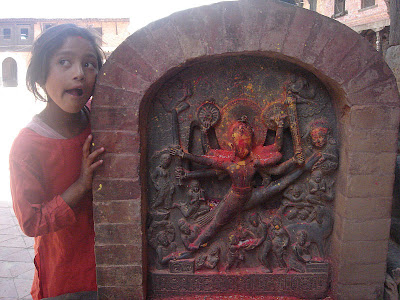
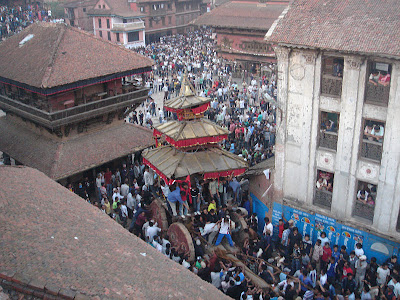
The morning after the insane tug-of-civil war that is Bisket Jatra in Bhaktapur (half the town goes to war with the other half the town trying to pull the chariot apart, or so it would seem), I met a couple of Americans who also wanted to go up to the hillside temple of Changu Narayan (one of the "Power Places of the Kathmandu Valley"). It is believed to be the very oldest temple in the valley, and also has the oldest inscription yet located here - from the 3rd century AD, in Licchavi script. (The Licchavis were one of the Indian Hindu dynasties who came up from Magadha way, I think.)
When we finally located the place everyone insisted was the "Changu bus stand," a taxi driver pulled up and did his very best to persuade us that in fact, there was NO bus to Changu. "No Changu bus. No bus. No bus today. Taxi, 300 Rs only." (By the way, the bus is 10NRs.) Instantly the shop owners, whose shop we were standing in front of, tried to get in on the act. They too insisted there was "no bus."
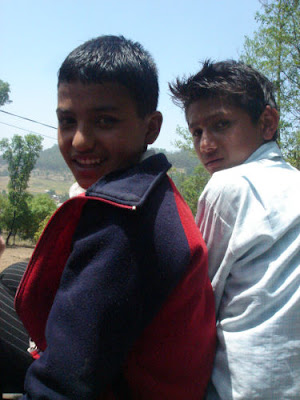 Our fellow roof-riders seemed well-informed about the upcoming US elections and wanted to know "Who will be the next president of your country?" As usual in this part of the world, the name "Cleenton" evoked the most recognition - a trusted brand name on the subcontinent.
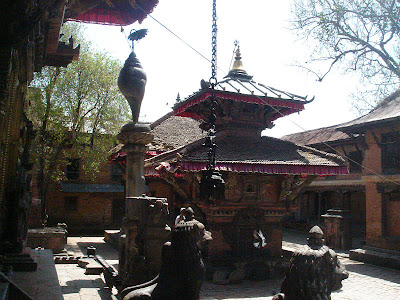
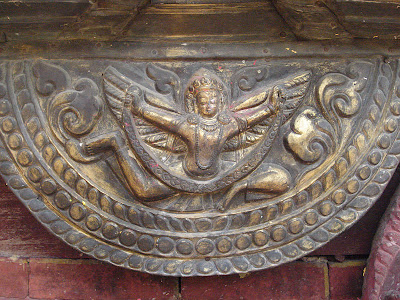
 Changu Narayan has got to be one of the most reasonable entrance fees in all of Asia - 60NRs or exactly $1.00 US to see the oldest temple in the Valley (and the one best noted for its sculptures).
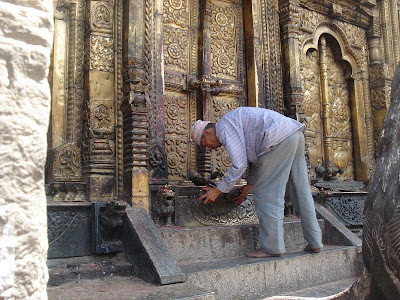
 Despite the fact that I can't read it, I think the stone below is my favorite part of Changu. In the ancient and now disused Licchavi script, it supposedly relates the story of how a Licchavi king dissuaded his mother from sati, or widow's ritual suicide on the funeral pyre of her husband, and instead persuaded her to stay with him among the living because he would miss her. (Some proof that, despite what many would like to claim, sati was real, not an invention of the British or anti-Hindu propagandists.)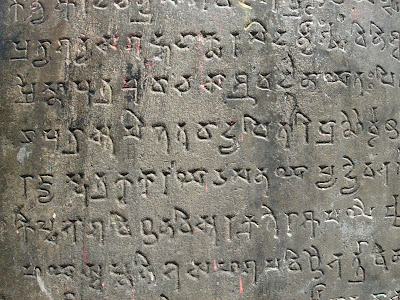
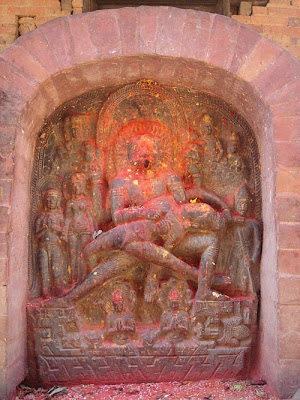
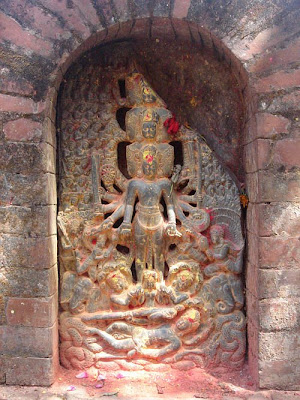
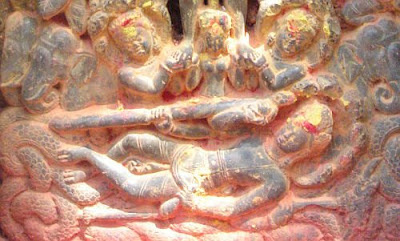
Isolated in their gilded cage are small statues of a former Licchavi King and Queen, possibly the ones who built the actual Changu Narayan temple (the site is believed to have been used for worship long before the building was erected). This is a common feature of Nepali temples - the patron king and queen immortalizing themselves in the kneeling posture of devotion, hands folded in salutation, facing the deity. 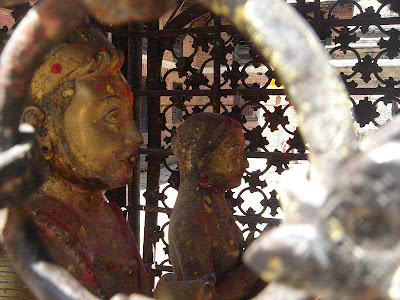
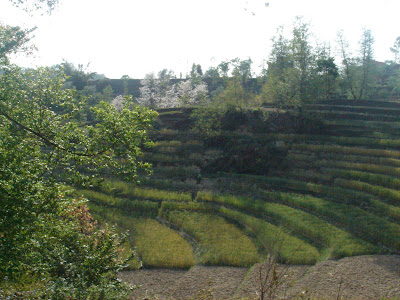
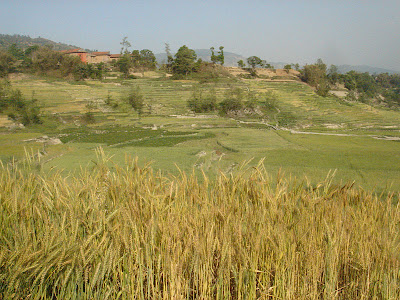
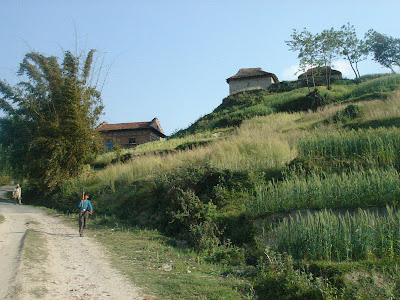 After a dreadful and very overpriced lunch at the neat, tidy garden style restaurant near the front gate (don't be fooled by the appearance - they do have a bathroom, though), we elected to walk the hour and half back down to Bhaktapur town, through the pine forest (the best part), windy wheat fields, and dusty small towns.
We knew we were near "town" when speeding vehicles threatened to knock us off the road into the ditch, and choked us with their fumes. Back in Bhaktapur, we were greeted by still more clanging cymbals, beating of drums and tooting of flutes. Was Bisket Jatra STILL going on? 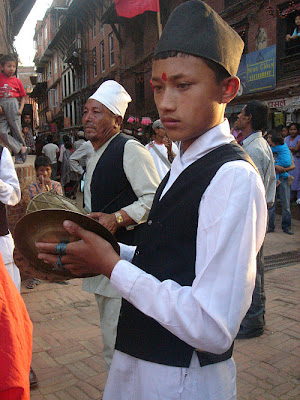
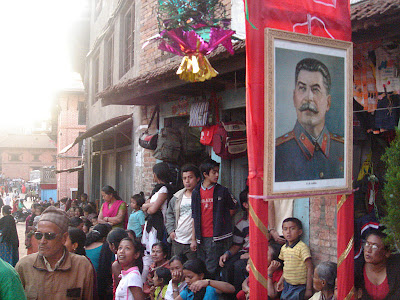
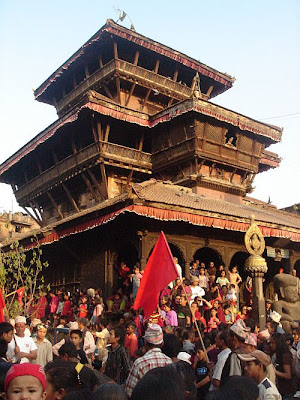 Dattatreya Temple square (also called Tachupal) was once surrounded by Maths, or Hindu ashram-style centres of residential learning. Students came from all over the region to learn traditional Ayurvedic (herbal) medicine in the ornately carved wooden buildings. Now, Pujari Math is a woodcarving museum, and another of the Maths has been transformed into a high-priced tourist restaurant.
New gods were being worshipped in the old square. It was high time for a shower and a pot of tea. We drifted through the narrow streets floating among political icons, Buddhist statues and Hindu gods back to the Bhadgaon Guest House.
---Thanks to Sudarshan for correcting some of the deity information.





 Posts
Posts