Showing posts with label festival. Show all posts

Saturday, October 09, 2010

Meanwhile, back in the Valley

Harvest Home
Body in NYC, mind in Nepal

I'm sitting in an East Village cafe, watching the corner grocery try to array produce in an attempt at a "harvest season" display.  Somewhere, outside of Manhattan's concrete canyons, leaves are changing colour, chrysanthemums are blooming and roadside stands are setting out sheaves of Indian corn and piles of pumpkins.  And all over Nepal, it's Dasain time - the nine-day festival dedicated to goddess Durga, in her local Nepali incarnation as Taleju Bhavani.  
The narrow streets of Kathmandu's old town are crammed with shoppers buying holiday gifts, and all the accoutrement required for a Nepali Hindu holiday (special food, sweets, and lots and lots of marigolds).  All this under a blazingly blue sky - weatherwise, it's the perfect season to be in Nepal.

This nine-day goddess festival ("Navratri") is celebrated throughout the Hindu world, taking on local characteristics in each region.  In Maharashtra (India), the holiday is called Dussehra, marked by  glowing paper lanterns.  Mysore (in Karnataka, near Bangalore) has its famous Dasara procession complete with elephants, a palace glowing with oil lamps and fairy lights, and the descendant of the former Maharajahs presiding.  On most every street corner in Calcutta, you will find pandals (platforms with decorated deity statues) for Durga, with ceremonies and devotional music ongoing throughout the holiday, till the clay statues are submerged in the Hooghly river on the tenth and final day.  In the Kullu Valley of Himachal Pradesh, the local goddesses are brought down from their respective temples and paraded on palanquins through the town. 

Dasain is the uniquely Nepali form of Navratri. Nepali festivals are tied to the seasonal agricultural cycle, reflecting the centrality of farming in many Nepali communities.  Each of the nine days is full of significance and traditional observances.  On Ghatasthapana, sprouted wheat grains are planted in a pot, and kept in a dark place in the household.  On the tenth day of Dashami, the beautiful spring-green sprouts (called "jamara") are plucked and worn, as a sign of new growth and regeneration, along with "tikka" (the red kumkum powder) on the forehead.

Nepalis having a genius for time-warping, the nine days and nights of Dasain magically extend to two weeks, even a month in some cases. Workers who have migrated from their remote villages to larger towns to find employment are packed onto rickety buses, crossing dusty and bumpy roads to make the pilgrimage home for the festival.  For many, is their one chance in the year to see their family and the old home place.   When a Nepali waiter, for instance, takes leave from his job to go home for Dasain, he returns whenever he returns - between over-capacity buses, unreliable vehicles, transport strikes and poor road conditions, he can't guarantee a definite date of return.  Most Nepali businesses are bound (by tradition as well as the powerful Maoist-led labour unions) to give each employee a full month's salary as Dasain bonus.

Most Nepalis don't consider their Dasain complete without the sacrifice of a goat.  In a traditional Hindu town like Bhaktapur, every house will have blood on the doorstep from the sacrifice, usually done on the ninth day of Navami.

As a visitor to Nepal, Dasain can be frustrating - transportation is crammed full, shops open and close erratically, most government offices (including those for trekking permits) are closed, and tourist restaurants and many hotels are running on a skeleton crew.  The best way to spend Dasain is to relax, forget your goals and travel checklist, befriend some Nepalis and get invited to their home.  You will enjoy  the traditional foods, and receive the blessings of  tikka and jamara from the family elders. 

Don't forget to bring a present (almost anything is appreciated, but sweets are always appropriate), visibly relish the food that is served, and demonstrate real interest in the holiday and its traditions.  For all the breathtaking mountain vistas, everyday life in Nepal is marked by simple pleasures and of course, the ever-present Nepali smile.

Thursday, January 14, 2010

Pongal O Pongal!

(The following column originally appeared January, 2008.)

Today is PONGAL, and I am not in Tamil Nadu! Not even close, not even in South India! Where can I possibly eat sweet pongal or ghee pongal? Guess I will have to experiment with recipes at home.

'Thai Pongal', as it is popularly called in Tamil Nadu, is a thanksgiving ceremony celebrated by Tamil farmers to thank the spirits of nature, the sun and farm animals for their assistance in providing a successful harvest all through the year.
The festival is spread over four days, from the last day of 'Margazhi' to the third day of following month 'Thai' as 'Bhogi', 'Thai Pongal', 'Mattu Pongal' and 'Kannum Pongal'.
"We may have settled here, but we haven't forgotten our traditions. Almost all Tamils in Delhi celebrate Pongal the same way it is celebrated in Tamil Nadu," Natesan, secretary of Tamil Youth Cultural Association, told.
It's also Makar Sankranti, which involves the movement of the sun through the Jyotish (Vedic) zodiac, and the approach of spring. I believe the sun is entering the sign of Capricorn (the Jyotish or Indian zodiac calculates differently from the Western one).

The best Makar Sankranti ever was at the Kalachakra initiation in 2006. The whole town of Amaravati, Andhra Pradesh was alive with Tibetan and Buddhist festivity anyway, and then added to
that was the Makar Sankranti observance (dressed-up cows and bullocks, street musicians, and special, extra- elaborate kollam designs in front of doorways). Here's the best picture I got that day...it's one of my best "India" photos ever.

Pongal is not just one day, but several, including my favourite, Mattu Pongal or the day to honour
cows and bullocks. In the Madurai area of Tamil Nadu, this has traditionally included a kind of bullfight or bull-run called Jallikettu. In 2008 the whole area was up in arms (declaring a "black Pongal") because the Supreme Court has banned the practice, declaring it inhumane and cruel.

I have a suggestion - they should do what Nepalis do at Gai Jatra, and instead of using real cows, dress up humans as cows. Then they could see how much fun it is to be chased, poked , stabbed and have their tails pulled. It's quite amusing to see all the Madurai Hindus defend their "400 year old tradition" - what about the much older Hindu tradition (about 4000 years old) of honouring the cows?


Related reading: 
 

Tuesday, January 27, 2009

Celebrate Saraswati - Geek Girls Unite


Another excuse to close the office
Kathmandu

January 31 is Sree Panchami, the day to honour Sri Saraswati, goddess of learning and wisdom. (Last year it was February 8.)

Wear yellow and bring yellow flowers to the Saraswati shrine (if you need one, you can borrow one of mine...they are all over Kathmandu.) It's considered the most auspicious day to begin learning anything, especially to read or write a new language.

The following prayer is recited on this day:

Yaa Kundendu tushaara haaradhavalaa, Yaa shubhravastraavritha|
veenavara dandamanditakara,
Yaa shwetha padmaasana||

Yaa brahmaachyutha shankara prabhritibhir Devaisadaa Vanditha|
Saa Maam Paatu Saraswatee Bhagavatee Nihshesha jaadyaapahaa||

--English Translation:

"May Goddess Saraswati,

who is fair like the jasmine-colored moon,
and whose pure white garland is like frosty dew drops;
who is adorned in radiant white attire,
on whose beautiful arm rests the veena,
and whose throne is a white lotus;
who is surrounded and respected by the Gods, protect me.
May you fully remove my lethargy, sluggishness, and ignorance."
Saraswati, the goddess of knowledge and arts, represents the free flow of wisdom and consciousness.


--Saraswati painting courtesy
Exotic India.


Saraswati's archetype appears elsewhere in world culture. For instance, Lisa Simpson represents very much the same archetype (Goddess of learning, wisdom and knowledge).

In the western pantheon (we actually do have one), she would be Athena, goddess of learning and wisdom; though Athena is also equated with war, which both Lisa Simpson and Saraswati would emphatically disown.

And I have heard that the Tibetan version of Saraswati is Tsering-Ma.

Tuesday, January 13, 2009

Eppady sugam?

Ivite nalla sugam
In Kathmandu

It's time for the annual Pongal-Makar Sankranti photos!


Something about the light in south India makes photography there very special.


I haven't been far enough south to celebrate Pongal (or to learn any new Tamil phrases) in several years; that makes me sad.

But I can still taste the Ghee Pongal from my last visit to Saravana Bhavan!

Monday, December 22, 2008

Days of our lives

Calling all culture geeks and India-heads! The new Hindu Festival Calendar 2009 is out, courtesy About.com Hinduism. It's more oriented toward India than Nepal, but is pretty inclusive. Of course there are always myriad celebrations and regional variations that don't make it to the general calendars. But, if you are planning to be in Tiruvannamalai for Shivratri (for example), this is a big help.

There's also an explanation of the calendar and its relation to the English (Gregorian) one.

Here is the January listing.
Of special importance to Nepal visitors will be the Dasain schedule. It's well known how difficult it is to get anything done at this time.

These observances get earlier and earlier every year. I read a few months ago about how the Jyotishis (Joshis in Nepal) are discussing how to adjust the calendar. At the rate the lunar calendar is progressing, or I suppose regressing, pretty soon the harvest-themed festivals such as Dasain will be in August. That just won't do.

Monday, April 21, 2008

Applied anthropology

"I was born a poor black child...then one day I heard my first Mantovani record, and realized - *these* are my people!"
- Steve Martin

White people just can't catch a break. If you stick with Strauss and the Civil War, you're a closed-minded ethnocentrist. However, if you express interest in some other culture, you're some kind of orientalist. I guess we should all just stay home and read De Bible, maybe join Daughters of the American Revolution.


I went out to Bhaktapur to exploit the natives this week. Here are some photos. Thank god I'll probably never make any money from them...then I'd be a neo colonialist.

::Bisket Jatra is a nine-day blowout festival in Bhaktapur, the second Every day features a different event. This is the raising of the Lingo (Lingam), a sort of Maypole equivalent (fertility/phallic symbol). When the Jesuits arrived centuries ago in their attempts to convert the Newars, they were so happy to see the lingo - they thought Christianity had already come to Nepal. Boy were they wrong....
::One of the focal points of Bisket is the tug-of-war chariot pull between lower Bhaktapur and upper Bhaktapur. This ancient chariot gets nearly pulled apart like a rag doll. I've seen at least a dozen Hindu chariot pulls and I've never seen anything like Thursday night's chariot wars.

::One of the guardian elephants (nearly life-sized) on the steps of Nyatapola Temple, overlooking the Bhairab Mandir in Taumudhi Square.

::Yummy daal bhatt - the Nepali national dish - at the Newa Family Restaurant in Sukul Dhoka - highly recommended. All this for 110NRS (about $1.50).
::The elaborate medieval style lock on a temple door.

::The Newars created their own brilliant art, wood carvings (above), metal work and Paubha religious paintings. However, most of what sells in places like Kathmandu, Boudha and Bhaktapur is Tibetan, or should I say "Tibetan." All this is junk created by Nepalis and sold by Nepalis. The real Tibetans are all in hiding from the police these days.

A real Tibetan, for instance, would probably never leave a sutra lying out uncovered as seen above...or sell it for a souvenir. Tibetan script itself is considered sacred, not to mention religious writings.

I went to visit a Thangka shop (Thangkas are Tibetan traditional religious paintings) called "Refugee Camp Thangka Painting School."

"Where are the refugees?" I asked. Of course, there were none. All the paintings are done by Tamangs, also Himalayan Buddhists, who learned the art from Tibetans after the 1959 exile.

I asked where all the Tibetans were. One painter guy told me "they're all staying in their rooms these days...they are scared of the police." It didn't seem to bother him at all that his own painting master was being persecuted and driven into hiding.

::Despite its image as an overwhelmingly Hindu traditional town, Bhaktapur also has at least one mosque and many Buddhist viharas, including one Theravada Buddhist vihara supported by a Thai donor.

Friday, March 21, 2008

Water world

Wet ones
Kathmandu & Patan, Nepal

The much-lamented water shortage doesn't seem to apply during Holi time. Supposedly a Hindu festival celebrating spring and the change of seasons, it's been commandeered by testosterone-poisoned young men who use it as an opportunity to harass women. Believe me, the transition of winter to summer is nothing to celebrate in this part of the world anyway.

After getting soaked on the way to the breakfast place (about 50 feet from my guest house), I decided to stay in today. Here are some scenes from the past week around town.


::At the foot of one of the four "Ashoka Stupas," Patan. It's believed that the Indian Buddhist emperor Ashoka had these four stupas, one at each corner of the Buddhist kingdom Patan, built during his visit. Patan remains a stronghold of Newar and now Tibetan Buddhists.


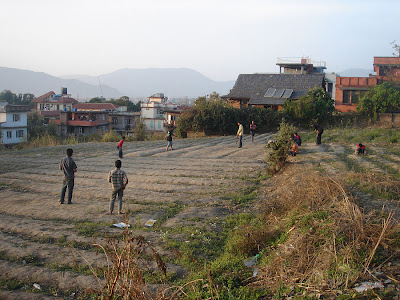
::Cricket game in a field near Pulchowk, Patan.


::Dorje or stylized "thunderbolt", representing the male creative principle, and a guy dressed like Cab Calloway at the Ashoka Stupa, Patan.


::Vintage Morris Minor car on Jyatha marg, Thamel.


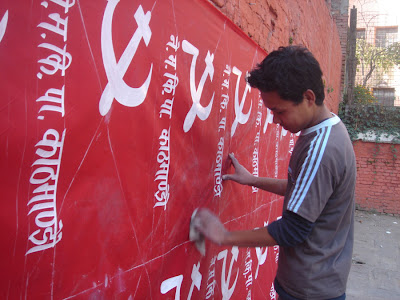
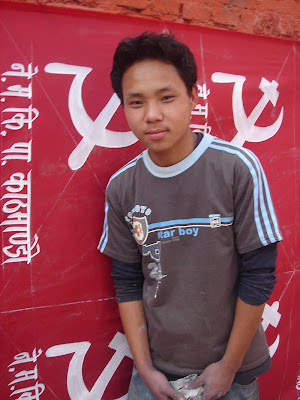
::This boy displayed the customary sweet, shy Nepali manners while installing a Communist Party Of Nepal (Maoist) poster at the public fountain in Thamel.

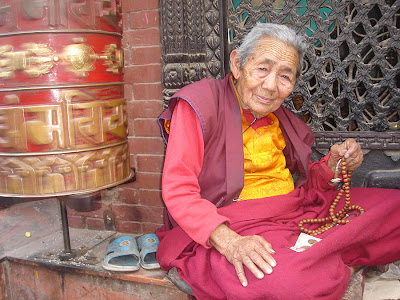
::A Tibetan nun who is always, always, always seated in front of the Ajima shrine at Boudha.

Monday, January 14, 2008

Pongal O Pongal!

Still in Delhi
PaharGanj/Ram Nagar

It's PONGAL, and I am not in Tamil Nadu! Not even close, not even in South India! However, I can still eat sweet pongal (and ghee pongal) at the Saravana Bhavan here on Connaught Place. (sigh)

'Thai Pongal', as it is popularly called in Tamil Nadu, is a thanksgiving ceremony celebrated by Tamil farmers to thank the spirits of nature, the sun and farm animals for their assistance in providing a successful harvest all through the year.

The festival is spread over four days, from the last day of 'Margazhi' to the third day of following month 'Thai' as 'Bhogi', 'Thai Pongal', 'Mattu Pongal' and 'Kannum Pongal'.

"We may have settled here, but we haven't forgotten our traditions. Almost all Tamils in Delhi celebrate Pongal the same way it is celebrated in Tamil Nadu," Natesan, secretary of Tamil Youth Cultural Association, told.


It's also Makar Sankranti, which has something to do with the movement of the sun throu
gh the Vedic zodiac, and the approach of spring. I believe the sun is entering the sign of Capricorn (in the Indian zodiac, which calculates differently from the Western one).

The best Makar Sankranti ever was at the Kalachakra 2 years ago. The whole town of Amaravati, Andhra Pradesh was alive with Tibetan and Buddhist festivity anyway, and then added to
that was the Makar Sankranti observance (dressed-up cows and bullocks, street musicians, and special, extra- elaborate kollam designs in front of doorways). Here's the best picture I got that day...it's one of my best "India" photos ever, IMHO.

Pongal is not just one day, but several, including my favourite, Mattu Pongal or the day to honour
cows and bullocks. In the Madurai area of Tamil Nadu, this has traditionally included a kind of bullfight or bull-run called Jallikettu. This year the whole area is up in arms (declaring a "black Pongal") because the Supreme Court has banned the practice, declaring it inhumane and cruel.

I have a suggestion - they should do what Nepalis do at Gai Jatra, and instead of using real cows, dress up humans as cows. Then they could see how much fun it is to be chased, poked , stabbed and have their tails pulled. It's quite amusing to see all the Madurai Hindus defend their "400 year old tradition" - what about the much older Hindu tradition (about 4000 years old) of honouring the cows?

Monday, October 22, 2007

Country Life

A town called Pity
Dha, Ladakh, India

Hey, all you back-to-nature, organic, mother Earth types. Ever want to live in a village with no electricity (only a bit of solar power), no running water, no roads, only composting toilets, no stores or commercial enterprises, no use for cash money, no hotels and no telephones? Have I got a hamlet for you!

I just returned from spending nearly six days in a village called Dha, in Kargil district . I had to walk half an hour to the nearby Indian Army post to charge my camera battery. That's my major memory...that and the pristine turquoise-blue Indus river running down the narrow gorge. And, the guy who runs the guest house (cook, janitor, and host all in one) openly picking his nose while he was discussing what I wanted for dinner. And the crisp golden and red trees against the blue sky. And the smell of urine that hit me in the face when I walked in the guest house door. And the flawless golden bundles of freshly harvested millet. And the continually screaming baby! A mixed bag, for sure.

The occasion was a once-in-three-years (I think the technical term is triennial) festival of the Brokpa people who live up there (better known as "the Aryans"). It started off like a Nat Geo TV special and somewhere in the middle threatened to turn into Deliverance.

Anyway, I am still getting over the changes in altitude. From Leh (about 12,000 ft) I went seven hours on the 1970s bus up to Dha, which is only about 10,500 feet. Every 300 metres (1000 feet or so) will mess with your altitude. Fortunately, anti-nausea medication is over the counter here and is now part of my regular travel kit.

Saturday, October 06, 2007

Desperately Seeking Thubstan

Astrologers Anonymous
Leh, Ladakh

Finding Ladakh's only Government-recognized Tibetan astrologer isn't easy. He's almost never in either one of the two stores that are named for him (either Thubstan Sanfan Stationer or Thubstan Sanfan Shopkeeper Now Shar Leh, which sells fabric for Buddhist thangka hangings and printed photos of Buddhist deities. I had to ask around and finally found him in yet a third store on the block. He doesn't look like an esoteric ritual specialist - just an elder Ladakhi man with a grey crew-cut, wearing a cheap navy-blue parka. But he is the man who has determined the dates and timings of all Buddhist festivals in Ladakh - which is quite a few - for the next five years.

Traditionally, each monastery has its own annual festival at a date determined by their own monks, by consulting placement of the moon and so on. But this was inconvenient for the growing number of tourists to Ladakh, who come from far away and need to plan ahead. The Jammu and Kashmir Tourist Board needed concrete dates to "fix" the festivities.

Who you gonna call? Thubsten Sanfan is the man.

Thubsten speaks not a word of English, and in my broken Hindi ("mere jyotish mandala milega? mere janam samaya, janam bhoomi chahiye?" or "is my astrological chart possible? do you need my birth time and place?) we established my request.

Fortunately, Tashi from the District Commissioner's office happened to be passing by. I had met Tashi just Thursday, when I visited the DC to establish the date of the BonoNah Festival in Dha-Hanu (that's another post).

Tashi speaks decent English and generously translated. Thubsten says my jyotish will be ready on "Dawa" (Ladakhi for Monday) .

Monday, July 16, 2007

Chariots of the gods

The gods must be lazy
Kathmandu, Nepal


Finally, the towering chariot of Rato Machhendranath, a Buddhist Bodhisattva figure who is traditionally regarded as bringer of the seasonal rains, was pulled to its resting place in Jawalkahel, Patan.

At last, after a delay of nearly 1.5 months (and even for Nepal, that is a big delay), the traditional Bhoto ceremony took place, with the Patan Kumari (one of the Kathmandu Valley's living goddesses) giving her blessings.

The eight-storey Rath (Chariot) of the deity, assembled of archaic wooden parts and a whole lot of bamboo and pine boughs lashed together, resembled a beserk Christmas tree careening through the crowded streets. Its massive wheels are about 2 metres, or 7 feet, high, each painted with the trademark "Kathmandu eyes." Now that's a big wheel.

Tradition clashed with modernity (literally) when the pine-topped peak scraped telephone and power lines. I wondered about the symbolism of the great piney tower. Sure, you could say it is phallic, but I saw more of a beacon. It's like they've constructed a literal skyscraper, maybe to reach cloudward and beseech the rain gods to come on down to earth. Maybe poking at the clouds with a big earthbound finger.

Such a primordial mega-spectacle takes a great deal of communal involvement and coordination every year. I could really see the practical role that such festivals play in bringing all parts of a diverse community together. Certain elements of the festival have traditionally been allocated to various castes and families, and this is a chance for them all to cooperate in a show of unity, sweat, incense, animal sacrifice, and heave-ho.

While the men pull the chariot en masse with giant ropes, the women now have an active role in the procession - linking hands as a security line to prevent onlookers from getting too near the crushing wheels. In Indian tradition the elderly and destitute used to throw themselves under the wheels, hoping for an auspicious death at the mercy of the gods. Don't know if they ever did that here in Nepal.

However, the rain gods may not be pleased. This year for the first time since the 7th century (!), the appointed Prime Minister, GP Koirala, presided over the Bhoto puja, rather than the King (or the Crown Prince).

While the papers are full of gloating crows like "King stripped of his cultural privileges," "Adieu monarchy" and so on, nowhere is addressed the issue of who decides these things.

Who, after all, gets to decide who participates in this ritual of primeval fertility and festivity?
Did the King decide not to go for security reasons (a wise move, really, considering all the anti-monarchy protests outside the palace on His Majesty's birthday)? Did the rain god Indra come to the high priest in a dream and demand the king's absence? Or did the Patan Guthi (community organization in charge of the event) just decide somehow?

Or, as I suspect, was this at least partially a cowardly kowtow to Prachanda and the Maoists, who have "vowed" to abolish the monarchy (not that it's up to them, or the political parties, to decide - supposedly, it is up to the people of Nepal. Supposedly). Prachanda's Young Communist League, a sort of Red Guard formed in the past 8 months, have been very active in the Valley, with all sorts of extortion, abductions and protection rackets. My Nepali friends say that because of the YCL, they do not feel as safe after dark as they did even six months before.

At any rate, it makes little sense for a Prime Minister of a proclaimed "secular" state to preside at an ancient ritual that represents Buddhist, Hindu and folk religions all rolled (literally) into one.

Let the King take his place in the rituals, for Peetha's sake. That's what Hindu monarchs are for, after all - Ritual,
ceremony and tradition.

Monsooner or later
Thank all the gods (and there's one on every street corner here), the monsoon appears to have at last set in, in earnest. That means, it rains at least once a day for at least an hour. Not the non-stop type of downpour we'll be getting in, say, Dharamsala, which has the second highest rainfall in all of India (after Darjeeling, I think). Back when Alex Frater wrote Chasing the Monsoon, Cherrapunji was #1. I guess shifting weather patterns have something to do with it.

It's wetter, cloudier, and the days are cooler. Bad for photos, but good for walking around exploring.

My friends in the Sakya community say Sajani Sakya, the (perhaps former) Living Goddess of Bhaktapur (reported here last week), is still touring India with her parents. Right now she is said to be in Gujarat. I am hoping to interview her when she returns to Nepal.

Two ancient traditions broken in one week. It may be hard to fathom the significance of this if you are sitting in America (perhaps London would be more sympathetic). But Nepal is a country that often appears to exist for the sole purpose of festivals and religious observances; a place where the old gods and devis still walk the streets and are brought to life with these seasonal cycles. I personally think there's plenty of room for the Old Gods in the New Nepal.


Wednesday, June 20, 2007

Dry spell

Who'll start the rain?
Kathmandu, Nepal

The monsoon season has supposedly begun. No big deal. It rains for about an hour, every other day. That just isn't enough rain. Come ON man, this is Asia in the monsoon! It's spozed to be up to our ankles already!

Maybe it's because the chariot festival of Rato Macchendranath was halted for nearly two weeks. Rato ("Red") Macchendranath is one of the local deities propitiated to bring rain and keep the agricultural cycle on track. Every year they drag a skyscraper-like (really, it's about eight storeys high and looks like a giant rolling Christmas tree) contraption around Patan to honour him. This is supposed to mark the beginning of the rainy season. But this year, the makeshift wooden chariot (which is quite a - did I already use the word contraption?) broke down on May 23 and had to be repaired. It just got rolling again yesterday.

All I have to do is cross the border, and I start thinking like a Nepali ("maybe it's because the chariot broke"). I wish it were so simple. In fact, monsoons get shorter and later every year, it seems....throughout the region. Could it be because they're cutting down all the trees in the Tibetan plateau - which happens to be the weather-generator for the entire south Asia region?

No. Must be just a coincidence.....

Well, if you think we're dry now, wait till China dams and
diverts all the rivers that originate up there. That's where all the water in India, Bangladesh, Nepal and Bhutan comes from. I predict the next world war will be a Water War.

In the meantime, between rainfalls, it's really, really hot - even here, in the temperate Kathmandu Valley. When I say "really hot," I mean, anything above 80F.

Right now, the planets are aligned in a near-perfect row. It's cool, even from the city, to be able to look up and see the Moon, Venus, Mars, and Jupiter all in a row. If we were in the countryside I could probably see Mercury too.

Flickring
Since the days are hot, I 've been spending a
lot of time on Flickr.com organizing and uploading photos. I did so much in the past six months in India, I almost forget till I look at the photos. Here are just a few. (below)

My friends in the United Arab Emirates say they can't op
en Flickr.com there. Well, at least in Dubai you have really good air conditioning .

50 million missing (photos only of Indian women and girls). Get yours at bighugelabs.com/flickr

I've also spent a lot of time online in my role as Co-Administrator (wheee!) of the 50 Million Missing Project, a photo project to raise awareness of the gender genocide ongoing in India. Because of a traditional preference for sons, Indian couples are using ultrasound to detect the gender of a fetus, then aborting it if it's female. This has resulted in a "skewed sex ratio" of as much as 800-1000 (female to male) in some areas of India.

Here's the link to 50 Million Missing (above). Check it out - there are now nearly 3,000 photos of Indian women and girls, from all communities and wa
lks of life, and some great ongoing discussions of the gender-ratio issue, as well as links to news stories about it.

Okay, here are a few shots from my past 6 months in Buddhist India, and a few you haven't seen before from the Kathmandu Valley.

Young Sri Lankan monks read the sutra of Buddha's first-ever sermon at Sarnath, Uttar Pradesh, the place where the Buddha first delivered the first sermon. (there has got to be a better way to state that....)

Butter lamps and water offerings at the Kagyu Monlam prayer ceremony, Bodh Gaya, Bihar

Tibetan monks going home after preparing the stupa for the ceremony; Bodh Gaya

Ladakhis in their trademark black robes, walking round the Dhamekh Stupa in Sarnath.

Tso Pema, or Rewalsar, in Himachal: site of an ancient Buddhist legend linking the lake to Guru Rinpoche, and home to a number of Tibetan monasteries.


Tiny dancer - these minstrels from Rajasthan had set up shop in Bhaktapur's Taumudhi square, Nepal.

Sunday, October 22, 2006

Diwali walli* goes Nepali

Festivus maximus
Kathmandu and Lalitpur, Nepal


*Wallah: someone who is particularly expert at or specializes in a certain activity or profession. Walli: feminine of Wallah.


Everything happens at once, all the time, here. We're now in the middle of yet another cluster of festival days. This one is Diwali, aka Tihar, the Hindu festival of lights and Lakshmi, goddess of wealth and abundance. Some things are closed, some are open for business, many look deceptively open yet are operating on skeleton crew.
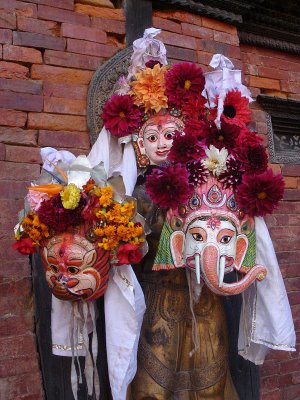
Naturally, all government offices are closed. In fact, I think they were literally closed more days than they were open this month.

Bunches of dressed-up, beaming people roam the streets, butter-lamps are lit at in doorways at dusk, children make the rounds singing and drumming deusi-bailo (a sort of Newari trick-or-treating from door to door) in the evenings. Every home and shop has a rangoli (sort of mandala-design invitation to the goddess, painted with cow dung, coloured powder, lamps and flower petals) at the front door - a painted pathway to guide Lakshmi as she enters to bless the residence. Everywhere you can hear the sounds of ringing puja bells, and Newari panchbhaje bands go from door to door playing their distinctive, reedy ceremonial music. A few months ago I wrote about the snake holiday (Naag Panchami). I can really hear the snake spirit in the sounds of the long, narrow Newari horns.

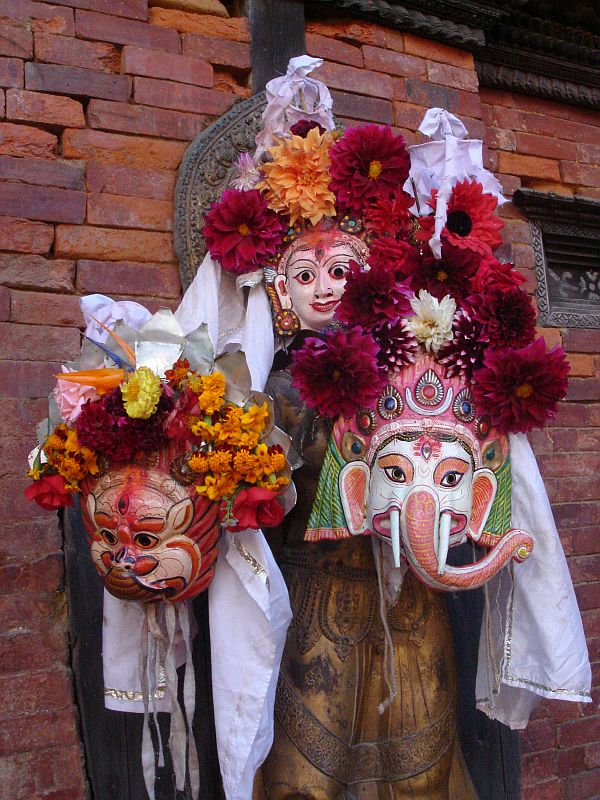
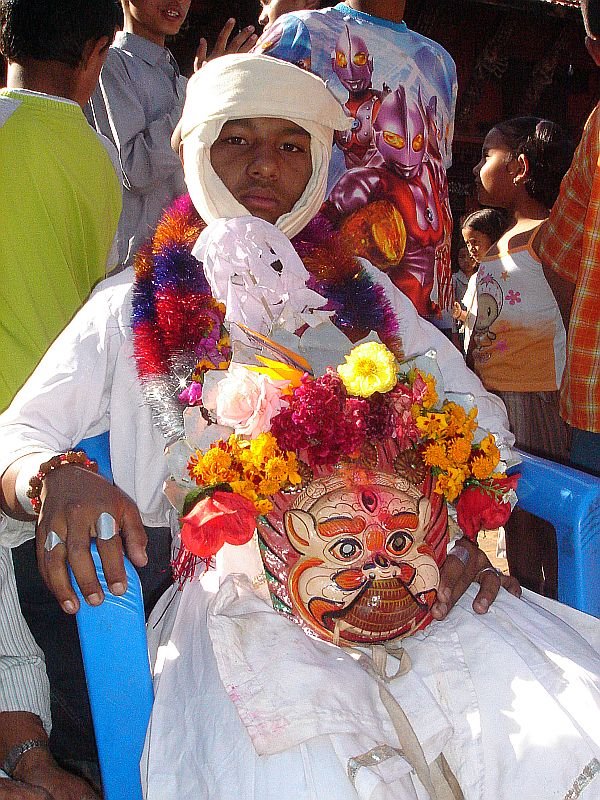
New Newaris
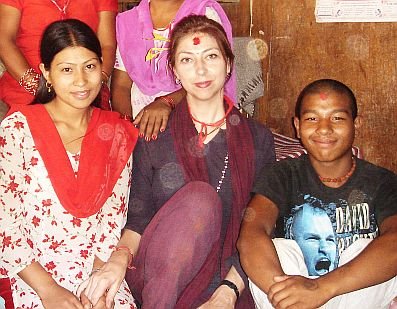
Today I am rushing to get some prints made for Pramochan, one of the (the many) Newari masked dancers I photographed this past Dasain season. On Dasain day, I received tikka and jamara (red powder on the forehead and sprigs of barley behind the ear) from Pramochan's father. Tikka and jamara are a sort of blessing given from elders to juniors on Dasain day. So, Pramochan's familiy (all five of whom live in a traditional Nepali wooden house, which looks like a hayloft with a five-foot ceiling) have invited me to Mha Puja. (Yet another puja!)

I love the tradition of jamara, which is (as far as I know) unique to Nepal. On the first day of Dasain, the lady of the house plants seeds of barley, rice or corn, in a bed of sand, in a special niche inside the home. The seeds are then covered and allowed to sprout secretly in warmth and darkness. It's during these nine days that the goddess Durga is symbolically fighting evil. On the tenth day, Vijaya Dashami, the jamara is uncovered and revealed to have grown into long, bright green grassy stalks. The stalks are then ritually harvested and bestowed upon juniors by the family elders.

Everyone walks around town with an enormous red dot (made of red kumkum powder, rice and yogurt) on their foreheads and chartreuse sprigs sprouting from their hair like feathers (see photo below). Nepalis absolutely love tikka and jamara ("sooooo beauty-full") and seemed very proud to be seen with me, once I was properly marked.

Today's festivity, Mha Puja, is done only by the Newari community on the occasion of Newari New Year (it's now 1126). This ceremony honours and blesses the individual's body for the coming year. Fortunately I have a Newari and Nepali interpreter and hope to find out more about it. I am bringing the prints as a present for the family. (Others might get away with bringing a box of sweets, but as a foreigner with a digital camera, I am honour-bound to provide free prints to the family. I think it's a tradeoff for the stigma they might otherwise receive of associating with a foreigner.)

Rituals in transfigured time
Here in Nepal, we are running three simultaneous calendars. The business calendar is (sort of) the "English" or Gregorian calendar. Then there's the Vikram Sambat or Nepali Hindu calendar, in which it's 2063 and the new year is in April. It is quite common for buildings to boast of having been "established in 2059" (my Australian friend Dave took a photo of this - he thought it was a typo), or for people to say "the conference will begin after 10 Bhadra."

When yet another time cycle, the Newari calendar, starts tomorrow, and it will be 1127. The Newari new year is figured from our AD 867, when legend has it that a Newari Jyapu (farmer caste) discovered a riverbed of gold, and thus paid off everyone's debts. A good way to make a fresh start.

Now if I could just make some money and pay off a few of my debts...guess I will be offering Lakshmi extra marigolds and butter lamps for that one.

New widgets on the block!
Feeds, widgets, clusters, tags, bookmarklets, clouds, sprinkles, aggregators, badges. I'm just now learning about the galaxy of nifty blog features and how they procreate.

I've added a couple of new widgets (nifty code dropped into my template to do cool things) to the blog site. The SirenLocator Map (requires Flash, I think) should show online viewers as they appear, and even reveal a map of their nation (for those unclear on geography).

Scroll down and you will find the Current Moon Phase, essential for life in Nepal and other parts of Asia.

My SirenDelicious feed shows my favourite items and headlines saved to Del.icio.us. And Global Voices headlines feed show selected headers from the Nepali and Indian blogosphere.

Coming soon: my very own tag cloud, and a Newsvine widget. Oh, and I've finally caught up and gotten myself a YouTube account, but some stupid folk singer already snatched the name Sirensongs....so SirenTV will be appearing as "SirensongsIndia." Maybe someday I'll figure out how to upload my many videos directly to this site.