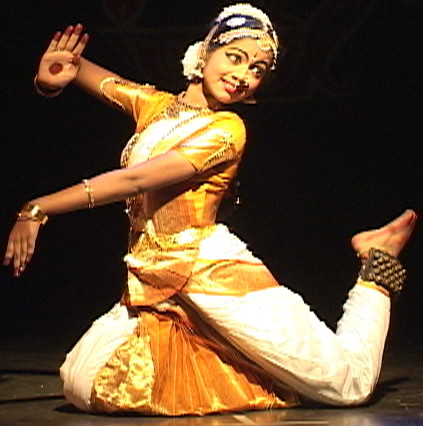
Dancing in the semi-dark
Kathmandu and Patan
What's "authentic," what's not, who gets to decide that when it comes to "culture"? -Especially when one is a foreign interloper?
Perhaps it's far from an original question, but it continues to present itself. I continue to learn
Newar Charya Nrtya, the Buddhist classical dance of Nepal, and to observe my own reactions to "authenticity," "tradition" and "updation."
Regardless of what the
Chennai dance masters will tell you, nearly *all* the Indian "classical dances" were reconstructed from next-to-nothing. (Kerala's
Kudiyattam is an exception, I believe, because it was continuously performed without a break in tradition.) That doesn't mean they are not classical, just that they are not as ancient, or entirely as ancient, as often fantasized.
I began to suspect this long ago when my
Bharatanatyam teachers had trouble pinning down provenances and answering questions about origins.

Given the Indian high esteem for ancient-ness (older the better), this was inconsistent. Being able to cite one's lineage and origin is, almost literally, everything.
(I know "literally" is a very overused word these days, excuse me....)
In trying to revise certain aspects (mostly, the costumes) of
Newar Charya Nrtya, I have noticed the same principle applies for the dance that works when observing and learning from Buddhist art.
Sometimes newer is better...because it just looks better. (I know, "better" is a subjective statement. Bear with me.)
That is, the most ancient, "authentic" things sometimes are just too dilapidated to really be of much use. In looking at Buddhist monastery art, it is great to see the oldest paintings...but most of the time, they are barely visible.
Kathmandu and parts of India are full of newly constructed monasteries, some with vivid psychedelic artwork. I can actually get a better idea of

forms, shapes and postures from observing and photographing these. It's for the art historians, I suppose, to narrate how the art has evolved. I would like to refer to the oldest artwork available - but it has to be available, and visible.
Are the new paintings "authentic"? They have been painted by modern persons who are students of an ancient, classical art form. "Classical" = there is a particular vocabulary, a canon, of images and styles that are "acceptable."
Until someone decides to throw in something new, that is. I now know this from experience.
Case in point: the costumes (and I know I am not the first -
Shahrazad and
my friend Margot are at least two that have done the same) that I have decided to revise. True, they are not what the National Academy is using, nor any of the (few) existing Charya dance troupes that I know of. "My" version of the costumes closely follows that of the
thangkas, paubha and temple sculpture. So which is more authentic? I'm not Nepali.
When I approached my friend about putting together more "authentic costumes," she responded that there were "no authentic costumes."
Okay, perhaps there are no unchanged costumes handed down in style and form from 500 or 1000 years ago. What I want to achieve is a return, so to speak, to what
SCA folks might call *period* materials.
That is, to eschew anything that could not have existed at the time of the dance's origin. (Within reason...I will use Lakme
kajal the same way I use red Magic Marker for Bharatanatyam. If they had had red Magic Marker back then, they would have used it. Yes, this is inconsistent! You
try using Alta and letting it dry while not getting red stains on your costume!)
This isn't for pedantic reasons...more aesthetic.
The
angika abhinaya (body expression) of the basic movements had been obscured, partly by slack standards (where is your
tribhangi??) and partly by the billowy costume.
Rather than wearing synthetic satins made in China or India with gold lame border, the original dancers wore
veshti. For references, I have been photographing the temple roof struts and sculptures.
Is this nitpicking? Well, the temple sculptures and paintings all depict very specific postures with leg, arm, head and foot positions. If you can't see them, what's the point?
The school of wishful thinking
A return to the ancient, the original, the authentic...this was a big part of the Yuppie ethos, wasn't it? (As the brilliant
humourist Cynthia Heimel said in the mid-80s, "You can't just eat maple syrup anymore. It has to be the purest maple syrup made by the cutest little old lady living in the quaintest tiny New England village, completely organic. And limited edition."
(paraphrase)
Twenty years later, now that everything seemingly is a copy of a sample of a Xerox of a photocopy of an imitation of a bootleg, it's even more alluring.
"Do they have any dances that are like it used to be 1000 years ago??" my elder sister said on visiting my dance recital at a modern
Nashville, Tennessee Hindu temple. I had to say, "not exactly," and watched her enthusiasm falter.
As I may have said before, t's only within the last 30 years that Charya has been performed publicly; previously it was restricted to Newar Buddhist temples. The mudras and songs that are the origin of modern Charya are still performed by the Vajracharya priests today.
An unbroken lineage of any kind is something to be proud of, for sure. But even what is now performed theatrically is not identical with the priestly performances.
Leaders of the New School
Getting Newars in-the-know to talk about this is gradual, hesitant and difficult - perhaps because they don't completely know themselves (only initiates can see most temple dances), perhaps because they hate to disappoint, or perhaps they are unwilling to acknowledge the reversions thinking foreigners will never know the difference.
Some Newars and other Nepalis even indignantly insist that the dance is"meant to be secret" and should not be revealed. If you need an example, just look at the comments on
YouTube. "Such things should not be commercialized," one viewer fumed.
Dancers generally have never been known for their material wealth, and I imagine that the other Charya dancers sometimes fervently *wish* that the dance was "commercialized," if only to make a better living. Is merely presenting the dances on a stage, for a pittance, commercializing them?
Then there's the (apparent) fact that the dances, as presented for the past 30 years, are not identical with the esoteric rites. There is no revelation of Tantric secrets in a performance of modern Charya, though I may regret having said that when attempting to get funding for projects.
Even leaving aside the question of inclusion ( it goes without saying that women, not to mention foreigners, did not perform the ritual dances), there have been numerous alterations.
In two years of participation, I made a few practical observations. For one thing, I have seen many Newar bahal monasteries -- the space of many is far too small to perform even a scaled-down version of some modern Ch

arya moves.
For another, I have seen numerous Bajracharya priests - with all due respect, they are unlikely to be performing some of the more acrobatic and yogic poses.
For yet another, the music presented for modern Charya often involves recorded female voices. This wouldn't be possible in traditional Newar practice; the women never did and still do not sing. Many recordings use non-traditional instruments, such as harmonium, and speed up the rhythm or add more percussion to make the song "perform" better.
This was reinforced by a visiting Chicago religion scholar who is studying the dances from a strictly scholarly standpoint. As a non-Newar non-initiate, he also has not seen the dances in the actual temples, but from his interviews with completely different sources than my own, had gathered much the same thing.
As my friend the Tibetan art dealer noted:
"My fake (replica
) Khatvanga sold for more than the original one."
Why? was it just at the right place at the right time? Maybe it looked more like a Tibetan khatvanga is "supposed" to. A Tibetan lama would be unlikely to buy such an instrument from an art dealer. The contemporary lay-buyer of a khatvanga (a kind of Tibetan ritual implement - a kind of magic wand) would likely crave a certain aura around the artifact. Is that commercialization?
Maybe the new one really was "better." Or even, in its way, "more authentic."




 Posts