News From Tibet and diaspora
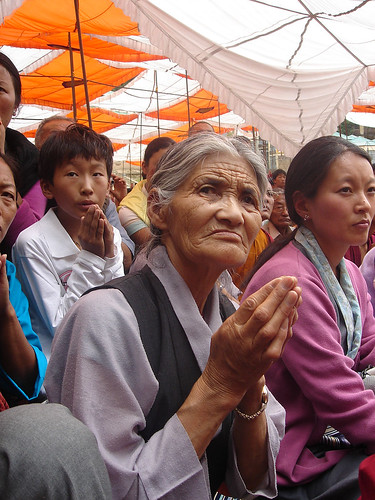
As I am usually what passes for a Tibetan-culture knowitall at most gatherings, foreign friends have been asking me: "So when is Losar?" (the Tibetan New Year celebration).
In 2009, Losar is supposed to be February 26. But this year, I don't know whether there will be any celebrations, or to what extent.
At least one sector of the Tibetan community feels Losar should not be observed with any festivity this year. This is partly due to the extreme state of distress in Tibet at the moment and partly to observe the 50th Anniversary of the Dalai Lama's escape from Tibet into India, and the Tibetan Uprising.
(If you would like to know more about the events of 1959, the Times of India has finally justified its existence by providing a handy online archive going back some 150 years with original news articles from the period.)
Of course, some don't agree; and I can definitely see the irony of asking a culture whose very survival is an achievement *not* to observe one of the major manifestations of said culture - even moreso when the Chinese government has tried to force ethnic Tibetans to celebrate the Chinese Lunar New Year instead.
No more questions!
Recently, the Chinese government made a big deal of "inviting foreign journalists to Tibet" (after expelling most of them last year) for a highly-orchestrated press trip to Lhasa. The trip included a visit to Drepung Monastery, which last year became a centre of Tibetan resistance.
I read two different accounts of the trip (some excerpted below); the reporters from different news outlets appear to have spoken with many of the same people and gotten the same rehearsed responses. China defenders say things like, "You can't believe what you read; you should go there yourself." As if that were even possible for most people at the best of times, the Chinese government has now declared several Tibetan-majority areas off limits to visitors.
Those who do go - such as these various journalists - give very similar reports. Every tourist account I have heard first or second-hand has reinforced these accounts (from one Indian tourist: "I was on a boat with a uniformed police officer; later I saw him in the monastery wearing monk's robes").
Tibet's religious life still bruised by riots (Reuters):
Inside, monks take patriotic education classes on Chinese law, alongside their Buddhist scripture studies, and were kept closeted away from visiting foreign journalists on a rare and tightly controlled government visit on Thursday.
In Tibet, it's just the facts, ma'am (MSNBC): In this account, one of the brave young monks who, last year, interrupted a similar government-arranged press trip, is now mysteriously transformed and recants:
-He said he no longer felt the way he did last March, because he and the others realized they had been "misled by the wrong people" (he did not elaborate what he meant). Norgyal also maintained that he had been able to continue his religious studies although he did say the monks had been given "patriotic" study sessions, during which they learned about Chinese law and constitution.
At Drepung Monastery, Ngawang said his monks had also been studying the legal system. "We have legal knowledge sessions for all the monks," he said, in order to ensure order in the monastery.
"We study the laws and the constitution so we understand the laws better and do not break them," he added. "The monks are also Chinese citizens."
A visit to TibetInfoNet gives an idea where some of the dwindling monastic population may have gone: "Nine monks sentenced; others committed suicide" This week's Site for Sore Eyes
If you're one of the majority who will never physically get close to the sacred places mentioned above, you might want a virtual visit via Sacred-Destinations.com -which looks extremely cool, well-arranged and informative, and is certain to become one of my preferred time-wasting devices.
Related Reading:
Tibetans in Exile 1959-1969 : A Report on Ten Years of Rehabilitation in India

Tibetans in Exile: The Democratic Vision




 Posts
Posts