Showing posts with label monastery. Show all posts

Thursday, February 19, 2009

Pressed

Unhappy new year
News From Tibet and diaspora
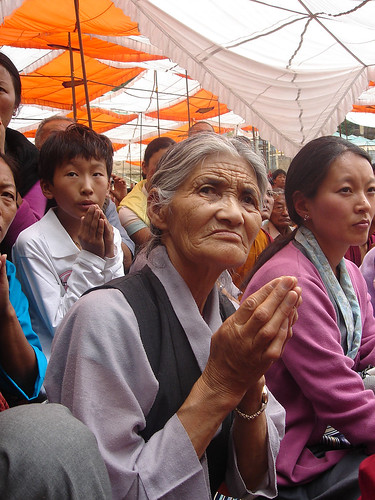
Waiting for HH
As I am usually what passes for a Tibetan-culture knowitall at most gatherings, foreign friends have been asking me: "So when is Losar?" (the Tibetan New Year celebration).

In 2009, Losar is supposed to be February 26. But this year, I don't know whether there will be any celebrations, or to what extent.

At least one sector of the Tibetan community feels Losar should not be observed with any festivity this year. This is partly due to the extreme state of distress in Tibet at the moment and partly to observe the 50th Anniversary of the Dalai Lama's escape from Tibet into India, and the Tibetan Uprising.

(If you would like to know more about the events of 1959, the Times of India has finally justified its existence by providing a handy online archive going back some 150 years with original news articles from the period.)

Of course, some don't agree; and I can definitely see the irony of asking a culture whose very survival is an achievement *not* to observe one of the major manifestations of said culture - even moreso when the Chinese government has tried to force ethnic Tibetans to celebrate the Chinese Lunar New Year instead.


No more questions!
Recently, the Chinese government made a big deal of "inviting foreign journalists to Tibet" (after expelling most of them last year) for a highly-orchestrated press trip to Lhasa. The trip included a visit to Drepung Monastery, which last year became a centre of Tibetan resistance.

I read two different accounts of the trip (some
excerpted below); the reporters from different news outlets appear to have spoken with many of the same people and gotten the same rehearsed responses. China defenders say things like, "You can't believe what you read; you should go there yourself." As if that were even possible for most people at the best of times, the Chinese government has now declared several Tibetan-majority areas off limits to visitors.

Those who do go - such as these various journalists - give very similar reports.
Every tourist account I have heard first or second-hand has reinforced these accounts (from one Indian tourist: "I was on a boat with a uniformed police officer; later I saw him in the monastery wearing monk's robes").

Tibet's religious life still bruised by riots (Reuters):
Inside, monks take patriotic education classes on Chinese law, alongside their Buddhist scripture studies, and were kept closeted away from visiting foreign journalists on a rare and tightly controlled government visit on Thursday.

In Tibet, it's just the facts, ma'am (MSNBC): In this account, one of the brave young monks who, last year, interrupted a similar government-arranged press trip, is now mysteriously transformed and recants:

-He said he no longer felt
the way he did last March, because he and the others realized they had been "misled by the wrong people" (he did not elaborate what he meant). Norgyal also maintained that he had been able to continue his religious studies although he did say the monks had been given "patriotic" study sessions, during which they learned about Chinese law and constitution.

At Drepung Monastery, Ngawang said his monks had also been studying the legal system. "We have legal knowledge sessions for all the monks," he said,
in order to ensure order in the monastery.
"We study the laws and the constitution so we understand the laws better and do not break them," he added. "The monks are also Chinese citizens."
A visit to TibetInfoNet gives an idea where some of the dwindling monastic population may have gone: "Nine monks sentenced; others committed suicide"


This week's Site for Sore Eyes

If you're one of the majority who will never physically get close to the sacred places mentioned above, you might want a virtual visit via Sacred-Destinations.com -which looks extremely cool, well-arranged and informative, and is certain to become one of my preferred time-wasting devices. 


Related Reading: 
Tibetans in Exile 1959-1969 : A Report on Ten Years of Rehabilitation in India 
Tibetans in Exile: The Democratic Vision 
 

Saturday, December 22, 2007

So close to heaven

Snowblind
Kaspang, Ladakh

For today's entry I am nicking the title of a pre-existing book about the "Vanishing Himalayan Kingdoms" Sikkim, Bhutan, Nepal, Ladakh and Mustang. I have yet to read So Close to Heaven by Barbara Crossette, but it expresses so perfectly the feeling I have when up among the snow covered hills.

Green, gold, grey, white. I have seen the Ladakhi landscape completely change colours four times. When I arrived in August the valleys were lush and green. The green turned to amber gold. There are a few weeks before the serious snow when everything just appears grey. Now from Hemis onward the valleys are blinding white, and the Indus, still running turquoise, is edged in ice.

The picture above was taken from the roof
top of Chemdey Gompa near Serthi ("Sakti") village.

Changes in latitude, changes in attitude

I had such a perfect "last day in Ladakh" on Dec. 19th, with trips to Chemdey and TakTok gompas and cozy, glowing village homes, that I decided to extend my stay another 2 days, into the Winter Solstice. There was a special chaam (ritual masked dance) at Chemdey monastery, and I was invited. A special chaam dance at a monastery on the Solstice - I couldn't resist.

As luck would have it, yesterday I ended up with altitude sickness, which ruined the next 18 hours. How, after 4 months at 13,500 feet, did I end up with altitude sickness, you ask?

I was invited to visit a remote (really remote) mountain monastery called Kaspang, past a valley called Igu, way out past Karu village. "It is so beautiful!" enthused my friends. "You won't believe it."

When we arrived at Ig
u Village, the entire local populace appeared to be out in the winding street, except for a few kids with makeshift snowboards who were skating on the frozen river. It turned out to be a cremation and funeral. A young woman of the village had died - no more than 25 years old or so.

M
y friends and the driver could not be deterred from their mission to the monastery. So we drove through lanes that became increasingly less dirt and more snow. About 2 kms from the monastery, the road was just covered in snow - about 4 inches. Not bad to walk in, but too much for the car (not a jeep) to make it uphill.

My Ladakhi friends insisted we abandon the car and walk, uphill, for the next 2kms. After about 1000 feet it became painfully- literally painfully - obvious that we were up too high for me to go hiking.

"How high are we anyway?" I puffed, s
eeing sparkles like confetti before my eyes.

"Oh, about 15,000 feet" Dorje answered.

For a Ladakhi, that is no problem. For ordinary lowlanders, once you get about 10,000 feet, every 1000 feet or so requires a new adjustment period. If you don't believe me, just try it.

At this point we had been at 15,000 feet about 2 hours. We had gained about 1,500 feet from our starting point in Leh valley. I was suffering in a very real way from altitude. My Ladakhi friends, never having been in this situation themselves, refused to recognize it.

"Come on! It will take only half an hour!" I looked up at the gompa in the distance, which with its white walls against the white mountains, felt like a mirage. It was at least one and a half hour's walk by my speed - including breath-catching stops. My friends could have walked the whole thing in half an hour.

Blood singing in my ears, I turned and
looked back where we had walked. The entire panorama was just like Seven Years in Tibet or the Shangri-la movie of your choice - unbelievably austere, lonely, purified by aeons of snow which managed to be crunchy and soft at the same time. Amazingly, not so cold, especially when you are hiking. And no wind.

In the distance a lone man in a black
goncha robe was leading an equally black and mighty, shaggy dzo (yak hybrid) through a pass. They looked like ink hieroglyphs on white paper. There was no sign of habitation anywhere around them. The man and animal appeared to have emerged from nowhere - they must have been trudging for hours. I suddenly wished I was riding the ponderous dzo. The yaks and dzos are so deliberate and grave in their movements, they are almost like walking boulders.

I looked down. Tracks of mysterious animals made pie-crust patterns across the powder. Sometimes the tracks criss-crossed one another. The trident shape of a partridge or magpie's feet, what looked like the petite hopping of a snow rabbit, and one kind of track that appeared in sets of three. Must have been a galloping wolf.

Back to reality. "There's no way," I said. "I can't make it. Sorry to ruin all your fun." From the comments, it was o
bvious my companions just thought I was being a wimp. Literally, I would walk fifty feet and have to collapse onto a rock. Still, they thought I was malingering.

My head was spinning. I heard one of them say, "Come on, take a picture of me with the gompa behind!" (I was the only one with a camera (quite possibly the reason I was invited.)

Finally I got angry. This s*** is dangerous, and here they were joking around about it. "Can you not see," I hissed, "that I am SICK, and ready to collapse? I am NOT laughing. This is NOT a joke. I have every single symptom of altitude, and still you won't listen to me!!! We have to go down." As soon as I was able, I wheeled around and began backtracking firmly toward the car.
By the time we got back to Igu, we had been at 15,000 feet nearly 3 hours. It took nearly the next 24 hours to recover. Moral of the story if you are not Ladakhi: Don't go trekking with Ladakhis (or Tibetans) who are not professional guides. They think you are faking altitude sickness. In a way, it makes sense. They have never and probably will never experience it themselves, unless they
climb Everest. Moral of the story if you are Ladakhi: don't take foreigners up to 15,000 feet and then expect them to hike up a hill, unless you want to carry them back down.

Down to earth
When we finally got to Igu, we stopped at the house of a distant relative (all Ladakhis appear to be cousins of cousins of second cousins from their father's village). As if to prove my symptoms were real, I dropped my glass of butter tea on the floor. "I don't have coordination yet." Then I dropped a biscuit someone handed me. And I couldn't really hear anything anyone was saying - like being underwater. It's like being drunk without any of the fun.

Eventually, after seeing me move like a drunkard, my friends started to take the condition seriously. I am s
till pissed off that it ruined the last day and half in Ladakh. I did get to take a fun sleeping pill at home to help me sleep it off and recover, though.

Strike!
The very last day (today) was additionally ruined by the LUTF strike. All shops were closed till about 3pm. Altitude sickness, beautiful scenery, spilt butter tea and political strikes - all in all a very Ladakhi day or 2.

Lamawatch

After the teachings at Mundgod, Karnataka,
HH Dalai Lama will hoof it to Ahmedabad, the capital of Gujarat, to open a Tibet festival, make a bunch
of speeches and inaugurate a bunch of stuff. Here's the news item.

I am interested to see HH on Gandhi's home turf, which has been so wracked by communal violence. I wonder if any local groups will invite him to address the subject.

Here is a photo I took of HH at the Hindu Long-Life puja in Dharamsala, back in April. I wonder whether he is looking at me saying, "So good to see you!" or, "You again!!!" Or maybe, "Get outta my way already...."

Wednesday, December 19, 2007

Flying on Friday

Winter wonderland
Leh/Shakti/Chemdey/Karu village
s, Ladakh

After a day of driving through snow-covered villages I am very tempted to change my ticket. But as it stands, I am flying Friday morning to Delhi. Farewell for now to the land of crazy pashmina goats (didn't write yet about my attack by a pashmina goat!), frozen rivers and very expensive internet.

As long as the sun is out, even December in Ladakh is a pristine fairyland, with monasteries perched like fairy-tale castles on solitary hills. And all those other cliches....:-)

But, I haven't washed my hair in more than
a week. Not that it matters, neither has anyone else...


I spy
You never know who is going to be an Indian intelligence officer in Ladakh (or perhaps, some other kind of intelligence officer, in which case they would be a spy). I have discovered that a number of things and establishments presenting themselves in an ordinary way are in fact intelligence operations.

It's kind of cool, because since I fully understand neither Hindi nor Ladakhi, I am not a high security risk. I did overhear the English words "body" and "spy" in an official conversation yesterday, though, in an official office with official officials. I was given strict instructions not to reveal the true identity of the office I was sitting in. Naturally, I wouldn't, but I think the Chinese and Pakistani governments probably know already. It made me wonder how many Chinese and Pakistani undercovers are walking around town. Not something I want to know too much about...I am a "spiritual investigative reporter" (thanks, Kullu Kid of IndiaMike.com) and prefer to keep it that way.
If you want to determine whether someone is "intelligence" I would recommend looking at the shoes. The shoes tell the whole story (with everyone, not just intelligence). Black, expensive shoes are a giveaway.

What do my shoes (slate-grey Merrell hiking boots, a donation from travel-mates Lisa & Jonah Nigro!) say? They are saying "I need a new pair." If anyone is coming over, I wear an American Boys' size 9.


Sunday, December 16, 2007

Trouble in paradise

Blue skies, no tsampa
Leh, Ladakh

I've been trying to wrap up my interview materials here in Leh for the past week. The interview session with the Principle of the Central Institute for Buddhist Higher Studies started off stiff and weird but turned out well.

Actually, I think the monk Kanchen Sonam, who was kind enough to come and pick me up in the monastery-owned car (one of four), is the man who really knows the inside story on the incarnation search for Bakula Rinpoche. No disrespect to his knowledge, but I think the principle was kind of a Buddhist spokesmodel. That is, he knew all the proper "acceptable" things to say to me, In English.

Anthropologists must have a handy jargon term for the phenomenon I keep encountering, but I just call it "assuming the worst." That is, whenever I approach a "native" informant (even with my rather non-corporate, non-mainstream appearance) they assume the absolute worst about me and my writing intentions. They launch into a pre-rehearsed speech (I can tell) about how modern, progressive and un-superstitious their people and ways are. How nobody believes in those old things any more. How all the people here are now educated .... blah, blah, blah.

In this case, I asked a direct question about "the search process for the new Bakula Rinpoche." I got a speech about how things were different now, you know the Dalai Lama himself is very scientific, we don't have any blind faith in Buddhism, etc.....

It takes a minimum of half an hour, usually, to crack this facade. They just assume I am a non-believing skeptical westerner there to mock their traditions. Usually, I have to do what we used to call, back in the hip-hop days, "dropping science."

That is, I have to violate what I consider a rule of interviewing (the interviewee should talk more than the interviewer) and demonstrate a bit of inside knowledge.

In this case, I think it was dropping the Sanskrit term "ishtadevata" (personal chosen deity). We were discussing the role of oracles in local Buddhist tradition, or trying to. I had to start throwing esoteric terms at him in order to prevent him explaining the whole thing from the ground up, which would have been redundant.

Finally, I got a genuine smile. Yes, she kind of understands, even though she is an Injee! "Yes, like an ishtadevata!" he repeated the magic word. In this way we finally came to an understanding, which went something like this (paraphrased): Science is all well and good and very very necessary. But we cannot discard all the old traditions, they have a science of their own. There is something to mystical traditions that is important to preserve, even if we cannot or do not yet consciously understand it.

Whew. Now, we are getting somewhere. The upshot of the conversation was: Yes, the search for the new Bakula has already begun. Since the passing of the Rinpoche, special pujas have been done, and a special mantra, designed to bring about his swift reincarnation, has been recited millions of times by the monks of all four monasteries and is still being recited every morning.

At this time, there are three boys who have come to the attention of the Spituk presiding authorities. Rather than go on a house-to-house search (as made famous in the movie Kundun), these boys came to the lamas' notice through reports. All three of the boys had shown special interest in Spituk Monastery, talking about it, insisting on visiting and so on. One of the boys had reportedly even pronounced Kushok Bakula Rinpoche's name (remember, the boys in question are about three).

One boy is from Nubra Valley, another from the remote Changtang region still inhabited by nomadic people. The third is actually of Tibetan (as opposed to Ladakhi) descent living in the Agling refugee camp outside of Leh.

At this time all three boys' names have been submitted to the Sras Rinpoche, who is heading the Bakula's monasteries in the meantime. He is conferring with other high lamas, including the Dalai Lama, about the matter. In case of any dispute, the final decision will rest with the Dalai Lama. A decision should be reached within the year.

Then, there will be an enthronement ceremony and much rejoicing. "We will invite you!"

All politics is local
It would be a real shame for the search for the new Rinpoche to fall prey to the local political infighting, but it does seem inevitable. As previously reported, the Buddhist political "scene" has for the past several years fragmented into various factions - so much so that, following the November 3rd "incident" at the main Gompa, the Ladakhi Buddhist Association office has remained completely closed. (Faction A and Faction B were fighting, the police were called, and shots were fired inside the Gompa grounds. This resulted in the rallies, protests and strikes mentioned earlier. What I really hate is that the people are practically forced to attend. Some try to make a statement by staying away entirely.)

My attempts to get quotes from local Buddhist "figures" about the Bakula situation and the role played by the Dalai Lama in local peacemaking have been so far thwarted. The LBA office is locked, and no one will even give me a name of a sometime or former or would-be LBA spokesperson to refer to . The Gompa itself (smack in the middle of downtown Leh) is being operated by a volunteer organization who are currently hosting a prayer ceremony.

I saw a notice on the bulletin board naming someone as General Secretary, so I started asking around for him. This caused a bit of consternation among the volunteers. They were just there volunteering and definitely didn't want any trouble.

"Who told you that was the secretary?" someone finally asked. Well, it says so on the board....I answered. "He is not the secretary. No one knows who is the secretary. Soon there will be new elections." But for now, no one's in charge and the whole thing is in disarray.

During the Dalai Lama's visit this year, he met with both Shi'a and Sunni Muslims and lauded them for getting along well locally, saying they were "an example for other communities." At the time I thought he meant Muslim infighting in other countries like Iraq and Pakistan. Now I think he was referring to the infighting in the Buddhist community, right here at home.


Wednesday, December 12, 2007

Snow day

Obscured by clouds
Leh, Ladakh

The sun didn't rise yesterday. At least, that's what it looked and felt like. Complete, opaque, Liquid Paper impenetrable white sky.

Yesterday was also the Day After New Year's Day here. January 2nd is depressing pretty much anywhere, and Ladakh is no different. Most of the stores were still shut, the streets largely empty. Only a few people dropped by the house for Losar; the majority of them had visited on Dec. 10, the actual traditonal Ladakhi new year. (I get to celebrate three or four different new years over here. Newar New Year in Nepal is in October; then Ladakhi Losar, then "English New Year"; then Tibetan Losar in February; then Tamil and Hindu New Year in April.)

It was so bitterly cold I almost didn't leave the house at all. It was much more comforting just sitting in the kitchen in front of the gas heater with Dolkar. She had to make butter tea all day long for the past 2 days, for the Losar guests. I helped out by washing dishes and trying to keep the dining hall neat and clean.

However, the trade-off for all this bitter cold was SNOW - my first ever Indian snowfall. By the time I arrived home around 6.30pm, snow was falling like confetti on New Year, strangely appropriate.

In the morning, we were greeted with a Winter Wonderland. No more than a centimeter or 2 of snow...but it blanketed everything. Best of all, we were treated to a generous day of sunshine. The perfect combination - snow on the ground, sun in the sky.

Born again
Since the sun decided to show today, it was the perfect day to embark on the last leg of this particular Ladakh mission: taking the bus out to Spituk Gompa just outside town (nestled between a military air base and a bunch of other military posts). I am on the trail of a newly incarnated Rinpoche, or high Tibetan lama who has chosen to reincarnate in a particular place and time in order to help "all sentient beings."

In this case, it's particularly to help all Ladakhi sentient beings. The Lama in question is Kushok Bakula Rinpoche, who "left his body" only two years ago. Bakula, in addition to being a member of the royal family, an incarnate lama and a Geshe Lharampa educated in pre-invasion Tibet, was also prominent diplomat (he became the Indian Ambassador to Mongolia), educator, social reformer, and philanthropist. Bakula is practically worshipped as a god among many Ladakhis. His photo (with prominent brow, eyes and ears a great deal like Yoda or ET) peers down from many a Ladakhi shop counter and vehicle dashboard.

Like a lot of high lamas in Buddhist dominated areas, he got involved in politics as well. In addition to being worshipped and admired he definitely had his detractors. That bit doesn't overly concern me, though. I am interested in the process of Operation Tulku Search - finding the newly incarnated lama.

Spituk Gompa was one of the "home" monasteries of Bakula Rinpoche. As I got off the mini-bus, I noticed the government street sign was spelt "Spithup Gompa."

There appeared to be absolutely no one home. After fifteen minutes of walking around empty corridors yelling "Jullay? Azhang-le? Acho-le??" a monk carrying a tea tray spotted me. I had been directed to Lama Kanchen Sonam.

When I found Kanchen Sonam, he insisted his English was no good and I should actually speak with someone in the nearby village of Sabu.

But I persisted, and after dropping a few key words of Buddhist jargon that showed I knew more than the average tourist, he invited me in for tea and biscuits. We ended up having a long conversation (somehow, despite language differences) about Bakula's significance and life works. Kanchen was only 12 when he first came to Spituk some 15 years ago. Obviously Kanchen had known and looked up to Bakula all his life. "All people of Ladakh now are praying," he said, " for Bakula to come quickly."

I wanted to know: what exactly will they do to find the new Rinpoche? I know they had done some pujas. Will they use an oracle? Meditate, examine their dreams? When will they begin the search from house to house? How will they know where to start?


Kanchen said the Dalai Lama was consulted during his summer visit here. It was somehow determined that the new Rinpoche had already taken birth, somewhere here in Ladakh. There was a bit of controversy because the people of Mongolia, who also remember him so fondly, had insisted he would be reborn there.

Because he talked to me for so long, Kanchen was late to say his 4pm prayers. So, I had to help him empty and refill the offering bowls for afternoon worship. As if to discourage me from snooping around the gompa while he prayed, the electric lights went out promptly as he started chanting.

I caught a late bus back home to Leh. Kanchen and I are meeting tomorrow to consult with someone at the Central Institute for Buddhist Higher Studies about reincarnation. Someone who "has full English."

Wednesday, November 14, 2007

Breathing space

Taking a breather
Leh, Ladakh and environs

I've been talking about leaving Ladakh for a few weeks...yet keep finding reasons to stay. Here is another one.

Ladakh is a great place to breathe.

In most of India (ironically the home of yogic deep breathing or pranayama), you really don't want to breathe too deeply. Either the air is horribly polluted, or there are dreadful smells nearby if you breathe more than superficially. After a while, you forget that you are not breathing properly.

I knew a guy in New York that said incense was bad for meditation, because you breathe in too much smoke that way. Obviously, he had never been to India. Compared to what you normally breathe here, incense smoke is benign, and pleasant.

Once you adjust to altitude and catch your breath, Ladakh has plenty of deep breathing space. Here is an exercise that is great for Ladakh:

"Now and again, it is necessary to seclude yourself among deep mountains and hidden valleys to restore your link to the source of life.

"Breathe in and let yourself soar to the ends of the universe; breathe out and let the cosmos back inside.

"Next, breathe up all the fecundity and vibrancy of the earth.

"Finally, blend the breath of heaven and the breath of the earth with that of your own, becoming the breathe of life itself."

- Morihei Ueshiba Osensei

Last week, in honour of both my birthday and Halloween, I spent 6 days in various remote monasteries in Leh valley area. I attended the Thiksey GuStor masked dancing ritual and festival, and visited Shey Gompa (which includes a ruined palace, the former home of the Ladakhi kings), Stakna Gompa (a Drukpa Kagyu monastery, patronized by the kings of Bhutan) and the out-of-the-way Matho Gompa, famous for its tradition of Oracles, or monks who become "possesed" by a protector deity and answer questions about the future.
Here are a few random photos.

You know that Incredible India tourism ad that shows the monks blowing horns at dawn? It was made at Thiksey Monastery. This is how it looks in real life. I think they only wear the yellow hats if you are from India Tourism!

Here (below) are two of the dozens of masked dancers at Thiksey Gustor. At the end of the ritual, the Torma, or gruesomely-shaped barley cakes that represent sacrifices to negative forces (they used to be real animal sacrifices, back in the bad old days) are brought outside, thrown over a cliff and burned, amid much fanfare and dancing.
This old timer gladly posed for me at Thiksey, whirling his prayer wheel. And, he did not ask for money! (below). I am quite fond of this traditional Ladakhi hat. It serves absolutely no practical purpose (doesn't keep your head warm, or keep the sun or wind off) - it's just a goofy kind of top hat with horns. Very jaunty.
Thiksey Gompa is very easily reached by a half-hour or so's bus ride (15 Rs, or about 45 cents) from the New Bus Stand. Buses leave all day long and the last one back to Leh is at about 5 or 6pm (no one knows for sure). In season, Thiksey has a fantastic guest house, well furnished with beautiful views (a bit pricey at 300Rs or $8.00 for single occupancy), and a good restaurant (run by Nepali staff) that has a killer veg thali for 45Rs. I was there the very last day of the guest house season....when they shut the water off and the Nepalis went south. Quite sad, really. There is also a family-run guest house in the village but then you must climb up the steep hillside to the gompa every day. (However, it is much cheaper than 300Rs.)

During GuStor, Thiksey, like most monasteries during their annual festival, becomes the epicentre of social life in the area. Locals descend en masse, as much to pay respects to the gods and lamas as to socialize. (This is especially evident in the behaviour of the younger people.) Vendors set up stalls and tents in the village below the monastery, selling plastic wares, mo-mos, simple food and tea, and playing Hindi film music. This gives a carnival atmosphere and I noticed several younger people getting intoxicated (outside the monastery, of course).

Below is one of the dancers after the torma-burning. Peek a boo!

Tuesday, October 02, 2007

Burma's burning

Mind on Myanmar ----
Body in Leh, Ladakh, J&K India


At left is a photo of my friends, some Burmese monks now studying in New Nalanda University, Bihar. Although Buddhism has not been a majority religion in India for about 1000 years, India remains a centre of Buddhist learning. These Burmese monks have come to study the sacred, ancient Pali language here.

Thoughts of the brave monks and civilians still in Burma, who are being killed while protesting the Burmese junta, are on my mind. This is the only Burma-related photo I have.


All the banks, schools and government offices are closed here today.

It's Gandhi Jayanthi, or Mohandas K. "Mahatma" Gandhi's birthday - a major national holiday throughout India. Gandhi is revered throughout India for obvious reasons, but especially in Buddhist areas for his commitment to non-violence (his photo is up in shoppes all over Dharamsala, next to the Dalai Lama's).

Ahimsa or non-violence (including vegetarianism) is a central concept in Buddhism, first developed by the Jains, and later adopted by some Hindus. Jains were especially prominent in Gandhi's homestate of Gujarat and it is believed they were a great influence on his philosophy.

There have been several recent attempts to malign Gandhi's saintly image by "telling the truth" about his personal life and relations with his family. Who cares - the guy never claimed to be a saint (that was thrust upon him, as was his role in Indian history - read the bio, he just wanted to be a middle class lawyer) and no one is perfect.

Nor need they be. The bottom line (as with Dr. Martin Luther King Jr., who was later shown to have had affairs and such) is, "is the world generally a better place because of this person?" Who could answer "no"? (by the way, if your answer is "no," for either one, please do not write to me. I mean it.)

I think a lot of modern Indians have a great need to show how "modern," "progressive" and irreligious they are by knocking down sacred cows and icons. Perhaps I would feel the same if I had grown up in such an icon-worshipping, hierarchical environment. I saw the same stuff happen at the Dalai Lama press conference in Andhra Pradesh. Wow, I sure was impressed with the "impartiality" those commie "reporters" (propagandists) showed by being disrespectful and rude to the Dalai Lama! Really demonstrated open-mindedness and progressive thinking!

Reactionary is reactionary - regardless of the direction in which you're reacting.

Burma bummer
However, I digress. Today's headlines were - I hate the word ironic, it is so overused. I'll just say the headlines regarding the situation in Burma (Myanmar) would be horrifying on any day, but especially today.

Hundreds killed, thousands arrested (includes photo of dead monk floating in river)
In photos: Burma crackdown (mostly shots of blocked city streets - looks like Kathmandu)
photos from Flickr members in Burma now
Burmese monks "to be sent away" to distant mass prisons
Satellite imagery shows Burmese plight
Losing hope inside a Burmese monastery

Okay, I'm going to say one last thing regarding armchair critics of Gandhi, King, HH the Dalai Lama, whoever. Actually, Teddy Roosevelt (26th US President) is going to say it.
“It is not the critic who counts; not the man who points out how the strong man stumbles, or where the doer of deeds could have done them better. The credit belongs to the man who is actually in the arena, whose face is marred by dust and sweat and blood, who strives valiantly; who errs and comes short again and again; because there is not effort without error and shortcomings; but who does actually strive to do the deed; who knows the great enthusiasm, the great devotion, who spends himself in a worthy cause, who at the best knows in the end the triumph of high achievement and who at the worst, if he fails, at least he fails while daring greatly. So that his place shall never be with those cold and timid souls who know neither victory nor defeat.”

Tuesday, August 28, 2007

Houses of the holy

Of monasteries and militaries
Leh, Ladakh

The past four days I've been on an exhausting tour of central Ladakhi monasteries (and I only saw about six of dozens that are here).

It's a wonderful change from the neo-Indian and Nepali monasteries, the vast majority of which were built post-Tibetan exile (from 1950s onward). A 1967 monastery would be a really old one in most of India (a few exceptions include the Nyima monastery in Rewalsar, Himachal - it's about 100 years old). These neo-monasteries are naturally built of reinforced concrete, tile and have glass in the windows - like all recent buildings in India.

Here, the monasteries average about 15th or 16th century. I decided early on that anything post 16th century was just a bit too new to make the visiting cut. Here in Ladakh there are so many to choose from.

These are the ultra-traditional monasteries, built of stucco, straw and wooden poplar beams, planned as a holy fastness high on distant hills, purposely isolated and difficult to reach.

My Tibetan friend Jamyang Norbu (in Dharamsala) told me how weird it was for Tibetans to see so many monks and monasteries right in the middle of a popular place like Dharamsala or Kathmandu. "Gompa" (Tibetan for monastery), Jamyang said, "means silent place. Lonely place. Monks should not be coming into town, eating in cafes, watching movies...in Tibet the monks were real monks. They stay in real gompa---" away, he explained, from the temptations and distractions of town.

It would certainly be difficult to get into much trouble at one of these gompas, unless it was for touching the sand mandala before it's finished. Usually the gompas rise up mirage-like from the desert, on a rock outcropping. These days, the Indian military presence guarantees an odd juxtaposition - most every monastery on its hill has a military base as a neighbor, down in the dusty valley. So, while you are chanting for world peace and turning prayer wheels, you have a birds-eye view of the military base with its dun-coloured barracks and olive soldiers trudging through the sand, dwarfed by the immensity of the landscape.

Most tourists like to get a small group of 4-5 people together and hire a taxi (ie, small van or jeep) to hop from one monastery to another. They are "close" on the map...which means, at least 10 kms away from one another down dusty, bumpy, largely unpaved tracks. This costs at least 1000Rs or $15 a day.

This does save time, and physical energy, but I like just getting the local bus (10-15rs), from "downtown" Leh, to the gompa in question, and trudging up the hill to the medieval fortress. Getting the bus means that I am more on my own time. I hate the feeling of having a driver waiting (they are always impatient, as though they have something better to do) and having the clock ticking. You just have to make sure, if you stay for the evening puja, that you don't miss the last bus back to Leh - usually at 6 or 7pm.

If you do, it's no big deal. In many gompas, you can just stay overnight, then catch a morning bus onto the next gompa. The primary monasteries unwind southeast and northwest of Leh along the National Leh-Kargil Highway. With the help of the local bus and a map, you can actually go gompa-trekking.

Admission to the gompas varies - about 15-30Rs per person, and they charge the same for foreigners as for Indians, which is refreshing.

So far I have visited Spituk, Phyang, Stok palace, Thiksey and the motherlode of Indian Buddhist artwork, Alchi Chuskor. My neck and shoulders are aching from looking up and craning my neck at wall paintings for hours at at time. You must bring a torch, because most of the gompas are not well lit, and do not expect to be able to take photography (flash or otherwise) in most of them - especially not Alchi, with its unique irreplaceable paintings. You can view a few photos at Hinduonnet.com. The Alchi paintings have a fluid Indian style so different from Tibetan Buddhist art.

At Spituk, the monks were completing a sand mandala, part of the special puja they are doing to find the new incarnation of their beloved high lama who passed away in 2003, Bakula Rinpoche. At Phyang, an enormous festival with thousands of people was in process, as the head of the Drikung Kagyu school was bestowing a special long-life blessing and phowa (transmission of consciousness at death) teachings that are given only every 12 years (in the Year of the Pig).

At Stok palace, the remnants of the Ladakhi royal family still live, where they were exiled by the invading Indian Dogras some 150 years before. After 900 years as an independent kingdom, Ladakh has been a part of India ever since. The king passed in 1987, but the Queen Mother Gyalmo Diskit Wangmo and her son, the crown prince, are still there. The palace caretaker declined our request for an interview. Little does he know, I am not so easily dissuaded!