Showing posts with label language. Show all posts

Wednesday, January 20, 2010

Updations

That's a word, in India. "Updations." They figure, if you can locate something in a location, why can't you update something with an updation? It is, in fact, grammatically correct.

It's the same logic that produced "pre-pone." If you can postpone something by moving it farther away in time, why not prepone something by making it more near? (That sentence, in fact, may not be grammatically correct.)

All of which raises the question: "What the hell is a 'Pone,' anyway?"

Anyway, this week's updation is of my Cool People Link Here links. I have dropped some that exist no more, and added a few new ones.

The photo has nothing to do with any of this. It's a man with his bicycle, crossing the vast dry Niranjana riverbed in Bihar, India.

Thursday, July 17, 2008

Coined of the realm

Copyrighted phrases 2007-08
Kathmandu

Just a few bits of terminology that have sprung to mind in the past 7 months or so. If you use them without
crediting me I will hunt you down like a redbone coon hound hunting a polecat under a Mississippi full moon.

E-Crastination:
The most socially acceptable form of "creative procrastination;" that is, procrastination involving work online: whether Flickr, Google, Google Earth or Wikipedia ("I'm doing research"), Facebook, one of the myriad chat gadgets (in the guise of "staying in touch" or "networking" when you're really putting off work). At a distance, E-crastination is indistinguishable from "work" - because you are studiously typing away and leaning intently into your laptop.

Dynocracy: A hereditary form of democracy passed on through the bloodline or via marriage, as seen in contemporary Nepal (the Koirala family), India (the Gandhis and many more), Pakistan, Phillipines & Nicaragua (widow successors) -- and now thanks to the Bush family, America.

See "Family Affair," January 2008.


Pseudhu: a type of intinerant performance artist dressed as a Hindu holy man or "Sadhu," but actually just a bum wearing the costume and garb of a sadhu, asking for traditional alms. About 90% of the "babas" and sadhus you see on the road, conspiciously offering tikka in exchange for a handout, are not sadhus - they are Pseudhus.


Chatalog: An internet text chat copied wholesale to a blog, providing "spontaneous' ready-made content. Special thanks to Amod Dange.


I know there are a few more rattling around in my brain....more to come.

Wednesday, May 07, 2008

Name game

Tapaiiko naam ke ho?
Kathmandu, Nepal


Someone needs to write "The Rules" for Nepal. Several spring to mind, but this one popped up first:

Rule #1: Every place is required to have more than one name, all of which must remain in use interchangeably.

All these synonyms reflect the diverse, multilingual and colourful history of the place. So many different communities have come through and given their own names to places and things.

(In its Indian form, the multi-name rule appears as: "We can't decide what to call this street - our national pride dictates that we give it an Indian name, but everyone uses the old colonial one anyway, damnit." So, all the signs say the new, "correct" name which does you absolutely no good since no one in the real world uses them.)

Nepal, like Thailand, was never a colony, and never faced that particular problem.


So, Kathmandu (which is actually spelt "Kathmandau" in Nepali script) is also known as Kasthamandap, Kantipur, and Catmando (attempted transliteration of the Nepali spelling).

According to the NY Times and the Economist, it's Katmandu - no H. However, in Nepali script the T is the dental TH. "Kathhmando." Someone needs to tell those guys they are misspelling our name.

Along the same lines, Patan ("PAT-ton," not "Pah-TAN" as foreigners are forever calling it) is also called Lalitpur and sometimes even referred to as Yala (its old Newar name).

Bhaktapur is often referred to as Bhadgaon or, by those really in the know, by its Newar name, Khwopa.

Thimi, the fourth largest city in the Valley, is equally recognizable by the name Madhyapur; sometimes even called Thimi-Madhyapur.

Nobody calls Swayambhunath, Boudhanath, Pashupatinath or any of the other -naths by their full name. They are commonly called "Swayambhu," "Boudha," etc. --Except on the maps and in all books, where they are referred to by their full names.

Oh, of course there is one exception - Muktinath. No one calls it "Mukti."

The mountain commonly known as Mount Everest is also Chomolungma (Tibetan) or Sagarmatha (Nepali).

Durbar Marg is more commonly called King's Way, and will be even if they get rid of the King. Or maybe the Maoists will call it the Shining Path.

If you ask directions to what the signs proclaim (in English) to be "Naya Sadak," you will be met with blank stares. Everyone calls it New Road.

The place commonly called "Buddhanilakanth" is evidently supposed to be Buranilakanth. These names have completely different meanings, but are used interchangeably.

Deities must also have more than one name. This gets really confusing because the same gods, or at least what appear to be the same forms of gods, are worshipped and respected by several communities, each having their own names for the deity.

So, for example, Seto Matsyendranath ("White Lord of the Fishes") who lives in the gorgeously ornamented courtyard at Jan Bahal, is also Jamali, and also Avalokiteshwara (Sanskrit), sometimes corrupted into Lokeshwar - who is also Chenresig (Tibetan).

Rule #2: At any given time, there must be a festival or religious or political holiday.
--
This one is fun, and virtually guarantees that you never know when the bank will be open. Maybe next time.

Thanks to Eric for correcting my Nepali!

Monday, April 14, 2008

Nepali Bhasha 101

Handy Nepali Phrases
Bhaktapur, Nepal


Nepalis are generally easy people (unless they are agitating for a separate Nepali-speaking state in Sikkim, I suppose....or unless they are extorting money from local businessmen....or sacrificing animals...or kidnapping wealthy Indians...or beating up Tibetan protestors. Okay, I'm out)
... well, what I was going to say before my generalization was so rudely interrupted, was "Nepalis are generally easygoing people and Nepali is an easy language to learn." It's like a softer Hindi, with all the sharp edges rounded off. Just put Os where Hindi has As, Cha or Ho where Hindi has Hai, Na where Hindi has Nahin, and the suffix -nus where Hindi has -jiye and there you go - you're speaking Nepali.

(Not exactly, but pretty close.)

Oh yeah, and to speak Nepali, you have to drop the obligatory bossy attitude of Hindi. And the nasality. You have to smile to speak proper Nepali. You have to look down your nose at someone to speak proper Hindi.

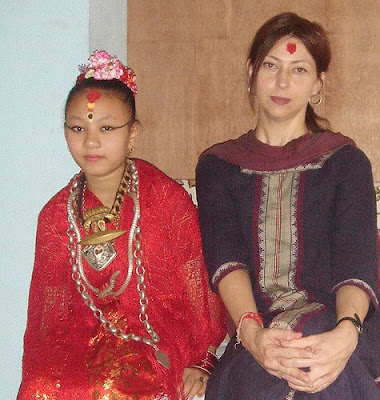
It's Nepali and Hindu new year, and just days after the election, the mood here in the traditional Newar town of Bhaktapur is just delicious. Today was the last of a luxurious week of holidays declared because of the election. The new year's tradition is to wear a brand-new sari or other outfit (for unmarried girls, that is anyone under 20, it's a new kurta-salwar set; for young men it's a WWF t-shirt and brand new stonewashed jeans) - wear your new new year's clothes and stroll around town arm in arm with family, chatting and stopping on the corner to eat homemade ice cream. (It looks homemade to me... I stick with the juju dahi or King's Curd for which Bhaktapur is famous.)
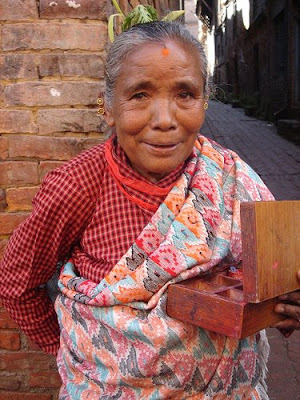
Naya barsha ko shubh kamana! will win you a lot of points right now. It means "happy new year."

First of all, you have to get used to addressing hierarchically, and as family. There is a definite pecking order involving age, caste and other status markers; but for foreigners, who this mostly means acknowledging seniors, peers and youth.

Elder men (elder to you) are addressed as Dai, or perhaps Kaka (uncle). A man your age or younger is Bhai. A very elder man is Huzoor-bho (respected father). Elder women are Didi (big sister), Kaki (auntie) or Huzoor-amma (respected mother) , very elder women are Ajima (grandmother), and young ladies are Bahinee (daughter).

"Huzzoor!" is the most respectful way to answer the phone or address an elder or superior. It just means something like, "respect." Otherwise, people normally say "Namaste" here to foreigners. People here actually say namaste and put their folded hands, up like praying. Only a few people in tourist places do that in India.

Let's start with practical things.
"Kalaam koti yo?" means, "how much is this ink pen."

Common numerical responses include "das rupiyah," (ten rupees)
"pandara" (pron. 'pundarra') = 15 rupees
"bis" (beese) = twenty
"tis" (tees) = thirty
Ek sau (one hundred) or Ek sau pachas (150).

"Mahango chha!" means, "your price is too expensive!"

"Duitaa (dwee-taa) kalaam tis rupiyah dinus." = Please give me 2 ink pens for thirty rupees.

"Shasto price dinus" = give me the cheap price.

The shop owner may counter with "Yo shasto price chha." ("This is a cheap price." To which you retort indignantly, "Shasto chhaina!" --(it's not cheap! )

Theek (pron. teak, like teakwood) chha! means, okay, all right or good!
Theek chhaina (pron. "chinaa") naturally means, "this is not okay." I find myself saying this more often than I would like....

and the classic Nepali phrase,
"Ke garne? " (pronounced "kay garnay")
means, "what to do?" and translates as, "I give up - it's someone else's job. " Or, "this is NOT going to get fixed or done today so relax and forget about it."

Dinus (deenus) is polite for "please give." Linus (lee-nus) is polite for "please take." In "street" Nepali these polite forms are little used - there are more truncated forms - but I prefer them. I figure as a newcome to the language I should be more polite.

Oh, that reminds me of the useful polite command forms, which usually end in -nus (noose).

Bussnus = Please sit. I often have to use this as shopkeepers tend to jump up the second they see you even look in their doorway.
Sodhnnus = please listen.
Bolnus = please tell me
Lekhnus = please write. And so on.

"Nepal maa, saarbhai jaan dehri ramro" = Here in Nepal, everyone is very good. Another diplomatic point-scorer.

"Taxi khali chha?" = is this taxi free?
Answers: Chha! (yes it is!)
Chhaina! (pron. chinaa) - (no it's not!) - and these are usually uttered with an exclamation point.
"Maa airport jaanchu" means, I am going to the airport.

"Meter maa theek chha?" means, "will you go on the meter?"

"Tapai ko naam ke ho?" = what is your name. But for children, you should use the diminutive "Timi lai naam ke ho?"

"Yo deva naam ke ho?"
is one I use all the time when visiting temples. It means, "What is the name of this deity?"

"Yo bus Bhaktapur jaane?" means, is this bus going to Bhaktapur?
Bhai, yahe (yahay) rokiyay is a polite way to tell your taxi driver "stop here, brother."

"Bholi parsi chhaina -- Ahilay! Ahilay!" is very useful indeed. ("Tomorrow tomorrow NO - TODAY! TODAY!)

"Tapai lai vetera malai dehri kusi lagyu" is "I am very pleased to meet you."

More practical ones:
Koti kero bundho garne? (what time do you close here?)
and
Koti kero kullchha garne? (what time do you open?)

Of course, you have to understand the answer - but everyone knows number up to ten at least. (Nothing opens before 10, or Das Bhaje.)

Speaking of which, it's ahht bhaje (8pm) and time to close here in sleepy Bhaktapur.

Saturday, December 22, 2007

The Magpie

The Bactrian Magpie is a local bird that chatters when agitated. It was also the name of a weekly newsletter that was the closest thing Ladakh had to a newspaper, till it was discontinued a few months ago.

Here is the kind of news item it might have carried if it were still in print.

December 20, 2007.
Ladakhis Demand Official Status for their Language

Last Thursday, several thousand Ladakhis staged a demonstration in the city of Jammu to demand that Ladakhi be added to the list of official Indian languages. Dressed in traditional costumes, over 2,000 people, carrying placards and flags, shouted that Ladakhi, also called Bhoti or Bhodi, should be included on the eighth schedule of the Indian national constitution, which lists the 18 official languages of India.

....Bhoti is an archaic form of Tibetan, and while it is not normally understood by the people of Tibet, its dialects are mutually understood by people in Leh, Kargil, Zangskar, and other regions of Ladakh—and to some extent beyond. According to Rizvi, scholars have been trying to develop a written form of Bhoti to correspond to colloquial Ladakhi, but as yet, the written form of the language is still Tibetan.

Wednesday, September 26, 2007

Yakz-N-the-Hood

People in my neighborhood
Leh, Ladakh

Well, I finally saw a yak. A great big beautiful black and white yak - or maybe a Dri (female yak). It had no horns; perhaps that is a trait of a Dri. It's absolutely huge, like a shaggy black-and-white tank, and is placidly grazing on the newly-harvested field down the lane from my guest house. (Wait, I think I used that phrase last week...placidly grazing camels!)

Since I can't get original photos onto the site from here, here is a stock photo.

In Ladakhi bioculture, nothing is ever wasted (even human waste gets composted for about a year, till it is non toxic, then used on fruit trees). So, after they finish cutting all the wheat or barley, the Ladakhis put the cows and yaks out to graze on the stubble and finish the job for them.


What was surprising was that it was a yak, a real yak and not a Dzo or Dzomo (yak-cow hybrid). In the last episode I related that the valleys are now still too hot for the yaks. But there has been a slight dip in the weather and perhaps this one was transferred from the upper elevations down to town.

<>I try to walk as much as possible down back-country lanes and away from main roads. The poplar leaves are falling and crunch golden under my feet. It's been so long since I smelled the smell of rotting deciduous leaves, it really feels like home in October. (Really - after a few years in the tropics you forget that trees elsewhere change colour).

Closing up shop
All the Kashmiri merchants are packing up and going back to Srinagar. If you are ever in doubt about which merchants are Kashmiri, they are the annoying ones that sit in front of their shoppes all day annoying you. I really love the contradiction between the obsequious, wheedling, oily tone of voice ("come have a look in my small shoppe madame???") and the resentful, frustrated and condescending facial expressions (which say, "you stupid foreigner, step inside like a bug into my spiderweb"). They never, ever seem to "get" that harassment does not equal salesmanship. Then they wonder why the foreigners and other tourists all go to the Tibetan and Ladakhi merchants. These other merchants give sincere smiles, and leave them alone to browse in silence. What a concept!

The fact that something does not work and never has worked is absolutely no obstacle to its continued practice in India. Doing things The Way They've Always Been Done is far more important than getting results.

I actually worked out a roundabout path from the guest house into town that bypasses all but one Kashmiri merchant on the Changspa road. Other foreign tourists I talked to had done the same.

<>Too bad, because the Kashimiri pashminas, sweaters, shawls, scarves and jewelery really are very nice. They just do not get the concept of "browsing."

Also, in case you need to identify them further, Kashmiri shoppes always have names like "Kashmiri Emporium," "Ancient Arts Antique Emporium," and my favourites: "Useless Wali Arts Emporium" and "Age of Old Era."

One shoppe I like to frequent because the owner does not resort to sidewalk touting is the cornily-named Antique Heaven, just off the main bazaar. Mr. Bhatt will not pressure me, will gladly show me anything I'm interested in with no pressure to buy, and loves to talk about Ladakh, Kashmir and the local political situations. He is extremely laid back, and a great source of information. I even go by his shoppe just to say hello (and as any experienced Indian traveller will tell you, that is saying a lot about a Kashmiri merchant).

Loads of restaurants are listed in the Lonely Planet, but for good service, good food, a good bathroom and the absolute best 360 degree view I go to Leh View Restaurant. The three-storey climb to the terrace was a real huffer and puffer when I first arrived, but now I am acclimated and trot up the stairs with ease. Everything I ate there (Vegetable Biryani for 70Rs or $1.50 reeks aromatically of cloves and all kinds of exotic spices) was great, the service is fast, it always looks clean and you can watch cricket games on TV in the downstairs room. Not to mention, one of the only decent bathrooms in town. A great bathroom here means, "the door locks, it doesn't stink and there is a sink - with SOAP!"

The rooftop terrace has stunning views of Leh Palace, Tsemo Gompa, the mountains, the golden-roofed Vihara across the street and even Shanti Stupa several miles away.

I noticed that during last week's Pakistan vs. India games, a lot of the Kashmiri Muslims (as opposed to Ladakhi Muslims or any other Indian Muslims) in various restaurants, shops etc. refused to stand for the Indian national anthem. They were rooting for Pakistan (they held their cheering at bay till the Indian tourists left the establishment in question, though). I thought maybe I was mistaken and asked them (when no one else was around) "who were you cheering for?" "Pakistan."

As soon as India won, the Kashmiris all poured out onto the street (all over Leh town) cursing. I was walking homeward when this happened and saw the crowds on the streets. I saw a Ladakhi kid start teasing a Kashmiri guy and decided to get home fast before something got out of hand. That is exactly the kind of thing that could start a rumble in an Indian neighborhood.

Ladakhi Libations
While in Ladakh, or anywhere in Kashmir, don't miss Kashmiri Kawa (also spelt Kehwa, Kahwa, etc). It's a Kashmiri hot drink made with saffron, crushed almonds, crushed cashews, cinnamon and sometimes green tea leaves (depends on where you go and who you ask). Leh View has very yummy Kahwa that is heavy on cinnamon. Only 15Rs (about thirty cents) for a glass.

A delicious drink that is a bit harder to come by is chang, the home-made Ladakhi barley beer. My guesthouse owner made it for a special puja last week, and I loved it - especially with a handful of tsampa or barley flour thrown in, making it like a grainy alcoholic milkshake. The Belgian guests at the dinner looked at me like I was some kind of intrepid adventurer just for trying it.

Another great unique Ladakhi drink is Seabuckthorn juice (aka Leh Berry juice or tsetsalu juice), reputed to have the highest level of Vitamin C and antioxidants of, well, anything. The juice of the tart, bright-orange berries, which grow only here in Ladakh, are mixed with a bit of sugar and served as a tangy drink. The Dzomsa, besides being a place to refill your water bottle, sells fresh glasses of this juice for 15Rs. Dzomsa also sells dried sweet apricots and roasted crunch, which make a great road snack.

I love the name of Hot Million Sweets and Snacks on the main bazaar - and they serve a really thick Punjabi-style lassi for 15Rs. However, the best samosas belong to Neha Sweets around the corner from the Big Mosque. One samosa, five rupees - you can pig out for 20Rs and a glass of tea to wash it down is another 5Rs. I like the big open picture windows, where I can watch people stroll by and even look up at the ancient Leh Palace on the hilltop.

The Big Mosque is a major neighborhood landmark. The muezzin's call is an easy way to tell the time of day. The mosque was built in 1666 as part of a deal between the Ladakhi Buddhist king (I think it was Sengge Namgyal) and the Mughals. The Mughals promised to defend independent Ladakh against Tibet, for a certain price. I have read in various places that the original Big Mosque (Jama Masjid) was built in a unique Central Asian-Ladakhi architectural style. More recently, it's been renovated to include onion domes, minarets and other more "Arabic" features.

My favourite internet place is Ancient Tracks Cyber Cafe right at the corner of Fort Road and the Main Bazaar. They are the only internet place downtown (or that I ever saw anywhere for that matter) who have a generator power backup. That means, when the power cuts out (at least once a day here), you can stay online. The Tibetan operators will offer you free tea if you stay long enough, especially during dinner time. I like the fact that it's run by women only. It completely changes the feel of the place. Plus, they are open the latest - open till 11pm.

The most centrally located pharmacy and medical shoppe- and a bit of Himalayan history - is Het Ram Vinay Kumar, whose Punjabi family has been trading here for about four generations - "since before the time of the Chinese aggression," Mr Kumar himself told me. He's the stern-looking man behind the desk. He told me that National Geographic featured the store in a story about exiled Tibetans in a 1960 issue.

In classic general store tradition, Het Ram sells a bit of everything, as do the other large old-timey general stores on the block (they used to call them Dry Goods Stores). Their jumbles of Tibetan khatag scarves, burlap sacks of spices, fabric for heavy goncha dresses, coils of rope, candles for power outages, bins of potatos and dusty boxes of L'oreal hair colour give the comfortable feeling: "we can scrounge up anything you need...just give us a minute." I felt like Mr Drucker from Green Acres would peep out from behind the counter.


That's it!
I finally realized who the Kashmiri Merchants remind me of....Green Acres' Mr. Haney.


.....
By the book
The most comprehensive bookstore in town is Ladakh Bookstore, just underneath Leh View Restaurant. Strolling through their aisles I feel almost like I'm in Delhi, or Barnes & Noble, and they accept credit cards (a rarity in Ladakh). However, they close up shop and leave for Punjab for the winter some time at end of September.


A more constant presence in the community is Leh Ling Books (Main Bazaar road), which is much more homespun but has a lot of the same stuff, in addition to kids' school supplies, blank notebooks, ink pens, maps, and greeting cards. Other great bookstores in town, some of which sell second-hand volumes, include the Bookworm and Otdan Books.

However, for a Ladakhi language-learning book - the kind used by primary school beginners - I searched in vain. The big bookstores had tourist pocket-phrase books in English script, and big unwieldy "Ladakhi-English-Urdu dictionaries."

I hit no less than five local stationery and bookshops (including shops that sold all kinds of Hindi, English and even Urdu learning books for schoolkids) and not ONE had a Ladakhi or even Tibetan script-learning book (Tibetan and Ladakhi share an alphabet). They all directed me to "Main Bazaar."

Surely Leh Ling would have it, I thought. Nope. Only one man in town, they said, "still" sold Ladakhi script-learning books - Thubsten Sanfan in the old bazaar.

I knew that there had been a struggle in the recent past about including Ladakhi language in the school curriculum - as opposed to Urdu, the official state language of J&K, but I thought it had emerged semi-victorious. Semi-, because now most public school education is in English medium, and the children can choose either Ladakhi, Urdu or (I think) Hindi as a second language. Ladakhi is not some obscure language - a great many of the signs are in Ladakhi Bodyig script. Most of the population is Buddhist and the script is the same for Tibetan, the sacred language of the area, which all Tibetan Buddhists should know how to read. I never thought it would be so difficult to find a Ladakhi script primer.

The old bazaar is a sort of more authentic, less exposed Main Bazaar, an alleyway running exactly parallel to the Main road but without the Kashmiri merchants, travel agents and junk stores. There are only real neighborhood stores here - tailors making salwar-kameez and Ladakhi gonchas, haircutters set up in tiny booths "for gents only" giving 40Rs cuts or shaves, a few butchers, a thangka-framer (a thangka is a sacred Buddhist scroll that must be mounted on brocade fabric), one tailor specializing in monk's maroon robes. I had to ask several times for Thubstan Sanfan, since there was no signboard in either Ladakhi or English.

Thubstan Sanfan Stationery was a tiny, dusty cubbyhole with nothing but the long skinny Tibetan scriptures on the shelves - nothing, not even a shopkeeper there, either. The shoppe was wide open and no caretaker to be seen. I thumbed through the mysterious books, deciphering an occasional letter, then decided to ask a neighbor where the proprietor was. The neighboring shopkeeper ran across the way to yet another shop, and brought back Thubstan Sanfan.

Mr Sanfan is a bit of a one-man industry. He publishes Ladakhi language calendars, reading primers, script primers, religious books and astrological references, in addition to running the religious supplies and thangka-mounting shop across the road. For 10Rs (about a quarter) I bought a bright yellow "Ladakhs Book Part I" which introduces me to the Tibetan/Ladakhi script.

Already, I can read simple one- or two-syllable words...but I haven't yet mastered the silent prefixes! As a spelling system, they are almost as annoying and illogical as English. Practicing Ladakhi script over and over is a good way to lull myself to sleep.

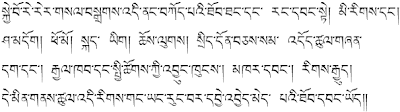
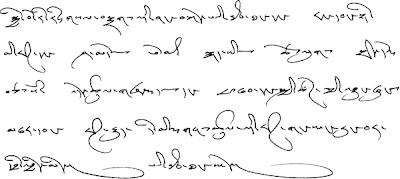
And for extra fun, there are actually 2 Tibetan scripts... U-chen (the everyday one I am learning) and the classical script, Gyuk Yig, sort of an elegant abstract version of U-chen. If I wanted to be an expert on Tibetan scripture, and thank god I don't, I would have to learn both.

Angmo will help me. She is the adorable nine year old niece of my guesthouse owners. I am really going to miss this place. Green Acres, we are there....


Above, and below, are examples of U-chen and GyukYig Scripts. What's written here is the 1st Article of the Universal Declaration of Human Rights, which reads:

All human beings are born free and equal in dignity and rights. They are endowed with reason and conscience and should act towards one another in a spirit of brotherhood.