Showing posts with label pakistan. Show all posts

Monday, April 06, 2009

Witch hunts and scarlet letters

Ring ring, Pot? this is Kettle calling
From Patan to Pakistan

Even a cursory glance at the Indian media and blogosphere shows people getting pretty uppity about the horrific Pakistan flogging case.

Other South Asians don't have room to talk. All this stuff happens regularly in India, Nepal and Bangladesh, and they don't even usuaily do it "in the name of Islam."

Take last week's case of a Nepali girl - not even in a remote region, but here by the urban centre Kathmandu - accused of witchcraft and tortured. Pyuthar village is within Lalitpur District (very near, if not precisely within, the capitol city)

And that, by a primary school headmaster! If this is what the educators are doing, imagine what the "general populace" are up to, or at very least, what an example that sets for them.

I scoured all the reports I saw, and still could not find an account of what exactly the poor girl had actually done, nor of what exactly she'd been accused of doing ("witchcraft" could mean anything at all, from drawing a design on the ground to being seen with the wrong person).

BK was allegedly tortured by villagers in allegation of practicing witchcraft. BK said she was beaten up, abused and even made to eat human excreta by a group of people in the village.
nepalnews.com Mar 27 09

I am glad, for lack of a better word, that the flogging case is being spotlighted this way - as it deserves. But such treatment is not so unusual, nor restricted to places like Swat Valley. .

Tuesday, January 15, 2008

Blogs unblocked

I need to toy with the template and include this link.

Supposedly, it will unblock blogs that are blocked within Pakistan, China, Iran and India. (Didn't know any were blocked in India...but I have a lot to learn.)

At least one person has used it to access my blog, which is how I discovered it (thank you, Site Meter!).
pkblogs.comhttp://www.pkblogs.com/


http://www.pkblogs.com/

Thursday, January 03, 2008

Family affair

Royal pain
News from south Asian neighborhood

It was a big week for South Asian politics. Bhutto's assassination, the capitulation of the democratic Nepal Seven Party Alliance to demands of the Maoists to somehow guarantee they will get rid of the monarchy (when previously they had promised to hold a referendum for the public to decide), and the first ever election in the now-former kingdom of Bhutan all would seem to spell change. So why don't I smell change?

Amid all the mourning of Benazir Bhutto and descriptions of her as a champion of democracy, her apolitical 19-year-old son has been appointed her successor. There are also reports that Bhutto "willed" leadership of the Pakistan People's Party to her husband Zardari, as though it were a personal possession. Which, let's face it - I suppose, it actually was.

When is a democracy not a democracy? When its leaders are appointed by non-democratic methods, for one thing. When heredity is 9/10 of the law; and yes, the same formula applies to the Gandhi-Nehrus and Thackerays of India, and many others.

Of course, after the elections of 2000 and 2004 were hijacked by our very own Bush dynasty, Americans aren't much better off.

An article from the Indian Express
explains the south Asian grafting of dynastic family structure onto democracy.

Royalism has been democratised in South Asia. In turning our backs on monarchy, we reinvent ourselves as republicans. But this is often a fragile and tenuous republicanism, as the political parties in our democratic polities are mini-kingdoms each with its own royal family.

My own observations: south Asians value stability over change, progress or principles. The continuity of heredity, with all the social expectations of a dutiful son or daughter carrying on the family legacy, is the best way to ensure that.

And, south Asian understanding of family as the most fundamental paradigm overrides any consciously learned, abstract concepts. When all you have is a hammer, everything you see looks like a nail. Unlike most of the west, where the individual is the basic unit, south Asian society seems to be irreducible to any unit smaller than that of the Family.

Therefore, because the current Nepali king was at first given benefit of the doubt, but has proven to be a rotten apple, the whole family has to go. Forget the outrageous Prince Paras who was always out of the question; there is no room to consider the well-behaved daughter or a regency for the very young Prince Hridayendra, grandson of the current king Gyanendra. They are not and cannot be seen as individuals; that's the whole point.

While the Nepali monarchy will suffer an uphill battle to retain even ceremonial kingship at this point, the Bhutanese palace is conversely struggling to encourage its subjects in baby steps towards the electoral process. Evidently most of the political parties were formed at the behest of the King - why doesn't that sound right? - following strict guidelines concerning the nature of such parties. "The king says we have to form some parties, I guess we had better" doesn't sound like a good start on democracy to me.

That other Himalayan monarch, HH the Dalai Lama, is not fareing much better encouraging his people to adopt democracy. He's been pushing the democratic process for decades; the government in exile has now elected a Prime Minister and other officers. In preparation for his inevitable passing, HH continually tries to delegate political tasks to these and other figures, hoping to train Tibetans to look toward other sources than himself for answers.

Within what are ostensibly republics in South Asia, thus, we remain at heart subjects rather than citizens, people who need and love royals....

Old habits are hard to break.

Wednesday, September 26, 2007

Yakz-N-the-Hood

People in my neighborhood
Leh, Ladakh

Well, I finally saw a yak. A great big beautiful black and white yak - or maybe a Dri (female yak). It had no horns; perhaps that is a trait of a Dri. It's absolutely huge, like a shaggy black-and-white tank, and is placidly grazing on the newly-harvested field down the lane from my guest house. (Wait, I think I used that phrase last week...placidly grazing camels!)
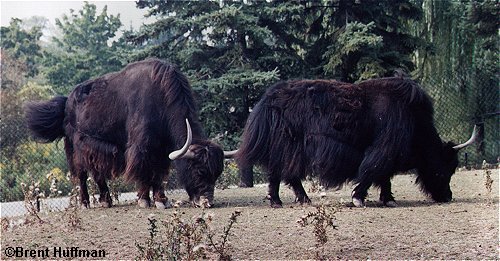
Since I can't get original photos onto the site from here, here is a stock photo.

In Ladakhi bioculture, nothing is ever wasted (even human waste gets composted for about a year, till it is non toxic, then used on fruit trees). So, after they finish cutting all the wheat or barley, the Ladakhis put the cows and yaks out to graze on the stubble and finish the job for them.


What was surprising was that it was a yak, a real yak and not a Dzo or Dzomo (yak-cow hybrid). In the last episode I related that the valleys are now still too hot for the yaks. But there has been a slight dip in the weather and perhaps this one was transferred from the upper elevations down to town.

<>I try to walk as much as possible down back-country lanes and away from main roads. The poplar leaves are falling and crunch golden under my feet. It's been so long since I smelled the smell of rotting deciduous leaves, it really feels like home in October. (Really - after a few years in the tropics you forget that trees elsewhere change colour).

Closing up shop
All the Kashmiri merchants are packing up and going back to Srinagar. If you are ever in doubt about which merchants are Kashmiri, they are the annoying ones that sit in front of their shoppes all day annoying you. I really love the contradiction between the obsequious, wheedling, oily tone of voice ("come have a look in my small shoppe madame???") and the resentful, frustrated and condescending facial expressions (which say, "you stupid foreigner, step inside like a bug into my spiderweb"). They never, ever seem to "get" that harassment does not equal salesmanship. Then they wonder why the foreigners and other tourists all go to the Tibetan and Ladakhi merchants. These other merchants give sincere smiles, and leave them alone to browse in silence. What a concept!

The fact that something does not work and never has worked is absolutely no obstacle to its continued practice in India. Doing things The Way They've Always Been Done is far more important than getting results.

I actually worked out a roundabout path from the guest house into town that bypasses all but one Kashmiri merchant on the Changspa road. Other foreign tourists I talked to had done the same.

<>Too bad, because the Kashimiri pashminas, sweaters, shawls, scarves and jewelery really are very nice. They just do not get the concept of "browsing."

Also, in case you need to identify them further, Kashmiri shoppes always have names like "Kashmiri Emporium," "Ancient Arts Antique Emporium," and my favourites: "Useless Wali Arts Emporium" and "Age of Old Era."

One shoppe I like to frequent because the owner does not resort to sidewalk touting is the cornily-named Antique Heaven, just off the main bazaar. Mr. Bhatt will not pressure me, will gladly show me anything I'm interested in with no pressure to buy, and loves to talk about Ladakh, Kashmir and the local political situations. He is extremely laid back, and a great source of information. I even go by his shoppe just to say hello (and as any experienced Indian traveller will tell you, that is saying a lot about a Kashmiri merchant).

Loads of restaurants are listed in the Lonely Planet, but for good service, good food, a good bathroom and the absolute best 360 degree view I go to Leh View Restaurant. The three-storey climb to the terrace was a real huffer and puffer when I first arrived, but now I am acclimated and trot up the stairs with ease. Everything I ate there (Vegetable Biryani for 70Rs or $1.50 reeks aromatically of cloves and all kinds of exotic spices) was great, the service is fast, it always looks clean and you can watch cricket games on TV in the downstairs room. Not to mention, one of the only decent bathrooms in town. A great bathroom here means, "the door locks, it doesn't stink and there is a sink - with SOAP!"

The rooftop terrace has stunning views of Leh Palace, Tsemo Gompa, the mountains, the golden-roofed Vihara across the street and even Shanti Stupa several miles away.

I noticed that during last week's Pakistan vs. India games, a lot of the Kashmiri Muslims (as opposed to Ladakhi Muslims or any other Indian Muslims) in various restaurants, shops etc. refused to stand for the Indian national anthem. They were rooting for Pakistan (they held their cheering at bay till the Indian tourists left the establishment in question, though). I thought maybe I was mistaken and asked them (when no one else was around) "who were you cheering for?" "Pakistan."

As soon as India won, the Kashmiris all poured out onto the street (all over Leh town) cursing. I was walking homeward when this happened and saw the crowds on the streets. I saw a Ladakhi kid start teasing a Kashmiri guy and decided to get home fast before something got out of hand. That is exactly the kind of thing that could start a rumble in an Indian neighborhood.

Ladakhi Libations
While in Ladakh, or anywhere in Kashmir, don't miss Kashmiri Kawa (also spelt Kehwa, Kahwa, etc). It's a Kashmiri hot drink made with saffron, crushed almonds, crushed cashews, cinnamon and sometimes green tea leaves (depends on where you go and who you ask). Leh View has very yummy Kahwa that is heavy on cinnamon. Only 15Rs (about thirty cents) for a glass.

A delicious drink that is a bit harder to come by is chang, the home-made Ladakhi barley beer. My guesthouse owner made it for a special puja last week, and I loved it - especially with a handful of tsampa or barley flour thrown in, making it like a grainy alcoholic milkshake. The Belgian guests at the dinner looked at me like I was some kind of intrepid adventurer just for trying it.

Another great unique Ladakhi drink is Seabuckthorn juice (aka Leh Berry juice or tsetsalu juice), reputed to have the highest level of Vitamin C and antioxidants of, well, anything. The juice of the tart, bright-orange berries, which grow only here in Ladakh, are mixed with a bit of sugar and served as a tangy drink. The Dzomsa, besides being a place to refill your water bottle, sells fresh glasses of this juice for 15Rs. Dzomsa also sells dried sweet apricots and roasted crunch, which make a great road snack.

I love the name of Hot Million Sweets and Snacks on the main bazaar - and they serve a really thick Punjabi-style lassi for 15Rs. However, the best samosas belong to Neha Sweets around the corner from the Big Mosque. One samosa, five rupees - you can pig out for 20Rs and a glass of tea to wash it down is another 5Rs. I like the big open picture windows, where I can watch people stroll by and even look up at the ancient Leh Palace on the hilltop.

The Big Mosque is a major neighborhood landmark. The muezzin's call is an easy way to tell the time of day. The mosque was built in 1666 as part of a deal between the Ladakhi Buddhist king (I think it was Sengge Namgyal) and the Mughals. The Mughals promised to defend independent Ladakh against Tibet, for a certain price. I have read in various places that the original Big Mosque (Jama Masjid) was built in a unique Central Asian-Ladakhi architectural style. More recently, it's been renovated to include onion domes, minarets and other more "Arabic" features.

My favourite internet place is Ancient Tracks Cyber Cafe right at the corner of Fort Road and the Main Bazaar. They are the only internet place downtown (or that I ever saw anywhere for that matter) who have a generator power backup. That means, when the power cuts out (at least once a day here), you can stay online. The Tibetan operators will offer you free tea if you stay long enough, especially during dinner time. I like the fact that it's run by women only. It completely changes the feel of the place. Plus, they are open the latest - open till 11pm.

The most centrally located pharmacy and medical shoppe- and a bit of Himalayan history - is Het Ram Vinay Kumar, whose Punjabi family has been trading here for about four generations - "since before the time of the Chinese aggression," Mr Kumar himself told me. He's the stern-looking man behind the desk. He told me that National Geographic featured the store in a story about exiled Tibetans in a 1960 issue.

In classic general store tradition, Het Ram sells a bit of everything, as do the other large old-timey general stores on the block (they used to call them Dry Goods Stores). Their jumbles of Tibetan khatag scarves, burlap sacks of spices, fabric for heavy goncha dresses, coils of rope, candles for power outages, bins of potatos and dusty boxes of L'oreal hair colour give the comfortable feeling: "we can scrounge up anything you need...just give us a minute." I felt like Mr Drucker from Green Acres would peep out from behind the counter.
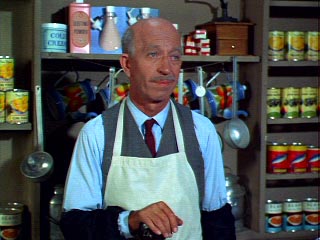

That's it!
I finally realized who the Kashmiri Merchants remind me of....Green Acres' Mr. Haney.



.....
By the book
The most comprehensive bookstore in town is Ladakh Bookstore, just underneath Leh View Restaurant. Strolling through their aisles I feel almost like I'm in Delhi, or Barnes & Noble, and they accept credit cards (a rarity in Ladakh). However, they close up shop and leave for Punjab for the winter some time at end of September.


A more constant presence in the community is Leh Ling Books (Main Bazaar road), which is much more homespun but has a lot of the same stuff, in addition to kids' school supplies, blank notebooks, ink pens, maps, and greeting cards. Other great bookstores in town, some of which sell second-hand volumes, include the Bookworm and Otdan Books.

However, for a Ladakhi language-learning book - the kind used by primary school beginners - I searched in vain. The big bookstores had tourist pocket-phrase books in English script, and big unwieldy "Ladakhi-English-Urdu dictionaries."

I hit no less than five local stationery and bookshops (including shops that sold all kinds of Hindi, English and even Urdu learning books for schoolkids) and not ONE had a Ladakhi or even Tibetan script-learning book (Tibetan and Ladakhi share an alphabet). They all directed me to "Main Bazaar."

Surely Leh Ling would have it, I thought. Nope. Only one man in town, they said, "still" sold Ladakhi script-learning books - Thubsten Sanfan in the old bazaar.

I knew that there had been a struggle in the recent past about including Ladakhi language in the school curriculum - as opposed to Urdu, the official state language of J&K, but I thought it had emerged semi-victorious. Semi-, because now most public school education is in English medium, and the children can choose either Ladakhi, Urdu or (I think) Hindi as a second language. Ladakhi is not some obscure language - a great many of the signs are in Ladakhi Bodyig script. Most of the population is Buddhist and the script is the same for Tibetan, the sacred language of the area, which all Tibetan Buddhists should know how to read. I never thought it would be so difficult to find a Ladakhi script primer.

The old bazaar is a sort of more authentic, less exposed Main Bazaar, an alleyway running exactly parallel to the Main road but without the Kashmiri merchants, travel agents and junk stores. There are only real neighborhood stores here - tailors making salwar-kameez and Ladakhi gonchas, haircutters set up in tiny booths "for gents only" giving 40Rs cuts or shaves, a few butchers, a thangka-framer (a thangka is a sacred Buddhist scroll that must be mounted on brocade fabric), one tailor specializing in monk's maroon robes. I had to ask several times for Thubstan Sanfan, since there was no signboard in either Ladakhi or English.

Thubstan Sanfan Stationery was a tiny, dusty cubbyhole with nothing but the long skinny Tibetan scriptures on the shelves - nothing, not even a shopkeeper there, either. The shoppe was wide open and no caretaker to be seen. I thumbed through the mysterious books, deciphering an occasional letter, then decided to ask a neighbor where the proprietor was. The neighboring shopkeeper ran across the way to yet another shop, and brought back Thubstan Sanfan.

Mr Sanfan is a bit of a one-man industry. He publishes Ladakhi language calendars, reading primers, script primers, religious books and astrological references, in addition to running the religious supplies and thangka-mounting shop across the road. For 10Rs (about a quarter) I bought a bright yellow "Ladakhs Book Part I" which introduces me to the Tibetan/Ladakhi script.

Already, I can read simple one- or two-syllable words...but I haven't yet mastered the silent prefixes! As a spelling system, they are almost as annoying and illogical as English. Practicing Ladakhi script over and over is a good way to lull myself to sleep.

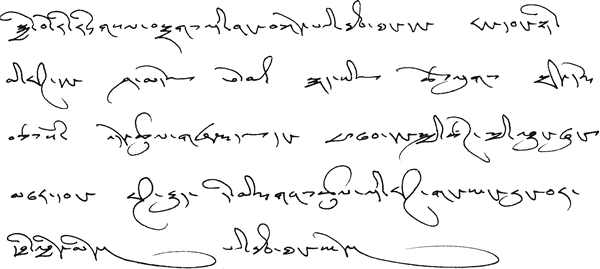
And for extra fun, there are actually 2 Tibetan scripts... U-chen (the everyday one I am learning) and the classical script, Gyuk Yig, sort of an elegant abstract version of U-chen. If I wanted to be an expert on Tibetan scripture, and thank god I don't, I would have to learn both.

Angmo will help me. She is the adorable nine year old niece of my guesthouse owners. I am really going to miss this place. Green Acres, we are there....
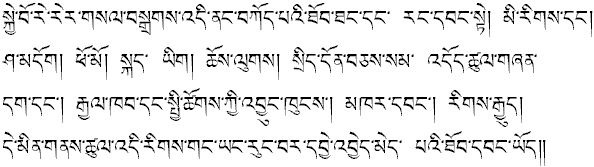

Above, and below, are examples of U-chen and GyukYig Scripts. What's written here is the 1st Article of the Universal Declaration of Human Rights, which reads:

All human beings are born free and equal in dignity and rights. They are endowed with reason and conscience and should act towards one another in a spirit of brotherhood.


Friday, August 17, 2007

Big sky country

Great wide open
Leh, Ladakh (India)
My lower back is really, really sore from sitting watching the Dalai Lama all day, my eyes are burning from the arid dusty air and I am too tired to think of a third thing to round out this paragraph. Oh yeah! My nose is full of crusty stuff.

His Holiness is teaching the "Lam Rim" scripture. Because I am sitting in the press section, have yet to hear the English translation. Maybe I will skip over to the "Foreigners" section tomorrow
It is wild to see the Dalai Lama in a Buddhist place. Usually, he appears in predominantly Hindu places and the Buddhists commute in. Here, most everyone is Buddhist. There are easily 30,000 people at every day's teaching.


Man, there is a lot of space out here. And a lot of dust. And a lot of sky!

It reminds me of a Halloween craft we did in kindergarten. We made a "starry sky" picture out of silver glitter, dropped onto blobs of glue, on black construction paper. But too much glitter always comes out of the tube, at first. We had to knock off the excess glitter into the waste can, and what was left was the "night sky." (Later I added a big yellow construction-paper cutout crescent moon.)


The night sky in Ladakh looks like the paper, before we knocked the extra glitter off. There are almost too many stars. I have a hard time identifying large constellations I know. But, a crescent moon rose last night.
Not of yellow construction paper, but a wafer-thin silver sliver.

Air conditioning of the gods

The most fun thing on this trip, so far, was also the cheapest. Returning from the teachings, the entire Choglam-Sa highway is packed bumper to bumper. I have to wait for the crowds to thin, and taxis want an outrageous 250Rs back to town. So, yesterday my German friends and I just hopped on top of a public bus, on the luggage rack. What fun! Who needs air conditioning, overpriced taxis, seat belts? Ten rupees for a panorama view of the valley and mountains. It really was much better than the hot, stuffy taxi stuck down among the exhaust fumes, or sitting inside the crowded bus itself. Of course, we had to constantly duck under the prayer flags that had been strung up across the roads for the Dalai Lama's visit.

Far from the madding crowd

One reason Ladakh does not "feel like" India is that it is just not crowded enough. Not that I am complaining. But at first, I really could not figure out what felt so weird. Almost lonely. Then it dawned on me....it was more like parts of southwest America; Arizona or New Mexico, to be exact.


My friend Gary warned me years ago that all the sensory overload of India would burn a hole in my brain, so that when I finally went somewhere quiet, I would miss the noise and clutter. Gary, you were right. I found myself looking around the relatively empty roads of Leh going, "where is IT?" and realizing I couldn't even define IT.

Another thing that doesn't feel like India is the absence of Hindus. There are a few. But I had been here five days before I saw my first Hindu temple ( a little tiny shrine).
It looks like one of the orange pyramidal ones the BJP put up in Buddhist places, just to say "we're here!"

Leh is the kind of place you can see minarets of a mosque superimposed with
Buddhist chortens and prayer flags, or sit in the Buddhist gompa and hear the Muezzin's call to prayer, and it feels totally normal.

Ladakh List
Definite must-brings for a trip to Ladakh:
1-Sunglasses
2-Sunblock
3-Lip balm, even better, sunscreen lip balm
4-Umbrella, or big floppy hat as sun protection

5-Eye drops - since I wear contacts, the aridity and dust is wreaking havoc
6-Trekking boots or chunky walking sandals
7-Jacket - evenings get nippy, though days are warm
8-Face moisturizer, which you will also have to put
inside your nose to keep it from crusting over, especially at bedtime
9- ORS (Oral Rehydration Salts, available at any pharmacy here for 15Rs). ORS have exactly what your body needs to replace fluids (potassium, sodium chloride etc) and are a literal lifesaver.

10-Lots and LOTS of water. Your water bottle can be refilled for 5Rs at the ecofriendly Dzomsa shops in town. If you feel weird, lightheaded, fatigued and cranky but don't know why, you are probably dehydrated.

11-Flashlight. The power goes out frequently, and if you are lucky the walk home to your guest house will be down a country road with few street lights.

12-Toilet paper. Guest house bathrooms do not have it, but will sell it at an inflated price.

Things that are totally useless here:
1-"Nice" shoes

2-Deodorant - you won't sweat-- or if you do it immediately dries into salt crystals on your skin

3-The talcum powder and astringent that are so needed in humid lower India. Again, you won't be sweating much

4-Tank tops, sleeveless blouses, singlets etc. show too much skin for local standards, and besides, you will either get a sunburn or freeze to death.

5-Your cell phone, unless you have post-paid. In Delhi, they happily sell you (ha ha) a SIM card saying it is good for all India. What they don't tell you is that in Ladakh and Kashmir (not Jammu), you must have a post-paid account; that is, you must be a resident with proof of address for billing. The prepaid cards are no good here. Of course, all tourists and most internationals have prepaid cards.

6-Alcohol. A disaster at this altitude, and not widely available anyway - rightly so.


Also, be warned - Internet is run by a cartel ("Ladakh Cyber Cafe Association") that has fixed prices at an obscene 90Rs an hour ($2.10). Not the place to play around tweaking the widgets on your homepage. And "photo uploading not allowed" - so, sharing the photos of this amazing place is quite difficult.

I appear to have missed all the really big Lama Dances with masks and costumes. In case you want to catch one, here is a calendar for next year.


Jeep 54 Where Are You?
Getting my press clearance to take photos of the Dalai Lama, when I am in a relatively podunk town like Leh or Bodh Gaya, means making friends with the police. Fortunately, this is easily done. I am the only foreign media person at these entire teachings, and probably one of the few the police have met all year.

What's not so easily done is catching the right guy in the office. The Superintendant of Police closed at 4pm (!) and the following day, Friday, was a holiday. God knows why, probably literally - in India, an unexpected holiday usually has something to do with religion. So I had to go to the main police station ("we never close").

It was an adventure but unfortunately, by the time I sat down to write about it last night, the net connections were down. Now, I am too tired. Maybe later.


The intrepid anthropologist in me never tires of poking into people's social dynamics. I discovered that among ethnic Ladakhis, there are both Muslims and Buddhists, and they feel themselves to be quite distinct from the ethnic Kashmiris. "He is
Kashmiri," one Ladakhi Muslim officer hissed to me, pointing out a Muslim guy on the street dressed in stereotypical beard and kurta-pyjama.

The kurta-wearing "Kashmiri" turned out to be another police officer, who helped me to get the pass, after a few bossy questions delivered in the usual accusatory style ("why did you not come earlier??") of the Indian "mainland."


Indeed, a lot of "Kashmiris" seem to have taken refuge here only as a resort from the violence in "Kashmir" proper. And they don't consider this Kashmir. One of the first things the kurta-wearing officer asked me was "Have you been to Kashmir?"

I thought we were in Kashmir, Sir.

"No, I mean Srinagar, real Kashmir. You should leave here immediately and go to Kashmir. Gulmarg, Dal Lake...." Then he started reminiscing about his homeland. Clearly, he felt Ladakh to be a hardship posting.

Lost tribe
I have also spent some time interviewing and photographing the "Indo-Iranian" Buddhists of Ladakh, the Brokpa people. Originally, they came from what is now Pakistan in Gilgit region. They speak a language called Dardi and have been Buddhist for many centuries. The Brokpa are supposed to be the last "Aryan" indigenous Buddhist people. (They actually call themselves Aryan, which in this case, just means originally from Iran.)

Since I can't upload my own photos, here is one cribbed from a Ladakhi tourist website.

The Brokpa traditional dress worn at the Dalai Lama's teachings is really distinctive, and their features set them well apart from the Mongolian-looking other Ladakhis. I am curious about the form of Buddhism they practice; it must date back, at least in part, to looooong ago when northwestern former India (now Pakistan) was Buddhist. Guru Rinpoche, the bearer of Buddhism into Tibet, was originally from Swat Valley, Pakistan.
Tibetan scriptures still refer to that area as "Ugyen" or "Oddiyana."

I went to the biggest bookstore in Leh looking for a book about the Brokpa. "Who?" said the Kashimiri Muslim guy at the desk. I pointed to a photo of one on a postcard (sold as proof of quaint tribal life in Ladakh).


"Oh, the Aryans? No, no books about them. Something-something in various books here and there, but nothing just about them." If they don't have it here, they don't have it anywhere.

Maybe no one could talk to the Brokpa. All the other foreigners take pictures of them from a safe distance with powerful zoom lenses. I guess there is one advantage to having a cheap camera...you are required to make contact with your subjects.