Sunday, March 30, 2008

Monks amok

I fell off
Kathmandu, Nepal
For the second time in as many months, I write a blog with the title "I Fell Off." Sorry for my silence. I can only have the wind taken out of my sails so many times (on every level - professional, financial, the list goes on) without getting profoundly discouraged. But enough about me!
Pro-Tibet protests at either the Chinese Embassy, the UN Building, or both are nearly a daily occurrence here. I spent Friday riding around on the back of an Enfield Bullet bike with a prominent Nepali photojournalist, sniffing out the action. Not to name names, but most of the wire service stories you read were written by him.

Like a surprising number of Nepalis I have spoken to, my friend seems to think that in some way, the Tibetans deserve to get beaten up for staging peaceful protests. "We have an agreement with China, not to allow any anti-China activity in Nepal," he said. Whether or not such actions are anti-China is definitely a matter of interpretation - I would characterize them as pro-Tibet. When the protestors are chanting "Stop the killing in Tibet" it's hard to construe that as anti-China.

He went on to say, "They say they are carrying out peaceful protests. But they are not peaceful. They have banners, and they are chanting against China." Sure, that justifies getting beat up with bamboo canes and being tear-gassed. Banners and chants are not violent.
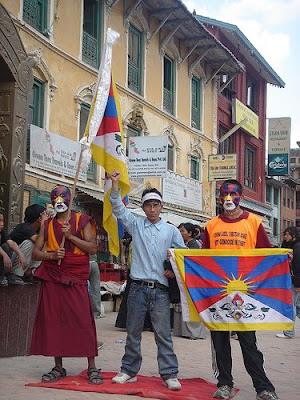
I showed him my photos of the monk being attacked 2 weeks ago in Boudha. I was surprised to learn he too had been there that day. "But," he said a bit sheepishly, "they chased away everyone with cameras."

Obviously, not everyone.

"I talked to some of the local people," he continued. (Local Nepali people, that is.) "They said, they don't like that the Tibetans put up a photo of the Dalai Lama in front of a statue of the Buddha. Dalai Lama is not greater than the Buddha. You know, they (Tibetans) are aggressive." Again, so that justifies beating them up with 2x2s? This conclusion seemed to follow very logically in his conversation.
"The people I interviewed, Nepali and Tibetan, felt that the attackers had been paid by the Chinese," I offered. He giggled. "Oh, I don't know about that." He hadn't even bothered to speak with any of the Tibetans regarding the localized violence.

His comments, and those of several other Nepalis who spoke frankly, reminded me how very inured the average Nepali has become to organized violence, how little sense of moral outrage there is and how regular beat-downs -- by either police, army, PLA or gangsters (of whatever stripe) -- have come to be expected.


Good luck with that democracy thing, guys. You don't have a clue! What do you think "democracy" means, anyway - that everybody gets a car?

Twilight of the gods
It's high tourist season, and foreign visitors continue to flood the Buddhist stupas, monasteries, thangka-painting concerns, guest houses with names like "Namo Buddha", and gift shoppes hawking Buddhist items such as prayer wheels and singing bowls. The entire mystique of Kathmandu and Nepal is based on two things only - proximity to Tibet and its "mysterious, spiritual" Buddhist culture, and the mountains (which of course are part and parcel of one another). The monks, caretakers of these living traditions, are being locked away for defending the very culture that is keeping Nepal commercially alive.

Nepal Tourism continually trumpets the nation as "the land of the Buddha." Monks and nuns, savaged and locked up in the "land of the Buddha." (In fact, saying that Gautama Buddha was "Nepali" is rather like saying Jesus was Israeli. But I digress.)
Meanwhile, the music shoppes continually play that sappy recording of the sacred Buddhist mantra, "Om Mani Padme Hung" (all visitors to Dharamsala and Kathmandu know the one....terrible, cheesy keyboards and all).
Maybe I can edit a video of the monks getting beaten using that as the soundtrack. I'm sure some tourists will buy it.....

Saturday, March 29, 2008

Eyes in the door

Power Places of Nepal: a cultural minute
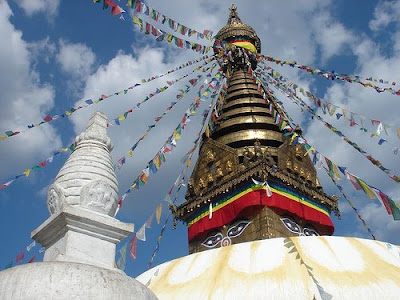
Swaymabunath, Kathmandu, Nepal

This is the doorway to the hilltop temple representing the element of Akash or Sky (there are five shrines, one for each element - Fire, Air, Earth, Water, and Space or Sky) at Swayambunath Buddhist stupa.

This temple's sanctum sanctorum contains an underground chamber opened only once a year, which can be entered only by specially initiated priests.
It sure does feel mysterious and arcane, standing in the mandap (front room) of the temple.

It is extremely dark in there; otherwise I would have better photos of the many brass figures and macabre wall paintings (nearly obscured by centuries of smoke from oil lamps).
I believe this same door can also be seen on the cover of Keith Dowman's coffee table book, Power Places of Nepal (which would make a great Christmas gift, hint hint).
Dowman lists 25 "power places" in the "Nepal Mandala" (there are undoubtedly lots more).
Hmm, just cause I'm tired of thinking about The Big Old Mean World for a minute, let's go on a quick Valley tour and see how many I've visited and photographed.

Swayambunath (ab0ve and below)::


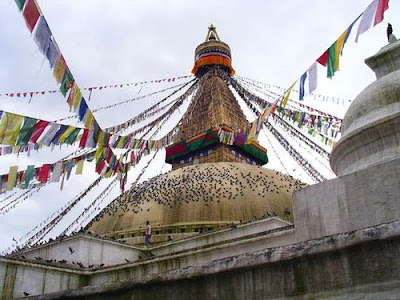
Boudhanath::


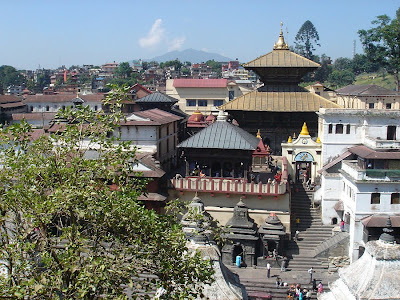
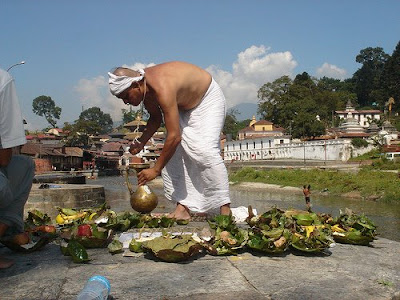
Pashupatinath::


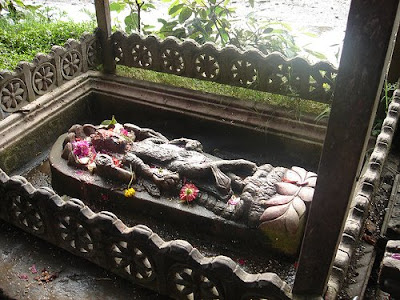
Buranilakanth (aka Buddhanilakanth): Officially 'non-Hindus' (aka, white people) are not allowed inside Buranilakanth to view the statue of the sleeping Vishnu, recling upon the ocean serpent. But there is a smaller replica statue of the Buranilakanth Adisesha in Bhaktapur, below:

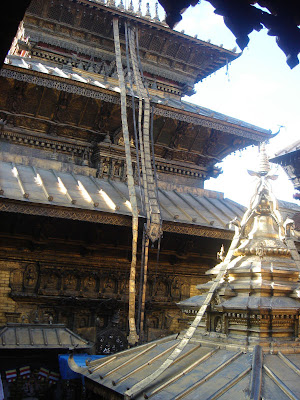
Kwa Baha (aka Patan's "Golden Temple")::

Rato Matsyendranath
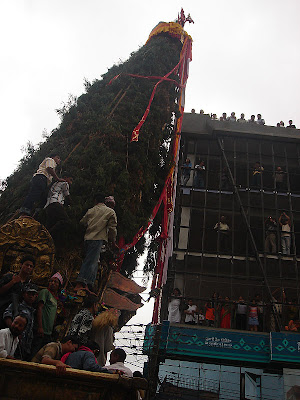
:: Whie I admit to never having visited the actual temple of Rato Matsyendranath in Bungamati, I did witness the Most Insane Pulling Of His Five-Storey Chariot through the streets of Patan last year, like a mammoth Christmas tree on wheels scraping the rooftops and occasionally the power wires.

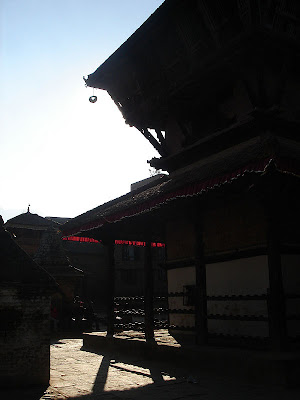
Kirtipur Bagh Bhairav Mandir:

Whew, I'm already tired. I still have to show you Chobar Adinath, Dakshinakali, Pharping Vajra Yogini, Sankhu Vajra Yogini, Bhaktapur Taleju, Pharping Sesh Narayana, Surya Vinayaka, Akasha Bhairava, Gokarneshvara, Teku Pachali Bhairav, Seto Matyendranath and Changu Narayana. I've been lucky enough to visit and photograph all but a few of these.
That will have to be another installation of the Cultural Minute.
This Cultural Minute was brought to you by the letter OM अ and the number १०८.

Monday, March 24, 2008

Torched


The Olympic Torch will be coming through New Delhi on April 17, on its way to Beijing. I imagine there will be an organized protest against China's human rights violations within Tibet. Best to check the Students for a Free Tibet website and get on their emailing list.
The Tibetan Marchers who departed from Dharamsala on March 10 also have a site with regular updates on their progress.


All over the world (including this morning in Greece) there are Tibetan and pro-Tibetan supporters protesting the Torch's planned route through Tibet. Here's a handy day by day guide to the Torch's round the world relay.

If you're stuck in a torch-less locale, you can at least phone, write, fax or email the International Olympics Committee (who keep insisting the Olympics are not political). Below are letter-writing guidelines courtesy Students for a Free Tibet.

Use the following talking points as a guideline when calling your NOC or drafting your own letter:
> Say you would like to leave a message with the President of the NOC. > If the Torch goes through Tibet it will likely cause further unrest, which would result in another heavy-handed crackdown and consequently more arrests, torture, and loss of life. > On humanitarian grounds alone, it is inconceivable that the Torch relay pass through Tibet at this time. > Please urge the IOC to immediately remove all Tibetan area from the Olympic torch relay route.

Here is a sample email/letter: To the President of the NOC of [insert country], As a citizen concerned about fundamental respect for human rights and dignity, I am deeply concerned that the International Olympic Committee and the organizers of the Beijing games are continuing with plans to carry the Olympic torch through Tibet. Right now in Tibet, there is no freedom of speech or movement and the entire nation is under martial law. International sources report that over a hundred Tibetans have been killed and hundreds more arrested or detained. As reports spread of arbitrary arrests, house-to-house raids, killings, and even beatings of schoolchildren, it is unthinkable that the IOC would continue to move forward with 'business as usual.' Allowing the torch to be carried through Tibet will greatly escalate tensions, giving the Chinese government an excuse to continue its violent crackdown, which will undoubtedly lead to more detentions and deaths.Allowing the torch through Tibet would indelibly tarnish not only the 2008 Olympics but the Olympic movement. The Olympic torch relay should be a celebration that unites people, not a propaganda exercise in which one people seeks to assert its dominance over another.
Tibetan people everywhere have made it clear that they do not want the Olympic torch to pass through their borders. The Chinese government's fervent desire to see the torch pass through Tibet is politically motivated, aimed at saving face despite the widespread protests, and asserting its sovereignty over Tibet. I urge you to place the needs of the Tibetan people and the values of the Olympic movement ahead of the Chinese authorities' desire to project an image of power and invincibility.
Please immediately appeal to the the IOC to withdraw the Tibetan Autonomous Region and the Tibetan provinces of Amdo and Kham - now annexed into China's Qinghai, Sichuan, Yunnan, and Gansu - from the Beijing Olympic Torch Relay route.
People, athletes and governments of conscience worldwide have responded with an outpouring of support for Tibetans inside Tibet. Please join us in saying "no torch through Tibet."
Thank you.
Sincerely,------------

Visit the web address below to tell your friends about this. Tell-a-friend!

Friday, March 21, 2008

Water world

Wet ones
Kathmandu & Patan, Nepal

The much-lamented water shortage doesn't seem to apply during Holi time. Supposedly a Hindu festival celebrating spring and the change of seasons, it's been commandeered by testosterone-poisoned young men who use it as an opportunity to harass women. Believe me, the transition of winter to summer is nothing to celebrate in this part of the world anyway.

After getting soaked on the way to the breakfast place (about 50 feet from my guest house), I decided to stay in today. Here are some scenes from the past week around town.


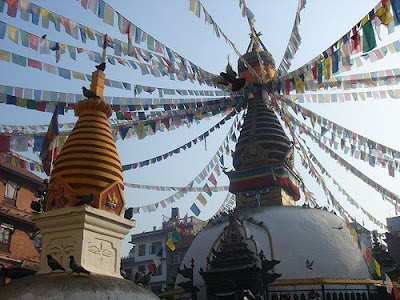
::At the foot of one of the four "Ashoka Stupas," Patan. It's believed that the Indian Buddhist emperor Ashoka had these four stupas, one at each corner of the Buddhist kingdom Patan, built during his visit. Patan remains a stronghold of Newar and now Tibetan Buddhists.


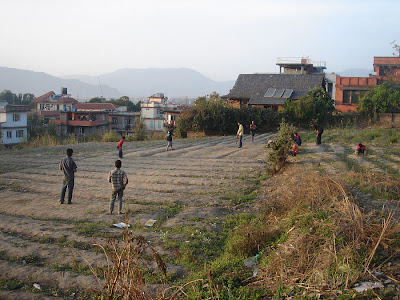
::Cricket game in a field near Pulchowk, Patan.


::Dorje or stylized "thunderbolt", representing the male creative principle, and a guy dressed like Cab Calloway at the Ashoka Stupa, Patan.


::Vintage Morris Minor car on Jyatha marg, Thamel.


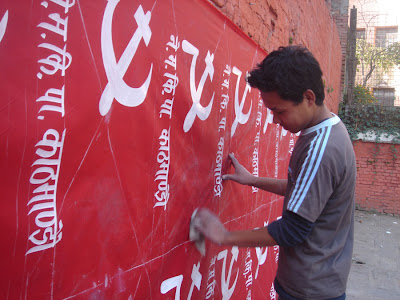
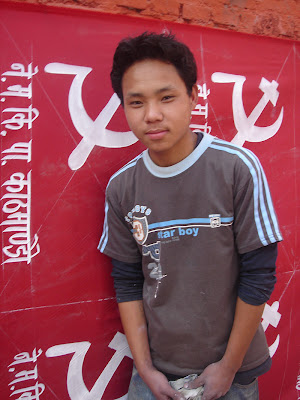
::This boy displayed the customary sweet, shy Nepali manners while installing a Communist Party Of Nepal (Maoist) poster at the public fountain in Thamel.
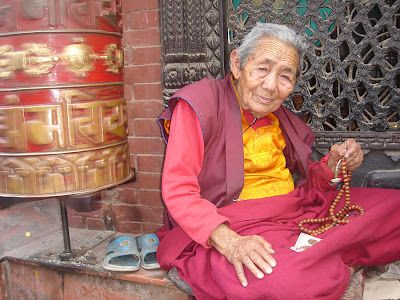
::A Tibetan nun who is always, always, always seated in front of the Ajima shrine at Boudha.

Thursday, March 20, 2008

Seeing red, and blue

Is that blood on your face, or just Holi colours?
Patan, Nepal

This morning, there was another attempted demonstration by pro-Tibetan protestors at the UN House in Patan. I didn't make it to the site in time (around 10.30 am).

An eyewitness who did make it, but asked not to be named, says it was very brief. The police acted so quickly in arresting the protestors this time that there was no violence. Basically, they just showed up (again in an attempt to deliver the memorandum, as below) and were immediately taken into custody.

When I arrived at Pulchowk, the street was still lined with dozens of Nepal's Men in Blue (police in riot gear). There will likely be no more actions for a day or so till their release of the Tibetan demonstrators - most of the leaders are incarcerated right now.

As I mentioned previously, Monday saw Nepal's most violent police intervention in a protest since the People's Uprising in 2006.

The latest I've heard about the Monday demonstrators is that nine were injured, including one monk named Tseten Dorjee who sustained serious head injuries. The wounded are dispersed between TU Teaching Hospital, Patan Hospital and Birendra Police Hospital. Above is a photo of an injured monk that appeared only in local paper the Nepali Times (not the "MSM"), so I will reproduce it here )(above). The photographer asked to remain anonymous.

The Tibetan protestors had been attempting to deliver a memorandum to the UN, requesting intervention in Tibet, when the Nepal police descended on them with not only bamboo canes but tear gas. Most of the serious injuries were from hurled tear gas cannisters.

Meanwhile, the UN themselves have issued a statement saying they did not request police "protection" from peaceful demonstrators and have or had no objection to receiving the petition. From what I've read, the Nepal police deny acting at the behest of Chinese Embassy, but I have yet to confirm that source.

On a lighter note, while on my way to the UN in Pulchowk, Patan today, I got splattered with a water balloon by a young Holi-gan who announced, "Happy Holi!" and ran away. What a coward, to throw it at my back. I actually felt a bit cheated that it was just a water balloon. Seems like a degraded version of Holi, just water instead of bright colours. I guess I should be glad it wasn't a teargas cannister.