Showing posts with label monarchy. Show all posts

Saturday, June 28, 2008

Cow palace

Where's Gary Larsen when you need him?
Kathmandu

There's a great Gary Larsen cartoon somewhere in this story, just waiting to be created.

The former King's sacred cows, left bereft of their Gaushala by the Children of the Revolution.

KATHMANDU (Reuters) - After the king, it is now the turn of his cows to face removal from Nepal's royal palace, two days after it was turned into a museum, a government official said on Tuesday.

Gyanendra, the last king of Nepal, left the main palace last week after a special assembly voted in May to abolish the 239-year-old monarchy and turn the Himalayan nation into a republic.

abolish the 239-year-old monarchy and turn the Himalayan nation into a republic.

But Gyanendra's 60 cows still graze in the sprawling grounds of the Narayanhiti palace in the heart of Kathmandu. He used the cows for fresh milk but authorities say the animals, considered holy by Hindus, must also leave.

"We can't keep them there and no decision has yet been taken about what to do with them," said Govinda Prasad Kusum, a senior bureaucrat in charge of preparing an inventory of palace contents.... "Maybe the livestock department under the ministry of agriculture should use these cows for research purposes," he said. Nepal, a mostly Hindu nation, forbids slaughtering cows.

Monday, June 02, 2008

Lost horizon

News from Uttarakhand & Kathmandu


I've been taking time off from blogging, worrying and other writing to compile some photos and paperwork for various photography festival submissions.

Meanwhile,

-Nepal's been officially declared a republic, The Federal Democratic Republic of Nepal. This followed the dramatic scenario, inside the Chinese-financed Baneshwor assembly hall, of the constituent assembly members taking oaths in their various "mother tongues." (It might be hard to appreciate the significance of this if you're not familiar with Nepali Khas Kuri nationalism and the old 'one nation, one king, one language' dictum),

-the King's been rumoured to have fled - some said to Nagarjun (another palace within a forest reserve on the edge of town), some said to Switzerland - then shown to still be in his counting house, presumably counting out his money from his various private business enterprises,

-six people were injured in small bombs around town last week (reportedly set by Royalist pro-Hindu nationalist parties)

-Angry protestors of many stripes thronged the palace gates just a few blocks away, insisting that the Monarchy's own dynastic flag be taken down and the National Nepali flag be hoisted. It was, though King G is still in da house.

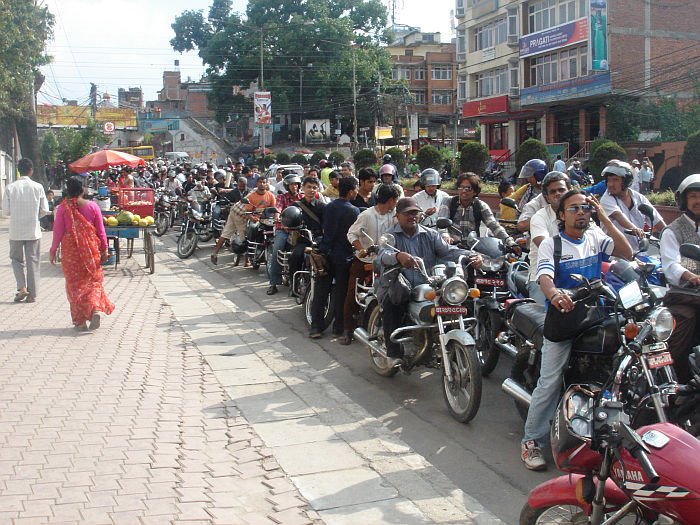
-Those massive assemblies in the road, three across and three hundred feet long (photo above), are NOT a National Pride Parade. These are hapless commuters waiting six, seven hours and more in line in the boiling sun - for petrol (gasoline). Naturally this is a boon for the very small micro-businessman (soda pop and bhel puri vendors!).

-And, of course, in good Nepali tradition, the "government" gave itself a three-day holiday in honour of its own ratification.

None of this, of course, really means that anything at all will necessarily change. My Australian friend just came from Immigration, where he was given an (illegal) 2-month visa just for paying 1500 extra Nepali rupees. He was approached by a tout ("agent") outside the Maitighar office, who asked him "did he need anything?"
He said sure, I would like to go into meditation retreat and not come out for 2 months, instead of having to return here every 30 days. The tout took him inside, where they side-stepped the dozens of waiting law-abiding visitors and went straight to the counter. Voila, sixty days. (No one ever approaches ME for such things. I guess I look like a budget traveler.)

The most appreciable change of Maoist influence, for a foreign visitor, is the prices. There is now a 10% added "service charge" on any venue (hotel, bar, restaurant) of repute (ie, any place clean enough for most foreigners to eat). This, combined with the pre-existing 13% VAT (value added luxury) tax, means you pay 23% tax on every freaking thing.

This is new as of 2008, initiated (so I'm told my several hotel workers and owners) by the Maoist-run All Nepal Hotel & Restaurant Workers' union. (Their symbol is a white knife and fork crossed, in the manner of the hammer and sickle, against a red field.)

Sixty-six percent goes to the workers themselves. Another percentage goes to the business owner, ostensibly to cover expenses incurred by the workers such as broken dishes. In this part of the world, that normally comes out of the worker's own pocket - business owners do not build in the concept of incidental expenses to their pricing structure. If you (or your waiter) breaks something, the waiter normally pays for it out of the $2 or so he makes daily.

The remaining 3% or so goes to the Maoist party.

Though I don't like making an enforced donation to the party, I have to admit, this is basically a good thing. No wonder the Maoists became so popular. After all, the Seven "democratic" Parties and the palace have never done a thing for the workers.

On the border
The Return March to Tibet has been halted in its tracks, by the Indian police, and is now regrouping on the Indo-Chinese border in the mountains Uttarakhand state.
This in and of itself was expected. What was not expected was that all the march's food and supply trucks were impounded, making it difficult to continue in this remote area. Also, many (if not all - a few managed to hide in the bushes!) of the foreign supporters/ demonstrators/ media crew were arrested and given Quit India notices. This means they have 10 days to leave the country or face imprisonment. Basically, they are being deported.

Again, I halfway expected something like this. What no one expected was the charge against them. The foreigners were arrested on grounds of "violating their tourist visa by participating in religious activity."

Religious activity?? Since when is that illegal for anyone, including tourists, to engage in within India, of all places?

In a strange move, at a time when the government is promoting “Come to India - Walk with the Buddha” to attract foreign tourists to Buddhist circuit in the country, five foreigners have been given Quit India notice to leave the country within seven days “for participating in a religious activity”.

And if it is, what about the thousands of Chinese, Japanese, Korean, Thai, Burmese, Taiwanese, Bhutanese, and Cambodian Buddhist tourists who throng to India every year to participate in religious activities? There are thousands more foreigners of all nationalities in the ashrams of Vrindavan, Puttaparthi, Pondicherry, Ganeshpuri and Amritapuri.
“On tourist visa, you cannot take part in a religious activity. If we allow that, you will have people coming here to propagate their religion."

((WHAT? oh, you can't take part in Missionary Activity! That's a horse of a different colour.))


".... It’s only for travelling and sightseeing, etc. So, they have violated the visa rule by participation in the march,” said Ashim Khurana, joint secretary (Foreigners) in the ministry of home affairs.
...

...However, legal experts Times of India spoke to said the notice in this case seems to be illegal. “The Quit India Notice is a very serious matter. It’s used sparingly only in such cases where the person is a threat to the national security.


In this particular case, it seems to be totally wrong, biased and prejudiced. There is no law in the country which prevents people, including foreigners, from taking part in a protest march or a rally,” said Shilpi Jain, a lawyer who deals with immigration and visa-related cases.

On the tourist visa application, you are asked your purpose. "Religious pilgrimage" is one of the boxes available. I always check this, and specify "attending Buddhist teachings" since it's always true, and is certainly something I can't do elsewhere in the world. (At least, not with the Dalai Lama and Karmapa.)

I figured that openly participating in political activity was contrary to the terms of a tourist visa - I'm sure it is in most nations.

But, if someone can be deported for partcipating in religious activity, it doesn't bode well for anyone in India - foreign or Indian nationals.

The Indian government appears to be willfully conflating "religious activity" with MISSIONARY activity. Perhaps they don't believe that foreigners, or more specifically non-Asians, can actually be sincere practitioners of anything but proselytizing.

Thursday, January 03, 2008

Family affair

Royal pain
News from south Asian neighborhood

It was a big week for South Asian politics. Bhutto's assassination, the capitulation of the democratic Nepal Seven Party Alliance to demands of the Maoists to somehow guarantee they will get rid of the monarchy (when previously they had promised to hold a referendum for the public to decide), and the first ever election in the now-former kingdom of Bhutan all would seem to spell change. So why don't I smell change?

Amid all the mourning of Benazir Bhutto and descriptions of her as a champion of democracy, her apolitical 19-year-old son has been appointed her successor. There are also reports that Bhutto "willed" leadership of the Pakistan People's Party to her husband Zardari, as though it were a personal possession. Which, let's face it - I suppose, it actually was.

When is a democracy not a democracy? When its leaders are appointed by non-democratic methods, for one thing. When heredity is 9/10 of the law; and yes, the same formula applies to the Gandhi-Nehrus and Thackerays of India, and many others.

Of course, after the elections of 2000 and 2004 were hijacked by our very own Bush dynasty, Americans aren't much better off.

An article from the Indian Express
explains the south Asian grafting of dynastic family structure onto democracy.

Royalism has been democratised in South Asia. In turning our backs on monarchy, we reinvent ourselves as republicans. But this is often a fragile and tenuous republicanism, as the political parties in our democratic polities are mini-kingdoms each with its own royal family.

My own observations: south Asians value stability over change, progress or principles. The continuity of heredity, with all the social expectations of a dutiful son or daughter carrying on the family legacy, is the best way to ensure that.

And, south Asian understanding of family as the most fundamental paradigm overrides any consciously learned, abstract concepts. When all you have is a hammer, everything you see looks like a nail. Unlike most of the west, where the individual is the basic unit, south Asian society seems to be irreducible to any unit smaller than that of the Family.

Therefore, because the current Nepali king was at first given benefit of the doubt, but has proven to be a rotten apple, the whole family has to go. Forget the outrageous Prince Paras who was always out of the question; there is no room to consider the well-behaved daughter or a regency for the very young Prince Hridayendra, grandson of the current king Gyanendra. They are not and cannot be seen as individuals; that's the whole point.

While the Nepali monarchy will suffer an uphill battle to retain even ceremonial kingship at this point, the Bhutanese palace is conversely struggling to encourage its subjects in baby steps towards the electoral process. Evidently most of the political parties were formed at the behest of the King - why doesn't that sound right? - following strict guidelines concerning the nature of such parties. "The king says we have to form some parties, I guess we had better" doesn't sound like a good start on democracy to me.

That other Himalayan monarch, HH the Dalai Lama, is not fareing much better encouraging his people to adopt democracy. He's been pushing the democratic process for decades; the government in exile has now elected a Prime Minister and other officers. In preparation for his inevitable passing, HH continually tries to delegate political tasks to these and other figures, hoping to train Tibetans to look toward other sources than himself for answers.

Within what are ostensibly republics in South Asia, thus, we remain at heart subjects rather than citizens, people who need and love royals....

Old habits are hard to break.

Tuesday, June 12, 2007

News From Nepal: (No) Business As Usual

The Waiting Land
Kathmandu, Nepal

Whew....after a nauseating taxi ride down the Himalayan foothills into sweltering Delhi, then a 2-hour delay at the airport, I'm back in Nepal, and it's business as usual.

Or perhaps, no business as usual. It's all an ordinary Nepali can do to get any work at all done, as various factions keep things churned up and out of working order.

And, did I mention the nation is broke, and out of petrol (gasoline)? They owe Indian Oil about 1 Billion (with a B) rupees. The joke is that all the strikes are an attempt to reduce gas consumption, since, in fact, we don't have any.

Popular support for the monarchy is at an all-time low (according to news polls). However, the current interim govt. isn't faring much better in the eye of the general public. The same polls showed abuot 59% of the public felt the new government was "same old, same old."

Improvements since I left in December: The Maobadis are no longer extorting donations from trekkers. They are having their own internal problems, what with the rebels rebelling against the rebel leaders. Now that the leaders are officially an enfranchised part of the Establishment, the field cadres don't feel so much solidarity with them - sweating in jungle tents while the Great Helmsmen ride in AC jeeps in the capital. As predicted here a year ago, they've begun to breakaway and form their own general hell-raising groups in the hinterlands.

Another plus: within the valley proper and from here to Pokhara, there are no more government roadblocks. That's because the conflict has shifted to the Terai.

....The Terai (southern Nepal plains bordering India) is becoming the Terror-ai. Literally every few days, there's some bundh (strike), curfew, demonstration, revenge killing or some damned thing holding up life and normal functionality there (and I don't just mean my ability, as a tourist, to travel freely- that's not so important). Ordinary people can't get to work and get stuff done. Stuff doesn't get delivered. Commercial transport from and to all-important commercial neighbor India doesn't go through. People,including the very large number of daily-wage labourers (who live for their next meals, get paid cash daily and get nothing for enforced strike days) go hungry.

The Northern border with China, ironically, is tranquil. Maybe all this agitation on the border is with the intent to rupture relations with India and force Nepal to be reliant on Communist China for damned near everything. What sort of person or party would want such a thing? A Communist party maybe? or even Maoist....?

....Tomorrow, Jimmy Carter is coming. He's been here before, on vacation to climb up to Everest Base Camp with Roslyn. This time, he's coming as an ambassador of peace, due process and proper electoral procedures. Nepalis seem to have an almost mystical faith in outsiders' ability to cut through the haze and bring some clarity to the situation. Interestingly, Carter will meet with both the Prime Minister Koirala and the Maoist supremo Prachanda - but not with the monarch, King Gyanendra.

Major peacenik groupie that I am, I will be camping out at Baluwatar to hopefully catch a glimpse of the man who's unquestionably our finest living President. ....
--Here's a link to a news story about the 2-day All Nepal Strike (during which, a bicycle cannot even move about freely) that was thankfully called off at the last minute.

Kathmandu, June 10 (IANS) After they went on the warpath in south Nepal's Kapilavastu district, calling an indefinite closure and attacking nearly a dozen vehicles, a Maoist group Sunday withdrew its protest following talks between their top leaders and Prime Minister Girija Prasad Koirala.

The controversial youth wing of the Maoists had enforced the indefinite shutdown in Kapilavastu, revered by Buddhists as part of the ancient kingdom where the Buddha was born and spent 29 years before leaving home in search of enlightenment, to pressure the Nepal Army into pulling out of the area.

Early on Sunday, the Young Communist League torched five buses and attacked seven more vehicles for trying to move out of the paralysed district under the cover of darkness.
...full story at
http://in.news.yahoo.com/070610/43/6gunr.html