Kathmandu, Nepal
This afternoon I witnessed 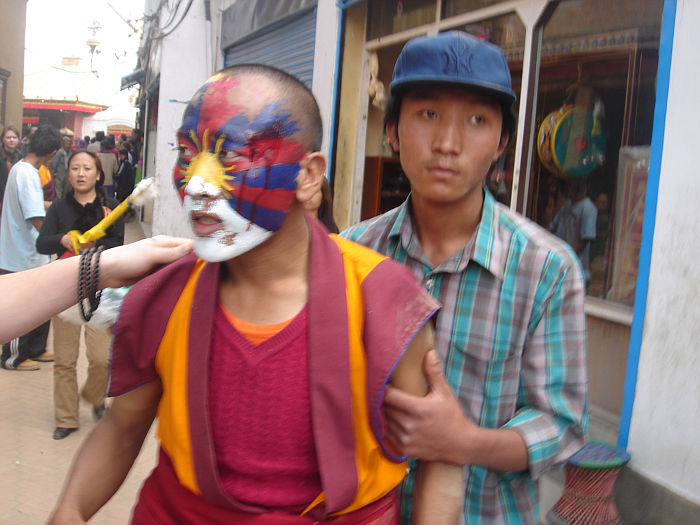 a Tibetan monk beaten, along with two other protestors, during a nonviolent anti-China protest at Boudha Stupa.
 a Tibetan monk beaten, along with two other protestors, during a nonviolent anti-China protest at Boudha Stupa.
 The three protestors were just standing (with Tibetan flags) at the stupa entrance, between the New Nyingma Gompa and the Ajima shrine, chanting slogans. Totally nonviolent. In fact, they were there for so long it got routine and I went off for tea.
When I returned half an hour later (about 3.30 pm) they were still there, chanting "Dalai Lama Zindabad," "Hu Jintao Murdabad," ("long live the Dalai Lama," "death to Hu Jintao"), "UN Where Are you?" "stop the killing in Tibet," and so on. They were standing on a Chinese flag that one protestor told me they planned to set alight. That's about as violent as they got, planning to burn a flag.
I looked down for just a moment to adjust my camera. Out of nowhere I heard a sickening thud and people start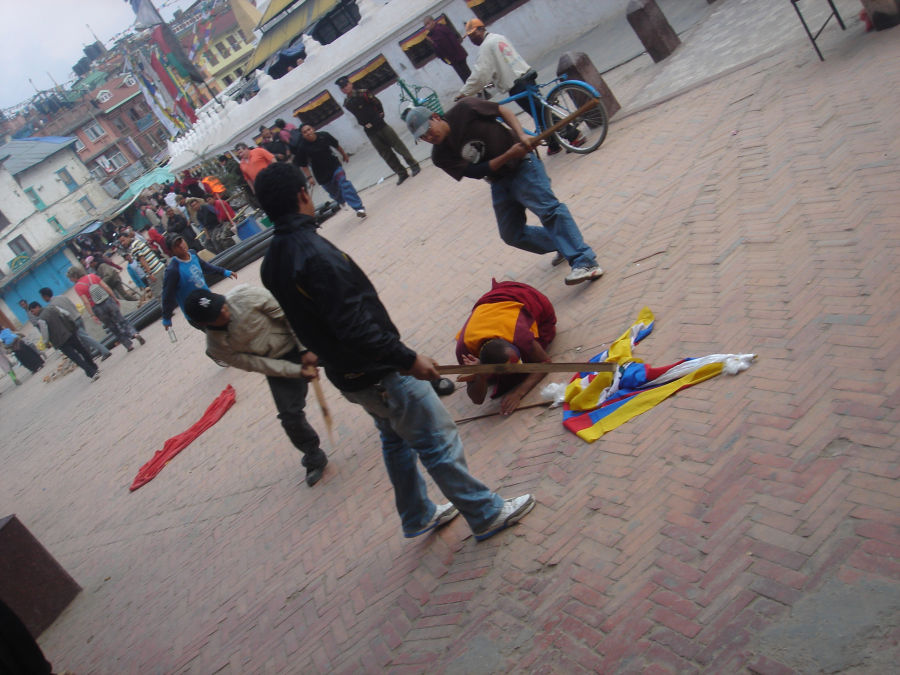 ed running. I ducked under the porch of the Nyingma Temple (figuring that if I had to, I could go inside - surely they wouldn't trash the monastery and shrine). The Nepali boys went straight for the one monk of the three protestors - -with large 2x2 wooden sticks raining blows.
 ed running. I ducked under the porch of the Nyingma Temple (figuring that if I had to, I could go inside - surely they wouldn't trash the monastery and shrine). The Nepali boys went straight for the one monk of the three protestors - -with large 2x2 wooden sticks raining blows.
 "Don't take pictures! Don't take pictures!" they yelled at anyone with a visible camera. Then, "This is not a place for protest! This is our God-place! Do not protest here!" in English. Which to me, sounded very rehearsed and conspicuous. In English? The attackers were local Nepali boys (from the Tamang community, if it matters).
Having a little sub-compact camera finally paid off as the professional photogs with their bulkier equipment were chased off and threatened by the attackers. I just stood behind a column on the mandap of the New Nyingma Gompa and snuck snaps.
The monk, his face painted with the red, blue, yellow and white of the Tibetan flag, lay motionless on the ground - I suppose he'd been trained to react that way to violence. The boys continued to whack him, with body blows to the back and front torso.
Some Tibetans tried to approach the monk to assist him. They, too, were attacked. A uniformed security guard, employee of the Nyingma gompa, stood by with hands behind his back.
Eventually the thugs disappeared and sympathetic persons could approach the monk. He was lucky they hadn't busted his ribs. The monk sustained only some bad abrasions to his face, which bled fluently through the face paint. Very slowly, with his friends sustaining him on either side, the monk began to walk. He must have had terrible bruises all over.
Two Tibetan helpers flanked the monk. I came over and suggested, "Shechen Clinic jaane." (It seemed better to go to the clinic of a local Tibetan monastery than to go to the Nepali-run hospital, which might not be sympathetic.) Slowly we all started moving down the unpaved lanes, toward Shechen.
Bystanders glanced up from their labour, looked aghast, clicked tongues and shook heads. The attackers had actually stooped to attacking a monk - a nonviolent monk. This was sure to rouse more anger in the community.
We were joined by another foreigner, a British man named Lewis. He had seen the whole thing too, and felt it important to accompany the monk and party down the lanes. It was less likely that the party would be attacked again if a couple of foreigners with cameras were walking beside them. (Indeed, the tradition of the sahib dies very hard.) Westerners are both assumed to be pro-Tibet and sympathetic, and simultaneously less susceptible to localized violence.
The fact that the attackers were local Tamangs confused me. Tamangs, a Tibeto-Burman people, share a language family, and more importantly, the same religion of Tibetan Buddhism with Tibetans. There are a number of Tamang monks as well as Tibetan in the area. Why would they attack the nonviolent protestors and monks?
When we reached Shechen, the doctor cleaned and dressed the monk's wounds. Luckily there was no serious injury. I took this chance to question the Tibetan compadre. The duo (and many other protesters in the area) turned out to be from Himachal, and came here with a coordinated group to launch nonviolent protests.
Tenzin and other Tibetans I spoke to believe the Tamang boys were paid by local Chinese contacts to carry out the beatings. They claim there have been a number of monks (at least eleven, according to the doctor at Shechen) injured in the same way, by local thugs on Chinese pay. It's true, there is a certain amount of rivalry between the Tamang and Tibetan communities - for one thing, the more recently-arrived Tibetans tend to be more prosperous and high profile. It's so sad that a bit of money and local rivalry could induce them to attack their co-religionists.
There were a few guys hanging round the Stupa who had "McLeodganj" written all over them. I cautiously approached them. One told me that there was another action planned for either the Chinese Embassy or the UN building in Pulchowk within the next hour, but they couldn't or wouldn't give a fixed time or place. The next time I looked, they had dispersed.
These days, there is a skirmish at the stupa every single evening. There is a routine march round the stupa Kora, or circumambulation path. After about 20 minutes of this, the procession attempts to leave the Stupa enclosure (a UNESCO World Heritage site) via the main gate. It seems a fitting symbol for the whole procedure - going round in circles, unable to find an outlet for their justifiable anger, then beaten back by local powers sympathetic to China.
Every night they are confronted by Nepali police in what's known locally as a "lathi charge" (raining blows with their bamboo canes, the subcontinental version of a billy club). The pro-Tibetan group is driven back (running, with that panic I know so well from a number of Indian stampedes) into the stupa enclosure.
I didn't see this, but in last night's skirmish several shops on the Main Road ("Boudha Tushal") were vandalized - bricks thrown through windows. Locals I spoke to claimed the shop owners were either Chinese, or locals functioning as Chinese spies, employees and sympathizers.
I'm waiting for a call from a photographer for Himal Media whose "stupa mole" will tell us if there's more activity tonight, but right now I'm exhausted.
Travel advice for Kathmandu: it helps to be white, and wear running shoes.


 Posts
Posts