Monday, April 14, 2008

Nepali Bhasha 101

Handy Nepali Phrases
Bhaktapur, Nepal


Nepalis are generally easy people (unless they are agitating for a separate Nepali-speaking state in Sikkim, I suppose....or unless they are extorting money from local businessmen....or sacrificing animals...or kidnapping wealthy Indians...or beating up Tibetan protestors. Okay, I'm out)

... well, what I was going to say before my generalization was so rudely interrupted, was "Nepalis are generally easygoing people and Nepali is an easy language to learn." It's like a softer Hindi, with all the sharp edges rounded off. Just put Os where Hindi has As, Cha or Ho where Hindi has Hai, Na where Hindi has Nahin, and the suffix -nus where Hindi has -jiye and there you go - you're speaking Nepali.

(Not exactly, but pretty close.)

Oh yeah, and to speak Nepali, you have to drop the obligatory bossy attitude of Hindi. And the nasality. You have to smile to speak proper Nepali. You have to look down your nose at someone to speak proper Hindi.

It's Nepali and Hindu new year, and just days after the election, the mood here in the traditional Newar town of Bhaktapur is just delicious. Today was the last of a luxurious week of holidays declared because of the election. The new year's tradition is to wear a brand-new sari or other outfit (for unmarried girls, that is anyone under 20, it's a new kurta-salwar set; for young men it's a WWF t-shirt and brand new stonewashed jeans) - wear your new new year's clothes and stroll around town arm in arm with family, chatting and stopping on the corner to eat homemade ice cream. (It looks homemade to me... I stick with the juju dahi or King's Curd for which Bhaktapur is famous.)

Naya barsha ko shubh kamana! will win you a lot of points right now. It means "happy new year."

First of all, you have to get used to addressing hierarchically, and as family. There is a definite pecking order involving age, caste and other status markers; but for foreigners, who this mostly means acknowledging seniors, peers and youth.

Elder men (elder to you) are addressed as Dai, or perhaps Kaka (uncle). A man your age or younger is Bhai. A very elder man is Huzoor-bho (respected father). Elder women are Didi (big sister), Kaki (auntie) or Huzoor-amma (respected mother) , very elder women are Ajima (grandmother), and young ladies are Bahinee (daughter).

"Huzzoor!" is the most respectful way to answer the phone or address an elder or superior. It just means something like, "respect." Otherwise, people normally say "Namaste" here to foreigners. People here actually say namaste and put their folded hands, up like praying. Only a few people in tourist places do that in India.

Let's start with practical things.

"Kalaam koti yo?" means, "how much is this ink pen."

Common numerical responses include "das rupiyah," (ten rupees)
"pandara" (pron. 'pundarra') = 15 rupees
"bis" (beese) = twenty
"tis" (tees) = thirty
Ek sau (one hundred) or Ek sau pachas (150).

"Mahango chha!" means, "your price is too expensive!"

"Duitaa (dwee-taa) kalaam tis rupiyah dinus." = Please give me 2 ink pens for thirty rupees.

"Shasto price dinus" = give me the cheap price.

The shop owner may counter with "Yo shasto price chha." ("This is a cheap price." To which you retort indignantly, "Shasto chhaina!" --(it's not cheap! )

Theek (pron. teak, like teakwood) chha! means, okay, all right or good!
Theek chhaina (pron. "chinaa") naturally means, "this is not okay." I find myself saying this more often than I would like....

and the classic Nepali phrase,
"Ke garne? " (pronounced "kay garnay")
means, "what to do?" and translates as, "I give up - it's someone else's job. " Or, "this is NOT going to get fixed or done today so relax and forget about it."

Dinus (deenus) is polite for "please give." Linus (lee-nus) is polite for "please take." In "street" Nepali these polite forms are little used - there are more truncated forms - but I prefer them. I figure as a newcome to the language I should be more polite.

Oh, that reminds me of the useful polite command forms, which usually end in -nus (noose).

Bussnus = Please sit. I often have to use this as shopkeepers tend to jump up the second they see you even look in their doorway.
Sodhnnus = please listen.
Bolnus = please tell me
Lekhnus = please write. And so on.

"Nepal maa, saarbhai jaan dehri ramro" = Here in Nepal, everyone is very good. Another diplomatic point-scorer.

"Taxi khali chha?" = is this taxi free?
Answers: Chha! (yes it is!)
Chhaina! (pron. chinaa) - (no it's not!) - and these are usually uttered with an exclamation point.
"Maa airport jaanchu" means, I am going to the airport.

"Meter maa theek chha?" means, "will you go on the meter?"

"Tapai ko naam ke ho?" = what is your name. But for children, you should use the diminutive "Timi lai naam ke ho?"

"Yo deva naam ke ho?"
is one I use all the time when visiting temples. It means, "What is the name of this deity?"

"Yo bus Bhaktapur jaane?" means, is this bus going to Bhaktapur?
Bhai, yahe (yahay) rokiyay is a polite way to tell your taxi driver "stop here, brother."

"Bholi parsi chhaina -- Ahilay! Ahilay!" is very useful indeed. ("Tomorrow tomorrow NO - TODAY! TODAY!)

"Tapai lai vetera malai dehri kusi lagyu" is "I am very pleased to meet you."

More practical ones:
Koti kero bundho garne? (what time do you close here?)
and
Koti kero kullchha garne? (what time do you open?)

Of course, you have to understand the answer - but everyone knows number up to ten at least. (Nothing opens before 10, or Das Bhaje.)

Speaking of which, it's ahht bhaje (8pm) and time to close here in sleepy Bhaktapur.

Thursday, April 10, 2008

Yes,no

Yes, the Nepal constituent assembly elections were held today.
No, so far there are no signs of "trouble" within the city.

Yes, it's been a week since I blogged anything.
Yes, I am having "problems" (mostly health related....horrible migraines and backaches).

Yes, five different bombs went off in the city of Kathmandu this week. I was a block away from one of them on Wednesday (in New Baneshwor. I went to renew my mobile account).

No, no one has been hurt yet in these bombings. They appear to be "scare tactic" mini-bombings - in Asia, if you really want to hurt someone it's not hard, it's a very crowded place. Wednesday's bomb was thrown from a moving motorcycle.

Yes, I am feeling really terse and headachey, so will sign off now.

No, I don't expect any trouble related to the election now...at least not for a few days. The trouble will start after a few days when the votes are counted. Anyone who comes out behind is going to "contest."

Thursday, April 03, 2008

Scenes from an embassy

Embassy embarassment
Kathmandu, Nepal


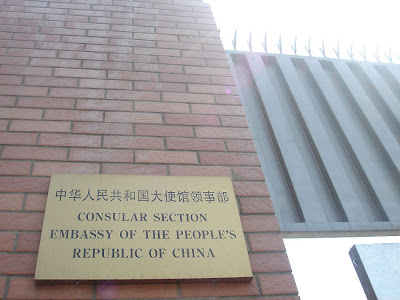
Pro-Tibetan Protests in front of the Consular section of the Chinese Embassy (Hattisar) had become an almost daily routine.

As of Tuesday the 1st, protests began in front of the actual Chinese Embassy building in Baluwatar (conveniently located down the block from the Prime Minister of Nepal's residence).


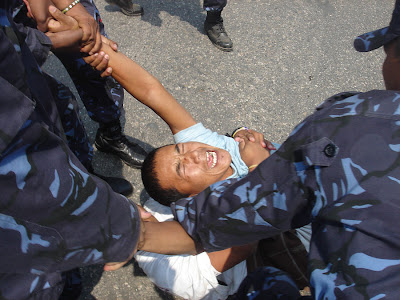
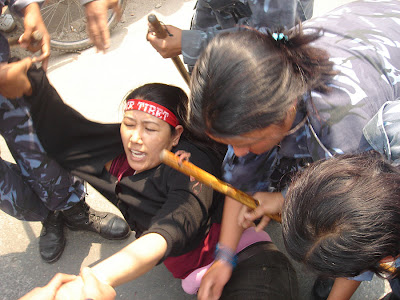
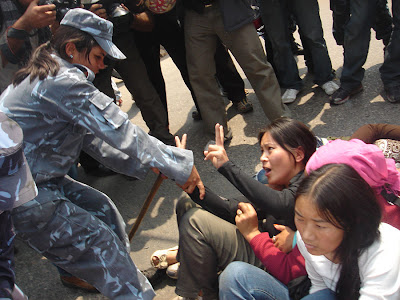
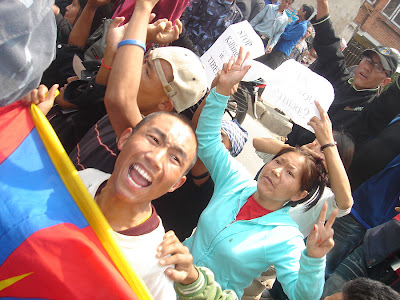
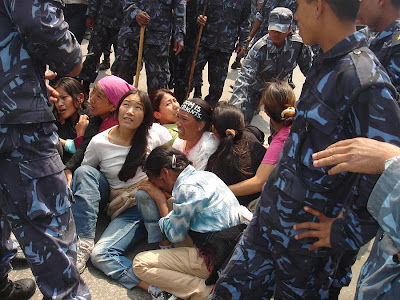
Here are some scenes from Monday's protest in Hattisar. Typically, the marchers approach the embassy's giant metal gates, holding banners and posters. The Nepal Police accost them, preventing them from approaching the gates. At this point the protestors sit down, "drop" or refuse to move, and the police drag them away.

On Monday, I noticed there were no monks in attendance. I asked a young English-speaking Tibetan girl about this. She, with her mother, was watching in tears.

"Some of them are monks," she said. "But they can't wear the monk dress. Police are arresting all monks and nuns on the road just for wearing the robes." So the monks were protesting in plainclothes. Indeed, I did notice quite a few protestors had the close-cropped monastic hair.


While the protestors shout and scream "stop the killing in Tibet, " "we want freedom in Tibet" and "Dalai Lama Zindabad" the police eventually apply the lathi (bamboo canes). Reporters and observers who'd been to many of the demos told me the police violence, while still including hair-pulling, even some face-punching, and lathi whacks, was actually reduced from that of a few days ago.


UN human rights observers in their trademark blue vests stood by watching. But they were denied entrance to the rooftop of a private house (next door to the Chinese Embassy) for better rooftop viewing. The Nepali homeowner said he "had been told not to" let anyone watch from the roof.

There were at least 2 dozen media members, both professional and amateur, in attendance, not to mention loads of ordinary Nepalis with cell phone cameras. Office workers peered down from the safety of first-floor windows while ground-floor shopkeepers slammed their metal gates shut.


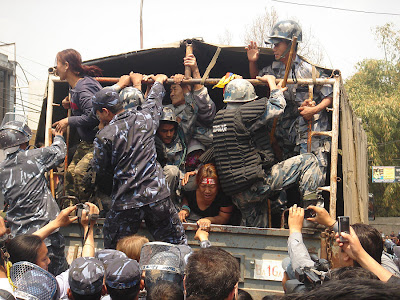
Protestors were piled into police vans and trucks, and taken to various police stations where they were jailed until nightfall.

Just when the police would drive off with a truckfull of screaming protestors, another scuffle would start up down the block, with another group appearing seemingly out of nowhere. This went on for about 2 hours - groups appearing, sitting down, getting rounded up and dragged off, trucked away then another small group appearing elsewhere.

I read one report that claimed "protestors attacked the Chinese Embassy." I find that hard to believe, as they are not allowed anywhere near the enormous metal gates of the compound.

Passing the torch

Updates - from....
New Delhi, India

April 17 is the day the Olympic Torch comes through New Delhi, on its way to Beijing. This will be a major day of protest action and here are suggestions from the March 10 Uprising organization on how you can get involved.

Already, one Indian torch-bearer (a Buddhist from Sikkim) has withdrawn from participation.

URGENT APPEAL TO INDIAN CITIZENS & OLYMPIC TORCH-BEARERS
Posted: 02 Apr 2008 05:27 AM CDT
When China ’s Torch Comes to India on April 17th - Speak out for Tibet .
We, the undersigned Tibetan individuals and organizations, appeal to all Indian citizens and, in particular, those people chosen to be Olympic torch-bearers, to speak out for the Tibetan people when China ’s Torch comes to India on April 17th.


At this critical moment, when countless Tibetans are suffering under a violent military crackdown by the Chinese government, we need to show that global citizens support the Tibetan people’s right to be free and to live their lives as they see fit.

The courageous actions taken by Tibetans inside Tibet over the past few weeks demonstrate that Tibetans have suffered unimaginably under a half century of Chinese rule. They are now risking everything and crying out for freedom. By speaking out when the Chinese government brings the Olympic Torch to India you will send a strong message to Tibetans, to the Chinese government, and to the world, that Indians support the Dalai Lama and the Tibetan people’s nonviolent struggle for freedom and justice.
There are so many ways for everyone to take action.

Torch-bearers can:- withdraw from the relay;
- wear a Free Tibet shirt or hold the Tibetan flag as they run with the torch;
- issue a statement in support of the Tibetan people before the Relay.

Indian citizens can:- join or organize a protest as the Torch passes through Delhi;
- wear a Free Tibet shirt or hold a Tibetan flag as the Torch passes by;
- plan a solidarity action in your town or city on April 17th.

As the Chinese government runs the Olympic torch around the world and attempts to whitewash its human rights violations and legitimize its illegal occupation of Tibet , tens of thousands of Tibetans and supporters will be speaking out to expose China ’s lies. Please join this global chorus of voices calling for justice for Tibet !

Wednesday, April 02, 2008

Mandala meanderings

Down in the Valley: Another Cultural Minute
Kathmandu Valley, Nepal
I haven't been meandering too much this trip....been in bed with a screaming migraine the past 3 days. But I would like to continue my Power Places of Kathmandu Valley series.
Tantric Hinduism was mostly wiped out or went underground in India, the land of its birth, centuries ago - by a resurgence of Brahmin orthodoxy and religious reforms. But it remained and remains alive and well in Nepal.
This has mixed results; the lovely sensual artwork celebrating human sexuality, along with the many bloody animal sacrifices.
The entire valley (and every city within the valley) is arranged as a mandala; that is, a ritual circular design with "power points" at key positions.
Here are my photos of a few more of the "Power Places of the Valley."

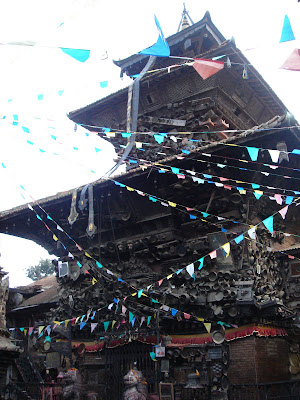
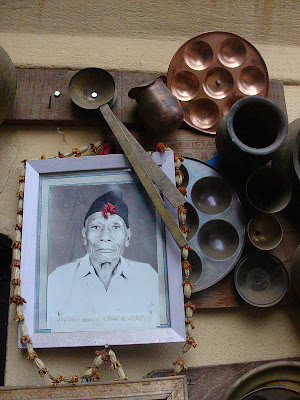
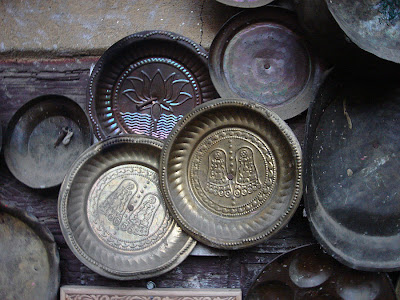
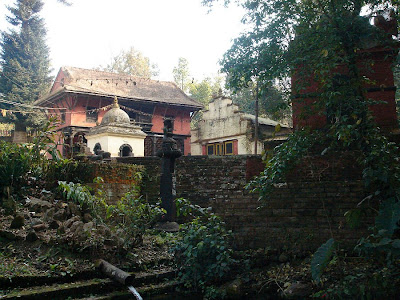
Chobar Adinath at first appears to be just another charming Newar style pagoda temple. But it's sacred to both Hindus and Buddhists, and inside the walls are covered with brass plates, pots, pans and photos of individuals. These are all homages to the deceased. The result feels very intimate; like being in someone's living room with the eyes of their ancestors peering down.


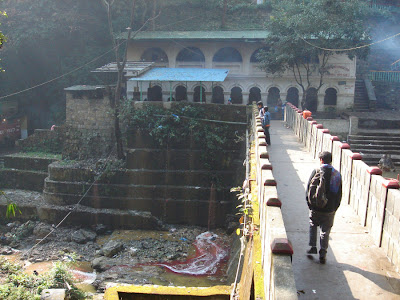
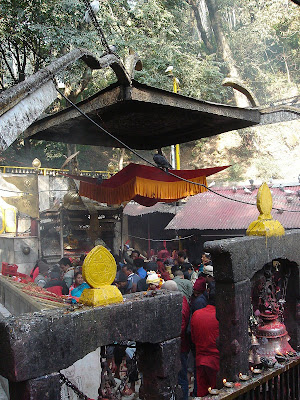
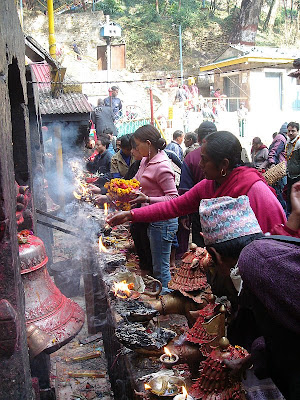
Dakshinakali, a Hindu temple located in a deep dark crevasse near Pharping, is the best known animal sacrifice temple, not only in Nepal but possibly in the world. It's not so much a temple building as a sprawling complex of bridges and platforms. Situated atop a small river, the water literally flows red most days (as you can see in the lower left-hand side of the river photo). Chickens, goats, sheep and so on are sacrificed by the dozens daily. Creates a powerful aura, but be prepared.

The hills and woodlands surrounding the grotto are strangely peaceful, green and beautiful, and if you climb to the hilltop, a quiet, less bloody Goddess temple awaits you. In general Dakshinakali is certainly a powerful antidote to the popular ideas of Hinduism as a nonviolent religion.


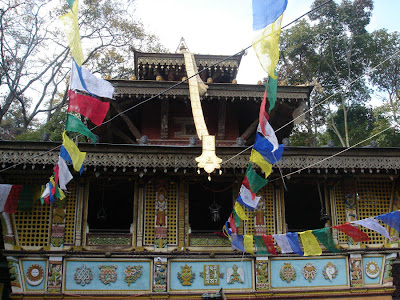
Pharping Vajra Yogini is just about the polar opposite, vibrationally, of Dakshinakali. It's a hillside temple to a Buddhist goddess, and unfortunately doesn't allow photos of the main deity figure. But the wooden pagoda structure gives a welcoming, cottage ambience, so that you really feel you are visiting the "house" of the devi. The Vajra Yogini is a very prominent figure in the region so if you are looking for the Vajra Yogini temple, be sure to specify which one - there are several.

I could never get a photo that managed to capture the serenity of Pharping Sesh Narayana, a Vishnu temple which is nearby the Vajrayogini and up the road from Dakshinakali. Again, it feels more like a charming collection of cottages, surrounded by a goldfish pond and placidly grazing cows, than any formal house of worship. It's a very enchanting location. The small waterfalls and pools seem appropriate for a temple dedicated to the reclining "Adi Sesha" (ancient serpent) form of Lord Vishnu.


Time to go eat dinner. I guess there will have to be a Power Places Part 3.