Friday, December 07, 2007

Uncommon ground


Democracy inaction
Leh, Ladakh

I spent several hours today talking with Abdul Ghani Sheikh, a Ladakhi Muslim writer, scholar and historian. He and his wife were extremely generous with their time (and with their namkeen tea and biscuits).

Our interview was delayed by a half hour because of a forced strike called throughout Leh. Coming into town I noticed every single shop was closed and shutters "downed." Only the Aluya restaurant had been "allowed" to stay open.


I asked one person if it was a "holiday," and they said yes. (People will just say anything to foreigners. ANYTHING at all to get you out of their face. )

Then I saw the riot police with their helmets, lathi canes, guns and bamboo riot shields (yes, here riot shields are made of bamboo). I asked them if it was a political strike. They also said yes.


Some holiday!


In a nutshell, the various factions of the Ladakh Buddhist Association are having a schism/war/leadership dispute and today was Faction B's turn to shut down the town. Last week Faction A had their chance.

When all the shops are shut, one must not mistake that for support of a cause or even interest in a cause. The shops are essentially forced to close by operatives of whatever political party wants to make a statement. Any shopkeeper not complying is threatened.

That way, there is no competition from business or socializing, and townspeople are essentially forced to either stay home or attend the "meeting" most of them care little about. As Jon Stewart would say, Democracy Inaction!

Mr Ghani Sheikh said, "The shopkeepers hate it, the people hate it. They lose business, they waste time this way. But it has become so common, now they are used to it. They just accept it as part of life now."

In Kathmandu, Kerala and Calcutta, this would not come as a surprise. But "even" quaint, Buddhist Ladakh has become overly politicized ground.

Her Holiness?

When I finally drag my cold feet outta here, which looks like it will be December 12, I will be on my way (a very long way, via Dharamsala, Delhi and Kathmandu) to see HH Dalai Lama in Mundgod, Karnataka at the famous Drepung Loseling Monastery. In the meantime, I keep up with the Lama Watch.

The photo below was taken (by me) at Annual Teachings last March in Dharamsala. Most of the old lamas (and some of the younger ones) seated on the platform near the Dalai Lama are also reincarnated lamas, or Tulkus. So when the Dalai Lama looks like he's greeting an old friend, he is possibly greeting a very, very old friend (like, through lifetimes).

Here's the latest:

News from Milan, Italy via Leh, Ladakh
MILAN: Tibet's spiritual leader the Dalai Lama on Thursday suggested that his successor could be a woman.

"If a woman reveals herself as more useful the lama could very well be reincarnated in this form," the 14th Dalai Lama told reporters in Milan, where he arrived for a private visit on Wednesday.

full story here.

But the visit was not without its political complications, as usual

...The Buddhist leader also said his 11-day visit to Italy was "not political" and that he did not intend to "cause problems for the state and the (Italian) authorities."

Beijing has complained to the Italian foreign ministry over the visit, which will take the 1989 Nobel peace prize laureate to Rome for four days from December 12, even though he will not meet with any members of the Italian government.

A planned meeting with Pope Benedict XVI was cancelled, in a decision that Italian media reports said facilitated the ordination on Tuesday of a new bishop in Guangdong, southern China, with the Vatican's approval.

Wednesday, December 05, 2007

A few of my favourite things

Apple cheeks and dried apricots
Leh, Ladakh

This morning I heard drums outside the guest house. Tsering said because it is the first day of Ladakhi Losar (the New Year celebration which ends on the 10th), the traditional drummers are making the rounds.


Ladakh has its own sort of Buddhist caste system, and musicians are a distinct group known as the Mon. Dancers, singers and musicians used to be a separate caste in most parts of India. Tsering said they go around playing the daman (drum) and surna (a kind of clarinet or shenai) in every neighborhood asking for money.


"In the old days," he said, "we used to give only tsampa (barley) powder, chappati, food, like that. Now we are expected to give some cash," he smiled. How much? "Oh, ten, twenty rupees, like that." So it's a bit like Ladakhi trick-or-treating.


The little things
I'm looking to fly outta here in the next week or so. Strangely, it is the same fare to fly to Jammu (and take the bus to Dharamsala) as to fly directly to Delhi.

Suddenly, all the signature little Ladakhi things I have come to take for granted for the past three and a half months are now jumping out at me. Even just sitting here typing and looking out the cybershop window, I see so many "little things" that are (perhaps unfortunately) Only In Ladakh.

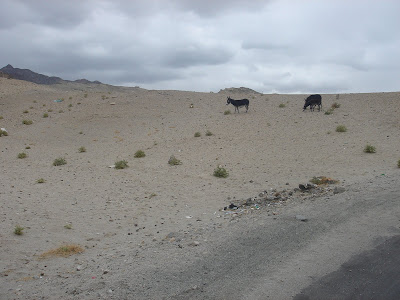
-a single file line of fuzzy grey donkeys, their colour identical to that of the surrounding mountains, trudging slowly up the street in search of some prime scavenging. They always remind me of the manger scene in the Christmas Story.
-Bright new private school buses full of immaculate children in maroon blazers with matching knit caps, which match their apple cheeks. (The government school students and their buses don't look quite as new and shiny, naturally. Same healthy apple cheeks, though.)

-Delivery trucks whizzing by with letters hand painted in both blocky English and flowery Urdu script

-NO beggars on the street. This is not necessarily "only in Ladakh." Yes, I have certainly been in plenty of other small Indian towns, particularly in the South, that also have no beggars. But this is downtown in a major city - that is unusual.

In fact, there are a few beggars here in the summer time (high season for tourists). They all come from outside Ladakh, and they all move on (following the tourists) in November.

-Almost NO child labour to speak of. There are a (very) few under-16s that are working. I noticed that all of them are from Bihar, Nepal or UP. The brief conversations we were able to have (in my bad Hindi) confirmed this.


There is a 14 year old "doing for" Mr Yassin's auntie. He sleeps in their hallway. He stands out among the Ladakhis like a palm tree in New England maples. When I asked him "kahan se?" he said he is from a village called "Goondar" in Uttar Pradesh. He may even be younger than 14. He still hasn't lost his sweet, shy smile.

Though I don't envy his life, I have to think he's better off here than labouring somewhere in his home state. It's just a much gentler place in general. How else can one explain the Rajasthani shoemaker who has set up business on the corner with his two tiny children - one girl, one boy? It must be unbelievably cold for them here. I would love to find out what drove him so far from Rajasthan and what keeps him here.

-Bactrian Magpies- enormous black-and-white birds, the size of large crows but prettier, and native only to this area.

-Young Kashmiri and Ladakhi Muslim men, all with full beards and wearing the Kashmiri poncho-type overcoat, pushing the water dollies up and down the roads.

-Old men and women selling baskets of dried apricots -- with faces that look also like dried apricots. Also, classic-looking elder men sitting in the afternoon sun in front of the mosque, with faces, hats, beards, and robes that bring to mind romanticized images of Silk Road traders.

-Glancing upward from almost anywhere around town and seeing the 400 year old Leh Palace originally built by (or rather, for) King Singge Namgyal. It's like a little mini-Potala just minutes away (in fact it is said to have been modeled on the Potala. Another version I heard said the Potala was modeled on Leh Palace!) (the Palace photo above is from Wikipedia).

Higher still is the Tsemo Gompa, looking like a kid's bucket sandcastle after a wave hit it. A lone monk still climbs up once every morning and evening to look after the shrines and light lamps in the crumbling former monastery.

I have climbed the hill (in Tamil Nadu they would call it a mountain) a few times, and can only imagine what it was like hauling the bricks up there...400 years ago.

-Moonlight bouncing off the snowcapped mountains that surround the city

-Hitchhiking (still acceptable, common and safe here) . Distances are vast, and it's rare that a driver does not stop. Sometimes on a deserted road, drivers even stop voluntarily to ask if you are "okay." (No, it is not just because I am a foreign female - almost everyone thumbs a ride here in Ladakh.)

-Cheerful, confident women of all ages striding down the street, unaccompanied by men, with none of the "please don't hit me" body language shared by so many Indian women.
The young ladies coming home from school wear crested school blazers, baseball caps and slacks; older married women wear full-skirted gonchas with embroidered Kashmir shawls draped elegantly round their shouders. Unmarried young women wear Indian salwar-kameez, sweaters and shawls. They seem very uninhibited in their movements.

-Single women running businesses, including restaurants, all on their own. No men in sight. No one says anything, no one hassles them, and nobody blinks an eye.
-The hum of the noisy red kerosene generators. Since there is no power during the day, a few choice businesses have these alternative sources of power, which is the only reason I am typing now!
-Big piles of fur lining the sidewalks, in the form of peaceful, sleeping street dogs. The Leh Street Dog Program (sponsored by a French NGO) has taken care of many of them. It's so nice to see street dogs with healthy, fluffy fur - *not* riddled with mange and other skin diseases. They generally seem much less hassled than street dogs elsewhere.

You can identify the rabies-inoculated, spayed and neutered street dogs fairly easily. The Program takes a small triangular notch out of their ear, while they are still under anesthesia.

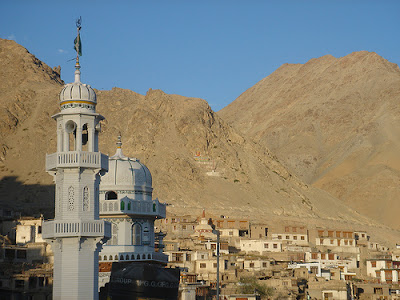
-The call of the mosque's muezzin, reminding the faithful to attend prayer 5 times a day. Since there are 2 major mosques here (Sunni and Shia), we actually hear the muezzin's call 10 times a day....the Shias go first, then about 15 minutes later we hear the Sunni muezzin. It's not always the same guys doing the call and some definitely sound more practiced than others.

There is one guy who gives his "call" at about 5.30 AM. Since I don't always get up that early, I have only heard him a few times....but it is worth getting up for. He really puts some artistry into his morning songs. To hear this as the sun is rising over the mountains is a cherished Ladakhi memory.

-The wicker baskets (actually woven willow) used by the women to carry vegetables on their backs, to and from the Bazaar market.
-Having total strangers, including little kids and old women, say "Jullay" on the street, with a big smile, and just keep walking. Unlike a lot of other places, they don't want anything...not to sell me anything, or "one pen please." They are just being polite.

and last but not least....

-only washing my hair once a week. It's so cold, no one is looking and I just throw a hat on it every day, anyway!
Monday, December 03, 2007

Real Kashmiri Kawa

The MilkMan Cometh
Leh, Ladakh
This morning, I rounded the corner from my guest house and came face to face with what looked like a Depression-era breadline.

A big "lorry" or truck was parked in the main street, almost in front of the Buddhist Gompa. Two lines of people snaked out behind - one for women, the other for men. (This is "normal" in India, but it's the first time I had noticed such line segregation in Ladakh.) Everyone - grandmothers, small children in school uniforms and so on - was holding every kind of vessel you could possibly imagine. Plastic pop bottles, stainless steel "tiffin" containers, old plastic jugs with handles, and so on.

It was the dudh-wallah, or milkman, or in this case milk men. Men inside the covered truck bed dipped into old-fashioned metal milk cans, the kind Americans now think are quaint decorations for their front porches. Then they poured opaque white liquid into each container.

The lines were long (probably forty people in each line) and the process slow. Everyone was bundled up in a cross-cultural mix of cheap down vests, knit ski hats, woollen goncha robes and running shoes. The painted side of the blue-and-white truck said something like, "Ladakhi Valley Milk Concern, Chuchot Village." Chuchot village is about 1/2 hour away by bus.

I had already noticed the absence of milk in many stores. You can often buy the government-issued homogenized milk ("Amul Taaza") which comes in a plasticky box. For travling and for emergencies, which are frequent, there's milk powder (like Carnation instant milk). Also, the abi-les (grandmothers) who sell vegetables on the Main Bazaar sell milk in old plastic mineral water bottles. (They also sell blue kerosene the same way; hopefully they don't reuse the bottles for milk.)

I joined the women's line and started snapping photos. Actually, the men were much happier to have their photos taken. It's funny, before a certain age (before puberty) and after a certain age (maybe after 50), it is more "okay" to photograph women and girls. During the reproductive years, they feel obligated to be more demure.

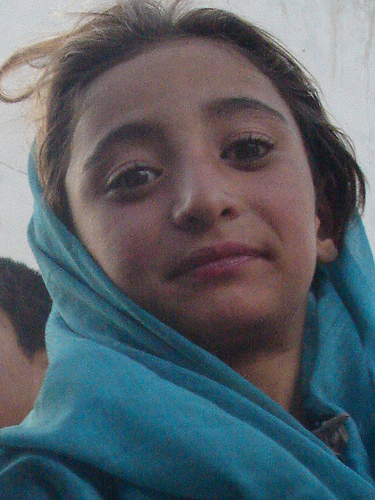
On the sidelines were three adorable little Muslim schoolgirls with green uniform crested blazers, book bags, and white headscarves. The headscarves somehow make them more beautiful - like a frame for their faces. The little ones were being shepherded by an older (teenaged) girl in the same attire.

I squatted down to their eye level and asked if I could photograph them. "Photo thik hai?" They agreed, but didn't look very comfortable. They are so serious in these photos... most of their natural beauty is hidden behind a sort of grimace. (!) I think more time is required to gain their trust.

I asked the older girl if I could then photograph her. "Sorry, no," she smiled. She looked sincerely regretful. All the girls had that handsome combination of Mongolian, Central Asian and Indian features, along with pink-white wind kissed cheeks, that adds up to uniquely "Ladakhi."
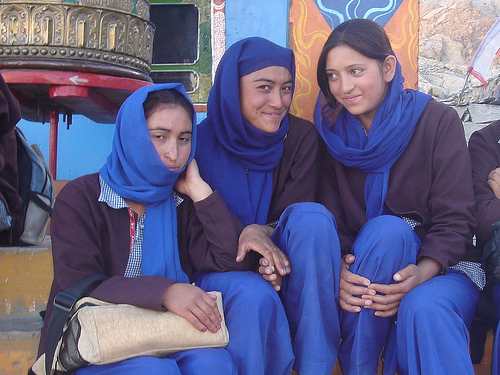
The girls in the photo above live in the Nubra Valley near Hunder. They were waiting for the school bus home. Now that I've gotten so many "nos" to photo requests, I feel extra lucky to have this beautiful picture.
Call for Kawa
I mentioned Kashmiri kawa before. It's a regional hot tea drink made from - depending on who you ask - saffron, green tea leaves, cinnamon, cardamom and almond. You can go into three different tea shops and get three different versions of Kawa. I have been served Kawa that ranged from an uplifting, exotic brew to what was just obviously black tea with a bit of cinnamon. Another shop (run by Tibetans) served hot water with crushed almonds and a few leaves of saffron - but no tea.
So I decided to ask Mr Yassin, owner of the TsoMori Hotel, what was REAL Kashmiri kawa. Mr Yassin is a Ladakhi Muslim whose family have roots long ago in Kashmir proper.
"Kawa is a special leaf," he said with animation, even a bit of vehemence. "Only one, two shops in the bazaar are selling this now. You go to that main general store, in the big burlap bags, there they are selling."

So Kawa is not green tea or black tea? "No, Kawa is Kawa. It is a special kind of green tea that comes from Assam, but it is not ordinary Assam tea. Long, twisty leaves, they look like snakes."

How do you make real Kashmiri kawa?

"You take the kawa leaves, the cinnamon bark and the elaichi (cardamom pods), and sugar, and boil them all together. Then you strain it into the glass of course."

What about the saffron, the famous product of Kashmir?

"After straining, you add two, three leaves of saffron. Enough to make the colour golden yellow. Then you crush the badam (almonds) and drop them in the glass.

It was important, he said, to brew the first three elements all together - if added later, the spices wouldn't give enough flavour, and the sugar wouldn't melt properly.

Though I am typing now with gloves on, my fingers are stiff with cold. I would love a glass of Real Kashmiri Kawa. Even a fake one would do.

The Chinese Province of Nepal ("Autonomous Region")
You read it here first. I predict this will be a reality within 10, 15 years.
Nepal has long been squashed as a little Switzerland country between two giant, billion-person superpowers (the "yam between two boulders" syndrome), playing China and India off one another, with varying bits of success and failure.

With the growing influence of the Maoists (mostly growing for lack of a better alternative), the fence-sitting scales appear to be tipping Northeastward.
Last month Nepal government announced they were dashing the hopes of Tibetan refugees now living within Nepal by refusing to cooperate with a US plan to offer 1,000 of the refugees asylum in America. To quote the news story:
China says there are no Tibetan refugees, only illegal immigrants who should be punished according to the law of the land.

Now Nepal is actually inviting the famous/notorious Tibet Railway - widely recognized as a major factor in diminishing Tibetan presence within Tibet itself - to be extended to Nepali borders. I think Nepal thinks this means greater access to Chinese goods, and with that, greater ability to tell India to shove off. In your face India! Nyaah Nyaah Nyaah!
What it really means is greater infiltration of Chinese people. If they need proof, they can just ask any of the Tibetans now living in Nepal what it's like to be such close "friends" with China.
Not only that, but China itself, which had previously disdained the Nepali Maoists as not proper Maoists, are now taking a special active interest in Nepal.
A high-level Chinese delegation which is in Nepal to assess the latest political developments, held a series of meetings with the political leaders. The seven-member team led by central politburo member of the Chinese Communist Party Wang Ziarui, on Sunday met the senior leaders of the Communist Party of Nepal (UML) and discussed the prospect of transforming Nepal as a "socialist nation".
China's claims to the Tibet region are based not only on supposed historical precedent ("it used to be part of China") but also cultural affiliation. Since Tibetan culture, according to them, has "always been" part of Chinese culture, logically they will lay claim to every area where Tibetan culture still survives, that has a convenient border with China. That means:
-within India: Arunachal Pradesh (birthplace of the 6th Dalai Lama), and Sikkim. According to an Arunachal Member of Indian Parliament, there are already Chinese troops inside Arunachal.
Ladakh is extremely well fortified now - after the Chinese made their point by commandeering Aksai Chin a few decades ago.
-Bhutan (there have been reports for the past several years of Chinese troops "accidentally" crossing the Bhutanese borders). Since India provides most of the muscle behind Bhutanese infrastructure, this would, for practical purposes, be equivalent to invading India.
-and of course, Nepal, particularly the remote Mustang region of Nepal (sometimes called "Little Tibet") where Tibetan Buddhist culture has survived, mostly unchanged, for centuries.
Some well-meaning European tourists this summer asked me about the heavy military presence in Ladakh. "Is it really necessary?" My answer: "Have you met the neighbors?"

Saturday, December 01, 2007

In the realm of a dying sun

Freakin freezin
Leh, Ladakh

The sun finally came out today, after 2 days of freezing grey watercolour skies. By the thermometer, it doesn't look so cold here. But remember, there is no running water, and no heating (unless you want to pay and extra $10 a day to have a propane heater placed in your room). The electricity is out all day long these days...no electric at all until 6pm. It cuts off again at 11pm. Evidently there's no insulation in the buildings (they are built like barns). ALL of the available heat comes from the Sun.

I only bathe every three days, or so. This is not as gross as its sounds. For one thing, it's impossible to sweat in this cold. For another, every "bath" has to be pulled up from the well (by the guest house employees) in a bucket, then poured into a vat on the propane stove for heating, then poured back into the plastic bucket and carried up to my room. Because this water is boiling, a bath requires yet another bucket of cold water (also drawn by hand of course) to be mixed to make bathing temperature water.

Then there's the ordeal of actually getting my clothes off in the freezing room. Baths must be taken while the sun is shining (if possible). After dark, it is just an invitation to pneumonia.

Don't ask about laundry.

Elemental
It reminds me of the April I spent in Tamil Nadu (never again!). When the power went out, of course, the fan went with it. I put a straw mat out on the terrace and prayed for wind from the nearby Bay of Bengal. It was easy to see how the elements became gods, long ago. The Wind God would be very, very welcome in Tamil Nadu. The Water God is frequently invoked all over India. And most of the hymns of the Brokpa people (the people I went to visit in Dha Village last month) begin with praise to the sun. Makes perfect sense to me!

Spruced up

Today the Main Bazaar is a bustle of colourful activity. It's nearly the Ladakhi New Year, or Losar. Shops that had been shut for a month are now open for holiday browsing. On the city streetcorners, young Kashmiri men sell piles of juniper branches to elderly Ladakhi women with grey braids. Fifty rupees a branch - pretty steep! I think I'll pick my own juniper.
Juniper is necessary for the rooftop shrine. Every Buddhist household has a rooftop shrine that looks like an evergreen bush, with khata or white scarves tied around it. Each year at the Losar New Year, a bunch of fresh juniper - considered cleansing and protective - must be installed on the household rooftop shrines. I don't know for sure, but am pretty confident that this must be accompanied by chanting, incense and other ritual.

Of course, putting a juniper branch on your roof to absorb negativity has nothing to do with Buddhism "proper." It is a pre-Buddhistic regional folk custom, like so many things in Tibetan Buddhism.

Fortunately, I will be here on Dec. 4 when Losar begins so "my" family - Tsering, Dolkar, Rinchen, Dorje and the two Angmos - will let me in on the fun!

Losar here in Ladakh runs from 4 December to 10 December.
Most of the Tibetan Buddhist community celebrates Losar in February. There is an historical reason for the early Ladakhi Losar. One of the ancient kings wanted to go to war with a neighboring kingdom. All the court advisors said that war should not be declared during the current year. So the king, being the king, decided to move the New Year forward so that when festivities were finished, he could go ahead and fight.

It's good to be the king.