Sunday, May 28, 2006

Smelly Delhi

Smelhi Delhi?

Just arrived in Delhi 3 hours ago on the sleeper bus from Rishikesh, and am typing on a honky-tonk crappy keyboard in Paharganj ("Pahar-Grunge"), the backpacker ghetto. It is really grungy. Kind of place a guy sits on top of his cycle rickshaw, horks his throat, spits right at your feet and says "rickshaw meddem?"

Lots of garbage with lots and lots of cow nosing through it, etc. (How come Delhi has soooo many cows, more than smaller towns like Pune?)

Just passing through Smelhi Delhi to get my contact lenses, new camera lithium battery and then the bus to the Nepali border. Maybe a few photo-ops of striking medical students.

Saturday, May 27, 2006

Viewer Mail

Fan mail from some flounder?
Laxman Jhula, Uttaranchal

Someone (okay, it's Vipin, the guy who runs
Red Chili Adventure rafting, trekking and cyber-joint) is playing a techno version of "House of the Rising Sun." Just when I thought the music couldn't get any worse, they switched to Simon & Garfunkel.

Ahem.

Last week, I got a lovely letter from a fellow Tennessean
(Go Big Orange!) (yes, I am from Tennessee. No, I do not have a moonshine connection) asking about travel in South India. I've tried to reply to her email twice, but it keeps bouncing back Returned. Not only is Melanie from Tennessee, she's actually from my hometown, Chattanooga (this is your cue to start singing "Chattanooga Choo Choo." It happens everywhere, from Finland to Delhi).

So, in hopes that Melanie will tune in again to the blog, and in hopes that it might help someone else, here's her letter and my reply.

My name is Melanie I'm a good Southern stay at home Buddhist mommy with 3 kids living in Chattanooga. Ok, so maybe my family is a lil odd.

Anyways I'm typin you because my Dh may be goin to Bangalore or Chennai, for work a 2 week trip. How far how difficult is it to get to Sera (Sera Jey Tibetan Monastery)? I see you have been. It would be great if he could also go, is Dreprung anywhere near? Thank You for your time.


Melanie is asking about visiting one of the many Tibetan monasteries that have sprung up since the 1959 exile of the Tibetans fleeing the Chinese invasion. (People often mistake this event as having been part of the Cultural Revolution, but that was years later - 1966. The Tibetan invasion was a good old fashioned rape and pillage invasion.) The major Tibetan monasteries were destroyed, and here in India the Tibetans recreated them, naming them after the originals. In Tibet there was a Sera Jey, a Sera Mey and a Drepung Monastery in Tibet - now their counterparts are in India.

The largest Tibetan population outside Tibetan borders exists not in Dharmsala, famed residence of His Holiness the Dalai Lama, but in Bylakuppe, a small village in misty green foothills of Karnataka tea-growing country. When the Tibetans were relocated here in the early 1960s, it was completely undeveloped. Many Tibetans died from the heat, humidity and subcontinental diseases to which they had no resistance. Over the decades, it has become a corner of Tibet in southern India. Here you can escape the manic quality of Indian life, where you are surrounded by maroon-robed monks sipping steaming glasses of butter-tea and speaking very little English.

Dear Melanie:
Welcome to India!

While I'm not sure what a Dh is (to me, it stands for Desperate Housewives), I will be glad to assist you.

Yes, Sera Monastery, in Bylakuppe, southern Karnataka, is accessible from Bangalore - in about five hours; from Chennai, about fifteen (train from Chennai-Bangalore is 5 to 7 hours; or just go direct to Mysore and follow below).

"Sera" is actually two institutions - Sera Mey Monastery and Sera Jey University, where monks study for their Khenpo degrees. It's only 3 hours from Mysore, but you'll feel for all the world that you're in the Himalayan foothills.

From Bangs, one must first go through Mysore, where you can catch a bus to BYLAKUPPE or KUSHALNAGAR, the nearest towns to Sera Monastery. (You might be able to get a direct bus to Bylakuppe/Kushalnagar from Bangalore bus stand, but it will go through Mysore). I recommend combining Sera with a day trip to Mysore if possible. (Check out the Maharajah's palace, Chamundi Temple, Devaraj Market. Warning: the Palace is under siege - by some of the worst hawkers imagineable. They literally chase you down, carrying beads, trinkets, postcards and such. I had to tell one, "if you don't leave me alone, I will hit you.")
The bus from Bangalore to Mysore, which you catch from Majestic Bus Stand (name for the nearby movie theatre) is approximately 2 hours; you can get a private coach for this to avoid the bumpier, smellier and more crowded state and local buses. From Mysore to Kushalnagar on the local bus is another 3 hours or so. My bus ride was quite colourful, including wandering minstrels with small fiddles who got on board to sing for their supper, and of course, a sprinkling of monks and other Tibetans returning from their errands in Mysore (the nearest big city).

Not including transition times (finding the bus, waiting for the bus to fill up so it can leave, and so on. Buses, at least state and local buses here, rarely leave before they are full to overflowing).

From the Kushalnagar bus stop, you must take an autorickshaw ("three wheeler") up to the monastery. Three years ago it was about 80Rs which sounds high, but it is a long way and there is no other way up there. Petrol (gas) prices have increased several times since then so it might be more. You can often find some monks wandering round the bus stand, or hoofing it up the long road, who are also on their way up to the monasteries and need a ride. Sometimes they flag you down for a lift, or you can be pro-active and offer. It's much more fun to share! Huddling innocently in a crowded autorickshaw with giggling monks who are nervous about getting too close to a woman is an experience every girl should have. Of course, you must dress conservatively and respect the monastic lifestyle while in the area.

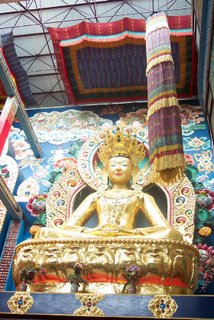
Up at Sera Jey/Sera Mey you can stay in one of several guest houses very cheaply (less than $3 a night, I think). You can go watch the morning pujas and the monks will bring you a cup of butter tea and Tibetan bread. It's worth 2 or 3 days or so in the area if you can swing it. There are several Buddhist establishments, in addition to the university, monastery, a Thangka painting concern and the refugee camp, but a real must-see is the Namdroling Golden Temple down the hill.

Technically, this is a restricted region since it is a refugee area and you are meant to have a permit, but I've never heard of this being enforced for a short stay. Anyone wanting to stay more than a few days could probably get the permit from the local police. They are well used to tourists and, mostly, don't mind photos at all, though you should always show restraint and respect.

I have lots of the Sera Jey photos at my other website, www.trekshare.com/members/sirensongs under "Sera Jey Tibetan Monastery."

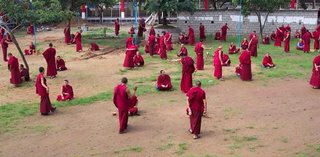
The monks of Sera Mey/Jey are famous for their debating, which is done with very stylized, theatrical flourish accompanied by hand-clapping and stamping of feet (I'm making it sound like the Hokey Pokey, you just need to see it). Every day you can watch the student monks practicing debate, in their trademark animated style, in the university courtyard. There's a book by the first Western student to graduate from Sera May all about his experience - it's called The Sound of Two Hands Clapping: the Education of a Buddhist Monk.
As for Drepung, I have been looking at their homepage for 10 minutes now and still can't figure out where their Indian monastery is!

Hope this helps, stay in touch. Keep those cards and letters coming.

Thursday, May 25, 2006

Organic Orphans

A Child's Garden

Laxman Jhula, Uttaranchal

I have been very out of touch with everyone lately, since every time I talk to anyone, try to be a friend with someone or write anything, I get jumped all over and told how much I suck. (Total strangers seem to be fine, it's just those who know me who can't stand me. I guess to know me is to hate me.) Tends to make one silent and withdrawn.

I will be in Kathmandu next week to do the visa and now I have lots of little junk to get done before taking the bus. Today I had to return two books (The Wisdom of Forgiveness by Victor Chan and the Dalai Lama, and Cave in the Snow by Vickie Mackenzie) to the orphanage I borrowed them from. Ramana's Garden is a great orphanage here in Laxman Jhula, run by Western volunteers, for Nepali (mostly) and local slum children. The Nepali kids are fleeing the civil war; the local kids are mostly fleeing poverty. They also run a health food restaurant (brown rice and organic veggies!) and when the kids are old enough (about 13) they train them to work in the cafe, serving and preparing and such, so they get job training. The orphanage itself is beautiful, built very organically right into a hillside with lots of trees and gardens (they grow lots of their own vegetables) - a healthy place for the kids to play. They also get schooling, including English of course. Most of the westerners are college kids volunteering for college credit. I am very favourably impressed with it. There are so many sham orphanages here in which the proprietors accept donations and pocket them, it is great to see something so altruistic succeeding.

It was starting to rain (thankfully) when I made it to the bottom of the garden steps. The volunteers thanked me for returning the books. I tried to pick their brains for stories about the kids. They said the Nepali kids usually describe a scenario where "the bad men came to their house and made us leave, and we ran into the forest." It's difficult to tell whether the bad men are Maoists or Royal Army - the effect is much the same.

Prabha, the American woman who founded the orphanage, has been in India for some 29 years! She was meditating in a cave by the Ganges years ago and local kids started wandering in (strange white lady living alone in a cave, everyone has to come check it out!). She didn't get much meditation done, but did learn of the difficulty of their lives and situations. Eventually Prabha just gave up her meditation quest and began helping the kids full time.

It was a good thing I returned the books today. Tomorrow they pack up all the kids and head for their retreat in the mountains, to sit out the next 2 months of intense heat. Some time in August they will return and the cafe will reopen.

Check it out! Their web page is www.sayyesnow.org

Wednesday, May 10, 2006

The Gods Must Be Crazy

Okay, he is the ruler (sort of) of the world's only Hindu kingdom. I guess he's entitled. This is the same man who declared a national holiday last year for a solar eclipse (which wasn't even visible from Nepal). Don't get me wrong, I am all for freedom of religion.

See, I told you 2 weeks ago how much he has in common with GWB ("God told me to invade Iraq").

From IndoAsian News Service (who, last time I checked, were not working for the Maoists):

Kathmandu, May 4 (IANS) Forced by the people to give up absolute power, Nepal's King Gyanendra is now seeking divine aid to destroy his enemies, a report said.

The 58-year-old king, known for his obsession with making sacrifices to propitiate the gods and consulting astrologers before undertaking any new venture, will offer panchabali - five sacrifices - to Kali, the Hindu goddess of power, in Kathmandu Friday, the Jana Aastha weekly reported.

Read the full story here.
Special thanks to Wild Willy B, Gemologist At Large.

Thursday, May 04, 2006

The Sincerest Form of Flattery

You can't tell your own story using someone else's voice

Plagiarism is all in the news these days, but it's old hat (tired topi?) around these parts. I don't know why people are so surprised about
Kaavya Vishwanathan; darn near every other Indian movie (except Lagaan. I like Lagaan) has a plot plagiarized from another Indian movie, which many times stole its story, in turn, from a Hollywood hit. Hit Indian film songs are often techno versions of Western hits (and I don't mean they sample vintage records here and there for flavour - I mean, they take entire hook lines and re-sing them as though it's their own). Lots more film songs just stay closer to home and rip off vintage Indian melodies. In 2004 a major film was released in which "each and every thing," as they say here, was lifted from Philadelphia.

Why don't the authors of the original screenplays sue? Probably because they'd then be ensnared in the Indian court system the rest of their natural lives (and beyond. The only explanation I can find for the Indian court system is a sincere belief in reincarnation).


It's a shame. Real Indian melodies are unmistakeable - unique, complex, and classic; like real Indian dances, and Indian storylines. So many people are so eager to go West - have they stopped singing their own songs and telling their own tales?

There seems to be an entirely different perception here of acceptable levels of pirating, copying, and ghost writing or singing. In the 1980s, Milli Vanilli was a scandal in the western entertainment industry; their lip synching led to Grammies returned, careers ruined and eventually, the drug addiction and suicide of the shamed performers. Even in the 1960s (before the rise of the verite singer-songwriter), Audrey Hepburn's dubbed singing voice in My Fair Lady caused shame and embarassment. Here, there's an entire Milli Vanilli Universe - a music industry built not around but squarely on top of faked performances in films (none of the actors really sing; the vocals are all done by professional playback singers). This doesn't seem to bother anyone; and I guess as long as it's presented so unapologetically it shouldn't. In other words, everyone knows the singing is fake; therefore, there's no misrepresentation.

Something Borrowed
Most revealing to me was Vishwanathan's defense of herself. Her story was different from McCafferty's, she explained, because "I am an Indian American. I got good grades." (Her precise words, as quoted in Hindustan Times.)

To her, I guess that makes all the difference. What else is there - but to be Indian, and get good grades? By her standards, she has fulfilled the ethical requirements placed on her by her parents and culture. That's enough to make someone else's story hers.


Indian columnist Cyrus Mistry wrote one of the most relevant pieces regarding the whole Kaavya mess, in which he asked, "Do we Indians just not see anything wrong with plagiarism?" He didn't feel the need to answer his own question.

Pedagogical Peculiarities
The variance in values must be due to the vast difference in cultural teaching methods. Western pedagogy puts a real premium on originality, asking questions and finding one's own voice. Asian teaching methods tend to emphasize memorization and repetition (ie, imitation). A student here is expected to absorb and internalize the lesson completely and wholly, with as little variation as possible. Also, the Western mentality is based on the Socratic Method - that is, asking questions. Here, asking questions (and having one's own opinion) is often just considered rude.

My British friend who taught English Literature Appreciation at Amrita Vishwa Vidyapeeth in Vallickavau, Kerala could not find a way to convey this to his students. They could read Shaw's Arms and the Man in a flash, and recite passages from it back to him nearly verbatim. When asked their thoughts about it, their feelings, or opinions, they were silent. Finally Tristan realized they didn't have an opinion about the book - they weren't capable of having one. And NOT because they didn't have the language skills (they did ) or because they weren't intelligent - they had simply never been taught, or perhaps been allowed, to think independently in such a fashion.

In a culture where it means so much to be a part of the group, finding one's own voice is not a big priority. In fact, it might even be detrimental. So naturally Vishwanathan "didn't realize the extent to which" she "had internalized McCafferty's work" - she was just being a good student by internalizing, absorbing it completely and recreating it elsewhere. In other words, she was doing what had always worked by her standards.

This doesn't mean she shouldn't be held to the standards of the West, where she was published - just that unconscious mimckry is, in her world (or perhaps that of her parents), often the acceptable way things are done.

Similarly, my Nepalese students at Rangjung Yeshe took meticulous and painstaking notes, were terrified of making mistakes and had great to absorb and regurgitate the words of the Khenpo (Buddhist abbot) who was teaching complexities of Buddhist philosophy. When I would ask them to describe the teachings in their own words, they were really at a loss. Often their answers began, "What the Khenpo taught was that...." and were followed by verbatim quotations from the week's lectures. They were becoming talented stenographers, not philosophy students. The late-night verbal wranglings over dharmic concepts and contradictions - what one might expect of philosophy students elsewhere - were the province of the visiting Western students.

They just had a completely different concept of what "a good student," or a good anything, is. This is not to say that one concept is superior to the other - they produce entirely different results that are appropriate to their respective sources.

To generalize, The West seems to appreciate bold innovation and "thinking for yourself" - for better or worse (needless to say, this doesn't guarantee originality or genius). Asia seems to value reproducing what already works. It is not a question of intelligence. It's as though they are teaching them: this is what worked before. Learn it; now, go out and keep doing it over and over, because this, after all, is a proven quantity. Asian culture values stability and maintainance over innovation; how else could it have maintained its traditions so well? Therefore, imitation here is not a negative thing - far from it. It's a sign that you have learned well. In fact, it's what you should be doing.

Despairing of their having an original thought (or even reworded version) on the lectures, I encouraged the students to find their own voices by telling their own life stories - stories for which they had no template and couldn't (I hoped) possibly copy, pattern or imitate anything. Things that had only ever happened to them - personal things. This confused them, as they were terrified of making "mistakes" and, with no template to follow, seemed lost. What was "the right way" to tell their story? Any way you want to, I explained.

And if you don't make mistakes, I added, how can I correct you, and how can you possibly learn? Gotta break a few eggs to make an omelette!

Blank stares. They were not at all concerned with, nor conversant with, what they wanted - their entire lives up to this point had been about doing what other people wanted. They had no desire to "tell their own story. " As an American, this was unimaginable to me. As so often happens, it appeared that I, after all, was the one getting the education.

Okay, it wasn't working; they would not be able to function without a role model, so I told my own story. "My name is....I first came to Asia in 2002." I gave a few details about my family and what had brought me to Kathmandu; what motivated me to study Buddhism.

In other words, they were not aware of wanting to say any particular thing themselves - they were only concerned with what I (the authority figure) wanted and doing things "right."

Such a mental environment is bound to lead to imitation and copying; how could it be otherwise? Doing what's always been done is what wins approval. The nail that sticks out gets hammered down. For myself, I have found far more success learning about Asian life by observation and imitation than by asking questions (which are often met with opaque answers, or seen as impertinent).

Lest you think I am some kind of missionary for Western culture, I could definitely see the beauty and value of their learning method, and the way imitation had supported their families, ethnic groups and collective culture through the ages. I wasn't even sure I wanted to encourage Western-style individuality - not if it will lead, eventually, to everyone living in their own isolated antiseptic bubble the way we've become accustomed to in America.

The sad part of the Kaavya Mess is: the story of a first-generation Indian American girl at Harvard really is a unique one, and one that hasn't been told yet. If only Kaavya had found and trusted her own voice and told her story in her own way, rather than packaging it along proven lines for greater acceptance, we might have an original contribution to modern writing. I think this story is still to be told; hopefully someone will learn from her mistakes and step forward with her own story, not "what the market will bear."