Tuesday, April 18, 2006

Notes from the front


Here's a note from another long-time expat resident of Kathmandu, about the now 14-day long strike, called by the Seven Party Alliance (pro-democracy politicians) in cooperation with the Maoists. The Royal Army has been ordered to accompany food-bearing trucks from the outskirts into Kathmandu (Maoists had been blockading roads preventing their passage to the capital):

The bandh won't last long. There's too much public anger against it and the food price hikes / petrol shortage it causes.

"Word" is that Monday will be a huge mess and then the parties will declare it all a success and end the strike. Maybe Tuesday. Ha!

With no strike or daytime curfew, it's the same Paradise on Earth you know and love. - "James"

And this item from Kathmandu Post. I wonder if I qualify as a "litterateur"?
Too bad they aren't in NYC, where some of the "artists" could really use a beating:

KATHMANDU, April 16 - Additional Inspector General of Police Krishna Basnet andArmed Police Force Deputy Inspector General Dilip Shrestha have been found ordering police officers leading security personnel in controlling demonstrations to beat demonstrators so severely that they cannot come back to the>demonstration.

According to police sources, Basnet and Shrestha have been found issuing the orders through radio sets from the Valley Police Office at Ranipokhari (note: Ranipokhari is a central point in town where most local buses stop).

A DSP said, "Once we inform about the situation, they give us the orderthrough the sets. We are then compelled to implement the order."

Police have been found beating up demonstrators severely in recent days. In recent days, police have been seen beating journalists, lawyers, artists and litterateurs.

Wednesday, April 12, 2006

Lost & Found


Buddha Boy Returns...or does he?

I can't keep track of this kid. First he appears, sits in one place for 10 months, disappears, reappears and now, according to one account, disappears yet again. Here is a link from Nepal. I have to go, I am closing out the Net place once again.

http://www.merosansar.info/content/view/25/41/

What the Dalai Lama says about terrorists

His Holiness The Dalai Lama told The Daily Telegraph that terrorists should be treated humanely.

"Otherwise, the problem will escalate. If there is one Bin Laden killed today, soon there will be 10 Bin Ladens. Awesome. Ten Bin Ladens killed, the hatred is spread; 100 bombed, and 1,000 lose members of their families."

He also said Westerners had become too self-absorbed and that modern terrorism was born out of jealousy of Western lifestyles. "This new terrorism has been brewing for many years. Much of it is caused by jealousy and frustration at the West because it looks so highly developed and successful on television. It is fascinating. In the West, you have bigger homes, yet smaller families; you have endless conveniences -- yet you never seem to have any time. You can travel anywhere in the world, yet you don't bother to cross the road to meet your neighbours."

Update: Nepalitics as usual

-No, don't worry, I'm not there! I'm still in...
Rishikesh, Uttaranchal, India

Visa renewal time looms once again on the horizon (really! Has it been six months already? Time flies when you're having anger issues). Which of these friendly neighbors will it be:
Pakistan? Sri Lanka? Bangladesh? Don't even need a link for that one because Americans aren't allowed to travel there directly from India without a prior visa from home (and the visa alone costs a spiffy $100USD).

The low-budget choice of least resistance,
Nepal, looks increasingly untenable (and that is really saying something because the situation was unstable already). The King is holed up in one of his palaces, flying yes-men in and out via chopper (that says a lot, when even All the King's Men aren't safe to travel by road) .

Or does it?

It does, if you listen to the news alone. However, the situation from the ground always reads differently. People don't seem to be taking the curfews seriously (in the city, at least) and don't seem to be suffering terribly for it. The European owner of my favourite Thai restaurant is a long-termer in Thamel, Kathmandu, the tourist hub. It's the middle of the "second high season" for Nepal (first high season being October and November). Just stay away from the demos (which are always planned, never spontaneous), it seems, and you won't catch a brick in the head. He writes:

Today is Tuesday, the sixth day of troubles and ugly mass demonstrations in Nepal. On Tuesday the government imposed again a daytime curfew from 12 noon to 5 pm. Despite the curfew we opened the restaurant even during the curfew hours. Other restaurants in Thamel were also open as usual. The curfew is not that strict in Thamel as tourists are walking around without any problems.

On Monday the daytime curfew was from 11 am to 6 pm and at night one hour earlier from 10 am to 4 pm. Between 5 and 6 pm a heavy storm swept over the valley followed by heavy rain. At 6 pm I walked to Thamel. Lots of people in the streets walking around and buying food stuff. On Monday night the restaurant was packed with tour groups. Inside we had a group of 27 people. At 9pm a Spanish mountaineering group came for dinner despite the curfew's starting at 10 pm. The staff told the Spanish about the curfew times but they insisted to have dinner and they stayed on until after 11 pm. I left the restaurant at 9.45 pm and walked home where I arrived at 10.30 pm. No problems to walk home; nobody in the streets even no army and police. There are just no taxis available in the evening. The staff stayed in the restaurant during the night curfew. The only problem was that we didn't had enough vegetables and beef fillet as it is difficult to get enough fresh vegetables in the mornings.

By imposing daytime (and nighttime) curfews the highly paranoid government is not gaining popularity. The authority of the unpopular government is waning fast. The Home Minister and the Minister of Propaganda are making fools of themselves by issuing banal and trivial statements. It seems to me that the despotic king with his feeble-minded ministers are on a self-destructing mode.

From the KTM Post: "Now there is a slippery road ahead for the monarchy. As this war drags on, more and more people will think that the war is being fought just because person or one family. Then finally one day, the people will ready themselves to trade that person and that family, for peace. In royal madness, surrounded by sycophants, yes-man and security men, it is easy to miss what is happening. But when it happens, it will be the end of a dynasty."

Kirtipur (an historic town one hour or so outside Kathmandu) seems to be a hotbed for demonstrations. On Monday the people from Kirtipur staged a succesful and peaceful sit-in preventing army trucks from driving into the town. Yesterday and today Charles Havilland, the BBC correspondent, was wearing a blue helmet while reporting live on BBC News from trouble spots in the Ring Road area. (so Blue is in this demonstration season in Kathmandu?)

Meanwhile the economy is going down the drain. As most shops and businesses remain closed since last Friday I wonder for how longer the state's coffers can afford an economy in standstill. The cash-strapped government needs lots of money and most of its budget is spent for defense purposes. The day will come when the government will be bankrupt and cannot pay salaries anymore.

A pitiable 2.5 percent growth rate of the GDP speaks volumes about the way the people are being treated by those in power. The growth rate of 2,5 percent is meaningless in a country where the inflation rate is 8,5 percent and the population growth is over 2 percent. Nepal's economy is already in a state of stagflation.

As long as there in no peace in Nepal there is no hope for a better future. Peace is also the prime requisite for development.

According to BBC, the police opened fire on demonstrators in Pokhara today. The situation seems to be very tense there. For the last few weeks the King has been staying in his lakeside palace in Pokhara. Before the demonstrations started he was on state-orchestrated road shows in western Nepal. Now he is frequently holding court with his court jesters from the royal regime who are flown in by helicopter.

Also according to BBC, the royal regime is sailing in a rudderless ship in stormy water (how many metaphors or similes or whatchacalls can you find in that sentence?) and the views among the cabinet regarding the reconciliation with the political parties are divided. The aging and senile hardliners from the Panchyat era within the cabinet are not ready for any compromises or dialogue. These idiots and a superstitious king rather prefer to push back Nepal to the dark Middle Ages. (The preceding sentence, by the way, is illegal under current Nepali rule thanks to HM Gyaendra.)

It seems that the situation in Nepal is going to deteriorate further in the days ahead.


And, that's the view from Thamel.

Another expat resident friend who's been there fifteen years writes:
Just heard on BBC news (3 pm) that the security personnel opened fire on demonstrators in Pokhara (Pokhara is the rural tourist hub and the base for all Annapurna region trekking). Pokhara seems to be very tense today. The king is staying in his lakeside palace in Pokhara for the last few weeks. His puppets and yes-man are always flying from KTM to Pokhara for consultations. They must spend a lot of money for helicopters.

In an encouraging (sort of) note, the foreign visitors are getting in on suporting the pro-democracy demos. Interestingly, this report doesn't go into the bit about the Japanese tourist getting beaten. Hey, you're wearing a peasant blouse, now you know what it really feels like to be a peasant! At least the police don't discriminate.

I can not find the original Nepali News story to link, so I am reprinting it here:

Tourists protest curfew, general strike
Tourists have organised a candle rally in Pokhara on Monday evening to protest the police beating of a Japanese visitor on the same day, report said.

Kantipur (name of a newspaper in this case) stated the tourists came to the streets also to protest against the atrocities of police upon the tourists in the last few days. The rally started soon after curfew hours were over.

At around 7:30 p.m. the tourists took out rally chanting slogans against the police atrocities. The rally started from Lakeside, passed through different parts of the city and ended at the Hallan Chowk. Many others tourists, who did not take part in the rally, applauded from road sides.

The daily quoted a British professor Charles Brown as saying the objective of the rally was for the establishment of peace and complete democracy in Nepal. He called on the palace to initiate dialogue with all political forces for the restoration of peace here.

Dozens of foreigners took part in the rally. The tourism entrepreneurs and local residents also joined the protests.

A student visitor, from the rally, has said she would not return Nepal till peace is restored.

The tourists have said their programmes have been badly affected by the imposition of curfew and general strike. This is the first instance of foreigners' staging protest against general strike and curfew in Nepal.

:Here is the link to the blue-helmeted
Havilland BBC story, and
:the
BBC news link to some reports from affected locals.

Special Thanks to Wild Willy B for hitting the Forward button!

Sunday, April 02, 2006

Rishi-Kitsch


The Spiritual Tourist
Rishikesh, Uttaranchal

My 12-year-old American friend Jason has come up with a description of the Great Indian Psychodrama in just one phrase. After watching some Indian TV, he commented, "it's all, like,
'You Ate Off My Plate!'
Dunt-dunt-DUHHHHH!!!"

Out of the mouths of babes.

Jason was equally perceptive when I described the Indian tradtion of worshipping one's dead parents. Once the parent "expires," it is the custom to put their photo on your altar in a place of honour along with all the other deities, and pray to them daily. Later, I heard my young friend ennumerating "Jesus Christ, Mary Magdalene....""What are you doing?" I asked.Jason shrugged. "I'm just trying to imagine praying to my mom. Jesus Christ, Mary Magdalene... Laurie Nieves?"

A Family Affair
Just arrived in Rishikesh, and am wondering why. It seems to have the worst of both tourist worlds - Indian and Western. The Indian tourists are dour-faced, unsmiling families plodding round in large groups, looking like they are carrying out some heinous enforced duty instead of holidaying on the Ganges. I wonder if they are all thinking, "how come I have to do everything with my family and never get a minute alone or with other friends?" They certainly all look as though they'd rather be somewhere else.


Occasionally (very) you see a young, "mod" Indian couple who have managed to break away from the tyranny of their family and squeeze in a weekend on their own. They probably get a lot of guilt for it when they return home ("why didn't you come to Sunday dinner? Always you are running here and there. And I made this special gulabacchanikicchhori just for you. Now it will spoil").

(I wonder, does anyone ever say the first thing that popped into my irreverent Western mind when I heard this? - "Food will spoil? Mom, that's what the fridge is for.")

Tangent Mode On: "If you love someone, set them free" could never catch on here. You can see how much they love the gods...they lock them up in cages. Laurie was told to look for a certain ashram with "devis in cages." We were sure we had found it, till we found another. And another. All the ashrams seem to lock up the painted plaster statues of the gods in cages. (I understanding guarding the valuable gold statues, but these are just plaster and stone.) They lock them up to immobilize them, to make sure they can never, ever, ever go anywhere else. I think that's the Indian way to say "I love you."

Tangent Mode Off:
Then there are the Western spiritual tourists dressed in bright red, orange and yellow "yogi" clothes with big chunky rudraksha malas round their necks to show how austere they are. I've lived in every major ashram in South India, and never seen quite the level of commercialization that's evident here. Tiruvannamalai, Pondicherry, Amritapuri, Puttaparthi - they are all towns with one primary ashram, but in Rishikesh it's a town chock full o' yoga schools all in competition.

All the statue-mala-yoga book-crystal stalls, with bhajans playing from every corner, the rectangular, institutional buildings that feel more like public schools or government buildings than places of meditation - I tried to put a grimy, road-tired finger on what it all reminded me of. It was a cross between Satya Sai Baba's Prashanti Nilayam (pink square birthday cake buildings, lots of enlightened junk for sale) but without the devotional focus on one charismatic figure - a cross between that and Callaway Gardens or other mid-1960s resort towns in Florida. Most of the structures look as though they were built in the early 70s and that seems to be the last time they were painted or repaired, as well. Strangely, the pastel pinks and baby-aspirin oranges are the same hues popular in Florida. Their perky optimism compares poorly with the reality of cracked cement, peeling paint and worn-down marble steps.

A little vintage kitsch is lots of fun, but not when it has that dogeared, down-at-the-heels feeling. Decay is perfected to an art form in, for instance, Calcutta, where it seems kind of classy and old world. Here it feels depressing, like the old shopping mall that's lost its following to the big new Galleria.

It's hotter here than McLeod (had been led to believe it was cool here, but it only means cooler than the rest of India) and there are lots of flies. The flies mill about as aimlessly as all the lost-soul Yoga tourists (why do so many young people who come to study yoga and meditation puff cigarettes? seems counterproductive).

I did feel much better after dipping my feet and hands into the Ganges, which, though not flowing at full capacity, is still cold and clear here in the foothills. For those not clear on the geography (I sure wasn't), Rishikesh is not in the Himalayas....it's not even in the foothills of the Himalayas. Rather, it is at the feet of the foothills of the Himalayas. After evening arati (the traditional fire-offering ceremony) on the riverbank, a delicious, invigorating breeze kicks up. At the Paramarth Niketan arati, they have a fleet of baby monks (in this case, dressed in saffron robes with shaved heads and tiny Brahmin tufts that gives them a whimsical look like a Dr Seuss character) singing and clapping along.


Maybe tomorrow I'll be rested enough to rise at dawn and have my first ritual bath in the holy river (can't believe I've been in India so long and still not had the cleansing bath in the Ganges).

Turn off your mind, relax and float downstream....
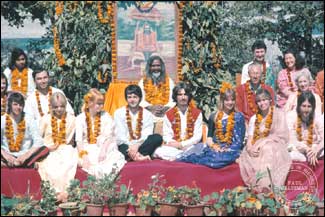
My dear friend Darkhorse will never forgive me if I leave here not having gotten photos of the Maharishi Mahesh Yogi ashram where the Beatles came some forty years ago. I think the Beatles were bodhisattvas in disguise. After they made mind-blowing music and changed the world, one went on to promote peace (John), another to promote Eastern spirituality (George), and a third to promote vegetarianism (Paul).

I wonder what Ringo's mission was. Maybe just to show that someone has to be there for other people, be supportive, and stay out of the limelight. I think he will be the last Beatle standing. Maybe then the real Ringo will emerge and become a Starr.

Yes, it's corny. Way corny! I'm in RishiKitsch! It's compare and contrast: candy-coloured plaster painted statues of smiling caged devis vs. dour-faced matrons in technicolour saris living in the invisible cages of their families. Sickening sewage smells vs. sickly sweet incense. Indians wearing western clothes, who've come to see what the Westerners came to see; Westerners wearing Indian clothes who come to see something "Indian."