Friday, July 21, 2006

No direction home

Refugee Nation
Kathmandu, Nepal

Everyone knows about the Tibetan refugees; they are very high-profile and have a dramatic, romantic story. Tibetans

are still coming over the mountains - still escaping Chinese occupied Tibet. But probably 20% of the city of Kathmandu - maybe more - are some kind of refugee.

Besides the Tibetans, there are several
Bhutanese Refugee camps here in town. Meant to be temporary, like all such camps, the Bhutanese have been there nearly 16 years. King Wangchuk, an absolute if otherwise somewhat enlightened monarch in the neighboring mountain kingdom, kicked out lots of ethnic Nepalis who had been born and raised there (they were demanding things like "rights") in the early 1990s. The UN Human Rights Commission is here investigating the Bhutanese refugee camps this week; yesterday a bunch of protesting Bhutanis were arrested in front of the SAARC Secretariat.

Then there are Biharis - refugees from comparatively prosperous neighbor I
ndia. Ordinarily Nepalis go south to find work in India. There are some 1 million Nepalis working there now, largely as waiters or hotel staff; the stereotypical Nepali diaspora job is that of security guard ("bahadurs" - a Nepali word meaning courageous). These reverse Indian migrants are fleeing the state of Bihar, notorious for its poverty, violence and corruption. With their distinctive Indian features - prominent noses, enormous bushy moustaches, large, liquid eyes and unsmiling faces giving them a somewhat doleful look - they are easily spotted selling fruit from large bicycle baskets all over town. Every time I buy fruit, I ask them "what is your native place?" So far, they have all answered "Bihar." They are thrilled that I even know one or two cities in their state and that I have ridden through it, however briefly, on the train.

Yet another category of Indian refugee comes from Kashmir. Theirs is a diaspora of long standing. The Kashmiri conflict needs little introduction; because of it, green-eyed, fair-skinned Kashmiri men (known as much for their butter-tongued salesmanship as for their good looks) can be found in curio shops from Ladakh to Kerala. I would imagine the Kashimiri diaspora accounts for a good percentage of Nepal's very small Muslim minority.

Where are the Kashmiri or Bihari women who must have accompanied their men? Do they stay at home in purdah (Muslim seclusion of women), or tending children? or did they stay behind, leaving the men to dream of a day when they could earn enough money to return home and marry? A few days ago, I saw two tall, thin women dressed in the unmistakeable style of far northern India. Punjabi suit with churidhar pants, chunri (long scarf) pulled over the hair, no bindi on the forehead - that means, she's Muslim. The younger one could have been my sister, her features were so Caucasian. They were so exotic in these surroundings, I sprinted to catch up to them. "Place you are coming from?" I asked breathlessly. The elder one couldn't understand. "Kashmir," said the younger girl; "you are from?" "America."

The ladies were carrying water in what looked like old-fashioned plastic gasoline jugs, the kind with a handle on one side. Since there is no running water near their tiny flat, she told me they go to fetch water from a public tap some four times a day. They trudged up the sidewalk with the plastic jugs perched on one shoulder, heads held high.

Internal Affairs
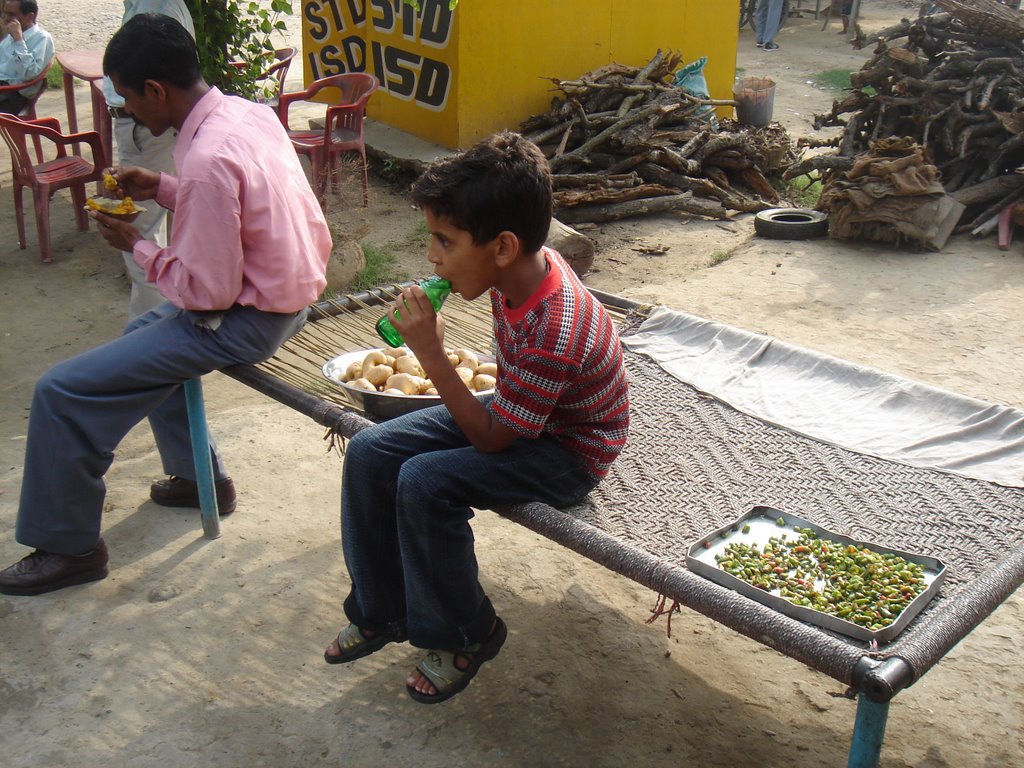
Then there are the Internally Displaced Persons (IDPs) - those who've been flooding Kathmandu escaping the Maoist/RNA conflict in their villages for the last few years. The Kathmandu population has mushroomed recently, mostly young men fearing recruitment or death at the hands of either army. Many young women have fled as well. Some find gainful employment; some are driven to dance in the many strip bars in the tourist district; some turn to either outright prostitution or a "softer" kind involving a relatively wealthy city man or "foreign gentleman" they have met during their migration.

Still more Nepalis are just fleeing poverty and lack of opportunity in their rural districts, armed conflict or no. Maya is here with her 2 daughters and sick husband. The husband has TB and is just sort of acknowledged to be terminal. There is treatment for TB, but they seem to have accepted that he is dying. The husband just lies in bed all day (all he can do) while Maya and her daughters do a sort of hybrid job in Thamel, alternately selling small pocketbooks (the kind tourists use as money pouches) and when that fails, begging. Maya buys the bags wholesale for about 30NRs each and sell them for whatever they can get. If the tourist looks rich, they start at 500NRs (about $8.00). However, they will part with the bag for as little as 50NRs. The same bags are for sale in every single shop in Nepal; often for much better prices, but Maya and girls are counting on pity and immediacy (being in your face on the street, that is). I wonder to myself whether she purposely doesn't wash her girls properly for this reason.

Maya came here from Pokhara, the centrally located lake town, seeking treatment for her husband. They seem to have forgotten about that now and just accepted that he's dying. While we were talking to her, Maya started crying and said "I just wish someone would take her" (the baby) "back to America."

And of course, there are the expats...not tourists, but lifers. Foreigners who came for a season and stayed. They're all running from something - many seem to be running from conventional ideas of prosperity and all its confining trappings, as our Nepali neighbors are hoping to run toward them. They ran to a place where the human touch still counts, everything is not yet mass produced, and you can still ride a bicycle to work without getting run down by SUVs.

Most foreigners are involved in one or more charities, projects or volunteer work; like Renate, the Dutch Nepali resident and owner of the posh restaurant 1905 Kantipath. Renate is deliriously busy not only running his business, but with myriad projects and homegrown, small-scale charities which emphasize training and education.

Unlike India, the locals here don't seem to consider you "stupid" for wanting to help. And a heartening number of projects seem to do long-term, sustainable good.

I met Rachael as she was taping up
hand-written posters to the notice board of the posh Kathmandu Guest House. Rachael is a very low-budget traveller here from New Zealand. "I hope you don't mind eating here," she said quietly as we ducked into a dark, smelly local lunch joint where flies buzzed around the food counter. It turned out to be too dirty even for her, and we ate elsewhere. Her guest house is 150 NRs a day (about $2.00 US) and only has hot water from 8-10 in the morning. Rachael is trying to raise money for "her" family in the Langtang region. She met them while trekking, spent time with them and got to know their situation intimately. Rachael wants to collect $100 US to repair their leaking roof (especially now that it is monsoon) and is in the city collecting it - 100 NRs (that's about $1.50) at a time. Her sunspotted skin, worn out sandals and frequently stitched and re-stitched pants showed that she spent no money on herself.

If she can buy a sheet of corrugated tin, Rachael can take it up to Langtang, tied onto the roof of a bus. (Anything and everything can be tied onto the roof of a bus here - I've seen full-sized sofas transported this way. It was amazing to see the men get it up there; but then, this is a land where five-foot men carry full-sized fridges on their backs.) From there, she will have to hire local men to carry it up to the family house. She's also collecting money to build a wall that will protect the family's apple orchard seedlings from the local deer, goats and pigs.

With $150 US, the family can buy a water buffalo, which will enable them to start a small-scale dairy business providing yogurt and milk to their neighbors.

Everyone gets involved, everyone has a project. No one, it seems, "belongs" here. Therefore, we all do. It's strangely liberating, and creates an environment in which anyone can fit in. Politicized enough to be relevant, romantic enough to be picturesque, bohemian enough to be accepting, and very international - a slice of Manhattan's 1980s East Village transplanted to a rain soaked mountain kingdom - Whoops! kingdom-slash-modern democratic republic... in the monsoon clouds.


Vote for meeeeee!

Go to this URL and give me a #5 rating:

http://www.trekshare.com/dailyPic/?id=110

Then page down to the following 2 photos and do the same!

Trekshare.com has selected not one, not two, but three of my Nepal photos in a row as their photos of the day.

They have a shot at being photos of the year, in which case I will win $200 US. (Hey, I can live on that for nearly a month here.)

What are you waiting for? Get clickin!

Tuesday, July 18, 2006

Dude, where's my Blog?


Democracy Inaction
Location: Indian Blogosphere

"Patriotism is the last refuge of the scoundrel" - some cool dude


"The only thing necessary for evil to triumph is for good men to do nothing" - Edmund Burke

Report: Indian gov blocks Blogspot, Typepad, Geocities blogs
Reprinted from BoingBoing (thanks guys and gals)
India's Department of Telecommunications (DoT) passed an order to ISPs Friday to block several websites. The list is confidential. Indian ISPs have been slowly coming into compliance. SpectraNet, MTNL, Reliance, and as of Monday afternoon, Airtel. State-backed BSNL and VSNL have not started yet but likely will soon. The known list of blocked domains is *.blogspot.com, *.typepad.com and geocities.com/*.

Yes folks, the Indian government has decided to censor blogs and refused to explain why. This morning Shivam Vij managed to talk to Dr Gulshan Rai, director of CERT-IN, the only body authorised to issue directives to ISPs. His response: "Somebody must have asked for some sites to be blocked. What is your problem?"

If any Boing Boing readers in India find several sites inaccessible today, please call your ISP and demand to know why. If you can help, please join the coordinating group: Link.

Link to Shivam's post, and Jace is following developments on his blog, here.

Manish adds,

The block is still spreading through Indian ISPs. This recalls Pakistan's Blogspot ban during the Danish cartoon controversy and India's Yahoo Groups ban in '03 to shut down a separatist forum.
Dina Mehta says,
The plot gets thicker and thicker as more bloggers are getting alerted to the fact that an increasing number of Indian ISP's are banning blogspot and typepad blogs and geocities.com. Several detailed posts on this, with regular updates here: withinandwithout.com, Conversations with Dina, and Travel Tales from India.

There's a wiki here: Link. We're treading with a little caution before we go whole-hog at the government. There is a possibility that it is a mistake - where a directive from the government on a few blogs might have been misrepresented by ISP's here - who have blocked the entire sites.

Amit Varma says,
Amit Agarwal has some tips on how Indian bloggers can circumvent the ban on Blogspot here: Link. More here: Link.
Update, 11AM PT: Shii says,
An Indian political blog is reporting that the ban was initiated by the Indian intelligence service to stop terrorism: Link. According totheir source, the terrorists are using blogs to communicate. Not only is this useless (because the terrorists can simply use proxies), it's akin to shutting off the country's telephone service because terrorists talk to each other through phones.
Jim says,
Indian Censorship can easily be bypassed when using TorPark. It's a no-install version of Firefox that uses the Tor Network for communication. This should also work in China and other countries that filter the web.
And of course, this and many other censorship workarounds at BoingBoing's "How to Defeat Censorware."

Vijay says,

I am not yet facing any of the blocking effects as reported by several Indian bloggers. I have noticed a certain pattern here. The blocking seems to be affecting city users while rural netizens have been spared of this curb for now. I have mentioned this in detail here.
Special thanks to Double T of Black Cats Manor, Chattanooga, Tennessee, USA.

Monday, July 17, 2006

Trashed

The Big Rot Candy Mountain
Kathmandu, Nepal

Shooooooooooooooo-weeeeeeee!

The KMC (Kathmandu Municipal Corporation) sanitation workers have been on strike here for over a week, and the city is trashed. Living in Asia, I am accustomed to a high level of street debris and smells (everyone knows Singapore does not count as Asia). But even I am not used to climbing over literal mounds of decomposing trash, sodden in the monsoon rains.

The mountains of garbage - paper, burlap sacks, rotting fruit hulls, wrung-out sugarcane used to make juices, plastic bags holding moisture, spent corn cobs, banana peels, newspapers and so on - are now large enough to block traffic on the already congested city streets. Yesterday Floriane and I were walking back from Patan to New Road and traffic was at a complete standstill. We squeezed in between piled-up cycle rickshaws, taxis, motorbikes, scooters and mini-buses on roads that in any other part of the world would be considered alleys. Of course everyone has to honk, as though some obstinate person at the front of the queue is willfully holding up everyone else...and as though honking would do any good whatsoever. Normally cows, goats and street dogs take care of the overflow of organic trash, but there isn't enough livestock in the city to make a dent in all this rot.

Mosquitoes are having a field day breeding in among all the piled-up rot and my entire backside is covered in red welts.

Use and Throw
If you have never lived in Asia, you don't know trash. For one thing, there are few, if any, garbage cans on the road here. The local habit is just to "use and throw" - drink your juice, eat your candy bar, and toss the wrapper down at your feet without a second thought. In fact, if you consume your drink at the shop and ask the shopowner "where can
I toss this garbage?" they will often instruct you to throw it right in the street (the phrase is "use and throw"). Most of them don't keep garbage cans. Those that do normally just toss their own garbage can's contents right into the street at night, anyway.

So garbage gets tossed into the tiny gutter, which is just a foot or 2 away from your sandalled feet, or right onto the street itself. Most streets don't have proper sidewalks ("footpaths"), with the result that you are constantly dodging garbage.

Trash: from the ground up
Here in Nepal, the Sanitation Department does not arrive in huge, roaring, dinos
aur-like trucks with hydraulic lifts on the back. Since there are no garbage trucks, there are no dumpsters or garbage bins.

In Thamel, garbage removal begins with the street sweepers. This is one of the lowest castes in Hindu society (slightly above the sewer-divers, latrine-cleaners, butchers, and those who dispose of corpses). They are employed by the city at the rate (in India) of about 100 IRs a day - that's about $2.25.

The sweepers come out after dusk and, stooping low over the broken pavement, push the accumulated gutter garbage into neat piles. A Westerner would not recognize their working equipment for what they are - brooms. To us, these brooms look like little bundles of stiff straw, sort of like uncooked spaghetti sticks wrapped in a bunch about 2 feet long and tied with a piece of twine. There is no handle, so the sweepers must bend double over the ground and have their faces in the dirt and dust for hours. They generally don't wear masks or scarves to protect their faces from the filth. Older sweepers' backs are permanently crooked.

If you were to give them a Western broom with a long handle, which would not only enable them to stand upright and save their backs, but would give them leverage and enable them to work more efficiently, they would sell them to someone and return to their familiar whisk broom. This is what they prefer. (In the 60s, one Peace Corps project became legendary among anthropologists. To enable subsistence farmers (can't remember where) to both work more quickly, and save their spines, the Peace Corps workers gave them long-handled hoes for tilling. The villagers promptly chopped the long handles off the farming implements and went back to bending double over the ground.)

Miles of piles - Recycling, Asian style
The next phase in urban sanitation are the rag pickers. This occupation covers all genders, ages and even species. Humans, dogs, cows, crows, cats, and goats all join in nosing and picking through the accumulated rubbish in search of various kinds of morsels. Most rag-pickers, however, seem to be women with young children. It's not often that you see an adult male ragpicking.

Some ragpickers work at night, but mostly I see them first thing in the morning- probably for better visibility. Popular items with humans seem to be plastic water and soda bottles, and re-useable plastic bags. I think they can re-sell them somewhere. In India, there are entire shops devoted to buying and selling old newspaper by the pound. Cows are fond of used corn cobs and banana peels. Dogs naturally concentrate in areas round the butcher shops. They are all working a bit frantically - to try and beat 1) each other - competing groups of scavengers, and 2) - the Garbage truck.

The garbage truck, in Thamel, is a guy on an ordinary push bicycle that has a large wire bin attached on back. Sort of like an ice cream vendor in reverse, he scoops up the piles (using seemingly nothing - maybe a piece of cardboard and his hands) and dumps them into his wire bin till it's full.

In areas with more modern, wide-open streets, the garbage truck is a weird sort of three-wheeler hybrid between a go-kart, a flatbed truck, and a tractor. I wish I could upload a photo for you. This contraption is usually peopled by 3 men, and for some reason, has handlebars rather than a steering wheel. The 2 guys on back scoop up the wet piles of muck onto the flatbed with maximum roaring of engines and blocking of traffic.

In that way, I guess it has a lot in common with Western, more sophisticated garbage trucks.

Friday, July 14, 2006

Close call

In harm's way
Guest blog from Mumbai, India

My friend and fellow Blogger
Shinu (the Mumbai Marauder) was three cars away from one of the bombs on the rush-hour commuter trains in Mumbai (Bombay) on July 11. Here are his letters detailing the experience. You can see photos here at his Blog.

Warning: the images are gruesome. People have criticized Shinu for even taking the photos, but I feel that real-life photos of these situations bring home the reality of what happens when fear and hatred take over hearts and minds.
........

It was a close call. Literally. I was in the 7th coach of the a ill-fated (Matunga Blast) train. The blast occured in 4th coach! In fact, the 4th coach is my regular one - it was a phone call that saved me!

I was late reaching the platform, and upon seeing the train ready to leave, just jumped into the nearest available coach. After leaving Dadar, I heard a loud sound, and a metal-scraping-on-metal sound. First, I thought someone is setting off crackers (fireworks). Then the overhead wire fell to the side of the train. People were jumping from the moving train.

All this happened in 50 seconds. I shouted "Don't Panic" but no one was listening. Then my friend came up to me, told me that the overhead wires broke and get down as fast as possible or there will be danger. Got down, looked ahead and saw a coach is completely tore open! At that moment, I thought the engine might have blew up. So sensing a scoop, I grabbed my camera (I was carrying it in my bag) gave the bag to the friend, ran towards the damaged coach.

Once there, I regretted my decision. I didn't recognise it at first. It was so eerie. Dead bodies, blackened from the blast, piled upon each other. Then all came into focus. A half-dead man raised his head from between two dead bodies, and looking at me. I didn't think of anything. It was an exclusive shot. After some 18 frames, I feel like throwing up. So I moved away from the scene.

By then, most of the alive transferred to hospitals by alert fellow passengers and locals. The police and help arrived after 45 minutes of the blast!!! All networks jammed, traffic brought to a standstill, blood and flesh scattered across the tracks, those who were standing on the doorway flew a few meters from the power of the blast and their bodies mutilated beyond recognition, a headless torso lying in the tracks, severed limbs scattered around....

Will get back once my mind is cleared. I still can't believe I am alive and in shock. I want to cry.

Shinu Mathew
www.blogofindia.blogspot.com

...
Here's a letter from another Mumbaikar friend, Aadil, about his experience after the blasts:

I just returned home after trying to go to work in the night shift but the trains on the Western Railway were not running after the blasts and the roads were blocked totally so nothing moving at all. All traffic was just waiting for hours on end with not even a crawling movement visible. People were waiting outside their vehicles for hours. Sadly returned home and am now online. About 137 people have died (Ed. note: it's now 200) and many more injured in the 8 blasts that took place all on the Western Railway all over Mumbai city. Women are being accomodated in school halls and public are out on the roads giving biscuits and water to people stranded on the roads in their cars.

May peace prevail and those injured get well soon, sad to hear about the loss of lives and courage to those who lost their near and dear ones. Just wish this crazy violence would stop someday soon.

Photos by Shinu Mathew used courtesy Jagraan TV, Mumbai, India.