Ahem. Back to plagiarized movies. Personally, I 'm waiting for the Bollywood version of The Big
 Lebowski. Now THAT would be fun. The Dude, bowling to
 Hindi film music - maybe a filmi Creedence dance number.
Ever-vigilant of current trends, I, too, want to try my hand at plagiarism. Maybe there's a $500,000 advance out there with my name on it. Below is my version of a Thorn Tree Top 5 someone named Hampi Man wrote last year. (His was better.)
Season of the Itch:
Top 5 Mystery Maladies I Got in India (so far)
1. The Mosquito Bite that Won't Heal: Mountains out of molehills division. It begins innocently enough - a mosquito bite on the most common place, the foot. H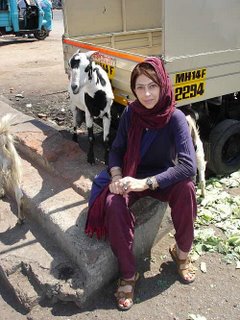 owever, this is also the most dangerous place, as wearing sandals exposes the bite, which I immediately scratch the hell out of in order to release the itchy toxin, to all manner of dirt and filth. In monsoon season Kerala, it becomes infected nearly overnight and by the second day was red and angry.
By the fourth day my whole ankle was starting to swell. I had to take oral antibiotics - the infection spread so fast that topical Bactrim wasn't enough. My feet were so covered in mosquito bites, I walked around for 2 weeks with both feet bandaged, wearing socks under my sandals to protect the Bandaids and shield the scabs from dangerous dirt. I must have looked like a geriatric Miami Beach matron.
Indian acquaintances were perplexed, as the mosquitos largely seem to leave them alone. Sort of like greedy autorickshaw drivers, the local mosquitos hone in on the newcomers. I guess both drivers and mosquitos could be considered members of the same species - bloodsucking parasites.
Oh, I know - if you don't scratch the bite, this won't happen. Well that's no fun!
2. Mystery Blisters. Small, itchy, fluid-filled blisters all over extremities (tops of feet and backs of hands). The only thing for it is to pop them, drain them, disinfect them and cover them with bandaids to prevent infection. They could be some weird insect bite but I've never been able to spot a bug nearby when they start itching. My friend Diana got them too, and thinks it's some special kind of Indian mosquito that makes this type of bite.
It did enable me to quote that immortal Beatles line from "Helter Skelter" - "I got blistahs on my fingahs!" - but there was no one around to get the joke.
3. Imperial Impetigo. According to the oral history project Plain Tales from the Raj, this plagued the colonials a hundred years ago. The sun never sets on the British Impetigo. Somewhere I still have the pictures of my entire chin, hands, and parts of my legs and torso covered in these horrible itchy welts. You can still see a white scar on my chin from the deepest one, which made a sort of hole under my lower lip.
Impetigo is a bacterial infection (related to staphylococcus and streptococcus) that flourishes in hot, humid and unclean environments. As little kids in the States, we got it sometimes playing in the sandbox during the muggy southern summer. The blisters pop to leave little wet, red craters and dry into a trademark "honey crust" scabby spot. Impetigo itched so badly that I nearly clawed myself bloody and had to take both antihistamines and sleeping pills to prevent this. All I could do was lay under the fan at AIMS Hospital in Kochi for a week. The elderly dermatologist, who seemed to enjoy holding and stroking my itchy hands (in order to examine them) just a little too much, prescribed an antibiotic.
Fortunately, AIMS has a great milkshake bar. For ten days, my life revolved around drowsily slumping from milkshake to fan to pharmacy to milkshake.....By the way, it's highly contagious, so I managed to nab a room all to myself! With cable TV!
I hope that old lecherous doctor caught impetigo from trying to hold my hands.
4. Fried Follicles. In a land where the local hair is so full and plentiful, it seems especially cruel that some combo of diet, climate and stress makes foreigners' hair fall at an alarming rate (this is well documented in Sarah MacDonald's autobio Holy Cow). My (Caucasian) dance teacher lost so much hair during her stay in south India that she was able to collect it and make a false plait from it. Long-term residents at Amritapuri ashram traded stories about how much hair they'd lost; Swamini Krishnamritaprana (from Australia) had a receding hairline by the time she left India.
I now have about half the hair I came to India with; after 1.5 years I had to hack off a few inches from the frazzled ends - they looked like a literal straw broom. A lot of it just fell out and is slowly growing back like little fuzzy baby tufts. All this happened despite my use of hair oil and covering my head with a dupatta every day!
5. Scabies: The People's Itch. All over India, you can see village folks (and those in urban slums) picking the lice out of one another's hair in a basic primate bonding ritual. I used to sit on the balcony of my friend's restaurant in Koregaon Park, Pune and watch the local housewives grooming each other this way. Despite many, many rural bus rides, I managed to avoid this, but still picked up scabies (also known as mange) while sleeping at a North Kerala temple near Kannur.
Sleeping in a temple is not as weird, nor nearly as much fun, as it sounds. Most temples allow for pilgrims to overnight in a temple dharmsala (pilgrim's shelter, usually just a stone pavillion).
Parsinikadavu Temple is famous as the only one in the world in which the Theyyam, a ritual trance dance unique to North Kerala, is performed daily. Lord Muttappan, the temple's primary deity, is considered a form of Shiva, but that sounds like later latterday Brahminical absorption of a local tradition. Muttappan was thought to have been a brave hunter in the area's forests long ago. He carried a spear, lived in a wooden house and was constantly surrounded by hunting dogs - therefore, the temple grounds were home to freely roaming dogs of every spot and stripe. This woodland hunting lord, unlike most orthodox Hindu gods, also loved offerings of toddy and meat.
Of course, the dog and whiskey motif immediately won me over. I decided I liked th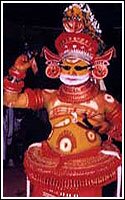 e primordial flavour of this lakeside temple, built in classic Kerala architectural style. What I didn't know at the time was that this temple was famous for more than just a ritual dance (performed by a pot-bellied man wearing costume and makeup that looked more Papua New Guinean than Indian). It was also known as a home for every class and caste. All the rituals were performed by members of the "lowest" castes, so naturally, many of the worshippers were from these social strata as well.
As an American, I had always considered myself immune to notions of "unclean" caste. I was soon to be proven wrong.
Determined to witness the Theyyam ritual, I happened to arrive there on a major festival day in May and every single guest house room was booked. The temple committee (when in need, look for The Guys In the Office who sit around and decide how much the pujas will cost) took pity on the lone foreigner and gave me a straw mat to sleep on in the mandap (large open foyer space) in the midst of several hundred women pilgrims and their children similarly stranded. (The men slept seperately elsewhere in the temple.) The Committee Guy was kind enough to empty one meeting room - the only one in the temple complex with a shower - so that Madame could take a bath in privacy (others were "bathing," fully clothed, in public with buckets of well water. As the only foreigner there, I was already attracting considerable notice and didn't want to cause yet more disruption by bathing publicly.)
The room's occupants - a bunch of young guys sitting round drinking whiskey and smoking cigarettes - seemed annoyed that I had interrupted their private party, but grudgingly cleared out. The imbibers appeared to be enjoying some of Lord Muttapan's whiskey for themselves.
Every Indian (and every Indian traveller worth their salted nimbu pani) knows how to sleep on a hard floor with nothing but a straw mat. I got comfy on my mat in the dharmsala, using my dupatta scarf as a sheet. My female dorm mates were lovely Malayalees who spoke very little English, but there were lots of welcoming smiles all around.
Next morning, I awoke to the comforting sounds of an ancient south Asian ritual: dozens of people retching to clear their throats of phlegm (hhhhaaaaaaaaaaaaahrrrrrrrrrrrrrrrrrkkkkkkkkkkkkkkkk ~~~~ ptttttttttttttttttahhhhhh!!!!).
I was chalking up my points as a solo road warrior and preparing to to put my adventure into words. On the bus ride back to the city, I felt the telltale itching that was definitely not a mosquito bite. Lord Muttappan had left me a little something to remember him by. The term "unclean" had a new meaning for me.
Scabies is (are?) a microscopic critter that burrows into your skin, especially loving the warm crevices between your fingers and crooks of elbows. Scabies is (are?) highly contagious - spread through proximity and sharing things like towels, or bedsheets (or perhaps, straw mats). It's only gotten rid of by applying topical ointment which kills the little critters burrowing deep, deep into your flesh. Then, you must wash your clothes and bedsheets in boiling water. The more you scratch, the harder they burrow away to hide.
Even more appetizing, what's really itching is their feces. That's right, it's their doo doo that makes you itch.
Aren't you glad you decided to read this far? You should be itching right now just reading about it!
The Safari Within
Your journey through India will give you the opportunity to play Host Organism to an amazing variety of wildlife. Your body, especially intestinal tract and epidermis, will at times feel like a miniature safari. If you are "foreign," don't expect any local doctors to sympathize with you- they typically either accuse you of making it up, or, as one doctor at AIMS Hospital told me, "this is just some skin irritation that the fairskinned people get." Because only white people get it, it doesn't need treatment. (Can you imagine any US doctor telling someone, "that's only a disease that brown people get!") They'll be only too happy to take your money for this sage advice, though!
Shucks, that's already Five. Here are some Bonus Afflictions:
Top 5 Mystery Maladies I Got in India (so far)
1. The Mosquito Bite that Won't Heal: Mountains out of molehills division. It begins innocently enough - a mosquito bite on the most common place, the foot. H
 owever, this is also the most dangerous place, as wearing sandals exposes the bite, which I immediately scratch the hell out of in order to release the itchy toxin, to all manner of dirt and filth. In monsoon season Kerala, it becomes infected nearly overnight and by the second day was red and angry.
By the fourth day my whole ankle was starting to swell. I had to take oral antibiotics - the infection spread so fast that topical Bactrim wasn't enough. My feet were so covered in mosquito bites, I walked around for 2 weeks with both feet bandaged, wearing socks under my sandals to protect the Bandaids and shield the scabs from dangerous dirt. I must have looked like a geriatric Miami Beach matron.
Indian acquaintances were perplexed, as the mosquitos largely seem to leave them alone. Sort of like greedy autorickshaw drivers, the local mosquitos hone in on the newcomers. I guess both drivers and mosquitos could be considered members of the same species - bloodsucking parasites.
Oh, I know - if you don't scratch the bite, this won't happen. Well that's no fun!
2. Mystery Blisters. Small, itchy, fluid-filled blisters all over extremities (tops of feet and backs of hands). The only thing for it is to pop them, drain them, disinfect them and cover them with bandaids to prevent infection. They could be some weird insect bite but I've never been able to spot a bug nearby when they start itching. My friend Diana got them too, and thinks it's some special kind of Indian mosquito that makes this type of bite.
It did enable me to quote that immortal Beatles line from "Helter Skelter" - "I got blistahs on my fingahs!" - but there was no one around to get the joke.
3. Imperial Impetigo. According to the oral history project Plain Tales from the Raj, this plagued the colonials a hundred years ago. The sun never sets on the British Impetigo. Somewhere I still have the pictures of my entire chin, hands, and parts of my legs and torso covered in these horrible itchy welts. You can still see a white scar on my chin from the deepest one, which made a sort of hole under my lower lip.
Impetigo is a bacterial infection (related to staphylococcus and streptococcus) that flourishes in hot, humid and unclean environments. As little kids in the States, we got it sometimes playing in the sandbox during the muggy southern summer. The blisters pop to leave little wet, red craters and dry into a trademark "honey crust" scabby spot. Impetigo itched so badly that I nearly clawed myself bloody and had to take both antihistamines and sleeping pills to prevent this. All I could do was lay under the fan at AIMS Hospital in Kochi for a week. The elderly dermatologist, who seemed to enjoy holding and stroking my itchy hands (in order to examine them) just a little too much, prescribed an antibiotic.
Fortunately, AIMS has a great milkshake bar. For ten days, my life revolved around drowsily slumping from milkshake to fan to pharmacy to milkshake.....By the way, it's highly contagious, so I managed to nab a room all to myself! With cable TV!
I hope that old lecherous doctor caught impetigo from trying to hold my hands.
4. Fried Follicles. In a land where the local hair is so full and plentiful, it seems especially cruel that some combo of diet, climate and stress makes foreigners' hair fall at an alarming rate (this is well documented in Sarah MacDonald's autobio Holy Cow). My (Caucasian) dance teacher lost so much hair during her stay in south India that she was able to collect it and make a false plait from it. Long-term residents at Amritapuri ashram traded stories about how much hair they'd lost; Swamini Krishnamritaprana (from Australia) had a receding hairline by the time she left India.
I now have about half the hair I came to India with; after 1.5 years I had to hack off a few inches from the frazzled ends - they looked like a literal straw broom. A lot of it just fell out and is slowly growing back like little fuzzy baby tufts. All this happened despite my use of hair oil and covering my head with a dupatta every day!
5. Scabies: The People's Itch. All over India, you can see village folks (and those in urban slums) picking the lice out of one another's hair in a basic primate bonding ritual. I used to sit on the balcony of my friend's restaurant in Koregaon Park, Pune and watch the local housewives grooming each other this way. Despite many, many rural bus rides, I managed to avoid this, but still picked up scabies (also known as mange) while sleeping at a North Kerala temple near Kannur.
Sleeping in a temple is not as weird, nor nearly as much fun, as it sounds. Most temples allow for pilgrims to overnight in a temple dharmsala (pilgrim's shelter, usually just a stone pavillion).
Parsinikadavu Temple is famous as the only one in the world in which the Theyyam, a ritual trance dance unique to North Kerala, is performed daily. Lord Muttappan, the temple's primary deity, is considered a form of Shiva, but that sounds like later latterday Brahminical absorption of a local tradition. Muttappan was thought to have been a brave hunter in the area's forests long ago. He carried a spear, lived in a wooden house and was constantly surrounded by hunting dogs - therefore, the temple grounds were home to freely roaming dogs of every spot and stripe. This woodland hunting lord, unlike most orthodox Hindu gods, also loved offerings of toddy and meat.
Of course, the dog and whiskey motif immediately won me over. I decided I liked th
 e primordial flavour of this lakeside temple, built in classic Kerala architectural style. What I didn't know at the time was that this temple was famous for more than just a ritual dance (performed by a pot-bellied man wearing costume and makeup that looked more Papua New Guinean than Indian). It was also known as a home for every class and caste. All the rituals were performed by members of the "lowest" castes, so naturally, many of the worshippers were from these social strata as well.
As an American, I had always considered myself immune to notions of "unclean" caste. I was soon to be proven wrong.
Determined to witness the Theyyam ritual, I happened to arrive there on a major festival day in May and every single guest house room was booked. The temple committee (when in need, look for The Guys In the Office who sit around and decide how much the pujas will cost) took pity on the lone foreigner and gave me a straw mat to sleep on in the mandap (large open foyer space) in the midst of several hundred women pilgrims and their children similarly stranded. (The men slept seperately elsewhere in the temple.) The Committee Guy was kind enough to empty one meeting room - the only one in the temple complex with a shower - so that Madame could take a bath in privacy (others were "bathing," fully clothed, in public with buckets of well water. As the only foreigner there, I was already attracting considerable notice and didn't want to cause yet more disruption by bathing publicly.)
The room's occupants - a bunch of young guys sitting round drinking whiskey and smoking cigarettes - seemed annoyed that I had interrupted their private party, but grudgingly cleared out. The imbibers appeared to be enjoying some of Lord Muttapan's whiskey for themselves.
Every Indian (and every Indian traveller worth their salted nimbu pani) knows how to sleep on a hard floor with nothing but a straw mat. I got comfy on my mat in the dharmsala, using my dupatta scarf as a sheet. My female dorm mates were lovely Malayalees who spoke very little English, but there were lots of welcoming smiles all around.
Next morning, I awoke to the comforting sounds of an ancient south Asian ritual: dozens of people retching to clear their throats of phlegm (hhhhaaaaaaaaaaaaahrrrrrrrrrrrrrrrrrkkkkkkkkkkkkkkkk ~~~~ ptttttttttttttttttahhhhhh!!!!).
I was chalking up my points as a solo road warrior and preparing to to put my adventure into words. On the bus ride back to the city, I felt the telltale itching that was definitely not a mosquito bite. Lord Muttappan had left me a little something to remember him by. The term "unclean" had a new meaning for me.
Scabies is (are?) a microscopic critter that burrows into your skin, especially loving the warm crevices between your fingers and crooks of elbows. Scabies is (are?) highly contagious - spread through proximity and sharing things like towels, or bedsheets (or perhaps, straw mats). It's only gotten rid of by applying topical ointment which kills the little critters burrowing deep, deep into your flesh. Then, you must wash your clothes and bedsheets in boiling water. The more you scratch, the harder they burrow away to hide.
Even more appetizing, what's really itching is their feces. That's right, it's their doo doo that makes you itch.
Aren't you glad you decided to read this far? You should be itching right now just reading about it!
The Safari Within
Your journey through India will give you the opportunity to play Host Organism to an amazing variety of wildlife. Your body, especially intestinal tract and epidermis, will at times feel like a miniature safari. If you are "foreign," don't expect any local doctors to sympathize with you- they typically either accuse you of making it up, or, as one doctor at AIMS Hospital told me, "this is just some skin irritation that the fairskinned people get." Because only white people get it, it doesn't need treatment. (Can you imagine any US doctor telling someone, "that's only a disease that brown people get!") They'll be only too happy to take your money for this sage advice, though!
Shucks, that's already Five. Here are some Bonus Afflictions:
-The Flaming Tongue. This has got to be one of the weirdest things that ever happened to me (and for a nine-year resident of Manhattan, that's really saying something). For the entire first five days of the Dalai Lama's Kalachakra initiation, my entire tongue was swollen with red, sore welts from out of nowhere. This was so painful, and so inexplicable, even the Tibetan hospital had no advice for me. All I could do was eat popsicles and ibuprofen in hopes of keeping the swelling down. I Googled all the symptoms to no avail. It was so painful, I would sit like a dog with my tongue hanging out - I had trouble closing my mouth. Slowly, the welts disappeared as mysteriously as they had come.
I chalked this one up to Sudden Dharma Onset - maybe in retribution for cruel words I had uttered in the past.
Perhaps in the same family of Dharma-Induced Afflictions was
-Hands Of Fire. Immediately (within a couple hours) of attending a Tibetan Tantric Chod puja at the monastery of Lama Wangdu in Kathmandu, both my hands begin t
 o swell with burning welts. It was as though I had placed both hands accidentally on a boiling pot of water and burned them - the "burns" were precisely in such places, inside my palms and all along my fingers. By evening, the raised swelling was such that I could do nothing with my hands, including turning the key in the lock to my house. The burning, raised red weals were crippling me. I couldn't hold a hairbrush, nor my toothbrush. It was as though some angry, internal fire was scalding my hands from the inside out.
Normally, one is meant to have a ritual empowerment before participating in a Chod puja but the monks were so welcoming to me - they had insisted I should sit with the participants and recite the English liturgy. Would it have been worse to refuse their invitation? What might the wrathful spirits have done then?
I washed my hands with antiseptic, ran cold water over them, applied ayurvedic oils and finally took ibuprofen hoping to reduce the swelling. Again, I ran Google searches (it was painful to type, nearly impossible to use the mouse) and found nothing, not even as a possible allergic reaction.
The next day, the "scalded" welts began to vanish and eventually were just pink traces along my fingers. I had gained a new respect for the mysterious Chod Puja.
Time's up, and I didn't even get to cover
-Giardia (which eventually resulted in my having to take a $5 a pill drug that has been banned in the US - it gave me chest pains and has been proven to scar the fallopian tubes);
- the Five Star Buffet Barf (hmm, everything looks clean, expensive and dandy, surely the Taj Residency wouldn't give me food poisoning? Wrong again! The plus side was that, after three days of puking and diarrhea, I lost five pounds and a dress size);
- or good old fashioned Bedbugs (courtesy of the mattresses at Sri Satya Sai Baba's Whitefield ashram).
Just keep repeating: What doesn't kill you will only make you stronger. (Of course, if you don't kill the organism, it will also get stronger. Round 2!)
Photo of author, truck and goat by Andy Beatty.
Photo of Lord Mutthappan courtesy Chennai Online.
Photo of Lama Wangdu courtesy Nityananda Institute.
Movie posters courtesy IMDB.
Photo of Lord Mutthappan courtesy Chennai Online.
Photo of Lama Wangdu courtesy Nityananda Institute.
Movie posters courtesy IMDB.




 Posts