Saturday, December 24, 2005

Top 5 Things about Christmas in India


1. Hearing "Hark the Herald Angels Sing" played on sitar as department store muzak (true story)

2. Seeing the locals bundle up in scarves, mufflers and woolen shawls when the temperature plummets to 65 Farenheit

3. Leftover Diwali fireworks can be recycled as Christmas crackers

4. Helping Hindu friends dress their kids as angels and elves for holiday costume parties (this actually happened to me in 2002 at Madras Gymkhana Club)

5. No danger of being force-fed fruitcake.

Friday, December 23, 2005

Powerless

Diary of a wannabe Bodhisattva
(Still no photos. We are not amused.)

My new room at the ominously named Hunted Hill House was unusually silent this morning, and not just because it's at the end of a dirt road. A quick check with the light switch showed the power was off. This meant I couldn't take a shower (it's an electric hot water heater - no showers in freezing weather with cold water, I've already got a sore throat and crusty nostrils). It's so cold I sleep fully clothed(t-shirt, blouse, 2 pairs of cotton pants, and toe-socks - those Asian socks with an articulated toe so you can wear them with sandals)under 2 heavy blankets and a sheet. The Tibetan habits of bathing rarely, if ever, and heavy clothing that's seldom changed began to make sense.

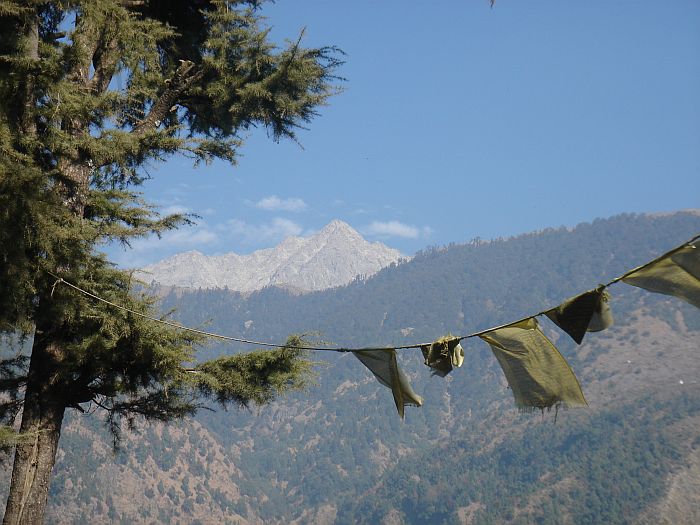
Actually, temperature-wise, it's nothing compared to the cold of the States at this time - but here there is nothing like a heater in any building, and structures are not properly insulated (that is to say, not at all). I rolled out of bed and pulled open the nylon curtains. The Dhauladhar mountaintops were hidden beneath dark navy-blue clouds. Rain? At this time of year? "Not possible madam."

Fortunately, most restaurants use butane stoves, so even though there's no electricity I could at least get a cup of tea. I zipped up my cheap fleece jacket and trudged up the hill. This steep rutted hill always seems muddy, despite the lack of rain, thanks to a troubling foul-smelling trickle that constantly runs down the center. In a week or so I expect it will be frozen; at least it won't smell anymore. Power was out everywhere, so I sat in the India House restaurant and began reading the local free community newsletter, Contact ("McLeod Ganj's religious diversity means an opportunity for peace and tolerance"). Two pots of tea later, still "no current."

I started the Kalachakra initiation book. There are two ways to participate in this teaching, as an interested observer or actual initiate. To be initiated into this teaching involves promising to think of other people first for the rest of your life (part of becoming a Bodhisattva). I wonder whether it's better to make such a promise with noble intent, and surely fail sometimes, or just be a bystander. The book said, "Technically, the correct term for this initiation is 'empowerment.'" I selfishly thought that all of McLeod could use some empowerment, electrically speaking.

When we finally became "empowered" three hours later at about 12.30, the servers were still down everywhere. Electricity, but no internet yet.

I decided to hurry back down the muddy hill and get a hot shower, maybe even a hair-washing, before the power disappeared again. I switched on the geyser (pronounced "geezer") and waited for the red light to appear, signalling the hot water's readiness. While waiting for the "geezer" I watched a TV show of folk dances from Assam state. This was followed by a news show in Hindi I couldn't follow, so I switched to Oprah(!) who was interviewing Kurt Russell about being a "cool dad" and grandfather for their Father's Day edition of the show. I guess there's a bit of a delay between these shows' original air date and the time they hit the air in India. Watching them talk about how much they loved their offspring, it reminded me of Amma's teaching that even the love of a parent for their child is selfish; they only love it because it's their own child. True love, she says, would be to love all children, everyone's children, equally.

The craggy peaks were now visible - with a dusting of snow. Those had been snow clouds, not rain. That's actually perfect; snow where I can see it, but not on the ground where I have to deal with it. (Besides, I haven't owned any shoes but sandals in 3 years.) So it's a snowy Himalayan Christmas for me, Stirling and her Tibetan friend at the St John's Carolling service tomorrow night. "Bring your own candles and show up early, the church fills up fast!" admonished the photocopied poster. "All faiths and creeds are welcome. Service conducted by Rev. Kunjamon," which I recognized as a Malayalee name. Maybe Shinu will teach me how to say "Merry Christmas and God Bless You" to him in Malayalam. It might bring a smile to the Rev's face, to hear his mother tongue from sunny Kerala in these frigid hills. If I'm going to be a Bodhisattva, I guess I have to think of these things.

Now the servers are back up and I'm typing here in Gu-Chu-Sum internet, a cybercafe run by the association of former Tibetan political prisoners. My fingers are freezing, and the sky is turning solid white. We may have snow on the ground here before the night is through. At least we're "empowered" again. I'd hate to miss the season finale of Desperate Housewives. I think the main characters represent the 7 deadly sins. Trouble is, there's only 5 of them. Some of them are so hateful they could comprise 2 sins in 1 persona. Actually, I'm pretty sure this season finale here in India is last season's season finale from America; so please, nobody ruin the suspense for me. That would truly not be bodhisattvic.
Thursday, December 22, 2005

Postcards from the Ganj


Dec. 22
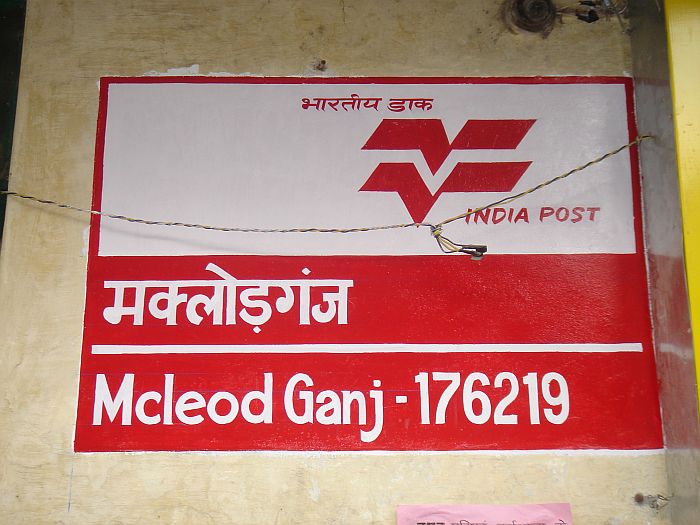
McLeod Ganj, Himachal Pradesh

Dear Mom and Dad:
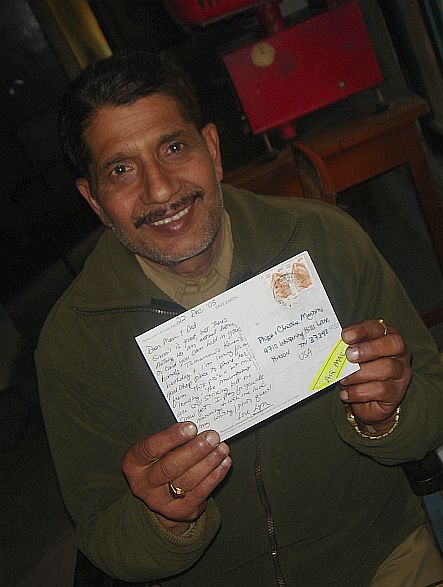
I just went to the McLeod Ganj post office to mail some cards to you. Email is nice but there's nothing like a letter or card you can actually hold in your hands. The post office is just a tiny grubby dimly lit room with rotary fans and Hindi bhajans (devotional hymns) playing on an old radio in the background. It was funny in this town full of Buddhists to hear the Hindu religious music I'm so familiar with from elsewhere in India. It's so dark in there I don't know how the 2 old guys actually see anything, maybe their jobs are so routine they just do them without actually looking. I sent one to you and one to Carter - total cost, about 35 cents (8 rupees per card).
The stamps feature the Indian painted crane. I asked for what they call "philatelic" stamps (special picture ones, some are magnificent) and they regretted they don't get them at this branch office. Stamps here are not lick and stick; you have to affix them on the card with a bit of rubber cement or paste, usually kept on the countertop in an old jar with a daubing stick. I glued them in place, trying to wipe the excess dry round the edges. The man behind the counter cheerfully placed them in a "go" batch, but I asked him (with a combination of English and sign language) to postmark them before my eyes. This is a standard precaution here; if you don't, the postal employees may peel off the yet-unmarked stamps, keep them for their own use, and your card will get thrown in the trash. Uncle obliged me and I then asked to see the postmarks. They were half in Hindi, half English, reading "Kangra Himachal" (the district, sort of like the county; and state). When I was younger I used to cherish any international mail that came through the office, running my fingers over the postmark, picturing the far-off place and exotic locale where it had been stamped and dreaming that someday I'd be there.

My friend seemed to think we got a great deal on the room, $5.60 a night for a toilet that doesn't flush, no carpet (extra freeze factor in this region) and no TV. Today I found a room with mountain view windows on 3 sides, bathroom that works w/24-hour hot water, room service, worn-out carpet and cable TV - not to mention a balcony where I can do yoga in the morning - for the same price, so I am shifting there tonight. It has full morning sun, which makes a big difference staying warm. There is no heat to speak of in most hotels, so it's direct solar heat in the day, heap on the double blankets and thermals at night. With all this talk of cold, I should mention that it's still about high 56 in the day, low around freezing - warmer than Tennessee. I'd like to get there before sunset (5.30 pm) so I need to run.

On Christmas Eve I may attend the Caroling service at the church of St John's in the Wilderness, an historic site with stained glass windows. McLeod Ganj was once a British administrative center and hill station, and the church is one vestige of those days.

Wednesday, December 21, 2005

Of Yakkers & Backpackers


Here in McLeod Ganj, Dharamsala, the Dalai Lama's residence, views of the Dhauladhar mountain range are stunning, but no snow till January, it's said. Everyone is gearing up to head down south for the Kalachakra event. I am here trying to confirm my press pass for this mammoth Buddhist free-for-all (and trying to picture what it looks like when Tibetan and Western Buddhists come to rural south India to have a free-for-all). My filmmaker friend brought a letter from an Indian production company (who have never met me) stating that I am covering the event for them. Hopefully the office won't notice that I don't own a video camera. I expect this entire process to take about a week. At least it's a rather Christmasy atmosphere. There are giant drooping fir trees on the steep hillsides that just cry out to be laden with snowfall. The local people use burros to transport building materials up and down the narrow, somewhat rocky roads, and the burros wear sleigh bells that make a Christmas jingle.


Street life is a lively mix of tie-dyed dreadlocked backpackers, Tibetan monks and nuns in burgundy robes, elderly Tibetans in full traditional dress, the younger generation (both Tibetan and Indian) in skintight jeans and jackets, and the older generation of Himachal hill farmers driving donkey trains and carrying loads of firewood to their villages. Every once in a while you see what looks like a giant walking Triffid or the old English Green Man coming up the street; it's a local person carrying a backload full of green-leaved tree trimmings. It always reminds me of those scary moving trees in The Wizard of Oz. This has a threefold use - their cattle (cows and hardy longhaired mountain goats) eat the leaves for fodder; then the branches are used for firewood; and the cycle is completed with the animals' resultant dung being dried in the sun and used for fuel. In Bihar I passed enormous rows of dung packed neatly into cakes and drying near the railroad tracks (in Bihar, though, it was probably water buffalo and bullock dung).

Yesterday we had lunch with my friend Stirling, a fellow native Tennessean, who's been here working with the Tibetan refugee children since last May. She was a goldmine of information about the refugee situation here and the politics of visiting Tibet itself. Then we went to see the Tibetan museum in the Library of Tibetan Works and Archives, and the Nechung Monastery, home of the Tibetan State Oracle. You'd be very lucky to catch an actual "performance," if that's the right term, of the oracle, the official advisor to the Dalai Lama, but it is possible. Stirling got to see one last week (it's on her blog, A Peaceful Adventure). If you're here long enough, or have a network of Tibetan friends, you might be invited to or clued in on one of his deliveries. The Dalai Lama consults him on various occasions (the reason for this is never publicly revealed).

The Oracle is an otherwise ordinary man who has inherited this position; he goes into deep trance at which time he is posessed by the spirit of Dorje Drakden (which means something like "Thunderbolt Dragon"), protector deity of Tibet, and gives advice on everything from politics to weather forecasts. Ordinary people can't udnerstand this, though; it's rendered in highly symbolic language and decoded by His Holiness and the advisors. Once the deity assumes posession, the attendants tie on an enormous helmet with a strangling knot beneath his chin; it's so heavy and tight there's no way he could wear it if he were not in a trance. Once the deity "leaves" the man's body, attendants rush to untie the knot quickly as without the spirit's aid, the knot and weight of the helmet would certainly choke him. You can visit the monastery itself (sans performing oracle) at any time.

Amod, my LA-Mumbai filmmaker friend, and I had dinner with a 19 year old Tibetan boy who had escaped across the mountains just 3 years ago. At that time, he lived in remote Amdo, a northeastern province of Tibet, where his family are still nomadic yak and sheep herders. Their entire lifestyle depends upon the yaks, and they are nomadic throughout the warmer herding season. In winter they shift to a small town and live indoors, sheltering the cattle in the harsh weather. At that time (when the family are in a fixed location) Gedun Gyatso is able to phone them.

This kid has an amazing story. Three years ago, he was herding yaks and learning Chinese propaganda in Mandarin medium in the schools there (they teach, of course, that Tibet has always been a part of China). He had no awareness of his own Tibetan identity or their political reality till he escaped. Now, he's in Dharmsala playing in local guitar jams, listening to Bob Marley, speaking excellent English he's learned in the local school, and doing email. Though he is 19, Gedun Gyatso is still in 9th standard because he was so far behind the local learning curve. However, if he works hard, he can leapfrog ahead a few years. His goal is to perfect his English and Hindi, and serve as an English-Tibetan-Hindi translator here in India.

Time to go drink milky chai at the Sunrise roadside stand. Maybe I'll run into "T," a 54-year-old truck driver from Yorkshire who ran away from home at age 14 and has been travelling the world ever since. He's been practicing Tibetan Buddhism for decades, that's how he taught himself to read and write. T lived here in McLeod for 14 years, started a business, successfully sponsored several Tibetan kids and got them on their feet, and was engaged to an Indian woman. But recently the immigration laws have changed and he's no longer able to get a long-stay visa. Now he's having to face his own enforced exile, in this case, back in his original country. He said,"forty years, forty years I've been travelling."

"Just like Moses - forty years wandering in the wilderness," I quipped.

T looked stunned. "Wow. I had never thought of that before."

Saturday, December 17, 2005

Techi-nickell problems

A Pilgrim's Blogress
Today, I am typing on an ancient, sticky and dirt-encrusted keyboard. I am waiting for the one terminal that is able to transfer digital photos to free up. Currently it's occupied by an elderly Tibetan monk typing at medieval rate so I think it will take a while. Actually it's quite cute. He leaned over a few minutes ago and asked for spelling assistance. He was trying to type the word "safely." "I am glad Budha has arrive safely." I reached over his shoulder to type for him and he was very grateful.

Now (one hour later) the terminal is free, but the shy young assistant (who is here from 7.30 am till about 11pm) can't get the drive to work at all. I've yet to be able to blog properly or upload photos since my return to India on Wednesday, due to crawling connections and non-working disk drives. Ah, back in India, where everything is possible, but nothing is easy.

It reminds me of the tailor who "fixed" the zipper on my backpack 3 times (three!) and each time it broke again with 24 hours. The second time, I began to get impatient and demanded he give me a good zipper. "But this good zipper," he kept insisting. "Good zipper, but techi-nickell problem." Well, that makes it a BAD ZIPPER! I kept trying to reason with him. The more I kept up with this line of reasoning, the more firmly he insisted that it was a GOOD zipper - somehow in his mind, the fact that it did not work, at all, did not inhibit its being an inherently good zipper. He also didn't understand why I would not give him additional money for fixing the broken zipper he had sold me to begin with. He wanted more money each time he repaired his own crummy zipper. The fourth time he repeated "just techi-nickell problem," without fixing it, I had to restain myself from throwing it across his tiny shop.

Perhaps I am being too harsh. Maybe it really was a good zipper at heart, but just needed three or four times repairing to see the error of its ways.
Tomorrow I have to find a place with a working disk drive.