Thursday, December 15, 2005

Ahhhhhrival in Delhi


A Bath By Any Other Name...

Ahhhh....that is the sound of me taking a hot shower after 26 hours on a train, after 18 hours in Raxaul, Bihar border; after 1 hour on a bus, after 2 hours on a different bus to see the Buddha Boy, after 1 hour on a bus to his village, after a very turbulent 30 minute plane ride over jagged mountains in a toy 20-seater to get to the nearest airport to his village, after a thrilling half-hour taxi ride to the airport just in time to be told the plane was delayed by 1.5 hours.

Whew.

And, as you can see, I'm a bit behind on emails....

Welcome, Caroline!
You have 1603 unread messages:
Inbox(87),

But I must say it's very comforting to arrive to a mailbox full of friends.

The foreign traveler's ghetto in Delhi is Paharganj, where some of the October 29 bombs exploded, which indicated to many people intention to target foreigners. Upon arrival at the Delhi station I opened the local paper to see there had been recent threats on the American Center and the US Embassy and that these locations were given extra security. This made it seem prudent to choose lodging elsewhere, so I came to theTibetan colony of Majnu Ka Tilla - not centrally located, about 30Rs rickshaw ride from Old Delhi station, but it's very peaceful and clean, a sound choice. The hotel Wongdhen House is extremely well-maintained; for $4.50 a night I get a room with an adjoining terrace and view of the Yamuna River (this is the river that runs past the Taj Mahal - although at this time of year, it's sadly reduced to a rivulet). Tonight will be primarily resting, eating, catching up on email. reading the Dalai Lama's autobiography as well as Taking the Kalachakra Initiation by Alexander Berzin, a little background research on the Andhra event in January.

The trip to see Buddha Boy was awesome, more for the process involved in getting there than the actual viewing (about 3 minutes), but I'm glad I went. As so often happens to foreigners here, just by my arrival in the tiny whistle-stop village, I became an attraction myself, momentarily rivalling the meditating saint.Right now, it is time for veg momos (Tibetan steamed dumpling) and tea. More later here! and hopefully in personal email.

Monday, December 12, 2005

Bound for Bara, Bihar and Border


Battling a case of recurrent Giardia and ever more recurrent procrastination, your correspondent heads south today for the "Buddha Boy" and Bara district, then the Indian border town of Raxaul, Bihar state, where I will - eventually - catch a train to New Delhi. I've done lots of scary things on this trip, but the reports of Delhi touts still frighten me. There's nothing like the smell of an Indian railway station - believe me, that's a good thing, and one thing I will not miss if India continues to modernize. But I love the big, lumbering, lived-in (literally) Indian Rail system. People, including myself, complain, it still does an amazing job moving millions of people a day.

I awoke early, breath fogging the air like a dragon, to kick around the streets with my new Sony T-17 camera. It's funny what people object to having photographed. A butcher had the entire torso of a goat (I think - hard to tell when it's completely skinned and headless) lying on its back, spreadeagled on a formica-topped table. The carcass was surrounded by various other chops of meat. I did get a few quick snaps before he motioned "no." Hey, you're gonna expose a headless, dead goat's genitals on the public road, and then act all modest?

Then I went to Mitho Cafe in Chhetrapati and had my first-ever authentic Nepali breakfast (a contradiction in terms since Nepalis don't really eat breakfast; I think they invented this for tourists like me who want to be "authentic"). "Ground maize powder with chickpea, soy and curd" turned out to be ground maize, chickpea and soy powder - that is, all dry powder, nothing but a bowl of sawdust - and an accompanying bowl of yogurt that you mix together to make a paste. Surprisingly tasty. The restaurant boys were so excited that I wanted to eat Nepali breakfast. They all enthused about going to see the Buddha Boy and said there were rumours that the King would visit the meditator sometime in the next few weeks. They also showed me a newspaper clipping that revealed (for the first time I had seen) the actual village I need to head for.

Kunda Dixit did a brilliant column this week about Nepal winning the "Conde Nasty Traveller Awards" in the coveted categories of "Place most difficult to get into" and "most difficult to get out of." I would have to agree. The road conditions, grounded airlines and nonexistent railways certainly go a long way toward preserving the Shangri-La mystique. Well, at least it's not in much danger of ruining the natural beauty. Some maintain that Nepal is under threat of invasion from China; having seen the map, my question is "How?" There's only one road that an army could even move down, the Kodari "Friendship" highway (just ask the Tibetans about having "friendship" with China). Personally I think they're going to pull an East India Company move, like the British did in India, and establish "business relations" first.

Currently I'm involved in a back-and-forth with my friend and fellow blogger Shinu about the fate of India, a huge question for anyone to even address. If sometimes my words sound too critical of India, all I ask is that people look at my photos. I think the photos show my real affection for the place and concern for the people; hopefully without overly romanticizing them.

Friday, December 09, 2005

Magical mystery tour

Too much, the magic bus

It's tempting to circumvent the tedious and often dangerous 10-hour bus ride to the 15-hour train ride to Delhi (total cost: about $20) by taking a 1-hour flight for just $80 - on Bhutan's only airline, Druk Air. Even more tempting to my crazed sensibilities is the idea of seeing Buddha Boy, the 16-year-old who was meditating and fasting for supposedly seven months in the jungles of southern Nepal. I have no illusions of seeing a halo around his head or even getting close enough to get a very good photo (thanks to his overzealous managers - uh, I mean devotees). But I just can't resist a pilgrimage to an obscure place to see freaky socio-religious phenomena.

However, I could be halfway to Delhi, on the train, even, in the time it takes to reach Bada district.

"Bada district? Not possible," said Bishnu, the good-natured, open-faced young Nepali Hindu man who runs Youth Travels, one room with faux wood-panelling, a phone, a desk and battered posters of Mount Everest Scotch-taped to the wall. His desk was surrounded by squat stools that look like those used for milking cows. In the West, this would be the reception area of a travel agency. Here, it's the entire operation. I plopped down on a milking stool and gazed up at the Nepali map in hope of finding some way around this verdict.

"Not possible! No, it's not possible that it's not possible. I have to go there. I must go there. "

"Well it is possible," he amended, "but it will take time. Some time, maybe ten, twelve hours on public bus. No taxi, no tourist bus. Only some big trucks are going that road." On a normal day, it takes nine hours on a bus to reach the border from Kathmandu. I was looking at a three-hour additional detour. "Actually," Bishnu beamed, leaning back in his chair and adjusting his leather jacket, "I am having lot of tourists ask to go there now. Today, two Korean, and one...well, two Korean, and you."

The jungles of Bada, newly populated by souvenir sellers and tea stands for the tourists, suddenly seemed more attractive than ever in their unattainability. Never mind that not even one report of the dozen I've read ever bothered to mention which town it's in in all of Bada district, the southernmost county of Nepal right on the Indian border. I guessed that a good place to start would be Kalaiya, the "capital." At the very least, there might be more English speakers there, and certainly more buses and taxis available.

"Look at the map!" I cried. There's a road, an actual road, running directly from Kathmandu to Kalaiya, making as near a straight line as ever happens on a road or what passes for one in Nepal. "What about that? Can't I just hire a car? It should take 5 hours max!"

"Yes, but this road not possible. This road very danger. Lot of problem is there, you must take this route." Bishnu rose and indicated a long, red oblong loop on the map, deviating far from the direct one, to the west through Bharatpur and finally southward through Chitwan. "You can take morning public bus" (at this point, visions of the 35 people killed in one day of Nepali road accidents last week flashed through my fevered mind) "and arrive there maybe 3, 4pm. You must spend one night there." It's dark by 5.30 these days - and remember, I don't even know exactly which town or village I'm visiting yet to see the Buddha Boy - I'm just showing up in the largest town and asking questions. In other words, once I get to the town, the fun is only starting.

The impossibility of it all began to appeal to my perverse side (admittedly difficult to distinguish from my other, equally twisted sides). A bona fide adventure - I mean, you can fly round Mount Everest now in 1.5 hours for $120, but this - this was really promising. Ten hours on a bus to the middle of nowhere. A day and half trying to find this freak, and then hopping a taxi to a bus to another bus to cross the border at Birgunj, Nepal to catch my train in Raxaul, Uttar Pradesh, India (described by no less than Lonely Planet as "one of the most god-forsaken places in the country").

THEN (pause to catch breath) a 20-hour train ride in 2nd class sleeper to Delhi!


Something really has to be done about all the new, superfast travel - before we know it Asia will be one giant express lane. I'm going to start a "slow travel" protest, in the spirit of the French and Italians who rebelled against the encroachment of fast food chains into their countries and responded with the "slow food" movement. At the very least, efforts should be made to preserve the bullock-cart. As long as there are bullock-carts, somewhere, Asia will still retain its basic character and traditions. Soon enough, I see a future in which the bullock-cart has gone the way of the horse and carriage or now, the hand-pulled rickshaw - a high-priced novelty ride in the country for foreign tourists, who are desperate to get away from the smog and rumble of the tractors and Tempos which replaced them.

Highway to Hell
The New York Times is running a series all about the new quadrilateral superhighway that's being built, largely by hand in Indian fashion, to connect major sectors of India. This project was begun by the previous government in one of their relentless attempts to make India just as boring and uniform as the rest of the world, in the name of progress and convenience. This writer predicts it will do exactly what the superhighways did in America - ruin small town life, increasingly homogenize the culture till you can't tell one freeway exit from another and everyone talks and dresses the same, then finally, destroy the train system, which has been the backbone of the nation since British times. At one time, you could take a train all across my country. Now it's all you can do to get anywhere by bus or train - it's either drive or fly.

So, Auntie's addvice (said in Indlish with emphasis on the first syllable) is: See India now while there's still something to see that can't be glimpsed at the local mall, or from your car window, anywhere in the West! While there are still people who don't look like the Backstreet Boys! The day is soon coming when vegetables and fruits won't be sold at all on the roadside, but in megamalls like Pune Central (see "New Indian Epidemic: Mall Rats"), and everyone will be wearing t-shirts and Dockers. At that point, you're better off watching Nat Geo.

Wednesday, December 07, 2005

Tuesday the 13th

5-Day Forecast for Kathmandu Valley:
Fair throughout the Kingdom.
Wed: High 68- Low 44
Fri: High 66 - Low 42
Sun: High 64 - Low 41

My enforced "Visa Sabbatical" departure date (December 13 - one is only allowed to stay in Nepal a total of five months of any calendar year, and I arrived in late July) looms like, well, some looming thing on my calendar and in my brain, clouding any clarity and ability to concentrate, a sort of preview of my return to India ("This is your brain. This is your brain in India.") Nepal has not ceased to amaze me with its comparatively greater space, personal and geographical. Foreigners are far more integrated into the Nepali culture and economy than they are in India, and people actually leave you alone here. If you like, you can socialize with the extremely warm, friendly yet dignified Nepalis; or live in as much privacy as you choose. This is rarely possible in India. There, it's all about the people - population is the overwhelming fact of Indian life. You have to deal with people whether you feel like it or not - and after the first ninety times you answer personal questions to total strangers, it becomes "not" more often than not.
The Nepali perception of climate seems quite different from that of India. It's the only place I've ever been in my life that has neither provisions for heat, nor cold. The hotel rooms, residences and restaurants usually have no fans, nor any form of heating. This, despite the fact that it's just as hot in April, May, June and so on here as it is in most of India (very), and gets very cold indeed after December.

Everywhere I lived in India (admittedly, I was mostly in the South, and never in a hill station) there were fans - vigorous electric ceiling fans that seemed on the verge of spinning off their axis (ax-es?) when put on "high" setting, which they usually were about half the year. I had never seen a fan rotate so furiously - at times I was afraid to sleep beneath them for fear the frenzied blades would actually come flying off. In contrast, fans, even in sultry summertime, are a real rarity here in Nepal. By August, I had discovered every restaurant that had even a single fan and made a point of eating there, my friend and I dashing to claim the lone table situated under the one pathetic fan, often a "swinging" tabletop model mounted on the wall at an angle. Sometimes I had to request the fan's activation. The employees and other customers didn't seem to mind stewing in the fetid torpor (so why did they have the thing if not to use it? Were they waiting for it to get hotter than a very humid 86 degrees?). In fact, they often seemed surprised that there was a fan. Oh, that strange machine, is that what that's for? okay....
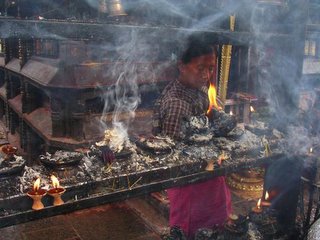
Equally weird, men and women both walked around Kathmandu all summer visibly sweating in long sleeved shirts. The Nepali style of sari-blouse is a distinctive one with full-length sleeves, mandarin collar and cross-ties. This is not to mention the Tibetan women in their bulky chubas. Local architecture, as in India, does take the heat into account; most buildings are somewhat open - that is, they may have an enclosed lobby but often the stairs lead to open balconies (the only equivalent in the US is an old-fashioned Holiday Inn, with doors along the outdoor corridor) and a courtyard.

It was never cold enough in my Indian homes to warrant any kind of heating device, just hot water heaters for winter mornings in the posher places. Here in Nepal, where it gets to freezing with frost on the windows (if not snow) in the Valley - let alone higher elevations- there are no heating systems in any building, and hot water is even more of a luxury than in India. Okay, I'm just a spoiled westerner, but explain this - everyone's walking round now in jackets, shawls and even ski hats and balaclavas, and they still keep all the doors and windows open all day and night (!). Extra blankets are the only heating supplement. When I hear tell of the electrical bills here for an ordinary house, even without heat, it explains perhaps the fact that there is no heating to speak of. (But whatever happened to the woodburning stoves with chimneys that are common in the countryside?)
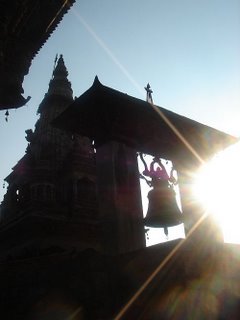
In the courtyards of most buildings, the watchman builds a small fire on the concrete, and idle employees huddle around, warming their hands. Can you imagine trying to do this in the States? they'd be shut down with some kind of fire violation immediately.

Though the days are increasingly short and growing gloomy here, the prospect of getting on a bus to Senauli - arguably one of the grimiest, dingiest places in all India - and then the train to Varanasi (say no more) after 5 months of shanthi Nepal is like having to leave an air-conditioned room for the pre-monsoon street in mid-May. Plunged into squalor, and often, besieged from every side. This is the real reason meditation developed in India - not because the people are so "spiritual" or advanced or anthing. Meditation was a last resort - it was the only way to get any kind of personal space, internally, because there is never any space externally.
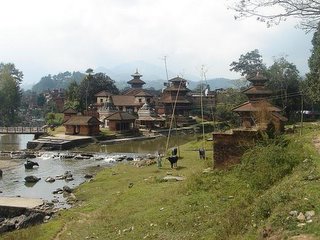
Almost as inexplicable as no heat when it freezes, is the fact that suddenly, everyone wants to know what I am doing, where I am going and what my plans are, right now. For some reason, the plans of a semi-employed photojournalist seem of the utmost importance to an alarming number of people. The only other option is nobody giving a toss about me (nice British expression picked up from companions on the travel circuit) which is equally discomfiting.

Funny how when you are physically ill, you can't think of or do anything else - all your energy goes toward recuperating. If only, you think, I didn't have this cold/sore throat/giardia/infection/headache/toothache, I could accomplish something. Once you recover, however, you then have to deal with all the stuff in your head...which does not go away with plenty of rest and drinking lots of fluids. You have to do something with it.
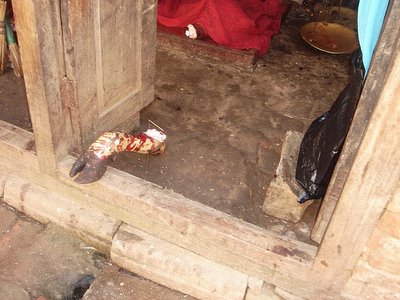
Foot Fetish: This is the fresh lower leg of a sacrificed buffalo, covered in blood and placed intentionally in the doorway of a shop in Bhaktapur. Though it's something we might do as a nasty prank, in Nepal it is auspicious and considered to both ward off evil spirits and bring good fortune to the shop.

Tuesday, December 06, 2005

Chilling effect


The days are getting short and darker here; it's gloomy and chill by 5.30. The tourists are half what they were 2 weeks before. Lodges up at Everest are shutting down for the season. It's very cold in the AM and after 4.30, though the days are still pleasant, like a perfect fall day. People kind of hustle through the streets in zipped-up jackets now, rather than strolling. The hoteliers and shop owners seem a bit depressed; "the season" is ending and they've seen all the business they're going to till March-April (the "second season"). It's too cold to do hand laundry or take a shower now till around noon.

My eyes are still burning with that about-to-get-a-cold feeling, and my muscles are strangely stiff. Maybe it's some weird mild allergy; or just the fact that I have not been anywhere with anything like a winter in 3 years. But it's far preferable to Indian heat and humdity any day - at least I feel alive. It does take some adjusting - in South India, sunrise and sunset are invariably at the same time every day, all year long, because of the proximity to the equator. I think. Somebody tell me if I'm wrong.

Nepalese bloggers, journalists defy media clampdown by king
After the Royal Takeover in Nepal, King Gyandendra censored the media, arrested journalists and cut communications. But tech-savvy journalists are using their blogs to get news out to the rest of the world.
Full story